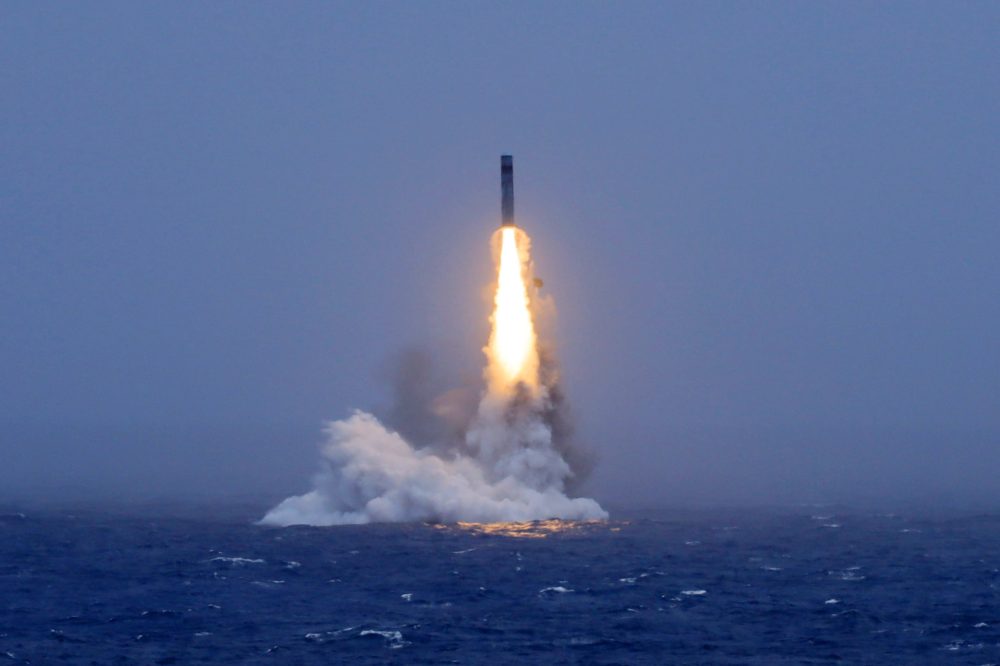

China’s navy carried out a test launch of a long-range ballistic missile from one of its nuclear-powered submarines on Monday, firing it into the Pacific Ocean. Defense experts say the move demonstrates Beijing’s growing ability to project nuclear deterrence power on a global scale.
The launch quickly drew protests from the United States and several nations across Asia and the Pacific. It marks only the second time in recent years that China has fired a ballistic missile into international waters. Although some neighboring countries received advance notice, several said it was insufficient — and analysts warn the test is adding fuel to already rising tensions over military expansion in the region.
China’s official Xinhua News Agency released a brief statement after the launch, saying it was part of routine annual training, was conducted in accordance with international law, and was not aimed at any specific country or target. No details were given about the type of missile used.
The missile carried a dummy warhead rather than a live nuclear one. While launching in international waters is uncommon, the United States has also conducted its own missile tests in international waters in the past.
Xinhua released a photograph of the missile on Tuesday but offered no further specifics. Experts believe it could be either a JL-2 or a JL-3 — both submarine-launched ballistic missiles — though most analysts said the image was not clear enough to make a definitive identification. The state-owned Global Times reported it was “most likely” a JL-3, with a range exceeding 10,000 kilometers, or roughly 6,200 miles. The JL-2 has a shorter range by comparison.
New Zealand’s government stated that the missile landed in treaty waters within the South Pacific Nuclear Free Zone, which it said violated the spirit of the agreement. That zone was created under the 1986 Treaty of Rarotonga, which bans nuclear weapons throughout the region. China ratified the treaty’s protocols in 1987, committing not to test nuclear weapons within the zone or threaten to use them against countries with territory there.
China has urged other nations to “avoid overinterpretation” of the test, but experts say the international concerns are grounded in real issues. Drew Thompson, a senior fellow at the S. Rajaratnam School of International Studies in Singapore, pointed to a lack of transparency as a central problem. “China’s military modernization and buildup have occurred without concurrent increases in openness and transparency, resulting in uncertainty about China’s intentions,” he said.
Australian Prime Minister Anthony Albanese said his government did not receive adequate warning before the launch. Speaking to reporters Tuesday while visiting Honiara in the Solomon Islands, he was direct in his assessment: “There is no doubt that this is a provocative act by China which does destabilize the region.”
He went further, adding: “This was a test of a nuclear-capable intercontinental ballistic missile fired from a nuclear-powered submarine. That is of real concern because what we need is less nuclear weapons, certainly not more. And the fact that this test took place yesterday with very little notice is of real concern.”
New Zealand echoed those concerns the previous day, with Foreign Minister Winston Peters describing the launch as “unwelcome and concerning.”
Solomon Islands Prime Minister Matthew Wale, also speaking to reporters in Honiara on Tuesday, expressed disappointment while acknowledging China’s relationship with his country. “China is a good friend of Solomon Islands, but this is not something a friend does. This is not … good in our region,” he said. He added: “We don’t want to see any more countries — China, America, anybody — we don’t want anybody testing their ICBMs in the Pacific Islands region. Be our friend, but don’t threaten us.”
China’s leader Xi Jinping has placed military modernization at the top of his agenda. China already maintains the world’s largest standing army and the world’s largest navy. Although its nuclear stockpile remains smaller than those of the United States and Russia, China has been steadily growing its arsenal of nuclear warheads while also developing longer-range missiles and advanced drone technology.
China’s defense budget is projected to reach $270 billion in 2026, having grown at approximately 7% per year over the past four years, representing just under 2% of its gross domestic product. However, independent researchers suggest actual spending could be significantly higher. The Stockholm International Peace Research Institute, for instance, estimates China’s total military spending for 2024 at $313.7 billion.
Much of the regional anxiety centers on Taiwan — the self-governing island that China claims as its own and has refused to rule out taking by force. China routinely dispatches warplanes and naval vessels into waters surrounding the island as part of what it calls military exercises.
In response to China’s military expansion, neighboring countries have been increasing their own defense budgets. Japan is abandoning its long-standing cap of 1% of GDP on defense spending, doubling that figure to 2%. The Philippines has also agreed to grant the U.S. access to four additional military bases within its borders.
Emma Chanlett-Avery, director of Political-Security Affairs at the Asia Society Policy Institute, noted the broader regional impact: “The Chinese launch exacerbates already deeply strained relations between Beijing and Tokyo. Since (Prime Minister Sanae) Takaichi’s comments last year suggesting that Japan would engage in a conflict over Taiwan, China has tightened export controls on Japan and accused it of embracing a ‘new time of militarism.’”