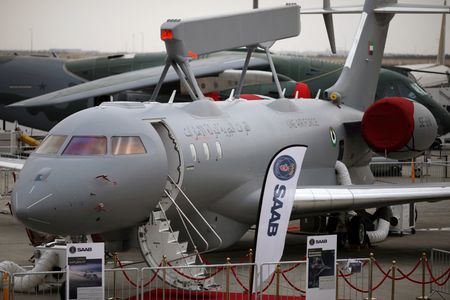

NATO has unveiled a roughly $4.5 billion plan to acquire up to 10 Saab GlobalEye surveillance aircraft, choosing the Swedish option over a competing offering from American aviation giant Boeing to replace its fleet of aging early warning planes.
The announcement came Tuesday during a NATO summit in Ankara, where Secretary-General Mark Rutte explained that swapping out the alliance’s Cold War-era Airborne Warning and Control System — commonly known as AWACS — for a newer platform built on smaller business jets would better address modern threats, including drone swarms.
“This will ensure we keep NATO’s… surveillance and early warning capability strong and credible for decades to come,” Rutte said at the summit event.
With U.S. President Donald Trump having repeatedly pushed NATO allies to increase defense spending and purchase more American-made equipment, Rutte was careful to highlight the program’s international roots. The GlobalEye system is installed aboard Bombardier Global 6500 business jets.
“Like its predecessor, GlobalEye is a transatlantic programme, delivered by European and Canadian industries with essential contributions from US industries. It is a real success story, again, made in NATO,” Rutte told those gathered.
Trump has frequently criticized European allies for depending too heavily on the United States for their defense needs while pushing them to buy more U.S. military hardware. He has also, at various points, threatened to withdraw from the alliance altogether.
The GlobalEye goes up against Boeing’s E-7 Wedgetail, an aircraft built on the 737 platform that is designed for early warning and battlefield command-and-control functions.
NATO described the GlobalEye as a mission-proven system, though it offered no further details on that characterization.
Reuters had reported last Thursday that NATO was set to replace its Boeing E-3 Sentry AWACS jets with Saab’s GlobalEye. The alliance is now entering formal contract negotiations with Saab following the public announcement of its preliminary selection.
Saab’s chief executive, Micael Johansson, put the total value of the deal at up to $4.5 billion and said the company could begin delivering aircraft in 2030, provided an agreement is reached in the near term. He noted that a final price has not yet been set, but estimated each aircraft would cost somewhere between approximately $400 million and $450 million.
The total number of planes to be ordered had been a point of debate, with planners weighing whether to pursue a more costly version of the aircraft capable of being refueled while airborne. A source with knowledge of the situation said the GlobalEyes would not initially include that feature, though it is expected to be incorporated through a future upgrade.
NATO’s current AWACS fleet does have in-flight refueling capability — a feature that has proven particularly useful during operations near Ukraine.