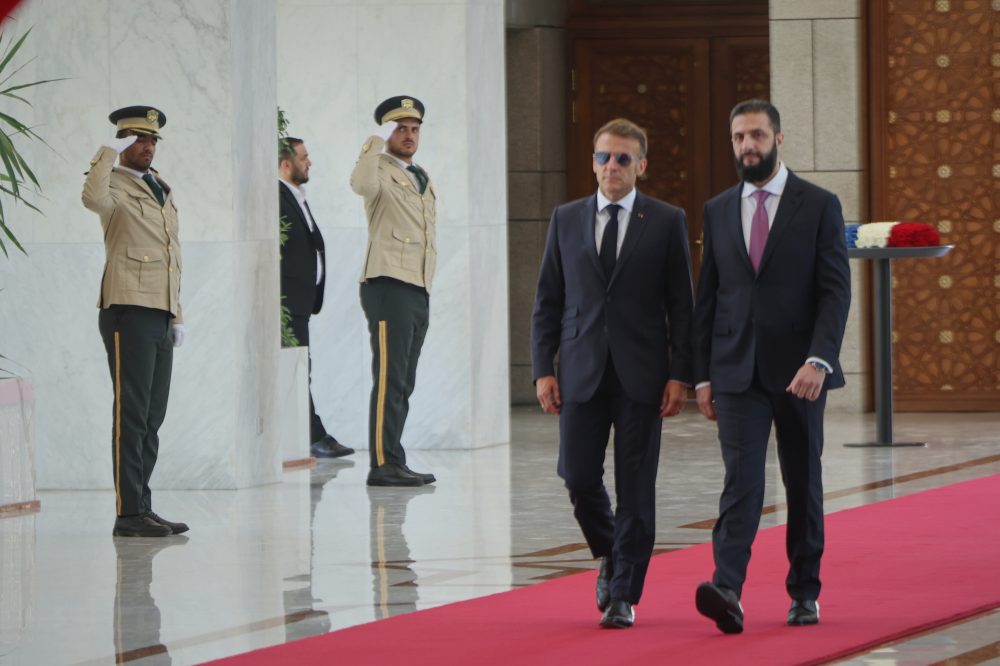

At least 18 people were hurt Tuesday when two explosions tore through central Damascus, even as France’s president was inside the Syrian presidential palace for a high-profile meeting with his Syrian counterpart, according to Syria’s Interior Ministry.
French President Emmanuel Macron had just begun his meeting with Syrian President Ahmad al-Sharaa when the blasts went off near the Four Seasons Hotel — the same hotel where Syrian media reported Macron was staying. The French president’s office quickly confirmed that Macron was not harmed and that his talks with al-Sharaa were ongoing.
Syria’s Interior Ministry, citing state media, said investigators determined that both explosions were caused by improvised explosive devices — one concealed inside a garbage bin and a second hidden in a parked vehicle. Among the 18 wounded, four were police officers. No fatalities were immediately reported, and an investigation was underway at the scene.
Witnesses described a large column of smoke rising from the area, which sits along a busy Damascus thoroughfare near the Tourism Ministry headquarters and the Damascus National Museum. Video spreading across social media showed a van and a motorcycle engulfed in flames, with bloodstains visible on the pavement. No group immediately stepped forward to claim responsibility.
The bombings come just days after a separate explosive device went off inside a café near the Justice Palace in Damascus, leaving at least 10 people dead and more than 20 others injured.
Macron’s trip marks a significant moment in international diplomacy — he is the first prominent Western leader to travel to Syria since al-Sharaa took power. The visit comes ahead of a NATO summit in Ankara, Turkey. Macron arrived in Syria Monday evening accompanied by an economic delegation, and the two leaders were expected to sign memorandums of understanding aimed at drawing foreign investment into a country still devastated by 14 years of war.
The French president has been a key figure in persuading Europe and the United States to lift most of their sanctions against Syria. Before heading to the presidential palace, Macron also met with members of Syrian civil society, though his office did not disclose the identities of those involved.
Tuesday’s violence represents a setback for al-Sharaa, who rose to power after leading an insurgency that forced former leader Bashar Assad from office in 2024. Since taking control, al-Sharaa has worked to consolidate authority, reassure religious and ethnic minorities wary of his Islamist-rooted background, and gain the confidence of Western governments that had long viewed his leadership of the former al-Qaeda-linked Hayat Tahrir al-Sham group with suspicion. His administration has pledged sweeping political and economic reforms following decades of authoritarian governance.
Although Syria’s new leadership has faced ongoing challenges from various armed factions as it works to stabilize the country, Damascus itself had largely remained calm throughout this turbulent transition period.
The Syrian conflict claimed the lives of nearly half a million people and uprooted millions more. The country’s infrastructure was left in ruins, and despite large investment pledges from other nations and businesses, Syria still requires hundreds of billions of dollars to rebuild and pull its population out of poverty.