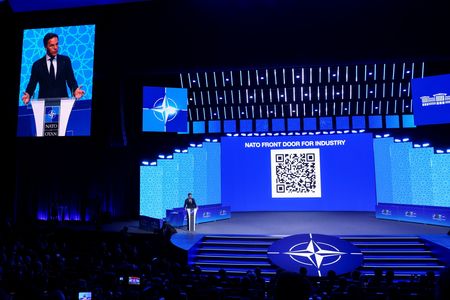

NATO foreign ministers gathered Tuesday with their counterparts from Gulf Arab nations to confront the ongoing crisis surrounding the Strait of Hormuz, including a proposal from France and the United Kingdom to launch a multinational maritime security mission — one that Iran has already rejected.
The meeting, held alongside a NATO summit in Ankara, brought together ministers from Bahrain, Kuwait, Qatar, and the United Arab Emirates. It comes after weeks of heightened tensions in the strategically vital waterway, even though a temporary peace agreement between the United States and Iran was reached in mid-June.
Early Tuesday, the United Kingdom Maritime Trade Operations agency reported that a tanker had been struck east of Oman’s Limah. Axios also reported that Iran’s Revolutionary Guards fired at least two missiles at commercial vessels passing through the Strait of Hormuz.
Belgian Foreign Minister Maxime Prevot spoke ahead of the meeting, emphasizing the stakes for European nations. “In the Gulf region, Bahrain, Kuwait, Qatar, and the United Arab Emirates were directly targeted by Iranian attacks this spring,” he said. “Their stability and ours are inextricably linked. This goes far beyond the Strait of Hormuz alone, however crucial it may be for Europe’s energy security.”
The crisis began when Iran started blockading the waterway after the United States and Israel launched military action against it in February. Despite the interim accord reached last month, ships are still struggling to pass through the strait, which normally carries roughly one-fifth of the world’s oil supply. The disruption has pushed oil prices higher, increased shipping costs, and strained global supply chains.
NATO member nations have largely tried to stay out of direct involvement in the conflict, preferring to work through non-alliance frameworks to reopen the strait. U.S. President Donald Trump, who was scheduled to arrive in Ankara later Tuesday, has publicly criticized NATO allies for being slow to contribute to efforts to restore passage through the waterway.
European countries have stated they did not want to be pulled into a war that began without their consultation, but they have expressed willingness to help secure the strait once the fighting ends. France and Britain have been working to assemble a coalition of roughly a dozen nations to guarantee safe navigation through the strait after tensions subside — though any lasting arrangement would require Iran’s cooperation.
Iran has consistently opposed any foreign military presence in the region and last week pushed back against comments by French President Emmanuel Macron, who suggested the mission would move forward regardless.
Several NATO members already have warships, minehunters, and support vessels operating in the area. Diplomats say France and Britain are hoping to announce in the coming days the launch of an initial mission in the Gulf of Oman — a neighboring waterway that connects the Arabian Sea to the Strait of Hormuz and borders Iran, Oman, and the UAE.
A joint statement issued by France and the United Kingdom on July 3 noted that “the Sultanate of Oman has agreed to work with the United Kingdom and France to ensure that its sovereign territorial waters are safe for navigation.”