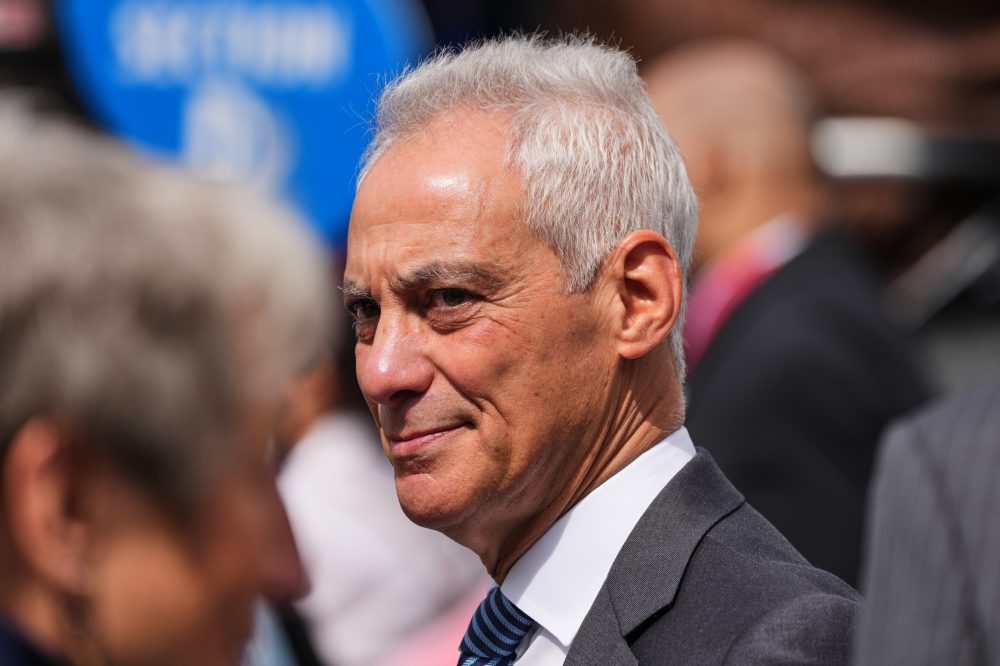

WASHINGTON (AP) — Rahm Emanuel, a longtime Israel supporter who is weighing a run for the Democratic presidential nomination, is preparing to deliver a pointed condemnation of Israeli Prime Minister Benjamin Netanyahu during a speech in Tel Aviv this week — warning that the bond between the United States and Israel stands at a critical turning point.
“It cannot stand or survive as it has been,” Emanuel is set to say at Tel Aviv University on Wednesday, according to remarks obtained by The Associated Press. “To maintain the strength of our ties, we need significant changes and a new direction.”
The address, coming from a prominent figure in the centrist wing of the Democratic Party, underscores just how dramatically the party has moved away from its historically strong backing of Israel.
A new survey from The Associated Press-NORC Center for Public Affairs Research found that roughly 58% of Democrats now believe the United States is “too supportive” of Israel — a notable jump from 45% in January 2024. About half of Democrats also believe Israel has committed genocide against Palestinians during the Gaza conflict, a charge that some human rights groups have made but that Israel and the U.S. government have firmly rejected.
Among Emanuel’s planned proposals: imposing sanctions on Israelis who target Palestinian civilians and property, as well as on companies and financial institutions that support settlements that most of the international community considers illegal. He also intends to push for ending U.S. subsidies to Israel’s defense budget, arguing that Israel “should be able to buy American arms under the same financial terms, the same restrictions, and the same requirements as every other trusted ally that abides by our laws.”
Emanuel will also lay blame squarely on Netanyahu for steering Israel toward what he calls a “dead end,” a situation he says was made worse by poor choices from American leaders over the years.
“For too long, American policy toward Israel operated under the assumption that the best thing Washington could do for Jerusalem was to blindly and silently stand behind your government, without conditions, without demands, and without consequences when we disagreed,” he plans to say. “That has been our mistake. Unconditional support has produced a prime minister who has presumed that his strategic interests would incur no cost if he ignored America’s concerns.”
It is highly unusual for an American with presidential aspirations to travel abroad — especially to a country as politically charged as Israel — to deliver such a direct attack on its leadership. Centrist Democrats like Emanuel have historically been more cautious than the party’s progressive wing when it comes to questioning U.S. support for Israel.
Netanyahu, who once referred to Emanuel — who had aspirations to become the first Jewish speaker of the U.S. House — as a “self-hating Jew,” could respond forcefully to the remarks. With Netanyahu facing his own reelection battle in October, he may attempt to use the confrontation to his political advantage by casting himself as standing firm against outside pressure.
For Democrats who may enter the 2028 presidential race, the speech signals an aggressive approach to addressing the fallout from Israel’s war in Gaza and Netanyahu’s perceived alignment with the Republican Party under President Donald Trump. The conflict has reshaped political alliances within both major U.S. parties, with younger voters in particular pushing American leaders to take a harder line. The issue has already stirred tension in some Democratic congressional primaries this year and could remain a flashpoint heading into the 2028 nomination fight.
Taking Netanyahu to task for doing little to advance diplomatic efforts to end the war, Emanuel will observe that “support for Israel is plummeting around the world.”
“You’ve lost Europe,” he plans to say. “Your scientists face exclusion from international research networks. Your artists and academics are shut out of exhibits and conferences.”
While Netanyahu has cultivated close ties with Trump and the Republican Party, Israel’s standing among Democrats has steadily eroded. Interestingly, Emanuel’s portrayal of Israel as increasingly isolated echoes recent comments from Vice President JD Vance, illustrating how criticism of Israel is gaining traction across party lines. Speaking from the White House briefing room as the U.S. worked toward a deal to end the conflict with Iran, Vance said Trump was “the only head of state in the entire world who is sympathetic to the nation of Israel at this moment in time.”
Despite his harsh words, Emanuel — who is Jewish and whose father was born in Jerusalem — will also express empathy. He acknowledged the devastating impact of the October 7, 2023 attacks, in which Hamas-led militants carried out air and ground assaults on Israel, killing nearly 1,200 people and taking more than 250 hostages. He also noted the frustrations stemming from past rounds of failed peace negotiations with Palestinian leaders.
“But even while acknowledging that history, the path forward cannot be held hostage to a past defined exclusively by recriminations,” he will say.
Rather than endorsing the traditional two-state solution, which he will call “discredited,” Emanuel plans to advocate for what he terms a “23-state solution” — one that brings together Israel, the Palestinians, and the 21 other members of the Arab League in a comprehensive peace agreement.
“The 21 Arab nations that have exploited Palestinian rights as a slogan for decades now need to roll up their sleeves and stand up a governing authority capable of accepting the historic Jewish connection to this land,” he will say.
While no major Democrat has officially launched a 2028 presidential campaign, that could change following the November midterm elections, with a potentially large field expected to form. Emanuel, a former White House chief of staff, U.S. congressman, Chicago mayor, and U.S. ambassador, has been among the most transparent about his ambitions. Without a current public office, he has kept his name in the conversation by releasing a series of policy proposals, cycling through the early-voting state of New Hampshire, appearing on podcasts, and building his social media presence.