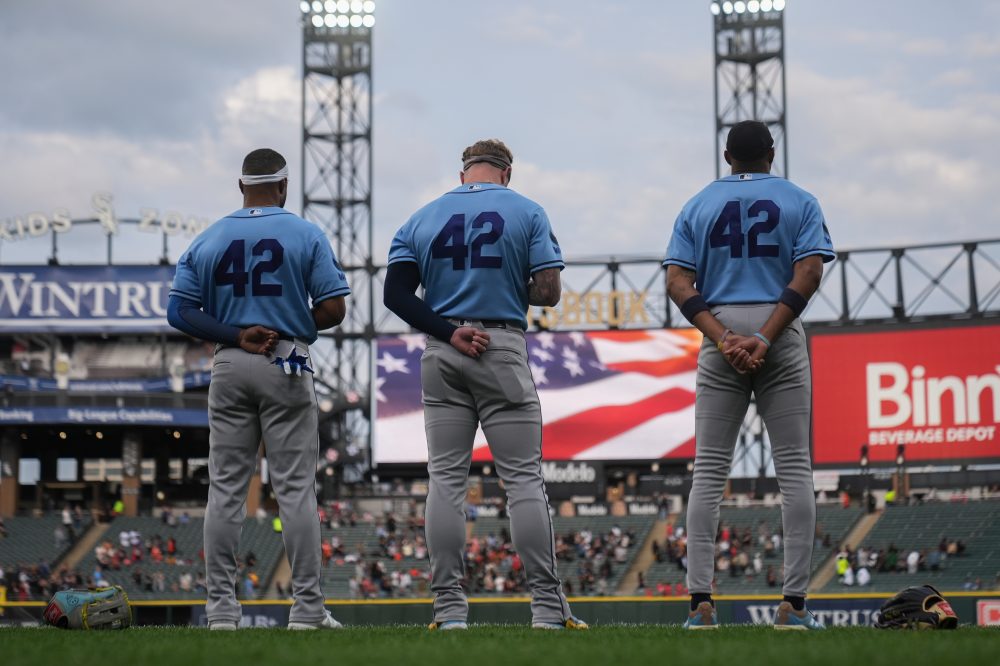
CHICAGO — A medical emergency during pre-game ceremonies at Wednesday night’s Chicago White Sox versus Tampa Bay Rays matchup sent a performer to the hospital and delayed the start of play.
Gerald Chaney, a Chicago resident, experienced a collapse while performing during Jackie Robinson Day commemorations at the ballpark. The White Sox organization reported that Chaney remained conscious following the incident that occurred as he sang “Lift Every Voice and Sing,” widely recognized as the Black national anthem.
The performer had begun singing just a few words of the hymn when he paused, attempted to continue, then fell to the ground. Medical personnel responded immediately, providing treatment on the field for several minutes while both teams observed from their respective dugouts.
Paramedics eventually transported Chaney from the playing field on a stretcher to receive further medical care. The baseball game’s first pitch was pushed back by 12 minutes due to the medical situation.
LOS ANGELES — For the first time in nearly three years, Shohei Ohtani stepped onto the pitcher’s mound for the Los Angeles Dodgers Wednesday evening without also taking his place in the batting order as designated hitter.
The Japanese superstar was sidelined from hitting duties due to lingering discomfort from being struck by a pitch during Monday’s game against the New York Mets. Pitcher David Peterson’s throw hit Ohtani on the back of his right shoulder, causing him to cry out in pain, though he remained in the contest.
This marked the first occasion since May 28, 2021, while playing for the Los Angeles Angels, that Ohtani has been absent from the batting lineup during one of his pitching appearances.
“If it weren’t for the hit by pitch, he would’ve been DHing and pitching tonight,” manager Dave Roberts explained prior to the game. “But I do think that just to be able to pitch and focus on that will be a benefit for the mind and the body, and hopefully, we’re just in a little moment of fatigue and we can get past it.”
According to Roberts, Ohtani’s condition has shown steady improvement since Monday’s incident. However, the medical staff, coaching team, and Roberts agreed it would be wise to rest him from batting in the series conclusion, even though Ohtani was caught off guard by the choice.
“Because I’ve never asked him to pitch and not hit,” Roberts explained. “I think that he understands that I’m making a decision that’s best for the player, for him, and for the team.”
The star player has struggled offensively since the injury, going hitless in seven at-bats following the incident.
Despite his recent batting woes, Ohtani extended his remarkable on-base streak to 48 games after receiving an intentional walk during Tuesday’s eighth inning. This achievement ranks as the fourth-longest such streak in the franchise’s history.
Roberts anticipates Ohtani will resume both pitching and hitting responsibilities for his upcoming start, though he mentioned potentially considering similar rest periods for hitting on future pitching days.
“It’s got to make sense to not have your best hitter not in the lineup,” Roberts noted. “Then the question is when he does hit, on days that he pitches, where’s the best for him to hit in the order? I think there’s fair arguments to both, to moving him down a little bit, give him a breather, let him get into the game. But I’m not prepared to make that decision quite yet. But it is something that I’m mindful of it.”
Regarding his pitching performance, Ohtani saw his impressive 22⅔-inning scoreless streak end during last week’s game in Toronto. However, the right-handed pitcher has maintained an extraordinary run without allowing an earned run since August 27, 2025, against Cincinnati — spanning 28⅔ innings.
Last season marked Ohtani’s inaugural pitching campaign with the Dodgers, where he compiled a 1-1 record with a 2.87 ERA and recorded 62 strikeouts across 47 innings in 14 starts. His four-seam fastball reached a career-high average velocity of 98.4 mph during the season.
Ohtani’s current 48-game on-base streak represents a record for Japanese-born players, surpassing Hall of Famer Ichiro Suzuki’s previous mark of 43 consecutive games set in 2009.
Roberts confirmed that Ohtani would not be available for pinch-hitting duties against the Mets.
“You can tell Carlos Mendoza he’s an option, though,” he joked, referring to New York’s manager.
Concert fans who have long griped about excessive Ticketmaster charges may finally have reason to celebrate after a federal jury determined Wednesday that parent company Live Nation has been operating an illegal monopoly across major entertainment venues nationwide.
However, music lovers shouldn’t expect cheaper ticket prices anytime soon.
The federal jury in New York concluded that Ticketmaster had illegally overcharged patrons $1.72 per ticket across 22 states, potentially forcing Live Nation to reimburse hundreds of millions of dollars to customers.
The legal battle began under former President Joe Biden’s administration, with federal prosecutors claiming Live Nation stifled competition and prevented venues from working with multiple ticketing companies. When President Donald Trump took office, his administration chose to settle the federal claims for $280 million, though the agreement still requires judicial approval. While some states joined the federal settlement, over 30 states continued pursuing the case in court.
“The jury’s verdict is not the last word on this matter,” Live Nation stated Wednesday following the decision.
While the ruling won’t immediately benefit concertgoers, state officials see it as progress toward creating genuine market competition that could eventually reduce ticket costs.
Syracuse University law professor Shubha Ghosh, who specializes in technology and antitrust matters, explained the potential impact: “There might be a few extra dollars that will come trickle down at consumers who bought tickets through Live Nation. Whether ticket prices will go down in the long run, I think it largely depends.”
The case now moves to the penalty phase, where Live Nation could face sanctions beyond monetary damages. Potential consequences might include forcing the company to divest some of its venue holdings. The entertainment conglomerate owns or controls booking for hundreds of venues nationwide, while its Ticketmaster division dominates global ticket sales for live entertainment.
Live Nation continues to deny monopolistic practices and expects the final outcome to mirror its federal settlement once appeals conclude and remedies are determined.
U.S. District Judge Arun Subramanian has instructed legal teams to submit a proposed timeline for proceedings by next week.
Following Wednesday’s verdict, six Democratic senators sent a letter to Judge Subramanian requesting thorough examination of the Trump administration’s settlement proposal before approval.
The federal agreement includes service fee limits at certain amphitheaters and provisions allowing promoters and venues to utilize Ticketmaster rivals like SeatGeek, Eventbrite, and AXS. However, it stops short of separating Ticketmaster from Live Nation, which was originally sought in the Justice Department’s 2024 lawsuit.
Senators Amy Klobuchar, Elizabeth Warren, Cory Booker, Richard Blumenthal, Mazie Hirono, and Peter Welch contend the agreement was “negotiated under suspicious circumstances” and fails to adequately restore competition or protect consumers, artists, and independent venues.
The Justice Department has characterized the settlement as a “win-win for everybody,” while Live Nation expressed satisfaction with terms that expand access for competing promoters.
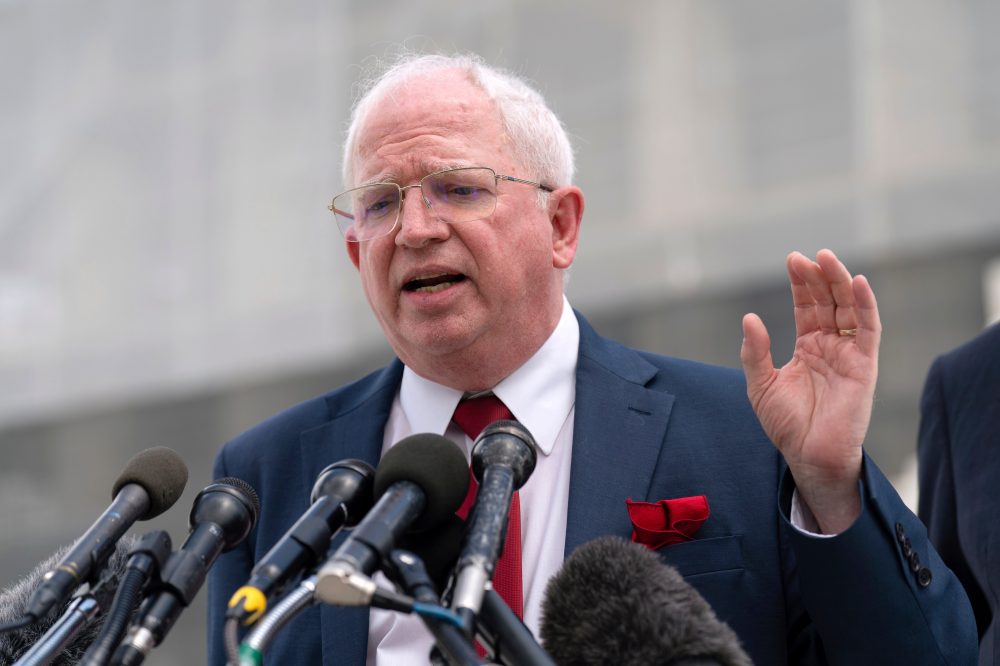
SAN FRANCISCO (AP) — An attorney from California who assisted former President Donald Trump in attempting to reverse the 2020 presidential election outcome has been permanently stripped of his legal credentials in the state.
On Wednesday, the California Supreme Court issued an order permanently disbarring John Eastman and removing his name from the official registry of licensed attorneys. This action concludes a multi-year campaign by the state bar association to revoke Eastman’s legal credentials following his creation of a legal framework designed to have then-Vice President Mike Pence block the confirmation of Joe Biden’s electoral win.
In 2024, a State Bar Court of California judge had recommended removing his California legal credentials. Eastman maintained that he was facing penalties merely for providing legal counsel.
George Cardona, who serves as chief trial counsel for the State Bar of California, stated that the ruling stems from compelling evidence showing Eastman “advanced false claims about the 2020 presidential election to mislead courts, public officials, and the American public.”
“The Court’s order underscores that Mr. Eastman’s misconduct was incompatible with the standards of integrity required of every California attorney,” he said.
Randall Miller, representing Eastman, described the ruling as one that “raises pivotal constitutional concerns” and announced plans to petition the Supreme Court for review.
In his statement, he argued the decision “departs from long-standing United States Supreme Court precedent protecting First Amendment rights, especially in the attorney discipline context.”
WASHINGTON — A Wednesday Senate vote revealed deepening divisions within the Democratic Party over military support for Israel, as more than three dozen Democrats backed Vermont Senator Bernie Sanders’ push to stop weapons sales to the nation.
Sanders introduced two measures aimed at blocking American sales of bulldozers and bombs to Israel. While both failed — losing by votes of 40-59 and 36-63 — the Vermont Independent has consistently brought these issues to the floor to pressure colleagues from both parties to oppose Netanyahu’s government.
The number of Democrats supporting Sanders’ position has more than doubled in under two years, reflecting growing party tensions over Israeli military operations in Gaza, Lebanon, and Iran, along with increased pressure from progressive activists who view Israel support as a key political test.
“It’s clear that Democrats are beginning to listen to the average American who is sick and tired of spending billions of dollars to support Netanyahu’s horrific wars when people in this country can’t afford housing or health care,” Sanders stated following the vote.
Arizona Democrat Mark Kelly switched his position to support both measures after previously opposing similar Sanders initiatives. Kelly explained his reasoning during floor remarks, citing concerns about current leadership decisions.
“Under Prime Minister Netanyahu’s government, we’ve seen an expanded war in Lebanon that is putting innocent Lebanese civilians at risk, and ongoing violence against Palestinians and their homes being demolished in the West Bank,” Kelly said. “All of this has undermined the path forward for peace.”
Senate Minority Leader Chuck Schumer and Senator Kirsten Gillibrand, both New York Democrats, voted against the proposals. Their positions prompted protests Monday when nearly 100 demonstrators were arrested outside their offices, demanding support for Sanders’ measures.
Jewish Voice for Peace organized the demonstration, with hundreds initially attempting to occupy the senators’ offices before being blocked by authorities. Communications director Sonya Meyerson-Knox said “The majority of Americans and New Yorkers want a resolution to what the Israeli government is doing.”
Earlier Wednesday, Democrats also supported a separate resolution to end Trump’s military action in Iran, though it too failed 47-52. Delaware’s Chris Coons, who opposed Sanders’ Israel measures but supported ending the Iran conflict, clarified his position afterward.
“My votes should be taken neither as an endorsement of the actions of the Netanyahu government nor as an abandonment of the state of Israel, the Jewish people, or the US-Israel relationship,” Coons explained in a statement.
Republican senators argued the votes could damage American interests in the Iran conflict. Foreign Relations Committee Chairman Jim Risch of Idaho warned the measures might encourage Iran and “send the message that the U.S. is prepared to leave our ally Israel vulnerable.”
“They will not help the United States of America,” Risch said before the voting began.
Ukrainian officials report that Russian forces launched a missile assault on the nation’s capital early Thursday morning, leaving multiple people wounded and igniting fires throughout various neighborhoods in Kyiv.
According to Mayor Vitali Klitschko, one missile struck the sixth floor of a 16-story residential building located in the central Podil neighborhood, though the impact did not spark a blaze at that location.
Klitschko reported that a significant fire erupted at a structure in the northern Obolon district, where four emergency medical personnel sustained injuries. The mayor also noted that missile fragments scattered across multiple areas of the city.
City military administration chief Tymur Tkachenko confirmed that no fewer than four individuals were wounded in the Thursday morning assault.
The attacks extended beyond the capital, with regional governor Oleksandr Ganzha reporting via Telegram that Russian strikes also ignited substantial fires in the southeastern city of Dnipro, where five people were injured. Social media images revealed buildings engulfed in flames throughout the area.
The U.S. Olympic and Paralympic Committee announced Wednesday it is keeping a watchful eye on the growing controversy surrounding Casey Wasserman, who leads the Los Angeles 2028 Olympics organizing committee, signaling a shift from earlier support for the embattled chairman.
The heightened attention comes after Justice Department documents released in January connected Wasserman to Jeffrey Epstein.
“We’ve actively engaged and listened to our stakeholders, including athletes, and we’re closely monitoring the impact on our community,” USOPC chair Gene Sykes told reporters during a conference call. “We’ve also shared our concerns directly with the LA28 board, which is responsible for determining who serves as its chair.”
Back in February, LA28 CEO Reynold Hoover had expressed confidence in Wasserman, stating that sponsors weren’t voicing worries and that daily operations remained unaffected.
Despite the ongoing scrutiny, Sykes noted that LA28’s leadership team continues making “very solid” headway in organizing efforts and building partnerships, maintaining robust backing from both commercial partners and government entities.
Olympic officials highlighted overwhelming interest in the 2028 Games after worldwide ticket sales launched last week.
The global sales phase began following a record-breaking local pre-sale period, though many prospective attendees have criticized steep prices, additional charges, and limited ticket availability.
Sykes explained that organizers have worked to provide various pricing options, including over one million affordable tickets.
“There was a registration process over a month. They had a tremendous number of registrations… and they’ve been selling tickets at a remarkable rate,” he said.
“There are clearly some tickets which are high-priced, but they’ve made a great effort to have low-price tickets. They’ll have a million tickets priced at $28… so I know they’re thinking very seriously about how to manage the ticket activity so that it satisfies everybody.”
Sykes also responded to widespread criticism about a 24% service charge added to ticket purchases, calling it industry standard practice, while acknowledging that organizers are aware of the negative reaction and have thoroughly discussed the matter.
“They are not only aware of the issue, but they had given us a lot to think about,” he said.
SINGAPORE, April 16 – Financial markets across Asia showed strong performance during Thursday’s early trading session as investors became increasingly optimistic about potential diplomatic breakthroughs between Iran and the United States, while also anticipating key economic reports and crucial corporate earnings announcements.
The MSCI Asia-Pacific index excluding Japan climbed 0.3%, positioning the indicator for its third straight day of positive movement. Japan’s Nikkei index jumped 1.5%, and S&P 500 e-mini futures edged up 0.1%.
During Wednesday’s trading in the United States, the S&P 500 increased 0.8% while the Nasdaq Composite surged 1.6%, driven by impressive quarterly results from Bank of America and Morgan Stanley that propelled both indices to new record levels. Among the roughly 6% of companies that have released quarterly results so far, 84% have surpassed analyst forecasts.
Goldman Sachs analysts expressed confidence in their research notes, stating “We remain constructive overall” regarding emerging market equities because “underlying profit growth is likely to be strong.”
The analysts noted that regional earnings would be “driven by AI-related demand, which should be relatively insulated from the direct impacts of the oil shock.”
Upcoming economic releases include employment figures from Australia and gross domestic product data from China. Taiwan Semiconductor Manufacturing Co (TSMC), a crucial player in the artificial intelligence industry, is scheduled to announce quarterly results, with analysts projecting a 50% jump in net earnings as demand for sophisticated semiconductors continues to accelerate.
Crude oil markets saw Brent prices open 0.4% lower at $94.55 per barrel following reports from a Tehran-briefed source who indicated Iran might consider permitting vessels to navigate safely through the Omani portion of the Strait of Hormuz without threat of attack, as part of negotiation proposals presented to the United States.
Gold recovered 0.8% to reach $4,829.24, while cryptocurrency markets showed mixed results with bitcoin remaining unchanged at $74,832.83 and ether declining 0.1% to $2,360.71.
WASHINGTON – Senate Republicans joined forces Wednesday to defeat two measures that would have halted approximately $450 million in military equipment sales to Israel, demonstrating continued GOP support for President Trump’s Middle East policies.
The failed resolutions highlighted a growing divide within the Democratic Party, as most of the 47-member Democratic caucus supported blocking the sales due to concerns about civilian casualties from Israeli military operations in Gaza, Lebanon and Iran.
Despite decades of bipartisan congressional support for Israel making such blocking measures unlikely to succeed, advocates believe bringing these issues to a vote pressures both Israeli leadership and U.S. officials to better protect non-combatants.
Those favoring the arms sales argue Israel remains a crucial ally deserving continued American military support.
Vermont Senator Bernie Sanders, an independent who works with Democrats, pushed for the votes on both measures, arguing the sales violated foreign aid requirements under the Foreign Assistance Act and Arms Export Control Act.
The first measure targeting a $295 million deal for D9R and D9T Caterpillar bulldozers and related equipment failed 59-40. Seven Democrats joined all Republicans in opposing the resolution, while Wyoming Republican Senator Cynthia Lummis was absent.
The second resolution aimed at blocking $151.8 million worth of 12,000 BLU-110A/B general purpose 1,000-pound bombs and associated support services was defeated 63-36. Eleven Democrats crossed party lines to vote with Republicans, and North Carolina Republican Senator Thom Tillis did not participate.
Sanders explained that Israel deploys these bombs in strikes against Gaza and Lebanon while using the bulldozers to destroy residential structures in Gaza, Lebanon and the West Bank.
“The United States must use the leverage we have — tens of billions in arms and military aid — to demand that Israel ends these atrocities,” Sanders stated while advocating for the blocking measures.
Israeli officials maintain they do not deliberately target civilians, stating their military actions aim to eliminate militants and destroy military infrastructure.
Wednesday’s voting results showed increased support for limiting Israeli arms sales compared to previous attempts. Two similar Sanders-sponsored resolutions failed in July with larger margins of defeat — 73-24 and 70-27 in the 100-member Senate.
The Trump administration circumvented standard congressional oversight procedures for these military sales early in the U.S.-Israeli conflict with Iran, claiming emergency circumstances required immediate weapons transfers.
Credit rating firm S&P Global has cut the Australian Securities Exchange’s issuer rating from “AA-/A-1+” to “A+/A-1” on Thursday, following a regulatory probe that uncovered serious governance and risk oversight deficiencies at the country’s primary stock market operator.
The rating reduction highlights ASX’s recent pattern of operational failures, including repeated system outages, a failed technology modernization project called CHESS, and settlement system breakdowns in 2024.
These operational problems have drawn sharp criticism from regulators who cite poor governance practices, insufficient risk oversight, and an organizational culture that appears to favor immediate profits over maintaining essential market infrastructure.
The Australian Securities and Investments Commission (ASIC) had earlier criticized ASX for focusing too heavily on delivering returns to shareholders while neglecting the maintenance and improvement of vital market systems.
S&P cautioned that ASX could face another rating cut if the agency determines that risk management practices, particularly regarding clearinghouse operations and related financial protections, worsen over the coming two years.
The rating firm indicated that an upgrade would most likely require ASX to successfully complete its governance and risk management improvement initiatives, though S&P considers this unlikely within the next 24 months.
Responding to the downgrade, ASX stated it was “committed to addressing the ASIC Inquiry’s interim and final reports by implementing our Commitments Plan.”
Following a 10-month investigation, ASIC concluded in its recently published final report that ASX had relied on short-term “tactical solutions” to address problems instead of tackling the underlying causes, which were primarily technology-related.
Despite the downgrade, S&P changed its outlook for ASX from “negative” to “stable,” noting that the company will maintain its market-leading position over the next two years and continue serving as a crucial part of Australia’s financial infrastructure.
The rating agency also lowered the long-term issue rating on ASX’s debt instruments from “AA-” to “A+.”
ASX shares gained up to 1.3% during early trading sessions, performing better than Australia’s broader S&P/ASX 200 index, which rose 0.2%.
Commuters traveling on Route 13 should expect delays this morning as construction crews continue work that has closed right lanes in both the northbound and southbound directions.
The Delaware Department of Transportation reports that right lanes are blocked between Voshells Mill Star Road and Shamrock Avenue as part of ongoing construction activities.
The lane closures are scheduled to remain in effect until 7 a.m., potentially impacting morning rush hour traffic. Drivers are advised to allow extra travel time and use caution when passing through the construction zone.
Motorists should merge safely into the left lanes when approaching the work area and follow posted speed limits in the construction zone.
Delaware Department of Transportation officials have shut down Route 896 at the Old Baltimore Pike intersection, forcing drivers to seek alternate routes.
The state transportation agency is directing all motorists to observe and follow detour signage that has been posted at the closure location.
No additional details about the cause of the road closure or expected duration have been provided at this time.
Delaware Route 72 is experiencing a complete closure overnight as construction crews work on the roadway between Old Baltimore Pike and Scottfield Drive.
Both northbound and southbound lanes are blocked to traffic, with the shutdown expected to last until 6 a.m. according to DelDOT officials.
Motorists traveling through the area are being directed to use alternate routes and pay attention to posted detour signage. Emergency personnel are on scene to help guide traffic around the construction zone.
Drivers should plan for additional travel time and consider using alternative routes to avoid delays during the overnight construction period.
INDIANAPOLIS — College sports officials announced Wednesday they are examining a potential shift to age-based eligibility requirements that would provide Division I athletes with a five-year competition window beginning right after they complete high school or reach age 19, whichever occurs earlier.
During meetings that wrapped up Wednesday, the Division I Cabinet reviewed this possibility but stopped short of adopting an official stance. Cabinet members endorsed having NCAA personnel continue exploring the concept with various stakeholders to collect input.
According to the Cabinet, this new framework would incorporate potential exemptions for situations including pregnancy, military duty, and religious missions.
This age-focused approach mirrors a concept featured in an executive order that President Donald Trump signed on April 3.
Under present regulations, student-athletes typically receive four seasons of eligibility spread across five years without any age limitations.
The consideration of age-based requirements follows multiple legal challenges by athletes seeking to extend their collegiate careers and earning opportunities through revenue sharing and name, image and likeness agreements.
At the same meetings, Cabinet members approved modifications to pre-enrollment eligibility standards, including a provision that would prevent athletes who have participated in and stayed in professional sports drafts from competing collegiately.
Among these regulations is a requirement for prospects to remove themselves from opt-in professional league drafts, such as the NBA draft, aligning pre-college enrollment draft policies with post-college enrollment draft policies. Men’s ice hockey and baseball would remain unaffected since athletes don’t opt into those sports’ drafts.
This modification followed the cases of two basketball players, Alabama’s Charles Bediako and Baylor’s James Nnaji, who competed collegiately this season despite having entered the 2023 NBA draft.
Bediako competed for two seasons at Alabama before declaring for the draft. Though undrafted, he spent three years in the G League, the NBA’s developmental league. He appeared in five games this past season before the Alabama Supreme Court confirmed a ruling declaring him ineligible.
Nnaji was chosen by the Detroit Pistons in the second round. Following professional play overseas, he enrolled as a freshman at Baylor in December. He received eligibility approval because he had never executed an NBA contract or competed in the G League. Under the new regulations, he would be ineligible for the 2026-27 season.
Additional changes permit athletes to work with agents before enrollment for purposes beyond name, image and likeness deals and allow them to receive prize money in their sports without affecting eligibility status.
LONDON (AP) — While William Shakespeare enthusiasts are familiar with his origins in Stratford-upon-Avon, where visitors continue to flock to see his birthplace, the legendary writer actually built his reputation in London — yet very little evidence of his presence remains in England’s capital today.
A recently uncovered map from the 1600s is providing fresh insights into Shakespeare’s life in London, revealing the precise location of the sole residence the playwright purchased in the city and potentially where he penned his last theatrical works.
Lucy Munro, a Shakespeare researcher who uncovered the historical document, explained that it adds “extra bits of the jigsaw puzzle” to understanding Shakespeare’s life. Like many significant findings, this one involved an element of chance.
“I came across it in the London Archives when I was looking for other things,” Munro said.
While scholars have been aware since long ago that Shakespeare acquired real estate in 1613 close to the Blackfriars Theatre, the precise whereabouts remained unknown. Currently, only a marker on a building from the 1800s indicates that the dramatist had quarters “near this site.”
The detailed layout of the Blackfriars area that Munro discovered and King’s College London revealed Thursday displays Shakespeare’s residence — a sizeable L-shaped structure converted from a former medieval monastery, complete with its entrance gate.
The Dominican religious community from the 13th century had been transformed for non-religious purposes following King Henry VIII’s monastery closures in the 1500s. This district housed the Blackfriars theater, which Shakespeare partially owned.
According to Munro, who serves as a professor of Shakespeare and early modern literature at King’s College London, the neighborhood was prestigious but experiencing a slight decline in status — partly due to residents like Shakespeare, who had wealth but connections to the somewhat disreputable theater world.
“After the dissolution of the monasteries, a lot of the nobility, quite high-ranking courtiers, court officials are living in the Blackfriars,” Munro said. When Shakespeare acquired his property, “there are still a lot of important people living there, people who make protests against the playhouses at various points, because they see the playhouses as a bit of a public nuisance.”
Shakespeare invested his theatrical earnings to construct an impressive family residence in Stratford, approximately 100 miles northwest of London, which has since been torn down. He passed away there in 1616 at age 52.
Whether Shakespeare actually resided in his London house or simply collected rent from it remains unclear. However, Munro suggests that the dwelling’s size and its proximity — just a five-minute walk to the Blackfriars Theatre — indicate he might have spent more time in London during his later years than commonly believed. She theorizes he could have created his final works there, including “Henry VIII” and “The Two Noble Kinsmen,” both collaborative efforts with John Fletcher.
Will Tosh, who heads education at Shakespeare’s Globe — a recreated version of the outdoor Elizabethan theater where many of Shakespeare’s plays debuted — described Munro’s finding as providing a “dazzling new sense of Shakespeare the London writer. She’s helped us to understand how much the city meant to our greatest ever dramatist, as a professional and personal home.”
Shakespeare bequeathed the property to his daughter Susanna, and it stayed within the family for an additional fifty years. Munro also located two historical records documenting its sale by the playwright’s granddaughter Elizabeth Hall Nash Barnard in 1665. The following year, the structure was consumed by the Great Fire of London, which devastated much of the ancient city.
Few traces of Shakespeare’s London survive in the area, now part of the city’s financial center, including a remaining piece of wall from the medieval monastery. The nearby street name Playhouse Yard serves as a reminder of the theater that once operated there.
Modern visitors can enjoy a drink at the Cockpit pub located across from where Shakespeare’s house once stood. The 1600s map identifies it as a structure called the Sign of the Cock, probably a tavern. It’s easy to envision Shakespeare and his theater associates gathering there for drinks.
“There are certainly complaints in the period about the playhouses leading to the opening of more and more drinking houses — ‘houses for tippling,’ as they call them in one of the documents I was looking at,” Munro said.
A federal jury in Miami has ordered Carnival Cruise Line to pay $300,000 in damages to a passenger who sustained serious injuries after cruise staff allegedly provided her with excessive amounts of alcohol before a devastating fall.
The jury ruled in favor of Diana Sanders, a 45-year-old registered nurse from Vacaville, California, concluding that Carnival acted negligently when serving the passenger.
Court records show that on January 5, 2024, Sanders was aboard the Carnival Radiance when crew members served her no fewer than 14 tequila shots during an eight-hour period from late afternoon until nearly midnight. Shortly after 11:45 p.m., Sanders fell down stairs, resulting in a concussion, potential brain trauma, spinal injuries, tailbone damage, and extensive bruising.
Sanders’ legal representative, Spencer Aronfeld, emphasized the significance of the David-versus-Goliath legal battle in a written statement. “Taking on a corporate giant like Carnival is a massive undertaking, and I have enormous respect for my client’s resilience throughout this 18-month litigation,” Aronfeld said in an email. “This case highlights the inherent dangers of all-inclusive drink packages, which encourage excessive consumption and pressure underpaid servers to prioritize tips over safety.”
The attorney revealed that jurors reviewed evidence showing a suspicious 30-minute gap in security footage covering the period from when Sanders departed the ship’s casino bar until crew members discovered her unconscious in a restricted crew area.
Carnival Corporation issued a response indicating the company disputes the jury’s decision and intends to challenge the outcome through requests for a new trial and appellate proceedings.
This verdict comes as the cruise industry faces additional scrutiny over alcohol service policies. A separate ongoing lawsuit targets Royal Caribbean, where a passenger’s fiancée alleges the cruise line bears responsibility for his death after serving him 33 alcoholic beverages and subsequently using excessive force during a physical altercation with crew members.
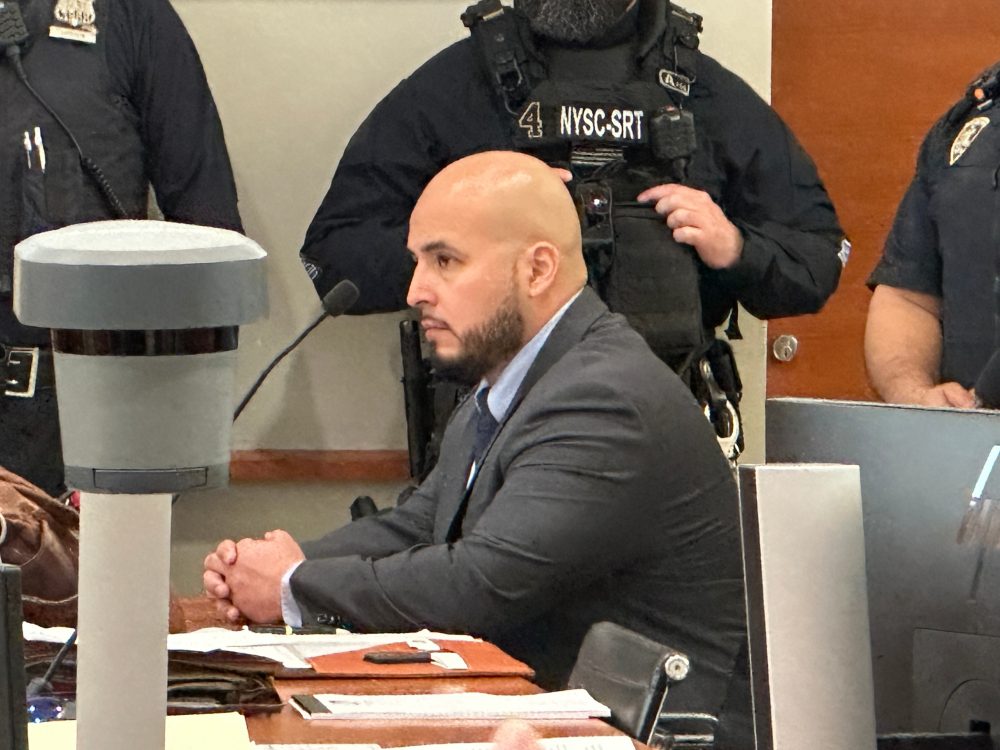
Two young men from the Philadelphia area have denied federal terrorism charges in connection with an alleged bomb plot targeting New York City’s mayor’s residence.
Emir Balat, age 18, and Ibrahim Kayumi, age 19, appeared in Manhattan federal court Wednesday where they entered not guilty pleas to the charges against them.
Federal prosecutors allege the pair traveled from Philadelphia to New York City with the intention of attacking participants at an anti-Islam rally held March 7th outside Gracie Mansion. The demonstration was organized by Jake Lang, a far-right activist who has criticized Mayor Zohran Mamdani, the city’s first Muslim mayor.
According to the government’s case, both defendants are charged with attempting to support a foreign terrorist organization and deploying weapons of mass destruction.
Court documents indicate Balat and Kayumi hurled two improvised explosive devices filled with TATP explosive material and metal fragments at the protest site, though the jar-shaped bombs never exploded. Authorities detained both suspects immediately after the incident, and no injuries occurred. The mayor and his spouse were away from the residence during the attack.
Federal investigators say the defendants later admitted to police that ISIS ideology motivated their actions. Prosecutors also revealed that dashboard camera footage from their vehicle captured the pair discussing plans to kill up to 60 individuals in order to “start terror.”
Defense counsel for Balat refused to provide statements following Wednesday’s court session. Legal representatives for Kayumi have not yet responded to requests for comment. Both defendants are scheduled to return to court on June 16th.
Motorists traveling on McKennans Church Road should plan for potential delays as intermittent lane restrictions continue along a stretch of the roadway.
The lane closures affect the section of McKennans Church Road running between Newport Gap Pike and Millcreek Road, according to DelDOT traffic information.
The temporary lane restrictions are expected to remain in place until 6 AM, after which normal traffic patterns should resume.
Drivers are advised to allow extra travel time and exercise caution when navigating through the work zone area.
Motorists traveling through New Castle County should plan for potential delays on McKennans Church Road during overnight hours.
The Delaware Department of Transportation is reporting periodic lane restrictions along McKennans Church Road in the stretch between Newport Gap Pike and Millcreek Road. These intermittent closures are scheduled to continue until 6 AM.
Drivers are advised to use alternate routes or allow extra travel time when navigating through this area during the affected hours.
A key technology executive at Ford Motor Company is stepping down after spending nearly five years helping transform the automaker’s approach to electric vehicles and digital innovation.
Doug Field, who serves as Ford’s chief EV, digital, and design officer, will depart the company next month, Ford announced Wednesday. Field, who previously worked at both Tesla and Apple, expressed his eagerness to share his accumulated expertise with others in future endeavors.
Ford brought Field aboard in 2021 to spearhead cutting-edge technology initiatives. CEO Jim Farley had described Field’s recruitment as a pivotal “watershed” moment that would revolutionize how Ford develops contemporary vehicles.
Traditional Detroit automakers have increasingly turned to Silicon Valley talent to modernize their corporate cultures, aiming to accelerate innovation, attract consumers with fresh features and updates, and potentially generate subscription revenue streams.
During Field’s tenure, shifting government policies and weaker-than-expected electric vehicle demand dramatically altered automaker strategies. Several programs under Field’s leadership were ultimately scrapped, including multiple next-generation EV projects and sophisticated electrical architecture designed to function as the central “brain” for future vehicles.
“The whole journey here has not been about the products for me,” Field explained to reporters Wednesday. “The journey here has been about building the team, building the set of capabilities, helping build the culture.”
Ford took a massive $19.5 billion writedown in December when it abandoned various electric vehicle initiatives.
Field’s most enduring contribution will likely be Ford’s upcoming affordable EV lineup, beginning with a $30,000 pickup truck scheduled for next year’s release. Working alongside Tesla alumnus Alan Clarke, Field guided efforts to manufacture U.S.-built vehicles capable of competing with Chinese automaker offerings.
Clarke will now assume leadership of that initiative and has been appointed to head advanced development projects, Ford announced.
Farley praised Field for attracting technology talent to Ford and implementing cultural shifts that reduced complexity while speeding up decision-making processes. “His influence will be felt for years to come,” Farley stated.
Ford is merging Field’s advanced technology division with the global industrialization team overseen by Chief Operating Officer Kumar Galhotra. The automaker has repeatedly attempted to separate its electric and gasoline vehicle operations, reporting their finances independently, though many organizational elements have since been reunited.
The company stated that consolidating these teams will better position Ford for upcoming product, software, and service launches, describing the period as among the most intensive in company history. Galhotra will oversee the newly formed product creation and industrialization group.
Ford plans to update 80% of its North American vehicle lineup by volume and 70% of its global portfolio by volume before 2029.
High-ranking Pentagon officials have been engaging in conversations with leadership from major corporations such as General Motors and Ford Motor Company regarding the production of military equipment and weapons, according to a Wall Street Journal report published Wednesday that cited sources with knowledge of the meetings.
These broad-scope discussions, which began prior to the conflict with Iran, reflect the current administration’s desire to involve automakers and other domestic manufacturers more heavily in defense production efforts, the Journal reported.
Pentagon representatives informed the publication that American manufacturing companies may be required to support existing defense contractors and inquired about these firms’ ability to quickly transition to military production work.
The conversations also included GE Aerospace and equipment manufacturer Oshkosh, according to the Journal’s reporting.
Reuters was unable to independently confirm these details. When contacted for comment after business hours, the Pentagon, General Motors, Ford, GE Aerospace, and Oshkosh did not provide immediate responses to Reuters’ inquiries.
A Defense Department representative stated to the Journal that the Pentagon “is committed to rapidly expanding the defense industrial base by leveraging all available commercial solutions and technologies to ensure our warfighters maintain a decisive advantage.”
In March, Trump conducted meetings with leadership from seven defense contracting companies as the Pentagon works to rebuild inventory depleted by U.S. military actions against Iran and other recent operations.
Following Russia’s 2022 invasion of Ukraine and Israel’s military campaigns in Gaza, the United States has depleted weapons stockpiles valued in the billions, including artillery equipment, munitions, and anti-tank weaponry.
Earlier this month, Trump proposed a substantial $500 billion military budget increase, bringing the total to $1.5 trillion, as the U.S. continues its military engagement with Iran.
Former world number one Iga Swiatek secured her spot in the quarterfinals at the Porsche Tennis Grand Prix in Stuttgart, Germany on Wednesday, defeating home favorite Laura Siegemund 6-2, 6-3. The victory marked Swiatek’s debut match working alongside her new clay court coach Francisco Roig.
The third-seeded Polish player, who has captured the Stuttgart title twice before, initially struggled to hold onto an early service break in the first set. However, she regained control by breaking Siegemund’s serve in both the sixth and eighth games to claim the opening set. The six-time Grand Slam winner faced similar early challenges in the second set, failing to convert an initial break opportunity, but ultimately broke through in the eighth game to establish a 5-3 advantage before sealing the victory. Having received a first-round bye, Swiatek now moves forward to the quarterfinal round.
Turkish qualifier Zeynep Sonmez delivered a stunning upset by defeating Italy’s fifth-seeded Jasmine Paolini 6-2, 6-2 in just one hour and 16 minutes. Sonmez dominated with a 72% first-serve percentage and captured 62.5% of second-return points, while Paolini struggled to convert her single break-point chance and managed only 41.8% of total points.
Ukraine’s fourth-seeded Elina Svitolina delivered a commanding performance against Germany’s Eva Lys, winning 6-1, 6-0. Meanwhile, sixth-seeded Mirra Andreeva of Russia overcame defending champion Jelena Ostapenko of Latvia in a three-set battle, 5-7, 6-2, 6-4. Additional winners included American qualifier Alycia Parks, who beat German wild card Noma Noha Akugue 6-4, 6-2, and Czech Republic’s Linda Noskova, who outlasted China’s Zhang Shuai 5-7, 6-1, 6-4.
At the Rouen Metropolitan Open in France, unseeded British player Katie Boulter stunned third-seeded Jaqueline Cristian of Romania 7-6 (5), 4-6, 6-1 to reach the quarterfinals. Boulter, who has claimed just one WTA Tour title, navigated a challenging opening set where she built a 5-0 tiebreaker lead before Cristian saved five set points. Though Cristian bounced back to take the second set, Boulter dominated the final set with two service breaks to secure the upset.
Top-seeded Marta Kostyuk of Ukraine recovered from dropping the first set to unseeded American Caty McNally, rallying for a 2-6, 6-2, 6-1 victory and a quarterfinal berth. Kostyuk’s next opponent will be fifth-seeded American Ann Li, who completed her own comeback against unseeded Kamilla Rakhimova of Uzbekistan, winning 4-6, 6-2, 6-3. Germany’s unseeded Tatjana Maria upset ninth-seeded Elsa Jacquemot of France 6-4, 6-3, while other advancing players included second-seeded Sorana Cirstea of Romania, Hungary’s Anna Bondar, and Ukraine’s Oleksandra Oliynykova.
Motorists traveling along a busy stretch of US Route 13 should expect delays due to ongoing construction activities that are causing periodic lane restrictions.
Delaware Department of Transportation officials report that construction crews are working between Bayview Road and Hyetts Corner Road, creating intermittent lane closures affecting traffic moving in both the northbound and southbound directions.
The lane restrictions are expected to remain in effect until 5:30 a.m., according to DelDOT’s traffic incident reporting system.
Drivers are advised to allow extra travel time when using this section of Route 13 and to exercise caution when approaching the work zone area.
The Goldey-Beacom Lightning softball squad captured a pair of Conference victories during their road trip to face Chestnut Hill this week.
The Lightning dominated the opening contest with a 9-7 victory over their opponents. The second game proved more challenging, requiring extra innings before Goldey-Beacom emerged victorious with another 9-7 final score after nine innings of play.
These two CACC conference victories on the road demonstrate the team’s ability to perform under pressure in away games, particularly showcased in the marathon second game that went beyond regulation play.
STEVENSON, Md. – Salisbury University’s softball team wrapped up their four-game away series with a doubleheader victory against Stevenson University on Wednesday, taking both contests to improve their season record.
The Sea Gulls, now 16-10 on the season, dominated the opening game with a commanding 10-2 triumph that ended after six innings due to the run rule. In the nightcap, Salisbury managed to hold off a determined Stevenson squad for a narrow 5-4 victory.
The Mustangs fall to 11-15 with the losses as they continue their challenging season. The doubleheader marked the end of Salisbury’s extended road trip, giving the team momentum as they head into their next series of games.
COLUMBIA, S.C. — The South Carolina Senate voted Wednesday to shield virtually every historic statue, monument, street and building name throughout the state from removal or modification.
Senators passed the legislation by a 31-7 margin, with the measure also prohibiting QR code stickers that smartphone users could scan for additional historical context. Advocates for these digital codes argued they could help provide modern perspective on Confederate or segregationist leaders who were commemorated with favorable language in past decades.
Under the legislation, local governments would need General Assembly approval before removing any monument or altering its inscription.
The vote contrasts with trends elsewhere in the South, where state legislatures are reducing special privileges for Confederate organizations. Virginia lawmakers recently eliminated certain benefits for groups that commemorate rebel soldiers and considered removing the last three Confederate statues at Capitol Square in the former Confederate capital.
South Carolina currently provides protection for Confederate memorials, honoring those who fought in the failed four-year effort to break away from the United States, along with monuments to other conflicts spanning from the Revolutionary War through the Persian Gulf War.
However, memorials honoring non-military figures fell through a legal gap, meaning monuments to historical figures like former Vice President John C. Calhoun or segregationist Governor “Pitchfork” Ben Tillman might lack similar protection from universities or municipal authorities.
The new South Carolina legislation extends protection to all historical figures, defining them as any deceased individual who “played a significant role in past developments.”
The vote split along party lines, with all supporting votes coming from Republicans and all opposition from Democrats.
On the Senate floor, Democratic Senator Margie Bright Matthews recited statements from Tillman advocating violence against freed slaves and their descendants, and from Calhoun defending slavery by claiming African Americans could not achieve civilization.
“Do we want to be a state that continues to debate and defend the legacy of treason, racism and exclusion?” Matthews asked. “You ought to be embarrassed about some of the stuff you want to preserve.”
South Carolina’s original monument protection statute became law in 2000 as part of an agreement that took down the Confederate flag from the capitol dome, where it had flown since being raised during the Civil War centennial in 1961.
The legislation, which advances to the House with roughly one month remaining in the session, would permit any officially recognized private historical organization to file lawsuits if they believe a monument faces improper treatment. The measure also mandates that any monument relocated due to construction or road work must be displayed in a location of equal or greater visibility.
Democratic Senator Ed Sutton warned this could create legal chaos for cities like Charleston, potentially facing multiple lawsuits from dissatisfied organizations. Current law limits such legal action to the state attorney general’s office.
“The practical effect is the city is going to take a step back and say we’re out of the history game,” Sutton said regarding Charleston, established in 1670 and central to both the Revolutionary and Civil wars.
Meanwhile in Virginia, newly elected Democratic Governor Abigail Spanberger recently signed legislation eliminating a Sons of Confederate Veterans license plate featuring rebel General Robert E. Lee.
Virginia’s General Assembly also removed official recognition this year from “Carry Me Back to Old Virginny,” a song with lyrics about an enslaved person using a racial slur while fondly remembering bondage. The song served as the official state song from 1940 to 1997, when it became the “state song emeritus.”
South Carolina legislators remain opposed to historical reinterpretation.
In the bill’s text, Republican sponsor Senator Danny Verdin argued that “the nearer a person stands in time to the event, the more likely their description reflects the conditions, perceptions and meanings as they were actually were understood when they occurred.”
This reasoning led Verdin to successfully maintain the QR code prohibition in the legislation. No other state with memorial protection laws bans such digital codes.
“As our knowledge and understanding of history continues to evolve, please consider the value in allowing for an evolution in how the lives of those in the past are told,” Preservation Society of Charleston President and CEO Brian Turner wrote to senators.
Democratic Senator Darrell Jackson noted that since his ancestors gained freedom through the Civil War, he feels no comfort seeing Confederate figures honored with statues, and believes his story deserves representation as well.
“History is usually a matter of who sees it, who tells it, who experiences it,” Jackson said.
ANN ARBOR, Mich. — Violent weather systems swept across Michigan early Wednesday, causing extensive damage including torn roofing at ice facilities, street flooding, and toppled trees in areas surrounding the University of Michigan’s central campus.
Teams from the National Weather Service conducted damage assessments throughout affected regions, including Ann Arbor, to verify whether tornadoes had made ground contact, though none were confirmed by Wednesday morning. The destruction stemmed from a severe thunderstorm front that traveled into Michigan from Iowa, Wisconsin and Illinois, according to meteorologist Sara Schultz.
Wind speeds reached 70 mph at the university’s football stadium during the early morning hours Wednesday, while Willow Run Airport and Detroit Metropolitan Airport recorded gusts of 69 mph and 62 mph respectively, Schultz reported. Additional powerful storm systems carrying potentially destructive winds were approaching the region from western states.
Widespread flooding affected roadways throughout southeastern Michigan communities Wednesday.
Multiple Ann Arbor public school facilities sustained structural harm and lost electrical service. District officials canceled classes Wednesday due to fiber network failures that disabled fire safety, telephone and security camera systems, along with building entry controls.
Ann Arbor Mayor Christopher Taylor reported that structural engineers were evaluating wall damage at the city’s Veterans Memorial Park Ice Arena. The university’s Yost Ice Arena also lost portions of its roofing.
The severe weather toppled a massive tree outside Seungjun Lee’s Ann Arbor residence, coming within feet of his second-story bedroom.
“If the tree fell down a couple more feet, I would not be standing here,” said Lee, a 20-year-old junior at U-M.
Lee and his housemates were roused by emergency sirens, followed by phone alerts between 1 a.m. and 2 a.m. instructing them to seek immediate shelter.
“As soon as I came out, everyone else was coming out of their rooms and everyone’s like, ‘What’s going on? This is crazy,’” said Lee, of Ridgewood, New Jersey. “And then we looked out the window: This tree just fell down.”
His roommate, Gautam Nigam, 21, said he couldn’t miss class despite the chaos: “I have a final presentation later today.”
Rainfall totals reached 2.5 inches across southeastern Michigan by Wednesday morning, with additional precipitation forecast for the Midwest, Great Lakes and Ohio Valley areas. Flood advisories were issued for extensive portions of Michigan’s eastern Lower Peninsula, southeastern Michigan, northern Indiana, northwestern Ohio, the Chicago metropolitan area and Wisconsin.
Wisconsin Governor Tony Evers issued an emergency declaration Wednesday following at least three confirmed tornadoes in the state this week, with additional severe weather anticipated.
Madison, Wisconsin’s capital, experienced hail ranging from golf ball to baseball size Tuesday afternoon.
In northern Michigan, electrical outages during the storm resulted in the death of 1,750 steelhead trout at a state hatchery facility where reproductive materials are harvested for fish production. Scott Heintzelman from the state’s fisheries division called it a “devastating event” involving “big, beautiful fish.”
The fish naturally migrate into a collection structure on the Little Manistee River before moving to holding ponds. Heintzelman said staff discovered Tuesday that power loss had halted oxygenated water circulation, causing the fish deaths.
Wisconsin’s Department of Natural Resources announced monitoring of levees surrounding Portage, a community of approximately 10,000 residents, as the Wisconsin River continues rising. By Wednesday morning, the river had reached nearly 19 feet at that location, approximately 2 feet above flood level, with potential increases to about 20 feet.
Following multiple days of rainfall and winter snowmelt, a “significant influx of water” is entering Black Lake in northern Michigan, according to the sheriff’s office.
The lake drains into the Black River and supplies the Cheboygan River, which flows through the city into Lake Huron. Officials have been controlling water flow through the city’s Cheboygan Dam by adjusting gates, installing pumps, raising a bridge and restricting public access to some waterfront areas.
Flooding and hazardous travel conditions prompted Cheboygan Area Schools to suspend classes and athletic activities for Thursday and Friday.
“Conditions are not improving significantly and, in some areas, continue to worsen,” the district stated.
Bill Bunting, a meteorologist with the weather service’s Storm Prediction Center, characterized a “very dynamic weather pattern” combining extremely humid air with powerful jet stream activity across the central United States and Great Lakes, creating ideal conditions for severe thunderstorms.
By early Wednesday afternoon, the weather service had documented over 400 reports of hail, winds exceeding 60 mph or tornadoes, he noted.
The weather system extended northward Wednesday evening from central Texas through Iowa and southern Wisconsin, then eastward across portions of Michigan, Illinois, northern Indiana and Ohio toward upper Pennsylvania and the Buffalo, New York region, Bunting explained.
In eastern areas, temperatures are expected to soar to extreme levels, potentially breaking record highs in New York, Philadelphia and Washington, D.C. through the weekend, forecasters predict.
Conference USA officials have moved up the University of Delaware women’s tennis team’s opening tournament match by one day due to anticipated severe weather in the southeastern region.
The Blue Hens will now take on fifth-seeded Jacksonville State on Wednesday instead of the originally planned Thursday matchup in the first round of the Conference USA tournament.
Tournament organizers made the scheduling adjustment after meteorologists predicted dangerous weather conditions throughout the south Atlantic area that could potentially disrupt play later in the week.
The change affects Delaware’s opening round contest as the team prepares to compete against one of the conference’s top-ranked programs in Jacksonville State.
ST. PAUL, Minn. – The Western Conference’s powerhouse teams are set to cannibalize each other in what promises to be a dramatic Stanley Cup playoff run, thanks to a controversial NHL bracket system that has drawn criticism from players and management alike.
The playoff structure guarantees that at least two of the conference’s three strongest teams – Colorado, Dallas, and Minnesota – will be eliminated before reaching the conference finals, despite their dominant regular season performances.
“The rules are the rules, so you deal with them, and if you’re going to win the Stanley Cup, you’ve got to beat all the teams anyway, so it is what it is,” Stars general manager Jim Nill said.
The NHL reintroduced this divisional-focused playoff system during the 2013-14 season restructuring, aiming to create more intense opening rounds and strengthen geographic rivalries. However, the format has sparked debate, particularly this spring as the Avalanche, Stars, and Wild dominated both their division and conference standings throughout most of the season.
Colorado, despite leading the entire league, would meet either Minnesota or Dallas in round two if they advance as expected against the second wild card team. Meanwhile, Dallas receives little benefit for securing the third-best record league-wide, having reached the Western Conference championship in each of the previous three seasons.
“Well, I’ve yet to meet somebody who likes it, so I’ll leave it at that,” Stars forward Matt Duchene said. “I think everybody feels the same way. Regular season should set you up well if you do well, and with our division being as strong as it is, it doesn’t, right? But at the same time, there’s nothing we can do about it. You’ve got to go through great teams no matter what round you’re in.”
Dallas nearly caught Colorado for the top spot last month before stumbling in the final stretch. Colorado’s first-place finish at least earned them the advantage of avoiding a Central Division rival in the opening round.
“We’re just worried about our business. We like to clinch the one seed just to be able to have home ice throughout the entire thing,” center Brock Nelson said.
This marks only the third instance in the current format’s 13-year history where one conference’s top three teams all belonged to the same division. In previous similar situations, the favored teams struggled to capitalize on their regular season dominance.
During the 2016-17 season, Washington led the NHL and captured the Metropolitan Division title, only to fall in round two to second-seeded Pittsburgh, which subsequently claimed the Stanley Cup. Similarly, in 2015-16, Dallas topped the Central Division with 109 points and the league’s second-best record, but lost in the second round to runner-up St. Louis.
Commissioner Gary Bettman remains dedicated to the current structure, which he promotes as creating the most exciting first round in professional sports, emphasizing both competitive intensity and extended series that generate additional games. The format echoes a 12-year period from 1981-82 through 1992-93 when the NHL selected each division’s top four teams without wild card spots, before eventually adopting conference-based seeding.
Players and executives who experienced or watched that earlier era feel some nostalgic connection to the current system, which helps temper their frustration with the format’s drawbacks.
“Winning the Stanley Cup, there’s no such thing as an easy path,” said Nill, who competed for Winnipeg during the mid-1980s when his squad consistently finished behind Edmonton and Calgary in the Smythe Division.
Minnesota, which achieved their third-best franchise record with 104 points, has suffered through nine consecutive series defeats since their last playoff advancement in 2015. Defeating Dallas would provide a significant breakthrough to snap that lengthy drought.
“It’s an opportunity for us to get better and to build our game and to hopefully be there at the finish line, right? So I’m not too concerned about who we’re playing,” forward Nick Foligno said. “I think this team understands that if we play the way we need to, we have a great chance against anybody.”
NEW YORK — The New York Islanders hockey organization is under fire after displaying a controversial fundraising appeal on their arena’s big screen during Tuesday night’s match against the Carolina Hurricanes.
The promotional display featured former New York Police Department sergeant Erik Duran, who recently received a three to nine-year prison sentence for manslaughter in connection with the death of 30-year-old Eric Duprey.
Arena attendees saw Duran’s photograph alongside a scannable code allowing direct contributions to his legal defense fund. The Sergeants Benevolent Association provided messaging encouraging supporters to join what they called “the fight for justice.” Additionally, the hockey franchise committed to donating 25% of their evening’s 50/50 raffle earnings to support Duran’s cause, union officials confirmed.
Vincent Vallelong, who leads the police union, explained that The New York Post contacted him about the Islanders organization “wanting to do something” to help Duran.
Team representatives chose not to provide statements regarding the matter. The Post also did not respond to media inquiries.
Legal counsel for Duprey’s relatives, Jon Roberts, expressed their family’s distress over the hockey team’s choice to support Duran’s defense efforts, even in a symbolic capacity.
“This was not a neutral act,” Roberts stated. “It sends a message — intended or not — that risks undermining public confidence in a fair legal process and deepens the pain of a family still grieving.”
National Hockey League officials have not yet responded to requests for comment.
The fatal incident occurred during a 2023 undercover narcotics operation in the Bronx involving Duran and fellow officers.
Video evidence captured Duran grabbing a nearby cooler containing beverages and ice, then hurling it toward Duprey as he attempted to escape on a motorized scooter. The thrown cooler caused Duprey to collide with a tree, resulting in his immediate death.
February’s guilty verdict against the former sergeant sparked significant demonstrations from law enforcement personnel and supporters who claimed such prosecutions would discourage police work and compromise community safety. This marks the first instance in approximately twenty years where an NYPD officer will serve prison time for a death occurring during official duties. Defense attorneys plan to challenge the conviction.
Union leader Vallelong described the fundraising opportunity at the professional hockey venue as unexpected, saying it “came out of left field.”
Published images from The New York Post show Vallelong photographed with Islanders co-owner Jon Ledecky and newspaper executive Pat Judge at the Long Island arena.
According to Vallelong, spectators responded enthusiastically when Duran’s image appeared on the scoreboard display. He defended the hockey organization’s fundraising decision against detractors.
“They’re a private organization. They can do whatever they want,” Vallelong said, comparing the promotion to military appreciation events common in professional athletics.
Vallelong refused to disclose the total amount collected for Duran’s legal fund. The evening’s 50/50 raffle generated $44,890 according to the team’s official website.
The Goldey-Beacom Lightning baseball squad made a road trip to Pennsylvania on Tuesday, where they faced off against the eighth-ranked West Chester Golden Rams.
The Lightning struggled against the highly-ranked opponent, ultimately falling by a score of 11-5 in West Chester, Pennsylvania.
The loss came during what was described as a brief journey for the Goldey-Beacom team to take on the nationally-ranked Golden Rams on their home field.
Israeli leadership will gather Wednesday for a security cabinet meeting focused on a potential truce with Hezbollah forces in Lebanon, according to a high-ranking Israeli official, as the conflict reaches its sixth week following escalation from broader tensions between the US, Israel, and Iran.
According to Walla news reports, Washington is intensifying diplomatic efforts to halt hostilities on Israel’s northern border and guide both parties toward a settlement. Meanwhile, Israeli forces are working to prolong military operations to conduct additional strikes within Lebanese territory.
An Iranian government official speaking to Lebanese media indicated that any emerging ceasefire agreement has been negotiated under Tehran’s influence and would be coordinated with a broader Iranian truce. Intelligence reports indicate this strategy aims to provide Iran with diplomatic leverage before upcoming negotiations, although Jerusalem officials are disputing suggestions that any deal is close to completion.
Al-Mayadeen, a Lebanese television network with Hezbollah connections, broadcast that a seven-day ceasefire might be declared as soon as tonight. Their reporting indicates Iran is spearheading this initiative to coordinate with a separate US-Iranian ceasefire agreement. Two Lebanese government sources confirmed to Reuters that diplomatic efforts are underway, though they lack specific information about timing for any potential pause in fighting.
In a recorded address, Prime Minister Benjamin Netanyahu discussed current military operations, stating: “Our forces continue to strike Hezbollah. The fighting is focused in Bint Jbeil. Bint Jbeil was Hezbollah’s capital in southern Lebanon. This is the place where Hassan Nasrallah said 26 years ago: ‘The Israelis are a spider’s web.’”
Netanyahu continued: “We are about to decide Bint Jbeil—we are essentially going to eliminate this major Hezbollah stronghold.”
The Prime Minister also referenced diplomatic discussions taking place in Washington involving Lebanon, explaining: “These negotiations did not take place for more than 40 years. They are happening now because we are very strong, and countries are coming to us—not just Lebanon. In negotiations with Lebanon, there are two main objectives: one is the disarmament of Hezbollah, and the second is a sustainable peace. Peace through strength.”
Iranian officials are moving forward with plans to execute Bita Hemmati, who has become the first woman to receive a death sentence linked to recent anti-government demonstrations that took place in Tehran during late December and January, the National Council of Resistance of Iran announced.
Hemmati joins three other protesters who have been condemned to death for their participation in the demonstrations. The group includes her spouse, Mohammadreza Majidi Asl, along with Behrouz Zamaninezhad and Kourosh Zamaninezhad. The resistance council reports that all four were taken into custody during the Tehran uprising and endured questioning and torture before receiving their sentences.
Branch 26 of the Tehran Revolutionary Court, under Judge Iman Afshari’s supervision, handed down the convictions for all four defendants, the National Council of Resistance of Iran reported. The court also mandated the seizure of their entire estates along with the death penalties.
Iran’s judicial system brought multiple accusations against the group, claiming they engaged in “using explosives and weapons, harming stationed forces on-site, throwing objects including bottles, concrete blocks, and incendiary materials from the roofs of buildings, destroying public property, participating in protest gatherings, and chanting protest slogans.”
Officials further claimed the defendants worked to undermine national security while collaborating with “hostile groups,” and distributed materials intended to threaten security.
A fifth person involved in the case, Amir Hemmati, received a prison term of almost six years. His convictions centered on “assembly and collusion against national security and propaganda against the regime.”
These pending executions occur as Iran dramatically increases its use of capital punishment. The resistance council’s statement indicates the government has executed 1,600 people during the past year.
Officials have not yet revealed when the four condemned prisoners will be executed.
Travel toward Lebanon’s Litani River today reveals an increasingly desolate landscape. The primary roadway linking southern Lebanon to the rest of the nation sits virtually abandoned, with only occasional ambulances racing along the asphalt before veering onto alternate paths. Approximately 30 kilometers north of Israel’s border, all passage comes to an abrupt halt – Israeli military forces have demolished every crossing except one, further isolating southern Lebanon’s residents.
This waterway has repeatedly emerged as a central element in the region’s military and political struggles throughout history. The World Zionist Organization presented a proposal to the Paris Peace Conference in 1919 suggesting the Jewish National Home should extend from the Mediterranean shoreline south of Sidon, encompass the Lebanon Mountains’ foothills reaching the Litani River, and continue eastward along the waterway.
While this historical detail remains factual, Israeli authorities emphasize it doesn’t reflect today’s military objectives. Current Israeli leadership states their mission involves forcing Hezbollah forces beyond the river and establishing conditions allowing northern Israeli residents to live free from rocket and anti-tank threats, consistent with UN Security Council Resolution 1701’s framework. This resolution demands the region south of the Litani remain clear of armed forces and weaponry outside Lebanese government authority.
During March 1978, three years into Lebanon’s civil war, Israeli forces launched Operation Litani, invading southern Lebanon up to the river. This military action followed the March 11, 1978 Coastal Road massacre, when Fatah militants from Lebanon hijacked an Israeli coastal highway bus, killing 38 Israeli civilians including 13 children. Israel’s declared objective involved dismantling Palestine Liberation Organization infrastructure in southern Lebanon while pushing these forces beyond the Litani. The offensive resulted in approximately 1,000 Lebanese and Palestinian deaths, many civilians, and helped expel PLO forces from southern regions.
Four years afterward, Israel initiated Operation Peace for Galilee, later known as the First Lebanon War. Israeli officials characterized it as an effort to eliminate PLO military presence from Lebanon’s border area, responding to the attempted assassination of Israeli ambassador Shlomo Argov in London on June 3, 1982.
Initially, Israel announced plans to push PLO forces roughly 40 kilometers north of the border, beyond range of weapons threatening northern Israeli communities. The conflict quickly exceeded these original parameters. Israeli troops advanced extensively into Lebanon, occupied territory south of the Litani, besieged Beirut for 10 weeks, and later created a southern Lebanon security zone. This occupation continued until 2000, when Israeli forces withdrew under pressure from Lebanese resistance fighters, including the Iranian-backed Hezbollah organization that emerged during the occupation.
For southern Lebanon residents, the current conflict feels like reliving past trauma. Israel’s renewed offensive against Hezbollah has again cleared roadways, damaged civilian infrastructure, and forced families northward. Simultaneously, Hezbollah’s rocket, missile, and anti-tank strikes continue pressuring northern Israel, undermining the Israeli campaign’s stated objective of reducing the group’s capacity to threaten border communities. Lebanese authorities report the current conflict, which intensified on March 2, has claimed over 2,000 lives and displaced approximately 1.2 million Lebanese residents, while Israel maintains the campaign aims to weaken Hezbollah’s military capabilities and prevent future attacks on Israeli communities.
“We are not going anywhere,” declared Khodr, a paramedic operating a damaged ambulance. Two weeks earlier, an Israeli strike on their facility destroyed nearly all windows and killed three colleagues. They’ve patched holes with paper and plastic materials. “Now it cannot move wounded people, but we still use the ambulance to transport food, water and medicines to the villages at the border,” he told The Media Line.
Khodr works as a farmer by profession but volunteers his services during wartime. “If there was a state here, taking care of its citizens, Hezbollah would not exist, but there isn’t,” he explained. “If someone comes and tries to take my land, of course I would go up in arms and defend it; who would do it if I don’t?” The 60-year-old provides unpaid paramedic services despite constant life-threatening risks. Lebanese health officials report Israeli attacks on healthcare infrastructure, including hospitals, ambulances, and primary care facilities, have killed at least 57 paramedics. “We are civilians, we do not carry any weapons,” Khodr emphasized.
Despite Israeli evacuation directives, many southern Lebanese residents have decided to stay in their homes. Some lack alternative destinations, as northern regions are overwhelmed with internally displaced populations. Israel claims it issues such orders in areas where civilians face risks from ongoing military operations and Hezbollah activities, though Lebanese critics and many residents dispute or consider this inadequate justification. “I cannot leave, because I need to continue working in order to feed my family,” explained Mohammad from a village near the Litani River. His wife and two children have relocated north, but he cannot afford to join them. “I would go if they would give me money,” he told The Media Line, referring to Israeli forces since they’re requesting his departure.
Nevertheless, diplomatic developments have evolved rapidly. Israel and Lebanon conducted their first direct negotiations in decades in Washington on April 14, 2026, with US mediation. Lebanon seeks a ceasefire, displaced person returns, reconstruction, and Israeli withdrawal, while Israel has focused discussions on Hezbollah’s disarmament and broader security arrangements. Hezbollah has rejected these negotiations, and Israel’s Security Cabinet was scheduled to discuss a potential ceasefire on April 15. Though no breakthrough has been announced, these talks represent the clearest indication in years that both parties are exploring negotiated solutions to reduce or end hostilities.
Life continues around the Litani River despite ongoing conflict. Spring has arrived, with small flowers appearing around craters left by Israeli missiles on the highway. The river’s waters flow peacefully, seemingly unaware of surrounding violence. For southern residents, the question no longer concerns whether the Litani remains significant in warfare – clearly it does. The more challenging question involves whether it can also play a role in achieving peace.
Two of the world’s most crucial shipping corridors have become focal points of international concern as ongoing conflicts threaten to disrupt global energy supplies and maritime commerce.
The Strait of Hormuz has emerged as a central battleground following military actions that began February 28, when American and Israeli forces conducted strikes against Iran, citing growing concerns over Tehran’s nuclear capabilities and regional military activities. The situation escalated further when President Donald Trump declared on April 12 that U.S. naval forces would begin intercepting vessels connected to Iranian shipping operations after diplomatic efforts in Islamabad failed to reach a comprehensive agreement.
This strategic waterway serves as a critical gateway connecting the Persian Gulf to the Gulf of Oman and Arabian Sea, typically handling approximately 20 percent of global oil and liquefied natural gas transportation. While the shipping channels primarily traverse Omani territorial waters with portions extending into Iranian territory, international maritime regulations govern passage through the strait. This geographical arrangement makes complete long-term closure challenging, yet allows for disruptions that can rapidly impact energy markets, shipping insurance rates, and international commerce.
Political statements from both Tehran and Washington have intensified concerns about the waterway’s future accessibility. Iran’s newly appointed supreme leader, Ayatollah Mojtaba Khamenei, declared in March that “the leverage of closing the Strait of Hormuz should be used,” positioning the passage as a strategic weapon against American and Israeli interests. Following unsuccessful negotiations in Pakistan, President Trump announced immediate naval blockade operations, while White House officials characterized any Iranian attempts to halt maritime traffic as “completely unacceptable.”
Current conditions as of April 15 reveal a complex situation where the strait remains technically open but faces significant practical obstacles. UK Maritime Trade Operations confirmed that no official closure has been announced through established maritime safety protocols. However, Reuters reported the same day that vessel traffic has dropped substantially below normal levels, with the American blockade already forcing multiple ships to turn back and at least one sanctioned Chinese-affiliated tanker reversing direction after encountering the new restrictions.
The difference between official closure and operational disruption carries significant implications. Maritime passages can become extremely hazardous or commercially unviable without formal shutdown declarations. Naval mines, military patrols, electronic jamming, seizure risks, elevated war insurance premiums, and general uncertainty can dramatically reduce shipping activity even without legal closure orders. Current conditions in Hormuz reflect this reality: while not officially closed, safe and economically feasible passage has been severely constrained. The exact parameters of American blockade operations and the persistence of these disruptions remain subject to rapid change as the conflict develops.
The Red Sea has entered discussions due to its role as another vital regional chokepoint. While the Gulf’s export gateway operates through Hormuz, the Bab el Mandeb strait at the Red Sea’s entrance provides southern access to the Suez Canal. Although no complete blockade exists there currently, American maritime officials continue warning that Houthi forces present active dangers to commercial vessels throughout the Red Sea, Bab el Mandeb, Gulf of Aden, Arabian Sea, and Somali Basin regions. The Houthis, an Iran-aligned armed organization based in Yemen, have previously attacked shipping during broader regional conflicts, including operations connected to the Gaza conflict. A Houthi representative informed Reuters in late March that the group stood prepared to support Iran militarily “if needed,” suggesting potential simultaneous pressure on both Hormuz and Red Sea traffic.
The most concerning escalation scenario involves combined pressure on Gulf energy exports through Hormuz alongside renewed Red Sea shipping disruptions. A single crisis typically drives up oil and gas costs, while dual disruptions begin affecting freight charges, insurance costs, delivery timelines, and supply networks. This explains why governments, traders, and shipping firms worldwide are closely monitoring developments in both waterways.
Historical examples provide insight into chokepoint crisis capabilities and limitations. Prior to current hostilities, the Strait of Hormuz had never experienced complete closure despite repeated Iranian threats. During the 1980s Tanker War, Iranian and Iraqi forces attacked commercial shipping extensively, striking hundreds of vessels and causing over 400 maritime casualties. American and European nations responded with ship escort operations and efforts to maintain open lanes. This period demonstrated that chokepoints can suffer severe disruption without permanent closure, with the crisis eventually resolving through external naval protection and the Iran-Iraq War’s conclusion.
The 1967 Strait of Tiran incident offers a different precedent. Egypt’s closure of this passage helped precipitate the Six-Day War after international attempts to reverse the action failed. This case illustrated how strategic waterway control can directly trigger broader regional warfare. While tactically effective, the closure did not achieve stable negotiated advantages, instead accelerating a conflict that reshaped regional dynamics and relegated navigation rights to subsequent diplomatic processes.
The Suez Canal provides another instructive example. Physical closure lasting years following the 1967 war created serious economic and military consequences. Eventually, global commerce adapted through Cape of Good Hope rerouting and modified trade patterns. Suez reopened only after diplomatic progress, military disengagement agreements, and extensive mine removal and salvage work. This demonstrates that extended maritime closures can persist but typically resolve only when underlying political and military circumstances change.
The overarching lesson indicates that chokepoints function as pressure instruments without guaranteeing clear or permanent political results. They can destabilize markets, impact civilians distant from combat zones, and draw external powers deeper into conflicts. Sometimes they influence negotiations; other times they contribute to broader confrontations. As of April 15, Hormuz remains significantly disrupted, the Red Sea faces credible threats, and both waterways occupy central positions in the unfolding strategic competition.
Three Iranian-American women activists recently shared their deeply personal perspectives on Iran’s political future during an international online discussion that reached audiences across 15 countries.
The webinar, organized by Women Champions for Change, brought together human rights advocate Nazanin Afshin-Jam Mackay, author Roya Hakakian, and media producer Shirin Taber to discuss ongoing resistance movements in Iran and the prospects for democratic change.
Israeli moderator Stav Bar-Shany, speaking from Japan, explained her motivation for organizing the event. She expressed frustration with traditional coverage dominated by “numbers of bombs, military analysis, statements of the heads of our states, which, let’s be honest, are all men.” Instead, she sought perspectives “based on the lived experience of women that I trust and that I know.”
Bar-Shany described how her own understanding of Iran had evolved through these connections. Previously, she said, Iran brought to mind “nuclear, threat, oppression, regime.” Now, other concepts had emerged: “struggle, belief, roots, homesick, and deep desire for change.”
The moderator also shared a written statement from Christina, a WCC member from East Jerusalem, who envisioned a future where people could “visit Iran freely,” “break bread with local Iranians,” and when Iranians might reciprocate “to experience this land, its people, and its history in the same spirit.”
Nazanin Afshin-Jam Mackay traced her activism to efforts saving a teenage girl facing execution after defending herself against attempted rape. “With much international pressure, we managed to save her life,” she recalled, which led to founding Stop Child Executions to help “160 other children on death row at that time.” However, she eventually concluded that individual rescue efforts weren’t sufficient. “I’ve moved away from trying to put Band-Aids on these problems per se,” focusing instead on “the root of the problem, which is a complete change of regime.”
Mackay outlined Iran’s resistance history from mandatory hijab laws in 1979 through student demonstrations in 1999, the Green Movement in 2009, “Bloody November” protests in 2019, the “Women Life Freedom” uprising in 2022, and recent protests in late 2025 and early 2026.
Writer Roya Hakakian explained her role in challenging false optimism about Iran’s capacity for internal reform. She recalled widespread hope when Mohammad Khatami rose to power in 1997, which she rejected. “I thought, this is ridiculous,” she said, because Iran’s post-revolutionary structure “was built up in such a way that it would not allow for such flexibilities, for changes like that.”
Hakakian emphasized Iran’s lengthy civil rights tradition spanning “the past 150 years.” She noted that January 2026 protests were distinctive because they united different resistance groups: “the youth, by women,” and demonstrations from “the lower classes, the less well-off people in Iran.”
Regarding recent military conflicts, Hakakian worried about shifting international attitudes. “The tone shifted within the international community from a tone of changing the regime to a tone of the regime is unchangeable,” she observed, warning this could lead Iranians to view their government as “invincible.”
Shirin Taber brought a multicultural perspective, describing her upbringing “in a home with an Iranian Muslim father and an American Christian woman.” Her childhood experiences traveling to pre-revolutionary Iran sparked fundamental questions: “How do we live together? How do we function in a home?”
When Taber asked her father about Iranian women’s future freedom to “choose their education, choose their career, who they want to marry, travel,” his pessimistic response was: “That won’t happen unless there’s war, unless there’s bloodshed.” She refused this fatalism: “I remember thinking, no, I think it can happen in our lifetime.”
The October 7 attacks prompted Taber’s latest initiative. Remembering her Irish Catholic grandfather who fought in World War II “because of the genocide of Jews,” she asked herself whether she would have “stood up for Jews” during that era. “This is my moment to do it,” she decided, launching the Abraham Women’s Alliance as “a very intentional initiative to counter antisemitism and to invite Jewish women into our network.”
Discussing recent Iranian protests, Afshin-Jam Mackay described January’s uprising as “unprecedented, like none other.” She reported that on January 8 and 9, “over 30,000 innocent Iranian peaceful protesters were slaughtered on the streets by machine gun, in a complete internet blackout by the regime,” with parents “rooting through piles and piles of body bags.”
Taber noted unexpected calls for foreign intervention from her Iranian contacts. “They’re actually calling the name Trump. They’re calling out the name Bibi,” she said, explaining some welcomed bombing because “they would rather have bombs fall than to live as they have lived.” However, both activists noted sentiment shifted when discussions moved from weakening the regime to damaging infrastructure. “The messaging is not clear,” Taber stated.
Education emerged as a crucial future strategy. Taber advocated for alternative learning through “TV broadcasting and radio and online platforms using WhatsApp,” teaching “the benefits of pluralism,” “religious freedom,” and women’s rights to reach “the tipping point where people really believe in this vision of pluralism and democracy.”
Hakakian stressed the regime’s early focus on educational control, noting efforts “to overhaul the education system” from universities to textbooks after 1979. She argued similar commitment would be needed “to rewrite those books” and free future generations from “the sort of permanent state of hostility that it promotes and perpetuates.”
In closing remarks, Afshin-Jam Mackay emphasized that “Change is rarely linear.” She described activism as requiring marathon-like endurance with “resources, both human and financial,” plus “a structure and a roadmap and patience.” Most importantly, she urged: “never give up on your values and principles for expediency.”
Taber concluded by connecting religious freedom to broader human rights. “The greatest democracies support pluralism,” she argued. “We’re all better when we’re all free to live what we believe.”
The discussion highlighted how personal experiences of revolution, exile, and activism shaped these women’s understanding of Iran’s future, offering perspectives rooted in lived experience rather than distant analysis.
Israel’s Supreme Court questioned Prime Minister Benjamin Netanyahu Wednesday about his failure to dismiss National Security Minister Itamar Ben-Gvir, while Justice Minister Yariv Levin declared the court lacks authority to force such action.
Justice Grosskopf expressed concerns during the proceedings, stating “the claim is politicization of the police, and that is a special danger—a danger to democracy.” He questioned whether the court must intervene if evidence supports the allegations, suggesting “it may be that the prime minister has no interest in removing him.”
Legal challengers and the attorney general seek Ben-Gvir’s removal, citing his alleged meddling in police operations, personnel decisions, and protest management. They also accuse him of repeatedly breaking legal constraints and taking actions that critics claim disrupted the Temple Mount status quo. The accusations include undermining police autonomy, equal treatment under law, and legal principles.
Netanyahu’s legal representative, attorney Ravilo, defended the prime minister’s authority before Chief Justice Yitzhak Amit. Ravilo contended that “in these political matters, where the prime minister is elected to appoint ministers, his discretion is absolute. It is subject to public judgment.” He warned that approving the petitions could lead to constant legal attacks on government officials.
Government lawyers showed willingness to negotiate, with Ravilo declaring: “On behalf of the prime minister and the national security minister, we are willing to return to dialogue on an agreed framework and even be assisted by the court.”
Before the hearing began, Justice Minister Yariv Levin rejected any potential court mandate to remove Ben-Gvir, claiming the justices lack such power and declaring “the judges’ decision will have no validity.”
Protesters gathered outside the courthouse carrying signs that read “It’s time to tell the High Court—enough,” while Ben-Gvir addressed his supporters with the message: “Democracy will not fall. The judicial dictatorship will fall.”
Over 100 advocates for Afghan human rights and women’s equality have penned a formal appeal to First Lady Melania Trump, requesting she leverage her position to assist women and girls experiencing harsh limitations under the Taliban’s control.
According to a Wednesday report from Khaama, a UK-based Afghan news outlet that referenced the correspondence, young Afghan women who previously dreamed of careers in medicine, education, and journalism now find themselves prohibited from schooling past elementary levels. Meanwhile, adult women face widespread exclusion from employment, community participation, and fundamental mobility rights.
Those who signed the appeal also emphasized deteriorating humanitarian circumstances, noting numerous families grappling with food insecurity, health challenges, and restricted healthcare access.
The advocates drew motivation from Melania Trump’s earlier work supporting children impacted by warfare and express confidence she could redirect global attention toward Afghanistan’s crisis.
During her March 2, 2026, remarks to the United Nations Security Council, Melania Trump declared, “Peace does not need to be fragile. Enduring peace will be achieved when knowledge and understanding are fully valued within all of our societies.”
She continued, “Conflict arises from ignorance, but knowledge creates understanding, replacing fear with peace and unity,” while encouraging world leaders to “build a future generation of leaders who embrace peace through education.”
While Melania Trump’s address did not explicitly reference Afghanistan, the session she led focused attention on the worldwide emergency of girls being deprived of schooling in war-torn regions—circumstances that closely parallel what Afghan girls currently face.
Nevertheless, additional speakers at the gathering, notably Under-Secretary-General Rosemary DiCarlo, repeatedly cited Afghanistan as a prime example, specifically referencing the denial of secondary education to 2.2 million girls and UN initiatives using digital platforms and radio broadcasts to reach them in their homes.
The correspondence requests enhanced public advocacy, broadened educational programs including informal or clandestine schooling, and heightened international pressure against the Taliban.
More than 100 people have endorsed the petition, encompassing women’s rights campaigners, human rights defenders, and protest movement participants both within Afghanistan and among refugee communities, especially in Pakistan where deportation fears persist.
Numerous signatories belong to organizations like the Afghanistan Impact Network and other community-based women’s advocacy groups.
The complete roster of supporters remains confidential for security reasons, as activists face potential intimidation, imprisonment, or worse consequences for voicing opposition.
Following the Taliban’s August 2021 return to authority, limitations affecting women and girls have grown more severe.
Female students cannot attend secondary schools or universities, women face exclusion from most jobs and public areas, and rigid clothing requirements plus male guardian mandates are strictly implemented. Simultaneously, financial difficulties and restricted humanitarian aid access have worsened the emergency.
Even amid these obstacles, Afghan women persist in their resistance through demonstrations, secret educational programs, and international advocacy efforts.
The letter represents part of a larger campaign to prevent their circumstances from being forgotten and conveys optimism that even minimal international involvement could help restore educational access, employment opportunities, and fundamental human rights.
Israel’s Ambassador to the United States Yechiel Leiter announced Tuesday that both nations discovered mutual objectives during their first face-to-face diplomatic discussions in over three decades, with both countries united in opposing Hezbollah’s influence.
Following the Washington meeting, Leiter stated: “We discovered today that we’re on the same side of the equation. That’s the most positive thing we could have come away with. We are both united in liberating Lebanon from an occupation power dominated by Iran called Hezbollah.”
The historic diplomatic session, facilitated by American officials, commenced at 11 a.m. Eastern Time and continued for two hours. Secretary of State Marco Rubio participated in the discussions along with Leiter and Lebanon’s US Ambassador Nada Hamadeh Moawad.
Before the meeting began, Rubio warned against anticipating quick breakthroughs. He characterized the initiative as a “process, not an event” and commented: “This is a historic opportunity,” while acknowledging that “we’re working against decades of history and complexities” that cannot be rapidly resolved. Rubio expressed that the Trump administration is “very happy” to facilitate these conversations.
Israeli officials have rejected any ceasefire before negotiations, maintaining their goal is Hezbollah’s complete disarmament and potentially reaching a peace accord with Lebanon. Foreign Minister Gideon Saar stated Tuesday that Israel’s conflict is not with Lebanon directly, emphasizing that “the problem is Hezbollah.”
Leiter indicated Israel anticipates Lebanon will “completely” distance itself from Iran and Hezbollah, noting that “the Lebanese government made it very clear that they will no longer be occupied by Hezbollah and Iran has been weakened; Hezbollah is dramatically weakened.” He characterized the current circumstances as “an opportunity.”
Before the discussions, Lebanon had demanded a ceasefire as a requirement for talks. President Joseph Aoun declared Monday: “Israel’s destruction of Lebanese territories is not the solution, nor will it yield any results,” stating that “Diplomatic solutions have consistently proven to be the most effective means of resolving armed conflicts globally.”
Hezbollah rejected participation in the talks and was excluded from representation. Wafiq Safa announced the organization would not honor any resulting agreements, while Secretary-General Naim Kassem advocated for returning to a 2024 framework involving indirect negotiations mediated by the US, France, and United Nations peacekeeping forces.
Tennessee lawmakers have approved legislation that will change how state agencies refer to a disputed Middle Eastern territory in official documents, according to the National Association of Christian Lawmakers (NACL).
House Bill 1446, dubbed the Recognizing Judea and Samaria Act, has been forwarded to the governor after winning approval from the Tennessee General Assembly. The new law will require state departments to use ‘Judea and Samaria’ when referencing the region in government materials.
Bill advocates contend this terminology better represents the area’s ancient Jewish heritage, while the commonly used international term ‘West Bank’ originated during Jordan’s administration of the region following 1948 and represents a more recent political designation.
The new requirement will become effective July 1, 2026. Chris Todd, who spearheaded the legislation and serves as the Tennessee State Chair for NACL, said the change aims to establish uniform language across government departments and align with what supporters call established historical references.
NACL President and Founder Jason Rapert described the bill as part of a wider national movement. He praised Todd for demonstrating ‘principled leadership’ by championing legislation based on what he characterized as historical truth. Rapert noted that his organization has supported comparable efforts nationwide and considers this measure part of an expanding movement for government language that reflects ‘reality, not political convenience.’
Todd, who leads the House Agriculture & Natural Resources Committee, positioned the bill as addressing how government institutions communicate information, stating that ‘accuracy and integrity must be the standard in official government communications.’
He explained that mandating state agencies to employ what he called ‘historically grounded terms’ would establish uniformity among state departments and prevent taxpayer-supported messaging that incorporates politically motivated language.
Todd additionally referenced wider debates concerning historical accounts, noting that official language shapes how information reaches the public and gets passed down to upcoming generations.
Arizona’s biggest electric company has reached a $7 million agreement to stop disconnecting power for unpaid bills whenever temperatures reach 95 degrees or higher, state Attorney General Kris Mayes announced Wednesday. The settlement follows legal action sparked partly by the 2024 death of an elderly woman whose electricity was cut off during extreme heat.
Arizona Public Service previously had a policy preventing shutoffs for nonpayment from June 1 through October 15. Under the new settlement terms, the utility will pay $2.7 million into a state consumer protection fund and allocate another $3.4 million toward enhancing a program that allows customers to name family or friends as emergency contacts for shutoff notices.
The legal case stemmed from concerns over disconnection policies during dangerous heat conditions, including the death of 82-year-old Katherine Korman at her Sun City West residence. Korman’s electricity was terminated in mid-May 2024 due to unpaid bills on a day when local temperatures soared to approximately 99 degrees. She was discovered dead six days following the power disconnection.
“No Arizonan should be at risk because they cannot afford their electric bill,” Mayes said in a statement. “This settlement ensures that APS will no longer disconnect power based on the date on the calendar alone – if temperatures are dangerous, the power stays on.”
The utility company did not admit fault in the settlement and stated it already complied with or surpassed state regulations regarding disconnection procedures and customer notifications. “Our entire team at APS prioritizes customer safety and cares deeply about the well-being of our customers and community,” the utility said.
Maricopa County, home to Phoenix, recorded 430 heat-related fatalities last year, down from 608 in 2024 and 645 in 2023. Officials announced the county’s first confirmed heat-related death of 2026 last week.
A federal court has extended its block on converting a large Maryland warehouse into an immigrant detention facility, dealing another setback to federal plans for housing thousands of detainees in repurposed industrial buildings across the nation.
Federal immigration authorities bought the 825,000-square-foot facility close to Hagerstown in Washington County during January, paying $102.4 million for the property. The Maryland location was among 11 warehouses acquired nationally and was slated to be among the first operational sites, designed to hold between 500 and 1,500 detainees.
However, widespread resistance across the country has prompted Homeland Security Secretary Markwayne Mullin to reassess the entire warehouse initiative. While Washington County officials passed a resolution expressing their “unwavering support” for DHS and Immigration and Customs Enforcement operations, Maryland state officials filed legal action.
Maryland’s legal challenge contends that federal authorities failed to complete mandatory environmental assessments. The lawsuit points out that the structure sits within a flood zone and that officials didn’t solicit public input on their proposal until over a month following the property acquisition.
Multiple organizations voiced objections before the March 5 deadline for public comments ended. According to the legal filing, ICE awarded a $113 million renovation contract the following day, backed by substantial congressional funding, with completion targeted for May 4.
A federal judge initially issued a brief temporary restraining order that stopped renovation activities. Following Wednesday’s court session, the judge approved a more extensive preliminary injunction permitting only minimal work such as fencing installation and HVAC systems while the litigation proceeds.
DHS released a statement expressing strong opposition to the court’s decision.
“Let’s be honest about what is happening,” the statement said. “This isn’t about the environment. It’s about trying to stop President Trump from making America safe.”
In previous court documents, federal officials indicated that “ICE is reconsidering the plans and scope of the warehouse.”
Maryland Governor Wes Moore praised the preliminary injunction as a “major and welcome step forward.” Maryland Attorney General Anthony Brown stated it demonstrates that “no one, not even the federal government, is above the law.”
Maryland state delegate Matthew Schindler, who has criticized the warehouse proposal, told The Associated Press that immigration officials’ strategy was “outpacing accountability.”
He added: “We don’t want to see our community compromised because corners were cut.”
This Maryland case represents one of three active federal lawsuits, with officials in other locations attempting to prevent warehouse conversions by claiming insufficient water and sewage systems.
“Washington County has become basically ground zero for all these warehouse fights,” said Kyle McCarthy, of Hagerstown Rapid Response, which is fighting the project. “We’ve helped show a blueprint for how other communities can fight and stop these from happening. We’ve been throwing sand in the gears at every possible moment.”
The USS Gerald R. Ford achieved a military milestone Wednesday, establishing a new record for the lengthiest aircraft carrier deployment in the post-Vietnam era after spending 295 days at sea during an extended mission spanning nearly 10 months.
The massive warship surpassed the previous benchmark set by the USS Abraham Lincoln, which deployed for 294 days in 2020 amid the coronavirus pandemic, according to information gathered by U.S. Naval Institute News.
This extended time away from port has sparked concerns about the psychological impact on sailors separated from their families for prolonged periods, while also placing additional stress on the vessel and its systems. The carrier has already experienced significant challenges, including a fire that required extensive repairs.
The Ford departed its Norfolk, Virginia home base in June 2025, initially sailing toward the Mediterranean Sea. Military leaders redirected the ship to Caribbean waters in October as part of the most substantial naval presence in that region in decades.
The vessel participated in the operation that led to the capture of former Venezuelan President Nicolás Maduro before being reassigned to Middle Eastern waters as conflicts with Iran intensified.
During the initial phase of the Iran conflict, the carrier operated from the Mediterranean before transiting through the Suez Canal and entering the Red Sea in early March.
A fire in the ship’s laundry facilities forced commanders to reverse course and return to the Mediterranean for necessary repairs.
Virginia Senator Tim Kaine expressed concerns that the unprecedented deployment has severely impacted crew morale and mental wellness. He highlighted that the fire temporarily displaced 600 sailors from their sleeping quarters.
“They should be home with their loved ones, not sent around the world by a President who acts like the U.S. military is his palace guard,” the Democratic lawmaker stated.
Pentagon leadership has not announced when the Ford will return home, though the Navy’s senior commanders have indicated publicly that they anticipate an 11-month deployment. This timeline would bring the ship back to port in late May.
“You’re going to see a record-breaking deployment by Ford,” Admiral Daryl Caudle, the Navy’s highest-ranking officer, remarked during a March discussion at the Center for Strategic and International Studies.
In earlier statements, Caudle told reporters he would resist further extensions for the Ford and expressed to The Associated Press his preference for deploying smaller, more modern vessels to combat areas rather than repeatedly relying on aircraft carriers.
Though Navy officials have not officially acknowledged the record-setting nature of the Ford’s deployment, they have not challenged the data presented by U.S. Naval Institute News.
The USS George H. W. Bush, another carrier designated for Middle Eastern operations, is currently positioned near African waters after beginning its deployment two weeks ago.
While the Ford’s 295-day mission represents a modern record, it remains shorter than Cold War-era deployments, including the now-retired USS Midway’s 332-day mission during 1972 and 1973.
The USS Nimitz crew spent 341 days away from home during 2020 and 2021, though this period included extended quarantine time on American soil to prevent COVID-19 transmission.
Apartment building employees throughout New York City have given the green light for their first work stoppage in more than three decades following failed contract discussions centered on healthcare benefits and retirement plans.
The potential strike would impact approximately 1.5 million residents living in rental units, cooperatives, and condominiums citywide, according to union 32BJ SEIU. Building occupants might find themselves handling door duties, package management, hallway cleaning, sidewalk maintenance, and garbage removal.
Should negotiators fail to reach an agreement, the work stoppage could commence at midnight Monday when their current labor agreement ends.
According to the union, property owners are attempting to burden 34,000 employees who are already finding it difficult to live in the expensive metropolitan region on wages averaging approximately $62,000 annually for door staff, with varying pay scales for different positions. Property owners, working through the Realty Advisory Board on Labor Relations, are demanding workers begin contributing to health insurance costs and want newly hired employees placed in a different job category that union officials say would offer reduced compensation.
“The owners’ association wants to cut costs on the backs of workers,” stated Union President Manny Pastreich.
“We won’t allow it!” Pastreich declared before Wednesday afternoon’s demonstration and authorization vote. He stressed that the city “is becoming more unaffordable for working people every day,” while property owners have raised rental prices in recent years, particularly for market-rate units in Manhattan.
While opposing management’s healthcare and hiring proposals, union representatives are seeking enhanced retirement benefits and salary increases, though they haven’t yet specified exact wage demands.
The Realty Advisory Board maintains that building owners face their own financial pressures, especially given Mayor Zohran Mamdani’s efforts to implement rent freezes on the city’s approximately one million rent-stabilized units. The board points out that most American workers contribute to their health benefit costs.
“Without meaningful movement to address costs … the long-term sustainability of the industry and its workforce is at risk,” Board President Howard Rothschild stated. He urged negotiations for “a contract that reflects these realities and supports a viable path forward.”
Mamdani and fellow Democratic officials participated in the union’s Wednesday protest along Manhattan’s Park Avenue, known for its upscale apartment buildings featuring door staff and support personnel.
Beyond the traditional image of formally dressed attendants, these positions encompass various responsibilities including building security for residences housing hundreds of tenants, managing the surge in package and food deliveries since the pandemic, and assisting residents with mobility equipment navigate lobby steps. Some workers also handle cleaning duties, snow removal, and moving refuse containers from basement storage areas for collection.
Building superintendents manage maintenance and repair work in structures that may date back over 100 years.
Several building management companies have already informed residents they may need to delay renovation projects, relocations, and large deliveries while limiting visitor access and package deliveries should a strike occur.
The union’s previous work stoppage occurred in 1991 and lasted 12 days. Since then, the organization has occasionally authorized strike action but ultimately reached contract settlements.
A standout player from Salisbury University’s nationally-ranked men’s lacrosse squad has received his second weekly recognition from the United States Intercollegiate Lacrosse Association.
Blake Malamphy was selected for the USILA Division III Team of the Week following his exceptional performance during Saturday’s contest against Kean University. The Sea Gulls, currently ranked sixth nationally, dominated their Colonial League Conference opponent in a lopsided 28-8 victory over the Cougars.
This marks Malamphy’s second selection to the prestigious weekly honor roll this season, highlighting his consistent impact for the successful Salisbury program. The recognition comes as the Sea Gulls continue their strong campaign in Division III men’s lacrosse competition.
Across Colorado, countless home cooks are preparing hot tamales in their residential kitchens for commercial purposes, though current state regulations prohibit such sales. State legislators are now working to change that by including tamales among the approved foods that can be legally sold from home-based operations.
The proposed legislation, known as the Tamale Act, would expand Colorado’s existing cottage food law to include this popular dish. Currently, home-based food entrepreneurs operate in a legal gray area when selling tamales directly to consumers.
Wall Street celebrated record-breaking performance Wednesday as both major stock indexes closed at all-time highs, driven by investor optimism about potential peace developments in Middle East conflicts.
The technology-heavy Nasdaq and broader S&P 500 index both achieved historic closing levels as market participants evaluated the latest developments in U.S.-Iran tensions while also digesting quarterly corporate earnings reports.
Several key factors influenced Wednesday’s market activity:
President Donald Trump indicated that military action against Iran may be approaching its end as diplomatic efforts continue to advance peace negotiations. Meanwhile, the International Monetary Fund warned nations against implementing widespread fuel subsidies as a response to war-related energy market disruptions.
Major financial institutions delivered strong quarterly results, with Bank of America exceeding profit forecasts thanks to increased trading revenue from market volatility. Similarly, Morgan Stanley surpassed earnings expectations, benefiting from robust deal-making activity and record-setting equity trading income.
Federal Reserve official Beth Hammack from Cleveland stated that while she sees no immediate necessity for interest rate adjustments, both rate decreases and increases remain possible in future policy decisions.
Technology shares provided significant momentum for the day’s gains, helping drive the S&P 500 to its record finish. European markets showed more cautious trading as investors there continued monitoring Middle East developments alongside earnings news.
Among the S&P 500’s eleven major sectors, four finished in positive territory with technology leading the advance. The S&P 500 Software & Services index stood out with a remarkable 4.3% gain, recovering from months of weakness related to artificial intelligence disruption concerns.
Currency markets remained relatively stable with the dollar showing minimal movement in range-bound trading. Treasury bond yields climbed as investors considered Trump’s statements about potential conflict resolution.
Commodity markets showed mixed results, with U.S. crude oil prices finishing essentially unchanged and international Brent crude posting modest gains. Gold prices declined as traders assessed the latest signals from U.S.-Iran diplomatic developments.
In an unusual corporate development, footwear company Allbirds saw its stock price surge 582.3% after announcing a dramatic business pivot from shoe manufacturing to artificial intelligence computing infrastructure. The San Francisco company revealed plans for a $50 million convertible financing deal with institutional investors to purchase graphics processing units.
Political tensions emerged as Trump threatened to remove Federal Reserve Chair Jerome Powell from his Board of Governors position if Powell doesn’t voluntarily step down when his leadership term expires May 15. These ongoing conflicts with Powell, including a criminal investigation, could potentially complicate Senate confirmation proceedings for Trump’s Fed nominee Kevin Warsh.
Market analysts noted the significance of achieving record highs during an active geopolitical crisis, suggesting traders have become more confident about pricing in reduced escalation risks in the near term.
Looking ahead, investors will monitor Middle East developments, energy market movements, Trump’s social media communications, weekly unemployment claims, March industrial production data, and earnings reports from major companies including Netflix, U.S. Bancorp, Travelers Companies, and PepsiCo.
NHL Commissioner Gary Bettman recently highlighted how the league has historically seen opening-round playoff pairings settled on the season’s final day, and this year follows that same pattern.
Three series matchups remained undetermined until the last day before this weekend’s playoff start. Here’s a breakdown of the confirmed first-round series:
Carolina (53-22-7, 113 points): Under Rod Brind’Amour’s leadership, the Hurricanes have reached the playoffs for eight straight seasons and earned the Eastern Conference’s top seed, giving them home-ice advantage through the conference championship. Their advantages include playoff experience with three Eastern Conference final appearances in recent years and seven players who scored 20 or more goals, topped by Seth Jarvis with 32. However, questions persist about their goaltending situation and their history of offensive struggles in high-pressure situations.
Ottawa (43-27-11, 97 points with 1 game remaining): The Senators sat 15th among 16 Eastern Conference teams on January 25 before winning 20 of their following 29 contests to secure a playoff spot. Travis Green’s squad plays with intensity, and goaltender Linus Ullmark can dominate when performing at his peak. Late-season injuries revealed impressive organizational depth. Their challenges include taking the seventh-most penalties league-wide while ranking fourth-worst in penalty killing, plus the energy spent on their dramatic comeback.
Whyno’s prediction: Carolina (-175) deserves favorite status due to superior talent, but expect a challenging series. Hurricanes in six games.
Pittsburgh (41-25-16, 98 points): The underdog Penguins have given Sidney Crosby, Evgeni Malkin, and Kris Letang another postseason opportunity after three years away from the playoffs. Erik Karlsson has excelled at age 35, while rookie coach Dan Muse employs a system that enables quick scoring bursts and momentum shifts. Their defensive play and goaltending remain problematic, often requiring them to outscore their issues.
Philadelphia (43-27-12, 98 points): The Flyers have dominated since March 7, posting a 15-5-1 record to reach their first playoffs since 2020. They benefit from veteran leadership like Sean Couturier while riding emerging young talents Tyson Foerster, Porter Martone, and Matvei Michkov. Goaltender Dan Vladar carried a heavy workload during the stretch run, and many players lack experience with playoff pressure.
Whyno’s prediction: Pittsburgh (-160) possesses too many battle-tested veterans and could surprise with an extended run. Penguins in five games.
Buffalo (50-23-8, 108 points with 1 game remaining): The Sabres overcame an 18-29 start to break the league’s longest playoff absence and capture their division title, with Lindy Ruff emerging as a coach of the year candidate. Unlike previous seasons, players have learned to handle close games and secure victories rather than collapse. Tage Thompson provides scoring threats from anywhere on the ice. Their inexperience could surface during playoff intensity, making player adaptation crucial.
Boston (45-27-10, 100 points): Following a one-year playoff absence, the Bruins leaned on 100-point scorer David Pastrnak, goaltender Jeremy Swayman, and top defenseman Charlie McAvoy for stability. Marco Sturm provides excellent coaching, and Swayman delivered an outstanding season. They represent a dependable but unspectacular team that relies heavily on Pastrnak and top offensive contributors.
Whyno’s prediction: Buffalo (-190) succeeds after being tested to their limits. Sabres in seven games.
Tampa Bay (50-25-6, 106 points with 1 game remaining): The Lightning weathered injuries to key players including defensemen Victor Hedman and Ryan McDonagh, plus centers Brayden Point and Anthony Cirelli, yet remain Stanley Cup contenders thanks to winger Nikita Kucherov, goaltender Andrei Vasilevskiy, and roster depth. Vasilevskiy provides championship-level goaltending nightly, while extended player absences showcased coach Jon Cooper’s excellence. Hedman hasn’t played since mid-March with uncertain playoff availability.
Montreal (48-24-10, 106 points): The Canadiens closed strong with eight consecutive victories and 15 wins in their final 21 games, featuring Cole Caufield as the franchise’s first 50-goal scorer since 1990 and center Nick Suzuki entering MVP consideration. They excel at quick puck movement and can score at even strength or on power plays. They must prove their ability to play playoff-style defense and receive consistent goaltending.
Whyno’s prediction: Tampa Bay (-235) brings championship experience, but Montreal arrives hot at the perfect time. Canadiens in six games.
Dallas (49-20-12, 110 points with 1 game remaining): The Stars will miss injured center Roope Hintz for at least two games, with top defenseman Miro Heiskanen’s return timeline also uncertain, despite their overall strength. Jake Oettinger can dominate in goal, particularly in third periods, while winger Mikko Rantanen has proven playoff credentials. Jason Robertson and Wyatt Johnson both exceeded 40 goals. Key injuries may prove overwhelming against elite competition.
Minnesota (46-24-12, 104 points): The Wild have lost eight straight playoff series since their last advancement in 2015, though they now feature elite defenseman Quinn Hughes following a December trade. Top wingers Kirill Kaprizov and Matt Boldy provide offensive firepower, with Hughes joining Brock Faber on defense. Center depth remains problematic, along with inconsistent goaltending since February’s Olympic break.
Whyno’s prediction: Dallas (-100) holds slight favorite status but faces injury concerns at an inopportune time. Wild in seven games.
Western Conference will finalize three remaining matchups by Thursday evening.
Colorado, the Presidents’ Trophy recipient, will meet either Los Angeles, Anaheim, or two-time defending conference champion Edmonton. Among the Kings, Ducks, and Oilers, two teams will face each other while the third meets Vegas.
Multiple news sources confirmed Wednesday that Indiana University has secured a commitment from Aiden Sherrell, a former Alabama center who entered the NCAA transfer portal.
The big man is heading to Bloomington following a productive season with Alabama where he posted 11.1 points per game, pulled down 6.2 rebounds, and recorded 2.2 blocks across 34 contests, starting every game for the Crimson Tide.
Standing 6-foot-10 and weighing 255 pounds, Sherrell demonstrated strong shooting efficiency last season, connecting on 53.9% of his field goal attempts and 33.8% from beyond the arc. His defensive presence was notable as well, recording eight rejections in two separate games during the season.
Earlier Wednesday, Sherrell announced his departure from Alabama through a social media post.
“I want to sincerely thank the University of Alabama, coach (Nate) Oats, and the entire coaching staff and support team for believing in me and giving me the chance to be a part of such a special program,” Sherrell wrote on Instagram. “The experience, knowledge, and relationships I’ve built during my time in Tuscaloosa are something I will always carry with me.
“To my teammates, thank you for pushing me every day and making this journey unforgettable. The brotherhood we created goes far beyond basketball, and I’m grateful for every moment we’ve shared.”
LAS VEGAS (AP) — Movie producers revealed the first footage Wednesday of a digitally recreated Val Kilmer at CinemaCon in Las Vegas, showcasing how artificial intelligence technology brought the late actor back to the screen for the independent film “As Deep as the Grave.”
In the trailer’s closing moments, Kilmer’s character Father Fintan, portrayed as both a Catholic priest and Native American spiritual guide, delivers the line: “Don’t fear the dead and don’t fear me.”
Kilmer passed away last year at age 65 from pneumonia complications. The decision to digitally resurrect the actor for this historical drama centered on archaeologists Ann and Earl Morris sparked significant debate when producers first announced the project last month. The preview footage displays Kilmer’s character across different time periods of his life.
Director and screenwriter Coerte Voorhees joined his brother John on a Wednesday panel discussion addressing the contentious choice to employ technology for recreating a performance by a deceased performer. They outlined their ethical approach, which involved collaboration with Kilmer’s family members and adherence to actors’ union protocols. However, Coerte Voorhees was careful not to label it as an authentic Val Kilmer performance.
“Val Kilmer influenced this performance,” Coerte Voorhees stated.
Producer John Voorhees acknowledged the dangerous ground of using AI to replicate real individuals but stressed their compliance with Screen Actors Guild-American Federation of Television and Radio Artists protocols, which he summarized as “consent, compensation and collaboration.” Kilmer’s estate, including daughter Mercedes, authorized the digital recreation, receives payment for the usage, and contributed archival material to assist the technological process.
The filmmakers drew parallels between Kilmer’s AI-generated role and traditional portrayals of historical figures, similar to Kilmer’s own depiction of Jim Morrison in “The Doors.” Notably, Kilmer had previously embraced AI technology during his lifetime. After losing his natural voice due to throat cancer treatment and two tracheotomy procedures, he worked with an AI software company to digitally restore his speaking ability. His voice also received digital enhancement for his final film appearance in “Top Gun: Maverick.”
Kilmer had originally committed to “As Deep as the Grave” several years earlier, with much of the storyline built around his character. When health complications forced him to withdraw at the last moment, the production team initially proceeded without the character rather than casting a replacement. The project faced multiple delays as one of the first productions to begin filming in New Mexico during fall 2020 amid pandemic restrictions. The creators later determined that Father Fintan remained essential to the story and approached Kilmer’s children, Mercedes and Jack, about the AI solution.
“We were so glad they were so excited and so supportive of the idea,” Coerte Voorhees explained. “We didn’t want to do it unless everybody thought this was going to work properly.”
According to the director, Kilmer appears on screen for one hour and 17 minutes, though the complete runtime remains undisclosed. He noted the film runs long, and the production team plans a release sometime this year.
PORT SUDAN, Sudan (AP) — The conflict in Sudan has now stretched into its fourth year, worsening what humanitarian organizations describe as the planet’s most severe crisis affecting human welfare. Millions of people throughout the nation are confronting severe food shortages, forced relocation from their homes, and continued violence.
This represents a collection of photographs selected by Associated Press photo editors to document the ongoing situation.
LONDON — A heated discussion about marmalade definitions has emerged in the British Parliament as legislators worry about potential changes to labeling rules for the popular citrus breakfast spread.
Members of the House of Commons voiced their concerns Wednesday following news reports suggesting that Prime Minister Keir Starmer’s efforts to strengthen relationships with the European Union might force alterations to how the traditional orange preserve is marketed.
Beyond its role as a morning meal favorite, marmalade holds cultural significance in Britain through its connection to Paddington Bear and the late Queen Elizabeth II, who famously appeared with the fictional character in a humorous video during her 2022 Platinum Jubilee celebration.
News outlets have reported that the fruit spread — typically crafted from orange juice and peel — may require new “citrus marmalade” labels as part of a food trade agreement with European nations.
“What would Paddington think!” declared the Daily Mail in an earlier report. Conservative Party representative Priti Patel criticized the administration for “attacking the great British marmalade.”
This controversy represents another example of what critics call “euromyths” — tales about European regulatory overreach that frequently capture British media attention — though containing some factual basis.
The European Union has modified a regulation — originally requested by Britain during its membership — that restricted the marmalade designation to citrus-based products only. Other fruit spreads required jam labeling, even though several European nations use marmalade for all fruit preserves. In Germany, “marmelade” serves as the standard term for jam.
Following Brexit, EU officials decided member countries could apply the marmalade label to non-citrus spreads, provided the specific fruit type appears on packaging.
Britain’s plan to harmonize its food regulations with European standards to improve post-Brexit commerce has created this labeling dilemma.
Democratic Unionist Party representative Jim Shannon complained in Parliament about “EU labeling interfering with our produce.”
British government officials note that marmalade currently sold domestically typically carries “orange marmalade” or “Seville orange marmalade” labels and already meets European requirements.
Food Security Minister Angela Eagle acknowledged “a small change to our marmalade description rules” but emphasized “the real-world impact would be minimal and consumers are unlikely to notice any difference.”
Liberal Democrat representative Tessa Munt, who requested Wednesday’s parliamentary discussion, focused on preserving this “distinctly British product’s” authenticity.
She called on officials to guarantee that “only citrus fruits can precede the world marmalade on labels.”
“I have seen strawberry marmalade and all sorts of pear marmalade” at premium grocery stores, she stated. “This is rubbish. There’s no such thing.”
Pope Leo XIV has launched an extensive African tour that represents his most significant international journey of the year, traveling across four countries over an 11-day period.
The comprehensive papal visit will take the pontiff to 11 different cities and towns throughout the African continent.
This collection of photographs has been assembled by Associated Press photo editors to document the historic journey.
Good evening, Delmarva! We’re wrapping up this Wednesday with some absolutely gorgeous weather across the peninsula. Tonight’s looking fantastic with mostly clear skies and a comfortable low around 68 degrees. You’ll feel a gentle southwest breeze at 5 to 10 mph – perfect for keeping those windows open!
Thursday’s shaping up to be a beautiful spring day with mostly sunny skies and temperatures climbing to a pleasant 89 degrees. It’s going to be warm but not oppressive, making it ideal for any outdoor plans you might have.
Thursday night stays nice with partly cloudy skies and temperatures dropping to a comfortable 66 degrees. However, I do need to give you a heads up about Friday – we’re tracking a chance of rain showers with temperatures cooling to around 80 degrees. Nothing too heavy expected, but you might want to keep that umbrella handy just in case.
Overall, we’re looking at some really nice spring weather for most of the next couple days. Enjoy this beautiful evening, and I’ll see you tomorrow with your updated forecast!
The head of FIFA confirmed on Wednesday that Iran’s national soccer team will definitely take part in the upcoming World Cup, even as the country remains engaged in military conflict with the United States.
During an appearance at CNBC’s Invest in America Forum, FIFA President Gianni Infantino emphasized the importance of Iran’s World Cup participation, despite questions surrounding their involvement following U.S. and Israeli military strikes against the nation.
“The Iranian team is coming for sure, yes,” Infantino stated. “We hope that by then, of course, the situation will be a peaceful situation. As I said, that would definitely help. But Iran has to come. Of course, they represent their people. They have qualified. The players want to play.”
Two weeks prior to his Wednesday comments, Infantino traveled to Antalya, Turkey, where he met with Iran’s national team and came away with positive impressions.
“I went to see them. They are actually quite a good team as well,” Infantino remarked. “And they really want to play and they should play. Sports should be outside of politics now.”
The FIFA president recognized that completely separating athletics from political matters isn’t always achievable.
“OK we don’t live on the moon, we live on planet Earth,” Infantino explained. “But you know if there is nobody else that believes in building bridges and in keeping them, you know, intact and together, well we are doing that job.”
The World Cup will take place across three host nations: the United States, Canada, and Mexico.
Iran’s tournament schedule includes two group matches in Inglewood, California, with an additional game set for Seattle.
The ongoing military conflict has created uncertainty about whether Iran would actually participate in the World Cup. Mixed messages from both Iranian government representatives and soccer officials have added to the confusion. President Donald Trump has advised against the Iranian team’s attendance, expressing concerns about their safety.
French diplomatic officials are urging the United States Department of Homeland Security to free an elderly French woman who remains in immigration detention after being arrested in Alabama earlier this month.
Immigration enforcement officers took Marie-Therese Ross, 86, into custody on April 1 following the expiration of her 90-day visitor visa, federal authorities confirmed. The French widow is currently housed at an immigration detention center in Louisiana.
The case represents part of the broader immigration enforcement efforts under the current administration’s deportation policies, which have included detention of military family members who previously may have received more lenient treatment under prior guidelines.
France’s Consul General in New Orleans, Rodolphe Sambou, confirmed to reporters that his government has “fully mobilized” efforts to secure her freedom. The diplomat has made two personal visits to see Ross during her detention.
“Given her age, we really want her to get out of this situation as soon as possible,” Sambou stated. “We want to get her out of jail.”
The consul general explained that he maintains regular contact with Ross’s relatives and French diplomatic personnel in Washington, D.C., Atlanta and Paris as part of coordinated efforts to arrange her release while ensuring she receives adequate meals and medical attention. French officials have also reached out directly to the Department of Homeland Security.
Sambou chose not to discuss specifics regarding her immigration status or other case details.
County marriage documentation reveals that Ross wed William Ross, an Alabama resident, in April of the previous year. According to his family’s published obituary, William Ross passed away this past January after serving as a captain in the United States Army.
An attorney handling a separate legal issue for Ross has not yet responded to inquiries for comment. Family members have also not replied to requests for statements.
WASHINGTON — Senate Republicans on Wednesday defeated a Democratic-backed measure aimed at ending President Donald Trump’s military operations in Iran, voting down legislation that would have mandated withdrawal of American forces until lawmakers approve continued engagement.
The 47-52 decision marked the fourth instance this year where senators chose to allow presidential war authority to continue in what Democrats characterize as an unauthorized and unjustified military campaign. GOP members expressed continued support for Trump’s military strategy, pointing to Iran’s nuclear threats, potential diplomatic discussions, and serious consequences of troop withdrawal.
However, Republican senators are growing eager to see the conflict conclude, with several considering future legislative actions that could prove challenging for the president should hostilities continue. A similar war powers measure in the House faces an uncertain outcome when it comes up for a vote this week.
The War Powers Act of 1973 mandates congressional declaration of war or force authorization within 60 days of military action beginning — a timeline set to expire at month’s end. The legislation allows for a possible 30-day extension, though lawmakers have emphasized their desire for the administration to present an exit strategy soon.
Following the 60 or 90-day timeframe, “it’s time to fish or cut bait,” stated North Carolina Republican Senator Thom Tillis. “I think that the administration would be wise to put together what would look like a well-founded authorization of military force and a funding strategy.”
Alaska Senator Lisa Murkowski, despite opposing Democratic withdrawal efforts, has been discussing with Republican colleagues a measure to authorize military action beyond the 60-day limit.
She indicated last month that Democratic proposals would harm military personnel by forcing sudden withdrawal. However, she believes Congress should ultimately create a force authorization and vote on it “so the American people know the limits and objectives of this military operation.”
“There is no question that the president should have sought authorization from Congress before striking Iran on this scale, likewise bringing in our allies ahead of time as they now are equally in danger,” she stated in early March.
Utah Senator John Curtis confirmed Wednesday he had reviewed Murkowski’s proposal and offered input, though he declined to share specifics. “I think we are all watching” the conflict and its timeline, Curtis noted, expressing hope for resolution before the deadline.
Missouri Senator Josh Hawley also voiced desire for the war to conclude in coming weeks. Otherwise, he said, “at the end of 60 days, I think we need to vote on a military authorization.”
Maine Republican Senator Susan Collins emphasized that presidential authority “is not unlimited as commander in chief.”
“If this conflict exceeds the 60 days specified in the War Powers Act, or if the President deploys troops on the ground, I believe that Congress should have to authorize those actions,” Collins stated.
Whether Republican leadership would support an authorization vote remains uncertain. Senate Majority Leader John Thune indicated this week that “at this point most of us I think feel pretty good about what the military has achieved” in Iran.
Nevertheless, Thune acknowledged “they do need a plan for how to wind this down, how to get an outcome that actually leads to a safer, more secure Middle East and, by extension, a stronger national security position for the United States.”
Thune identified another critical moment as an eventual White House funding request for the war. Congress continues awaiting this request, which could reach hundreds of billions of dollars.
This represents a “power that Congress has to influence what happens there,” Thune explained.
Oklahoma Republican Senator Jim Lankford called war funding “the big vote.” He added that the central question will be: “Is it going to happen or is it not going to happen?”
Louisiana Senator John Kennedy suggested that at the 60-day deadline, Congress won’t “jump up and say that’s it, it’s one second past 60 days, everybody come home.”
Kennedy claimed some lawmakers seeking votes simply want to embarrass Trump.
“I want to see us achieve our objective in Iran,” Kennedy said. “And then I want to see us get out.”
Democrats have pledged to continue forcing Senate floor votes throughout the conflict’s duration.
“As our troops continue to sacrifice whatever is asked of them, we senators need to do the absolute minimum required of us,” said Illinois Democratic Senator Tammy Duckworth, an Iraq war veteran who lost both legs in combat, before Wednesday’s vote.
Senate Majority Leader Chuck Schumer argued that with rising gas prices, “the American people literally cannot afford for Republicans to forgo another opportunity to work with Democrats to end Trump’s disastrous war.”
AUSTIN, Texas — A security guard who worked at Camp Mystic during last year’s devastating flood testified Wednesday that issuing an early evacuation directive could have prevented the tragic loss of life.
Glenn Juenke, who assisted in relocating several girls to a two-story structure before becoming stranded in a cabin, also rescued a group of campers by directing them to flee to elevated terrain as floodwaters surged.
His testimony concluded a three-day court proceeding in a legal dispute between camp management seeking to reopen the all-girls Christian facility this summer and families of victims who perished in the July 4th flooding that devastated the Guadalupe River area during early morning hours.
Juenke, testifying on behalf of the camp operators, stated that his choice to direct campers to climb a hillside on foot as waters rose was his own initiative, not instructions from camp leadership or officials.
He could not remember camp management ever conducting emergency evacuation training for campers, counselors and staff members.
The facility’s reopening plans have infuriated families of the deceased girls, and the camp’s operating license remains under examination by state health officials. Last month, a judge mandated the camp preserve damaged sections as evidence for ongoing litigation. That decision is being challenged.
The proceedings have revealed the most comprehensive account from camp officials about the flood events, including opportunities missed to prepare for the weather emergency and delayed evacuation choices.
Recounting the powerful storm that struck the facility, Juenke described initially joining camp directors Dick and Edward Eastland in transporting some girls from their sleeping quarters. However, Juenke later left his vehicle when rising water made driving impossible.
Walking on foot, Juenke commanded a group of young campers to seek higher elevation. He returned to another cabin where he soon found himself trapped in waist-high water. Storage containers were thrown about by the current before being swept away.
Juenke instructed the girls in the cabin to climb onto air mattresses, where they remained floating for multiple hours.
“It was a long night. We were getting bitten by fire ants. There were spiders … The girls did everything I told them to do,” Juenke stated. No girls in that particular cabin lost their lives.
Juenke said they emerged at daybreak. He then reconnected with Catie Eastland, a camp director, near the two-story recreation facility where approximately one hundred girls had survived the flooding.
“I said y’all could have had a million different evacuation plans, nothing would have worked,” Juenke testified.
Attorneys representing the families have focused on the absence of a comprehensive evacuation strategy and the failure to issue cabin evacuation orders. A brief emergency notice displayed in cabins, which had received state approval just two days prior, instructed campers to remain in their quarters until staff provided further direction.
The disaster claimed 25 campers and two teenage counselors. Camp co-owner Dick Eastland also perished.
“You can blame it on Mother Nature or God Almighty, but if anyone had used the speakers or walkie talkie and told them to leave before 3 (am), they would’ve survived,” said Brad Beckworth, representing the family of Cile Steward, 8, the only camper whose remains have not been found.
Juenke stood by his actions and those of staff members that evening.
“We did everything we could do in the time that we had,” Juenke said.
The University of Maryland Eastern Shore Hawks softball team dropped a 4-0 decision to George Washington University, despite offensive contributions from players Skinner and Beltran who each recorded hits in the matchup.
The Hawks were unable to generate enough offense to overcome their opponents, falling short in what proved to be a challenging contest against George Washington.
While the final score reflected a shutout loss for UMES, the team showed some bright spots with Skinner and Beltran reaching base safely during the game.
The defeat adds to the Hawks’ season record as they continue their softball campaign. The team will look to bounce back from this setback in upcoming games.
Wall Street’s tech-heavy Nasdaq index soared to unprecedented heights on Wednesday, marking its first record-breaking performance since late October as investors showed renewed enthusiasm for technology companies.
The Nasdaq Composite climbed 1.6% during trading, reaching an intraday peak above 24,020 points before closing at a new record level. This milestone surpassed the previous benchmark of 24,019.99 established on October 29, when artificial intelligence giant Nvidia first achieved a $5 trillion market value.
Technology companies had experienced significant sell-offs in recent months due to investor worries about inflated stock prices, artificial intelligence’s potential to disrupt traditional business models, and questions about whether massive tech investments would deliver adequate profits.
Concerns deepened in early February when Anthropic unveiled new AI capabilities, raising fears that established software companies could face unprecedented challenges from emerging technologies.
By late March, the Nasdaq had officially entered correction territory with a 10% decline from its previous high, coinciding with escalating Middle East tensions that drove oil prices higher and sparked inflation concerns that complicated Federal Reserve policy decisions.
Recent diplomatic developments, including a ceasefire agreement between the United States and Iran along with ongoing peace negotiations, have restored investor confidence and renewed interest in the major technology and artificial intelligence companies that powered last year’s market gains.
Semiconductor manufacturers have emerged as standout performers this year, ranking among the top percentage gainers within the S&P 500. Within the so-called “Magnificent Seven” tech giants, Amazon has particularly impressed investors with its artificial intelligence expansion strategy.
This technology stock revival comes as companies prepare to report quarterly earnings, with analysts projecting that S&P 500 information technology sector profits will surge 46.2% compared to earlier forecasts of 35.8% growth at the year’s start. According to LSEG data through April 10, this would represent the largest profit growth of any market sector.
President Donald Trump granted multiple permits Wednesday to enable oil and petroleum product transportation across the U.S.-Canada border, according to White House documentation.
Among the approvals, Bakken Pipeline Company received authorization to build new pipeline infrastructure in Burke County, North Dakota.
Additional permits were granted for ongoing operations and upkeep of current pipeline systems located at border crossings in North Dakota and Michigan.
The White House released details on four specific permits:
• A presidential permit allowing Bakken Pipeline Company LP to build, connect, operate and maintain pipeline infrastructure in Burke County, North Dakota
• A presidential permit for Bakken Pipeline Company to operate and maintain current pipeline infrastructure in Burke County, North Dakota
• A presidential permit for Enbridge Energy to operate and maintain existing pipeline infrastructure in St. Clair County, Michigan
• A presidential permit for Enbridge Energy to operate and maintain existing pipeline infrastructure in Pembina County, North Dakota
A former University of Alabama football player who helped the team win a national championship in 2009 is preparing to enter a guilty plea in connection with an elaborate $20 million fraud operation where he allegedly posed as professional NFL players, according to reports from The Guardian and federal court records obtained by AL.com.
Federal prosecutors in Atlanta filed charges against Luther Davis on March 19, though the case remained under wraps until Wednesday’s news report. Davis faces serious felony charges including conspiracy to commit wire fraud and aggravated identity theft.
Court filings reveal that Davis collaborated with an associate named CJ Evins to secure 13 separate loans by assuming the identities of active and former NFL players. The victims included Michael Penix Jr., David Njoku, and Xavier McKinney, who was recruited by former Alabama head coach Nick Saban in 2017. The total amount of the fraudulent loans exceeded $19,845,000.
Federal documents state that Davis and Evins “executed a scheme to fraudulently obtain millions of dollars in loans from multiple lenders … by impersonating football players and falsely claiming those players were seeking multi-million dollar loans.”
The elaborate deception involved Davis wearing what authorities described as a “durag-style head covering” while pretending to be Penix, and using photographs of players found online to support their false identities. Both suspects employed wigs, cosmetics, and fabricated identification documents during “virtual loan closings” conducted without the knowledge or permission of the actual players.
Federal prosecutors detailed the timeline of the criminal activity, stating: “Beginning no later than in or around May 2023 and continuing through in or about October 2024, the defendant, Luther Davis, and CJ Evins, executed a scheme to fraudulently obtain millions of dollars in loans from multiple lenders, including, but not limited to, Aliya Sports and All Pro Capital Funding, by impersonating professional football players and falsely claiming those players were seeking multi-million dollar Loans.”
Davis, who operates a sports management business in Georgia, was among the first recruits signed by Saban when he arrived at Alabama in 2007. The Louisiana native from West Monroe had earned U.S. Army All-American honors and went on to play 45 games as a defensive lineman during his four-year career with the Crimson Tide.
Following his departure from Alabama, Davis came under scrutiny in 2013 when Yahoo Sports identified him as a potential “runner” who facilitated payments from advisers and agents to SEC prospects. Former Alabama star offensive lineman D.J. Fluker was reportedly among the recruits involved in those allegations.
A Maryland nuclear reactor development company with backing from Amazon announced Wednesday its plans to go public with a stock offering that could reach a $7.51 billion company valuation.
X-Energy disclosed it aims to raise as much as $814.3 million through the sale of approximately 42.9 million shares, with each share expected to be priced in the $16 to $19 range.
The company plans to trade its Class A common shares on the Nasdaq stock exchange using the ticker symbol “XE.”
Several major financial institutions will handle the public offering, including J.P.Morgan, Morgan Stanley, Jefferies, Moelis & Co, Cantor Fitzgerald, Guggenheim Securities, Nomura Securities and TD Securities serving as underwriters.
Major League Baseball has shortened the suspension handed to Los Angeles Angels outfielder Jorge Soler from seven games down to four following a successful appeal, according to multiple reports released Wednesday.
The 34-year-old veteran started serving his penalty Wednesday during the Angels’ third matchup in their four-game road series against the New York Yankees. Soler will remain sidelined through Sunday when Los Angeles wraps up a three-game homestand against the San Diego Padres.
The disciplinary action stemmed from a bench-clearing brawl that erupted between the Atlanta Braves and Angels on April 7 during their regular season matchup.
The incident began when Soler launched a two-run home run against pitcher Reynaldo Lopez during his initial plate appearance. In his subsequent at-bat, Lopez drilled Soler with a pitch that struck his left hand. The situation escalated further when Lopez threw a high and tight fastball in the fifth inning that deflected off catcher Jonah Heim’s mitt and rolled to the backstop.
After glaring at Lopez for several moments, Soler charged toward the pitcher’s mound. The two players confronted each other and exchanged swings, though none of the punches connected cleanly, as teammates from both dugouts rushed onto the field. Lopez defended himself using his glove while throwing punches with his pitching hand, which was still gripping the baseball.
Braves skipper Walt Weiss ultimately brought Soler down near the first base line, helping to end the altercation.
Soler earned World Series MVP honors with Atlanta in 2021 and has since played for three different organizations, including a second stint with the Braves in 2024.
Lopez also negotiated with MLB officials and had his original suspension reduced to five games.
The United States Treasury Department announced Wednesday it has imposed financial penalties on over two dozen Iranian individuals, businesses, and ships as part of efforts to disrupt Iran’s oil transportation network.
The financial restrictions focus on operations connected to Iranian shipping businessman Mohammad Hossein Shamkhani, according to Treasury officials. Mohammad Hossein Shamkhani is the son of Ali Shamkhani, an influential figure in Iran’s security apparatus and nuclear policy decisions who died in joint U.S.-Israeli attacks on Tehran on February 28.
“Treasury is moving aggressively with Economic Fury by targeting regime elites like the Shamkhani family that attempt to profit at the expense of the Iranian people,” Treasury Secretary Scott Bessent said in the statement.
The Treasury Department has also placed sanctions on Iranian citizen Seyed Naiemaei Badroddin Moosavi, whom officials accuse of providing financial support to Hezbollah. Additionally, three companies connected to a money laundering operation involving Iranian oil sales in exchange for Venezuelan gold have been sanctioned.
Drivers traveling north on Route 1 should expect delays this afternoon due to a lane restriction at the Broadkill Road intersection.
The Delaware Department of Transportation has closed the right lane on northbound Coastal Highway where it meets Route 16, also known as Broadkill Road.
Officials say the lane closure will remain active until 4 PM today. Motorists are advised to use caution in the area and allow extra travel time.
Motorists traveling through the Hockessin area should prepare for traffic delays this week as state transportation officials conduct tree removal operations along a busy corridor.
The Delaware Department of Transportation has announced that drivers will encounter lane restrictions on Route 48, also known as Lancaster Pike, as crews work to eliminate dangerous trees. The affected stretch runs from Centerville Road to Route 41, with operations taking place during weekday business hours.
The tree removal project is scheduled to run for three consecutive days, beginning Monday, April 27th and concluding Wednesday, April 29th. Work crews will be active from 9:00 a.m. until 3:00 p.m. each day.
Additionally, transportation officials say two trees will be taken down along the southbound lanes of Route 41, located just north of Brackenville Road as part of the same safety initiative.
Beautiful spring weather is creating exceptional fishing opportunities across Maryland waters this week, with state Department of Natural Resources crews actively stocking trout throughout management areas. Among the highlights for trout enthusiasts are the distinctive golden rainbow trout that consistently bring joy to anglers.
Water Conditions Outlook: April 15-21
Chesapeake Bay waters are warming significantly as gamefish migrate toward spawning grounds. Monitoring buoys show main bay surface temperatures and river mouth readings now reaching the low to mid-50s. Smaller waterways maintain temperatures in the upper 40s to low 50s, though protected areas and sunny downstream sections can reach the low 60s on warm days.
These conditions create ideal environments for white perch (optimal spawning at 54-57 degrees) and hickory shad (55-65 degrees) as they advance toward downstream river sections preparing for spawning in coming weeks. Striped bass are actively moving to spawning locations in low-salinity bay areas and tidal rivers where temperatures range from 57-66 degrees.
River flows remain at typical levels statewide. Enhanced tidal movements are expected throughout the week following the April 17 new moon phase.
Upper Chesapeake Region
Hickory shad fishing continues to provide exciting catch-and-release opportunities at Conowingo Dam pool, Deer Creek mouth, multiple shoreline locations, and Octoraro Creek. Anglers find success with colorful sinking flies, shad darts, and reflective spoons, with preferred colors varying based on water clarity and light conditions.
White perch are arriving in the lower Susquehanna River, while warmer tidal waterways show post-spawning white perch activity. Prime locations include the Magothy, Chester, Gunpowder, Bush, Patapsco, and Sassafras rivers. Small jig heads paired with grass shrimp remain the preferred approach.
Blue catfish activity has increased in lower tidal river sections, with the lower Susquehanna, Chester, Gunpowder, Patapsco, and Magothy rivers offering excellent opportunities. Many catches in these areas are notably large specimens. Oily cut baits and scented options work effectively, though circle hooks are recommended due to potential striped bass encounters.
Striped bass catch-and-release fishing continues within designated areas, bounded by a line from Abby Point to Worton Point. Popular techniques include trolling barbless hook lures and jigging with large soft plastics.
Mid-Bay Waters
Striped bass catch-and-release fishing has performed well this month, with warmer temperatures making bay fishing more comfortable. Trolling and jigging along main channel edges attracts striped bass moving up the bay. Post-spawn fish are leaving the upper Choptank after two weeks of spawning activity, requiring careful catch-and-release practices.
White perch remain accessible in upper Choptank River and Tuckahoe sections, though anglers will encounter post-spawn fish moving downstream. Effective baits include 1/16-ounce or 1/8-ounce jig heads with grass shrimp, minnow pieces, or bloodworms. Bottom rigs work well in deeper areas.
Blue catfish are abundant in the Choptank River from Dover Bridge to Denton. Target deeper channel edges around river bends and deep shelves adjacent to channels. Most Choptank blue catfish weigh under 30 pounds, making them excellent table fare. Cut baits like gizzard shad, menhaden, or white perch prove effective, along with scented options.
Lower Bay Region
Post-spawn striped bass are moving down the Potomac River toward the bay, while spawning continues in the Patuxent and Nanticoke rivers. Earlier spawners are reaching lower bay areas, where menhaden schools along steep channel edges attract striped bass.
Trolling large barbless bucktails with chartreuse or white soft plastics remains popular for catch-and-release striped bass. Light tackle anglers enjoy success jigging with large soft plastics and fishing shallow bay shorelines.
Hickory and American shad fishing excels in the Potomac River below Chain Bridge, with low flows and warm temperatures creating ideal conditions. Shad respond to flashy spoons, shad darts, and bright sinking flies. Mason Branch of Mattawoman Creek also provides excellent hickory shad opportunities.
Blue catfish fishing is outstanding along main channel edges in lower bay tidal rivers. The Potomac River from Route 301 Bridge to Wilson Bridge holds abundant blue catfish. The Patuxent from Benedict through Jug Bay and Nanticoke near Sharptown also offer excellent fishing. Various baits work, including cut gizzard shad, menhaden, white perch, live bluegill, scented baits, chicken liver, cheese, and even processed foods.
White perch are completing spawning runs and returning to lower river sections. Target areas below spawning reaches in the Potomac, Patuxent, Nanticoke, Pocomoke, and Wicomico rivers. Light jig heads with grass shrimp, minnow, or bloodworm pieces work in confined waters, while bottom rigs excel in deeper areas.
Inland Fishing
Put-and-take trout waters in central and western regions top freshwater angling priorities this week. Beyond regular stockings, hatchery crews are releasing large breeder trout exceeding 26 inches. The trout stocking website provides real-time updates, with email subscribers receiving daily location notifications.
Upper Potomac River flows remain steady but seasonally low with clear water. Anglers make long casts to current breaks, boulders, and submerged ledges using swimbaits, crankbaits, and tubes for smallmouth bass.
Deep Creek Lake warming brings largemouth and smallmouth bass near rocky points, sunken timber, and emerging vegetation. Northern pike frequent cove mouths while yellow perch patrol steep shorelines.
Largemouth bass across Maryland are entering pre-spawn behavior patterns. Larger females hold in transition waters outside shallows while feeding aggressively. Smaller males occupy shallow areas, with some creating spawning beds. Various lures effectively target feeding females.
Rising temperatures increase Chesapeake Channa (snakehead) activity. Target sunny creek sides during afternoon hours using white paddletails, chatterbaits, and large minnows under popping corks or bobbers near shoreline structure.
Youth fishing rodeos offer excellent opportunities to introduce children to fishing, even for inexperienced adults. These events typically occur at small ponds and lakes designed for beginner success.
Ocean and Coastal Waters
Surf anglers report increasing black drum numbers along Assateague beaches. Sand fleas and peeler crab serve as top baits. Ocean City Inlet and Route 50 Bridge areas produce tautog on sand fleas and crab pieces, flounder on Gulp baits and squid strips, and mostly undersized striped bass for catch-and-release.
Flounder numbers are increasing, with ebbing tides producing optimal results in inlet channels. Striped bass provide excellent catch-and-release action at Route 90 and Verrazzano bridges using soft plastic jigs and paddletails. Most catches fall below the 28-inch minimum, though occasional fish reach the 28-31 inch slot.
Inshore and offshore wreck and reef sites hold tautog responding to crab baits, with flounder also available for targeted anglers.
President Trump’s approval numbers are taking a hit due to the ongoing conflict in Iran, according to findings from a recent focus group study. The research, which examined the views of swing voters in Georgia, revealed widespread criticism of how the president has managed the Iranian war.
The focus group participants expressed significant dissatisfaction with Trump’s approach to the conflict, suggesting that his handling of the situation is creating political challenges for his administration among this crucial voting demographic.
A sustainable shoe company that once attracted tech executives and Hollywood celebrities is making a surprising transformation into the artificial intelligence sector.
Allbirds announced Wednesday it has secured a binding agreement with an undisclosed institutional investor for $50 million to completely transform its operations toward AI infrastructure services. The San Francisco company will adopt the name NewBird AI and plans to invest the funding in graphics processing units (GPUs). The deal is anticipated to finalize in the second quarter of this year.
“The rise of AI development and adoption has created unprecedented structural demand for specialized, high-performance compute that the market is struggling to meet,” the company said in the release. “NewBird AI is being built to help close that gap.”
The radical business transformation has left industry experts questioning the strategy.
“On the surface, it’s a strange pivot,” said AI infrastructure expert Bill Kleyman. “I’ve been in this industry a while, and a company like Allbirds moving from shoes into AI infrastructure is not a very natural adjacency.”
The company’s plan to become a “GPU-as-a-service” operation that leases computational resources to AI firms remains vague. This business model involves providing access to massive quantities of graphics processors and specialized AI chips from manufacturers like Nvidia or AMD, typically housed in large data centers operated by cloud computing leaders such as Amazon or Oracle.
Managing physical AI infrastructure “requires access to GPUs in a constrained market, long-term power agreements, advanced cooling strategies, and a credible operating model,” explained Kleyman, who serves as CEO and co-founder of Apolo.us.
This announcement follows Allbirds’ sale of its intellectual property and select assets to American Exchange Group for $39 million more than two weeks ago. American Exchange Group specializes in accessories design, licensing and manufacturing, owning retail brands including Aerosoles, White Mountain, Jonathan Adler and Ed Hardy.
The current situation represents a steep decline from Allbirds’ $4 billion valuation peak in late 2021. The company previously announced it would skip its scheduled March 31 quarterly earnings report.
This development represents a complete reversal from the company’s 2015 founding by former soccer professional Tim Brown and renewable resources specialist Joey Zwillinger. Their original goal focused on manufacturing footwear using natural materials instead of synthetic alternatives. The company introduced its signature wool runner shoe in 2016. However, the brand expanded too aggressively, similar to other online companies that opened brick-and-mortar locations, while consumer enthusiasm waned.
In February, the brand closed most remaining physical locations to concentrate on online sales, retail partnerships and international distribution. Currently, it maintains two outlet locations in the United States and two regular stores in London.
Allbirds stock jumped over 600% following Wednesday’s announcement, trading near $18 in late afternoon sessions. The stock was valued at $3 just days earlier and previously reached $520 per share.
Kleyman characterized the stock surge as “more like initial excitement and speculative momentum tied to anything AI rather than validation of execution.”
Kleyman also observed that $50 million represents modest funding for entering an infrastructure-intensive market and noted the widespread desire among companies to associate with AI.
“Some of those shifts are real and strategic,” he said. “Others feel more reactive. In this case, I think it’s fair to say it can come across as a bit desperate. The underlying business struggled, and AI presents a compelling narrative reset.”
Brazilian President Luiz Inácio Lula da Silva expressed strong support Wednesday for Pope Leo XIV, stating the pontiff deserves protection from “powerful people” who have launched attacks against him. The Brazilian leader’s remarks come as tensions escalate between the Pope and former U.S. President Donald Trump.
During his visit to Cameroon on Wednesday, Pope Leo XIV emphasized that the world requires a message focused on peace and dialogue. The first American-born pope has faced intensified criticism from Trump in recent days over his stance opposing military action in Iran.
Speaking through a video address to Brazil’s national bishops conference, the 80-year-old Lula, who seeks reelection in October, offered his backing to the pontiff.
“My deepest solidarity to Pope Leo XIV. Throughout mankind’s history, advocates for peace and for the oppressed have been attacked by powerful people who think they are deities to be adored,” Lula said. “It’s better to have a heart full of love than the power of weapons and money.”
The conflict between the Pope and Trump began when Leo XIV stated that God does not bless those who use bombs against others. The pontiff also condemned Trump’s threats to destroy Iranian civilization as “truly unacceptable.” Trump responded by characterizing the Pope as soft on criminal activity and influenced by leftist politics, while asserting he was responsible for Leo’s papal appointment.
WASHINGTON — The Trump administration is preparing to escalate its approach against Iran through intensified economic pressure rather than continued military strikes, should ongoing negotiations fail to produce results before next week’s ceasefire deadline.
During a Wednesday White House press briefing, Treasury Secretary Scott Bessent announced plans to intensify financial pressure on Tehran, describing the upcoming measures as the “financial equivalent” of military bombardment.
The strategy involves expanding secondary sanctions to target nations conducting business with Iranian-controlled entities, people, and vessels — a move that could affect both allied countries like the United Arab Emirates and rival nations such as China.
“We have informed companies and nations that those purchasing Iranian oil or holding Iranian funds in their banking systems will face secondary sanctions, which represents a severe action,” Bessent stated. “Iran should understand this will serve as the financial equivalent of the kinetic operations we have witnessed.”
This announcement followed Tuesday’s Treasury Department correspondence to banking institutions across China, Hong Kong, the UAE, and Oman, warning of potential secondary sanctions for Iranian business dealings and alleging these nations permit illicit Iranian financial activities through their institutions.
According to a source familiar with the administration’s strategy who spoke anonymously due to lack of authorization for public comment, this economic approach remains available for President Donald Trump to compel Iran toward accepting American proposals regarding nuclear program limitations.
Internal discussions suggest that while Iranian leadership believes they can endure current pressures, inability to compensate supporters could force Tehran into negotiations.
Administration officials identify additional economic targets that could increase pressure on Iran, particularly bonyads — charitable organizations controlling substantial portions of Iran’s economy.
Bessent revealed that two Chinese financial institutions have received warnings regarding Iranian money handling, with Trump scheduled to meet Chinese President Xi Jinping in Beijing next month.
The Treasury Secretary also noted Iran’s regional neighbors now show willingness to freeze Iranian assets due to Iran’s wartime aggression.
Sanctions attorney Daniel Pickard cautioned that secondary sanctions implementation might trigger “diplomatic and economic blowback” from allies, potentially undermining coalition-building efforts against Tehran.
“Many trading partners have voiced opposition to the Iranian conflict,” Pickard explained. “Economic sanctions professionals generally agree that broader participation increases effectiveness chances.”
Wednesday brought new sanctions against an oil smuggling operation linked to deceased Iranian security official Ali Shamkhani, a former Supreme Leader advisor. The sanctions target numerous individuals, companies, and ships secretly moving Iranian and Russian oil through shell companies, many UAE-based.
“Treasury will persist in disrupting Iran’s illegal smuggling and terrorist proxy networks,” Bessent declared. “Financial institutions should recognize Treasury’s commitment to utilizing all available tools, including secondary sanctions, against Tehran’s terrorist activity supporters.”
Trump administration representatives express increasing confidence that the ceasefire and Strait of Hormuz shipping blockade have created favorable momentum.
Iran has sustained billions in infrastructure damage from bombardments — particularly affecting its oil sector, central to the nation’s isolated economy — requiring years for restoration.
Vice President JD Vance stated Tuesday that Trump “seeks a comprehensive agreement, not minor concessions.”
“That represents his offer,” Vance explained. “Commit to nuclear weapon abandonment, and we will enable Iranian prosperity.”
Deputy Chief of Staff Stephen Miller provided a sharper assessment, suggesting Trump executed a “checkmate move” through strait blockade implementation.
“Should Iran select the path toward a globally beneficial agreement, that serves everyone’s interests,” Miller said during Tuesday’s Fox News appearance. “If Iran chooses economic strangulation through blockade, the world will move beyond Iran. Alternative energy pathways and supply chains will emerge. Other regional and global nations — especially America — will fuel the world while Iran becomes irrelevant.”
Some Republicans support increased Tehran pressure through any available means.
“I would endorse anything,” said Senator Thom Tillis, R-N.C. “Whatever proposals the administration develops, I support comprehensive approaches. Greater pressure proves beneficial.”
Others expressed skepticism, noting Tehran already faces extensive economic penalties with minimal behavioral impact.
“Sanctions alone may prove insufficient. Current sanctions are quite substantial,” said Senator Mike Rounds, R-S.D., who serves on Banking and Armed Services Committees. “I remain pessimistic about resolution without regime change.”
Trita Parsi, Quincy Institute executive vice president and Trump war critic, argues Trump faced political and strategic constraints before announcing the ceasefire. However, Parsi suggests Trump may have shifted dynamics, creating conditions where “Iran appears to need agreement more than the United States.”
“The current opening provides Tehran opportunity to transform battlefield advantages into enduring strategic benefits,” Parsi wrote in recent analysis. “Allowing this window to close would sacrifice not only incremental progress but possibilities for economic and geopolitical repositioning. Conversely, the United States, having secured a tentative exit through ceasefire, faces less immediate stakes.”
A man from Atlanta faces murder charges following a deadly rampage that spanned several hours and multiple locations, claiming the lives of two women and critically injuring a third victim. The violence has captured federal attention after officials confirmed one victim worked for the Department of Homeland Security.
The federal employee, identified as Lauren Bullis, was fatally shot and stabbed while walking her dog early Monday morning. Her death, along with the shooting of two other victims that same day, prompted Homeland Security Secretary Markwayne Mullin to release a public statement questioning how the suspect, 26-year-old Olaolukitan Adon Abel from the United Kingdom, obtained American citizenship in 2022 during the Biden presidency.
“These acts of pure evil have devastated our Department and my prayers are with the families of the victims,” Mullin stated on social media, detailing the suspect’s alleged criminal background without clarifying whether those incidents occurred before his citizenship was approved.
Police believe at least the male victim was chosen completely at random, while investigators continue examining whether the two female victims were also selected arbitrarily.
The violence began around 1 a.m. Monday when the first victim was discovered with multiple bullet wounds near a Decatur-area restaurant, according to DeKalb County Police Chief Gregory Padrick during a press briefing. Despite being rushed to a medical facility, she succumbed to her injuries. Officials have not released her identity.
Approximately one hour later in Brookhaven, a suburban community roughly 12 miles northwest of the initial incident, a 49-year-old homeless individual sleeping outside a grocery store suffered multiple gunshot wounds, Brookhaven Police Chief Brandon Gurley reported. The victim, whose identity remains undisclosed, continues fighting for his life in the hospital.
“It is apparent to us that it was a completely random attack on a member of our unhoused community,” Gurley explained.
The final assault occurred shortly before 7 a.m. in Panthersville, more than 10 miles from the second location, where responding officers discovered a woman suffering from both gunshot and knife wounds, Padrick confirmed. The victim, Bullis, was pronounced dead at the location. Brookhaven investigators later established connections between all three violent incidents, Gurley noted.
Bullis’s relatives honored her memory in a public statement, describing her as “selfless, kind and compassionate.”
“She deeply loved her family and found joy in running, reading and traveling,” the family expressed. “Her warmth and generosity touched everyone surrounding her.”
Law enforcement apprehended Adon Abel later Monday during a vehicle stop in Troup County, which shares a border with Alabama. Criminal charges against him include two malice murder counts, aggravated assault, and weapons violations, according to court documentation.
Adon Abel declined to appear at his initial court hearing Tuesday. No legal representative is currently listed in court files who could comment on his case.
Mullin, who assumed leadership of DHS last month following Kristi Noem’s dismissal, revealed in his statement that Adon Abel possesses a criminal history including a sexual battery conviction, though he did not specify the conviction date. Digital court records indicate someone named Adon Olaolukitan, sharing the same birthdate as Adon Abel, entered guilty pleas last June in Chatham County, Georgia, to four misdemeanor sexual battery charges.
The secretary emphasized that since President Donald Trump’s administration began, U.S. Citizenship and Immigration Services, operating under DHS oversight, has strengthened efforts to prevent individuals with criminal backgrounds from obtaining citizenship. However, the United States has historically prohibited most violent felons from achieving citizenship status, and officials have not immediately clarified whether Adon Abel possessed any disqualifying criminal record prior to his 2022 citizenship approval.
DHS officials have not yet responded to requests for additional information.
More than eleven years have passed since the tragic death of Howard Smallwood, and New Castle County police continue searching for answers in this unsolved murder case.
The 63-year-old victim was discovered deceased on April 15, 2013, in the Riverview Place Apartments complex located on the unit block of Golden Acres Drive in Claymont.
New Castle County Division of Police officers rushed to the scene that evening around 7:48 p.m. after receiving an emergency 911 call reporting the incident.
Despite the passage of time, investigators have not closed the case and continue working to bring justice for Smallwood and his family. The circumstances surrounding his death remain under investigation.
Anyone with information about this cold case homicide is encouraged to contact the New Castle County Division of Police.
Federal authorities have distributed all designated security funding for the upcoming World Cup, though the Department of Homeland Security shutdown continues to create obstacles for event preparation, according to testimony delivered to senators on Wednesday.
Christopher Tomney, who leads the DHS Office of Homeland Security Situational Awareness, informed the Senate Appropriations Committee that coordination efforts have faced significant setbacks. “A lot of the planning efforts underway for the World Cup have been slowed down, have been delayed due to the lapse in appropriations, individuals being furloughed,” Tomney stated during his testimony.
Security concerns for the international soccer competition have intensified following intelligence reports from last month that highlighted potential threats from extremist groups and criminal organizations targeting the event. Officials had previously raised concerns about delays in releasing approved security funding.
According to Tomney’s testimony, the Federal Emergency Management Agency has successfully distributed the complete $625 million budget designated for tournament security measures. The expanded 48-team competition represents one of the planet’s largest sporting spectacles and will take place during June and July across venues in the United States, Canada, and Mexico.
“All the funding has been released now. FEMA GO is up and operational,” Tomney confirmed, referencing the emergency management agency’s grant distribution platform.
The Department of Homeland Security has remained shuttered for more than two months as congressional representatives remain deadlocked over funding legislation following President Donald Trump’s immigration enforcement initiatives. Trump issued an executive order this month ensuring compensation for all DHS personnel.
When senators pressed for specific examples of how the shutdown has compromised event organization capabilities, Tomney highlighted the exodus of numerous transportation security personnel from the Transportation Security Administration.
“We just can’t replace that expertise overnight. It has hindered our coordination with state and locals,” he explained to committee members.
WASHINGTON – During a contentious House Budget Committee session Wednesday, White House budget director Russell Vought acknowledged he cannot provide cost projections for the Iran conflict while advocating for President Donald Trump’s proposed $1.5 trillion annual defense budget.
“We’re not ready to come to you with a request. We’re still working on it. We’re working through to figure out what’s needed,” Vought testified before lawmakers. “I don’t have a ballpark.”
The financial burden of the Iran conflict, which Trump initiated with Israel on February 28, continues to puzzle Capitol Hill officials. Congressional leaders strongly opposed an earlier $200 billion supplemental war funding proposal last month.
Vought defended Trump’s fiscal year 2027 budget blueprint, which includes a $500 billion boost in defense expenditures while slashing non-defense programs by 10 percent. The proposal aims to showcase Republican priorities before November’s midterm contests, where the party seeks to maintain House and Senate majorities amid voter concerns over living costs, energy expenses, and the U.S.-Israeli military campaign against Iran.
Lawmakers from both parties questioned the Pentagon’s financial transparency during the hearing. Democratic Representative Pramila Jayapal of Washington confronted Vought after he criticized fraud in healthcare, education, and energy assistance programs.
“I’m so glad you asked about fraud, because you are coming back to ask for a $1.5 trillion budget for the Department of Defense,” Jayapal stated. “The Department of Defense is the only federal agency that has never passed an audit … But you’re not going after any of that.”
Vought responded that the administration is addressing Pentagon “inefficiencies.”
Republican Representative Glenn Grothman of Wisconsin also expressed frustration, demanding a completed Pentagon audit before any defense spending vote. “I don’t think you’re doing enough,” Grothman said.
“There is so much arrogance in that agency,” Grothman continued. “They just say we don’t have to do it on audit. We’re so damn important. We don’t care what Congress thinks.”
The budget director promoted Trump’s spending plan for the fiscal year starting October 1 as a deficit reduction measure. He highlighted Trump’s 2025 “One Big Beautiful Bill Act,” claiming it generated $2 trillion in mandatory savings through Medicaid and food assistance reductions for low-income Americans.
However, the Congressional Budget Office projects that legislation, which extended 2017 tax reductions, will increase federal deficits by $4.7 trillion over ten years, with immigration restrictions adding another $500 billion.
Budget Committee ranking Democrat Brendan Boyle of Pennsylvania challenged Vought on healthcare projections showing over 15 million Americans losing coverage. Vought characterized those affected as able-bodied adults, undocumented individuals, or ineligible recipients.
“You’re going to sit here with a straight face and say they’re all illegals? They were all defrauding the system? That’s actually your position?” Boyle pressed.
“Yes,” Vought answered.
California Democratic Representative Scott Peters confronted Vought about Government Accountability Office findings that the administration illegally withheld billions designated for National Institutes of Health grants, public education, and Head Start programs nationwide.
“Do you dispute GAO’s findings?” Peters inquired.
“Yes. GAO is typically wrong. They’re very partisan,” Vought responded.
Trump’s budget requires Congressional approval during a period when Republicans face Democratic resistance to immigration enforcement funding, following the nation’s longest government shutdown. Democratic leaders have already declared the proposal unviable, relegating government funding decisions to private negotiations between appropriations committees.
A New York jury delivered a major blow to the entertainment industry giant Live Nation on Wednesday, determining that the company and its Ticketmaster division unlawfully controlled portions of the live entertainment market, according to New York Attorney General Letitia James.
The verdict sent Live Nation’s stock tumbling 6.3% during afternoon trading, while rival companies saw their shares climb. Vivid Seats jumped 9.3% and StubHub increased 3.5% following news of the decision, which was initially reported by Bloomberg News.
As the globe’s biggest live entertainment corporation, Live Nation now faces additional court proceedings to determine what steps must be implemented to restore fair competition in the marketplace. The company has drawn sustained backlash from concert-goers and politicians regarding excessive ticketing fees and questionable resale policies.
While Live Nation reached an agreement with federal authorities last month through a Department of Justice settlement, Wednesday’s jury decision represents a significant victory for New York and several other states that chose to pursue their case independently.
“This is a landmark victory to protect New Yorkers from harmful monopolies,” James declared in a statement posted on social media platform X.
Representatives from Live Nation did not provide an immediate response when contacted for comment regarding the jury’s decision.
A major agricultural investment is coming to Virginia’s Rockingham County as the Virginia Poultry Growers Cooperative, Inc. (VPGC) moves forward with a massive $113.9 million expansion project. Governor Abigail Spanberger revealed the development, which is projected to bring 146 new employment opportunities while boosting the state’s farming sector.
The centerpiece of this multi-stage development involves building an advanced feed mill and grain processing operation with storage capacity reaching nearly two million cubic feet. This facility will hold the distinction of having the East Coast’s largest feed mill capacity. The enhanced operations will enable VPGC to handle 4.5 million additional turkeys annually and source 2.4 million more bushels of corn and wheat from local Virginia producers during the upcoming three-year period.
The comprehensive project encompasses several other improvements, including construction of a new rail connection at the Linville location, water treatment system enhancements at the Hinton site, expanded turkey processing capabilities, and increased support for area family farming operations.
VPGC operates as a farmer-owned enterprise that distributes 100% of its profits to Virginia farmers, ensuring agricultural revenue stays within local communities. The cooperative has evolved since its 2004 establishment to become a major commercial turkey processor in the United States, specializing in antibiotic-free and organic products for both domestic and international customers.
State officials facilitated the development through collaborative efforts involving multiple governmental levels. Governor Spanberger authorized $2.25 million in grant funding, which includes performance-based incentives, agricultural development support, and rail infrastructure assistance.
This significant investment highlights agriculture’s importance as an economic catalyst, generating employment opportunities, enhancing farm sustainability, and promoting sustained development throughout rural Virginia communities.
Championship-caliber NFL franchises have mastered the art of discovering talent in the final days of the draft, turning overlooked prospects into essential roster pieces.
Though media attention focuses heavily on first-round selections who command immediate attention, the ability to evaluate talent in rounds four through seven proves critical for long-term organizational success.
First-round selections capture headlines, earn substantial contracts, and face enormous pressure to perform immediately. These marquee players drive ticket sales and jersey purchases. However, championship rosters are constructed and maintained through Saturday’s draft selections in the fourth through seventh rounds. Organizations that regularly compete for titles consistently uncover contributors during these later rounds.
These players become special teams cornerstones, develop into starting-caliber talent, and supply vital roster depth.
“I’d say the late round to (undrafted) free agents, honestly, the fifth through undrafted players, it’s probably a similar pool of players,” Texans general manager Nick Caserio said. “That’s where you tip your hat to your scouting staff because they know the players as much as anybody, and we spend as much time talking about that group of players as we do the other players that are graded higher. …
“You take a lot of pride in those players because those players have an opportunity to enhance your overall program, enhance your overall team. Again, just get them in the building. If they’re on the roster, great. If they’re off the roster in the practice squad, no problem. We’ve talked about this. You’re going to need those players at some point to go in and play really important snaps.”
Elite scouting organizations distinguish themselves during the draft’s final rounds by investing months identifying overlooked characteristics and untapped potential that competing teams missed.
The defending Super Bowl champion Seattle Seahawks featured five regular starters who were either Day 3 selections or undrafted signings. Tight end A.J. Barner, guard Anthony Bradford, and cornerback Coby Bryant all came via fourth-round selections. Center Jalen Sundell and linebacker Drake Thomas joined the roster after going undrafted.
The 2024 Super Bowl champion Philadelphia Eagles discovered one of their premier offensive linemen by taking a gamble on Australian rugby player Jordan Mailata in the seventh round during 2018. Edge rusher Josh Sweat, who recorded 2½ sacks against Patrick Mahomes in their dominant Super Bowl victory over Kansas City, was a fourth-round selection. Starting safety Reed Blankenship joined as an undrafted free agent.
Among Philadelphia’s legendary players stands Jason Kelce, a sixth-round selection who commanded the offensive line for over ten years and contributed to the franchise’s first Super Bowl championship in 2018 plus another title game appearance in 2023. Howie Roseman was serving his second season as general manager when he drafted Kelce in 2011.
“I think when you’re talking about the first-round picks, you’re hoping you’re getting a two-contract player that has Pro Bowl potential,” Roseman said. “So you’re looking at it over hopefully eight-, nine-, 10-year period. Then I think as you go through the draft, those expectations change just based on really the research on those picks. When you’re in the fifth round, can you expect that you’re going to get an eight-, nine-, 10-year player based on the resource? Maybe not. Obviously, that’s what we’re looking to do and that’s what we’re looking to hit on.”
Regarding salary cap management, Day 3 selections and undrafted signings provide exceptional value through smaller salaries, controllable contracts, and minimal financial risk. These athletes also contribute to organizational culture. They typically arrive with motivation to prove doubters wrong, feeling undervalued or dismissed. They challenge veteran players and intensify internal competition.
“Great players come from everywhere in the draft, whether they’re a first-round pick, seventh-round pick, undrafted free agent,” Colts GM Chris Ballard said. “Our scouts do a great job of digging and trying to dig out those types of players that we think can come in and produce right away. They come from everywhere.”
Tom Brady represents the pinnacle of late-round draft success. New England selected him 199th overall in the sixth round during 2000. He subsequently guided the Patriots to six Super Bowl championships and established himself as the greatest quarterback in professional football history.
The San Francisco 49ers transformed Mr. Irrelevant—the draft’s final selection in 2022—into a franchise quarterback by choosing Brock Purdy with pick 262. Despite trading up to select QB Trey Lance third overall in 2021, Purdy surpassed him, directing San Francisco to the NFC championship game as a rookie and the Super Bowl during his sophomore campaign.
“I will tell you that a lot of the things we track in terms of successful draft choices over the years, there’s obviously a requisite amount of ability,” 49ers GM John Lynch said. “A lot of it goes to the person, the intangibles that they possess or don’t possess in terms of them making it or not making it. And I think that’s because, having done it myself for 15 years, the NFL is very hard. It’s tough. It’s not easy. You’re going to be tested over and over and over. And so, do you have that mental fortitude that when things get tough, because they will and they do and that never goes away, do you have that mental toughness, that physical toughness to endure and get the most out of whatever your abilities are? I think that’s really critical, but the tape is very critical.”
MINNEAPOLIS — Both Major League Baseball and the Minnesota Twins have launched investigations after Boston Red Sox outfielder Jarren Duran claimed a spectator told him to take his own life during Tuesday night’s game at Target Field.
The incident occurred when Duran was walking back to the dugout following a ground out in the fifth inning of Boston’s 6-0 defeat. Duran responded to the alleged comment by making an obscene gesture toward the fan.
Dustin Morse, the Twins’ senior vice president of communications and public affairs, confirmed the team’s investigation Wednesday. “We were made aware of the situation late last night and are looking into it,” Morse stated. “There’s no place in our game for conduct like that.”
Major League Baseball has also confirmed they are conducting their own review, following standard protocol to examine both the player’s actions and the fan’s behavior before deciding on any potential disciplinary measures.
Following the game, Duran spoke about the incident with reporters. “Somebody just told me to kill myself. I’m used to it at this point, you know?” he explained. The outfielder acknowledged his reaction was inappropriate, saying he “shouldn’t react like that, but that kind of stuff is still kind of triggering.”
Duran has been open about his mental health challenges, including severe depression and a suicide attempt, which he discussed in a Netflix documentary series released last year.
The player expressed regret about sharing his mental health journey publicly. “Honestly, it’s my fault for talking about my mental health because I kind of brought in the haters. So I’ve just got to get used to it,” Duran said. “I was just trying to hold it in and not really bring that up to the team. I mean, we’re trying to win a game. I shouldn’t even bring that up to anybody. … It just happens.”
Red Sox manager Alex Cora didn’t witness the incident or review footage immediately after the game, but addressed the situation before Wednesday’s series finale.
“I know the Twins are all over the case and trying to find out who he was, and hopefully they find the person,” Cora told reporters. He added that if the fan is identified, “it’s probably the last big-league game that that person is going to attend.”
Cora expressed full support for his player. “We have Jarren’s back. Like I said last year, for him to open up, he saved lives,” the manager stated. “And it’s not easy. It’s not easy because, like he said, we’re in the business of winning games, and he doesn’t want to be a distraction. And he’s not a distraction. He’s not. He’s just a player that plays for the Red Sox and has our full support.”
If you or someone you know is struggling with thoughts of suicide, help is available by calling or texting 988 for the national suicide and crisis lifeline. Online chat support is also available at 988lifeline.org.
Date/Time: Friday, November 28th, 2025 at 11:58 p.m.
Location: 400 Block of Cowgill Street Dover, DE
Contact: Dover Police Department Public Information Officer Lt. Mark Hoffman Email: [email protected]
Latest Development: Dover Police have taken a 19-year-old Wilmington resident into custody on Tuesday, April 14th, related to a shooting incident that took place in Dover on November 28th, 2025. Through their investigation, detectives determined that Malik Isabell (19) was responsible for the shooting that caused damage to an occupied residence in the 400 Block of Cowgill Street in Dover. Isabell was apprehended in Wilmington peacefully and was held at SCI with a $96,000 cash bond for these charges:
-Possession of Firearm During Commission of Felony -Reckless Endangering 1st Degree -Possession of Firearm/Ammo by Person Prohibited (3x) -Criminal Mischief (4x)
Initial Report: Dover Police launched an investigation into a shooting incident that caused property damage to a residence late Friday evening. The investigation started at 11:58 p.m., following a report of gunfire in the 400 block of Cowgill Street. Responding officers spoke with the homeowner and determined through their investigation that an unidentified individual had fired a weapon, hitting the victim’s house. People were inside the residence during the incident, but fortunately, no one was hurt in the shooting.
Religious scholars are describing President Trump’s public confrontations with Pope Leo XIV as historically unprecedented in the relationship between American presidents and Vatican leadership, according to a new NPR report.
Experts in religious affairs emphasize that while previous pontiffs have occasionally weighed in on political matters, the current dynamic between Trump and Pope Leo XIV represents a dramatic departure from established diplomatic norms.
The ongoing tension between the White House and the Vatican has drawn attention from religious historians who note that past American presidents have generally maintained respectful dialogue with papal authorities, even during periods of policy disagreement.
According to the religious experts interviewed by NPR, the public nature of Trump’s criticism toward Pope Leo XIV stands in stark contrast to how previous administrations have handled differences with Vatican leadership.
The situation has prompted discussion among scholars about the evolving relationship between American political leadership and the Catholic Church’s highest authority.
The Environmental Protection Agency revealed new federal guidelines on March 27, 2026, designed to tackle recurring problems with Diesel Exhaust Fluid systems that have plagued farmers, truckers, and diesel equipment users nationwide. The EPA made this announcement during the White House Great American Agriculture Celebration as part of ongoing efforts to resolve operational and safety issues connected to these systems.
Understanding DEF Systems and Their Problems
Diesel Exhaust Fluid technology serves as an essential element in today’s diesel engines, created to cut nitrogen oxide emissions using selective catalytic reduction methods. Despite their effectiveness in meeting emissions standards, these systems—especially the DEF quality sensors—have experienced numerous breakdowns.
Equipment users have documented that defective sensors trigger unexpected power cuts, speed restrictions, or total equipment shutdowns, even when engines are running properly. These breakdowns have created safety hazards, productivity losses, missed agricultural seasons, and expensive repair bills for farmers and transport companies across the nation.
Details of the Updated EPA Guidelines
The revised EPA guidelines eliminate the federal mandate requiring DEF quality sensors on diesel machinery. Equipment manufacturers can now use NOx sensors instead as an acceptable method for meeting emissions regulations.
EPA officials state that dropping the DEF sensor mandate offers immediate operational flexibility to manufacturers and provides relief to equipment operators, while continuing to ensure emissions compliance through alternative monitoring technologies.
Financial Benefits and Industry Response
The EPA projects significant financial benefits from these updated guidelines:
• Annual savings of $4.4 billion for agricultural producers, based on U.S. Small Business Administration calculations
• Nationwide total yearly savings of $13.79 billion, resulting from decreased repair expenses and reduced equipment downtime
Trade organizations and equipment operators have praised the modification, emphasizing that DEF sensor malfunctions were a primary cause of warranty issues and work disruptions, especially during busy farming and shipping periods.
Previous and Ongoing Initiatives
The March 27 guidelines build upon earlier EPA measures to tackle DEF-related issues:
• During August 2025, the EPA urged manufacturers to update DEF software to minimize sudden performance reductions
• In February 2026, the EPA required comprehensive failure information from 14 leading manufacturers controlling over 80% of the DEF component market
• The agency has also reinforced equipment owners’ Right to Repair privileges, covering DEF system repairs
EPA representatives have suggested that additional regulatory changes may be forthcoming, potentially including new rules to address DEF-related performance issues in future engine models.
Impact on Farmers and Diesel Equipment Users
For agricultural producers, truckers, and equipment owners, these guidelines could:
• Decrease unexpected equipment breakdowns
• Lower maintenance and repair expenses
• Improve equipment dependability during critical work periods
• Provide manufacturers with more compliance design options
Equipment operators should understand that these guidelines affect federal emissions standards and do not remove all emissions controls—instead, they permit alternative compliance methods that may prove more dependable in everyday use.
Future Outlook
The EPA’s decision represents a movement toward finding balance between emissions compliance and the practical reliability issues voiced by agricultural and transportation sectors. As more information is analyzed and additional regulations are developed, equipment owners and manufacturers should monitor ongoing regulatory changes.
Nevada Attorney General Aaron Ford announced Wednesday that the popular gaming platform Roblox has agreed to pay over $12 million and strengthen child safety measures in what officials are calling a groundbreaking settlement.
“This settlement will create a safer environment for our children online, and I hope that it will serve as a bellwether for how online interactive platforms allow our state’s youth to use their products,” Ford, a Democrat, stated during the announcement.
The online gaming service, which attracts nearly half of all American children under 16, will distribute $10 million across three years to support organizations like the Boys & Girls Club and other offline youth activities, according to Ford. Additional funds will establish a law enforcement liaison role dedicated to addressing platform safety issues and will support a digital safety awareness initiative.
This agreement, reached to avoid court proceedings, mandates stronger safeguards for underage users, including mandatory age verification for all accounts and limitations on evening notifications sent to minors. The company currently faces legal challenges in Texas and Kentucky over allegations of inadequate child protection measures.
“Roblox is proud to have worked alongside Attorney General Ford to reach this landmark agreement, which builds on our work to establish a new standard for digital safety,” stated Matt Kaufman, the company’s Chief Safety Officer.
Kaufman emphasized that the deal establishes a framework for collaboration between technology companies and government officials to safeguard children online.
This development follows recent legal action against social media corporations regarding their impact on young people. Just last month, courts held Meta and YouTube responsible for creating platforms designed to captivate young users without considering their welfare.
Under the new terms, Roblox will deploy facial recognition technology to estimate user ages and restrict younger players’ communication to peers in similar age brackets. Adults and users under 16 will be prohibited from chatting unless they have established a verified friendship, Ford explained. Verified friends can only be added through QR codes or phone contacts to ensure children know the person offline. The company will also monitor user behavior to detect age misrepresentation.
The platform will establish dedicated children’s accounts for users under 16, blocking access to mature content and offering games reviewed for age-appropriateness. The settlement also extends parental supervision tools to all users under 16, expanding beyond the previous limit of 13 years old.
Donch’e King, a supervising criminal investigator with the attorney general’s office, noted that approximately 500,000 online predators target children at any time across various platforms. Most predatory interactions happen through chat features and direct messaging, he explained. King encouraged parents to have open conversations with their children about online platforms and to contact law enforcement with any concerns.
“Protecting Nevada’s children is not an option; it’s our duty,” King declared.
NEW YORK (AP) — After spending months resisting pressure from progressive activists demanding higher taxes on wealthy New Yorkers, Governor Kathy Hochul is now offering a middle-ground solution.
The Democratic governor announced plans to support legislation creating a tax on expensive secondary residences in New York City valued above $5 million, commonly called pied-à-terres. This proposal represents her attempt to satisfy Mayor Zohran Mamdani and progressive advocates while avoiding broader tax increases that could harm the state’s economic stability.
Under Hochul’s plan, New York City would be authorized to add a tax surcharge on these luxury second homes, potentially bringing in at least $500 million each year. The revenue would help Mamdani address his city’s significant budget deficit while funding his policy priorities.
“As Governor, I understand the importance of stabilizing the city’s finances without compromising on essential services New Yorkers count on,” Hochul said in a statement. “If you can afford a $5 million second home that sits empty most of the year, you can afford to contribute like every other New Yorker.”
Hochul plans to incorporate this tax proposal into the state’s annual budget package, which remains under intense negotiations in Albany after lawmakers missed their April 1 deadline for finalizing the spending plan.
Mayor Mamdani, who has advocated for more extensive tax increases on affluent residents, welcomed the governor’s announcement as progress. He described the proposal as moving him “one step closer to balancing our budget by taxing the ultra-wealthy and global elites.”
During a tax-focused event on Wednesday, Mamdani spoke before a “Tax The Rich” banner and explained that the measure would target the “super wealthy who can purchase properties and use them to store their wealth to benefit from New York City’s real estate market but not have to pay back into that same city.”
The governor has consistently opposed raising personal income taxes or corporate tax rates, warning that such policies would encourage more residents and businesses to relocate to states with lower tax burdens, ultimately weakening New York’s revenue base.
Progressive activists have persistently pressured Hochul on this issue, shouting “tax the rich” slogans at her public appearances and even following her to a political gathering in San Juan last year.
Hochul faces additional political challenges regarding taxation as she seeks re-election and works to counter Republican attacks about the state’s high tax burden.
Her GOP opponent, Bruce Blakeman, quickly criticized the new proposal using familiar talking points.
“Kathy Hochul’s ‘No Tax Hike’ promise has expired faster than the families fleeing New York’s affordability crisis,” said Blakeman, who serves as a county executive in the city’s suburban areas. “Unlike Hochul, I’ll actually keep my word when I’m governor: I’ll cut your taxes, slash your utility bills in half, and protect the American Dream.”
Mamdani has consistently pushed the governor and state lawmakers to increase taxes on wealthy New Yorkers, arguing they should contribute more funding for programs supporting the city’s working-class residents.
Meanwhile, he’s dealing with a substantial budget shortfall that he initially estimated at approximately $12 billion but later reduced to about $5 billion after identifying savings and securing state financial aid. This deficit threatens both his policy agenda and essential city services.
Speaking to reporters Wednesday, Hochul said her tax proposal would help New York City address its budget crisis without reducing services, though she emphasized that the mayor and City Council must identify additional cost savings to balance their budget.
“Our goal is to get the city on stable ground, to close the gap so we can take the pressure off,” she said.
NEW YORK — After four days of deliberation, a federal jury in Manhattan has determined that entertainment powerhouse Live Nation and its Ticketmaster division operated an illegal monopoly in the concert venue industry, delivering a significant defeat to the company in a multi-state legal challenge.
The Wednesday verdict concluded a closely monitored trial that provided an unprecedented look into the business practices of a company that dominates live entertainment across America and internationally.
Live Nation Entertainment maintains ownership, operational control, booking authority, or financial stakes in hundreds of performance venues nationwide. Meanwhile, its Ticketmaster division holds the distinction of being the globe’s biggest ticket distributor for live entertainment events.
The civil litigation, originally spearheaded by federal authorities, alleged that Live Nation leveraged its extensive influence to eliminate competition through tactics such as preventing venues from working with multiple ticket distribution companies.
During closing statements, states’ attorney Jeffrey Kessler declared, “It is time to hold them accountable,” characterizing Live Nation as a “monopolistic bully” that inflated costs for concert-goers.
Company representatives contested the monopoly allegations, arguing that performers, athletic organizations, and venue operators determine pricing and ticketing procedures. Defense attorney David Marriott emphasized that the company’s market position resulted from superior performance and dedication.
“Success is not against the antitrust laws in the United States,” Marriott stated during his closing remarks.
Ticketmaster began operations in 1976 before combining with Live Nation in 2010. According to Kessler’s testimony, the merged entity now commands 86% of the concert ticketing market and 73% of all live event ticketing when sporting events are included.
The ticketing company has faced criticism from fans and performers for years. Rock band Pearl Jam challenged the organization during the 1990s, even submitting an antitrust complaint to the Justice Department, which chose not to pursue legal action at that time.
Years later, the Justice Department, supported by numerous states, filed the current lawsuit under former President Joe Biden’s Democratic administration. Early in the trial proceedings, President Donald Trump’s Republican administration announced a settlement agreement with Live Nation.
The settlement agreement established service fee limits at certain amphitheaters and introduced additional ticketing alternatives for promoters and venues, potentially enabling them to work with Ticketmaster rivals like SeatGeek or AXS, though not mandating such partnerships. However, the agreement does not require Live Nation to separate from Ticketmaster.
Several states accepted the settlement terms, but over 30 continued with the trial, arguing that federal negotiators had not secured sufficient concessions from Live Nation.
The legal proceedings brought Live Nation CEO Michael Rapino to testify, where he faced questioning about various issues including the company’s 2022 Taylor Swift ticketing crisis. Rapino attributed the problems to a cyberattack.
The trial also revealed internal communications from a Live Nation executive who described certain prices as “outrageous,” called customers “so stupid,” and bragged that the company was “robbing them blind, baby.” Executive Benjamin Baker offered an apology during his testimony, acknowledging the messages were “very immature and unacceptable.”
WASHINGTON — In a rare public rebuke, Supreme Court Justice Ketanji Brown Jackson has sharply criticized her conservative colleagues for what she describes as hastily written emergency rulings that have favored Trump administration policies.
During a nearly hour-long address at Yale Law School on Monday, Jackson took aim at approximately two dozen court decisions from last year that permitted President Donald Trump to implement disputed policies on immigration and significant federal budget reductions, despite lower courts determining these policies were probably unlawful.
Jackson characterized these emergency rulings as “back-of-the-envelope, first-blush impressions of the merits of the legal issue” and criticized them as “scratch-paper musings” that can “seem oblivious and thus ring hollow.”
The newest member of the high court expressed particular concern that these brief orders, typically issued with minimal explanation, are then required to be followed by lower courts in similar cases.
Jackson also challenged the court’s reasoning that blocking presidential policies causes harm that typically outweighs potential damage to policy opponents.
“The president of the United States, though he may be harmed in an abstract way, he certainly isn’t harmed if what he wants to do is illegal,” Jackson stated during a question-and-answer session with law school dean Cristina Rodriguez.
The justice noted that the Supreme Court previously showed more restraint in intervening early in legal proceedings. “There is value in avoiding having the court continually touching the third rail of every divisive policy issue in American life,” Jackson explained.
She observed that “in recent years, the Supreme Court has taken a decidedly different approach to addressing emergency stay applications. It has been noticeably less restrained, especially with respect to pending cases that involve controversial matters.”
Jackson, who frequently dissents alongside Justices Sonia Sotomayor and Elena Kagan, acknowledged internal discussions about emergency orders but chose to speak publicly hoping to serve as “a catalyst for change.”
Last week, Justice Sotomayor made similar comments about emergency orders during an appearance at the University of Alabama, also questioning the conservative justices’ methodology.
While these emergency measures were intended as temporary solutions, they have effectively enabled Trump to advance significant portions of his policy agenda for the time being.
WASHINGTON — The Trump administration’s budget chief appeared before House lawmakers Wednesday to justify a proposal that would dramatically expand military spending to nearly $1.5 trillion in the upcoming budget year, representing a significant jump from the current $1 trillion allocation.
Russell Vought, President Trump’s budget director, explained that expanding America’s weapons manufacturing capabilities and increasing production of ships, aircraft, and unmanned vehicles demands substantial initial funding commitments.
The administration’s plan calls for boosting defense expenditures while simultaneously reducing funding for domestic initiatives including medical research, energy assistance programs, and numerous other non-defense areas by approximately 10% across the board. These reductions would not affect mandatory spending programs such as Social Security and Medicare.
“For the industrial base to double or triple and build more facilities, not just add shifts, it requires multiyear agreements to purchase into the future,” Vought explained to committee members. “That cost has to be booked in this first year.”
The administration’s strategy involves securing roughly $1.1 trillion through traditional appropriations channels, which typically demands bipartisan cooperation for passage. The remaining $350 billion would be pursued through separate legislation that Republicans could advance independently using simple majority votes.
Pennsylvania Representative Brendan Boyle, serving as the committee’s top Democrat, acknowledged his support for robust national defense but criticized the approach. He characterized the notion of boosting defense spending by more than 40% while reducing programs citizens depend on as evidence that Republican priorities are “out of whack.”
Committee Chairman Jodey Arrington anticipated the session would be more heated than typical hearings, a prediction that materialized immediately with his opening remarks targeting former President Joe Biden’s administration. The Texas Republican stated he was unaware of any president in his memory who “inherited such a complete and utter mess as President Trump did in January of last year.”
Arrington credited Trump with border security improvements, tax reductions, and restraining non-defense spending since taking office.
The hearing featured multiple heated exchanges between committee members.
“You know how bad this economy is when we hear Joe Biden being invoked, we hear trans people being invoked. I was waiting for Jimmy Carter to be blamed next,” Boyle responded to Arrington’s opening comments.
Boyle highlighted declining consumer confidence under Trump’s leadership and referenced a Philadelphia gas station he recently observed charging $4.11 per gallon, up from under $3.00 just six weeks earlier, attributing the increase to Trump’s “war of choice in Iran.”
Vermont Representative Becca Balint described the proposed defense spending increase as shocking.
“We’ve never in the history of this country seen spending like this, paid for by slashing health care, education and housing,” Balint stated. “Mr. Vought, yes or no, is $350 billion for the war in Iran lowering costs for Americans?”
“It is certainly not defunding child care. We fully fund child care in this budget,” Vought responded, avoiding a direct answer to the question.
Balint continued her questioning by referencing Trump’s “America First” messaging, noting that $350 billion could fund enhanced health insurance tax credits for a decade. She said her constituents question how the nation can continue financing wars while failing to address healthcare affordability challenges.
Vought defended the president’s position, stating Trump has made clear his intention to prevent Iran from acquiring nuclear weapons, missiles, and naval capabilities that threaten American national security.
“He is doing what is necessary to keep us safe, while at the same time trying to pursue diplomacy so that we can get out of wars and lower those costs over time,” Vought explained.
Regarding funding for current military operations, Vought acknowledged uncertainty about how much the administration would request for the ongoing budget year ending September 30. Those funds would be included in emergency supplemental spending legislation separate from next year’s defense spending increase.
When Texas Representative Veronica Escobar asked whether the amount would exceed $50 billion, Vought replied, “We’re still working on it. I don’t have a ballpark for you.”
A major spirits company has made a massive takeover bid for the owner of one of America’s most famous whiskey brands, according to a new report.
The Wall Street Journal reported Wednesday that Sazerac, a private liquor company, has submitted an acquisition proposal worth roughly $15 billion for Brown-Forman, the corporation behind Jack Daniel’s Tennessee whiskey.
The newspaper cited sources with direct knowledge of the potential deal in its reporting. The proposed transaction would represent one of the largest acquisitions in the spirits industry if completed.
Brown-Forman, which has owned the Jack Daniel’s brand for decades, has not publicly responded to the reported offer. Sazerac is known for owning numerous spirit brands and distilleries across the United States.
The Indiana Fever announced Wednesday they have signed veteran guard Shatori Walker-Kimbrough to strengthen their backcourt depth.
Financial details of Walker-Kimbrough’s contract were not disclosed by the franchise.
“Shatori is a versatile guard who adds depth to our backcourt rotation,” said Fever chief operating officer and general manager Amber Cox. “She’s a proven veteran in our league who brings a championship mindset and experience, both on and off the court.”
The 30-year-old Walker-Kimbrough posted 1.7 points per game across 41 appearances (including one start) during last season with the Atlanta Dream.
“I’m looking forward to joining an amazing organization like the Fever. I’m excited to play alongside some of the most talented players in the league,” Walker-Kimbrough stated. “The success of the team last year not only speaks to the players but also Coach White and her staff, so I’m blessed to be a part of it.”
Washington selected Walker-Kimbrough as the sixth overall choice in the 2017 WNBA Draft. She was part of the Mystics’ championship squad in 2019. Throughout her professional career spanning 274 games (54 as a starter), she has posted averages of 5.6 points and 1.5 rebounds while playing for Washington, Phoenix Mercury, Connecticut Sun and Atlanta.
When NFL teams call Miami Dolphins general manager Jon-Eric Sullivan asking what it would take to trade for running back De’Von Achane, they’re getting a firm rejection.
Sullivan has made it clear that Achane is “not available for trade” as the organization clarifies his status amid a major roster overhaul under new head coach Jeff Hafley’s first season.
The team has already parted ways with several key players, cutting quarterback Tua Tagovailoa and wide receiver Tyreek Hill while dealing outside linebacker Bradley Chubb and receiver Jaylen Waddle in trades.
Interest from other franchises naturally increased when these moves began and word spread that Achane was skipping voluntary offseason training sessions.
“Things are going good. We’ve have some positive conversations over the last couple days. Trending in the right direction,” Sullivan explained. “He’s obviously very important to what we’re doing. It’s all part of it. It’s part of professional sports. We’ll get where we need to be one way or another, but yeah, things are trending in the right direction.”
The Dolphins intend to construct their offensive game plan around Achane alongside newly signed free agent quarterback Malik Willis, who is expected to take over the starting role following Tagovailoa’s departure.
The 24-year-old Achane is playing out his final season under his initial rookie deal after Miami selected him in the third round of the 2023 draft from Texas A&M. Last season, he compiled 1,350 rushing yards with eight touchdowns while posting the league’s best average of 5.7 yards per carry. He also contributed 67 receptions for 488 yards and four scores through the air.
North Carolina freshman basketball sensation Caleb Wilson has officially announced his intention to enter the NBA draft, ending his college career after just one injury-plagued season.
Wilson’s collegiate journey concluded unexpectedly on February 10th, marking his last appearance in a Tar Heels uniform. The towering forward has emerged as a projected top-five selection in the upcoming draft.
In a video announcement, Wilson expressed his appreciation for his time at the university. “I am grateful for the opportunity I had to represent North Carolina,” Wilson said in a video. “Wearing No. 8, running out of that historic tunnel every day for practice and games, and I’m happy to say every day I gave it my all.”
Despite playing in only 24 contests, the 6-foot-10 Wilson earned second-team All-American honors while posting impressive statistics of 19.8 points and 9.4 rebounds per game. However, injuries derailed the final portion of his season, forcing him to miss the team’s last nine games.
Wilson’s injury troubles began when he suffered a fractured left hand during the February 10th matchup against Miami. Just as he neared a return to action, the freshman sustained another setback on March 5th, breaking his right thumb during a practice dunking session, which required surgical intervention.
Reflecting on his college experience, Wilson acknowledged both the challenges and rewards of his freshman campaign. “This past year has been the most fun year of my life, although it has been filled with a lot of growth and adversity,” Wilson said in his announcement. “I will always cherish this university and the people that make this place what it is.”
Wilson’s professional aspirations come amid significant changes within the North Carolina program, as the university recently dismissed head coach Hubert Davis and brought in former NBA coach Michael Malone as his replacement.
The Tar Heels’ season ended in disappointment with an 82-78 overtime loss to VCU during the opening round of the NCAA Tournament.
JERUSALEM, April 15 – Israeli Prime Minister Benjamin Netanyahu announced Wednesday that his nation’s armed forces are maintaining military operations against Hezbollah while simultaneously pursuing diplomatic talks with Lebanon for a potential peace agreement.
Speaking in a recorded statement, Netanyahu revealed he has directed military commanders to keep strengthening Israel’s security buffer zone in southern Lebanon as diplomatic negotiations with Beirut proceed.
“These negotiations have not taken place for over 40 years. They are happening now because we are very strong, and countries are coming to us – not only Lebanon,” he said.
The Israeli leader outlined two primary goals for the Lebanon discussions: eliminating Hezbollah’s capabilities and establishing lasting peace that is “achieved through strength.”
The current hostilities between Israel and the Iran-supported Hezbollah organization resumed following joint U.S.-Israeli military actions against Iran on February 28, which sparked broader regional tensions across the Middle East.
Netanyahu highlighted Israeli military focus on the town of Bint Jbeil, which he characterized as Hezbollah’s southern Lebanon headquarters.
“We are, in effect, about to eliminate this great stronghold of Hezbollah,” he said.
Regarding Iran, Netanyahu stated that American officials keep Israel informed and both nations share common objectives: removing enriched nuclear materials from Iran, ending Iran’s uranium enrichment programs, and ensuring the Strait of Hormuz remains open.
“It is too early to say how this matter will end, or even how it will progress,” he said. If combat operations restart, “we are prepared for any scenario.”
New federal statistics reveal continued growth in the nation’s chicken production industry, with increases recorded in both egg settings and chick placements across the United States.
According to the latest report from the U.S. Department of Agriculture’s National Agricultural Statistics Service, the number of broiler-type eggs placed in hatcheries nationwide climbed 2 percent compared to previous periods.
The data also shows that broiler-type chicks placed for grow-out operations increased by 3 percent across the country, indicating sustained demand in the poultry sector.
These figures reflect the ongoing activity in America’s chicken production pipeline, from initial egg incubation through the placement of young birds at growing facilities that will eventually supply the nation’s food chain.
Worcester County officials in Maryland have announced plans for a ribbon cutting ceremony scheduled for April 20 to celebrate the reopening of county offices on Isle of Wight.
The ceremony will mark the return of county services to the Isle of Wight location, restoring operations that had been previously suspended.
County officials have not yet released specific details about the timing of the ribbon cutting event or which services will be available at the reopened facility.
The announcement was made on April 15, giving residents five days’ notice of the planned reopening celebration.
Delaware Transit Corporation is inviting New Castle County residents to participate in three upcoming public forums designed to collect rider input on local bus service improvements.
The transit agency wants to hear from community members about their experiences using DART bus routes 10, 15, 33, and 51, along with recommendations for potential modifications to these services.
Three public meetings have been scheduled:
Wednesday, April 22 from 4 to 6 PM Route 9 Library (Multipurpose Room A), 3022 New Castle Avenue, New Castle, DE 19720
Thursday, April 23 from 4:30 to 6:30 PM DART Administration Building (Brandywine Room), 119 Lower Beech Street, Wilmington, DE 19805
Wednesday, May 6 from 4:30 to 6 PM Route 9 Library (Multipurpose Room B), 3022 New Castle Avenue, New Castle, DE 19720
Transit officials encourage residents to attend these informal gatherings to discuss their transportation needs and suggest improvements. The agency emphasizes that community input plays a vital role in their ongoing efforts to enhance public transit services throughout Delaware.
Tehran has put forward a potential agreement that would permit vessels to travel safely through the Omani portion of the Strait of Hormuz without facing attacks, according to a source familiar with ongoing diplomatic discussions between Iran and the United States.
The current conflict has created unprecedented disruptions to worldwide energy shipments, as Iran has blocked passage through the strategic waterway that carries approximately 20% of global oil and liquefied natural gas transportation.
Since hostilities commenced on February 28, hundreds of tanker vessels and cargo ships along with 20,000 maritime workers have remained stranded within the Gulf region.
An anonymous source, speaking on condition of confidentiality due to the delicate nature of the negotiations, indicated that Iranian officials might permit unrestricted vessel movement through the narrow waterway’s opposite side within Oman’s territorial waters.
The source did not specify whether Iran would remove any naval mines potentially deployed in those waters or clarify if vessels with Israeli connections would receive the same safe passage guarantees.
However, the source emphasized that such an arrangement would depend entirely on Washington’s willingness to satisfy Tehran’s conditions, which remains the crucial factor for any possible resolution regarding the Strait of Hormuz situation.
White House officials have not yet provided a response to requests for comment on the reported proposal.
A Kremlin representative stated Wednesday that Washington has turned down Moscow’s offer to remove Iran’s entire stockpile of enriched uranium from Iranian territory as part of efforts to address Middle Eastern tensions.
Moscow initially put forward this proposal in June of last year to assume control of Iran’s uranium reserves, though no progress was made at that time. Media reports indicate Russia renewed the offer earlier this week.
“Russia was prepared to accept Iran’s enriched uranium on its territory,” Kremlin spokesman Dmitry Peskov told India Today television, as reported by state news agency RIA.
“This would be a good decision. But unfortunately the American side rejected this proposal.”
American media outlets have cited sources indicating that President Donald Trump’s administration has dismissed the Russian plan. Meanwhile, Iranian officials have stated that any such arrangement would require reaching broader agreements with Washington, particularly regarding Tehran’s nuclear activities.
Washington has pointed to Iran’s enriched uranium reserves and the potential for nuclear weapons development as justification for military actions against Iran.
A Russian deputy foreign minister indicated last year that Moscow was willing to take possession of the stockpile and transform it into fuel for civilian nuclear reactors to support diplomatic efforts.
Devastating flooding across the Caribbean island of Hispaniola has claimed the lives of at least 16 people following several days of intense rainfall, emergency officials reported Wednesday.
The majority of casualties occurred in Haiti’s northern region, where 12 people lost their lives as floodwaters devastated communities in Port-de-Paix, Saint-Louis du Nord and Anse-a-Foleur, according to Le Nouvelliste, a local news publication.
Across the border in the Dominican Republic, which occupies the eastern portion of Hispaniola, four additional deaths were confirmed by Listin Diario news outlet. Among the victims were several people who were carried away by rapidly rising rivers, and a baby girl who died when a wall in her home gave way.
Emergency management officials in the Dominican Republic announced Monday that the severe weather conditions displaced more than 30,000 residents from their homes. Weather forecasters warn that rainfall intensity is expected to increase again over the weekend.
The dangerous conditions have also affected nearby Puerto Rico, a U.S. territory, where officials are warning residents to stay off flooded roadways as precipitation is forecast to persist through the afternoon hours.
This latest tragedy follows another deadly incident in northern Haiti just days ago, when 25 people died in a crowd surge at the Laferriere Citadel, a site recognized by UNESCO as a World Heritage location. The stampede occurred during an annual gathering when attendees began pushing to enter the venue as rain started falling.