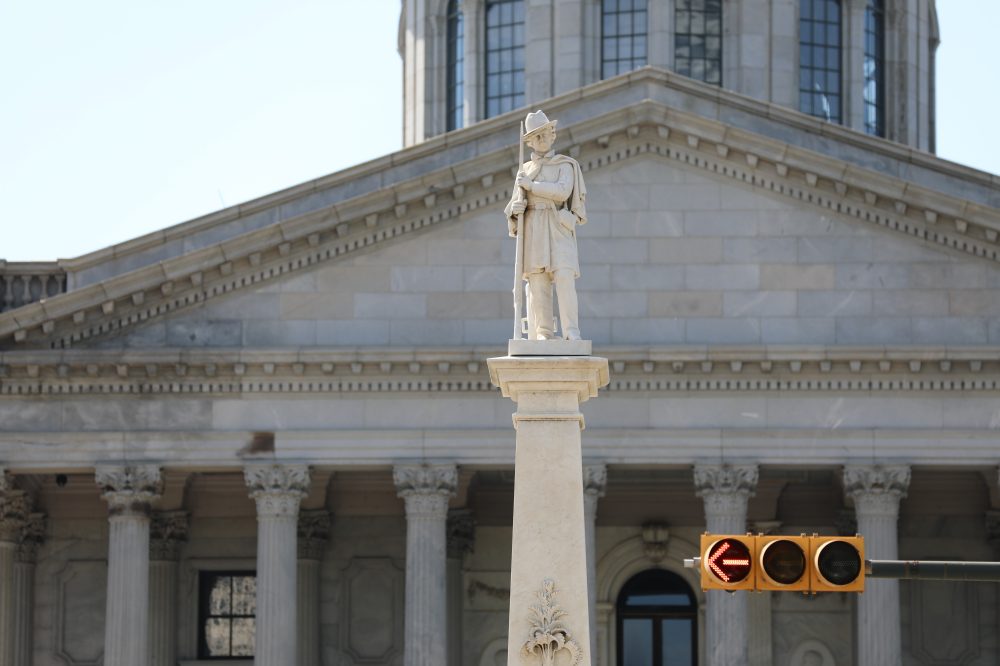

COLUMBIA, S.C. — The South Carolina Senate voted Wednesday to shield virtually every historic statue, monument, street and building name throughout the state from removal or modification.
Senators passed the legislation by a 31-7 margin, with the measure also prohibiting QR code stickers that smartphone users could scan for additional historical context. Advocates for these digital codes argued they could help provide modern perspective on Confederate or segregationist leaders who were commemorated with favorable language in past decades.
Under the legislation, local governments would need General Assembly approval before removing any monument or altering its inscription.
The vote contrasts with trends elsewhere in the South, where state legislatures are reducing special privileges for Confederate organizations. Virginia lawmakers recently eliminated certain benefits for groups that commemorate rebel soldiers and considered removing the last three Confederate statues at Capitol Square in the former Confederate capital.
South Carolina currently provides protection for Confederate memorials, honoring those who fought in the failed four-year effort to break away from the United States, along with monuments to other conflicts spanning from the Revolutionary War through the Persian Gulf War.
However, memorials honoring non-military figures fell through a legal gap, meaning monuments to historical figures like former Vice President John C. Calhoun or segregationist Governor “Pitchfork” Ben Tillman might lack similar protection from universities or municipal authorities.
The new South Carolina legislation extends protection to all historical figures, defining them as any deceased individual who “played a significant role in past developments.”
The vote split along party lines, with all supporting votes coming from Republicans and all opposition from Democrats.
On the Senate floor, Democratic Senator Margie Bright Matthews recited statements from Tillman advocating violence against freed slaves and their descendants, and from Calhoun defending slavery by claiming African Americans could not achieve civilization.
“Do we want to be a state that continues to debate and defend the legacy of treason, racism and exclusion?” Matthews asked. “You ought to be embarrassed about some of the stuff you want to preserve.”
South Carolina’s original monument protection statute became law in 2000 as part of an agreement that took down the Confederate flag from the capitol dome, where it had flown since being raised during the Civil War centennial in 1961.
The legislation, which advances to the House with roughly one month remaining in the session, would permit any officially recognized private historical organization to file lawsuits if they believe a monument faces improper treatment. The measure also mandates that any monument relocated due to construction or road work must be displayed in a location of equal or greater visibility.
Democratic Senator Ed Sutton warned this could create legal chaos for cities like Charleston, potentially facing multiple lawsuits from dissatisfied organizations. Current law limits such legal action to the state attorney general’s office.
“The practical effect is the city is going to take a step back and say we’re out of the history game,” Sutton said regarding Charleston, established in 1670 and central to both the Revolutionary and Civil wars.
Meanwhile in Virginia, newly elected Democratic Governor Abigail Spanberger recently signed legislation eliminating a Sons of Confederate Veterans license plate featuring rebel General Robert E. Lee.
Virginia’s General Assembly also removed official recognition this year from “Carry Me Back to Old Virginny,” a song with lyrics about an enslaved person using a racial slur while fondly remembering bondage. The song served as the official state song from 1940 to 1997, when it became the “state song emeritus.”
South Carolina legislators remain opposed to historical reinterpretation.
In the bill’s text, Republican sponsor Senator Danny Verdin argued that “the nearer a person stands in time to the event, the more likely their description reflects the conditions, perceptions and meanings as they were actually were understood when they occurred.”
This reasoning led Verdin to successfully maintain the QR code prohibition in the legislation. No other state with memorial protection laws bans such digital codes.
“As our knowledge and understanding of history continues to evolve, please consider the value in allowing for an evolution in how the lives of those in the past are told,” Preservation Society of Charleston President and CEO Brian Turner wrote to senators.
Democratic Senator Darrell Jackson noted that since his ancestors gained freedom through the Civil War, he feels no comfort seeing Confederate figures honored with statues, and believes his story deserves representation as well.
“History is usually a matter of who sees it, who tells it, who experiences it,” Jackson said.