
LONDON (AP) — While William Shakespeare enthusiasts are familiar with his origins in Stratford-upon-Avon, where visitors continue to flock to see his birthplace, the legendary writer actually built his reputation in London — yet very little evidence of his presence remains in England’s capital today.
A recently uncovered map from the 1600s is providing fresh insights into Shakespeare’s life in London, revealing the precise location of the sole residence the playwright purchased in the city and potentially where he penned his last theatrical works.
Lucy Munro, a Shakespeare researcher who uncovered the historical document, explained that it adds “extra bits of the jigsaw puzzle” to understanding Shakespeare’s life. Like many significant findings, this one involved an element of chance.
“I came across it in the London Archives when I was looking for other things,” Munro said.
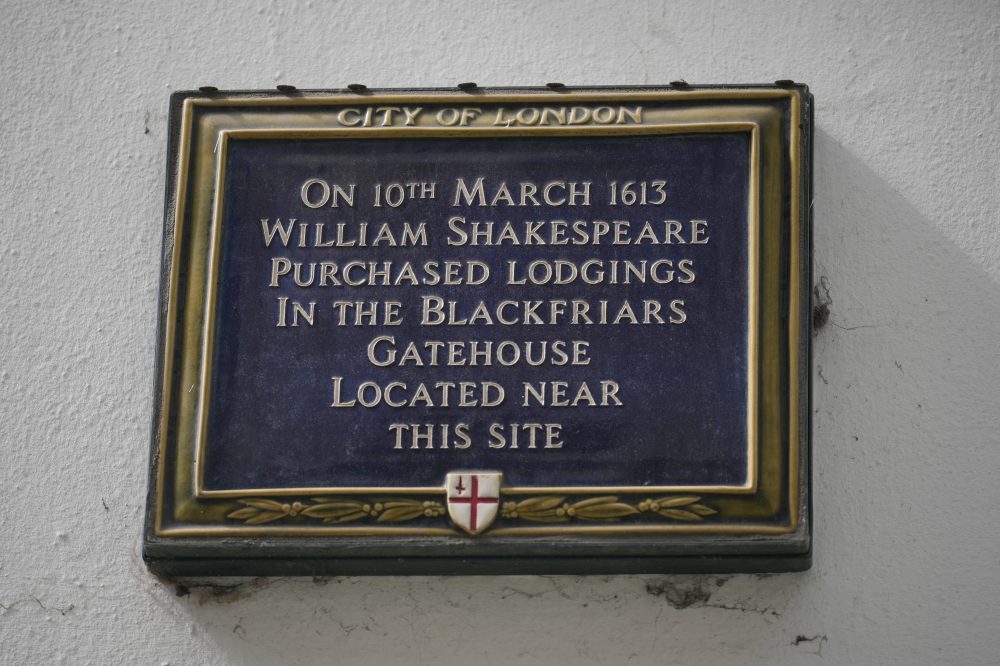
While scholars have been aware since long ago that Shakespeare acquired real estate in 1613 close to the Blackfriars Theatre, the precise whereabouts remained unknown. Currently, only a marker on a building from the 1800s indicates that the dramatist had quarters “near this site.”
The detailed layout of the Blackfriars area that Munro discovered and King’s College London revealed Thursday displays Shakespeare’s residence — a sizeable L-shaped structure converted from a former medieval monastery, complete with its entrance gate.
The Dominican religious community from the 13th century had been transformed for non-religious purposes following King Henry VIII’s monastery closures in the 1500s. This district housed the Blackfriars theater, which Shakespeare partially owned.
According to Munro, who serves as a professor of Shakespeare and early modern literature at King’s College London, the neighborhood was prestigious but experiencing a slight decline in status — partly due to residents like Shakespeare, who had wealth but connections to the somewhat disreputable theater world.
“After the dissolution of the monasteries, a lot of the nobility, quite high-ranking courtiers, court officials are living in the Blackfriars,” Munro said. When Shakespeare acquired his property, “there are still a lot of important people living there, people who make protests against the playhouses at various points, because they see the playhouses as a bit of a public nuisance.”
Shakespeare invested his theatrical earnings to construct an impressive family residence in Stratford, approximately 100 miles northwest of London, which has since been torn down. He passed away there in 1616 at age 52.
Whether Shakespeare actually resided in his London house or simply collected rent from it remains unclear. However, Munro suggests that the dwelling’s size and its proximity — just a five-minute walk to the Blackfriars Theatre — indicate he might have spent more time in London during his later years than commonly believed. She theorizes he could have created his final works there, including “Henry VIII” and “The Two Noble Kinsmen,” both collaborative efforts with John Fletcher.
Will Tosh, who heads education at Shakespeare’s Globe — a recreated version of the outdoor Elizabethan theater where many of Shakespeare’s plays debuted — described Munro’s finding as providing a “dazzling new sense of Shakespeare the London writer. She’s helped us to understand how much the city meant to our greatest ever dramatist, as a professional and personal home.”
Shakespeare bequeathed the property to his daughter Susanna, and it stayed within the family for an additional fifty years. Munro also located two historical records documenting its sale by the playwright’s granddaughter Elizabeth Hall Nash Barnard in 1665. The following year, the structure was consumed by the Great Fire of London, which devastated much of the ancient city.
Few traces of Shakespeare’s London survive in the area, now part of the city’s financial center, including a remaining piece of wall from the medieval monastery. The nearby street name Playhouse Yard serves as a reminder of the theater that once operated there.
Modern visitors can enjoy a drink at the Cockpit pub located across from where Shakespeare’s house once stood. The 1600s map identifies it as a structure called the Sign of the Cock, probably a tavern. It’s easy to envision Shakespeare and his theater associates gathering there for drinks.
“There are certainly complaints in the period about the playhouses leading to the opening of more and more drinking houses — ‘houses for tippling,’ as they call them in one of the documents I was looking at,” Munro said.