
WASHINGTON — Senate Republicans on Wednesday defeated a Democratic-backed measure aimed at ending President Donald Trump’s military operations in Iran, voting down legislation that would have mandated withdrawal of American forces until lawmakers approve continued engagement.
The 47-52 decision marked the fourth instance this year where senators chose to allow presidential war authority to continue in what Democrats characterize as an unauthorized and unjustified military campaign. GOP members expressed continued support for Trump’s military strategy, pointing to Iran’s nuclear threats, potential diplomatic discussions, and serious consequences of troop withdrawal.
However, Republican senators are growing eager to see the conflict conclude, with several considering future legislative actions that could prove challenging for the president should hostilities continue. A similar war powers measure in the House faces an uncertain outcome when it comes up for a vote this week.
The War Powers Act of 1973 mandates congressional declaration of war or force authorization within 60 days of military action beginning — a timeline set to expire at month’s end. The legislation allows for a possible 30-day extension, though lawmakers have emphasized their desire for the administration to present an exit strategy soon.
Following the 60 or 90-day timeframe, “it’s time to fish or cut bait,” stated North Carolina Republican Senator Thom Tillis. “I think that the administration would be wise to put together what would look like a well-founded authorization of military force and a funding strategy.”
Alaska Senator Lisa Murkowski, despite opposing Democratic withdrawal efforts, has been discussing with Republican colleagues a measure to authorize military action beyond the 60-day limit.
She indicated last month that Democratic proposals would harm military personnel by forcing sudden withdrawal. However, she believes Congress should ultimately create a force authorization and vote on it “so the American people know the limits and objectives of this military operation.”
“There is no question that the president should have sought authorization from Congress before striking Iran on this scale, likewise bringing in our allies ahead of time as they now are equally in danger,” she stated in early March.
Utah Senator John Curtis confirmed Wednesday he had reviewed Murkowski’s proposal and offered input, though he declined to share specifics. “I think we are all watching” the conflict and its timeline, Curtis noted, expressing hope for resolution before the deadline.
Missouri Senator Josh Hawley also voiced desire for the war to conclude in coming weeks. Otherwise, he said, “at the end of 60 days, I think we need to vote on a military authorization.”
Maine Republican Senator Susan Collins emphasized that presidential authority “is not unlimited as commander in chief.”
“If this conflict exceeds the 60 days specified in the War Powers Act, or if the President deploys troops on the ground, I believe that Congress should have to authorize those actions,” Collins stated.
Whether Republican leadership would support an authorization vote remains uncertain. Senate Majority Leader John Thune indicated this week that “at this point most of us I think feel pretty good about what the military has achieved” in Iran.
Nevertheless, Thune acknowledged “they do need a plan for how to wind this down, how to get an outcome that actually leads to a safer, more secure Middle East and, by extension, a stronger national security position for the United States.”
Thune identified another critical moment as an eventual White House funding request for the war. Congress continues awaiting this request, which could reach hundreds of billions of dollars.
This represents a “power that Congress has to influence what happens there,” Thune explained.
Oklahoma Republican Senator Jim Lankford called war funding “the big vote.” He added that the central question will be: “Is it going to happen or is it not going to happen?”
Louisiana Senator John Kennedy suggested that at the 60-day deadline, Congress won’t “jump up and say that’s it, it’s one second past 60 days, everybody come home.”
Kennedy claimed some lawmakers seeking votes simply want to embarrass Trump.
“I want to see us achieve our objective in Iran,” Kennedy said. “And then I want to see us get out.”
Democrats have pledged to continue forcing Senate floor votes throughout the conflict’s duration.
“As our troops continue to sacrifice whatever is asked of them, we senators need to do the absolute minimum required of us,” said Illinois Democratic Senator Tammy Duckworth, an Iraq war veteran who lost both legs in combat, before Wednesday’s vote.
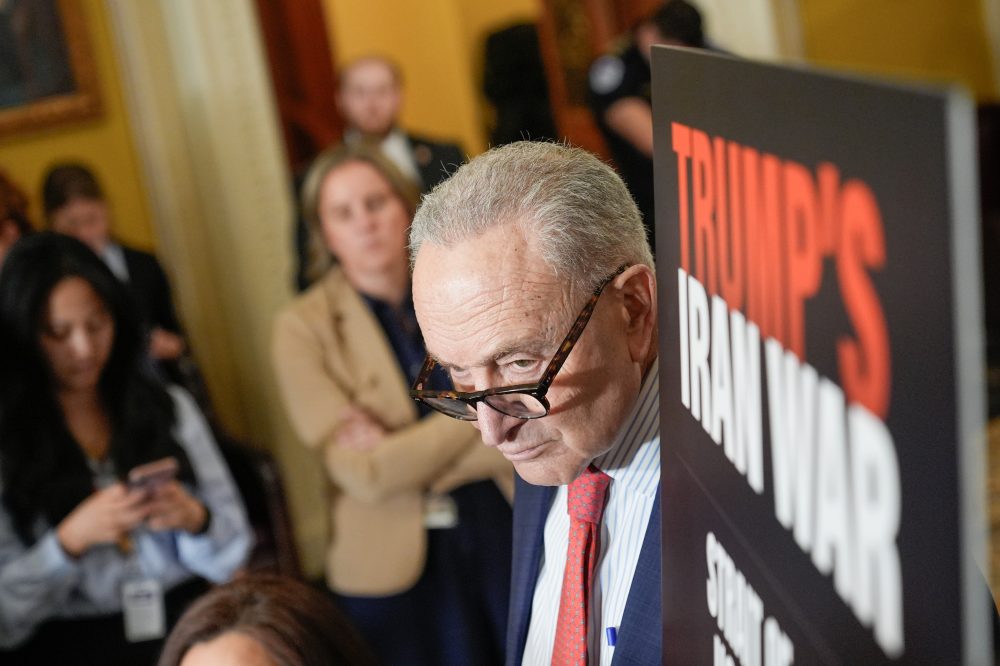
Senate Majority Leader Chuck Schumer argued that with rising gas prices, “the American people literally cannot afford for Republicans to forgo another opportunity to work with Democrats to end Trump’s disastrous war.”