In the United Arab Emirates’ Al Quaa Desert, astronomy enthusiasts are discovering what most of the country has lost to modern development: a crystal-clear view of the stars that once helped desert nomads navigate the vast wilderness.
While the UAE’s towering buildings and brilliant lights showcase the nation’s remarkable transformation into a global center for business and travel, this progress has come at a cost. The celestial views that historically guided Bedouin travelers through the shifting sands of the Empty Quarter have largely disappeared from populated areas.
Volunteers from the Dubai Astronomy Group are now organizing nighttime trips to Al Quaa Desert, among the few remaining dark locations in the Emirates, to help residents reconnect with the night sky and witness the Milky Way.
“It causes us to appreciate our existence in this galaxy,” said Sheeraz Awan, the general manager of the astronomy group, while leading participants during a late May stargazing session.
The Emirates is classified as one of the planet’s most light-polluted nations, joining other Gulf states where most citizens reside in major urban centers.
Research from 2016 determined that “humanity has enveloped our planet in a luminous fog” and found that 99% of UAE residents cannot observe the Milky Way from their residences due to artificial lighting.
This artificial brightness includes everything from highway street lamps to the spectacular LED displays that captivate visitors at Dubai’s Burj Khalifa, the planet’s highest structure. Abu Dhabi is planning to construct a $1.7 billion replica of the Sphere, the Las Vegas venue, on its Yas Island.
In Abu Dhabi, the UAE’s capital, officials have recognized the light pollution issue and established what they term a “Dark Sky Policy” in 2024 addressing illumination and related concerns throughout their emirate. In Dubai, LED displays on buildings are becoming more prevalent and LED billboards are increasingly common. Dubai officials did not respond to requests for comment, though the emirate also contains Al Qudra Lakes, a countryside location with reduced light pollution.
Urban illumination cannot reach Al Quaa Desert.
The desert location is accessible by car, approximately 100 kilometers (62 miles) southeast of Abu Dhabi city via a main highway toward the oasis town of Al Ain, then another route heading south deep into the desert.
Although overhead lighting exists on the section called Razeen Road, including a brightly lit correctional facility along the route, the desert extends just beyond in complete darkness, free from urban illumination. Razeen Road eventually turns east, but an automated gate permits drivers onto a dirt path leading further into the wilderness.
Several kilometers deeper, beyond those camping among the dunes and enjoying some of the final pleasant overnight conditions before UAE summer temperatures reach approximately 45 degrees Celsius (113 degrees Fahrenheit), the astronomy volunteers assembled dozens of visitors for stargazing.
They had company. Multiple workers wrapped in thick blankets were sleeping nearby in a pickup truck bed beneath the stars. Under a single LED light marking the parking area, a Solifugae — commonly called a camel spider — consumed another camel spider following an extended battle. The creature briefly moved toward a reporter and volunteer before vibrations from an approaching vehicle caused it to retreat into the darkness. Everyone present then monitored their footing carefully.
On rugs spread for the May weekend expedition, families conversing in Arabic, English and Russian gazed upward. The half-moon gradually descended beyond the horizon. Shortly after, the Milky Way’s outline became visible to the unaided eye.
“When you look toward the east, can you see that faint cloud,” Awan asked. “That, ladies and gentlemen, is the Milky Way.”
Using a laser pointer to illuminate the star formations, he prompted one woman to cry out: “Ay ye ye!”
The Dubai Astronomy Group volunteers explained this represented one of the optimal periods annually for galaxy observation. Several people gasped upon spotting meteors periodically crossing the sky, clearly visible in the darkness without urban light interference.
Some congregated around telescopes to examine individual stars. Others reclined on the cold desert sand, receiving guidance on using their mobile devices for long-exposure photography to capture the galaxy shining above. Gradually, people slowly returned to their vehicles and began driving back to the UAE’s illuminated highways and cities.
For a brief time, they had connected with the night as Bedouins had done before them.
“When we look at this Milky Way, we’re kind of involved in an activity, which is not new,” Awan told the stargazers. “It’s something that people throughout time have been engaged in.”
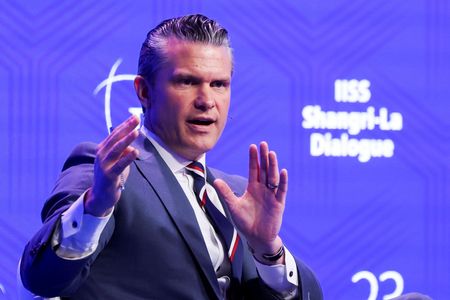
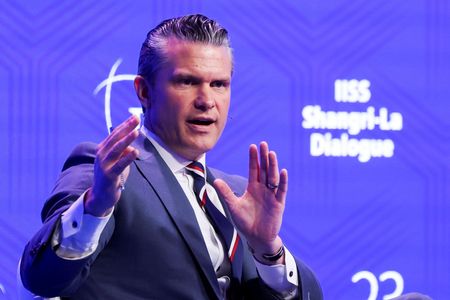
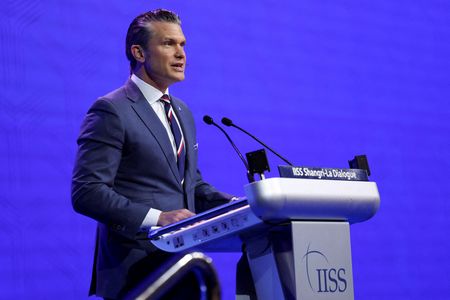
The U.S. Defense Secretary Pete Hegseth called on Asian partners to significantly increase their military expenditures during a major defense conference in Singapore on Saturday, citing concerns about China’s expanding military capabilities across the region.
Speaking at the Shangri-La Dialogue, Asia’s leading gathering for defense officials and military leaders, Hegseth emphasized the need for stronger, more independent allied networks to prevent regional dominance by any single power.
“There is rightful alarm regarding China’s historic military buildup and the expansion of its military activities in the region and beyond,” he said.
The Pentagon leader warned against allowing any nation to control the Pacific, stating: “A Pacific dominated by any hegemon would unravel the regional balance of power. No state, including China, can impose its hegemony and hold the security or prosperity of our nation and our allies in question.”
Hegseth announced that the U.S. expects its Asian partners to raise defense spending to 3.5% of their GDP, while America commits $1.5 trillion to its own military investments.
The defense secretary emphasized that allies seek stability rather than conflict, explaining: “What they want, and what the United States delivers, is strength that is disciplined, resolve that is steady, and leadership that is confident enough to speak and walk softly while carrying a big stick.”
Despite his warnings about China’s military expansion, Hegseth adopted a more measured approach regarding U.S.-China relations, describing them as “better than they have been in many years,” with increased military-to-military communication helping manage tensions.
“We are meeting more frequently with our Chinese counterparts by maintaining open lines of military-to-military communication,” he noted.
Zhou Bo, a senior fellow at Tsinghua University and retired People’s Liberation Army senior colonel who was part of the Chinese delegation, described U.S.-China relations as “complicated.”
However, he said Hegseth struck “a much better tone” this year than last, attributing the shift to Trump’s visit to China.
“Both sides have open channels of communication, the situation is not as exaggerated as the outside world makes it out to be,” Zhou said.
China’s defense minister is absent from the dialogue for the second year running. Last year, China criticized Hegseth for making “vilifying” remarks.
Hegseth reinforced President Donald Trump’s ongoing position that allies must take greater responsibility for their own defense costs, stating that European and NATO partners should depend less on Washington.
“The era of the United States subsidizing the defence of wealthy nations is over,” Hegseth declared. “We need partners, not protectorates. We don’t have a strong alliance unless everyone has skin in the game. No freeloading.”
The defense secretary commended contributions from allies including South Korea, the Philippines, Australia, Singapore, Malaysia and Thailand, noting that Japan was taking concrete steps to strengthen its defenses.
Regarding Japan specifically, he said Tokyo and Washington “must each pull our weight to strengthen the U.S.-Japan alliance.”
Addressing Middle East tensions, Hegseth indicated the United States remains prepared to resume military action against Iran if diplomatic efforts fail, as negotiators from both countries work to resolve significant disagreements preventing an agreement.
“Our ability to recommence if necessary…we are more than capable,” Hegseth stated. He added that Trump remains “patient” and is seeking a “strong deal” to ensure Iran does not obtain a nuclear weapon.
Trump announced on Friday he would gather advisers in a secure White House setting to make a “final determination” on a proposal to end the Iran war.
Hegseth dismissed concerns that the Middle East conflict would divert attention from Asia-Pacific priorities, saying: “We can do two things at one time.”
When questioned about arms sales to Taiwan, Hegseth minimized worries that a multi-billion-dollar package could be impacted as the United States reduces its weapons stockpiles amid the Middle East conflict. “We feel very good about our stockpiles and how we use them,” he said.
Taiwan, which China considers its own territory, has been awaiting U.S. approval for an arms sale that Reuters reported could be worth up to $14 billion.
Trump created uncertainty in Taipei by saying, after meeting China’s President Xi Jinping this month, that he was undecided on whether to approve the package.
Any decision on future arms sales would rest with President Trump, Hegseth said, indicating no change in Washington’s established approach despite recent engagement with Beijing.
“Those decisions will depend on the president and the nature of that relationship,” Hegseth said. “There’s been no change in our status.”
Parliamentary elections commenced Saturday in Malta, with polling data indicating the ruling Labour Party is positioned to secure an unprecedented fourth consecutive term in office.
Prime Minister Robert Abela initiated the early election four years into the current five-year term, referencing future challenges facing the Mediterranean nation due to international uncertainties.
The country’s economic performance ranks among the European Union’s strongest, with 4% growth recorded last year, minimal inflation, and virtually no unemployment. Energy and fuel costs have remained frozen for nearly a decade, resulting in Europe’s most affordable rates.
Nevertheless, officials worry that Middle Eastern conflicts could increase inflation in the EU’s smallest member nation, which depends heavily on imports, and could damage the tourism sector as aviation fuel costs climb.
Multiple polling surveys have repeatedly indicated his Labour Party is positioned to secure a substantial parliamentary majority, similar to victories achieved in 2013, 2017 and 2022.
Although six political organizations appear on the ballot, Labour and the opposition centrist Nationalist Party have been the sole parties to gain parliamentary representation since 1966, with minor parties receiving under 5% of votes.
Abela has focused his campaign on economic achievements, pledging competence and stability.
The Nationalist Party under new leader Alex Borg has argued that the robust economy has failed to improve living standards.
A significant increase in migrant workers during the past decade has also sparked concerns about rising housing costs, overcrowding and strain on infrastructure and healthcare systems.
Election outcomes are anticipated around midday Sunday.
Authorities in New Castle County are actively searching for a missing 19-year-old man after issuing a Gold Alert on Friday evening.
The New Castle County Division of Police activated the alert for Lukas Ernst, who vanished from the unit block of Liborio Lane in Buena Vista Park Townhouses at approximately 8:44 p.m. on Friday, May 29, 2026.
Police report that their search teams have conducted thorough investigations but have not been successful in finding Ernst or making contact with him.
TEL AVIV, Israel (AP) — An Israeli reservist watched as his fellow soldiers celebrated enthusiastically, cheering each other on. They had just attacked a Palestinian vehicle traveling near the Israeli-controlled section of the Gaza Strip, leaving all occupants dead.
The military member said such incidents had become routine following the implementation of a fragile ceasefire in October. During his weeks of deployment in Gaza, he witnessed troops eagerly pursuing those who violated — or nearly violated — the yellow boundary line separating Israeli-controlled zones from Palestinian territories.
“It was a jungle,” the soldier, who is in his twenties, told The Associated Press. “After the ceasefire, the order was: If someone crosses the line, you shoot them.”
While diplomatic attempts to reinforce the agreement have reached an impasse, three military personnel shared with AP their experience of disorder in the war-torn region, citing unclear guidelines for engagement near the yellow boundary. The soldiers reported that some commanding officers publicly supported the ceasefire while privately expressing hopes for continued warfare in Gaza. Occasionally, forces were positioned too distantly or responded too hastily to properly identify their targets, according to one soldier — a worry also raised by a veteran whistleblower organization.
These military accounts offer an uncommon look into events within Israeli-controlled Gaza since the agreement took effect seven months prior. The soldiers — reserve forces deployed across Gaza from October through January who have since returned home — requested anonymity due to concerns about potential social isolation for their statements. They explained their motivation for speaking publicly stemmed from anger and grief over their observations.
AP has recorded instances of Palestinian civilian shootings, including children at play, near the yellow boundary. The soldiers indicated that fatal incidents seemed continuous throughout the unstable agreement.
“To call it a ceasefire is a joke,” one soldier told AP.
Following the ceasefire implementation, Israel repositioned forces to a buffer area marked by a yellow boundary, securing control over slightly more than half the territory. The agreement requires Israeli forces to execute a more complete withdrawal, though no specific timeline exists. The diplomat backed by the U.S. who supervises the truce reports that advancement has stalled due to the primary obstacle of disarming Hamas, which affects all other matters — including Israeli pullbacks and rebuilding efforts.
During this period, Israel has extended its authority over additional Gaza territory. Each side has blamed the other for ceasefire violations.
The boundary’s precise position has remained unclear and sometimes unmarked. In certain areas, yellow blocks and barrels indicate its location; elsewhere, it has occasionally gone completely unmarked.
The Israeli military brought AP this week to observe a portion of the yellow boundary in central Gaza, close to the Maghazi refugee camp. The boundary was clearly visible there, marked by a broad dirt pathway and small yellow indicators. To the east lay an empty expanse of open ground extending to a heavily defended Israeli military position approximately 500 meters distant.
An Israeli military commander stated that Hamas operates on the opposite side of the boundary and regularly dispatches individuals — both fighters and civilians — toward and across the line to evaluate the army’s preparedness and reactions.
“There is no reason for anyone to come near the line,” he said, speaking on condition of anonymity under military rules. “There’s nothing here.”
The army claims the complete boundary, spanning Gaza’s entire length, now has clear markings.
Since the ceasefire began, over 900 individuals have died in Gaza — dozens of them near or beyond the yellow boundary, according to Gaza’s Health Ministry. The ministry does not specify how many were fighters, but unarmed men and children were among the casualties.
Israel’s military has stated that most individuals killed while crossing the boundary presented a danger to troops. However, soldiers who spoke with AP and Breaking the Silence — the whistleblower organization that has gathered troop testimonies during the war — report that soldiers sometimes acted from too great a distance, too rapidly, and under excessive pressure to make accurate determinations.
Israel’s army informed AP that the zone near the yellow boundary represents a “sensitive operational environment” with posted warnings against approaching. It stated the army does not target civilians merely for approaching the boundary and that engagement rules mandate warnings before force is used. In cases involving immediate danger, forces have authorization to respond, it explained.
This marked the combat soldier’s second deployment in Gaza when the ceasefire commenced. He reported being positioned several hundred meters from the yellow boundary and witnessing multiple individuals attempting to cross it being killed by soldiers.
Soldiers conducting shootings or requesting drone attacks do not always identify who is crossing the boundary, he explained. While soldiers must provide location coordinates and obtain superior approval before attacking, delivering precise information becomes difficult as people move, he noted. He described soldiers reporting coordinates based on assumptions or the last observed location of someone.
Breaking the Silence reports that general engagement rules are extremely lenient, particularly regarding boundary crossers, with instructions in many zones being “shoot to kill.” Executive director Nadav Weiman, a veteran who served in Gaza but not during this conflict, identified distance from targets and some overeager soldiers as problematic factors.
He stated that directives and policies from military leadership “have created a reality where countless civilians have and are being killed for crossing invisible lines.”
In one testimony to Breaking the Silence, documented in interview notes reviewed by AP, a soldier describes instructions for troops regarding anyone crossing the yellow boundary: “eliminate him no matter what.”
Another soldier deployed in Gaza for weeks following the ceasefire said commanders emphasized maintaining the boundary at any cost.
“There was a general feeling that human lives are not valuable,” he said.
Regarding yellow boundary marking, the soldier reported his superiors called it “too much work,” not their responsibility, and claimed Palestinians should know its location.
Gaza deployment created emotional strain, he explained.
While snipers sometimes fired warning shots at people approaching the boundary, he said, commanders instructed troops to take greater self-protective measures. The soldier interpreted this as authorization for more lethal shooting.
He and other soldiers who spoke with AP said troops generally believed, based on leadership and peer actions, that Israel planned a permanent Gaza presence rather than eventual withdrawal.
An internal report distributed among aid organizations last month and reviewed by AP indicated that throughout Gaza, Israel has grown “increasingly proactive” with its attacks.
Independent data from the Armed Conflict Location and Event Data Project, a nonprofit based in the U.S., showed April as Gaza’s deadliest month this year and reported that documented deaths near the yellow boundary or of people who crossed it rose over 25% from January to April, increasing from 58 to 73.
This week, Israeli Prime Minister Benjamin Netanyahu announced Israel controls 60% of Gaza and indicated the next objective was advancing to 70% control.
The soldiers informed AP that conditions on the ground make the ceasefire seem nonexistent.
“We need to stop using this term,” one said regarding the word ceasefire. “It’s not serving people that want to stop the war.”
EASTLAKE, Ohio – Salisbury University’s baseball squad watched their remarkable 17-game winning streak come to an end Friday evening, dropping a 5-1 decision to Endicott in their opening contest of the 2026 NCAA Division III College World Series at Classic Auto Group Park.
The third-seeded Sea Gulls were defeated by the sixth-seeded Endicott Gulls on the tournament’s first day, marking the conclusion of their impressive run of victories.
The defeat puts Salisbury in a must-win situation as they prepare to face second-seeded Rowan in an elimination contest Saturday afternoon. The crucial matchup is slated to begin at 5 p.m.
Though neither the Vegas Golden Knights nor Carolina Hurricanes emerged as the NHL’s top teams during regular season play, both franchises have dominated throughout their playoff campaigns.
The two hottest clubs in professional hockey are now set to battle for the Stanley Cup championship.
The Golden Knights completed a sweep of Presidents’ Trophy winner Colorado in the Western Conference Final and have captured 19 victories in 24 contests since John Tortorella assumed coaching duties in late March. Meanwhile, Carolina has secured 12 wins in 13 playoff games, including a four-game winning streak that eliminated Montreal and secured their Cup final berth.
“I probably would give an edge to Vegas, but I don’t feel that secure in that,” former player-turned-NHL Network analyst Mike Rupp said. “Both teams are just playing this demonstrative way right now that it feels like it’s the right matchup here in the finals.”
Carolina enters the championship series as slight betting favorites, likely due to their home-ice advantage and impressive recent performance. Tuesday night’s opening game takes place in Raleigh.
The Hurricanes posted a perfect 8-0 record through their first two playoff rounds, sweeping both Ottawa and Philadelphia. Their lone setback against the Canadiens may have resulted from an 11-day break between rounds, but Carolina has remained undefeated since that wake-up call.
Vegas faced more challenges while defeating Utah and Anaheim before easily handling the injury-riddled Avalanche. The Golden Knights will enjoy a full week of rest between rounds.
“I worry about, just you lose your edge just a little bit, that’s a big disadvantage,” Tortorella said Friday. “That’s the key for us. As a coach, you’re always worried about that. I think our players, the group is good, and I think they understand that because they’ve been in this before, most of them.”
Carolina reaches the championship round for the first time since 2006, when current coach Rod Brind’Amour served as team captain. For Vegas, this represents familiar territory – their third final appearance in less than a decade of existence and second in four years, following their 2023 Stanley Cup victory.
Twelve players from that championship team remain with Vegas.
“That feeling, you want that feeling back,” said defenseman Shea Theodore, who has been with the team since the inaugural season in 2017-18. “It feels different, but I think the feeling in the locker room with the guys and how we are with one another, it feels very similar to that — that group in ’23 — how close we are, and it’s just exciting to be back.”
Expect a defensive battle with limited scoring opportunities. Both the Golden Knights and Hurricanes rank among the stingiest defensive teams remaining in the playoffs.
“Both these teams defend at a high level,” former goalie and now NHL Network analyst Cory Schneider said. “They work at a high level. They don’t give you much room and space and time. I don’t want to say it’s going to be a boring final, but it’s definitely going to be a bit of a grind and whoever comes out on top is going to be the team that can sort of survive that grind.”
Brind’Amour’s demanding coaching approach has finally delivered results in his eighth season leading the team. While Carolina advanced at least one round in each of the previous seven seasons, they consistently fell short of reaching the finals.
The Hurricanes have reached this stage without relying on offensive firepower.
“So far, it’s worked, but this where they run into trouble,” Schneider said. “This is why in years past they haven’t quite broken through to the finals is because they play such a high-intensity style that emphasizes shot quantity over quality, so that doesn’t always lead to goals. They’ll possess the puck and throw a million pucks on net, but they don’t always get great looks and high-end scoring chances and they don’t have a ton of elite finishers.”
KINSHASA, Congo (AP) — At Kinshasa’s bustling Masina Market, sellers of bushmeat don’t always put their products on full display. Shoppers need to specifically request what they want, from large swamp rodents to pieces of antelope meat.
Some merchants do sell openly, including women managing enormous baskets filled with wriggling caterpillars throughout the market.
Throughout Congo and other parts of Central and West Africa, bushmeat represents both a culinary desire and an integral element of local culture. Even a devastating illness like Ebola, which is currently destroying communities in eastern Congo’s remote areas, hasn’t reduced the appetite for wild game from the Congo Basin, a vast forest region often referred to as the planet’s second lung.
The Congo Basin contains diverse wildlife ranging from large primates to snakes — both hunted for consumption. This creates exposure risks for residents to diseases that jump from animals to humans, including Ebola.
While Ebola typically doesn’t transmit through food consumption, African cases have been linked to hunting, slaughtering and preparing meat from diseased animals, according to the U.S. Centers for Disease Control and Prevention.
“Once there is human, animal and environment interface, we have these kinds of outbreaks on a frequent level,” said Dr. Tolbert Geewleh Nyenswah of the Africa Centres for Disease Control and Prevention. “And this is why one health approach in dealing with virus outbreaks is important, because we still interact with the bats, and our hunters are still killing monkeys, and we are close to the environment.”
Congo’s government has verified over 1,000 potential cases with no fewer than 220 fatalities since announcing the Ebola outbreak on May 15. The virus appears to have circulated unnoticed for weeks, with the World Health Organization believing the actual scope exceeds reported numbers.
Ebola, which takes its name from a Congo River tributary, was initially identified in 1976 during concurrent outbreaks in Congo and what is now South Sudan. Outbreaks typically begin when the virus jumps from infected animals like fruit bats into human populations. These animal-to-human transmissions frequently occur during wild meat handling and consumption, according to specialists.
However, because Ebola outbreaks occur infrequently in areas where bushmeat consumption is routine, some residents “don’t believe the linkage” while others remain “totally ignorant” about health risks from eating wild game, explained Dr. Misaki Wayengera, a microbiologist who counsels Uganda’s Ministry of Health on disease outbreaks.
“It is very difficult to change some of these core practices,” he said.
Communities have suffered severely from periodic Ebola outbreaks, with the disease’s gruesome symptoms terrorizing entire settlements and leading many to think they’re cursed.
The Ebola virus has caused 17 outbreaks in Congo plus numerous others across the region. The most devastating outbreak occurred in West Africa from 2014 to 2016, infecting approximately 28,000 individuals and causing over 11,300 deaths.
The Food and Agriculture Organization — which examined Ebola risks from bushmeat consumption and handling following West Africa’s epidemic — found that animal-to-human Ebola transmission is uncommon, but “their consequences are nonetheless disastrous.”
After Ebola infects an initial person, the virus spreads through direct contact with bodily fluids from ill or dead patients, including perspiration, blood, waste or vomit. Healthcare workers lacking adequate protection face particularly high risks.
The present eastern Congo outbreak involves the Bundibugyo virus, an uncommon Ebola strain without approved treatments or vaccines.
This outbreak is happening in a Congo region also experiencing armed conflict from rebel forces and mass population displacement from fleeing violence.
Though Congolese officials have banned hunting threatened wildlife, including great apes pushed toward extinction by poachers, no comprehensive wildlife trade prohibition exists and illegal hunting continues for symbolic animals like bonobos.
Numerous Congo Basin residents rely on bushmeat as their main animal protein source. Annual wild meat harvesting from the Congo Basin reaches an estimated 4.5 million tons, based on Center for International Forestry Research data.
Viande de brousse, the French term for wild meat, enjoys popularity as food, even appearing in upscale restaurants. This has increased pressure on the Congo Basin’s declining resources. Despite continuing biodiversity loss, the Congo Basin remains the world’s largest carbon sink, exceeding the Amazon’s carbon capture and storage capacity.
Public health advocates must intensify educational efforts about Ebola’s origins and transmission in communities facing repeated outbreaks, according to Gladys Kalema-Zikusoka, founder of Uganda’s Conservation Through Public Health organization.
Communities need education that “eating meat from an unknown source, or a dead animal, is a no-no,” Kalema-Zikusoka said. “It’s a very cultural thing.”
Certain fruit bats are thought to naturally carry Ebola-causing viruses, the WHO reports. Yet bats remain delicacies across much of Central and West Africa. Roasted fruit bat soup is highly prized, along with various monkey parts.
At Kinshasa’s Masina Market one recent morning, before the current Ebola outbreak, merchants reported selling antelope, rodent and snake meat obtained from the Congo Basin.
They indicated they had long since ceased selling monkey meat, which could harbor the Ebola virus.
Vendor Guyva Mputu was offering python, its frozen meat beginning to steam in the moisture-heavy air.
Another seller, Charles Ntanga, used a flywhisk against flies landing on a spoiled giant rodent carcass, with each kilogram priced at roughly $17. Ntanga reported serving customers from diverse backgrounds.
“We sell wild meat,” he said. “We make our lives through this business.”
Three high-ranking European intelligence officials have revealed to The Associated Press that Russia’s spy operations are becoming increasingly bold in their attempts to obtain Western technology and military secrets, driven by economic pressure from international sanctions.
According to these officials, Moscow’s operatives are establishing fraudulent businesses, enlisting intermediaries, and using digital espionage specialists and hackers to collect intelligence that might also be weaponized against vital infrastructure.
International sanctions imposed over four years have restricted Moscow’s access to European machinery, technology, and research, while the ongoing conflict in Ukraine has strained critical industries and threatens to push the nation toward economic crisis.
Christoffer Wedelin, deputy head of operations at the Swedish Security Service, explained that Russian agents “really know what they need” and are investing “serious effort” into obtaining sophisticated machine tools, manufacturing equipment, research materials, and dual-use technology.
According to Wedelin, Russia is focusing on Sweden’s defense sector and cutting-edge research involving the nation’s most sophisticated weapons, including the Gripen fighter jet. Moscow is also attempting to acquire camera and laser technologies originally designed for civilian applications that could be incorporated into Russian military systems, he noted.
Juha Martelius, director of Finland’s Security and Intelligence Service, stated that Moscow is also attempting to acquire technology to maintain competitiveness or gain advantages over the West in coming decades.
“We’re talking about space technology, quantum … arctic technology, marine technology,” he explained, noting that space technology is something Russia requires “right now,” though he didn’t provide additional details. Nations utilize such technology for satellite imagery, communications, and navigation systems.
Martelius also mentioned that Russia requires sanctioned computer technology and software updates for machine tools.
On Wednesday, Anne Keast-Butler, director of the U.K’s signals intelligence agency, charged Russia with “relentlessly targeting” the U.K. and its European partners through technology theft and planning sabotage and assassination operations.
Swedish authorities arrested two individuals in May on charges of sanctions violations connected to a Turkish company that has shipped dozens of metalworking and metal-turning machine tools to Russia.
Wedelin warned that as these technology acquisition schemes become more sophisticated, businesses must recognize they could inadvertently become part of Russia’s military supply network.
“All of the security and intelligence services in Russia are helping out on the state’s efforts to get this,” he stated.
Moscow is also launching cyberattacks against European companies and critical infrastructure to collect intelligence, which it could use “when they get the chance and when it serves their purpose,” Wedelin explained. He referenced an attack on a Swedish power facility last year.
Russian-affiliated groups attempted to “destroy” the facility but were unsuccessful because security systems identified the breach, Wedelin said. He noted the attack was partially designed to weaken Western support for Ukraine.
Previously, Sweden’s security agencies had primarily observed reconnaissance for possible attacks, intelligence collection, or activities connected to cybercriminals. The attack represented a “switch” in Russia’s approach, Wedelin said.
“They’re no longer caring as much about potential attribution after their activities, so they are taking greater risks to achieve their goals,” he explained.
Russia’s escalating aggressive methods may indicate growing internal worries about its economy, which “is not doing well at all,” according to Kaupo Rosin, head of Estonia’s Foreign Intelligence Service.
Martelius reported that approximately one-third of Russia’s gross domestic product is currently allocated to the war effort. The conflict and resulting sanctions have reduced growth and sustained high inflation.
Russian leadership projected a budget shortfall of 3.7 trillion rubles ($52.1 billion) for all of 2026 and had already accumulated about 3.4 trillion rubles ($47.9 billion) by February’s end, Rosin reported.
The Iran war that began on Feb. 28 has provided relief by driving oil prices higher. The U.S. has issued sanctions exemptions for Russian oil sales and the U.K. reduced its sanctions to attempt lowering global fuel costs.
Higher revenues since then have probably enhanced Russia’s budget, but “it doesn’t save them,” Rosin said, adding that continued Western pressure could lead Moscow to face a financial crisis by year’s end.
Rosin said intelligence reviewed by his agency indicates a more pessimistic outlook among Russian officials over the past six months, with the narrative of “total victory” in Ukraine having disappeared. Keast-Butler, of British intelligence, reported nearly 500,000 Russian soldiers have died in Ukraine since the comprehensive invasion in 2022.
Russia and Ukraine have generally kept their battlefield casualty numbers confidential.
Stagnant battlefield progress and economic difficulties have many Russian officials privately questioning “what is this all for,” Rosin said, referencing intelligence reports.
Martelius, from Finland’s intelligence service, said that although some reports about the Ukraine war may have been “sanitized” before reaching President Vladimir Putin’s office, he believes the Russian leader understands the economic difficulties fairly well.
However, that doesn’t indicate political change will occur.
It is “very dangerous … to start analyzing Russia as if it is some country like ours,” Martelius said. “It is not.”
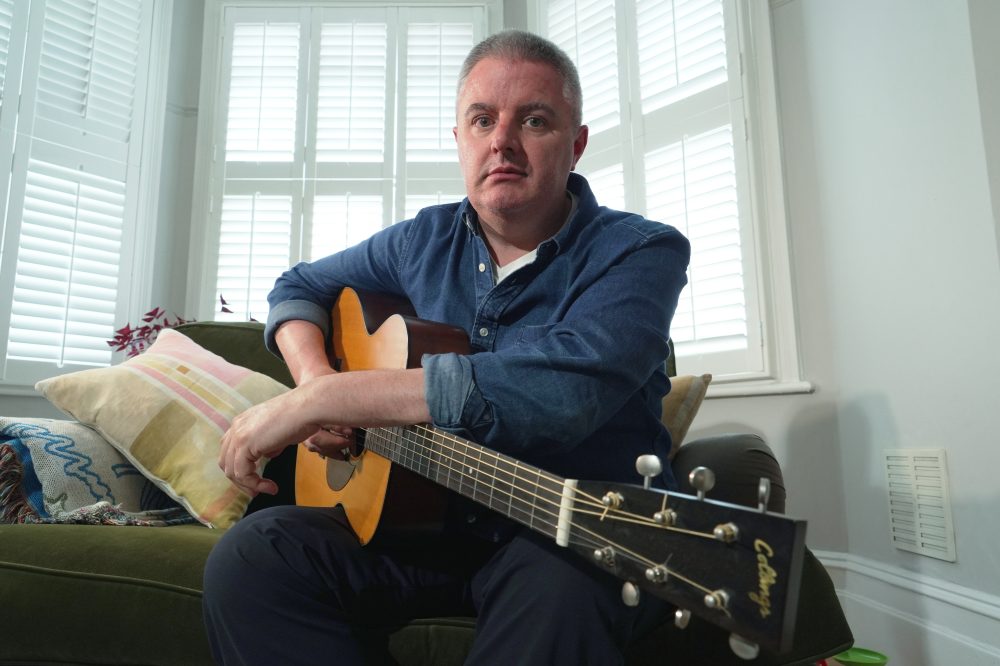
A musician from London has found an innovative way to continue creating music after Parkinson’s disease affected his ability to play guitar, turning to artificial intelligence technology to complete his latest recording project.
Samuel Smith, a singer-songwriter who has spent years crafting Americana music with guitar as his primary instrument, received his Parkinson’s diagnosis in 2020. The 49-year-old artist recently completed his second album, “The Art of Letting Go,” using AI music generation platforms to help translate his creative ideas when his physical abilities became limited.
For an instrumental track called “Horizon” on the eight-song collection, Smith utilized AI-powered music generators after humming melodies into his phone. He then uploaded these recordings to platforms including Suno and Udio to create demonstration arrangements that communicated his artistic vision to the session musicians who would record the final version.
Smith emphasized that these AI-generated demos were not incorporated into the finished studio recording. However, as Parkinson’s symptoms including tremors, stiffness, and fatigue progressed during the album’s year-long creation process, his guitar abilities declined significantly.
“So then I’m faced with a question,” Smith said. “‘Don’t play, don’t be creative, or find a way out, find a route.’ And for me, this was the route.”
The use of generative AI technology has created controversy within the music industry, with artists and record companies expressing concerns about copyrighted material being used to train AI models. Major labels Sony Music Entertainment, Universal Music Group, and Warner Records filed lawsuits against Suno and Udio in June 2024, though Universal and Warner later reached settlement and partnership agreements with the respective companies.
However, Smith’s situation highlights a different application of these tools – assisting musicians whose medical conditions impact their traditional creative processes. His debut album “In the Springtime” was released in 2023, which he described as wanting to preserve memories of his musical abilities for his two sons.
“I’d always written, I’d also played, I always sung,” Smith explained. “And immediately it became clear to me that I was in trouble, that my music was going to be seriously compromised.”
The AI music generation systems operate by analyzing large collections of recorded music and audio, studying patterns in melody, harmony, and rhythm to create new audio based on user prompts or uploaded recordings. These platforms allow users without traditional musical training to produce complete songs.
Smith described the process of creating usable demos as requiring “50, 100, 150 attempts” along with extensive editing “to get something that sounds close to my music.” After recording himself humming melodies and uploading the audio, he provides detailed prompts describing the desired instrumentation, mood, and musical style.
“AI is not replacing anything for me,” Smith stated. “It’s unlocking, it’s enabling. It’s allowing me to keep writing. I upload my lyrics; AI doesn’t create my lyrics. I upload my music; AI does not create my music.”
He continued: “It then brings it to life in a way that I can play to session players and say, ‘Here, that’s what I’m thinking, that is what I’m hearing.’”
Grammy-winning pianist and producer Matt Rollings produced the album, assembling a group of accomplished roots and bluegrass musicians for the recording sessions. The lineup included dobro player and 16-time Grammy winner Jerry Douglas, Grammy-winning banjo player Alison Brown, fiddler Stuart Duncan, guitarist Bryan Sutton, bassist Viktor Krauss, and vocalists Jonatha Brooke and Glen Phillips.
Smith described performing in a Nashville studio alongside musicians he had long admired as “an extraordinary moment.”
Grammy-nominated guitarist Julian Lage, recognized for his jazz and acoustic work with Blue Note Records, contributed to both the album’s title track and “Horizon.” The “Horizon” recording became particularly meaningful for Smith, as he managed to perform a guitar duet with his friend despite his condition’s progression.
“I hadn’t been able to play for months, but I kept telling myself that if I wrote something to take to the studio, perhaps the clouds would part for a few minutes,” Smith recalled. “That’s what happened. I had a window of about 10 minutes in the studio when my arm freed up. … So in the end, I was able to capture the last breath of my guitar playing.”
Music experts suggest that AI-assisted tools could provide benefits for other individuals dealing with disabilities or illnesses that affect their musical abilities.
Ruaidhri Mannion, a composer, music producer, and sonic artist who teaches at Brunel University of London, noted that affordable digital recording technology “effectively democratized the making of music” in recent years. He believes AI tools that create polished-sounding material from voice or text inputs could serve a similar function by helping songwriters and musicians communicate concepts and collaborate more effectively.
“If these tools are able to enable people to be able to participate with other creative groups and encourage more people to feel confident to be able to reach out to an ensemble or an orchestra or something, then I think that is all for the better,” Mannion explained.
However, Mannion cautioned that excessive dependence on technology might interfere with the trial and error, frustration, and creative synergy that are essential components of a musician’s artistic growth.
“What makes a lot of music-making meaningful is the collaborative element,” he noted. “There’s a lot of experimentation and development and failure that’s part of musical discovery.”
Both Udio and Suno have rejected copyright infringement claims and expressed interest in working cooperatively with the music industry. Some musicians remain skeptical of these platforms. A coalition of recording artists and activists, including singer-songwriter Tift Merritt, David Lowery from bands Cracker and Camper Van Beethoven, and ECR Music Group President Blake Morgan, released an open letter in February titled “So no to Suno.”
“Many in our community are embracing responsible AI as a tool for creation, and as a means for fans to explore and interact with our artistry. That’s wonderful,” the letter stated. “But it’s not the same as creating an environment where AI-generated works sourced from our music are mass distributed to dilute our royalties or, worse yet, reward those actively seeking to commit fraud. Artists need to know the difference.”
Smith believes his experience demonstrates how AI technology could benefit society and expand creative opportunities when developed responsibly.
“My message would be that if these companies want to show they’ve got a place, a role in society, then step up,” Smith said. “Engage with health professionals, engage with music therapists, engage with society and show us what you can do.”
On May 21, Smith partnered with the Berklee Music and Health Institute for a New York event that brought together music industry executives, researchers, and medical professionals to explore how music can support individuals living with neurological conditions. Smith shared his experience with Parkinson’s disease and performed again with musicians from “The Art of Letting Go.”
Continuing to create music remains essential to the legacy Smith wants to establish for his children, who are 4 and 17 years old.
“My 4-year-old is probably never going to remember me playing, and it’s heartbreaking,” he said. “But I’ve been able to pull this into something and refuse to be defined by this disease.”
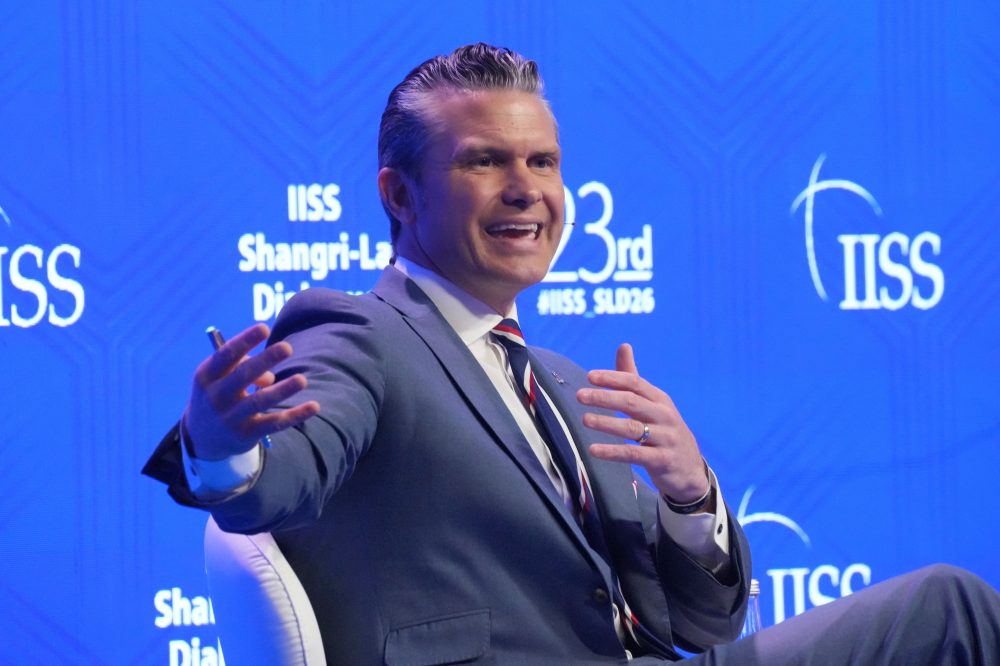
SINGAPORE — Defense Secretary Pete Hegseth delivered reassurances to Pacific region partners during a Saturday address, confirming America’s ongoing dedication to the area while adopting a more moderate stance regarding China compared to his previous statements.
During his presentation to international leaders, diplomatic representatives and senior security personnel at Singapore’s Shangri-La defense summit, Hegseth emphasized that the Pacific region “has profound implications for U.S. security and prosperity.” He stated Washington’s objective was to “achieve a lasting and favorable balance of power in the Pacific.”
This marked Hegseth’s second appearance at the annual gathering. During his previous participation, he drew criticism from Beijing after delivering stark warnings about China’s escalating threats, especially regarding Taiwan. He had declared that China was no longer merely expanding its armed forces to capture Taiwan, but was “actively training for it, every day.”
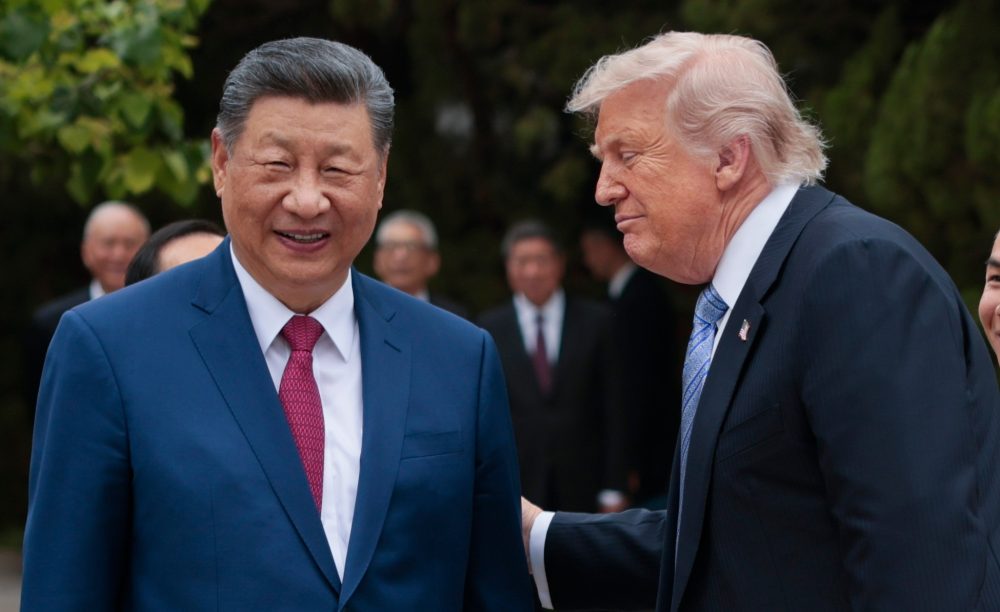
However, this year’s conference occurred approximately two weeks following President Donald Trump’s visit to meet Chinese leader Xi Jinping in Beijing. After that diplomatic encounter, Trump praised Xi as a “great leader” and expressed optimism about having a “fantastic future together.”
Hegseth, who accompanied Trump during the Beijing visit, revealed that both leaders had reached an understanding that China and the United States should “build a constructive relationship of strategic stability, based on fairness and reciprocity, reaffirming that while our nations will vigorously protect our respective interests, we can secure practical, mutually beneficial agreements where our interests align.”
Nevertheless, he maintained that preventing Chinese dominance over the Indo-Pacific remained a key American objective.
“There is rightful alarm regarding China’s historic military buildup and the expansion of its military activities in the region and beyond,” he stated.
“We share a clear-eyed assessment of that security environment and a mutual understanding that a Pacific dominated by any hegemon would unravel the regional balance of power and undermine the equilibrium we all seek to preserve,” he added.
Following the Xi-Trump discussions, the American president questioned Washington’s commitment to Taiwan’s defense, describing a pending $14 billion weapons package as “a very good negotiating chip for us” with China.
China maintains territorial claims over the democratically governed island, with Xi refusing to eliminate military action as an option for reunification. American law mandates providing Taiwan with defensive capabilities, though the U.S. maintains “strategic ambiguity” regarding potential military intervention if China attacks the island.
Hegseth informed attendees that there was “no change in our status” concerning Taiwan, but declined to discuss the weapons agreement.
“Any decision about future Taiwan arms sales, as the president said, will rest with him,” he explained.
He emphasized the Trump administration’s demand that allies boost defense expenditures, declaring “we need partners, not protectorates.”
He praised multiple Asian nations for their contributions while criticizing unnamed European allies who he claimed became “distracted by empty globalist rhetoric about the rules-based international order.”
“Our partners in Asia have long understood that the bedrock of a durable partnership is not based on idealistic values but on the concrete alignment of national interests,” he stated.
“When our interests diverge, we adjust pragmatically, without the drama or the moralizing,” he continued. “I think Western Europe might take note — this is a mindset we fully embrace.”
Hegseth omitted references to the Ukraine conflict or Iran during his presentation. When questioned about Iran, he simply noted that Trump had assured him that upon completion of Tehran negotiations, “any deal will be a good deal.”
SACRAMENTO, Calif. — California’s tumultuous gubernatorial contest neared its conclusion Saturday as top contenders worked frantically to make their final appeals ahead of Tuesday’s voting deadline.
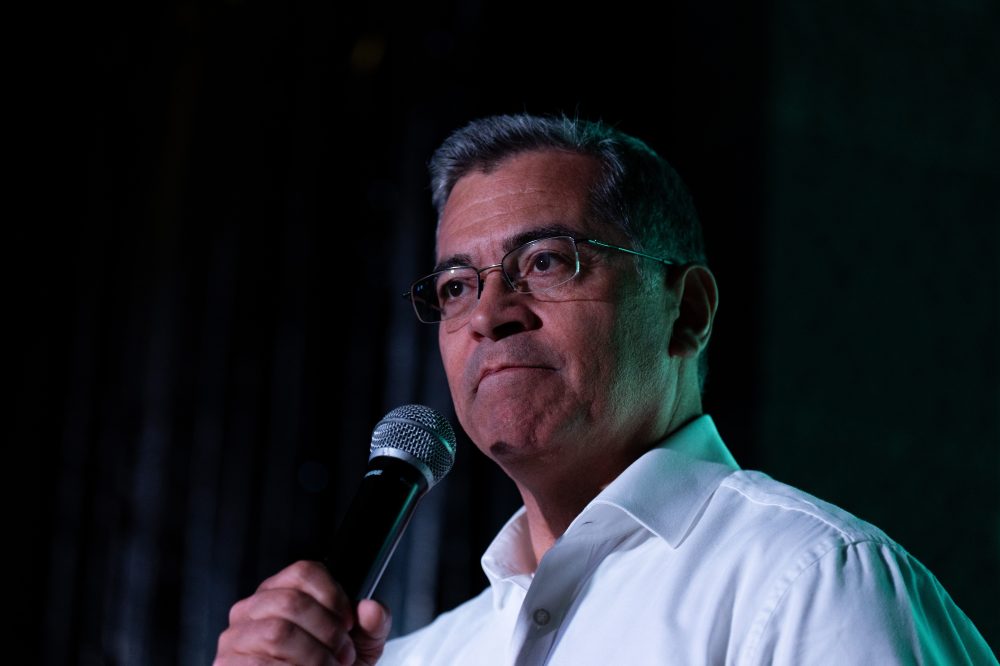
Xavier Becerra, who previously served as U.S. health secretary, has championed what he calls “hot competence summer,” highlighting his extensive decades in public service as proof he possesses the necessary skills to lead California.
During comments made outside the state Capitol on Wednesday, Republican Steve Hilton promised to eliminate what he described as a “bloated, nanny-state bureaucracy.”
Tom Steyer, a billionaire environmental advocate, informed reporters this week in Berkeley that advancing progressive policies has become his life’s mission, which he plans to continue in Sacramento.
These candidates are working to distinguish themselves among approximately 60 contenders appearing on one ballot, with no party distinctions, under California’s top-two primary format. The pair receiving the highest vote totals will compete in the general election to succeed Democratic Gov. Gavin Newsom, who cannot pursue a third term.
The packed field features Democrats Becerra, Steyer, former U.S. Rep. Katie Porter, and Matt Mahan, the mayor of San Jose. Hilton, a former Fox News host with President Donald Trump’s backing, and Riverside County Sheriff Chad Bianco represent the most notable Republican contenders.
By Friday afternoon, 13% of voters had submitted their ballots. This included 13% of Democrats and 18% of Republicans, based on tracking data from Democratic strategist Paul Mitchell. The pattern differs from recent years when Democrats typically voted early while many Republicans waited until Election Day.
Several Democrats have delayed voting to see if any candidate emerges as a clear frontrunner in the closing days, or due to dissatisfaction with the extensive candidate list.
Polling conducted in mid-to-late May indicated that Becerra and Hilton each garnered support from approximately 2 in 10 California likely voters. One survey showed Steyer performing closer to Becerra and Hilton, with Bianco and Porter further back, while another poll showed similar support levels for Steyer, Bianco, and Porter. No other candidates reached double-digit support in either survey.
The hopefuls have crisscrossed the state, which contains roughly 23 million registered voters, seeking advantages over their competitors. Becerra, Hilton, Steyer and Bianco will all campaign in the San Francisco Bay Area this weekend. Fresno and Los Angeles have also drawn frequent campaign visits.
Becerra has emphasized his more than 35 years serving in state and federal positions.
“This is not a place for on-the-job training,” he stated during a podcast with political commentator Ana Navarro. “You better know what you’re doing.”
His weekend schedule includes a text-banking event with Democratic Attorney General Rob Bonta in San Francisco and a rally with the Service Employees International Union in San Jose.
Hilton has positioned himself as someone offering fresh perspectives on state government, promising to reduce regulations while lowering housing and energy expenses. He believes this message will unite voters, he explained to reporters this week in Sacramento.
“It’s not ideological,” Hilton stated. “It’s just simple, practical commonsense — $3 gas, cut your electric bills in half.”
Hilton plans to conduct a town hall in Silicon Valley Saturday night. He has avoided emphasizing Trump’s endorsement. Should he reach the November election, he’ll need support from voters beyond his party to succeed in the Democrat-heavy state that last elected a Republican governor in 2011.
Steyer, who calls himself a “billionaire who wants to tax other billionaires,” characterized the race as a three-way competition between himself, Hilton and Becerra.
“There is a hard-right Republican who’s endorsed by Donald Trump,” he addressed supporters at a Berkeley sports bar.
“The second candidate is Xavier Becerra, who, to my surprise, is a corporate Democrat,” Steyer added, citing his acceptance of campaign money from Chevron.
“And the third person’s me,” he continued. “And I am running because Californians can’t afford to live here anymore.”
Steyer plans to attend a campaign rally Saturday in San Francisco to sharpen his voter outreach.
Meanwhile, Mahan will meet with voters in Los Angeles, Porter will deliver remarks in Orange County, and Bianco will present his platform at a San Jose church.
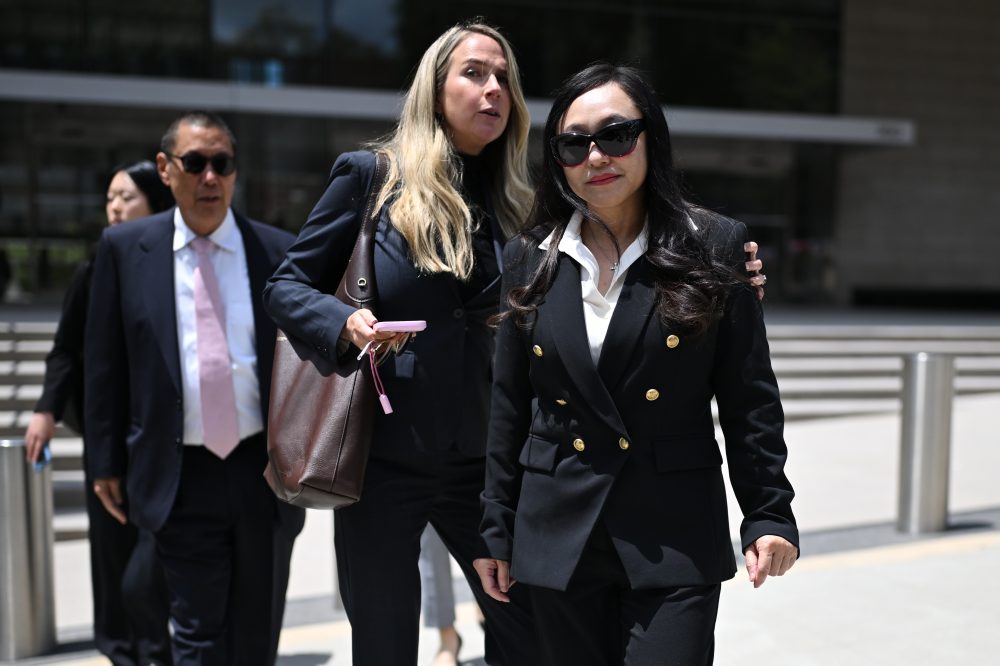
A former mayor in Southern California has admitted to federal charges of acting as an illegal agent for China’s government, sparking worries about foreign interference and potential discrimination against Asian American residents.
Eileen Wang, who previously served as mayor of Arcadia, entered her guilty plea in federal court Friday. Her case has become a source of controversy in the community, where some fear it could lead to unfair targeting of Chinese and Asian American populations.
The city of Arcadia made history in 2024 when voters chose the first entirely Asian city council in its past. The San Gabriel Valley community has experienced dramatic population shifts over the past twenty years as people from China, Taiwan and Hong Kong have moved to the area east of Los Angeles.
Following the public disclosure of Wang’s case on May 11, the story gained widespread media attention and created tension within the quiet suburban community. Social media discussions centered on concerns about espionage and influence from the Chinese Communist Party.
“We cannot allow this moment to become an excuse for people to paint entire communities with one brush or weaponize ethnicity for political gain,” acting Mayor Paul Cheng said in a statement.
Court documents show Wang admitted to working on behalf of Chinese officials by publishing pro-Beijing content on a news website she operated, without properly registering with U.S. authorities as the law requires.
The 56-year-old politician won election to the five-member City Council in November 2022, with the mayoral position rotating among members. Wang was born in Chengdu, China, and came to America in 1995.
The San Gabriel Valley hosts the nation’s largest population of Chinese and Taiwanese residents. Starting in the 1970s, property developers promoted the area as “Chinese Beverly Hills” to attract wealthy immigrants. The growing community became a destination where newcomers could conduct daily life in Chinese, find business opportunities, and provide their children alternatives to China’s highly competitive school system. Arcadia’s roughly 53,000 residents are predominantly Asian, similar to neighboring communities.
Ted Tseng, 52, moved to Arcadia from Taiwan nearly four decades ago with his family, who left due to worries about possible conflict between Taiwan and China.
Tseng expressed concern that Wang’s charges could increase hostility toward Asian Americans and undermine their positive contributions to the area. Anxiety about anti-Asian prejudice persists, even though hate crimes have decreased since the COVID-19 pandemic.
“I’m just worried our image has been damaged,” Tseng said.
Federal authorities have intensified their efforts recently to counter Chinese espionage activities. In April, a defendant accused of operating a covert Chinese intelligence post in Manhattan’s Chinatown was found guilty of illegal foreign agent activities.
Wang has indicated she was deceived by her former fiance, Yaoning “Mike” Sun, who admitted to identical charges last year and is currently serving four years in prison. Sun handled finances for Wang’s 2022 campaign.
A statement from Wang’s legal team mentions her “trust and love for apparently the wrong person who ultimately led her astray.”
April Verlato, a previous City Council member who worked alongside Wang, noted that Wang and Sun shared a residence, and Sun regularly accompanied Wang to events.
Verlato believes Wang should have resigned immediately when the investigation began.
“She was being selfish, getting sworn in as mayor and not resigning when she knew she was going to be pleading guilty to something,” Verlato said.
Gene Sun, a longtime attorney in Arcadia, shared similar views.
“I don’t understand how she could have continued being a City Council member,” he said.
Given rising political tensions and economic competition between China and the United States in recent years, Chinese government attempts to exert political influence in the region are not unexpected, according to Wei Li, a professor of Asian Pacific American Studies at Arizona State University.
“A lot of countries, if they have the will and if they have the means, will try to influence their diaspora,” Li said.
Federal court records indicate Sun communicated with John Chen, who also pleaded guilty to serving as an unregistered Chinese agent, about local politicians Beijing might influence. In their reports to Chinese authorities, Sun and Chen described Wang as a “New Political Star” and highlighted her connections with mainstream U.S. politicians.
Their communications also discussed opposing “anti-China forces” including Taiwan independence advocates and the Falun Gong, an exiled anti-communist spiritual movement.
In a January 2023 message from Chen to Wang mentioned in Sun’s criminal complaint, Chen said: “You are doing a good job, I hope you can continue the good work, make Chinese people proud.”
Acting mayor Cheng described the news of her guilty plea as a “slap in the face,” and said community reactions have also been hurtful.
During a May 19 City Council meeting, some residents criticized remaining council members for allowing Wang’s actions and demanded their resignations.
“I’ve been called more names, been told to go back to China although that’s not where I’m from,” said Cheng, who arrived in the U.S. from Taiwan at age 2.
For many Arcadia residents and employees, daily routines continued normally after the news emerged. Many offered apologetic smiles when questioned about the situation, explaining they don’t follow politics closely.
Aliza Mo, who moved from China six years ago for her children’s schooling, initially thought the news reports must be overstated.
“A lot of people wondered if it was discrimination,” she said.
After learning the details of Wang’s admission, she reconsidered her position.
“I think it would be improper for anyone to be doing something like that,” she said.
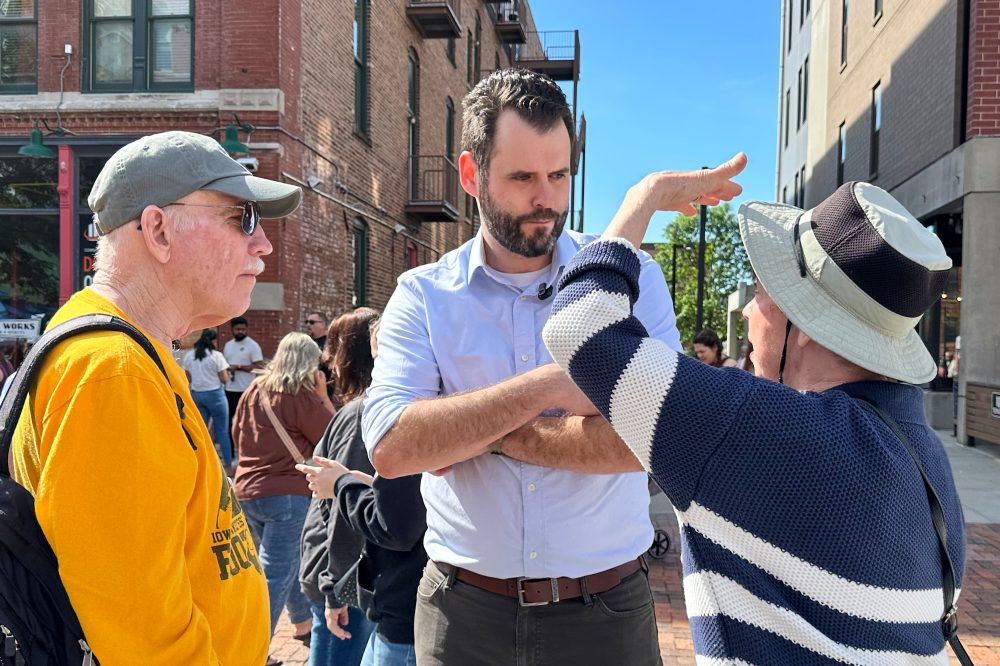
AMES, Iowa (AP) — Democratic voters in Iowa are struggling to choose between two candidates in Tuesday’s U.S. Senate primary, with many focused on selecting whoever has the strongest chance of defeating the Republican incumbent this fall.
The challenge is that many voters can’t determine which of the two state legislators running would be the stronger general election candidate.
“I am having a lot of trouble,” said Mike Lazere, a 65-year-old Democrat who always votes on Election Day.
State Rep. Josh Turek and state Sen. Zach Wahls are competing for the Democratic nomination to challenge the seat currently occupied by retiring Sen. Joni Ernst in a state where the GOP holds advantages but Democrats believe they might have an opportunity.
The primary decision carries significant weight for Iowa’s Democratic voters, who lack recent examples of winning statewide candidates to inform their choice. The most recent Democrat to capture federal office statewide was President Barack Obama in 2012. Republicans hold all six federal delegation seats, and the GOP has controlled the statehouse for nearly ten years. The state’s last Democratic U.S. senator, Tom Harkin, won election in 2008 and stepped down six years later.
U.S. Rep. Ashley Hinson is seeking the GOP nomination, and a Republican-aligned political group has already committed $29 million to protect the seat.
While Turek and Wahls claim their differences are obvious, voters who remain undecided see things differently.
“They both have strong legislative records. They both have compelling stories. I think they both share my values,” Lazere said Thursday outside of the Ames public library, where Story County Democrats had just held their monthly meeting.
“Since they’re so close, I just want the candidate who is more likely to have a chance,” he said. “It’s an uphill battle, probably, in Iowa still.”
At the Des Moines Farmers’ Market last weekend, where both candidates moved through the crowds, Sundie Ruppert voiced her support for Turek as he walked past her tent, declaring he had her vote.
Ruppert described the race as an “embarrassment of riches,” something that’s been uncommon recently. She said the two candidates support “virtually everything the same,” so for her, the question is who can attract crossover support to win in November.
Turek, a four-time wheelchair basketball Paralympian born with spina bifida, believes his story of overcoming challenges and his political positions will attract independent and moderate Republican voters. He represents a state House district that supported President Donald Trump.
Turek said he’s concentrated on securing a livable wage, health care access and drinkable water, not the culture-war issues that he said Republicans use to distract voters from the core problems they are facing.
“I’m not gonna get dragged down the rabbit hole of worrying about these distraction issues,” Turek said in an interview.
“I think that if we are going to win again in a state like Iowa, it is going be a message of economic populism,” he said. “It is going to be that we as a Democratic Party stand for the workers and for the middle class. That’s the way forward.”
Ruppert said she believes general election voters are more likely to support Turek, even if they “have to hold their nose.”
“We’ve got to get the independents,” she said. “I do believe that Josh in a red district has better pull than Wahls.”
About 37 miles (60 kilometers) north in Ames on Thursday, Shellie Orngard said she’s heard that reasoning and remains unconvinced.
Orngard said both are good people and strong candidates, but Wahls strikes her as “somebody with real character behind his convictions.”
“I think that whether you’re Democrat or Republican or independent, you appreciate authenticity and real values,” Orngard said. “I think Zach Wahls just seems to have the character that I feel he’s the person that I want to put my vote behind.”
Wahls says he’s the candidate willing to defy leadership in both parties, and he has criticized Turek for not rejecting Democratic Sen. Chuck Schumer as caucus leader.
He says his anti-establishment message is winning back the working-class voters, especially common across eastern Iowa, who supported Obama before they pivoted to Trump.
“We’re not just talking about building a coalition that can win in November, we are already doing it,” he said. “These are voters who are not hardcore MAGA Trump Republicans. A lot of them are just really frustrated with both parties, they don’t trust Washington, they don’t trust the establishment.”
“And what we hear from people all the time is, ‘Even if we don’t agree on every issue, if you are willing to take them on, you’ve got my vote,’” Wahls said.
Iowa has changed dramatically since Obama’s victory in 2012, supporting Trump in the last three presidential elections. Democrats trail Republicans by roughly 200,000 registered voters statewide.
Rob Sand, state auditor and candidate for governor, was the only Democrat to win statewide in 2022.
Nearly 30,000 Democrats have already cast their ballots as of Friday, according to data from the secretary of state’s office. Still, in Ellston on Wednesday, many of the two dozen southwest Iowa Democrats waiting to hear from Turek said they’d rely on a gut feeling.
“As far as I’m concerned, Ashley Hinson has got to be beat,” said Lynne Wallace, a 67-year-old from Mount Ayr. The committed Democrat said she’d support either candidate in the general election, already eager to make calls and knock on doors, but added that she’s got “shaky faith” that either Democrat can pull it off.
Lois Rose, 77, and her 79-year-old husband, John, said at the Des Moines farmers’ market that they might not vote in the primary at all since they, so far, hadn’t been able to make up their minds on whether one candidate is stronger than the other.
She suggested the pair could also coordinate their votes, each casting a ballot for one of the two. John liked the idea.
“They’re both so qualified,” said Lois Rose of West Des Moines. “They’re both very genuine, hence the difficulty.”
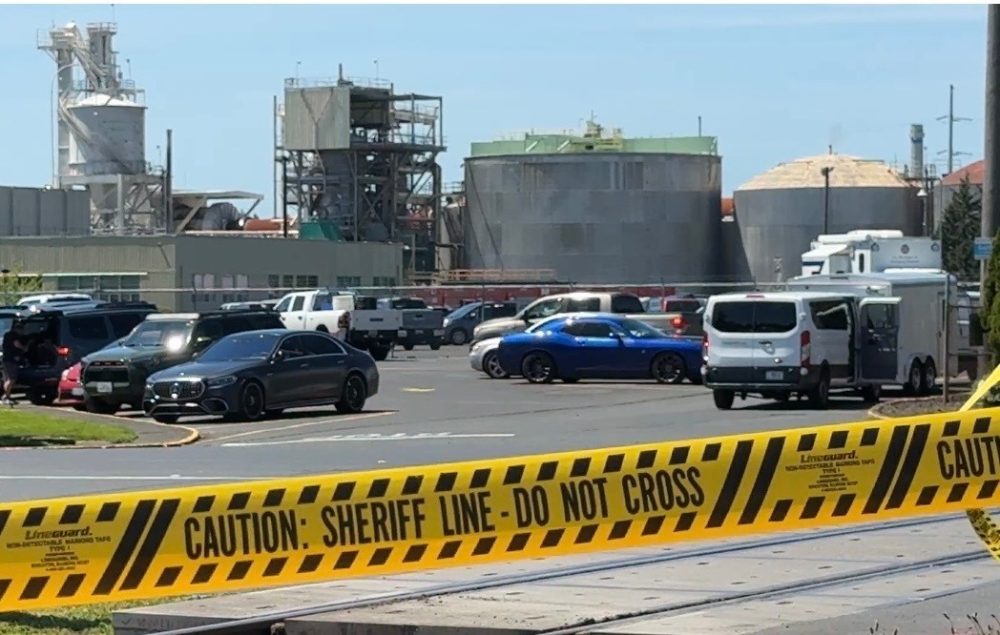
LONGVIEW, Wash. — A devastating industrial accident at a Washington state paper mill has claimed 11 lives after a massive chemical storage tank failed, releasing a torrent of dangerous substances that overturned vehicles and damaged buildings.
Washington state Sen. Jeff Wilson, who lives nearby and can view the facility from his home, has personal connections to the site through his former environmental cleanup business. When emergency sirens began wailing, his first thought was for his son who works at the industrial complex.
“I personally have been inside that tank and near that tank many times,” said Wilson, who has lived in Longview for 56 years. “I can assure you that we all know somebody there. … The casualties are our friends and neighbors.”
The failed storage vessel held more than 500,000 gallons (1.9 million liters) of chemicals used in wood processing for paper production. Tuesday morning’s catastrophic failure at Nippon Dynawave Packaging Co. sent a wave of corrosive materials across the facility with enough force to flip pickup trucks and cause structural damage.
This workplace tragedy ranks among the most fatal industrial accidents in recent U.S. history, striking a community where multiple generations have earned their livelihoods at local manufacturing facilities. The city’s origins trace back to a timber magnate who established the area’s first mills, creating a century-long bond between residents and the lumber and paper sectors.
Beyond supporting families in mourning, community members express concerns about the facility’s future operations. These positions provide essential employment in a sector that historically drove the region’s economy but has faced significant decline over recent decades.
Tokyo-based Nippon Paper Group, the facility’s parent organization, released a statement indicating they are evaluating how the incident will affect their financial results.
“Last night at the vigils, people who work in mills told me that they’re proud of their jobs and they’re proud of their work, and they don’t want to lose it,” U.S. Rep. Marie Gluesenkamp Perez, whose district includes Longview, told reporters Wednesday.
Local residents interviewed by The Associated Press emphasized the critical importance of these manufacturing positions for their community.
“If you’re a waitress, a grocery store worker, a teacher, a paraeducator as I was for 30 years — every walk of life here knows somebody and is related to somebody from these mills,” Cindy Stiebritz said in the antiques store where she volunteers.
Stiebritz noted that her husband’s parents first met while employed at the lumber operation owned by the city’s founder, Robert A. Long.
“Those mills, that is the backbone of this town,” Stiebritz added. “You feel like you’ve lost part of your family.”
The city’s manufacturing district sits alongside the Columbia River, housing timber, paper and chemical operations. Most residents in this community of nearly 40,000 can observe the facilities, steam from industrial boilers, or detect the distinctive sulfur scent associated with pulp and paper production from their neighborhoods.
The community’s industrial heritage is visible throughout downtown, where R. A. Long Square functions as a primary landmark and gathering spot, including for memorial services following the disaster. A recreational area surrounding an artificial lake, another Long initiative, provides green space where residents use walking trails and tree-lined roadways.
Officials report that investigators are still determining what caused the tank’s structural failure. The manufacturing site, operating since 1953 with approximately 1,000 employees, produces materials for tissues, printing paper, cups, plates, cartons and similar products.
Fundraising efforts for victims’ families reveal that those who perished included a grandfather known for helping others, two brothers with one serving as the primary income source for his partner and three children, and a husband survived by two children and an expecting wife.
Brianna Pesio, who serves customers at the Mill City Grill downtown, described Tuesday morning’s terror when her brother, employed at the adjacent lumber facility, couldn’t reach their father who works at the plant and has been there over 30 years.
“I just didn’t know if I lost my dad or not,” said Pesio, whose husband also works in a paper mill. “I drove over to my dad’s house and pounded on his door until he did wake up. He had just gotten off shift at 5 a.m.”
At the nearby Country Folks Deli, longtime server Gayle Leavitt mentioned her in-laws also spent decades working at the mill, adding: “That’s how this town has survived.”
Area representatives reinforced residents’ pride in manufacturing work and the economic significance of well-compensated positions in a region where other communities have suffered from timber industry contraction.
“This is a place where real people make real things. This is not the virtual world,” state Rep. Jim Walsh said at a news conference at the plant on Tuesday. “Real things and real industry always carries risks. But it’s our job to make sure that risk like this is well managed and, to the extent it can be, controlled.”
Stiebritz, the antiques shop volunteer, expressed hope that authorities determine the cause “so it never happens again.”
“If anything comes out of it, I hope lives can be saved,” she said, tearing up as she thought of the children who have lost their parents.
“This town is family. It’s one big family,” she added. “But we’ll make it though. We’re strong. We’ve got a lot of love.”
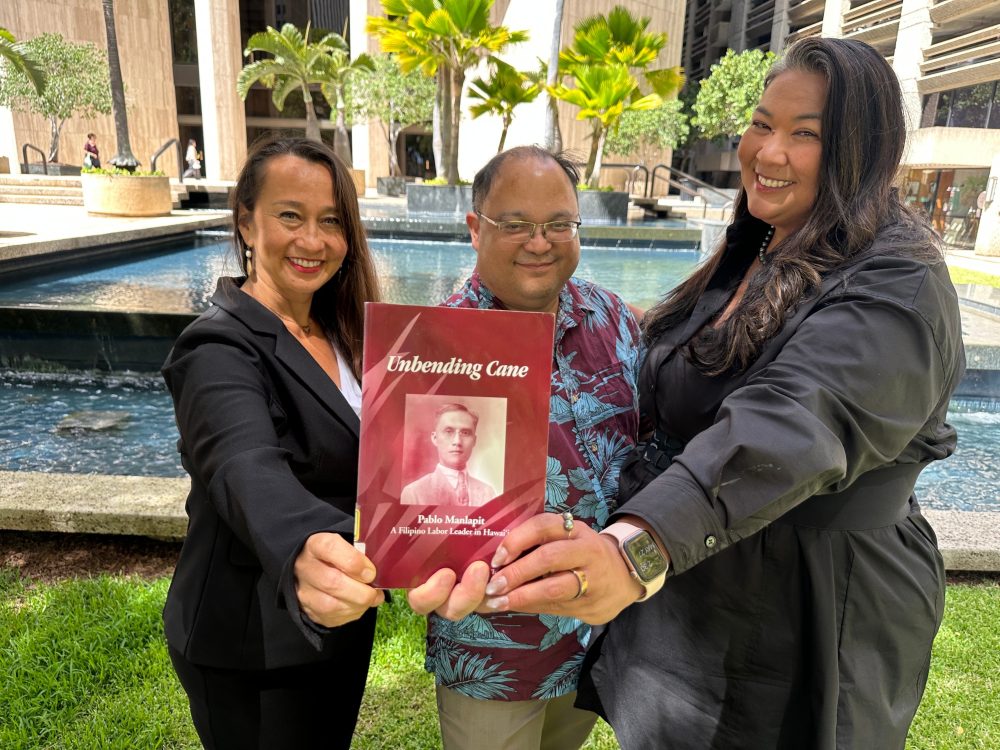
Long before Filipino American farm workers staged their famous California strike, Pablo Manlapit was building labor unions among Filipino plantation workers in Hawaii.
After arriving in Honolulu in 1910 to work sugar plantations, Manlapit witnessed the harsh treatment of fellow Philippine immigrants called “sakadas.” Ten years later, risking his career and family, he became Hawaii’s first Filipino attorney and established a Filipino workers’ union fighting for equal wages and eight-hour shifts.
He successfully convinced Japanese laborers, who earned higher wages, to join the movement. His organizing activities led to his involvement in the deadly 1924 Hanapepe Massacre on Kauai, where 16 workers and four officers died during labor violence.
The devastating incident destroyed the strike’s progress.
Manlapit faced imprisonment, exile to California, and eventual deportation. Though he continued advocating for workers’ rights throughout his life, he passed away in 1969 largely forgotten.
More than 100 years later, Manlapit has emerged as an inspiration for Filipino attorneys who never learned his story growing up. The Hawaii Filipino Lawyers Association is working to reverse his conspiracy conviction in a symbolic campaign aimed at securing Manlapit’s rightful place in labor history. The group argues that Manlapit’s achievements and broader Asian American and Pacific Islander history in Hawaii remain largely unknown on the mainland.
“It’s a story that needs to be told. A lot of us are second generation, so we don’t have knowledge of these stories,” said Daniel Padilla, the group’s president. “His story gets overshadowed … in the broader labor movement in California.”
New sexual abuse allegations against well-known Mexican American labor leader César Chavez have sparked discussions about Filipinos who played crucial roles in America’s farmworker movement.
This development motivated the Filipino attorney organization to pursue clearing Manlapit’s record. Their mission to reverse Manlapit’s conviction, the association states, focuses on “restoring what was taken from a movement that always belonged to many.”
Filipino Americans have traditionally been overlooked by historians, according to Kevin Nadal, president of the Filipino American National Historical Society. Hawaiian Filipino communities – separated by an ocean – received even less historical documentation over the years. Nadal, who teaches psychology at City University of New York, only discovered extensive information about Manlapit while researching a Filipino American Studies encyclopedia in 2020.
“It may have been documented through just like oral histories,” Nadal said. “We love oral histories but, if no one writes them down and then it doesn’t become published, then it just gets lost.”
Manlapit’s organizing efforts likely represent the first recorded instance of Filipino worker mobilization.
“It started with Hawaii,” Nadal said. “What was happening in Hawaii, it would have been really hard for people to know that it was happening in California.”
Recognition has increased in recent years. This past May during Asian American Pacific Islander Heritage Month, the Smithsonian Asian Pacific American Center collaborated with Hawaii U.S. Sen. Mazie Hirono on a poster display featuring sakadas.
Workers who traveled from the Philippines to Hawaii’s plantations helped make Filipinos one of the state’s largest ethnic populations today. They comprised more than half the workforce. Hawaii later became home to America’s first and only governor of Filipino heritage, Ben Cayetano.
Cayetano, 87, said he never felt compelled to explore his Filipino heritage while growing up in poverty in Honolulu.
“I was born and raised here so I was more influenced by the local culture, which is a mixture of the Hawaiian culture and all the other cultures,” said Cayetano, who completed college and law school in Los Angeles.
However, recognizing sakadas and leaders like Manlapit serves as a way to honor the sakada who raised Cayetano as a single parent, he explained.
Growing up mixed-race in rural upstate New York, Becky Gardner struggled to connect with her mother’s Filipino heritage but heard family stories about her great-grandfather and grandfather who labored on Kauai plantations. Seeking to embrace those roots, Gardner relocated to Honolulu for law school.
While serving as an attorney in the state Office of Language Access, she promoted “Sakada Day,” honoring the Dec. 20 arrival of the first contract workers who departed the Philippines for Hawaii’s sugar and pineapple plantations.
During this work, Gardner discovered her own sakada ancestry.
She entered her great-grandfather’s name, Francisco Alcano, into an online Filipino laborer database and located records showing his 1928 arrival in Honolulu on a steamship named for President Grover Cleveland.
“It made me feel like I was part of Hawaii’s history too,” Gardner said.
The Hawaii Filipino Lawyers Association is examining whether Manlapit’s 1924 conviction was unjust and exploring legal options to clear his name after death, said Padilla, who received his law degree from the University of Hawaii.
They’re also considering establishing a fellowship at University of Hawaii’s law school to fund a legal researcher who could investigate the case as part of efforts to formally exonerate Manlapit.
Kainani Collins Alvarez, who grew up on Oahu aware of her sakada grandfather’s history, previously worked as a public defender and now operates a family-law practice. She hopes to contribute her criminal defense experience to the association’s Manlapit initiative. Half-white, she connects to Hawaii Filipinos through her mother and childhood time spent in the Philippines.
“For me, it’s really important to go back and rectify the truth,” she said. “History is built on the facts that we knew at the time.”
Manlapit was not present on Kauai during the 1924 massacre when striking Filipino sugar workers and police engaged in deadly conflict.
Despite Manlapit eventually receiving a pardon, the association seeks to highlight evidence proving his innocence, Alvarez explained.
Based on a Manlapit biography, he declared in a 1927 “farewell statement” his intention to establish his innocence: “I was railroaded to prison because I tried to secure justice and a square deal for my oppressed countrymen who are lured to the plantations to work for a dollar a day.”
A conviction reversal would carry greater significance than a pardon in certain respects, Nadal noted.
“It would mean more of understanding justice and ensuring that people realize that we can fight for justice and that justice can prevail,” he said.
Manlapit’s experience motivated Khara Jabola-Carolus to pursue a legal career in Hawaii. Similar to him, she began as an organizer and activist. She was raised in California and graduated from Hawaii’s law school.
“There’s a long history of Filipino organizing,” she said. “That’s why I wanted to be a lawyer here.”
She hopes more people will learn about Manlapit’s life with the same familiarity they have for famous Filipino entertainers.
“We need representation and access to seeing ourselves as heroes and movement leaders and not just entertainers,” she said. “Like Filipino Americans need to know Pablo Manlapit as much as they know Bruno Mars or Olivia Rodrigo.”
Defense Secretary Pete Hegseth declared Saturday that the United States stands prepared to resume military operations against Iran should diplomatic negotiations fail to produce an agreement, as representatives from both nations continue working to overcome significant obstacles to a deal.
“Our ability to recommence if necessary…we are more than capable,” Hegseth stated while speaking in Singapore.
“Our stockpiles are more than suited for that, both there and around the globe, so we’re in a very good place,” he continued.
During his remarks at the Shangri-La Dialogue, the region’s leading conference for defense officials, military leaders and diplomatic personnel, Hegseth emphasized that America remains committed to the Asia-Pacific area despite ongoing Iranian hostilities.
“We can do two things at one time. We’re super-charging our defence industrial base so that we’re building 2X, 3X, 4X the munitions very soon to ensure that all of our (operations) plans are properly funded throughout the world,” he explained.
The Defense Secretary characterized President Donald Trump as “patient” and seeking to negotiate a “great deal” that would prevent Iran from acquiring nuclear capabilities.
Trump announced Friday his intention to convene in a secure White House location to reach a “final determination” regarding a proposal to halt the Iranian conflict, which would extend a truce established in early April for an additional 60 days while negotiators work toward a lasting resolution.
The military campaign initiated by the United States and Israel on February 28 has resulted in thousands of casualties, predominantly in Iran and Lebanon, while creating worldwide economic disruption through elevated energy costs caused by Iran’s blockade of the Strait of Hormuz.
The White House issued a statement Friday declaring that U.S. President Donald Trump maintains excellent health, with robust heart, lung, brain and general physical functioning, according to a medical evaluation conducted earlier this week.
Following his Tuesday appointment at Walter Reed National Military Medical Center, marking his third visit there in just over a year, Trump stated that “everything checked out perfectly.”
As the oldest individual to take the presidential oath, Trump regularly portrays himself as having more vigor and better physical condition than Joe Biden, his Democratic predecessor, who concluded his term last year at 82 years old amid concerns regarding his capability to serve.
However, recent photos displaying a patchy rash on his neck have sparked additional concerns about Trump’s wellbeing, coming after July 2025 images revealed swollen ankles and what appeared to be a bruised hand covered with cosmetics.
New Zealand’s defense minister announced Friday that the country plans to gradually increase military expenditure to reach a target of 2% of GDP over the next eight years, representing nearly double current spending levels.
Defense Minister Chris Penk outlined the strategy during remarks in Singapore before the start of the Shangri-La Dialogue, Asia’s premier defense conference. He emphasized the government’s goal of maintaining consistent growth in military funding.
“As much as possible, it’s our intention to have a smooth and steady upward trajectory to 2 percent,” Penk stated during his interview with Reuters.
Penk acknowledged that spending patterns may fluctuate during periods when the country purchases major military equipment and platforms, but stressed the overall objective remains doubling New Zealand’s defense budget to strengthen military capabilities.
The defense minister assumed his role in April, taking over from Judith Collins following her retirement after an extensive political career.
These remarks follow the government’s announcement last week of NZ$1.58 billion ($924.62 million) in additional defense allocations for the 2026 budget as part of military modernization efforts.
The planned investments include acquiring two new surveillance and intelligence drones designed for operations in the South-West Pacific region and polar environments. New Zealand is also seeking long-term replacements for its aging pair of Anzac-class frigates and the multi-role vessel HMNZS Canterbury.
Essential maintenance work for the surface fleet is also in preparation phases.
Speaking during a panel at Saturday’s dialogue, Penk revealed that Wellington continues assessing British and Japanese alternatives for the frigate replacement program.
The defense spending increases are part of a broader budget that includes enhanced funding for education and healthcare, despite Prime Minister Chris Luxon’s conservative government implementing an otherwise restrictive fiscal approach this week.
Government projections show a budget deficit of NZ$15.06 billion for the fiscal year concluding June 30, 2026, representing an improvement from the NZ$16.93 billion deficit forecast in December’s mid-year review.
As a treaty partner with Australian forces, New Zealand has been expanding its presence throughout East Asia alongside Western military forces and their allies in response to China’s expanding military capabilities.
“I think the word inter-operability is an important one for us, and I would add inter-changeability, certainly with regard to Australia, who’s our nearest neighbour, but also a formal ally,” Penk explained.
“I think it’s important that we are very visibly present…in the Asian region, and we do things in conjunction with the likes of Korea and Japan,” he continued, emphasizing the importance of maintaining and exercising navigation freedoms.
Oklahoma City Thunder guard Jalen Williams has been ruled out for Saturday night’s pivotal Game 7 matchup against the San Antonio Spurs following a disappointing return to action in the previous game of the Western Conference finals.
The 25-year-old guard, who worsened a left hamstring injury during Game 2 and missed the following three games, returned to the court for a limited 10-minute stint in Game 6. His performance was lackluster, missing his only field goal attempt while making one free throw, turning the ball over twice, and posting a minus-18 rating.
Following his team’s 118-91 defeat on Thursday, Thunder coach Mark Daigneault addressed Williams’ condition. “He’s obviously not 100%,” Daigneault explained. “He didn’t know what to expect. I didn’t know what to expect. So, it was a matter of getting him out there in kind of an insulated role and see what he can bring to the team.”
The coach continued to praise Williams’ dedication despite his physical limitations. “He’s an All-Star player, he’s an All-NBA player. He hasn’t done a full return-to-play (protocol) like he would if this was the regular season, and yet, he just wants to do whatever he can to try to contribute whatever he can to the team.”
The Thunder officially declared Williams unavailable on Friday evening’s injury report, joining Ajay Mitchell, who was previously sidelined for the entire series due to a soleus strain.
Williams earned third-team All-NBA honors for the 2024-25 season, posting averages of 21.6 points, 5.3 rebounds and 5.1 assists during the regular season before contributing to the Thunder’s championship run alongside Shai Gilgeous-Alexander and Chet Holmgren.
Injuries to his wrist and hamstring restricted Williams to just 33 regular season appearances in 2025-26, during which he averaged 17.1 points, 5.5 assists and 4.6 rebounds per contest. Throughout five playoff games this postseason — including the opening two contests against Phoenix and Games 1, 2 and 6 versus San Antonio — he has contributed 14.4 points, 3.2 rebounds, 2.8 assists while shooting 41.7% from beyond the arc.
The NHL playoffs have culminated with two teams remaining as the Stanley Cup Final approaches.
Following early rounds filled with teams that hadn’t experienced postseason action in years, the conference championships brought back familiar contenders.
The Vegas Golden Knights dominated their West final series, sweeping the Presidents’ Trophy champion Colorado team, while the Carolina Hurricanes eliminated Montreal in a five-game series. These squads will face off in the championship round as the two most successful franchises over the last two months.
A fresh champion will emerge this year, and no team will achieve a three-peat following the Florida Panthers’ injury-plagued exit after reaching three straight finals. Both finalists are different from last year after Edmonton fell to Anaheim.
WESTERN CONFERENCE: Vegas advanced past Utah and Anaheim in six-game series, then completed a four-game sweep against the Avalanche.
EASTERN CONFERENCE: Carolina eliminated Ottawa and Philadelphia in sweeps, then bounced back from an opening game defeat to the Canadiens to reach their first final since 2006.
The playoff format includes the top three teams from each division’s four groups. The remaining four positions are awarded to the next two highest-ranking teams per conference, without regard to division. All playoff rounds follow a best-of-seven format, with the Stanley Cup going to the first team reaching 16 wins.
— Carolina faces Vegas, with Game 1 scheduled for Tuesday night.
Carolina enters as a narrow favorite with slightly better than even odds.
All playoff contests receive national television coverage in the United States through ESPN or Turner networks. The NHL schedule is available online along with streaming information. Much of TNT’s programming, including the Stanley Cup Final, will air simultaneously on truTV and stream on Max’s B/R Sports Add-On. Canadian viewers can watch games on Sportsnet and CBC.
Following three rounds of seven-game series, the final begins Tuesday evening. Should the series reach its maximum length, Game 7 could occur as late as June 20.
WEST: Straightforward coach John Tortorella assumed control of the Vegas Golden Knights in late March, and the team has maintained momentum since. Mitch Marner, previously criticized for postseason struggles during his Toronto tenure, has emerged as potentially the playoffs’ top performer.
EAST: The Carolina Hurricanes have dominated their Eastern Conference run, receiving outstanding goaltending from 36-year-old Frederik Andersen and versatile contributions from 2018 league MVP Taylor Hall. Following numerous disappointing playoff conclusions, they seek the franchise’s second title and first since 2006.
The Stanley Cup drought for Canadian teams will continue another year. No team from north of the border has captured the championship since Montreal’s 1993 victory.
The president’s doctor has declared Donald Trump to be in outstanding health and completely capable of fulfilling his presidential responsibilities following a comprehensive medical examination conducted this week at Walter Reed National Military Medical Center.
Dr. Sean Barbabella issued a report late Friday detailing that Trump received extensive testing including heart scans, CT imaging, cancer screenings, and additional preventive evaluations performed by a team of 22 medical specialists.
The 79-year-old president commented following Tuesday’s medical visit that all results came back “PERFECTLY.”
Medical records show Trump’s weight at 238 pounds (108 kilograms), representing a 14-pound (6 kg) increase since his previous examination in April 2025. While his medical team provided recommendations regarding nutrition, exercise, and weight management, they determined his “cognitive and physical performance are excellent.”
Oakland Athletics pitcher Luis Severino was forced to leave Friday’s matchup with the New York Yankees in West Sacramento, California, after completing just one inning due to discomfort in his right arm.
The 32-year-old was preparing for the second inning when he abruptly stepped away from the pitcher’s mound and glanced toward his team’s dugout. Catcher Shea Langeliers noticed the situation and gestured to the bench for assistance. After a quick conversation with the team trainer and manager Mark Kotsay, Severino departed the game.
Left-handed pitcher Jose Suarez took over pitching duties in his place.
Originally, Severino was set to take the mound Tuesday against the Seattle Mariners, but his appearance was delayed. Team officials explained they preferred to use left-handed starters in that series.
During his single inning of work, Severino allowed four runs, though none were considered earned due to a fielding mistake by first baseman Nick Kurtz. Aaron Judge contributed an RBI single while Paul Goldschmidt connected for a three-run home run.
The right-hander previously played for the Yankees organization from 2015 through 2023, and his former club had given him trouble in recent outings. Coming into Friday’s contest, he held an 0-2 record with a 10.66 ERA across three appearances against them. This marks his second year with Oakland following a 2024 stint with the New York Mets.
Severino has posted a 4.16 ERA over 12 starts during the current season.
Myanmar’s newly appointed president will travel to India this Saturday for his inaugural foreign trip since assuming civilian leadership, marking a significant diplomatic milestone less than two months after his transition from military junta commander.
The five-day diplomatic mission will include meetings with Indian Prime Minister Narendra Modi and represents Myanmar’s gradual re-entry into regional diplomacy, five years after neighboring countries isolated the Southeast Asian nation’s military government following their seizure of power.
India views this visit as a chance to reduce China’s substantial sway over Myanmar while pursuing access to the nation’s valuable rare earth mineral reserves and strengthening security along India’s northeastern frontier, according to policy experts.
“After changing into civilian clothes as president, Min Aung Hlaing is looking to boost diplomatic engagement across the region,” said Richard Horsey, senior Myanmar adviser at Crisis Group.
“He expects more normal ties with ASEAN,” Horsey added, referring to the grouping of 11 southeast Asian countries, “with support from Thailand and some other member states. He is also likely to visit Beijing soon to meet Xi Jinping. India is Myanmar’s other key neighbour.”
A Myanmar presidential office representative contacted by phone refused to provide details about the upcoming visit.
Indian foreign ministry spokesman Randhir Jaiswal told reporters on Friday: “All issues that form part of the gamut of relations between Myanmar and India will come up for discussion.”
The military takeover occurred at dawn on February 1, 2021, when Min Aung Hlaing removed the democratically elected civilian administration headed by Nobel Peace Prize winner Aung San Suu Kyi, triggering widespread protests that evolved into a nationwide armed resistance against military rule.
The power grab generated international criticism, including from the ASEAN alliance that prohibited Myanmar’s military leaders from attending its conferences, leaving the new military government increasingly cut off from the international community.
A catastrophic earthquake last year offered a diplomatic opportunity for Min Aung Hlaing, who attended a regional conference in Bangkok, an opening he hopes to expand following a controversial election that led to his presidency.
“He is seeking more and more regional and international respectability post-election,” said Gautam Mukhopadhaya, a former Indian ambassador to Myanmar.
Despite Beijing’s historical support and extensive investments in Myanmar, Min Aung Hlaing’s decision to make India his first international destination partly aims to offset China’s extensive influence, analysts explained.
“This has been part of Myanmar’s way of dealing with India and China, capitulating more to China and trying to sort of balance it with India,” said Mukhopadhaya.
The diplomatic trip occurs as Myanmar’s armed forces have initiated fresh military campaigns in border regions containing rare earth deposits and crucial trade corridors connecting to India and Thailand.
“Min Aung Hlaing will almost certainly seek India’s help in countering the Arakan Army and Chin armed groups,” Horsey said, referring to rebels fighting the military in Myanmar’s Chin state, which borders India, and nearby Rakhine state.
India has shown interest in accessing Myanmar’s natural resources, including efforts to obtain mineral samples with assistance from a powerful rebel group, Reuters has reported.
“The bottom line behind this visit from the Indian side is what they can get out of it in terms of raw materials, rare earths (and) business propositions,” Mukhopadhaya said.
“And that’s exactly what the Myanmar military wants, because it wants its military enterprises strengthened.”
A federal appeals court ruling on Friday has enabled Texas to move forward with implementing significant portions of legislation that grants state authorities the power to detain and remove individuals believed to have entered the country illegally through the U.S.-Mexico border.
The 5th U.S. Circuit Court of Appeals, located in New Orleans, issued a 2-1 decision that suspended a court order blocking the law. That original injunction had been put in place on May 14 following a class-action case brought by civil rights organizations representing thousands of individuals who might face consequences under the legislation.
U.S. District Judge David Ezra, based in Austin, had previously blocked the state law after determining it inappropriately interfered with federal authority over immigration, citizenship processes, and deportation procedures.
Republican Texas Attorney General Ken Paxton, who is running for a seat in the U.S. Senate, promptly challenged the injunction, resulting in Friday’s appellate decision.
Organizations representing those affected by the law — including the American Civil Liberties Union, its Texas branch, and the Texas Civil Rights Project — released a joint statement expressing disappointment with the court’s decision and stated they “will continue to fight against this abhorrent and blatantly illegal law.”
Paxton’s office did not respond to a request for comment.
The legal challenge was initiated to block sections of the 2023 legislation from being implemented, following an April appeals court decision that reversed an earlier restraining order from Democratic President Joe Biden’s tenure that had prevented the Republican-supported measure, designated as SB 4, from going into effect.
Republican President Donald Trump’s administration had abandoned a legal challenge that the Biden administration had pursued against the law. Immigration advocacy organizations that had also filed suit continued their efforts, but the 5th Circuit ruled 10-7 that these groups did not have proper legal standing to continue their case.
The recent ACLU-supported legal action attempted to resolve this issue by filing suit on behalf of non-citizens who might be affected by four specific sections of the legislation.
These sections include measures that establish state-level criminal penalties for individuals who reenter the United States following deportation, regardless of whether they possess federal authorization or have subsequently received permanent resident status, and provisions that authorize Texas magistrate judges to issue removal orders.
The Los Angeles Dodgers have officially placed outfielder Teoscar Hernandez on the 10-day injured list following a left hamstring strain he suffered two days earlier, the team announced Friday. Additionally, Hyeseong Kim, who stepped in to replace Hernandez in left field, has been sent down to the minor leagues.
Kim found himself in unfamiliar territory Wednesday when Hernandez sustained his injury while running to first base on a ground ball during the second inning of their matchup with the Colorado Rockies. It marked Kim’s first-ever appearance in left field at the professional level.
After completing Wednesday’s contest and sitting out Thursday’s off day, Kim received his assignment to Triple-A Oklahoma City on Friday, just before Los Angeles began a three-game homestand against the Philadelphia Phillies.
The Dodgers addressed their roster needs by bringing up infielder/outfielder Ryan Ward from Triple-A Oklahoma City and bringing back infielder/outfielder Santiago Espinal through a new signing.
The 33-year-old Hernandez has compiled a .276 batting average this season, along with seven home runs and 31 RBIs across 51 games. His injury came during an impressive stretch where he posted a .375 average with three homers and 14 RBIs over his most recent 14 contests.
Throughout his career, the two-time All-Star has maintained a .261 batting average, .317 on-base percentage, and .482 slugging percentage, accumulating 224 home runs and 692 RBIs in 1,150 games. His major league journey has included stops with the Houston Astros (2016-17), Toronto Blue Jays (2017-22), Seattle Mariners (2023), and now the Dodgers.
Kim, age 27, has recorded a .259/.323/.328 slash line this season with one home run and 11 RBIs in 43 appearances. Following his major league debut with Los Angeles last season, he posted a .280/.314/.385 line with three homers and 17 RBIs over 71 games.
The 31-year-old Espinal had been moved to Oklahoma City on Thursday after going unclaimed on waivers. His 2024 performance with Los Angeles included a .220 batting average, one home run, and four RBIs in 26 games before being designated for assignment earlier this week.
Ward, 28, made his major league debut with the Dodgers last month, collecting two hits in six at-bats during two games while covering for Freddie Freeman during his paternity leave.
In Triple-A action this year, Ward has posted a .254 average with six home runs and 31 RBIs in 47 games, following a standout 2023 campaign for Oklahoma City where he launched 36 homers and drove in 122 runs. His minor league career spans seven seasons with 156 total home runs.
To create room on the 40-man roster for Espinal’s return, left-handed pitcher Blake Snell, who underwent left elbow surgery earlier this month, was moved to the 60-day injured list.
U.S. Defense Secretary Pete Hegseth delivered a stark warning to Asian partners on Saturday, calling for increased military investments to counter China’s expanding military capabilities and prevent regional dominance.
Speaking at the Shangri-La Dialogue in Singapore, Asia’s leading defense and diplomatic gathering, Hegseth emphasized the need for stronger, more independent allied networks to discourage aggression and maintain regional stability.
“There is rightful alarm regarding China’s historic military buildup and the expansion of its military activities in the region and beyond,” he said.
Hegseth warned against any single power controlling the Pacific region. “A Pacific dominated by any hegemon would unravel the regional balance of power,” he stated. “No state, including China, can impose its hegemony and hold the security or prosperity of our nation and our allies in question.”
The Pentagon leader announced expectations for Asian allies and partners to boost defense spending to 3.5% of GDP, while the U.S. commits $1.5 trillion to military investments.
Hegseth emphasized that allies seek stability rather than conflict escalation. “What they want, and what the United States delivers, is strength that is disciplined, resolve that is steady, and leadership that is confident enough to speak and walk softly while carrying a big stick.”
Despite security concerns, Hegseth adopted a balanced approach regarding U.S.-China relations, describing them as “better than they have been in many years,” with increased military-to-military communications helping manage tensions.
“We are meeting more frequently with our Chinese counterparts by maintaining open lines of military to military communication.”
“NO FREELOADING”
Hegseth reinforced President Donald Trump’s ongoing demands for allies to bear greater defense responsibilities, similar to expectations for European and NATO partners to reduce dependence on Washington.
“The era of the United States subsidizing the defence of wealthy nations is over,” Hegseth declared. “We need partners, not protectorates,” he continued. “We don’t have a strong alliance unless everyone has skin in the game. No freeloading.”
The Defense Secretary commended contributions from multiple allies including South Korea, the Philippines, Australia, Singapore, Malaysia and Thailand, while noting Japan’s concrete measures to strengthen its defenses.
Regarding the U.S.-Japan partnership, he said both nations “must each pull our weight to strengthen the U.S.-Japan alliance.”
ARMS SALES DECISION TO TAIWAN IS TRUMP’S CALL
When questioned about weapons sales to Taiwan, Hegseth dismissed concerns that a multi-billion-dollar package might be impacted by U.S. weapons stockpile reductions due to Middle East conflicts. “We feel very good about our stockpiles and how we use them,” he said.
Taiwan, which China considers its territory, awaits U.S. approval for an arms sale that Reuters reported could reach $14 billion.
Trump created uncertainty in Taipei by stating, following his meeting with China’s President Xi Jinping this month, that he remained undecided about approving the package.
Hegseth indicated that any future arms sales decisions would remain with President Trump, showing no departure from Washington’s established approach despite recent Beijing engagement.
“Those decisions will depend on the president and the nature of that relationship,” Hegseth explained. “There’s been no change in our status.”
NEW YORK (AP) — When Bobby Valentine put on sunglasses and a fake mustache to sneak back into the dugout after getting ejected on June 9, 1999, he was simply trying to keep team morale up — and maybe keep his job with the New York Mets.
That sneaky move became a career-defining moment, possibly the most unforgettable incident in his four decades in professional baseball.
Before his upcoming induction into the Mets Hall of Fame, Valentine celebrated that legendary stunt Friday evening by once again sporting the same disguise while delivering the ceremonial first pitch to an equally disguised Mr. Met.
The 76-year-old former skipper, set to be honored Saturday along with former Mets teammate Lee Mazzilli, walked out from the New York dugout to enthusiastic applause from the Citi Field audience, many already wearing the promotional giveaway items — sunglasses and fake mustaches.
Valentine stepped forward near the pitcher’s mound and delivered his throw to the team mascot, whose cap displayed the words: Not Mr. Met.
Shortly after, local students from John Lewis Childs grammar school on Long Island performed the national anthem — with several sporting fake mustaches. Another group of disguised children then pressed a button to light up the Home Run Apple in center field.
“Great memories for me,” Valentine shared through vice president of alumni public relations and team historian Jay Horwitz. “At the time I did the mustache, we were struggling and I wanted to let the guys know I was behind them.”
Valentine created his disguise — using eye black for the mustache — just three days after general manager Steve Phillips dismissed three New York coaches. Valentine had challenged the organization by declaring the Mets, sitting at 27-28 when the coaches were let go, should dismiss him if the team couldn’t achieve a 40-15 record in their following 55 games.
The team won their next three contests and were tied with Toronto when Valentine was ejected for disputing a catcher’s interference ruling involving Mike Piazza. With encouragement from Orel Hershiser and Robin Ventura, Valentine put on the sunglasses, fashioned his mustache and slipped back into the dugout, where TV cameras quickly caught him.
Valentine’s cover was completely blown when he rushed onto the field to join the celebration of Rey Ordoñez’s walk-off hit in the 14th inning. The league penalized Valentine with a $5,000 fine and a two-game suspension.
“It was made a big thing because things were kind of big at that time,” Valentine explained to ESPN in 2019. “I was supposed to be fired.”
The Mets actually delivered on Valentine’s challenge, going 40-15 over those next 55 games and advancing to the National League Championship Series. Valentine led New York to the World Series against their crosstown rivals the Yankees in 2000 and held the second-highest totals in franchise history for victories and games managed before his dismissal after the 2002 season.
WASHINGTON — American military forces executed another attack Friday against a vessel suspected of drug smuggling in the Pacific Ocean’s eastern waters, resulting in three deaths in what represents the third such operation this week, bringing total fatalities beyond 200 individuals.
The military’s Southern Command revealed details of the most recent strike as part of an extended operation targeting suspected narcotics vessels moving through Caribbean and eastern Pacific waters, using standard terminology describing the boat as “engaged in narco-trafficking operations” and linked to a designated terrorist organization. No supporting evidence was presented.
Though military social media posts routinely feature attack footage, this instance appears unique in showing color video rather than the typical black and white imagery. The recording depicts a small watercraft floating on ocean waters before being struck and consumed by an explosive fireball. The footage transitions to what appears to be the burning vessel surrounded by a widespread field of packages or debris floating in the surrounding water.
This latest operation brings the cumulative death count to 202 individuals from the series of American strikes that commenced in early September, following two additional attacks reported on Tuesday and Wednesday. The Trump administration has announced that America is engaged in armed conflict with Latin American drug cartels, identifying them as responsible for narcotics flowing into American communities.
Southern Command stated in its X platform post that the strike occurred under orders from Gen. Francis L. Donovan, the senior U.S. commander for Latin America, who also conducted meetings with Cuban military officials near the U.S. Navy installation at Guantanamo Bay on Friday.
A devastating climbing accident on Alaska’s Mount McKinley has claimed the lives of three mountaineers from Latvia, while a fourth climber survived and was airlifted to safety, according to officials and a climbing organization from the victims’ homeland.
The tragedy unfolded Wednesday when four members of a seven-person climbing team plummeted near Denali Pass, positioned roughly 2,100 feet below the 20,310-foot peak of McKinley, which stands as North America’s highest mountain, the National Park Service reported.
Emergency crews rescued the surviving climber Thursday from a mountain basin situated at 17,200 feet elevation. The survivor was subsequently transported by air ambulance to receive medical treatment, park officials stated.
“Operations for the three remaining climbers have transitioned from a search and rescue mission to a recovery effort,” the Park Service said in an online statement, adding the agency “does not release information about fatality victims until 72 hours after next-of-kin notification.”
Park authorities provided limited additional information and did not identify the climbers’ country of origin in their official announcement.
However, the Latvian Mountaineering Association identified the three deceased mountaineers as Inese Puceka, Vija Olte, and Renars Kunigs-Salaks, based on a translation of the organization’s website statement from Latvian to English.
“This is an indescribably painful and irreversible loss for the entire Latvian climbing community,” the group said in its statement.
The mountaineering association also reported that the fourth climber who fell, Mārtiņš Bilzēns, remained in critical condition.
The expedition’s three other members, who were unharmed in the incident, safely returned to a mountain camp after assisting their injured teammates, park officials confirmed.
According to the Latvian Mountaineering Association, the three uninjured climbers intended to descend from their 17,000-foot camp with help from rescue personnel.
The mountain serves as the focal point of the surrounding park and is commonly known to area residents and Alaska Natives as Denali, which translates to “the high one” in the Athabascan indigenous language. The peak received its official designation in 1917 to honor William McKinley, the 25th U.S. president, who was killed by an assassin in 1901.
In 2015, President Barack Obama formally changed the mountain’s name back to Denali, observing that McKinley had never set foot on the mountain and had no meaningful historical ties to the peak or Alaska. The Trump administration later restored McKinley as the official designation.
Chicago White Sox power hitter Munetaka Murakami exited Friday’s contest against the Detroit Tigers during the third inning after suffering a hamstring injury.
The slugger, who shares the American League home run crown with 20 blasts alongside Houston’s Yordan Alvarez, clutched his right hamstring following a sprint to first base while trying to beat out a potential 4-6-3 double play.
The injured player made his way back to the bench under his own power, moving at a cautious pace.
“He’ll be evaluated and we’ll see what we got,” White Sox manager Will Venable explained to CHSN following the inning. “Obviously, it grabbed on him. In that instance, you just want to make sure he’s all right and not push it. Obviously with all our guys, we want to protect them and make sure they’re healthy.”
Luisangel Acuna entered as a pinch runner for the injured Murakami and came home to score on Miguel Vargas’ two-base hit. When the fourth inning began, the team made several defensive adjustments: Vargas shifted from third base to first, Acuna moved to shortstop, and Colson Montgomery transitioned from short to third base. Montgomery remained in the lineup despite experiencing lower back discomfort after making an out to end the previous inning.
The injured player has been a standout performer for a White Sox team that held the second American League wild card position entering Friday’s matchup. The 26-year-old first baseman has started every one of the team’s 57 contests this season, posting a .240/.378/.560 statistical line while contributing 20 home runs, 41 runs batted in, and drawing 44 walks.
Canada revealed its World Cup roster Friday, putting to rest concerns that injured captain Alphonso Davies wouldn’t recover in time to compete in the tournament.
The 26-player lineup announcement, broadcast on television, held few unexpected selections.
Davies from Bayern Munich made the cut as anticipated, along with other key players including Juventus forward Jonathan David.
“We really think this is our strongest group,” said coach Jesse Marsch. While injuries have affected the Canadian team, several players who are healing from ailments earned spots on the roster.
Most discussion surrounding the announcement centered on Davies, who hurt his hamstring during the Champions League semi-final match against Paris St Germain.
Marsch indicated Davies would meet up with his teammates in Edmonton on May 31, giving him additional recovery time. The rest of the squad completed training this week in Charlotte, North Carolina. Davies worked out on his own during the week, according to Marsch.
The coach has wrestled with selecting his starting goalkeeper, admitting he feels “tormented” choosing between Orlando City’s Maxime Crepeau and Inter Miami’s Dayne St. Clair. His decision isn’t expected for several days.
The competing goalkeepers, who are friends, made light of the pressure surrounding the selection battle.
“We’re gonna play rocks-paper-scissors,” St. Clair joked about determining the starter during the TSN television broadcast.
Davies stands out among soccer players who remain largely unknown to most Canadians, who typically prefer ice hockey, American-style football, basketball and baseball. The Bundesliga defender has gained recognition among millions, drawing crowds of supporters at the 2022 World Cup.
David has also built a significant fan base in Canada, especially among the country’s millions of residents with Italian and Haitian heritage.
One notable 2022 player missing from this squad is Junior Hoilett. The veteran team member has declined in performance during his 36th year, and Marsch is recognized for prioritizing pace.
Marsch, who is American, brings extensive coaching experience, having led Germany’s RB Leipzig in 2021 and England’s Leeds United in 2022-23, while also earning multiple achievements in MLS as both coach and player.
The coach expressed frustration that injuries dominated questions about Canada’s chances, insisting the roster represents the country’s finest ever assembled.
“Guys are getting healthy,” he stated.
Soccer has gained significant popularity as a spectator sport in Canada recently, with English and Spanish leagues attracting widespread viewership, a domestic league launching, and Major League Soccer enjoying strong fan engagement.
Canada squad:
Goalkeepers: Maxime Crepeau from Orlando City SC, Owen Goodman from Barnsley FC (on loan from Crystal Palace FC), and Dayne St. Clair from Inter Miami FC.
Defenders: Moise Bombito from OGC Nice, Derek Cornelius from Olympique de Marseille, Alphonso Davies from Bayern Munich, Luc de Fougerolles from Fulham FC, Alistair Johnston from Celtic FC, Alfie Jones from Middlesbrough FC, Richie Laryea from Toronto FC, Niko Sigur from Hajduk Split and Joel Waterman from Chicago Fire FC.
Midfielders: Ali Ahmed from Norwich City FC, Tajon Buchanan from Villarreal CF, Mathieu Choiniere from LAFC, Stephen Eustaquio from FC Porto, Marcelo Flores from Tigres UANL, Ismael Kone from U.S. Sassuolo Calcio, Liam Millar from Hull City FC, Jonathan Osorio from Toronto FC, Nathan Saliba from R.S.C. Anderlecht and Jacob Shaffelburg from LAFC.
Forwards: Jonathan David from Juventus FC, Promise David from Royale Union Saint-Gilloise, Cyle Larin from RCD Mallorca, and Tani Oluwaseyi from Villarreal CF.
The United States demanded Friday that Nicaragua immediately release Indigenous leader Brooklyn Rivera following the publication of hospital images showing him in critical condition.
Rivera, who leads the Miskito people and has faced decades of conflict with the ruling Sandinista government, has been held since September 29, 2023, during an extensive campaign targeting dissent. His relatives maintain his detention is politically motivated and assert authorities have not filed formal charges.
Several detainees have died while in Nicaraguan government custody in recent years as officials have jailed hundreds of media members, activists and political opponents.
Nicaraguan authorities announced in January they would free certain prisoners after facing pressure following the U.S. military action to apprehend Venezuela’s then-President Nicolás Maduro. However, the government has provided minimal transparency since making that statement.
“This repression, violence and inhumanity is abhorrent,” the Bureau of Western Hemisphere Affairs posted on social platform X Friday. “We reiterate our call for his and all political prisoners’ unconditional release NOW.”
On Wednesday, the administration led by co-Presidents Daniel Ortega and his wife Rosario Murillo issued a health report about Rivera, describing his condition as “delicate” while connected to a mechanical ventilator with multiple organ failure. The released photographs depicted a severely weakened Rivera attached to numerous tubes in his hospital bed.
A coalition of Nicaraguan Indigenous organizations issued a Thursday statement condemning the government for Rivera’s arbitrary imprisonment and “distorting the narrative” by alleging he was already in poor health when taken into custody.
“We know that who is responsible for this very grave situation that he is in, for the violations of human rights, is the Sandinista Ortega-Murillo regime,” they said in the statement sent to The Associated Press.
Currently, at least 47 individuals remain imprisoned in Nicaragua for political reasons, according to the Mechanism for Recognition of Political Prisoners, an organization monitoring these cases. Hundreds have been detained following a 2018 uprising that triggered a violent government response killing hundreds.
What began as demonstrations against social security system changes grew into demands for Ortega’s resignation. Ortega has governed the nation for nearly twenty years after constitutional modifications permitted his continued reelection. The suppression escalated before 2021 presidential elections, during which all competitive candidates were jailed before Ortega claimed victory. The United States does not recognize Ortega’s presidency.
Over 200 political prisoners were freed and transported to the U.S. in 2023, describing solitary confinement and physical and psychological abuse. Many developed ongoing health issues from detention conditions and currently face uncertain immigration status under the Trump administration. An additional 135 political prisoners were released and sent to Guatemala in 2024.
The Miskito population has been a particularly prickly thorn in the side of the Ortega regime, according to Manuel Prado, vice president of the Miskitu American Organization.
Rivera was instrumental in opposing Ortega’s Sandinista government during the late 1970s and 1980s, joining the armed U.S.-backed Contra movement and helping establish the northern coastal area as an autonomous region.
The resource-rich Miskito territory, containing gold and silver deposits, is crucial for the Ortega-Murillo administration’s efforts to attract international investment, especially from China.
Prado demanded Rivera’s release and voiced concern about his current physical condition.
“We do feel like Ortega will allow him to die,” Prado said.
President Donald Trump issued an executive order Friday backing a January report from the Department of Health and Human Services that advocates for reducing childhood vaccine recommendations across the United States.
Trump’s directive instructs federal agencies to coordinate their policies with the report’s findings, which supports changes long advocated by Health Secretary Robert F. Kennedy Jr. The research determined that America suggests more childhood immunizations than numerous comparable countries.
Earlier efforts by the Trump administration to reduce recommended childhood vaccines based on this report were halted by a federal judge in Massachusetts. Officials are currently challenging that court ruling.
The report suggests immunizing all children against 11 specific diseases. Additional vaccines would only be suggested for high-risk populations or through what researchers call “shared decision-making” between doctors and families. These conditional recommendations include immunizations for influenza, rotavirus, hepatitis A, hepatitis B, certain types of meningitis and RSV.
Trump’s directive strengthens support for the study during a period when his administration seemed to be shifting attention from Kennedy’s more controversial vaccine positions toward widely accepted topics such as nutritional wellness.
The executive order instructs the Centers for Disease Control and Prevention to examine the study and “take any appropriate steps” to modify its vaccination guidance. It states the CDC should “provide maximum flexibility to parents and doctors” and requires agencies to ensure all policies, rules and funding match the study’s recommendations.
The directive also specifies that any modifications must preserve Americans’ existing vaccine access.
Individual states, rather than federal authorities, control vaccination requirements for school attendance. Although CDC guidelines frequently shape state policies, several states have started forming coalitions to resist the Trump administration’s vaccine direction.
Trump ordered HHS to conduct the study in December.
Kennedy has long opposed vaccines and has worked to incorporate his doubts about immunizations into federal recommendations. He previously announced the CDC would stop recommending COVID-19 vaccines for healthy children and pregnant women, a decision questioned by public health professionals who found no new evidence supporting the change.
In June, he dismissed a 17-member CDC vaccine advisory panel and subsequently appointed his own members, including several vaccine critics.
The January analysis determined that vaccine recommendations for American children have grown significantly over recent decades. The report also noted countries where no immunizations are mandated for school enrollment.
California environmental regulators approved modifications to a major climate initiative on Friday, despite widespread opposition from green advocacy groups who argued the revisions would diminish the program’s effectiveness and hamper efforts to reduce emissions that contribute to global warming.
Oil industry representatives, however, contended that the program would continue to create obstacles for reducing energy costs in a state known for high prices.
Democratic Gov. Gavin Newsom and state legislators renewed authorization for California’s cap-and-trade initiative last year, extending it through 2045. This system establishes a decreasing ceiling on total greenhouse gas emissions from large polluting entities throughout the state. Businesses must either cut their pollution output, purchase permits from the government or other companies, or support projects designed to offset their emissions. Comparable systems operate throughout Europe and Asia, with California’s program connected to similar initiatives in Quebec, Canada and Washington state.
The modifications approved Friday will provide companies — primarily manufacturers and oil refiners — with approximately $3.5 billion in free permits if they construct projects that help decrease their emissions. State officials explained this approach aims to prevent major businesses from relocating outside California, though environmental advocates argue it contradicts the program’s fundamental purpose of encouraging companies to reduce pollution to minimize permit costs. They also contend it will reduce funding available for climate change mitigation and reduction programs.
California Air Resources Board Chair Lauren Sanchez, who previously served as the governor’s top climate adviser, stated the modifications will help California maintain its position as a climate leader.
“Moving forward shows that we can be responsive to affordability concerns, new legislative direction, while also setting a clear signal for Californians, other states and global partners that we remain committed to driving long-term investments in clean energy jobs and reducing pollution in communities,” she said.
State law mandates California reduce its planet-warming emissions by 40% and 85% below 1990 levels by 2030 and 2045, respectively. Program supporters believe cap and trade will help achieve these targets.
The governor signed legislation designed to better align the decreasing emissions ceiling with state climate objectives, designate program revenue for various climate, housing and transit initiatives, and potentially enhance carbon-removal projects. The legislation also renamed the program “cap and invest” to highlight its funding of climate initiatives.
However, achieving these objectives has generated months of air board discussions and intensive lobbying by both environmental organizations and the oil industry. An original proposal primarily focused on aligning the program with last year’s legislation, but was modified to emphasize reducing program costs.
California officials have encountered growing pressure to prioritize affordability in climate policy development after two oil refineries announced closure plans in recent years. The Democratic-controlled state has also confronted federal challenges to its climate agenda, including legislation Republican President Donald Trump signed last year blocking a pioneering rule prohibiting new gas-powered car sales by 2035.
The newly approved changes also boost funding from permit sales by $2 billion from 2027 through 2030 for a program offering utility bill credits to Californians and designate approximately $800 million to help cap-and-trade participating businesses limit program costs for residents.
Previously, roughly $4 billion the state collected annually from permit sales funded climate change mitigation, affordable housing and transportation projects through the Greenhouse Gas Reduction Fund.
The governor and state lawmakers determine which programs receive fund money, and last year they agreed to provide $1 billion annually for the state’s delayed high-speed rail project.
The modifications will likely reduce annual fund revenues by half, according to the nonpartisan Legislative Analyst’s Office. This reduction stems largely from the new incentive program for manufacturers and refiners, said Danny Cullenward, a climate economist who opposes the changes, though board staff disputes this assessment.
This week’s regulatory deliberations extended into a second day following extensive public commentary where climate advocates, legal experts and fossil fuel industry leaders discussed the rules’ effects on pollution and consumer costs, with many requesting the board postpone its vote to better align regulations with state priorities.
Environmental groups, Democratic lawmakers and other critics argue the changes impede state efforts to reduce planet-warming emissions. Cullenward stated the new manufacturer and refiner incentive program lacks testing and adequate safeguards to prevent misuse.
“The state is not on track for its climate goals,” he said at a media briefing Wednesday. “Cutting our climate funding does not help address consumer cost concerns, and it doesn’t accelerate emission reductions.”
The board agreed Friday to postpone issuing permits from the new incentive program until the agency’s executive officer reviews the program and reports back with potential modifications.
The Greenhouse Gas Reduction Fund reductions will severely impact diverse programs serving communities statewide, said Michelle Pariset, director of legislative affairs for social justice law firm Public Advocates.
“These are investments that determine whether a student can afford to take transit to school, whether a senior can get to a doctor’s appointment, whether a family can live near reliable transportation instead of enduring long commutes and higher costs,” Pariset said at the Wednesday briefing.
Jodie Muller, president and CEO of the Western States Petroleum Association, said the updates represent progress but inadequately address future energy affordability concerns.
“California refineries need long-term certainty to make the investments that keep energy reliable and affordable for consumers –- and right now, that certainty stops at 2030,” she said in a statement.
The changes will increase California’s dependence on oil imports to satisfy energy requirements, said Rock Zierman, CEO of the California Independent Petroleum Association.
“That means high GHG emissions, fewer jobs, more expensive gasoline, and lower tax revenue for schools, police, fire, and parks,” Zierman said in a statement, using an acronym for greenhouse gas.
The soccer world has seen significant transformations since the previous World Cup tournament concluded.
The global FIFA competition has expanded by 16 additional teams, bringing the total to 48 nations that will participate across the United States, Mexico and Canada between June 11 and July 19. The tournament schedule has shifted back to its customary summer timing, unlike Qatar’s November and December 2022 matches.
On a more personal level, United States midfielder Gio Reyna exemplifies these changes. During a Friday press conference, Reyna discussed his evolution from the 20-year-old player who faced criticism from his coach regarding insufficient effort during 2022 World Cup preparations.
“Obviously, a lot has changed,” Reyna said. “(I’m) married now. Have a dog. I just like to say, I matured and grown up in many aspects of my life. It’s hard to pinpoint one.”
Questions about Reyna’s development persist due to comments made by Gregg Berhalter, who coached the USMNT during the 2022 World Cup. After that tournament ended, Berhalter revealed he had considered sending a player home.
Investigation later identified Reyna as that player, who accumulated only 53 minutes of playing time during the 2022 World Cup. This situation led to a family dispute spanning multiple generations between the Reyna and Berhalter families.
“It doesn’t really affect me anymore,” Reyna said. “… It more confuses me when I get asked the question still. It’s obviously four years removed and I think everyone is so far removed from that.”
Among the 26-player roster for this World Cup, Reyna represents one of 13 returning team members. The 2022 squad secured second place in Group B, earning advancement to the Round of 16, where they lost 3-1 to the Netherlands.
Prior to Sunday’s exhibition match against Senegal in Charlotte, N.C., the American team holds the 16th position in FIFA’s official world rankings.
Reyna’s influence on this year’s team remains uncertain. His roster spot wasn’t guaranteed due to limited Bundesliga action this season with Borussia Monchengladbach, where he started only four games and netted one goal across 137 total minutes.
“I think rhythm comes from game time, which I feel even those 30, 20-minute stints definitely help,” Reyna said.
“But in the end, it also comes down to training well every day and preparing yourself, which I feel like I try to do whether I’m playing 90 minutes in a good situation or not playing at all. So it’s just the consistent body of work every day showing up and trying to get better.”
American military forces announced Friday they conducted a fatal strike against a boat in Pacific waters, resulting in the deaths of three individuals in what officials describe as the most recent operation of its kind in recent months.
The current administration has highlighted its achievements in targeting suspected narcotics smuggling boats operating in Pacific waters and Caribbean regions.
In a statement posted on social media platform X, U.S. Southern Command described the targeted boat as being “engaged in narco-trafficking operations.”
Independent confirmation of these details was not immediately available through Reuters.
Federal prosecutors are calling for a judge to step down from a Georgia voting case following her involvement in a judicial misconduct scandal.
The U.S. Department of Justice filed the recusal request on Friday, one week after a federal judicial panel confirmed a private reprimand against an unidentified judge for engaging in sexual conduct with a senior police official in her courtroom chambers while law clerks could hear.
While the judicial misconduct orders didn’t name the judge publicly, the Justice Department referenced media reports identifying the official as U.S. District Judge Eleanor Ross in Atlanta, who is overseeing the voter registration case.
According to a February ruling from the 11th Circuit Judicial Council, the judge conducted an extramarital relationship and engaged in sexual activity with the officer. The judge also participated in a political campaign celebration for an unspecified district attorney.
Federal prosecutors identified that district attorney as Fulton County District Attorney Fani Willis, “who rose to nationwide fame for her failed prosecution of President Trump for alleged crimes related to the 2020 election.”
The department argued that if Ross, who was nominated by Democratic President Barack Obama, is indeed the judge referenced in the misconduct proceedings, she should recuse herself because her attendance at the Willis event creates an appearance of prejudice.
“A judge who attended a party celebrating the election of a Democrat best known for prosecuting a Republican President for alleged election interference cannot then preside over a case concerning that President’s efforts to ensure election integrity,” Justice Department lawyers wrote.
The judge’s court hasn’t responded to requests for comment. Ross, who was scheduled to hear arguments in the department’s lawsuit Wednesday, has previously declined through her court to discuss the misconduct case.
Willis, whose office hasn’t commented on the misconduct proceedings, filed charges in 2023 against now-President Donald Trump and 18 co-defendants for what she described as a comprehensive criminal plot to reverse Georgia’s 2020 election outcomes after Trump lost his reelection campaign to Democrat Joe Biden.
A court of appeals removed Willis, an elected Democrat in Atlanta, from the case in 2024. The court determined she had created an “appearance of impropriety” through a romantic involvement with the special prosecutor she had appointed to handle the case.
After her removal, the case was dropped in 2025 following Trump’s return to the White House by another prosecutor who assumed control.
HONOLULU — Residents of Puna, an isolated and diverse area on Hawaii’s Big Island, are grappling with the shocking murders of three elderly men who embodied the region’s unconventional, off-the-grid way of life.
Almost a full day following Jacob Baker’s arrest, community members are wrestling with understanding the events and seeking explanations for why law enforcement focused on the 36-year-old as their primary suspect in the deaths of three men who were approaching or had reached their 70s.
Baker continues to be held in custody on suspicion of murder, burglary and additional charges.
Legal documents reveal Baker has had numerous encounters with law enforcement for various violations. Local Puna residents told The Associated Press that their worries about Baker had intensified in recent times, describing him as becoming more menacing.
Baker stands accused in the deaths of three individuals: a 69-year-old discovered partly underwater in a concrete pond, a 79-year-old found mere hundreds of feet away, and a third 69-year-old whose remains were located approximately 19 miles from the other two. By Friday, formal charges had not yet been filed by prosecutors.
Authorities named the first victim as Robert Shine and the third as John Carse. While the 79-year-old’s identity awaits official confirmation, acquaintances have identified him as Chitta Morse.
Police Chief Reed Mahuna stated that investigators discovered no links between the victims beyond two living in proximity to each other.
Those who knew Shine and Morse describe how both men relocated to Puna seeking its independent, tropical and community-oriented atmosphere.
Shine found joy in moving and dancing to rhythms at drum gatherings, typically held on Sunday afternoons, according to Donald Hyatt, a drummer.
Hyatt’s final encounter with Shine occurred at a gathering the previous month where a local rock band performed and Shine danced enthusiastically.
“He was dancing like he loved life,” Hyatt remembered. “Bob had a permanent smile. Always in good spirits.”
Morse relocated from Van Nuys, California four decades ago “to live off-grid and to live in a warm tropical place, and to eat fruit,” explained friend Jezuz Cinderland. “For 40 years he only ate raw food. Since he got to the island he just went completely raw and this was just the right environment for him to do it.”
On fertile volcanic land along Papaya Farms Road, Morse cultivated what Cinderland described as a “fruit forest,” producing coconuts, avocados and durian among other crops.
“He would just share all the fruit he had,” Cinderland noted. “The most fabulous abundance that you can imagine.”
Though Morse had once belonged to the raw-food commune that Cinderland joined when moving to Puna, Morse had become more isolated in recent years, Cinderland explained.
Shine belonged to Cinderland’s commune, which county officials have closed due to multiple code infractions, Cinderland said.
Janelle Honer, who also cultivated fruit along Papaya Farms Road, appears to represent the link connecting Baker to the victims, who frequently participated in communal meals and gatherings at Honer’s land.
Baker had been residing on Honer’s property while performing coconut tree climbing and trimming services, according to her former husband, Stephen Shaffer. Exchanging labor for housing arrangements is typical in Puna.
Hyatt explained that Baker departed the cabin on Honer’s land months earlier but recently returned asserting “squatter’s rights” and made threats toward Honer. Hyatt said he encouraged her to obtain a protective order.
The murders occurred just days following two women’s requests for temporary protective orders against Baker, claiming he had made threats and harassed them at an agricultural property. One woman was residing there while the other held partial ownership. A judge rejected both requests, citing insufficient evidence of harassment.
Baker had no legal representation listed and has accumulated 20 additional court cases over two decades, primarily traffic violations. Baker typically served as his own attorney in most instances.
Honer, who Shaffer indicated was traveling internationally, could not be contacted for comment.
A remembrance ceremony for the victims was scheduled for Saturday adjacent to Honer’s property.
Puna represents one of Hawaii’s few locations offering affordable property, though the region’s infrastructure has failed to match its population growth, according to Ashley Kierkiewicz, who serves Puna on the county council.
Despite Puna’s reputation as an unconventional frontier area, it also represents a culturally rich community where residents demonstrate resilience and mutual support, she noted.
Puna’s terrain combines dense jungle with stark lava rock formations, while the area also faces challenges including substance abuse, economic hardship and insufficient resources, said long-term resident Tiffany Edwards Hunt.
“People have this mistaken impression that they can come to Hawaii and heal,” she observed. “Hawaii can either really be kind to you or it can chew you up and spit you out.”
Mark Wyatt and Richard Valdez proved instrumental in Baker’s apprehension, contacting authorities when their security camera system alerted Valdez’s phone, showing Baker on their land Thursday. Their property sits roughly half a mile from Carse’s residence, though they barely knew him.
The footage depicts Baker without shirt or shoes, accompanied by a dog, walking near a roadway and crouching when vehicles passed, seemingly attempting to remain unseen.
“He was ducking from the traffic, so it was pretty obvious” that he was trying to avoid detection, Valdez explained.
Law enforcement apprehended Baker nearby after discovering him in a small cave, police reported.
Wyatt believes Baker had been concealing himself near his property at a crude campsite positioned on a cliff above the ocean. He said Baker took couch cushions from a storage container outside his residence plus some charcoal, using coconut palm fronds to camouflage the location.
Valdez hadn’t encountered Baker for approximately two years. During that earlier period, Baker lived adjacent to them, renting space from their neighbor while harvesting and selling coconuts along the area’s primary road. He remained next door for roughly six months, Valdez said.
“He told me he was from Maui and that he had just had a newborn baby and his girlfriend had left and that he was trying to get his life together,” Valdez recalled. “So he seemed pretty normal and conscientious, so it’s hard to fathom that this happened.”
Meta Platforms is reportedly developing plans to test an artificial intelligence pendant over the coming year, according to a Friday report from The Information. The initiative represents part of a comprehensive strategy for wearable technology designed to address significant financial losses within the company’s hardware operations.
The parent company of Facebook and Instagram intends to substantially broaden its artificial intelligence glasses offerings while introducing a workplace-oriented program titled “Wearables for Work,” according to the report, which referenced an internal company document.
Reuters was unable to immediately confirm the details of the report.
A school district in Kentucky has obtained roughly $27 million through settlements with major social media platforms following allegations that these companies contributed to a mental health crisis among students, according to documents obtained by Reuters that disclosed the financial details for the first time.
The Breathitt County School District reached a settlement with Meta Platforms for $9 million on May 21, just weeks ahead of a scheduled June trial. This followed previous agreements with other defendants including Snap Inc, Alphabet (YouTube’s parent company), and ByteDance (TikTok’s parent company). The terms of these agreements had remained confidential until now.
According to copies of the settlement documents that Reuters acquired through a public records request from the school district, Alphabet agreed to pay $2.01 million, while both Snap and ByteDance each paid $8 million to resolve the case.
All companies have rejected the accusations and maintain they implement comprehensive measures to protect teenagers and young users on their platforms.
Following the announcement of the settlements, Meta, Snap and YouTube stated they had amicably resolved the claims. Legal representatives for the plaintiffs indicated after the announcement that they are now concentrating on pursuing comparable claims filed by 1,200 additional school districts.
The rural Appalachian school district in Breathitt County alleged that these companies deliberately designed their platforms to create addictive experiences for young users, resulting in increased rates of anxiety, depression and self-harm among students while forcing schools to address the resulting problems.
The school district had sought more than $60 million to cover expenses related to addressing social media’s effects on student mental health and to establish a 15-year mental health initiative. They also requested a court mandate requiring the companies to alter their platforms to eliminate addictive elements.
Breathitt’s lawsuit was positioned to become the first among the school districts’ cases to reach trial, as these cases have been combined in federal court in California. Legal experts had been monitoring it closely as a test case for the school districts’ allegations in the extensive litigation. Bellwether trial outcomes are frequently used by judges and lawyers to evaluate the potential worth of remaining claims and inform settlement negotiations.
While Breathitt is a small district educating approximately 1,600 students across six schools according to federal statistics, the litigation encompasses much larger districts as well. The Tucson Unified School District in Arizona, which serves about 40,000 students and has a trial scheduled for February, is pursuing more than $1.1 billion for a 15-year mental health program, plus over $100 million in damages for time educators and staff have invested in managing social media’s impact. Both the Los Angeles Unified School District and the New York City public school system — collectively serving more than 1.2 million students — have also filed lawsuits.
Meta has cautioned investors that legal and regulatory consequences in the European Union and the United States regarding youth social media concerns “could significantly impact our business and financial results.”
Over 3,300 lawsuits involving addiction allegations are currently pending against social media companies in California state court. An additional 2,400 cases filed by individuals, municipalities, states, and school districts are pending in California federal court.
In a significant trial outcome, a Los Angeles jury determined on March 25 that Meta and Alphabet’s Google were negligent in creating social media platforms that harm young people. The jury awarded a total of $6 million to a 20-year-old woman who claimed she developed a social media addiction as a child. Snap and TikTok were also named in that lawsuit but reached settlements prior to trial.
The Philadelphia 76ers have appointed Cleveland Cavaliers general manager Mike Gansey to serve as their new president of basketball operations, multiple media outlets reported Friday.
The 43-year-old executive takes over for Daryl Morey, who departed Philadelphia on May 12 following six seasons as the organization’s top basketball executive.
Gansey, a former West Virginia college basketball standout who helped lead the Mountaineers to the 2005 Elite Eight, began his front office career with Cleveland during the 2011-12 campaign. He worked his way through the organization’s hierarchy before being promoted to general manager in February 2022. Under his leadership, the Cavaliers posted an average of 53.8 victories across four complete seasons and made it to the Eastern Conference finals this past year.
In his new role, Gansey will answer to Josh Harris and the team’s ownership group — Harris Blitzer Sports & Entertainment (HBSE) — along with Bob Myers, who previously served as GM and President of the Golden State Warriors and helped construct four NBA championship squads (2015, 2017, 2018, and 2022). Myers joined HBSE as President of Sports last October.
Gansey inherits a team that hasn’t reached the Eastern Conference finals since 2001. Following a disappointing 2024-25 campaign that saw them miss the playoffs due to injuries to Joel Embiid and other core players, Philadelphia bounced back with a 45-37 record this season to claim the seventh seed in the Eastern Conference. The team pulled off an upset victory over the Boston Celtics in a seven-game opening round matchup before falling to the New York Knicks in a four-game sweep during the conference semifinals.
Delaware State Police’s Sex Offender Apprehension and Registration Unit (SOAR) has released public notifications regarding homeless and wanted sex offenders throughout the state.
Individuals Currently Being Sought
SOAR officials are actively searching for several sex offenders who have either failed to complete their initial registration or failed to update their registration with a current address. Anyone with information about the whereabouts of these individuals should contact authorities at (302) 739-5882. Tips can also be submitted anonymously through Delaware Crime Stoppers at (800) 847-3333. The individuals identified in this notification represent just a fraction of the sex offenders currently being sought. A comprehensive list is available on the Delaware Sex Offender Registry website.
The wanted individuals include Bruce Chandler, Charles Fulton, Christopher Gartner-Hunter, Deangelo Hoskins, Tori Lied, and Michael Viscount. Complete profiles for each individual can be accessed through the state’s online registry.
Homeless Sex Offender Alert
Additionally, police are issuing notifications about sex offenders who are currently without permanent housing. These individuals are not being sought for registration violations but are part of a community awareness initiative. Citizens who have knowledge that any of these listed individuals may be staying at a residence are encouraged to call (302) 739-5882 or Delaware Crime Stoppers at (800) 847-3333. The individuals named in this alert were recently reported as homeless and represent only some of the current homeless sex offenders tracked by the state. The complete roster is accessible on the Delaware Sex Offender Registry website.
The homeless sex offenders identified include Cleveland Quarles, Clifford Schuyler, and Devon Sutton. Detailed information about each individual is available through the state registry system.
The Philadelphia 76ers have selected their new basketball leadership, reaching an agreement with Cleveland Cavaliers general manager Mike Gansey to serve as president of basketball operations, according to a source familiar with the decision who spoke to The Associated Press on Friday.
The source requested anonymity since the organization has not yet made the hiring official.
Gansey has been with the Cavaliers organization since 2011 and took over general manager duties in 2022.
The 43-year-old executive hails from Northeast Ohio and played college basketball at West Virginia, earning first-team All-Big East honors. His previous experience includes serving as general manager for the Cleveland Charge in the NBA’s G League.
Gansey will step into the position left vacant by Morey, who was dismissed earlier this month following the team’s playoff elimination in the Eastern Conference’s second round.
The 76ers suffered a decisive defeat to the New York Knicks, concluding Morey’s sixth year leading the organization. Team leadership quickly determined a change was needed in the basketball operations department.
During Morey’s tenure, the Sixers compiled a 270-212 record in regular season play but managed only 28-26 in playoff games, never advancing beyond the second round. The team returned to postseason play this year after missing the playoffs for the first time during Morey’s leadership in 2024-25, when they finished 24-58.
Former Golden State Warriors general manager Bob Myers conducted the search to find Morey’s successor.
Myers constructed the Golden State squads that captured NBA titles in 2015, ’17, ’18 and ’22. Following his departure from the Warriors, he worked as an ESPN analyst before taking on the role of president of sports with Harris Blitzer Sports & Entertainment in October 2025.
Bringing Gansey into the front office represents Myers’ first significant decision with the 76ers. When the organization let Morey go, they chose to retain Nick Nurse as head coach.
During his time in Cleveland, Gansey collaborated with President Koby Altman and contributed to developing the Cavaliers into a competitive Eastern Conference playoff contender.
The highest-ranking U.S. military commander for Latin America conducted discussions with Cuban military leadership on Friday, focusing on operational security issues in the vicinity of the Guantanamo Bay naval facility. This meeting represents the most recent high-level contact with the island nation as President Donald Trump intensifies his administration’s pressure campaign against Cuban leadership.
Following the successful U.S. military operation that resulted in the capture of Venezuelan dictator Nicolás Maduro during a January mission, Trump has indicated that Cuba “is next” on his list of targets. Recent months have seen the Trump administration implement an oil embargo against Cuba, deploy naval vessels to Caribbean waters, and bring federal criminal charges against a former Cuban official.
High-ranking Trump administration officials, including Secretary of State Marco Rubio and CIA director John Ratcliffe, have conducted meetings with Cuban representatives to examine potential pathways for better diplomatic relations. However, American officials have expressed disappointment with the outcomes of these discussions, resulting in additional economic penalties against Cuba’s government.
During Friday’s activities, U.S. Gen. Francis L. Donovan not only engaged with Cuban military personnel but also evaluated security conditions at the naval installation and reviewed “safety of service members and their families, and operational readiness with base officials,” according to a statement from U.S. Southern Command posted on X.
Despite ongoing tensions with Cuba’s socialist government, which Trump seeks to remove from power, the United States continues operating its military facility at Guantanamo Bay after decades of diplomatic conflict.
Currently, the U.S. military maintains several Navy vessels in Caribbean waters, including at least one amphibious assault ship, though this represents a significantly reduced presence compared to the force levels during the Maduro operation.
The Pentagon announced Friday that a fresh deployment of 1,300 sailors and Marines will soon replace the 22nd Marine Expeditionary Unit, which has been stationed in the area since last summer.
Search teams on Friday found the body of another victim from Tuesday’s devastating chemical tank failure at a Washington state paper mill, bringing the confirmed death toll to 11 with two employees still missing.
The catastrophic incident occurred Tuesday morning when a massive storage tank holding over 500,000 gallons (1.9 million liters) of wood-processing chemicals failed at the Nippon Dynawave Packaging Co. facility in Longview, a Columbia River community. The tank’s failure unleashed a torrent of caustic liquid known as white liquor, which has enough force to flip pickup trucks and damage facility structures. The chemical mixture causes serious burns upon contact and can damage lungs if its fumes are breathed in.
Recovery operations have proceeded carefully and systematically due to hazards from remaining chemicals and other industrial dangers, according to Matt Amos, Longview fire battalion chief.
Search teams located six bodies on Thursday.
Workers are avoiding the area immediately surrounding the failed tank while collaborating with engineers to assess which damaged structures nearby can be safely accessed.
During body recovery, teams must decontaminate remains before transferring them to the coroner’s office for identification. The search personnel also undergo decontamination procedures.
The incident’s cause remains under investigation.
Officials haven’t publicly identified the deceased, though family members and friends have started confirming identities and establishing online fundraising campaigns for the families.
Two brothers, Tyler and Brad Covington, who were employed together at the facility, were among those killed. An online fundraising effort for Tyler Covington’s family described how he “leaves behind his wife and their three beautiful children, who are now trying to navigate a future without the man who was their rock, protector, and greatest source of love and support.”
Gilbert Bernal, a grandfather who served as an electrician at the facility, was the first confirmed fatality, according to his friend Todd Cornwell.
“He was one of the most genuinely good people that you’ve ever met. He would give you the shirt off his back if you needed it,” Cornwell said.
John Forsberg, another victim of the incident, was described as witty, kind and “wicked smart,” according to friend Kole Musgrove, who runs a trivia event at Ashtown Brewing in Longview, where Forsberg was a regular participant. The establishment plans to rename its trivia award the Forsberg Cup in his memory.
“It seemed like there was never a fact he didn’t know,” Musgrove said. “He was also a tremendous sport — he was always the first to cheer for another team when they won.”
A GoFundMe campaign has been established to help Forsberg’s two children.
CJ Doran, 26, was described as “the spiritual leader of their family, the joy of their home, and the family provider,” in a GoFundMe posting confirmed by the crowdfunding platform.
Additional victims included Jared Ammons, who had two children with a third expected, and Braydon Finkas, a facility electrician who, together with his longtime partner, Kaitlyn Kincaid, welcomed exchange students and others needing assistance, friend Rex Czuba said.
Finkas relocated to Cathlamet approximately four years ago to construct a home and establish a farm, Czuba explained. He consistently offered help to fellow farmers with hay cutting or equipment loading, or would purchase drinks for newcomers in their small community, he noted.
“He really jumped in and became a part of the community so quickly,” Czuba said.
The tank failure also left eight people injured, including one firefighter. Several sustained burns or breathing injuries, officials reported.
The facility’s Japanese parent company, Nippon Paper Group, issued an updated statement Friday expressing “heartfelt sympathies to the bereaved families.”
Officials confirmed Friday that the chemical release hasn’t polluted air quality or drinking water supplies in and around Longview, a community of approximately 40,000 residents near Washington’s Oregon border.
The community, established where the Cowlitz and Columbia rivers meet by a Kansas City timber entrepreneur in the 1920s, maintains strong connections to paper and lumber manufacturing.
Multiple generations of families have been employed at the mills, and numerous residents interviewed by The Associated Press had relatives or friends working at the Nippon Dynawave facility. The extensive operation, which employs roughly 1,000 workers, produces materials for tissues, printing paper, cups, plates and cartons. The facility is located along the Columbia river adjacent to other timber, paper and chemical operations.
Workers continued efforts to flush water from drainage areas near the facility and dilute it before releasing it into the river.
While some contamination has entered the river, the U.S. Environmental Protection Agency reported it has caused no observable impact.
Former President Donald Trump announced his support for two Republican candidates seeking their party’s gubernatorial nominations on Friday, inserting himself into competitive races in South Carolina and Iowa where multiple allies had been vying for his endorsement.
Through social media announcements, Trump threw his weight behind South Carolina Lt. Gov. Pamela Evette and Iowa Rep. Randy Feenstra as both states gear up for their upcoming primary contests.
Voters in Iowa head to the polls Tuesday, while South Carolina’s primary is scheduled for June 9.
Evette has worked as lieutenant governor for two terms under Gov. Henry McMaster, who was among Trump’s first supporters during his initial White House campaign. McMaster endorsed his second-in-command earlier this year, signaling to observers that Trump’s support might follow.
In his Friday announcement, Trump praised both Evette and the state she serves, highlighting that she campaigned for him in 2024. He described “A BIG added plus” for her candidacy as the possibility that Henry McMaster Jr. — the current governor’s son — could join her ticket as running mate.
The battle for the former president’s endorsement has dominated the primary campaign in the solidly Republican state of South Carolina.
In his separate statement about Feenstra, Trump called him “MAGA all the way” and predicted he would “fight tirelessly” for the state on matters including economic issues, border security and backing law enforcement.
Both candidates had actively sought Trump’s endorsement, believing it could prove decisive in states that helped secure Trump’s 2024 electoral victory. Feenstra publicly stated earlier this year that he had requested Trump’s support, while Evette’s campaign materials have prominently displayed photographs of her alongside Trump.
Feenstra faces four other Republicans in his primary race — state Rep. Eddie Andrews, businessman and former conservative political director Zach Lahn, former state Rep. Brad Sherman and former director of the state Department of Administrative Services Adam Steen — as they compete to succeed outgoing Iowa Gov. Kim Reynolds, who decided against seeking a third term.
In South Carolina, Evette is running against Rep. Nancy Mace, Rep. Ralph Norman and state Attorney General Alan Wilson for the Republican nomination.
Both states are experiencing their first contested Republican gubernatorial primaries in several years, as Reynolds and McMaster have each held office for approximately ten years.
ROMULUS, Mich. — Morning travelers at Detroit Metropolitan Airport experienced a frightening scene Friday when a confused elderly man drove his SUV directly through the terminal entrance doors, according to airport officials.
The 67-year-old motorist was taken into custody immediately after his vehicle came to a stop, according to Tadarial Sturdivant, vice president of emergency and support services.
Sturdivant described the driver as appearing “very disoriented” and making strange claims about being there to meet actor Tom Cruise and “to save his dad.”
“It is hard for me to put semblance behind it,” Sturdivant said.
One woman who tried to get out of the vehicle’s path suffered a potential leg injury but refused medical attention, officials reported.
According to Sturdivant, the vehicle had been moving in the wrong direction outside the Evans Terminal before managing to fit through spaces between concrete barriers at the entrance.
Those openings in the barriers are mandated by federal rules, Sturdivant explained. He noted that the suburban Detroit airport is currently developing plans for a redesign.
“It was scary, man, like, we didn’t know what to do,” Sedeq Arshuhtpi, who works at the airport, told WDIV-TV. “We don’t know what’s inside that car. There’s a lot of people around. There could be a threat, so everybody was nervous.”
This marks the second vehicle incident at the airport this year. In January, another motorist crashed into the airport’s McNamara Terminal at high speed, then got out of his car shouting incomprehensibly before being arrested.
New York Giants wide receiver Gunner Olszewski may have suffered a torn Achilles tendon during Friday’s organized team activities, according to ESPN reports.
The 29-year-old veteran player went down during practice without any contact from other players and will need medical testing to determine the extent of his injury. Olszewski was seen clutching his right leg before hitting the ground in frustration as medical staff transported him from the practice field.
“That was a noncontact change in direction kind of a deal on the grass there,” coach John Harbaugh told reporters after practice. “So that was disappointing.”
The Giants brought Olszewski aboard on a one-year contract during the offseason, planning to use him primarily in the return game while also having him contribute at the receiver position. His potential absence comes as other receivers Malik Nabers (knee) and Darius Slayton (core muscle) continue recovering from their own injuries.
During his most recent healthy season, Olszewski handled 24 punt returns totaling 216 yards and managed 26 kickoff returns for 682 yards. He also contributed 10 catches for 145 yards and one touchdown as a receiver. A groin injury sidelined him for the entire 2024 season.
Throughout his seven-year professional career with the New England Patriots (2019-21), Pittsburgh Steelers (2022-23) and Giants, Olszewski has accumulated 122 punt returns for 1,386 yards and two touchdowns. His kickoff return statistics include 67 attempts for 1,586 yards.
As a receiver across 81 games with five starts, Olszewski has recorded 25 career catches for 325 yards and two touchdowns.
A devastating multi-vehicle collision on Interstate 95 in Northern Virginia has claimed five lives and left more than 40 people injured, with three victims in critical condition, according to state police.
The tragic accident unfolded early Friday morning when a tour bus crashed into a sport utility vehicle, setting off a deadly chain reaction that ended with one vehicle bursting into flames.
Initial findings from the investigation indicate the bus operator did not slow down while approaching backed-up traffic in a work zone along the busy Interstate 95 corridor, which serves as a major transportation route running north and south through the region.
The impact sent the bus careening into a Chevrolet Suburban, which then collided with an Acura SUV and other vehicles. The bus continued forward, striking additional cars, while the Acura became engulfed in flames, state police reported in their official statement.
The collision happened around 2:35 a.m. in the highway’s southbound direction within Stafford County, located approximately 45 miles southwest of the nation’s capital.
The motor coach, run by E&P Travel, a charter bus company based in North Carolina, was transporting roughly 34 passengers and the driver from New York City to Charlotte, North Carolina.
Among those who lost their lives, four victims were trapped in the burning Acura vehicle: a 45-year-old man, a 44-year-old woman, a 13-year-old girl, and a 7-year-old boy, all residents of Greenfield, Massachusetts. The fifth fatality was a 25-year-old woman from Worcester, Massachusetts, who was traveling in the Chevrolet Suburban that was struck by the bus.
Emergency responders transported approximately 44 additional crash victims, including the bus operator, to nearby medical facilities for treatment. Three patients remain in critical condition at area hospitals.
State police spokesperson Matthew Demlein confirmed that criminal charges are being considered against the bus driver related to the incident, though he would not provide additional specifics about the potential charges.
Court filings reveal that quarterback Brendan Sorsby wagered on Indiana football at least 40 times during his tenure with the program, according to ESPN reports released Friday. The documents were submitted by his attorneys as part of efforts to secure a temporary injunction against the NCAA to preserve his college playing eligibility.
Legal paperwork shows Sorsby gambled approximately $90,000 across four years using betting accounts registered under names of relatives and acquaintances, with his wagering activity persisting even after his winter transfer from Cincinnati to Texas Tech, ESPN reported.
The quarterback was ruled ineligible following investigations that uncovered thousands of dollars in sports betting through mobile applications, breaking NCAA regulations. Current rules prohibit student-athletes from wagering on any NCAA-sanctioned or professional sporting events. Athletes face potential lifetime bans for betting on their own programs.
After the NCAA rejected Sorsby’s reinstatement appeal Tuesday, his legal challenge seeking an injunction for 2026 season eligibility has become crucial. A court hearing for that matter is set for Monday in district court in Lubbock, Texas.
Recent court filings disclosed that Sorsby admitted to making no fewer than 2,900 wagers exceeding $30,000 during his Indiana enrollment from June 2022 through December 2023. Among these were at least 40 bets valued between $1 and $114 on Indiana football and/or specific players, ESPN reported. The wagers amounted to no less than $850 during September and October 2022, when he was redshirting.
Sorsby first appeared for Indiana against Penn State on Nov. 5, 2022, with betting activity reportedly ending two weeks beforehand.
In correspondence to the NCAA, Sorsby stated he never wagered on contests in which he participated, nor did he ever bet against his team.
Tuesday brought a social media statement from Sorsby announcing his recent completion of a 35-day inpatient rehabilitation program in Arizona for “a diagnosed gambling addiction and anxiety disorder.”
“While I accept responsibility for my behavior and know that I have a lot of work ahead of me, for the first time in many years I feel more free and no longer fully at the mercy of my addiction,” Sorsby wrote in part.
“With the support of my coaches, teammates and the university, I’m looking forward to returning to campus in Lubbock. If I’m blessed and fortunate enough to have the opportunity to continue my college career at Texas Tech, I know I will get the support I need, including through the school’s Center for Students in Addiction Recovery. I am deeply sorry to everyone I’ve disappointed and am committed to the hard and necessary work ahead.”
Sorsby moved to Texas Tech from Cincinnati during the offseason and was expected to be the Red Raiders’ starting quarterback for 2026. ESPN rated Sorsby as the top overall transfer in this year’s recruiting class.
Texas Tech filed an appeal Friday regarding the NCAA’s reinstatement denial, while university officials including coach Joey McGuire and president Lawrence Schovanec maintained their support for the quarterback following news of his addiction struggles.
Sorsby’s lawsuit criticized what he termed the NCAA’s “deeply hypocritical” positions on sports gambling, while Schovanec issued an open letter to the campus community Tuesday stating the NCAA’s decision “should be reversed or modified” considering the circumstances and “context” of Sorsby’s situation.
“As a generation of college athletes face the legalization and rapid proliferation of sports betting in our country, gambling addiction is rising to the point of epidemic among college aged men in particular,” Schovanec wrote. “The NCAA’s stated mission includes ‘fostering (student-athletes’) lifelong well-being,’ and they have claimed their goal is to promote a ‘culture of care’ for student athletes’ mental health. Gambling addiction is a clinically recognized behavioral disorder.”
Motorists traveling on northbound Interstate 95 should expect delays as construction crews have closed the right lane at the Interstate 495 northbound split.
The lane restriction will continue until 5 a.m., according to traffic officials.
Drivers are advised to plan for extra travel time and merge safely when approaching the work zone.
Traffic is being rerouted around two roadways that have been shut down following the collapse of electrical infrastructure.
Iron Branch Road has been blocked off between Firetower Road and Thorogoods Road after a utility pole fell across the roadway. Power lines are also down in the area, creating dangerous conditions for motorists.
Additionally, Bunting Road is impassable from Power Plant Road to Iron Branch Road due to the same incident involving the fallen pole and electrical wires.
Drivers are advised to find alternate routes and avoid the affected areas until utility crews can safely remove the debris and restore the roadway to normal conditions.
Motorists traveling on westbound Savannah Road should expect a lane shift in the area between Wescoats Road and Old Orchard Road.
Work crews are currently operating in the zone, causing the temporary traffic pattern change. The lane shift is scheduled to remain in effect until 5 PM today.
Drivers are advised to use caution when traveling through the work area and to expect potential delays during their commute.
WASHINGTON — The United States has canceled the visa of a Chinese journalist employed by state news agency Xinhua, marking a direct response to Beijing’s recent expulsion of a correspondent from The New York Times.
Sources familiar with the situation confirmed the visa cancellation, speaking anonymously due to privacy restrictions surrounding visa matters. A State Department official also verified plans to revoke the journalist’s credentials.
This retaliatory action follows Beijing’s removal of Vivian Wang, who has served as a China correspondent for The New York Times. Her expulsion reportedly stems from the Taiwanese leader’s participation in a DealBook event, despite Wang having no involvement in the interview. Such direct U.S. government retaliation against China’s journalist expulsions is uncommon.
The New York Times, which initially broke news of the reciprocal visa revocation, stated the publication does not request governments to cancel media credentials or interfere with journalistic work. On Friday, the newspaper released a statement demanding Wang’s reinstatement and calling on both nations to “reverse this deterioration in journalist access.”
“The Chinese government’s decision to expel Vivian Wang is wrong,” Joseph Kahn, the paper’s executive editor, said in a statement published on the Times’ corporate website. “Her expulsion will make it even harder for our global audience to get accurate, independent and in-depth reporting about the world’s second largest economy at a critical time.”
The Chinese embassy in Washington has not yet responded to requests for comment.
Wang’s departure occurs when American media presence in China has already diminished significantly following previous credential disputes, leaving many U.S. news organizations operating with minimal staff in their Chinese bureaus.
“The number of correspondents from American media outlets allowed to work in China has now fallen to an alarmingly low level, at a time when the need for people everywhere to understand China is greater than ever,” Kahn wrote.
Beijing initiated Wang’s expulsion after The New York Times’ DealBook Summit 2025 included a recorded interview with Taiwanese President Lai Ching-te, conducted by host Andrew Ross Sorkin. During the interview, Sorkin referred to Taiwan as a country, while Lai discussed Beijing’s aggressive actions in the Taiwan Strait and pledged that “Taiwan will do everything necessary to protect itself.”
China maintains territorial claims over Taiwan, which separated from the mainland in 1949 following Mao Zedong’s communist victory in the civil war. During recent discussions with President Donald Trump in Beijing in mid-May, Chinese President Xi Jinping cautioned that China and the U.S. could “collide or even clash” over Taiwan without proper handling of the issue.
The action against The New York Times has raised concerns among other Western media outlets that might interview Lai, potentially risking their ability to report from China in exchange for giving the self-governed island a platform.
China requires all foreign journalists to obtain accreditation from the country’s foreign ministry for reporting activities, and Beijing has consistently used accreditation and visa policies to remove or exclude foreign journalists whose coverage has displeased Chinese leadership or to express dissatisfaction with coverage deemed unfavorable or hostile.
In 2020, Chinese authorities expelled three Wall Street Journal correspondents following the financial newspaper’s publication of an opinion piece titled “China is the Real Sick Man of Asia” after the COVID-19 pandemic emerged.
As relations between the U.S. and China deteriorated, the U.S. State Department designated several major Chinese news organizations as “foreign missions” in 2020. Xinhua, for instance, operates under direction from the ruling Chinese Communist Party to function as the party’s and government’s official voice, including distributing their authorized news content.
In response, Beijing severely restricted visa availability for journalists employed by U.S. media organizations.
During the first half of 2020, at least 18 foreign journalists from The Washington Post, The New York Times and The Wall Street Journal faced expulsion, according to the Foreign Correspondents’ Club of China. Many others received abbreviated visas lasting between one and three months, the organization’s annual survey indicated.
The two nations subsequently negotiated a limited agreement permitting U.S. media to deploy a small number of correspondents to mainland China. Wang was among those journalists.
CHICAGO (AP) — A towering granite structure rises from Chicago’s South Side, its nearly windowless facade resembling something from a science fiction movie rather than housing a cutting-edge presidential museum.
Workers are completing final preparations for the Obama Presidential Center before its official opening to the public on Juneteenth, over ten years since the location was selected. However, the design of the approximately $850 million complex — especially the prominent 225-foot tower on its northern edge — continues to split opinions in the city known as the birthplace of modern high-rise construction.
Some view it as an inappropriate choice for Barack Obama’s home city following an intense fight over placing it in a waterfront park typically featuring classical architectural styles. Others see it as a daring contribution that will influence Chicago’s famous skyline for generations.
Local residents have likened it to a grain storage facility, a vessel from “Star Wars,” and a tomb.
“It doesn’t fit in at all,” said Brenda Nelms, who has lived in the area since the 1970s and leads a group that advocates for nearby Jackson Park, which spans more than 500 acres.
Obama Foundation leadership, which has secured private funding, acknowledges they’ve heard all the criticism. They even recruited “Star Wars” actor Mark Hamill for playful promotional content on May the 4th, a date celebrated by the movie series’ fans.
“Part of the joy of the center is everyone is going to have their unique experience,” said Valerie Jarrett, foundation CEO and a former Obama advisor. “The design of the building was intended to be inviting and opening to people whether they live across the street or around the world.”
Chicago sets a high standard for architectural excellence, from Louis Sullivan’s modern towers following the Great Chicago Fire of 1871 to Helmut Jahn’s post-modern office structures.
Design discussions are so passionate in the nation’s third-largest city that Chicago Sun-Times architecture critic Lee Bey calls it “a spectator sport.” His first reaction to the Obama Presidential Center was that it appeared more appropriate for a graveyard.
The dramatic design features minimal windows, all strategically positioned. Foundation representatives explain this choice also helps shield interior artifacts from sunlight damage, including a replica Oval Office.
Bey noted the museum’s design becomes more logical when viewed alongside other shorter structures on the campus, which features a basketball court, children’s playground, public library branch and works by prominent artists.
Other famous Chicago buildings have received mixed initial reactions, he explained. The former John Hancock Center, a black 100-story structure marked by massive X-shaped supports, was likened to an oil rig shortly after its 1960s construction. Recently renamed 875 North Michigan Avenue for its street address, the building contains retail spaces, condominiums and offices.
“As we begin to experience buildings, we begin to imprint our own impressions,” Bey said. “The John Hancock becomes less of an oil derrick and more of the building that has your doctor’s office.”
Edward Keegan, a Chicago Tribune architecture columnist, has labeled the presidential museum “an un-Chicago building” due to its limited windows and unconventional form. Nevertheless, it provides a distinctive city perspective.
The building’s summit features a glass-walled “Sky Room” offering sweeping Chicago vistas, including northward views of downtown that are rare from such elevation.
“It doesn’t feel like any other place in Chicago,” he said. “It does feel unique and unexpected.”
The path to the museum’s completion was challenging, despite Obama maintaining strong support in the Democratic stronghold.
Legal challenges to halt construction began after the location announcement in 2015. Worries about displacing low-income and Black residents in nearby neighborhoods intensified. Community organizations pushed for housing protections, though area residents argue they remain insufficient as property values near the museum have skyrocketed.
Building the museum required removing nearly 20 acres of parkland and eliminating a portion of a major roadway, which residents claim was essential for connecting people from other city areas and suburbs to downtown.
During a recent stroll through a bird sanctuary adjacent to the center, activist Robin Kaufman, 82, explained she couldn’t fully appreciate the wildflowers near the secluded ponds as before. She observed ducks swimming in a lagoon but couldn’t overlook the center’s tower visible above the trees.
“Everywhere I go, you can see it, so you’re reminded of what’s going on and that’s distressing,” she said. “I’m very distrustful of anything they say.”
She and others worry about what additional developments might arrive in the area due to Obama’s presidential center.
“It’s a Trojan horse,” said Shannon Bennett with the Kenwood Oakland Community Organization. “It’s an extreme version of a scheme to transform these communities for another population.”
Multiple design decisions were made by the former president alongside New York-based architects, Tod Williams and Billie Tsien. Obama selected a stone design and desired a tall tower for city panoramas near where he raised his family and taught law at the University of Chicago.
The tower’s structure represents four hands joining together in unity. Wrapping around one side are 5-foot concrete capital letters, featuring text from Obama’s 2015 speech marking the 50th anniversary of the Selma-to-Montgomery march. It starts with “You are America.”
The Obama Foundation reports they have expanded some streets, created a new field for local school use, and the campus includes a new public library branch, basketball gymnasium for community access, a playground and gardens landscaped to harmonize with the surrounding park.
“The benefit of having this extraordinary facility far outweighs any costs,” Jarrett said. “It’s a symbol to the community of how important they are to us.”
Adam Rubin at the Chicago Architecture Center described it as a successful project thus far, while noting lingering questions about whether trading parkland for the center was justified.
“It really does have a sense of place,” he said of the museum. “Time will tell how people utilize it.”
The White House announced Friday that U.S. President Donald Trump has issued an executive order designed to eliminate barriers that currently limit public access to federally-owned lands.
The directive is focused on reducing existing limitations that restrict how the public can use federal property, according to the White House statement released on May 29.
Brazilian President Luiz Inacio Lula da Silva delivered sharp criticism Friday against the United States’ move to classify two major Brazilian criminal organizations as terrorist groups, denouncing the action as improper meddling in his nation’s domestic matters.
“We will not accept being treated like children, we will not accept being treated as if we were a banana republic,” Lula declared during a public appearance Friday, mentioning “a certain Marco Rubio, who said that our criminals are terrorists and that Americans can intervene.”
The announcement came Thursday when U.S. Secretary of State Marco Rubio revealed a new policy targeting Brazil’s largest criminal organizations with terrorist designations, potentially allowing for more forceful interventions. This decision followed lobbying activities in Washington conducted by the sons of far-right former president Jair Bolsonaro.
Brazilian officials characterized the designation as harmful to productive relations and a challenge to national sovereignty, while legal analysts cautioned about potential consequences for companies doing business in Brazil.
The U.S. embassy in Brazil did not immediately respond to a request for comment.
The two major organizations affected by the U.S. action, Comando Vermelho (CV) and Primeiro Comando da Capital (PCC), originated as drug trafficking operations but have broadened their activities into additional economic sectors, including extortion and controlling local supply networks in certain regions.
Legal analysts noted that due to this extensive reach, corporations might face indirect risks if they conduct operations in areas where these groups hold sway, even without direct connections.
Legal firms distributed advisories to business leaders Friday cautioning that the U.S. classification could heighten oversight of financial institutions and corporations working in sectors including agribusiness, energy, mining and telecommunications.
“Scrutiny on financial institutions is also expected to tighten. Recent examples in Mexico show how quickly the situation can escalate, with local banks cut off from the financial system,” one report by local attorneys said.
A separate analysis by international lawyers warned that companies that operate across Brazilian territory face an even steeper challenge, particularly those in agribusiness and the energy, mining, and telecommunications sectors, where exposure to the criminal factions’ economic orbit can be difficult to map and harder to avoid.
Comando Vermelho (CV) and Primeiro Comando da Capital (PCC) are both set to be formally listed as Foreign Terrorist Organizations (FTOs), effective June 5, 2026.
Financial markets displayed a subdued initial reaction, though several banking stocks declined Friday, with Brazil’s primary Ibovespa index closing down 0.7%.
During a Washington meeting with Trump this week, Brazilian Senator Flavio Bolsonaro, who is organizing a presidential campaign with his father’s support, ex-President Jair Bolsonaro, revealed he had requested the U.S. designate these organizations as terrorists.
His brother Eduardo Bolsonaro, who took part in the Washington discussions, stated that the decision had been under review in Washington but was postponed due to Lula’s policies.
Speaking with Reuters, Eduardo said he was not focused on whether such measures could sway votes in the Brazilian business community. “I am concerned with the interests of the Brazilian people. I want to destroy the Comando Vermelho, the PCC, so that Brazilians don’t go out to buy bread at the bakery and end up taking a bullet to the head.”
Lula’s administration had worked to prevent such classifications, worrying they might create pathways for future U.S. military involvement or penalties against financial institutions that unknowingly conduct business with organization members.
During his comments, Lula, who is seeking re-election in October, criticized Senator Bolsonaro for “betraying our homeland and going to the U.S. to ask for intervention in Brazil.”
Lula himself had also met with Trump at the White House to discuss ways to combat organized crime, but said at the time they did not discuss the possibility of Washington designating the CV and PCC gangs as terrorist organizations.
Friday, Lula described the U.S. decision as “disappointing” and promised to maintain focus on the domestic battle against both organizations, which control the drug trade across much of Brazil and have strengthened connections throughout Latin America.
The parent company of Pizza Hut is reportedly engaged in advanced negotiations to sell the popular pizza chain to LongRange Capital, according to a source with knowledge of the discussions.
The talks between Yum Brands and the investment firm are progressing toward a potential agreement that could be finalized within the coming weeks, the source revealed on Friday. However, the source cautioned that reaching a final deal remains uncertain.
Representatives from both Yum Brands and LongRange declined to provide immediate comment when contacted about the reported negotiations.
Stock prices for Yum Brands, the company that also operates KFC, climbed approximately 4% during after-hours trading once news of the potential sale emerged. The development was initially reported by Bloomberg News.
The reported sale discussions occur as the quick-service restaurant sector faces ongoing challenges with weakened consumer demand. The growing popularity of GLP-1 weight-loss medications has influenced dining habits, with customers increasingly choosing healthier meal options.
Economic pressures from inflation and deteriorating consumer confidence, which hit record lows in May, have further intensified these challenges. These factors are causing customers to reconsider their dining-out frequency. Pizza chains across the United States are additionally confronting intense market competition and escalating ingredient prices.
Major League Baseball has handed down a one-game suspension and monetary penalty to Milwaukee Brewers relief pitcher Abner Uribe following what the league termed “inappropriate actions” during Tuesday’s matchup with the St. Louis Cardinals.
The disciplinary measures remain on hold as Uribe has filed an appeal, allowing him to remain eligible for Friday’s game when Milwaukee begins a three-game road series against the Houston Astros.
The league’s punishment stems from vulgar gestures the Milwaukee reliever directed at the Cardinals’ bench during the eighth inning of Tuesday’s 6-0 victory.
Following a strikeout that ended the inning with two baserunners stranded, Uribe performed three crotch chops while turned toward the opposing team’s dugout.
Speaking through an interpreter after the contest, the 25-year-old offered his regrets while also placing blame on the Cardinals organization.
“Everyone here knows me and knows who I am, and knows I have a bit of a history of being emotional out there,” he said. “I think first I owe an apology to the Brewers. I owe an apology to my teammates, to my manager, all the bosses of the team. I understand that’s unacceptable, to go out there and react in a way like that.
“But at the same time, I don’t think it’s professional for their manager to be making signs towards our dugout saying that he’s going to be hitting guys,” Uribe said, apparently referencing actions he saw from Cardinals manager Oliver Marmol during Monday’s series-opening 5-1 win by the Brewers.
“There was an event that occurred during the practice (Tuesday), too, and I don’t think that was right. So, I have my teammates’ back always,” Uribe added.
When pressed for more details about Tuesday’s batting practice incident, Uribe declined to elaborate, stating “I don’t have any comments toward that.”
This season, Uribe has compiled a 2-2 record with five saves and a 4.19 ERA across 21 relief outings.
Motorists traveling southbound on Route 1 are experiencing traffic delays between Christiana and Delaware City due to heavy congestion.
According to state transportation officials, drivers can expect delays ranging from 5 to 10 minutes when traveling through this stretch of highway.
The congestion is impacting the southbound lanes, and commuters are advised to plan for additional travel time or consider alternate routes if possible.
Authorities in Dover are actively searching for a missing woman and are asking for the public’s help in locating her.
The Dover Police Department activated a Gold Alert Friday evening for Brenda Wanjiku, age 28, who was last observed walking away from the Laurel Drive area on foot around 5:09 p.m.
According to police, Wanjiku is described as a Black woman standing 5 feet 3 inches tall and weighing approximately 115 pounds. She has black hair and brown eyes. When last seen, she was dressed in a pink or peach-colored tank top paired with brown pants.
Officials report that Wanjiku has a medical condition that could pose risks to her health and safety without proper treatment.
Anyone who has seen Wanjiku or has information about where she might be is urged to contact the Dover Police Department immediately at 302-736-7111.
The public information officer for this case is Lieutenant Mark Hoffman, who can be reached at [email protected]. The incident is being tracked under complaint number 50-26-18059.
A financial expert weighs in on President Trump’s efforts to secure his likeness on a proposed $250 denomination currency note.
NPR’s Sacha Pfeiffer conducted an interview with financial historian Brendan Greeley regarding the president’s campaign to appear on this new bill design.
Motorists traveling on N Star Road should plan for potential delays as construction crews have implemented intermittent lane restrictions along a section of the roadway.
The lane closures affect the stretch of N Star Road located between Planet Road and Venus Drive. Work crews are expected to maintain these traffic restrictions through 5 PM today.
Drivers are advised to allow extra travel time when using this route and to exercise caution while passing through the construction zone.
A financial historian recently discussed President Trump’s efforts to secure his placement on a proposed $250 currency note.
Brendan Greeley, who specializes in financial history, spoke with NPR’s Sacha Pfeiffer about the president’s campaign to appear on the new denomination bill.
The conversation explored the president’s initiative to be represented on what would be a new addition to American currency.
A newly released government survey reveals that adult cigarette smoking across America has reached an unprecedented low, with just 1 in 11 adults reporting they currently smoke cigarettes.
The habit remains linked to lung cancer, heart disease and stroke, and health officials have long identified it as the top preventable cause of death in the country.
The Centers for Disease Control and Prevention gathered these preliminary results through survey responses from over 24,200 adults. Researchers classified current cigarette smokers as those who have smoked at least 100 cigarettes during their lifetime and continue smoking either daily or occasionally.
Back in the mid-1960s, 42% of American adults used cigarettes. The numbers have steadily declined over the decades thanks to tobacco taxes, higher product costs, smoking restrictions, public awareness efforts and shifting social attitudes about smoking in public spaces.
The 2024 data shows current adult smoking dropped below 10% for the first time ever, landing at 9% in the latest survey.
Meanwhile, adult use of electronic cigarettes has been slowly rising but remained stable in 2025 at approximately 7%.
“The continued decline in smoking is a monumental public health achievement that has saved millions of lives and billions in healthcare costs,” said Yolonda Richardson, president and chief executive of the Campaign for Tobacco-Free Kids, a Washington, D.C.-based advocacy and research organization.
Richardson noted that current anti-smoking initiatives have suffered setbacks due to cuts made by President Donald Trump’s administration that shut down the Centers for Disease Control and Prevention’s Office on Smoking and Health and ended its “Tips from Former Smokers” advertising campaign.
She referenced studies indicating that the “Tips” campaign by itself helped over 1 million Americans stop smoking and prevented more than $7.3 billion in healthcare expenses.
“This critical work must be restored and sustained to continue reducing smoking-related disease, death and healthcare costs nationwide,” Richardson said.
ACCRA, Ghana (AP) — Lawmakers in Ghana have approved legislation Friday that would sentence individuals to as many as 10 years behind bars for promoting LGBTQ activities, bringing back legislation that religious organizations in the West African nation have long advocated for while human rights groups have denounced it.
The legislation, anticipated to receive President John Dramani Mahama’s signature, would also sentence individuals to three years in prison for participating in LGBTQ acts.
A previous iteration of this legislation was approved in 2024 but never received the signature of former President Nana Akufo-Addo to become law, though advocacy groups and religious organizations have persistently campaigned for a version of this bill and Mahama has signaled his willingness to support it.
Ghana becomes part of an expanding number of African nations implementing legislation that outlaws homosexuality. These laws receive widespread backing in many traditional African nations despite global criticism.
The new law prohibits “promoting, sponsoring or advocating” LGBTQ acts, along with financing LGBTQ organizations and activities. The legislation also establishes a five-year prison sentence for operating a brothel for prohibited sexual activity.
Those backing the legislation claim it safeguards what they characterize as Ghanaian family values and cultural traditions, while opponents argue it breaches constitutional rights and may promote discrimination and mistreatment of sexual minorities.
Human Rights Watch criticized the legislation and called on Ghana’s government to “uphold the international legal protections that guarantee every Ghanaian the rights to equality, nondiscrimination, freedom of expression, and privacy.”
Same-sex relationships are currently illegal in Ghana under existing colonial-era legislation that bans what it terms “unnatural carnal knowledge.” The new law, however, greatly broadens these limitations by making advocacy, support and related activities connected to LGBTQ acts illegal.
When the earlier version was approved in 2024, Ghana’s Finance Ministry cautioned that implementing it might threaten billions of dollars in international funding and assistance from development partners.
Over 30 of Africa’s 54 nations have legislation criminalizing same-sex relationships. Some laws include lengthy prison sentences exceeding 10 years, while countries such as Somalia, Uganda and Mauritania impose the death penalty.
New Jersey’s governor is deploying state police to restore order at a Newark immigration detention facility where violent confrontations and arrests have occurred over several days.
The Democrat made the announcement Friday that officers will establish designated demonstration areas and implement vehicle checkpoints to control traffic flow around Delaney Hall. The governor explained that confrontations between demonstrators and federal immigration enforcement agents have escalated.
“It has grown unsafe, and that’s completely unacceptable,” Sherrill said at a news conference along with the state attorney general and state police leaders. “Our top priority is public safety, and we need to take this opportunity to lower the temperature.”
Representatives from the U.S. Department of Homeland Security and the GEO Group, the private company operating the facility under contract, did not immediately return requests for comment.
The demonstrations started last Friday following reports from immigrant advocacy groups that detainees had begun a hunger strike protesting substandard living conditions at the 1,000-bed facility, which began operations last May.
Protesters have worked to prevent people and vehicles from accessing the building entrance in recent days. They have formed human chains by linking arms and constructed makeshift barriers using trash containers, umbrellas and other items.
U.S. Immigration and Customs Enforcement officers wearing helmets and tactical gear have deployed pepper spray and batons in efforts to scatter protesters and keep roadways clear for vehicle access.
DHS reported that at least six demonstrators faced arrest for assaulting law enforcement officers Wednesday night, with additional arrests occurring during other protest nights.
With state police assuming public safety duties outside Delaney Hall, ICE officers currently positioned at the entrance have agreed to step back, according to Sherril and state officials.
Along with establishing protest zones, the governor said officers will implement vehicle checkpoints to manage traffic flow and ensure safe passage.
Sherril emphasized her concern about providing ICE with justification to expand operations in the state by allowing the situation to spiral out of control.
“We know what ICE has done in other states, and we know American citizens lost their lives, and I refuse to let that happen in New Jersey,” the governor said. “We all need to do everything we can to cool things down now.”
Sherrill was part of a group of Democratic officials who attempted to visit detainees on Monday but were refused access.
Democratic members of Congress from New York City, however, were able to tour Delaney Hall Tuesday and described dire conditions where detainees are fed small portions of often spoiled food and their varied medical needs are ignored.
The families of detainees and their supporters, meanwhile, say their loved ones have been subjected to pepper spray and physical force in retaliation for their hunger strike and the protests outside.
The newly appointed president of Jackson State University will undergo a full year of specialized leadership coaching as she steps into a position that has experienced significant instability in recent years.
Denise Jones Gregory officially assumed the presidency on May 1 following a year in an interim capacity. She now leads an institution that has cycled through four different presidents over the past six years and faces multiple operational challenges, including insufficient student housing and damaged relationships with graduates stemming from the frequent leadership changes and concerns about the presidential selection process.
The executive coaching Gregory will receive was included in a $97,500 agreement that the Mississippi Institutions of Higher Learning Board executed with AGB Search last September, according to documents obtained by Mississippi Today. The company specializes in executive recruitment for higher education institutions.
This represents the first instance of a Jackson State president receiving such specialized training upon taking office.
According to Kim Bobby, a principal with AGB Search, the coaching program helps new presidents understand their institution and surrounding region while developing key relationships with board members, faculty, and community stakeholders. The firm customized the training to acknowledge Jackson State’s important role as a historically Black university, she explained.
“It’s not a generic process,” Bobby said. “It’s really designed looking to initiate a close relationship and establish communication expectations and protocols around the transition.”
Gregory, who graduated from Jackson State, assumes permanent leadership during a challenging period for higher education nationwide, with state legislators increasingly questioning universities’ effectiveness in student preparation and the current presidential administration pressuring institutions to eliminate diversity, equity and inclusion programs while threatening research funding.
University presidents nationwide are serving briefer terms than previously — 5.9 years compared to 8.5 years twenty years ago — according to the American Council on Education.
In an email statement to Mississippi Today, Gregory acknowledged that like all universities, JSU “faces challenges that require steady attention and measurable progress.” She identified key issues including student retention support and providing academic assistance and practical opportunities.
Gregory also highlighted infrastructure concerns that need addressing. The university has difficulty maintaining adequate housing and completing building renovations on time, she noted. However, she pointed to a recent achievement: the university began construction Tuesday on a new dining facility with capacity for 550 people. Multiple housing projects are underway and scheduled for completion next year, she added.
Gregory is also focused on expanding scholarship opportunities and maintaining donor contributions to the university.
“Students and families want to invest in institutions where they can clearly see momentum, opportunity, support and long-term vision, and that is exactly what we are working to build,” she said.
The presidential position at JSU has historically been characterized by instability and leadership controversies.
Carolyn Meyers stepped down from JSU in 2016, leaving behind unresolved financial problems. Her replacement, William B. Bynum Jr., resigned in 2020 following his arrest in a prostitution operation.
The subsequent two presidents, Thomas Hudson and Marcus Thompson, both departed abruptly without providing explanations.
Gregory expressed her intention to provide stability. Moving from interim to permanent status helps “to ensure continuity with strong governance support and an effective transition,” she stated in an email.
University presidents are leaving their positions earlier than in the past due to job pressures and sometimes insufficient preparation, explained Judith Wilde, a George Mason University professor who researches college presidential searches. Training programs like AGB Search provides can assist presidents in managing an increasingly complicated role, she noted.
“I don’t think any president, even if they’ve been president before, is ready to become a president right now,” Wilde said. “Things are so different with the current administration. It has also become a job that is not Monday through Friday, nine to five.”
Presidential search companies engage with graduates, faculty, students and board members throughout the selection process. This provides them with valuable insights that help identify institutional needs, said Felecia Commodore, an education policy professor at University of Illinois Urbana-Champaign who studies HBCUs.
Female presidents, especially at HBCUs, often face greater scrutiny regarding their leadership capabilities than their male colleagues, Commodore observed. Gregory is the second woman in ten years to hold the permanent position at JSU.
“We see it happen more so with women, especially black women, that after there have been some challenges and sometimes crises at an institution, women are either put in as interim president or president and expected to fix everything,” Commodore said.
Gregory’s nearly year-long experience as JSU’s interim president may facilitate her transition to the permanent role, Wilde suggested.
Gregory informed Mississippi Today in an email that she used the past year building relationships with staff, faculty and leaders throughout the university community.
“If she showed that she is serious and does position herself with the knowledge, skills and expertise to lead a university, that shows her commitment to the institution and serving the community,” Wilde said.
Earlexia Norwood, incoming JSU National Alumni Association president, believes Gregory merits this type of coaching. Alumni have recently disagreed with JSU and IHL regarding presidents not receiving adequate support to lead Mississippi’s largest historically Black university.
“All the support possible should be given to her just like support is given to all Mississippi university presidents,” Norwood said. “That support is well overdue.”
WASHINGTON — Federal financial regulators announced Friday their intention to eliminate regulations requiring certain publicly traded companies to disclose greenhouse gas emissions and climate-related financial risks, marking another step in dismantling environmental policies from the previous administration.
The Securities and Exchange Commission’s climate reporting regulation has remained suspended since last year, when the Republican-controlled commission halted its legal defense amid court challenges from business organizations and Republican state attorneys general.
In an official statement, the SEC declared its intention to eliminate the disclosure regulations “in their entirety because they exceed the scope of the agency’s statutory authority.” The agency argued that the regulations, which became final in 2024, “impose substantial costs on public companies and their shareholders that are not justified by the informational benefits they may provide to some investors.”
SEC Chairman Paul Atkins stated that removing the regulation would “avoid the practical effect of dictating corporate behavior” and ensure agency rules would “be imposed only when the expected benefits justify the likely costs and burdens.”
Environmental advocacy organizations criticized the move, arguing it would deprive investors of crucial information needed to evaluate financial risks and other climate-related dangers.
“The SEC’s mission is to protect investors and the public by ensuring they have access to material information,” said Kathy Fallon, director of land systems at the nonprofit Clean Air Task Force. “While imperfect, the rule was an important step toward giving investors consistent information about financially material climate risks, including the use of carbon offsets.”
Fallon called on the commission to maintain the regulation and enforce disclosure requirements “that give both investors and the public the transparency they need.”
The elimination of the climate disclosure regulation represents one of numerous environmental policy reversals during President Donald Trump’s second administration. The Environmental Protection Agency has dismantled significant climate change initiatives, advanced deregulatory measures that Trump describes as the most extensive in American history, and terminated billions of dollars in environmental justice funding from the previous administration.
EPA Administrator Lee Zeldin has concentrated on weakening or removing regulations considered climate-friendly, including withdrawing a scientific determination that has served as the foundation for U.S. greenhouse gas regulation and climate change action.
Zeldin has stated his actions will put a “dagger through the heart of climate change religion.”
The SEC, an independent agency with presidential appointees, approved the climate regulation in March 2024 in a partisan decision. Three Democratic commissioners voted in favor while two Republicans voted against.
The commission now consists of three Republican members, including Atkins, with no Democratic representation.
The 2024 regulation was among the most closely watched recent proposals from the nation’s primary financial regulatory body, generating over 24,000 public comments from corporations, auditors, lawmakers and industry organizations during a two-year development process. The approval moved the United States toward alignment with the European Union and states like California, which have established comparable corporate disclosure requirements.
A 60-day public comment period will begin once the proposal appears in the Federal Register, anticipated within days.
WASHINGTON — A federal court delivered a significant legal blow to President Donald Trump’s efforts to reshape Washington landmarks, ruling Friday that his administration illegally placed his name on the Kennedy Center and preventing planned facility closures for major construction work.
U.S. District Judge Christopher Cooper determined that the Kennedy Center board’s March 16 decision to shut down the venue was “ill-informed and seemingly preordained” without proper consideration of legal requirements. The planned construction was set to start in July and continue for roughly two years, but Cooper’s decision stops those efforts immediately.
“The trustees might have assessed the propriety of closure in a number of prudent ways. This was not one,” he wrote.
The judge further determined that board members “overstepped its statutory bounds” when they independently decided to attach Trump’s name to the facility. Since Congress originally designated the Kennedy Center’s name, only Congress has authority to alter it, Cooper stated.
Cooper, who received his judicial appointment from Democratic President Barack Obama, directed defendants to strip Trump’s name from the building’s exterior and all “official materials,” including digital and physical signage, within a two-week timeframe.
“May the John F. Kennedy Center for the Performing Arts be renamed absent Congressional authorization? The answer, plain from the face of the statute, is no. Nor can any other individual be memorialized on the front portico of the building,” Cooper wrote.
The White House had no immediate comment.
During his current presidential term, Trump has prioritized placing his personal influence on Washington’s most significant historical locations. He tore down the White House East Wing for ballroom construction. His name or likeness now appear on various government facilities, including the U.S. Institute of Peace and Justice Department headquarters. He’s also advocating for a triumphal arch with views of the Potomac River.
Legal challenges to other Trump building initiatives have emerged in courts — with favorable outcomes for opponents. However, district court decisions may not be final as the administration pursues appeals.
Roma Daravi, the Kennedy Center’s vice president of public relations, stated Friday that the organization remains “confident that on appeal the court will uphold the Board’s will to recognize President Trump’s historic contributions to our nation’s cultural center.” She indicated the ruling would receive “careful” review.
“Though the reality remains — the Center requires an urgent and significant restoration – a truth that even the plaintiff acknowledges,” Daravi said. “With $257 million secured by President Trump and approved by Congress, the resources are in place and we remain committed to pursuing every lawful avenue to ensure the Trump Kennedy Center is restored as a national cultural landmark for all Americans to enjoy.”
Cooper conducted hearings in late April for two separate lawsuits challenging the construction plans. Cultural and historic preservation organizations filed one case. The other came from Rep. Joyce Beatty, an Ohio Democrat serving as an ex officio Kennedy Center board member. He sided with Beatty’s petition while dismissing the alternative challenge.
Beatty described the ruling as a victory for the Kennedy Center and performing arts community. “Now hopefully people can come back to work, we can continue to be the Kennedy Center that we were intended to be,” she told The Associated Press.
Justice Department lawyers argued that building renovation plans remain limited in scope and fall entirely within board authority without requiring external approvals.
Plaintiffs expressed concerns that the president and his board supporters would ignore preservation regulations meant to protect the building’s historical integrity. During previous court proceedings, lawyers representing Beatty and preservation organizations questioned the project’s claimed limited scope, citing Trump’s comments about “fully exposing” the building’s steel framework.
Beatty expressed being “very fearful that we’ll see what happened with the East Wing and what happened with the Rose Garden” if the center closes and renovations proceed without oversight, referencing substantial modifications the president implemented at the White House.
Mike Floca, the Kennedy Center’s executive director and chief operating officer, dedicated several spring weeks guiding bipartisan congressional members and staff, plus journalists and Washington municipal officials, through the massive building spanning 1.5 million square feet.
These tours aimed to demonstrate that the Kennedy Center, with construction beginning in 1965, genuinely required comprehensive updates. The guided visits revealed extensive water damage, visible through discoloration and standing water in certain areas. Various equipment pieces, including multiple 800-ton cooling chillers, are decades old and need replacement.
Floca informed reporters in April that he evaluated completing repairs separately but maintained it was his recommendation to Trump to close the facility and proceed with comprehensive renovation work simultaneously.
Trump, a Republican, has shown strong interest in Kennedy Center management since returning to the White House last year. He established a personally selected board that designated him as chairman. His name was placed on the exterior of a building regarded as a living memorial to Kennedy.
The Kennedy Center has continued hosting performances before the planned closure, though at a significantly reduced schedule compared to previous years. Trump attended the “Chicago” musical premiere in March, and additional productions, including “Moulin Rouge,” are scheduled for June.
Bill Maher, the comedian with a complicated relationship with Trump, is set to receive the Mark Twain Prize for American Humor on June 28, an occasion expected to serve as one of the Kennedy Center’s final major events before the planned closure.
BUNIA, May 29 – Health officials in Congo are tracking a growing outbreak of Ebola after suspected infections jumped to 1,028 cases, according to the country’s health minister Samuel Roger Kamba, who briefed the media Friday evening. The figure represents an increase from 906 suspected cases reported just one day earlier.
Among the total suspected cases, 225 have received laboratory confirmation, Kamba stated.
New York Giants defensive player Abdul Carter spoke openly Friday about his previously deleted social media post that criticized teammate Jaxson Dart for his role introducing President Donald Trump at a campaign event this month.
Following Friday’s practice session, Carter expressed no regret for his original comments while emphasizing that the incident hasn’t damaged his friendship with Dart.
“First off, I’m going to say that some things are bigger than football, and this is one of those things. Jaxson is one of our leaders. He’s the face of our franchise. He not only represents himself and what he does, but he represents all of us, and that goes for anybody who wears a Giants uniform,” Carter said.
“But if he chooses to align himself with a man like President Trump, it’s my responsibility based on what I believe and what I stand on to not only show my teammates that I’m against that, but to show the world.
“That doesn’t mean that we have to spread hate. It doesn’t mean that me and Jaxson hate each other or we have beef. I sit next to Jaxson every day, every team meeting. We’re close. We talk. As long as we make sure we’ve got the same goal as a team and our goals align, which they do, I feel like that’s all that matters. I just want to move past this.”
The controversy began when Dart appeared at a campaign event supporting Rep. Mike Lawler, who represents New York’s Hudson Valley in Congress and is seeking a third term. Dart served as the person introducing Trump at the rally.
Carter, who was the third overall selection in the 2025 draft, reacted to video of Dart’s appearance with a now-deleted social media post. Both players were drafted by the Giants in the same year, with Dart chosen 25th overall.
“Thought this (s-) was AI,” Carter wrote in his deleted post on X, which included the video of Dart’s presidential introduction. “What we doing, man?”
When Dart addressed reporters Friday, he began by explaining his decision to participate in the political event.
“This was a unique opportunity, being asked and given the opportunity to introduce the President of the United States,” Dart said. “My thinking was pretty simple, in the fact of, I’ve always loved this country. I have extended family members who have fought in wars. I have two uncles who have retired from the Air Force Academy and served themselves. And I even have a great-grandfather who served as the Secretary of the Treasury at some point.
“The president position has always been a position that I have a lot of respect in, regardless of political affiliation, regardless of political party. My intentions were just that.”
According to Dart, the situation has led to meaningful discussions among Giants teammates.
“We have a real brotherhood. We’ve had a lot of honest conversations with each other, as a team, and I’d like to keep those things private between me and my teammates.”
Carter, who was observed embracing Dart during Friday’s practice, stated he doesn’t expect an apology from his teammate.
“I don’t want him to say he’s sorry. Stand on what you believe in,” Carter said. “But it can’t be a problem when I stand on what I believe in. That’s all that matters to me. As long as we have that understanding, it’s all good.”
Veteran backup quarterback Jameis Winston, who has 12 years of NFL experience, offered his perspective on how the two second-year players have handled the situation.
“I think these two young guys being resilient and showing that uncomfortable situations and coming to a, not a compromise, but coming to a position of strength, of authority, of the impact that they have, that we have as athletes with this platform to the world, is so good for them to experience,” Winston said.
“Because guys, they were drafted together. You don’t have a tighter bond than that. They sit next to each other in the team meeting room. That’s what we see in this world. Sometimes we try to normalize just opinions, people’s opinions. Everybody wants to jump on, oh, he said this, she did that, but we don’t normalize togetherness. We don’t normalize perspective. Everyone has that.”
Drivers on northbound Interstate 95 are facing delays this morning due to heavy traffic congestion between the Maryland state line and the Biden Welcome Center.
According to DelDOT traffic reports, motorists can expect delays of 5 to 10 minutes while traveling through this stretch of highway.
The backup appears to be caused by congestion rather than any specific incident or accident.
The crawfish processing sector in Louisiana is facing serious challenges due to difficulties obtaining guest-worker visas for seasonal employees. Processing facilities throughout the state are struggling to maintain operations without access to their traditional migrant workforce.
The visa complications have created widespread disruption across Louisiana’s crawfish processing operations, leaving many facilities unable to handle the seasonal demands of the industry.
A financial historian recently discussed President Trump’s efforts to have his likeness featured on a proposed new $250 bill during a radio conversation.
Brendan Greeley, who specializes in financial history, spoke with NPR’s Sacha Pfeiffer about the president’s campaign to secure a spot on the potential new currency denomination.
The discussion covered Trump’s advocacy for being included on what would be a new addition to American paper money if the $250 bill moves forward.
A traffic accident has resulted in the closure of the right lane on Bay Road northbound at the Transportation Circle, creating potential delays for commuters.
The lane restriction is currently in effect as emergency crews and transportation officials work to clear the collision scene and restore normal traffic flow.
Drivers traveling through the area should anticipate slower moving traffic and may want to consider using alternative routes until the roadway fully reopens.
No additional details about the crash or timeline for reopening have been provided at this time.
A federal judge has issued a comprehensive court order requiring the removal of the former president’s name from the Kennedy Center for the Performing Arts, according to a detailed 94-page judicial decision.
In the extensive ruling, the judge stated it was “crystal clear” that the performing arts venue was originally designated in honor of the late president John F. Kennedy. The judicial decision emphasized the historical significance of the center’s original naming.
The court order also blocks the arts facility from shutting down its cultural programs and proceeding with a planned two-year closure for renovation work, at least temporarily.
The former president’s name had been incorporated into the Kennedy Center’s official designation in December of 2025, but this recent court ruling now requires its removal from the Washington D.C. cultural landmark.
HOUSTON (AP) — Major League Baseball issued a one-game suspension and undisclosed financial penalty to Milwaukee relief pitcher Abner Uribe on Friday for his improper conduct directed at the St. Louis dugout during this week’s game.
Since Uribe is contesting the disciplinary action, he remains eligible to play Friday evening as the Brewers begin a three-game series in Houston.
The penalty stems from Uribe’s conduct on Tuesday evening after completing an inning with a strikeout during Milwaukee’s 6-0 win against the St. Louis Cardinals.
After getting Alec Burleson out on a called third strike with two outs and baserunners on first and second during the eighth inning — his only inning of work — Uribe performed three wrestling-style crotch chops while looking toward the Cardinals bench.
St. Louis requested a review of the close pitch call, but replay officials confirmed the strike was just inside the bottom edge of the strike zone.
Milwaukee manager Pat Murphy expressed his displeasure with Uribe’s conduct following the contest, stating he felt embarrassed by the display and calling it unacceptable behavior.
Speaking through a translator on Tuesday, Uribe issued an apology.
“Everyone here knows me and knows who I am, and knows I have a bit of a history of being emotional out there,” Uribe said. “I think first I owe an apology to the Brewers. I owe an apology to my teammates, to my manager, all the bosses of the team. I understand that’s unacceptable, to go out there and react in a way like that.”
This marks Uribe’s second disciplinary action in recent months, following a six-game suspension and fine he received after a bench-clearing incident involving the Tampa Bay Rays in April 2024.
EAST RUTHERFORD, N.J. — New York Giants linebacker Abdul Carter explained Friday why he chose to publicly oppose his teammate quarterback Jaxson Dart’s appearance at a President Donald Trump rally last week.
“Some things are bigger than football, and this is one of those things,” Carter explained. “Jaxson is one of our leaders. He’s the face of our franchise. He not only represents himself and what he does, but he represents all of us and that goes for anybody who wears a Giants uniform. But if he chooses to align himself with a man like President Trump, it’s my responsibility based on what I believe and what I stand on to not only show my teammates that I’m against that — but to show the world.”
After discovering that footage of Dart appearing on stage with Trump was authentic, Carter posted criticism on social media Saturday. The linebacker reported that he and Dart had a conversation hours afterward and resolved their differences, statements he reiterated following an offseason practice session.
“That doesn’t mean that we have to spread hate,” Carter explained. “It doesn’t mean that me and Jaxson hate each other or we have beef. I sit next to Jaxson every day, every team meeting. We’re close. We talk. As long as we make sure we’ve got the same goal as a team and our goals align, which they do, then I feel like that’s all that matters.”
Through a prepared statement, Dart addressed the matter with his teammates without mentioning Trump by name, expressing his respect for the presidential office.
Coach John Harbaugh believes the Giants organization will emerge stronger from this experience.
CONCORD, N.H. — A federal court has ordered New Hampshire to ease its voter registration process by permitting applicants to use sworn statements declaring their U.S. citizenship when they cannot provide required documentation.
The legal challenge marked the first significant court test of voting reforms championed nationally by President Donald Trump and embraced by numerous Republicans. U.S. District Court Judge Samantha Elliot clarified she wasn’t ruling on whether citizenship proof requirements are constitutional overall. However, her Thursday night decision on specific New Hampshire statutes highlighted potential problems with implementing rigid documentation demands for voters to verify their U.S. citizenship before casting ballots.
Elliot determined that 2024 modifications to the state’s voter registration statute unconstitutionally eliminated one verification method — specifically, sworn affidavits where voters attest to their citizenship status.
“The evidence shows that this is the only method of proof available to a significant number of New Hampshire voters,” she wrote.
The modifications became effective last year after former Gov. Chris Sununu, a Republican, signed the legislation two years prior. The attorney general’s office announced plans to challenge the judge’s decision, describing the citizenship requirements as a “common-sense approach to voter registration and election administration designed to protect the integrity of our elections.”
The decision represented a victory for the American Civil Liberties Union of New Hampshire and additional plaintiffs who contended the modifications that became effective last year created unnecessary obstacles.
“New Hampshire’s elections have always been safe, secure, and accurate — and this law could have unconstitutionally and needlessly prevented thousands of eligible voters from casting a ballot,” said Henry Klementowicz, deputy legal director of the ACLU of New Hampshire.
The legal action, brought on behalf of the Coalition for Open Democracy, the League of Women Voters of New Hampshire, the Forward Foundation and five voters, characterized the state’s voter registration statute as among the nation’s most restrictive. During municipal elections last fall, some voters encountered difficulties obtaining passports, birth certificates or alternative citizenship documentation.
New Hampshire joins other states with citizenship verification laws for voters. Arizona, South Dakota, Utah and Wyoming have comparable statutes currently in place, according to the Brennan Center for Justice. Florida enacted legislation this year mandating documentary citizenship proof for voting, though implementation is delayed until next year.
A comparable Kansas statute requiring citizenship proof for state and federal elections was determined in 2018 to violate both the U.S. Constitution and the National Voter Registration Act after blocking more than 31,000 citizens from voter registration.
Arizona created a dual-tier system following a 2013 U.S. Supreme Court decision preventing the state from mandating citizenship documentation for federal elections. In August 2024, the court permitted certain portions of the state’s citizenship proof statute to remain enforced while legal challenges continued in lower courts.
The decision arrives as Trump promotes a citizenship proof measure, the SAVE America Act, through Congress. Voting rights advocates warn such federal mandates could disenfranchise millions of people. A 2025 University of Maryland study calculated that 21.3 million Americans eligible to vote lack or cannot easily access documents proving their citizenship, including nearly 10% of Democrats, 7% of Republicans and 14% of people unaffiliated with either major party.
Three members of a Latvian climbing expedition have perished after falling on Alaska’s Mount McKinley near a dangerous area known for multiple fatalities, officials announced Friday.
The mountaineers were part of a seven-person team from the Latvian Mountaineering Association when they fell Wednesday while crossing an area notorious for its hazardous exposed terrain where numerous accidents have previously occurred, according to the National Park Service.
Recovery of the victims’ remains has not yet been possible, park officials stated.
A fourth member of the climbing party who also fell was airlifted off the mountain and remains in critical condition, the Latvian Mountaineering Association confirmed in their announcement.
Weather conditions prevented Denali National Park and Preserve rangers from immediately reaching the accident site where the climbers had fallen.
The accident occurred close to Denali Pass, located approximately 18,200 feet above sea level on North America’s highest peak, which reaches 20,310 feet in elevation.
The remaining three climbers in the expedition provided assistance to their fallen teammates before making their way back to their base camp, park officials reported.
The team was ascending via the West Buttress route, which represents the most frequently used path to reach the summit. This route presents significant challenges including deep crevasses, steep icy terrain, and dangerous exposed ridge lines.
The mountain has claimed more than 130 lives throughout the park’s recorded history.
The section between Denali Pass and the high camp area at approximately 17,000 feet has been the site of numerous climbing accidents and fatalities over the decades, primarily due to unprotected falls, park data shows. The majority of fatal incidents along this pass occur during descent.
To enhance safety, park rangers and experienced mountain guides install and maintain snow pickets in this area, which climbers use to create anchor points for additional protection on steep terrain.
Mount McKinley attracts between 1,000 and 1,200 climbers annually, with most attempts occurring during May and June. A typical expedition requires approximately 17 days, and fewer than half of all climbers successfully reached the summit during the previous year, based on park records.
Last year’s climbing season resulted in two deaths on the mountain, both involving skiers, while rangers conducted 16 medical evacuations, according to park data.
As of Thursday, 516 climbers were currently on the mountain, according to Scott Carr, a park service spokesperson.
In a separate incident Wednesday, two additional climbers not associated with the Latvian group were also evacuated by helicopter, park officials noted.
Atlanta law enforcement officials have launched an internal investigation to identify whether a “high-ranking law enforcement officer” who engaged in sexual conduct with a federal judge in courthouse chambers belongs to their police force.
A federal judge serving in the 11th Judicial Circuit, covering Alabama, Florida and Georgia, was issued a “private reprimand” following a judicial inquiry that determined the judge engaged in “sexual intercourse in the judge’s chambers during business hours within hearing distance of staff” with a senior uniformed police officer.
The investigative findings did not reveal the identities of either the judge or the law enforcement officer, nor did it specify which courthouse within the 11th Circuit served as the location. The Associated Press has not been able to verify the names independently.
When contacted by telephone, William Pryor, the chief judge of the 11th Circuit, who established a committee to examine the accusations that emerged from a complaint filed by one of the judge’s law clerks, refused to provide comment or verify the judge’s identity.
Beyond the extramarital sexual relationship, investigators also determined the judge participated in a partisan political gathering. When initially confronted with these accusations last fall, the judge’s first response was to provide false denials, characterizing the claims as “outrageous” and “baseless.”
Regardless of the severe nature of the violations, the Judicial Council of the 11th Judicial Circuit decided in a February ruling to issue a private reprimand that maintained the judge’s anonymity. The Committee on Judicial Conduct and Disability of the Judicial Conference of the United States upheld that decision last week.
“We need a lot of reform on who judges the judges when they act badly,” Georgia State University law school professor Eric Segall said. “Judges will protect judges.”
Federal judges enjoy protection from significant penalties due to their lifetime tenure and can only face removal through congressional impeachment, which supports the argument for publicly identifying them during disciplinary proceedings, he explained.
“I’m not one who likes to publicly embarrass people, but what else can we do?” Segall said.
Following the initial denials, the judge subsequently acknowledged the wrongdoing and provided honest testimony about the incidents, according to the investigative committee’s findings. The judge also terminated the relationship with the officer, making future similar conduct unlikely, investigators concluded. These circumstances, combined with the judge’s “otherwise exemplary service to the court,” led the committee to suggest a private rather than public reprimand, according to the report.
The judge also consented to compose apology letters to six former law clerks, decline the chief judge position when eligible and avoid serving on any Judicial Conference committee.
However, this misconduct will remain an “elephant in the room” until the judge makes a public acknowledgment of poor judgment, Segall stated.
“When you have a public position of deciding cases and controversies between adverse parties, your judgment and your character are very much in play,” he said. “The very first thing I tell my students is all of you will make mistakes in practice. You own it, you admit to it, you try your best to fix it and only then is it possible to move on.”
Leaders from four major international organizations issued a warning Friday that ongoing warfare in the Middle East is placing significant pressure on worldwide energy markets and causing the greatest harm to developing nations.
The conflict between the U.S.-Israel alliance and Iran has caused disruptions to international commerce, created volatility in financial markets, and sparked worries about global energy security, especially regarding shipments through the Strait of Hormuz, a crucial passage for petroleum and natural gas transport.
While the worldwide economy has shown strength, the fighting is having an outsized impact on less wealthy nations through rising costs for fuel and fertilizer, greater economic uncertainty, and employment risks, according to the international organizations.
Leaders from these groups convened Thursday to discuss their response to the economic consequences of the conflict, according to their joint announcement.
U.S. President Donald Trump indicated he would make a decision Friday regarding a possible agreement with Iran to extend their current ceasefire, which would require reopening the shipping route and eliminating Tehran’s nuclear weapons development capabilities.
The organizations stated: “If shipping flows do not return to normal, continued rapid depletion of global oil inventories ahead of peak summer oil demand in the Northern Hemisphere would present increasing risks for fuel security, market conditions, and broader economic resilience.”
Food service employees at SoFi Stadium are preparing to vote on whether to strike, creating potential disruption just days before the venue is set to host the opening match of the 2026 World Cup, according to a report from The Athletic published Friday.
Unite Here Local 11, which represents more than 2,000 stadium employees, has called off contract talks and approved a strike authorization vote after reaching an impasse with facility management.
The balloting is scheduled for the final days of next week — only seven days before the Inglewood, California venue welcomes the tournament’s first game on June 12, when the United States faces Paraguay.
The affected employees work in food service operations, handling both preparation and service of meals and drinks throughout the facility.
SoFi Stadium, which serves as home field for both the Los Angeles Rams and Chargers NFL teams, will host eight total World Cup games. The facility is also planned to accommodate major competitions during the 2028 Los Angeles Olympics.
Contract talks between Legends Global, the stadium’s operating company, and Unite Here Local 11 have broken down following the expiration of their previous labor deal.
Kurt Petersen, who serves as the union’s co-president, informed The Athletic that his organization terminated discussions on Tuesday.
“We felt the company (Legends) were not taking the concerns and demands seriously enough,” Petersen said. “At midday (Tuesday), the workers told the company that we intend to proceed with a strike vote. The vote is scheduled for next week over two days on Thursday and Friday.”
A spokesperson for Legends Global responded to The Athletic regarding the possible work stoppage: “Legends Global has enjoyed a strong relationship with Unite Here Local 11 for more than a decade and remains committed to reaching a fair agreement through good faith negotiations. We look forward to delivering an outstanding hospitality experience for fans at the FIFA World Cup matches at SoFi Stadium.”
Officials with the World Cup organizing committee in Los Angeles refused to provide comment about how a potential strike might affect the tournament games planned for SoFi.
According to The Athletic, the union’s requests include:
—Assurance that U.S. Immigration and Customs Enforcement agents will be prohibited from entering stadium property during World Cup events, citing worker safety concerns. Federal authorities have indicated ICE personnel would focus on security rather than immigration enforcement.
—Limitations on the hiring of subcontracted workers.
—Prohibition of automation or artificial intelligence technology that might eliminate union positions.
—Access to workplace data including scheduling information and details about tip and service charge distribution.
“Our members are clear,” Petersen told The Athletic. “They are angry about this. We recognize the World Cup is an extraordinary event but the lack of transparency and movement is raising concerns and this could impact the 2,000 food service workers at the stadium.
“If we were to strike, then FIFA has a significant problem because other workers may not be accredited, which is a whole process for them requiring background checks a while in advance and would not be straightforward to rush through.”
A mobile marketing company supported by Blackstone is making a second attempt to go public, aiming for a market value of as much as $3.66 billion in its U.S. stock market debut.
Liftoff Mobile’s decision to move forward with its public offering follows an earlier cancellation when the stock market experienced widespread skepticism toward software companies viewed as vulnerable to disruption from emerging artificial intelligence technology.
Following Liftoff’s initial withdrawal, the new stock listings market faced additional uncertainty as volatile trading linked to Middle East conflicts dampened investor risk appetite. However, expectations of a brief conflict have since helped stock markets recover.
The company plans to generate as much as $418 million by selling 19 million shares at a price range of $20 to $22 per share. This represents a significant reduction from its earlier goal of raising up to $762 million.
Based in Redwood City, California, the business was created in 2021 when Blackstone merged two of its investment holdings, Liftoff and Vungle. The combined entity offers marketing and revenue-generating solutions for mobile application developers, helping them attract users and boost user interaction.
The company’s public offering follows the recent successful market debut of SoftBank-supported PayPay, where the Japanese digital payments platform secured approximately $880 million in funding.
Investment firms are pushing forward with plans to take their portfolio companies public, particularly as excitement builds around major anticipated stock offerings from companies like SpaceX and OpenAI expected later this year.
Goldman Sachs, Jefferies and Morgan Stanley will serve as the primary underwriters for the stock sale, after which Liftoff plans to trade on the Nasdaq exchange using the symbol “LFTO.”
The U.S. Space Force announced Friday that it has granted Elon Musk’s SpaceX a massive $4.16 billion contract to develop a program that will detect and monitor airborne threats from orbit.
Known as the Space-Based Advanced Moving Target Indicator (SB-AMTI), the system will function as an integrated network combining orbital sensors, protected communication channels, and terrestrial data processing to enhance collaboration throughout the government’s space industry partners.
According to the Space Force, multiple companies are part of the SB-AMTI contractor group, with SpaceX among them, and additional contracts will be distributed over the next twelve months.
“This initial award is projected to field a constellation of satellites by 2028, providing the Joint Force with an early capability to eliminate operational blind spots,” the agency stated in its announcement.
SpaceX, which announced its initial public offering plans earlier this month, is seeking a valuation exceeding $1.75 trillion.
Just days ago, the Space Force granted SpaceX another major contract worth $2.29 billion to construct a protected, high-speed satellite communication system that will link military sensors and weapons platforms worldwide.
Delaware’s highest-ranking officials have responded to a federal appeals court ruling that mandates the state labor department hand over employment records to federal immigration authorities.
The Third Circuit Court of Appeals issued the order on Wednesday, directing the Delaware Department of Labor to provide employment records to the U.S. Department of Homeland Security Investigations (HSI).
Following the court’s decision, Governor Matt Meyer and Attorney General Kathy Jennings each released public statements addressing the ruling.
Governor Matt Meyer commented on the situation, saying: “Federal overreach into state governments and immigrant communities needs…”
Drivers heading north on Route 1 are facing traffic delays this evening between DE 1A at Rehoboth Beach and U.S. 9.
The Delaware Department of Transportation reports that heavy congestion in the area is causing delays of 5 to 10 minutes for motorists traveling through this stretch of highway.
Drivers are advised to plan for additional travel time or consider alternate routes if possible.
The tennis world was rocked Friday when Brazilian teenager Joao Fonseca delivered a stunning upset victory over Novak Djokovic at the French Open, crushing the Serbian star’s hopes of capturing a historic 25th Grand Slam championship.
Fonseca defeated the 39-year-old tennis legend 4-6 4-6 6-3 7-5 7-5 in their third-round match in Paris, marking a dramatic end to Djokovic’s quest to surpass Margaret Court’s all-time Grand Slam record.
The shocking elimination extends Djokovic’s pursuit of the milestone as his illustrious career enters its final chapters. The upset also creates additional opportunities in the tournament bracket, coming just one day after top-ranked player Jannik Sinner was surprisingly knocked out of the competition.
Authorities in Smyrna are investigating the death of a 10-year-old girl discovered in her home early Tuesday morning.
Delaware State Police officers were called to a home on Oakwynn Circle around 2:00 a.m. on May 28, 2026, after the young girl was discovered dead in her bedroom. Following their initial response, officers called in the Delaware State Police Homicide Unit, which has now taken charge of the case.
The child’s body has been transferred to the Delaware Division of Forensic Science, where experts will work to establish how and why she died.
The investigation remains ongoing.
Those who have been affected by crime or sudden loss can reach out to the Delaware State Police Victim Services Unit and Delaware Victim Center for support and assistance around the clock. Help is available through their toll-free number at 1-800-VICTIM-1 (1-800-842-8461) or by sending an email to [email protected].
A federal judge has mandated the removal of President Donald Trump’s name from the Kennedy Center for the Performing Arts, determining that the renowned Washington performing arts venue cannot undergo a name change without congressional authorization.
U.S. District Judge Christopher Cooper issued the ruling on Friday, instructing the Trump administration to remove all physical signs displaying Trump’s name and eliminate any mention of a “Trump Kennedy Center” from official documents within a two-week timeframe.
The decision comes after the administration attempted to rename the famous Washington cultural institution.
British financial institutions continue to face barriers in obtaining access to Anthropic’s Mythos artificial intelligence system for cybersecurity assessment purposes, more than six weeks after initial concerns surfaced, according to Bank of England Governor Andrew Bailey’s statements on Friday.
During an interview with Bloomberg TV, Bailey explained that while Anthropic has expressed willingness to provide the models for testing purposes, political complications appear to be creating obstacles.
“It hasn’t happened yet and I think this has been somewhat caught up in the process with the U.S. administration,” Bailey commented during the interview conducted at a central banking conference in Reykjavik.
“Quite why the process is a bit different from one company to another, I’m afraid I can’t explain to you. Obviously, from our point of view, given our concern about the risks involved in this, it’s very important that there is access,” he stated.
The AI company has been engaged in disputes with the U.S. administration regarding safety measures for potential military applications of its artificial intelligence technology.
In previous statements last month, Bailey warned that “Anthropic may have found a way to crack the whole cyber risk world open.”
However, cybersecurity professionals have since informed Reuters that concerns about unlimited hacking capabilities using this model may be exaggerated.
President Donald Trump recently delayed the signing of a comprehensive AI executive order that would have established voluntary guidelines for AI companies to collaborate with federal authorities before releasing advanced AI systems to the public.
Bailey, who serves as head of the international Financial Stability Board, emphasized the need for worldwide coordination in addressing hacking vulnerabilities.
“Spillovers from this sort of cyber risk are so big that we can’t just have a single sort of national approach,” he explained.
“Anybody who thought, ‘Well, I’ve dealt with my banks, that’s okay’, I’m afraid that won’t work, because they’re all so heavily interconnected.”
Delaware State Police have taken three people into custody following a drug bust that began with surveillance at a Dover gas station Tuesday evening.
Louis Tolson, 60, of Magnolia, Delaware; Keara Harrington, 36, of Dover, Delaware; and Stanley Baynard, 32, of Greenwood, Delaware, were arrested on various drug-related charges after authorities witnessed what they say was a narcotics transaction.
According to police, members of the Special Investigations Unit were monitoring activity at a gas station located in the 2600 block of State Street in Dover around 10:00 p.m. on May 26, 2026. Officers spotted a blue pickup truck in the parking lot with Baynard behind the wheel. Shortly afterward, authorities say they watched a red sedan pull up and park close by.
Police report that Tolson, who was driving the sedan, got out and walked over to the pickup truck where he conducted what appeared to be a hand-to-hand exchange of drugs with Baynard. Following this exchange, Harrington, who was riding as a passenger in the sedan, also approached the pickup for a brief conversation with Baynard before both vehicles departed the location.
Officers then initiated traffic stops on both vehicles. Baynard was apprehended peacefully, and a search turned up roughly 1.44 grams of cocaine in his possession. Similarly, Tolson and Harrington were detained without resistance during their traffic stop, and investigators found a digital scale inside their vehicle.
The investigation expanded when detectives discovered that Tolson, who was serving probation for a previous conviction, shared a home with Harrington on the 4000 block of Rhode Island Drive in Dover. Probation and Parole officers went to the residence and discovered what appeared to be illegal drugs in Tolson’s bedroom, prompting investigators to secure and carry out a search warrant for the property.
The search of the residence yielded significant evidence, including approximately 2.14 grams of suspected crack cocaine, roughly 103 bags of suspected heroin, and additional drug-related equipment.
Baynard received a criminal summons for possession of a controlled substance and was released at the scene.
Tolson was transported to Troop 3, where he faced multiple charges including Possession with Intent to Distribute a Controlled Substance Tier 2 Quantity (Felony), two counts of Possession with Intent to Distribute a Controlled Substance (Felony), Possession of a Controlled Substance Tier 2 Quantity (Felony), Conspiracy Second Degree (Felony), and Possession of Drug Paraphernalia. He was processed by Justice of the Peace Court 11 and is being held at Sussex Correctional Institution on $44,200 cash bond.
Harrington was also taken to Troop 3 and charged with Possession with Intent to Distribute a Controlled Substance Tier 2 Quantity (Felony), Possession with Intent to Distribute a Controlled Substance (Felony), Possession of a Controlled Substance Tier 2 Quantity (Felony), Conspiracy Second Degree (Felony), and Possession of Drug Paraphernalia. After appearing before Justice of the Peace Court 11, she was released on $9,200 unsecured bond.
A North Miami kosher restaurant has made culinary history by becoming the first kosher establishment ever to receive a Michelin star, achieving one of the food industry’s most prestigious accolades in under two years of operation.
Mutra, owned by Israelis and helmed by Jerusalem-born chef Raz Shabtai, launched in February 2025 and has now earned recognition from Michelin inspectors for its innovative approach to kosher cuisine.
The Michelin Guide noted that this selection was unexpected, given that kosher dietary laws inherently limit certain ingredients typically used in high-end restaurants. Despite these constraints, Michelin praised Mutra for its kosher food interpretation, commending the establishment’s success in developing diverse, rich, and unique flavors while maintaining strict farm-to-table principles.
The restaurant’s unique dining format also caught inspectors’ attention, who emphasized the communal setting where diners sit around a bar and sample various dishes together.
Chef Shabtai celebrated this historic moment through an Instagram post featuring video footage from the announcement ceremony.
“First, thank you, God. For every blessing, every challenge, and for giving me the strength to keep going when the road seemed impossible,” he wrote.
The chef also recognized his restaurant team’s contributions.
“To my team – this honor belongs to you. Every long day, every late night, every sacrifice, every detail, every plate. Your passion and dedication turned a dream into reality. I am forever grateful to walk this journey beside you,” Shabtai stated.
In his message to patrons and supporters, he expressed: “To our guests, friends, and supporters – thank you for believing in us and allowing us to share our story through food.”
Chef Shabtai also revealed the personal significance behind his restaurant’s name in another social media post, explaining that Mutra honors his grandmother.
“The woman who raised me. The woman whose love, strength, and values shaped the person I am today. I named this restaurant after you so that your spirit would live on through every guest we welcome and every dish we serve. This moment carries your name, your legacy, and your love,” he shared.
This recognition represents a groundbreaking achievement for kosher restaurants in Michelin Guide history.
Syrian officials have taken 18 people into custody who are believed to have played key roles in the Assad government’s chemical weapons operations, as newly uncovered evidence may strengthen international war crimes prosecutions.
The arrests come alongside the discovery of chemical weapons materials and munitions that could help investigators build cases against those who oversaw the deadly program during Syria’s civil war.
Retired Brig. Gen. Mustafa al-Sheikh, a military affairs expert, explained to The Media Line that finding munitions matching those from the Ghouta and Al-Latamenah attacks represents a major breakthrough for international investigators. “Any technical match between the newly discovered materials and previously documented evidence could provide additional grounds for legal accountability and strengthen efforts to prosecute those responsible for the use of chemical weapons,” he stated.
A United Nations investigation from September 2013 found “clear and convincing evidence” that Sarin gas was used in the Ghouta area near Damascus, an assault that reportedly caused hundreds of deaths.
Former Secretary-General Ban Ki-moon called the investigation results “deeply disturbing.” The UN team concluded that “chemical weapons have been used in the ongoing conflict between the parties in [Syria], also against civilians, including children, on a relatively large scale.”
The UN investigation revealed that 85% of blood samples collected from Ghouta locations showed positive results for Sarin, while most rocket debris also contained traces of the lethal nerve agent.
“This is a war crime,” Ki-moon declared to the UN Security Council in 2013 following the report’s release. “The international community has a responsibility to hold the perpetrators accountable and to ensure that chemical weapons never re-emerge as an instrument of warfare.”
French courts have issued international arrest warrants for Bashar Assad regarding the 2013 Ghouta chemical attacks, determining that such crimes are not covered by head-of-state immunity. Additional legal actions in Germany and Sweden use universal jurisdiction principles, while the International Criminal Court cannot automatically intervene since Syria has not signed the Rome Statute.
Mohamed Katoub, Syria’s permanent representative to the Organization for the Prohibition of Chemical Weapons (OPCW) in The Hague, revealed that officials detained 18 people suspected of running and operating the previous government’s chemical weapons operations. Katoub stated that those in custody include high-ranking military, political, and technical personnel, though their names and exact positions remain undisclosed.
These detentions mark the start of what may become an extended legal and security investigation, especially as international demands persist for accountability regarding banned weapons used against civilians throughout the conflict.
Syrian officials announced a major step forward in dismantling the chemical weapons infrastructure created under former President Bashar Assad, following reports from the OPCW and Syrian authorities about discovering munitions, chemical substances, and specialized equipment connected to the program. The discoveries also included documentation that may help explain the extent of activities that stayed hidden despite years of international oversight and disarmament work.
A source within Syria’s Ministry of Defense informed The Media Line that specialized government units found raw materials, munitions, and missiles linked to the chemical weapons program used during the Syrian conflict, including weapons similar to those used in poison gas attacks throughout the war.
Search operations resulted in recovering more than 70 missiles and bombs designed for the former government’s chemical weapons program, though the OPCW indicated the materials are still being analyzed technically, according to the anonymous source.
The OPCW verified that recent inspection missions discovered dozens of munitions, chemical materials, and associated equipment across multiple Syrian locations, along with thousands of documents connected to the former government’s chemical weapons program. OPCW experts are currently conducting technical analysis of the materials.
This discovery occurs as Syria’s new leadership attempts to resolve one of the war’s most sensitive and complicated issues, while facing continued international pressure to fully reveal the status of undeclared chemical weapons supplies and ensure accountability for their use.
In the first comprehensive official statement about the findings, Syrian Foreign Minister Asaad al-Shaibani said national teams successfully located “munitions, precursor materials, as well as mixing and storage equipment,” noting that the materials were secured and moved to specialized facilities for destruction. He described the accomplishment as resulting from “months of national, intelligence, and technical work,” including gathering and analyzing information, accessing dangerous sites, and enabling OPCW inspection visits to dozens of locations connected to the former program.
Al-Shaibani also mentioned that Syrian authorities made progress in pursuing people involved in the former government’s chemical weapons program, describing these efforts as demonstrating cooperation between Damascus and the OPCW within what he termed a “new Syria” founded on transparency and international collaboration.
Syria’s mission to the OPCW reported that search operations identified sites connected to the former chemical weapons program and found munitions and materials linked to previous chemical attacks during the war. The mission stated that investigators discovered 54 aerial bombs similar to those used in the 2017 Al-Latamenah attacks and 25 ground-to-ground munitions resembling those used in the 2013 Eastern Ghouta attack, plus sarin precursor materials and equipment for mixing and storage.
Emphasizing growing international attention to the matter, US Special Envoy for Syria Thomas Barrack called the discoveries “an important milestone” in building a new Syria and strengthening international security. Barrack said uncovering remnants of the chemical weapons program represented another step toward ending what he termed the “brutal legacy” of chemical weapons in Syria. He attributed the progress to cooperation between Syrian authorities and the OPCW, with support from the United States and international partners.
“A safer, more sovereign, and more accountable Syria is in the interest of the Syrian people and the world as a whole,” Barrack stated.
The chemical weapons matter remains among the most controversial and sensitive elements of the Syrian conflict, connected to multiple attacks that prompted widespread international criticism and became central to efforts holding the former government accountable. While Syria agreed in 2013 to eliminate its chemical weapons arsenal under international supervision, the OPCW has continued finding gaps, inconsistencies, and unresolved questions about Syria’s declarations.
Observers think the recent discoveries, combined with unprecedented cooperation between Syrian authorities and international organizations, may mark a crucial moment in international accountability efforts, especially if ongoing investigations confirm previously undeclared stockpiles, equipment, or operational networks outside earlier disarmament agreements. Such findings could begin a new phase in legal investigations into one of the Syrian war’s most disputed legacies.
Military representatives from Israel and Lebanon will participate in US-facilitated discussions at the Pentagon on Friday, concentrating on border security matters, Hezbollah’s disarmament, and establishing a schedule for Israeli forces to withdraw from southern Lebanon. Washington is advancing these operational conversations through military channels.
The Friday session will address military matters such as border arrangements, security coordination, and the practical aspects of implementing future measures. Additional political conversations are planned to resume next week at the State Department.
These discussions occur while fighting continues and ceasefire violations persist along the Israel-Lebanon border.
The Lebanese Armed Forces are emphasizing the need for a definitive ceasefire structure and a schedule for Israel’s pullback from southern Lebanon. Israel is insisting on measures to disarm Hezbollah and protect the mutual border, pointing to ongoing drone and rocket attacks.
These military-to-military conversations aim to advance the 45-day ceasefire extension that was agreed upon in mid-May.
On Thursday, Israel conducted a targeted attack in Beirut against Ali al-Husni, described as the missile commander in the Imam Hussein Division, a unit connected to Iran’s Quds Force. The Israel Defence Forces (IDF) has not confirmed whether al-Husni was eliminated.
The attack came after the IDF expanded military operations in Lebanon past the Yellow Line and represented a shift in Israeli tactics following earlier signals that Israel would refrain from military action in Beirut.
Israel’s military response came after multiple Hezbollah attacks in recent weeks that resulted in several IDF casualties, along with drone strikes into Israel.
Iranian naval forces discharged warning shots at four commercial vessels attempting unauthorized passage through the strategic Strait of Hormuz, according to reports from an Iranian military-linked social media account, while diplomatic talks continue regarding a potential peace agreement between the United States and Iran.
According to the social media posting, the ships tried to navigate through the waterway “without prior coordination or authorization.” No identification of the vessels or further specifics about the confrontation were provided in the report.
The maritime confrontation happened while American and Iranian officials achieved initial agreements Thursday evening on a potential 60-day agreement aimed at prolonging the current ceasefire and initiating discussions about Iran’s nuclear program, CNN reported. The news outlet noted that President Donald Trump has not yet given his approval to the deal.
CNN reported the proposed agreement would temporarily maintain the ceasefire, restore unrestricted maritime passage through the Strait of Hormuz, and create a framework for negotiations concerning Iran’s nuclear program.
Axios reported the plan would also feature an Iranian statement pledging not to develop nuclear weapons, with subsequent talks addressing sanctions removal and access to frozen Iranian funds.
Meanwhile, Iran’s semi-official Fars News Agency announced Friday that Iranian military forces fired missiles from southern Iran at “designated targets.” Fars reported the targets remained unidentified and offered no further information about the military action.
The connection between the missile strikes reported by Fars and the maritime incident described by the Iranian military-affiliated account remained uncertain.
These events unfolded during heightened focus on maritime traffic through the Strait of Hormuz. U.S. Treasury Secretary Scott Bessent stated Thursday that the Treasury Department might take measures against Oman if that nation assisted Iran in collecting fees from ships using the waterway. Oman shares a border with the Strait of Hormuz.
Bessent’s statements came after President Trump’s Wednesday remarks cautioning Oman against disrupting shipping traffic through the strait.
“Oman will behave just like everybody else or we’ll have to blow them up,” President Trump said.
South Africa finds itself walking a diplomatic tightrope as it desperately seeks billions in Gulf investment to rescue its faltering economy while maintaining controversial ties with Iran that are making investors nervous.
The nation’s ministers spent this year traveling across the Middle East asking for financial help from oil-rich monarchies, even as South African naval forces conducted joint military exercises with Iranian ships.
The country is attempting to juggle relationships with Saudi Arabia, the United Arab Emirates, and Qatar while strengthening bonds with BRICS alliance members Russia and China. This balancing act includes pursuing a legal case against Israel at the International Court of Justice and defending its engagement with Iran under a policy of non-alignment.
“Our foreign policy of non-alignment is not anti-West or anti anyone,” International Relations Minister Ronald Lamola said at a Pretoria foreign policy event on Monday, calling it a “sovereign choice grounded in the constitution and international law.”
As Africa’s most developed industrial nation, South Africa faces severe economic challenges. Manufacturing’s contribution to the economy has dropped dramatically from approximately 23% in the early 1980s to just over 11% today. Factory output declined again recently, with steel, machinery, and automotive plants reducing both production and workforce.
Rising oil prices have worsened the situation. While the International Monetary Fund predicted in February that inflation would decrease and growth would slowly return, conflicts affecting shipping through the Strait of Hormuz have pushed Brent crude over $100 per barrel. The South African Reserve Bank now cautions that inflation could approach 5% later this year if oil costs stay high, with the rand becoming increasingly vulnerable to Gulf region developments.
The government’s debt burden has reached 77% of economic output and keeps growing. Unemployment exceeds 32%. Electrical outages and deteriorating rail and port infrastructure have forced factories to operate at roughly two-thirds capacity, hampering the export growth South Africa desperately needs.
Public Works and Infrastructure Minister Dean Macpherson traveled through the Middle East earlier this year seeking investment from Saudi Arabia, Qatar, Kuwait, and the UAE for infrastructure, logistics, and real estate projects. Government officials described the trip as part of efforts to attract external funding that the state can no longer secure independently.
Gulf nations have shown interest and possess substantial financial resources. The UAE has emerged as Africa’s biggest foreign investor, directing over $110 billion to the continent from 2019 to 2023 according to government figures. In South Africa specifically, Abu Dhabi’s International Resources Holding established a strategic partnership with the Public Investment Corporation covering mining, rail, logistics, and green energy sectors.
Saudi Arabia’s ACWA Power has investigated multibillion-dollar hydrogen and renewable energy projects with South African companies. The UAE reports its investments in the country exceeded $1.3 billion in 2024 alone.
However, South Africa’s military cooperation with Iran has created complications. Early this year, the country hosted naval exercises called Will for Peace with China, Russia, and Iran off its eastern coastline, near Indian Ocean shipping routes connecting the Middle East, Asia, and Africa.
These drills attracted significant attention in Washington, particularly since Iran participated while South Africa was simultaneously courting Gulf states that view Tehran as their primary regional adversary.
The exercises also revealed divisions within South Africa’s government. After the African National Congress lost its parliamentary majority in 2024, it now governs alongside the Democratic Alliance (DA), which supports stronger Western relationships. The DA’s defense spokesman, Chris Hattingh, argued that hosting and training with heavily sanctioned forces involved in active conflicts cannot be considered neutral. “It is a political choice, whether the government admits it or not,” he said.
Domestic and international critics have questioned whether South Africa remains truly non-aligned or is shifting toward an anti-Western stance. In January, the country abstained from a UN Human Rights Council resolution condemning Iran’s violent suppression of protesters, refusing to criticize a government it has historically supported.
“I don’t think anyone still regards South Africa as truly non-aligned,” Darren Olivier, director of the African Defence Review, told The Media Line. “It has virtually ceased military exercises with Western countries and now primarily conducts them with fellow BRICS states, while investing far more heavily in military relationships with Russia, Iran, Cuba, and China over the past decade.”
“At this point, it’s less of a complete realignment and more a case of testing the waters,” he added.
Olivier noted that consequences are already emerging. “South Africa’s closeness with Iran and Russia has already affected investment, international partnerships, and confidence in the country,” he said. “It frequently comes up in investor discussions, creates friction around trade relationships with Western countries, and has become an issue the current US administration increasingly uses against Pretoria.”
Tensions are most pronounced with Washington, South Africa’s second-largest trading partner after China. South Africa primarily exports platinum-group metals, vehicles, steel, aluminum, and agricultural products like citrus and wine to the United States. Automotive and agricultural exports depend heavily on the African Growth and Opportunity Act (AGOA), which provides duty-free access to US markets; vehicles alone represented about two-thirds of South Africa’s AGOA exports last year.
This preferential access has deteriorated as the administration of President Donald Trump allowed AGOA to expire on September 30, renewing it only in February and only through the end of 2026. The month before expiration, Washington imposed a 30% tariff on South African goods, the highest rate on the continent. Vehicle shipments to the United States dropped by approximately three-quarters in 2025, though stronger mineral exports prevented overall totals from declining.
The US Supreme Court overturned the broad reciprocal tariffs in February, and the administration replaced them with a flat rate of roughly 10% to 15%, placing South Africa on equal footing with most other exporters but far below its previous duty-free status.
Despite political tensions, Trade Minister Parks Tau informed parliament on Tuesday that exports to the United States increased from 238 billion rand ($13 billion) in 2024 to 260 billion rand ($14 billion) in 2025.
President Trump boycotted the 2025 G20 summit South Africa hosted in Johannesburg, repeating unsubstantiated claims, rejected by Pretoria, that “white farmers are being killed” and their land seized.
In January, South Africa announced it would temporarily withdraw from the group as Washington assumed the presidency for 2026. At the same Johannesburg summit that the United States avoided, the UAE committed $1 billion to expand artificial intelligence infrastructure across Africa. The most widely referenced South African government land audit determined that whites—who comprise less than 8-10% of the population—still control roughly 72% of individually held agricultural and farmland. Black South Africans, who represent more than 80% of the population, own about 4% in that category.
Siphamandla Zondi, a politics professor at the University of Johannesburg, described the ANC’s approach as principled rather than opportunistic. “South Africa’s approach to BRICS and non-alignment is rooted in long-held traditions of South-South cooperation,” he said, tracing it to the Bandung Conference and the Non-Aligned Movement.
The party frames its Israel case as both a legal matter concerning Gaza and an issue of national identity, with President Cyril Ramaphosa stating in March that South Africa “would keep defending international law under the Genocide Convention.” This position has enhanced its standing throughout the Arab world and much of the Global South, even as it concerns Western governments and investors focused on geopolitical risk.
Nigeria, Africa’s other major economy, demonstrates the limitations of a more accommodating approach. It maintained its embassy in Tel Aviv and full diplomatic relations with Israel throughout the Gaza conflict, filed no genocide case at the ICJ, and like South Africa, seeks Emirati investment; the UAE lifted a visa restriction on Nigerians in 2023 and promised billions in new investment.
However, this warmer relationship provided Abuja little benefit in Washington. The Trump administration designated Nigeria a Country of Particular Concern over the killing of Christians, threatened military intervention, and had already imposed a 10% tariff.
Meanwhile, Saudi Arabia and the UAE are rapidly expanding across Africa in ports, logistics, renewable energy, food security, and critical minerals, seeking influence beyond oil and positioning in future supply chains. However, their largest recent commitments have gone elsewhere, with tens of billions allocated to projects in Egypt and Mauritania over two years, far exceeding what the UAE has invested in South Africa.
South Africa remains one of the continent’s largest economies. It produces more platinum than any nation and supplies much of the world’s manganese and chromium, minerals that both Gulf and Western supply chains require.
The greater risk for South Africa may be less the loss of Gulf funding than developing a reputation for unpredictability among risk-conscious investors. The country is attempting to maintain positions that don’t align easily: depending on Western markets, aligning with America’s adversaries, staying close to Russia and China, and courting Gulf states that fear Iran.
“Investors want certainty and long-term predictability,” said Darren Bergman, the DA’s former shadow minister for international relations. “There is still uncertainty about where South Africa actually stands internationally, and investors dislike uncertainty.”
“The danger is antagonizing major trade partners such as the United States and possibly the European Union,” Bergman said. “South Africa has to balance both sides carefully.”
A long-awaited opportunity is finally coming to fruition for Sean Sweeney, who is on the verge of landing his first NBA head coaching position with the Orlando Magic.
According to a source familiar with the negotiations who spoke to The Associated Press anonymously on Friday, Sweeney is completing final arrangements to become Orlando’s next head coach. The team has not yet made the hiring official and declined to provide comment when contacted. ESPN was first to report the impending agreement.
The 41-year-old associate head coach from San Antonio beat out several other contenders for the position, including veteran coaches Billy Donovan and Jeff Van Gundy. Sweeney will take over from Jamahl Mosley, who was dismissed following five years with the team and three consecutive first-round playoff eliminations. Mosley has since joined the New Orleans Pelicans as their head coach.
The timing allows Sweeney to finish the current campaign with San Antonio. The Spurs face Oklahoma City in Game 7 of the Western Conference finals Saturday evening, with the winner advancing to face the New York Knicks in next week’s NBA Finals.
Known for his defensive expertise, Sweeney has earned recognition as one of the league’s most promising young minds on that end of the court. During his first year in San Antonio, he transformed what had been a struggling defense into one of the NBA’s most effective units, building his system around Victor Wembanyama, who earned unanimous selection as this season’s Defensive Player of the Year.
Both Wembanyama and Spurs coach Mitch Johnson have praised Sweeney throughout the season. Johnson valued Sweeney’s contributions so highly that he elevated him to associate head coach when assembling his inaugural San Antonio staff.
“I just took a liking to his ability to articulate his basketball philosophy and what he thought about the game and NBA coaching in general, in terms of competitiveness and how hard you should coach and holding guys accountable,” Johnson said earlier during this postseason, in comments published by the San Antonio Express-News. “But also the modern, creative part and thinking outside the box.”
While technically a first-time head coach, Sweeney’s situation mirrors that of Mosley when Orlando brought him aboard in 2021. Sweeney enters at 41 after 13 seasons as an assistant, while Mosley was 42 with 15 years of assistant experience when hired.
Sweeney does bring some head coaching experience to the role. He temporarily stepped in for former Dallas coach Jason Kidd on two occasions due to illness and COVID-19 health protocols. He has also mentioned previously that he may have coached more Summer League contests than any other person in NBA history.
When Orlando begins their season this fall, Sweeney will be leading a team for the first time in a full-time capacity.
His NBA journey began as a video coordinator with the then-New Jersey Nets, followed by assistant coaching roles with the Nets, Milwaukee, Detroit, Dallas and San Antonio. Despite being regularly considered for head coaching vacancies in recent years, Sweeney had never received an offer until now.
His international experience includes working with Luka Doncic as part of Slovenia’s coaching staff during the 2024 Paris Games. The Minnesota native began his coaching career with stops at Northern Iowa, Evansville, Anoka-Ramsey Community College and the Academy of Art University.
Sweeney will become the franchise’s 15th head coach, or 16th if counting Billy Donovan, who initially accepted Orlando’s offer in 2007 to leave the University of Florida before reversing his decision approximately one week later.
Donovan recently parted ways with the Chicago Bulls this spring. Jeff Van Gundy also interviewed for the Orlando position and is the brother of former Magic coach Stan Van Gundy.
Orlando dismissed Mosley one day after the team’s playoff elimination by the Detroit Pistons in the Eastern Conference’s opening round, following a collapse from a 3-1 series advantage. During Game 6 of that series, Magic supporters booed the team off the court after they squandered a 24-point second-half lead by missing 23 straight shots.
The roster features considerable talent, anchored by forwards Paolo Banchero and Franz Wagner. Under Mosley’s leadership, Orlando won 22 games in his debut season, improved to 34-48 in year two, and maintained .500 or better records in the three seasons that followed: 47-35 in 2023-24, 41-41 last season, and 45-37 this season.