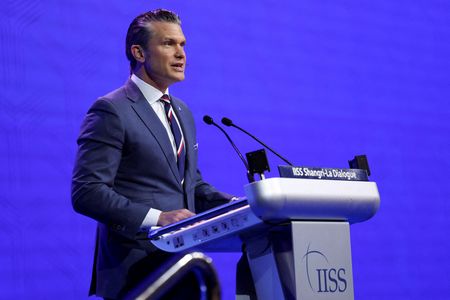

U.S. Defense Secretary Pete Hegseth delivered a stark warning to Asian partners on Saturday, calling for increased military investments to counter China’s expanding military capabilities and prevent regional dominance.
Speaking at the Shangri-La Dialogue in Singapore, Asia’s leading defense and diplomatic gathering, Hegseth emphasized the need for stronger, more independent allied networks to discourage aggression and maintain regional stability.
“There is rightful alarm regarding China’s historic military buildup and the expansion of its military activities in the region and beyond,” he said.
Hegseth warned against any single power controlling the Pacific region. “A Pacific dominated by any hegemon would unravel the regional balance of power,” he stated. “No state, including China, can impose its hegemony and hold the security or prosperity of our nation and our allies in question.”
The Pentagon leader announced expectations for Asian allies and partners to boost defense spending to 3.5% of GDP, while the U.S. commits $1.5 trillion to military investments.
Hegseth emphasized that allies seek stability rather than conflict escalation. “What they want, and what the United States delivers, is strength that is disciplined, resolve that is steady, and leadership that is confident enough to speak and walk softly while carrying a big stick.”
Despite security concerns, Hegseth adopted a balanced approach regarding U.S.-China relations, describing them as “better than they have been in many years,” with increased military-to-military communications helping manage tensions.
“We are meeting more frequently with our Chinese counterparts by maintaining open lines of military to military communication.”
“NO FREELOADING”
Hegseth reinforced President Donald Trump’s ongoing demands for allies to bear greater defense responsibilities, similar to expectations for European and NATO partners to reduce dependence on Washington.
“The era of the United States subsidizing the defence of wealthy nations is over,” Hegseth declared. “We need partners, not protectorates,” he continued. “We don’t have a strong alliance unless everyone has skin in the game. No freeloading.”
The Defense Secretary commended contributions from multiple allies including South Korea, the Philippines, Australia, Singapore, Malaysia and Thailand, while noting Japan’s concrete measures to strengthen its defenses.
Regarding the U.S.-Japan partnership, he said both nations “must each pull our weight to strengthen the U.S.-Japan alliance.”
ARMS SALES DECISION TO TAIWAN IS TRUMP’S CALL
When questioned about weapons sales to Taiwan, Hegseth dismissed concerns that a multi-billion-dollar package might be impacted by U.S. weapons stockpile reductions due to Middle East conflicts. “We feel very good about our stockpiles and how we use them,” he said.
Taiwan, which China considers its territory, awaits U.S. approval for an arms sale that Reuters reported could reach $14 billion.
Trump created uncertainty in Taipei by stating, following his meeting with China’s President Xi Jinping this month, that he remained undecided about approving the package.
Hegseth indicated that any future arms sales decisions would remain with President Trump, showing no departure from Washington’s established approach despite recent Beijing engagement.
“Those decisions will depend on the president and the nature of that relationship,” Hegseth explained. “There’s been no change in our status.”