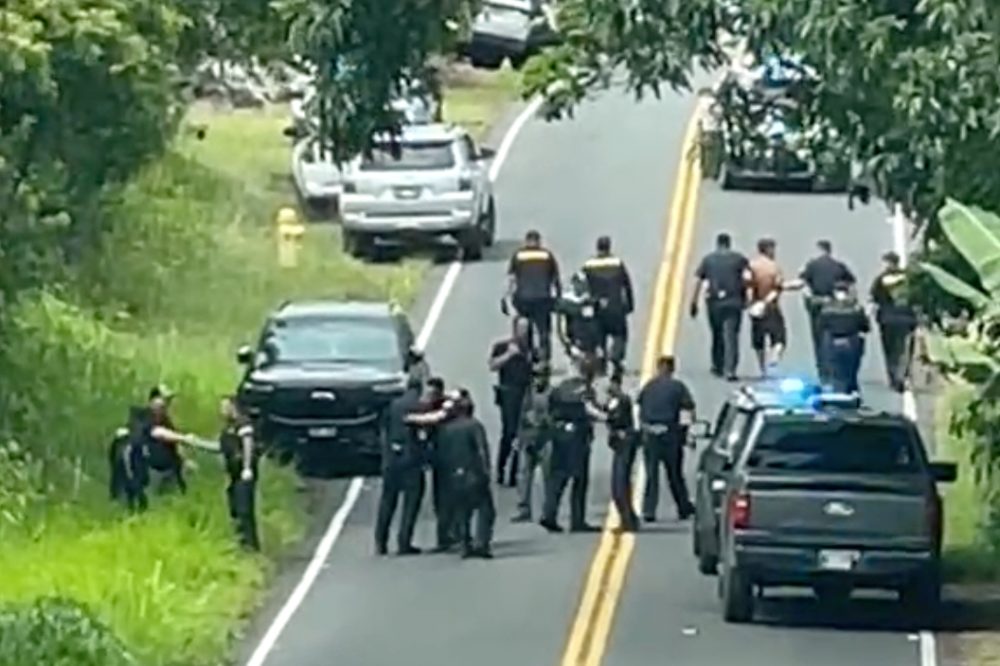

HONOLULU — Residents of Puna, an isolated and diverse area on Hawaii’s Big Island, are grappling with the shocking murders of three elderly men who embodied the region’s unconventional, off-the-grid way of life.
Almost a full day following Jacob Baker’s arrest, community members are wrestling with understanding the events and seeking explanations for why law enforcement focused on the 36-year-old as their primary suspect in the deaths of three men who were approaching or had reached their 70s.
Baker continues to be held in custody on suspicion of murder, burglary and additional charges.
Legal documents reveal Baker has had numerous encounters with law enforcement for various violations. Local Puna residents told The Associated Press that their worries about Baker had intensified in recent times, describing him as becoming more menacing.
Baker stands accused in the deaths of three individuals: a 69-year-old discovered partly underwater in a concrete pond, a 79-year-old found mere hundreds of feet away, and a third 69-year-old whose remains were located approximately 19 miles from the other two. By Friday, formal charges had not yet been filed by prosecutors.
Authorities named the first victim as Robert Shine and the third as John Carse. While the 79-year-old’s identity awaits official confirmation, acquaintances have identified him as Chitta Morse.
Police Chief Reed Mahuna stated that investigators discovered no links between the victims beyond two living in proximity to each other.
Those who knew Shine and Morse describe how both men relocated to Puna seeking its independent, tropical and community-oriented atmosphere.
Shine found joy in moving and dancing to rhythms at drum gatherings, typically held on Sunday afternoons, according to Donald Hyatt, a drummer.
Hyatt’s final encounter with Shine occurred at a gathering the previous month where a local rock band performed and Shine danced enthusiastically.
“He was dancing like he loved life,” Hyatt remembered. “Bob had a permanent smile. Always in good spirits.”
Morse relocated from Van Nuys, California four decades ago “to live off-grid and to live in a warm tropical place, and to eat fruit,” explained friend Jezuz Cinderland. “For 40 years he only ate raw food. Since he got to the island he just went completely raw and this was just the right environment for him to do it.”
On fertile volcanic land along Papaya Farms Road, Morse cultivated what Cinderland described as a “fruit forest,” producing coconuts, avocados and durian among other crops.
“He would just share all the fruit he had,” Cinderland noted. “The most fabulous abundance that you can imagine.”
Though Morse had once belonged to the raw-food commune that Cinderland joined when moving to Puna, Morse had become more isolated in recent years, Cinderland explained.
Shine belonged to Cinderland’s commune, which county officials have closed due to multiple code infractions, Cinderland said.
Janelle Honer, who also cultivated fruit along Papaya Farms Road, appears to represent the link connecting Baker to the victims, who frequently participated in communal meals and gatherings at Honer’s land.
Baker had been residing on Honer’s property while performing coconut tree climbing and trimming services, according to her former husband, Stephen Shaffer. Exchanging labor for housing arrangements is typical in Puna.
Hyatt explained that Baker departed the cabin on Honer’s land months earlier but recently returned asserting “squatter’s rights” and made threats toward Honer. Hyatt said he encouraged her to obtain a protective order.
The murders occurred just days following two women’s requests for temporary protective orders against Baker, claiming he had made threats and harassed them at an agricultural property. One woman was residing there while the other held partial ownership. A judge rejected both requests, citing insufficient evidence of harassment.
Baker had no legal representation listed and has accumulated 20 additional court cases over two decades, primarily traffic violations. Baker typically served as his own attorney in most instances.
Honer, who Shaffer indicated was traveling internationally, could not be contacted for comment.
A remembrance ceremony for the victims was scheduled for Saturday adjacent to Honer’s property.
Puna represents one of Hawaii’s few locations offering affordable property, though the region’s infrastructure has failed to match its population growth, according to Ashley Kierkiewicz, who serves Puna on the county council.
Despite Puna’s reputation as an unconventional frontier area, it also represents a culturally rich community where residents demonstrate resilience and mutual support, she noted.
Puna’s terrain combines dense jungle with stark lava rock formations, while the area also faces challenges including substance abuse, economic hardship and insufficient resources, said long-term resident Tiffany Edwards Hunt.
“People have this mistaken impression that they can come to Hawaii and heal,” she observed. “Hawaii can either really be kind to you or it can chew you up and spit you out.”
Mark Wyatt and Richard Valdez proved instrumental in Baker’s apprehension, contacting authorities when their security camera system alerted Valdez’s phone, showing Baker on their land Thursday. Their property sits roughly half a mile from Carse’s residence, though they barely knew him.
The footage depicts Baker without shirt or shoes, accompanied by a dog, walking near a roadway and crouching when vehicles passed, seemingly attempting to remain unseen.
“He was ducking from the traffic, so it was pretty obvious” that he was trying to avoid detection, Valdez explained.
Law enforcement apprehended Baker nearby after discovering him in a small cave, police reported.
Wyatt believes Baker had been concealing himself near his property at a crude campsite positioned on a cliff above the ocean. He said Baker took couch cushions from a storage container outside his residence plus some charcoal, using coconut palm fronds to camouflage the location.
Valdez hadn’t encountered Baker for approximately two years. During that earlier period, Baker lived adjacent to them, renting space from their neighbor while harvesting and selling coconuts along the area’s primary road. He remained next door for roughly six months, Valdez said.
“He told me he was from Maui and that he had just had a newborn baby and his girlfriend had left and that he was trying to get his life together,” Valdez recalled. “So he seemed pretty normal and conscientious, so it’s hard to fathom that this happened.”