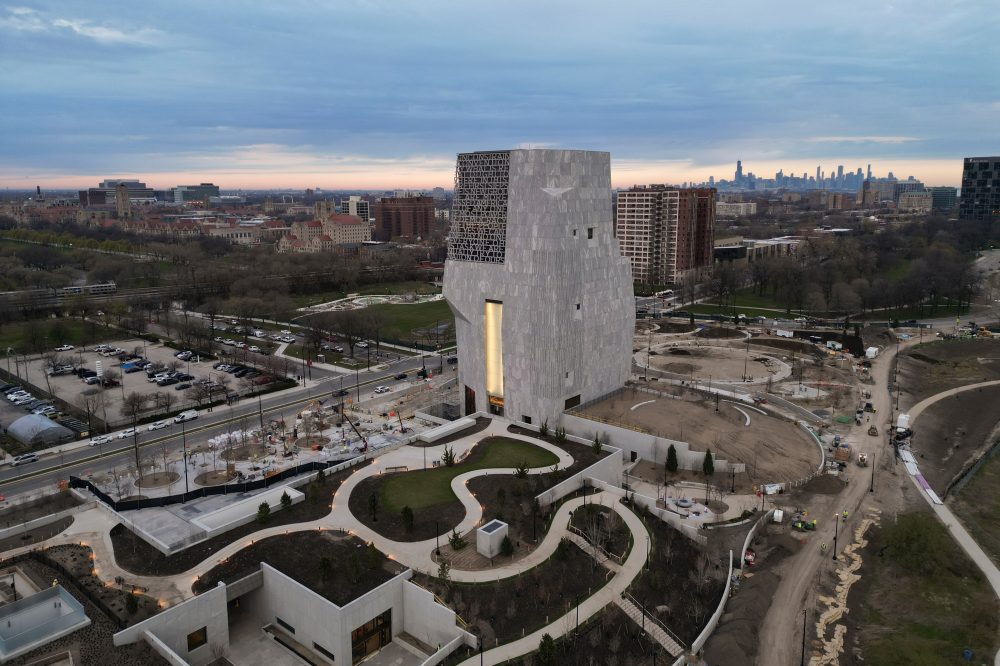

CHICAGO (AP) — A towering granite structure rises from Chicago’s South Side, its nearly windowless facade resembling something from a science fiction movie rather than housing a cutting-edge presidential museum.
Workers are completing final preparations for the Obama Presidential Center before its official opening to the public on Juneteenth, over ten years since the location was selected. However, the design of the approximately $850 million complex — especially the prominent 225-foot tower on its northern edge — continues to split opinions in the city known as the birthplace of modern high-rise construction.
Some view it as an inappropriate choice for Barack Obama’s home city following an intense fight over placing it in a waterfront park typically featuring classical architectural styles. Others see it as a daring contribution that will influence Chicago’s famous skyline for generations.
Local residents have likened it to a grain storage facility, a vessel from “Star Wars,” and a tomb.
“It doesn’t fit in at all,” said Brenda Nelms, who has lived in the area since the 1970s and leads a group that advocates for nearby Jackson Park, which spans more than 500 acres.
Obama Foundation leadership, which has secured private funding, acknowledges they’ve heard all the criticism. They even recruited “Star Wars” actor Mark Hamill for playful promotional content on May the 4th, a date celebrated by the movie series’ fans.
“Part of the joy of the center is everyone is going to have their unique experience,” said Valerie Jarrett, foundation CEO and a former Obama advisor. “The design of the building was intended to be inviting and opening to people whether they live across the street or around the world.”
Chicago sets a high standard for architectural excellence, from Louis Sullivan’s modern towers following the Great Chicago Fire of 1871 to Helmut Jahn’s post-modern office structures.
Design discussions are so passionate in the nation’s third-largest city that Chicago Sun-Times architecture critic Lee Bey calls it “a spectator sport.” His first reaction to the Obama Presidential Center was that it appeared more appropriate for a graveyard.
The dramatic design features minimal windows, all strategically positioned. Foundation representatives explain this choice also helps shield interior artifacts from sunlight damage, including a replica Oval Office.
Bey noted the museum’s design becomes more logical when viewed alongside other shorter structures on the campus, which features a basketball court, children’s playground, public library branch and works by prominent artists.
Other famous Chicago buildings have received mixed initial reactions, he explained. The former John Hancock Center, a black 100-story structure marked by massive X-shaped supports, was likened to an oil rig shortly after its 1960s construction. Recently renamed 875 North Michigan Avenue for its street address, the building contains retail spaces, condominiums and offices.
“As we begin to experience buildings, we begin to imprint our own impressions,” Bey said. “The John Hancock becomes less of an oil derrick and more of the building that has your doctor’s office.”
Edward Keegan, a Chicago Tribune architecture columnist, has labeled the presidential museum “an un-Chicago building” due to its limited windows and unconventional form. Nevertheless, it provides a distinctive city perspective.
The building’s summit features a glass-walled “Sky Room” offering sweeping Chicago vistas, including northward views of downtown that are rare from such elevation.
“It doesn’t feel like any other place in Chicago,” he said. “It does feel unique and unexpected.”
The path to the museum’s completion was challenging, despite Obama maintaining strong support in the Democratic stronghold.
Legal challenges to halt construction began after the location announcement in 2015. Worries about displacing low-income and Black residents in nearby neighborhoods intensified. Community organizations pushed for housing protections, though area residents argue they remain insufficient as property values near the museum have skyrocketed.
Building the museum required removing nearly 20 acres of parkland and eliminating a portion of a major roadway, which residents claim was essential for connecting people from other city areas and suburbs to downtown.
During a recent stroll through a bird sanctuary adjacent to the center, activist Robin Kaufman, 82, explained she couldn’t fully appreciate the wildflowers near the secluded ponds as before. She observed ducks swimming in a lagoon but couldn’t overlook the center’s tower visible above the trees.
“Everywhere I go, you can see it, so you’re reminded of what’s going on and that’s distressing,” she said. “I’m very distrustful of anything they say.”
She and others worry about what additional developments might arrive in the area due to Obama’s presidential center.
“It’s a Trojan horse,” said Shannon Bennett with the Kenwood Oakland Community Organization. “It’s an extreme version of a scheme to transform these communities for another population.”
Multiple design decisions were made by the former president alongside New York-based architects, Tod Williams and Billie Tsien. Obama selected a stone design and desired a tall tower for city panoramas near where he raised his family and taught law at the University of Chicago.
The tower’s structure represents four hands joining together in unity. Wrapping around one side are 5-foot concrete capital letters, featuring text from Obama’s 2015 speech marking the 50th anniversary of the Selma-to-Montgomery march. It starts with “You are America.”
The Obama Foundation reports they have expanded some streets, created a new field for local school use, and the campus includes a new public library branch, basketball gymnasium for community access, a playground and gardens landscaped to harmonize with the surrounding park.
“The benefit of having this extraordinary facility far outweighs any costs,” Jarrett said. “It’s a symbol to the community of how important they are to us.”
Adam Rubin at the Chicago Architecture Center described it as a successful project thus far, while noting lingering questions about whether trading parkland for the center was justified.
“It really does have a sense of place,” he said of the museum. “Time will tell how people utilize it.”