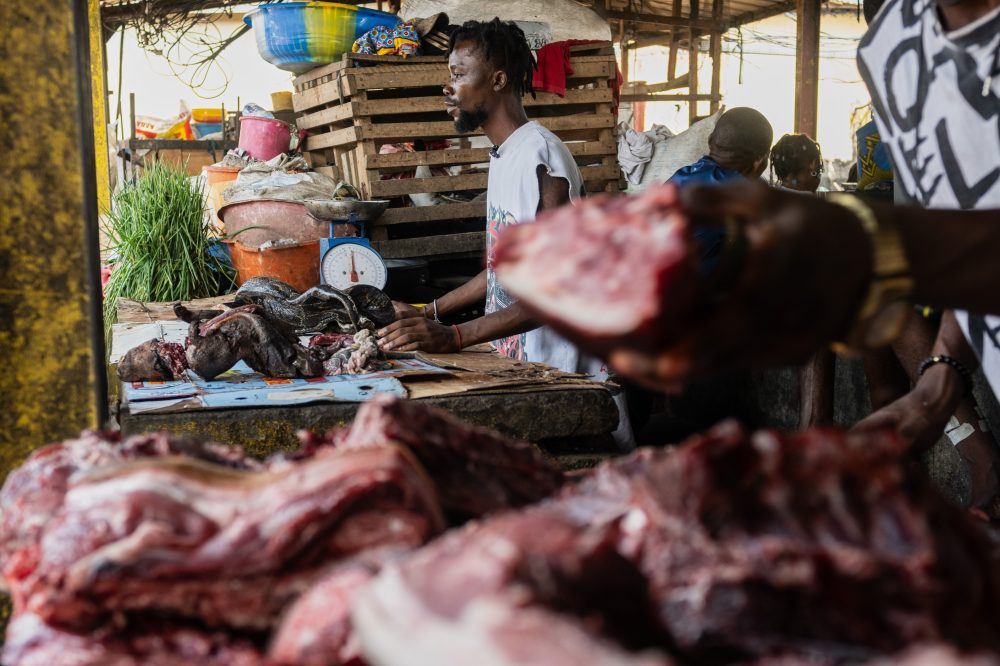

KINSHASA, Congo (AP) — At Kinshasa’s bustling Masina Market, sellers of bushmeat don’t always put their products on full display. Shoppers need to specifically request what they want, from large swamp rodents to pieces of antelope meat.
Some merchants do sell openly, including women managing enormous baskets filled with wriggling caterpillars throughout the market.
Throughout Congo and other parts of Central and West Africa, bushmeat represents both a culinary desire and an integral element of local culture. Even a devastating illness like Ebola, which is currently destroying communities in eastern Congo’s remote areas, hasn’t reduced the appetite for wild game from the Congo Basin, a vast forest region often referred to as the planet’s second lung.
The Congo Basin contains diverse wildlife ranging from large primates to snakes — both hunted for consumption. This creates exposure risks for residents to diseases that jump from animals to humans, including Ebola.
While Ebola typically doesn’t transmit through food consumption, African cases have been linked to hunting, slaughtering and preparing meat from diseased animals, according to the U.S. Centers for Disease Control and Prevention.
“Once there is human, animal and environment interface, we have these kinds of outbreaks on a frequent level,” said Dr. Tolbert Geewleh Nyenswah of the Africa Centres for Disease Control and Prevention. “And this is why one health approach in dealing with virus outbreaks is important, because we still interact with the bats, and our hunters are still killing monkeys, and we are close to the environment.”
Congo’s government has verified over 1,000 potential cases with no fewer than 220 fatalities since announcing the Ebola outbreak on May 15. The virus appears to have circulated unnoticed for weeks, with the World Health Organization believing the actual scope exceeds reported numbers.
Ebola, which takes its name from a Congo River tributary, was initially identified in 1976 during concurrent outbreaks in Congo and what is now South Sudan. Outbreaks typically begin when the virus jumps from infected animals like fruit bats into human populations. These animal-to-human transmissions frequently occur during wild meat handling and consumption, according to specialists.
However, because Ebola outbreaks occur infrequently in areas where bushmeat consumption is routine, some residents “don’t believe the linkage” while others remain “totally ignorant” about health risks from eating wild game, explained Dr. Misaki Wayengera, a microbiologist who counsels Uganda’s Ministry of Health on disease outbreaks.
“It is very difficult to change some of these core practices,” he said.
Communities have suffered severely from periodic Ebola outbreaks, with the disease’s gruesome symptoms terrorizing entire settlements and leading many to think they’re cursed.
The Ebola virus has caused 17 outbreaks in Congo plus numerous others across the region. The most devastating outbreak occurred in West Africa from 2014 to 2016, infecting approximately 28,000 individuals and causing over 11,300 deaths.
The Food and Agriculture Organization — which examined Ebola risks from bushmeat consumption and handling following West Africa’s epidemic — found that animal-to-human Ebola transmission is uncommon, but “their consequences are nonetheless disastrous.”
After Ebola infects an initial person, the virus spreads through direct contact with bodily fluids from ill or dead patients, including perspiration, blood, waste or vomit. Healthcare workers lacking adequate protection face particularly high risks.
The present eastern Congo outbreak involves the Bundibugyo virus, an uncommon Ebola strain without approved treatments or vaccines.
This outbreak is happening in a Congo region also experiencing armed conflict from rebel forces and mass population displacement from fleeing violence.
Though Congolese officials have banned hunting threatened wildlife, including great apes pushed toward extinction by poachers, no comprehensive wildlife trade prohibition exists and illegal hunting continues for symbolic animals like bonobos.
Numerous Congo Basin residents rely on bushmeat as their main animal protein source. Annual wild meat harvesting from the Congo Basin reaches an estimated 4.5 million tons, based on Center for International Forestry Research data.
Viande de brousse, the French term for wild meat, enjoys popularity as food, even appearing in upscale restaurants. This has increased pressure on the Congo Basin’s declining resources. Despite continuing biodiversity loss, the Congo Basin remains the world’s largest carbon sink, exceeding the Amazon’s carbon capture and storage capacity.
Public health advocates must intensify educational efforts about Ebola’s origins and transmission in communities facing repeated outbreaks, according to Gladys Kalema-Zikusoka, founder of Uganda’s Conservation Through Public Health organization.
Communities need education that “eating meat from an unknown source, or a dead animal, is a no-no,” Kalema-Zikusoka said. “It’s a very cultural thing.”
Certain fruit bats are thought to naturally carry Ebola-causing viruses, the WHO reports. Yet bats remain delicacies across much of Central and West Africa. Roasted fruit bat soup is highly prized, along with various monkey parts.
At Kinshasa’s Masina Market one recent morning, before the current Ebola outbreak, merchants reported selling antelope, rodent and snake meat obtained from the Congo Basin.
They indicated they had long since ceased selling monkey meat, which could harbor the Ebola virus.
Vendor Guyva Mputu was offering python, its frozen meat beginning to steam in the moisture-heavy air.
Another seller, Charles Ntanga, used a flywhisk against flies landing on a spoiled giant rodent carcass, with each kilogram priced at roughly $17. Ntanga reported serving customers from diverse backgrounds.
“We sell wild meat,” he said. “We make our lives through this business.”