
TEL AVIV, Israel (AP) — An Israeli reservist watched as his fellow soldiers celebrated enthusiastically, cheering each other on. They had just attacked a Palestinian vehicle traveling near the Israeli-controlled section of the Gaza Strip, leaving all occupants dead.
The military member said such incidents had become routine following the implementation of a fragile ceasefire in October. During his weeks of deployment in Gaza, he witnessed troops eagerly pursuing those who violated — or nearly violated — the yellow boundary line separating Israeli-controlled zones from Palestinian territories.
“It was a jungle,” the soldier, who is in his twenties, told The Associated Press. “After the ceasefire, the order was: If someone crosses the line, you shoot them.”
While diplomatic attempts to reinforce the agreement have reached an impasse, three military personnel shared with AP their experience of disorder in the war-torn region, citing unclear guidelines for engagement near the yellow boundary. The soldiers reported that some commanding officers publicly supported the ceasefire while privately expressing hopes for continued warfare in Gaza. Occasionally, forces were positioned too distantly or responded too hastily to properly identify their targets, according to one soldier — a worry also raised by a veteran whistleblower organization.
These military accounts offer an uncommon look into events within Israeli-controlled Gaza since the agreement took effect seven months prior. The soldiers — reserve forces deployed across Gaza from October through January who have since returned home — requested anonymity due to concerns about potential social isolation for their statements. They explained their motivation for speaking publicly stemmed from anger and grief over their observations.
AP has recorded instances of Palestinian civilian shootings, including children at play, near the yellow boundary. The soldiers indicated that fatal incidents seemed continuous throughout the unstable agreement.
“To call it a ceasefire is a joke,” one soldier told AP.
Following the ceasefire implementation, Israel repositioned forces to a buffer area marked by a yellow boundary, securing control over slightly more than half the territory. The agreement requires Israeli forces to execute a more complete withdrawal, though no specific timeline exists. The diplomat backed by the U.S. who supervises the truce reports that advancement has stalled due to the primary obstacle of disarming Hamas, which affects all other matters — including Israeli pullbacks and rebuilding efforts.
During this period, Israel has extended its authority over additional Gaza territory. Each side has blamed the other for ceasefire violations.
The boundary’s precise position has remained unclear and sometimes unmarked. In certain areas, yellow blocks and barrels indicate its location; elsewhere, it has occasionally gone completely unmarked.
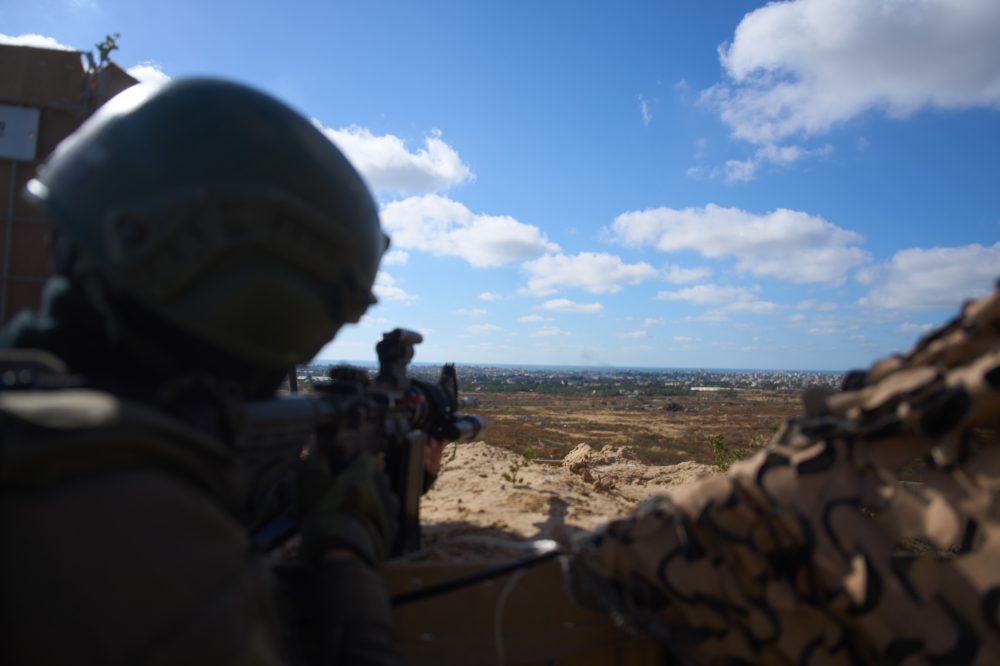
The Israeli military brought AP this week to observe a portion of the yellow boundary in central Gaza, close to the Maghazi refugee camp. The boundary was clearly visible there, marked by a broad dirt pathway and small yellow indicators. To the east lay an empty expanse of open ground extending to a heavily defended Israeli military position approximately 500 meters distant.
An Israeli military commander stated that Hamas operates on the opposite side of the boundary and regularly dispatches individuals — both fighters and civilians — toward and across the line to evaluate the army’s preparedness and reactions.
“There is no reason for anyone to come near the line,” he said, speaking on condition of anonymity under military rules. “There’s nothing here.”
The army claims the complete boundary, spanning Gaza’s entire length, now has clear markings.
Since the ceasefire began, over 900 individuals have died in Gaza — dozens of them near or beyond the yellow boundary, according to Gaza’s Health Ministry. The ministry does not specify how many were fighters, but unarmed men and children were among the casualties.
Israel’s military has stated that most individuals killed while crossing the boundary presented a danger to troops. However, soldiers who spoke with AP and Breaking the Silence — the whistleblower organization that has gathered troop testimonies during the war — report that soldiers sometimes acted from too great a distance, too rapidly, and under excessive pressure to make accurate determinations.
Israel’s army informed AP that the zone near the yellow boundary represents a “sensitive operational environment” with posted warnings against approaching. It stated the army does not target civilians merely for approaching the boundary and that engagement rules mandate warnings before force is used. In cases involving immediate danger, forces have authorization to respond, it explained.
This marked the combat soldier’s second deployment in Gaza when the ceasefire commenced. He reported being positioned several hundred meters from the yellow boundary and witnessing multiple individuals attempting to cross it being killed by soldiers.
Soldiers conducting shootings or requesting drone attacks do not always identify who is crossing the boundary, he explained. While soldiers must provide location coordinates and obtain superior approval before attacking, delivering precise information becomes difficult as people move, he noted. He described soldiers reporting coordinates based on assumptions or the last observed location of someone.
Breaking the Silence reports that general engagement rules are extremely lenient, particularly regarding boundary crossers, with instructions in many zones being “shoot to kill.” Executive director Nadav Weiman, a veteran who served in Gaza but not during this conflict, identified distance from targets and some overeager soldiers as problematic factors.
He stated that directives and policies from military leadership “have created a reality where countless civilians have and are being killed for crossing invisible lines.”
In one testimony to Breaking the Silence, documented in interview notes reviewed by AP, a soldier describes instructions for troops regarding anyone crossing the yellow boundary: “eliminate him no matter what.”
Another soldier deployed in Gaza for weeks following the ceasefire said commanders emphasized maintaining the boundary at any cost.
“There was a general feeling that human lives are not valuable,” he said.
Regarding yellow boundary marking, the soldier reported his superiors called it “too much work,” not their responsibility, and claimed Palestinians should know its location.
Gaza deployment created emotional strain, he explained.
While snipers sometimes fired warning shots at people approaching the boundary, he said, commanders instructed troops to take greater self-protective measures. The soldier interpreted this as authorization for more lethal shooting.
He and other soldiers who spoke with AP said troops generally believed, based on leadership and peer actions, that Israel planned a permanent Gaza presence rather than eventual withdrawal.
An internal report distributed among aid organizations last month and reviewed by AP indicated that throughout Gaza, Israel has grown “increasingly proactive” with its attacks.
Independent data from the Armed Conflict Location and Event Data Project, a nonprofit based in the U.S., showed April as Gaza’s deadliest month this year and reported that documented deaths near the yellow boundary or of people who crossed it rose over 25% from January to April, increasing from 58 to 73.
This week, Israeli Prime Minister Benjamin Netanyahu announced Israel controls 60% of Gaza and indicated the next objective was advancing to 70% control.
The soldiers informed AP that conditions on the ground make the ceasefire seem nonexistent.
“We need to stop using this term,” one said regarding the word ceasefire. “It’s not serving people that want to stop the war.”