
LONGVIEW, Wash. — A devastating industrial accident at a Washington state paper mill has claimed 11 lives after a massive chemical storage tank failed, releasing a torrent of dangerous substances that overturned vehicles and damaged buildings.
Washington state Sen. Jeff Wilson, who lives nearby and can view the facility from his home, has personal connections to the site through his former environmental cleanup business. When emergency sirens began wailing, his first thought was for his son who works at the industrial complex.
“I personally have been inside that tank and near that tank many times,” said Wilson, who has lived in Longview for 56 years. “I can assure you that we all know somebody there. … The casualties are our friends and neighbors.”
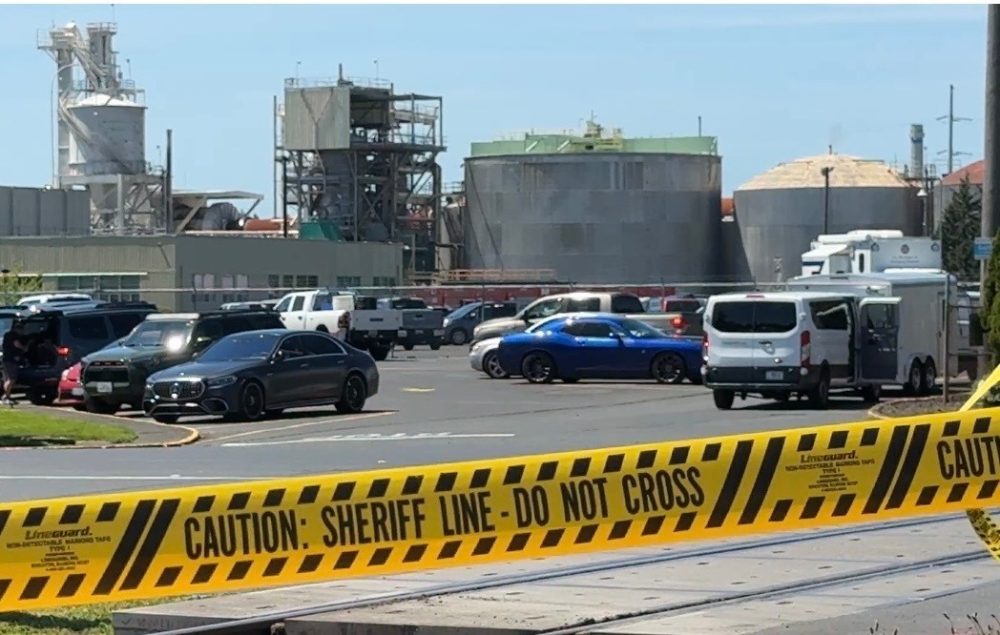
The failed storage vessel held more than 500,000 gallons (1.9 million liters) of chemicals used in wood processing for paper production. Tuesday morning’s catastrophic failure at Nippon Dynawave Packaging Co. sent a wave of corrosive materials across the facility with enough force to flip pickup trucks and cause structural damage.
This workplace tragedy ranks among the most fatal industrial accidents in recent U.S. history, striking a community where multiple generations have earned their livelihoods at local manufacturing facilities. The city’s origins trace back to a timber magnate who established the area’s first mills, creating a century-long bond between residents and the lumber and paper sectors.
Beyond supporting families in mourning, community members express concerns about the facility’s future operations. These positions provide essential employment in a sector that historically drove the region’s economy but has faced significant decline over recent decades.
Tokyo-based Nippon Paper Group, the facility’s parent organization, released a statement indicating they are evaluating how the incident will affect their financial results.
“Last night at the vigils, people who work in mills told me that they’re proud of their jobs and they’re proud of their work, and they don’t want to lose it,” U.S. Rep. Marie Gluesenkamp Perez, whose district includes Longview, told reporters Wednesday.
Local residents interviewed by The Associated Press emphasized the critical importance of these manufacturing positions for their community.
“If you’re a waitress, a grocery store worker, a teacher, a paraeducator as I was for 30 years — every walk of life here knows somebody and is related to somebody from these mills,” Cindy Stiebritz said in the antiques store where she volunteers.
Stiebritz noted that her husband’s parents first met while employed at the lumber operation owned by the city’s founder, Robert A. Long.
“Those mills, that is the backbone of this town,” Stiebritz added. “You feel like you’ve lost part of your family.”
The city’s manufacturing district sits alongside the Columbia River, housing timber, paper and chemical operations. Most residents in this community of nearly 40,000 can observe the facilities, steam from industrial boilers, or detect the distinctive sulfur scent associated with pulp and paper production from their neighborhoods.
The community’s industrial heritage is visible throughout downtown, where R. A. Long Square functions as a primary landmark and gathering spot, including for memorial services following the disaster. A recreational area surrounding an artificial lake, another Long initiative, provides green space where residents use walking trails and tree-lined roadways.
Officials report that investigators are still determining what caused the tank’s structural failure. The manufacturing site, operating since 1953 with approximately 1,000 employees, produces materials for tissues, printing paper, cups, plates, cartons and similar products.
Fundraising efforts for victims’ families reveal that those who perished included a grandfather known for helping others, two brothers with one serving as the primary income source for his partner and three children, and a husband survived by two children and an expecting wife.
Brianna Pesio, who serves customers at the Mill City Grill downtown, described Tuesday morning’s terror when her brother, employed at the adjacent lumber facility, couldn’t reach their father who works at the plant and has been there over 30 years.
“I just didn’t know if I lost my dad or not,” said Pesio, whose husband also works in a paper mill. “I drove over to my dad’s house and pounded on his door until he did wake up. He had just gotten off shift at 5 a.m.”
At the nearby Country Folks Deli, longtime server Gayle Leavitt mentioned her in-laws also spent decades working at the mill, adding: “That’s how this town has survived.”
Area representatives reinforced residents’ pride in manufacturing work and the economic significance of well-compensated positions in a region where other communities have suffered from timber industry contraction.
“This is a place where real people make real things. This is not the virtual world,” state Rep. Jim Walsh said at a news conference at the plant on Tuesday. “Real things and real industry always carries risks. But it’s our job to make sure that risk like this is well managed and, to the extent it can be, controlled.”
Stiebritz, the antiques shop volunteer, expressed hope that authorities determine the cause “so it never happens again.”
“If anything comes out of it, I hope lives can be saved,” she said, tearing up as she thought of the children who have lost their parents.
“This town is family. It’s one big family,” she added. “But we’ll make it though. We’re strong. We’ve got a lot of love.”