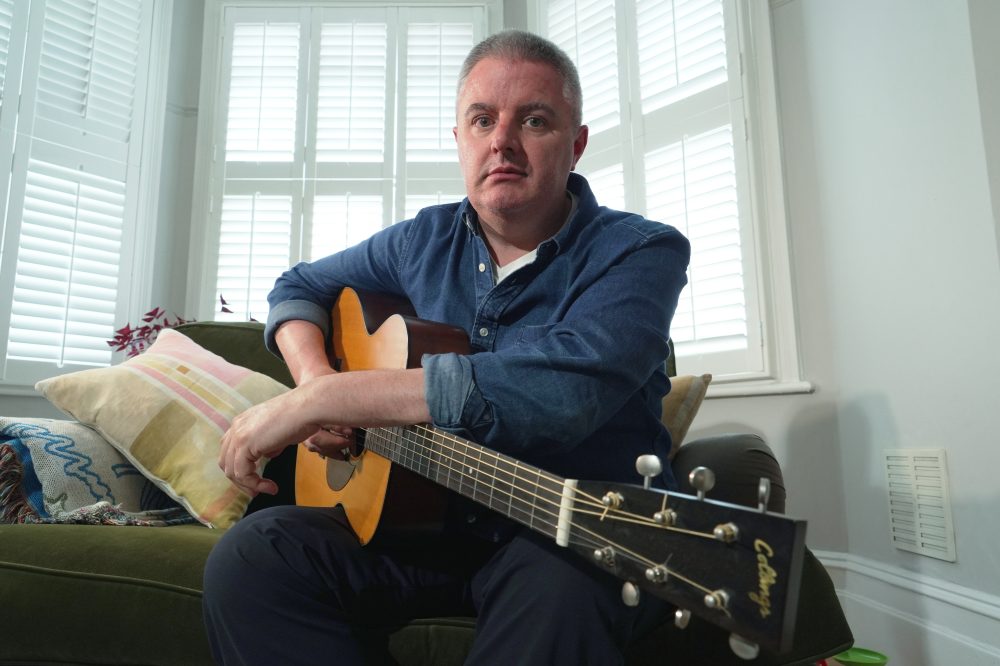

A musician from London has found an innovative way to continue creating music after Parkinson’s disease affected his ability to play guitar, turning to artificial intelligence technology to complete his latest recording project.
Samuel Smith, a singer-songwriter who has spent years crafting Americana music with guitar as his primary instrument, received his Parkinson’s diagnosis in 2020. The 49-year-old artist recently completed his second album, “The Art of Letting Go,” using AI music generation platforms to help translate his creative ideas when his physical abilities became limited.
For an instrumental track called “Horizon” on the eight-song collection, Smith utilized AI-powered music generators after humming melodies into his phone. He then uploaded these recordings to platforms including Suno and Udio to create demonstration arrangements that communicated his artistic vision to the session musicians who would record the final version.
Smith emphasized that these AI-generated demos were not incorporated into the finished studio recording. However, as Parkinson’s symptoms including tremors, stiffness, and fatigue progressed during the album’s year-long creation process, his guitar abilities declined significantly.
“So then I’m faced with a question,” Smith said. “‘Don’t play, don’t be creative, or find a way out, find a route.’ And for me, this was the route.”
The use of generative AI technology has created controversy within the music industry, with artists and record companies expressing concerns about copyrighted material being used to train AI models. Major labels Sony Music Entertainment, Universal Music Group, and Warner Records filed lawsuits against Suno and Udio in June 2024, though Universal and Warner later reached settlement and partnership agreements with the respective companies.
However, Smith’s situation highlights a different application of these tools – assisting musicians whose medical conditions impact their traditional creative processes. His debut album “In the Springtime” was released in 2023, which he described as wanting to preserve memories of his musical abilities for his two sons.
“I’d always written, I’d also played, I always sung,” Smith explained. “And immediately it became clear to me that I was in trouble, that my music was going to be seriously compromised.”
The AI music generation systems operate by analyzing large collections of recorded music and audio, studying patterns in melody, harmony, and rhythm to create new audio based on user prompts or uploaded recordings. These platforms allow users without traditional musical training to produce complete songs.
Smith described the process of creating usable demos as requiring “50, 100, 150 attempts” along with extensive editing “to get something that sounds close to my music.” After recording himself humming melodies and uploading the audio, he provides detailed prompts describing the desired instrumentation, mood, and musical style.
“AI is not replacing anything for me,” Smith stated. “It’s unlocking, it’s enabling. It’s allowing me to keep writing. I upload my lyrics; AI doesn’t create my lyrics. I upload my music; AI does not create my music.”
He continued: “It then brings it to life in a way that I can play to session players and say, ‘Here, that’s what I’m thinking, that is what I’m hearing.’”
Grammy-winning pianist and producer Matt Rollings produced the album, assembling a group of accomplished roots and bluegrass musicians for the recording sessions. The lineup included dobro player and 16-time Grammy winner Jerry Douglas, Grammy-winning banjo player Alison Brown, fiddler Stuart Duncan, guitarist Bryan Sutton, bassist Viktor Krauss, and vocalists Jonatha Brooke and Glen Phillips.
Smith described performing in a Nashville studio alongside musicians he had long admired as “an extraordinary moment.”
Grammy-nominated guitarist Julian Lage, recognized for his jazz and acoustic work with Blue Note Records, contributed to both the album’s title track and “Horizon.” The “Horizon” recording became particularly meaningful for Smith, as he managed to perform a guitar duet with his friend despite his condition’s progression.
“I hadn’t been able to play for months, but I kept telling myself that if I wrote something to take to the studio, perhaps the clouds would part for a few minutes,” Smith recalled. “That’s what happened. I had a window of about 10 minutes in the studio when my arm freed up. … So in the end, I was able to capture the last breath of my guitar playing.”
Music experts suggest that AI-assisted tools could provide benefits for other individuals dealing with disabilities or illnesses that affect their musical abilities.
Ruaidhri Mannion, a composer, music producer, and sonic artist who teaches at Brunel University of London, noted that affordable digital recording technology “effectively democratized the making of music” in recent years. He believes AI tools that create polished-sounding material from voice or text inputs could serve a similar function by helping songwriters and musicians communicate concepts and collaborate more effectively.
“If these tools are able to enable people to be able to participate with other creative groups and encourage more people to feel confident to be able to reach out to an ensemble or an orchestra or something, then I think that is all for the better,” Mannion explained.
However, Mannion cautioned that excessive dependence on technology might interfere with the trial and error, frustration, and creative synergy that are essential components of a musician’s artistic growth.
“What makes a lot of music-making meaningful is the collaborative element,” he noted. “There’s a lot of experimentation and development and failure that’s part of musical discovery.”
Both Udio and Suno have rejected copyright infringement claims and expressed interest in working cooperatively with the music industry. Some musicians remain skeptical of these platforms. A coalition of recording artists and activists, including singer-songwriter Tift Merritt, David Lowery from bands Cracker and Camper Van Beethoven, and ECR Music Group President Blake Morgan, released an open letter in February titled “So no to Suno.”
“Many in our community are embracing responsible AI as a tool for creation, and as a means for fans to explore and interact with our artistry. That’s wonderful,” the letter stated. “But it’s not the same as creating an environment where AI-generated works sourced from our music are mass distributed to dilute our royalties or, worse yet, reward those actively seeking to commit fraud. Artists need to know the difference.”
Smith believes his experience demonstrates how AI technology could benefit society and expand creative opportunities when developed responsibly.
“My message would be that if these companies want to show they’ve got a place, a role in society, then step up,” Smith said. “Engage with health professionals, engage with music therapists, engage with society and show us what you can do.”
On May 21, Smith partnered with the Berklee Music and Health Institute for a New York event that brought together music industry executives, researchers, and medical professionals to explore how music can support individuals living with neurological conditions. Smith shared his experience with Parkinson’s disease and performed again with musicians from “The Art of Letting Go.”
Continuing to create music remains essential to the legacy Smith wants to establish for his children, who are 4 and 17 years old.
“My 4-year-old is probably never going to remember me playing, and it’s heartbreaking,” he said. “But I’ve been able to pull this into something and refuse to be defined by this disease.”