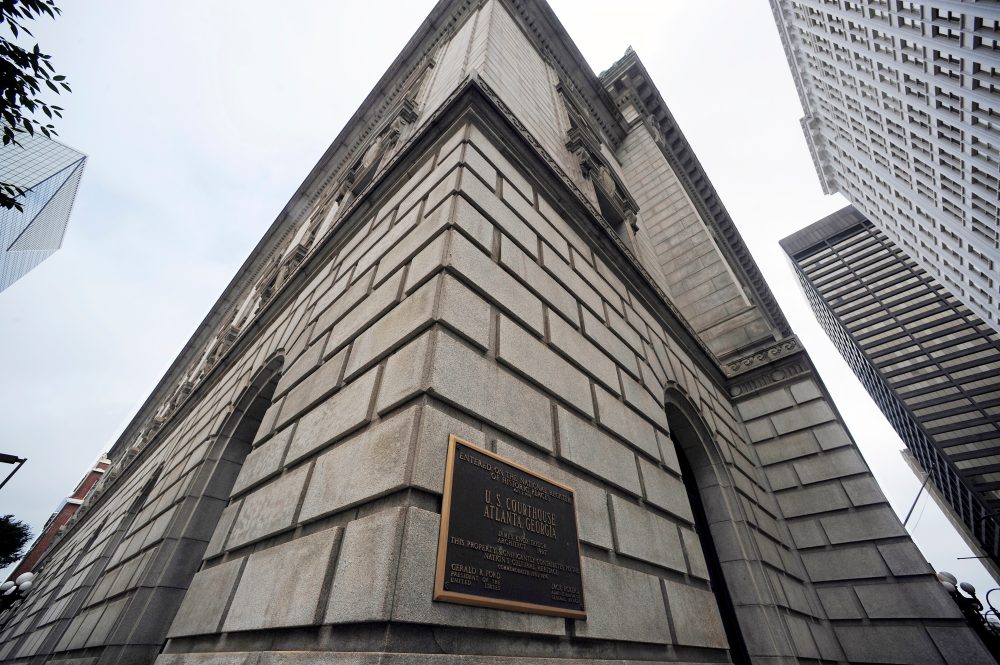

Atlanta law enforcement officials have launched an internal investigation to identify whether a “high-ranking law enforcement officer” who engaged in sexual conduct with a federal judge in courthouse chambers belongs to their police force.
A federal judge serving in the 11th Judicial Circuit, covering Alabama, Florida and Georgia, was issued a “private reprimand” following a judicial inquiry that determined the judge engaged in “sexual intercourse in the judge’s chambers during business hours within hearing distance of staff” with a senior uniformed police officer.
The investigative findings did not reveal the identities of either the judge or the law enforcement officer, nor did it specify which courthouse within the 11th Circuit served as the location. The Associated Press has not been able to verify the names independently.
When contacted by telephone, William Pryor, the chief judge of the 11th Circuit, who established a committee to examine the accusations that emerged from a complaint filed by one of the judge’s law clerks, refused to provide comment or verify the judge’s identity.
Beyond the extramarital sexual relationship, investigators also determined the judge participated in a partisan political gathering. When initially confronted with these accusations last fall, the judge’s first response was to provide false denials, characterizing the claims as “outrageous” and “baseless.”
Regardless of the severe nature of the violations, the Judicial Council of the 11th Judicial Circuit decided in a February ruling to issue a private reprimand that maintained the judge’s anonymity. The Committee on Judicial Conduct and Disability of the Judicial Conference of the United States upheld that decision last week.
“We need a lot of reform on who judges the judges when they act badly,” Georgia State University law school professor Eric Segall said. “Judges will protect judges.”
Federal judges enjoy protection from significant penalties due to their lifetime tenure and can only face removal through congressional impeachment, which supports the argument for publicly identifying them during disciplinary proceedings, he explained.
“I’m not one who likes to publicly embarrass people, but what else can we do?” Segall said.
Following the initial denials, the judge subsequently acknowledged the wrongdoing and provided honest testimony about the incidents, according to the investigative committee’s findings. The judge also terminated the relationship with the officer, making future similar conduct unlikely, investigators concluded. These circumstances, combined with the judge’s “otherwise exemplary service to the court,” led the committee to suggest a private rather than public reprimand, according to the report.
The judge also consented to compose apology letters to six former law clerks, decline the chief judge position when eligible and avoid serving on any Judicial Conference committee.
However, this misconduct will remain an “elephant in the room” until the judge makes a public acknowledgment of poor judgment, Segall stated.
“When you have a public position of deciding cases and controversies between adverse parties, your judgment and your character are very much in play,” he said. “The very first thing I tell my students is all of you will make mistakes in practice. You own it, you admit to it, you try your best to fix it and only then is it possible to move on.”