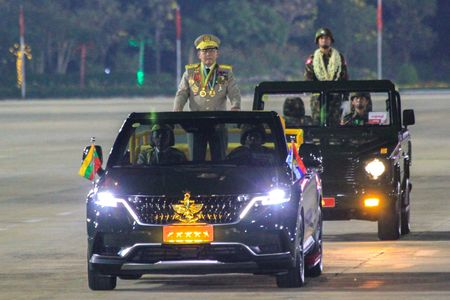

Myanmar’s newly appointed president will travel to India this Saturday for his inaugural foreign trip since assuming civilian leadership, marking a significant diplomatic milestone less than two months after his transition from military junta commander.
The five-day diplomatic mission will include meetings with Indian Prime Minister Narendra Modi and represents Myanmar’s gradual re-entry into regional diplomacy, five years after neighboring countries isolated the Southeast Asian nation’s military government following their seizure of power.
India views this visit as a chance to reduce China’s substantial sway over Myanmar while pursuing access to the nation’s valuable rare earth mineral reserves and strengthening security along India’s northeastern frontier, according to policy experts.
“After changing into civilian clothes as president, Min Aung Hlaing is looking to boost diplomatic engagement across the region,” said Richard Horsey, senior Myanmar adviser at Crisis Group.
“He expects more normal ties with ASEAN,” Horsey added, referring to the grouping of 11 southeast Asian countries, “with support from Thailand and some other member states. He is also likely to visit Beijing soon to meet Xi Jinping. India is Myanmar’s other key neighbour.”
A Myanmar presidential office representative contacted by phone refused to provide details about the upcoming visit.
Indian foreign ministry spokesman Randhir Jaiswal told reporters on Friday: “All issues that form part of the gamut of relations between Myanmar and India will come up for discussion.”
The military takeover occurred at dawn on February 1, 2021, when Min Aung Hlaing removed the democratically elected civilian administration headed by Nobel Peace Prize winner Aung San Suu Kyi, triggering widespread protests that evolved into a nationwide armed resistance against military rule.
The power grab generated international criticism, including from the ASEAN alliance that prohibited Myanmar’s military leaders from attending its conferences, leaving the new military government increasingly cut off from the international community.
A catastrophic earthquake last year offered a diplomatic opportunity for Min Aung Hlaing, who attended a regional conference in Bangkok, an opening he hopes to expand following a controversial election that led to his presidency.
“He is seeking more and more regional and international respectability post-election,” said Gautam Mukhopadhaya, a former Indian ambassador to Myanmar.
Despite Beijing’s historical support and extensive investments in Myanmar, Min Aung Hlaing’s decision to make India his first international destination partly aims to offset China’s extensive influence, analysts explained.
“This has been part of Myanmar’s way of dealing with India and China, capitulating more to China and trying to sort of balance it with India,” said Mukhopadhaya.
The diplomatic trip occurs as Myanmar’s armed forces have initiated fresh military campaigns in border regions containing rare earth deposits and crucial trade corridors connecting to India and Thailand.
“Min Aung Hlaing will almost certainly seek India’s help in countering the Arakan Army and Chin armed groups,” Horsey said, referring to rebels fighting the military in Myanmar’s Chin state, which borders India, and nearby Rakhine state.
India has shown interest in accessing Myanmar’s natural resources, including efforts to obtain mineral samples with assistance from a powerful rebel group, Reuters has reported.
“The bottom line behind this visit from the Indian side is what they can get out of it in terms of raw materials, rare earths (and) business propositions,” Mukhopadhaya said.
“And that’s exactly what the Myanmar military wants, because it wants its military enterprises strengthened.”