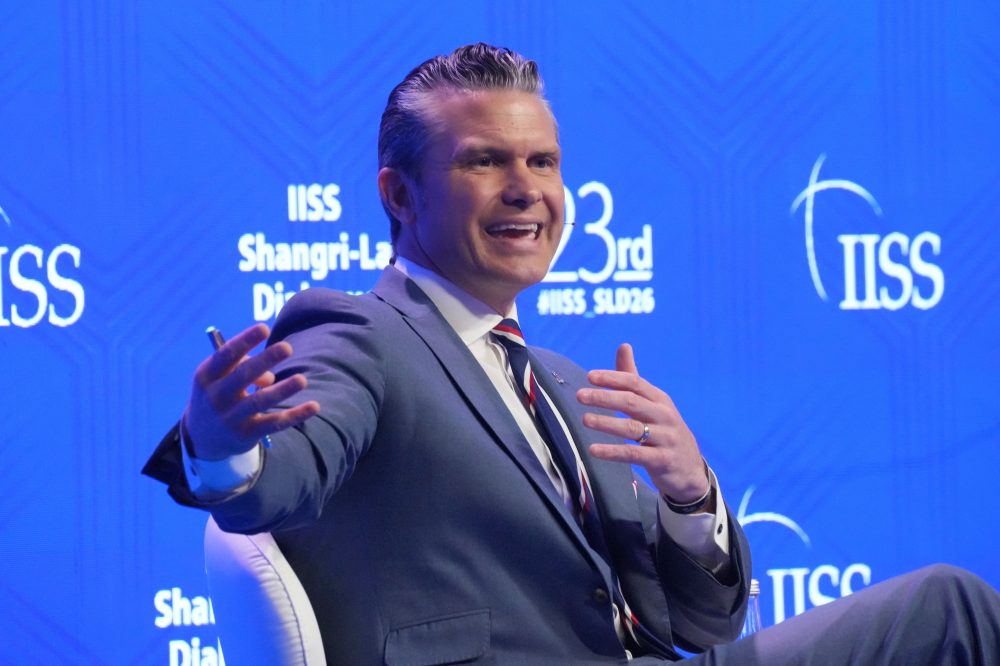

SINGAPORE — Defense Secretary Pete Hegseth delivered reassurances to Pacific region partners during a Saturday address, confirming America’s ongoing dedication to the area while adopting a more moderate stance regarding China compared to his previous statements.
During his presentation to international leaders, diplomatic representatives and senior security personnel at Singapore’s Shangri-La defense summit, Hegseth emphasized that the Pacific region “has profound implications for U.S. security and prosperity.” He stated Washington’s objective was to “achieve a lasting and favorable balance of power in the Pacific.”
This marked Hegseth’s second appearance at the annual gathering. During his previous participation, he drew criticism from Beijing after delivering stark warnings about China’s escalating threats, especially regarding Taiwan. He had declared that China was no longer merely expanding its armed forces to capture Taiwan, but was “actively training for it, every day.”
However, this year’s conference occurred approximately two weeks following President Donald Trump’s visit to meet Chinese leader Xi Jinping in Beijing. After that diplomatic encounter, Trump praised Xi as a “great leader” and expressed optimism about having a “fantastic future together.”
Hegseth, who accompanied Trump during the Beijing visit, revealed that both leaders had reached an understanding that China and the United States should “build a constructive relationship of strategic stability, based on fairness and reciprocity, reaffirming that while our nations will vigorously protect our respective interests, we can secure practical, mutually beneficial agreements where our interests align.”
Nevertheless, he maintained that preventing Chinese dominance over the Indo-Pacific remained a key American objective.
“There is rightful alarm regarding China’s historic military buildup and the expansion of its military activities in the region and beyond,” he stated.
“We share a clear-eyed assessment of that security environment and a mutual understanding that a Pacific dominated by any hegemon would unravel the regional balance of power and undermine the equilibrium we all seek to preserve,” he added.
Following the Xi-Trump discussions, the American president questioned Washington’s commitment to Taiwan’s defense, describing a pending $14 billion weapons package as “a very good negotiating chip for us” with China.
China maintains territorial claims over the democratically governed island, with Xi refusing to eliminate military action as an option for reunification. American law mandates providing Taiwan with defensive capabilities, though the U.S. maintains “strategic ambiguity” regarding potential military intervention if China attacks the island.
Hegseth informed attendees that there was “no change in our status” concerning Taiwan, but declined to discuss the weapons agreement.
“Any decision about future Taiwan arms sales, as the president said, will rest with him,” he explained.
He emphasized the Trump administration’s demand that allies boost defense expenditures, declaring “we need partners, not protectorates.”
He praised multiple Asian nations for their contributions while criticizing unnamed European allies who he claimed became “distracted by empty globalist rhetoric about the rules-based international order.”
“Our partners in Asia have long understood that the bedrock of a durable partnership is not based on idealistic values but on the concrete alignment of national interests,” he stated.
“When our interests diverge, we adjust pragmatically, without the drama or the moralizing,” he continued. “I think Western Europe might take note — this is a mindset we fully embrace.”
Hegseth omitted references to the Ukraine conflict or Iran during his presentation. When questioned about Iran, he simply noted that Trump had assured him that upon completion of Tehran negotiations, “any deal will be a good deal.”