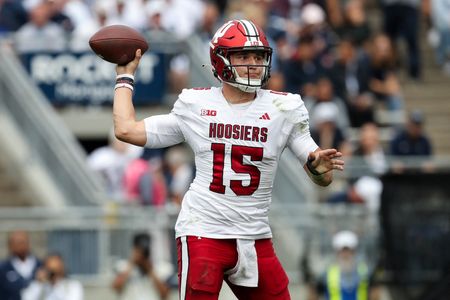

Court filings reveal that quarterback Brendan Sorsby wagered on Indiana football at least 40 times during his tenure with the program, according to ESPN reports released Friday. The documents were submitted by his attorneys as part of efforts to secure a temporary injunction against the NCAA to preserve his college playing eligibility.
Legal paperwork shows Sorsby gambled approximately $90,000 across four years using betting accounts registered under names of relatives and acquaintances, with his wagering activity persisting even after his winter transfer from Cincinnati to Texas Tech, ESPN reported.
The quarterback was ruled ineligible following investigations that uncovered thousands of dollars in sports betting through mobile applications, breaking NCAA regulations. Current rules prohibit student-athletes from wagering on any NCAA-sanctioned or professional sporting events. Athletes face potential lifetime bans for betting on their own programs.
After the NCAA rejected Sorsby’s reinstatement appeal Tuesday, his legal challenge seeking an injunction for 2026 season eligibility has become crucial. A court hearing for that matter is set for Monday in district court in Lubbock, Texas.
Recent court filings disclosed that Sorsby admitted to making no fewer than 2,900 wagers exceeding $30,000 during his Indiana enrollment from June 2022 through December 2023. Among these were at least 40 bets valued between $1 and $114 on Indiana football and/or specific players, ESPN reported. The wagers amounted to no less than $850 during September and October 2022, when he was redshirting.
Sorsby first appeared for Indiana against Penn State on Nov. 5, 2022, with betting activity reportedly ending two weeks beforehand.
In correspondence to the NCAA, Sorsby stated he never wagered on contests in which he participated, nor did he ever bet against his team.
Tuesday brought a social media statement from Sorsby announcing his recent completion of a 35-day inpatient rehabilitation program in Arizona for “a diagnosed gambling addiction and anxiety disorder.”
“While I accept responsibility for my behavior and know that I have a lot of work ahead of me, for the first time in many years I feel more free and no longer fully at the mercy of my addiction,” Sorsby wrote in part.
“With the support of my coaches, teammates and the university, I’m looking forward to returning to campus in Lubbock. If I’m blessed and fortunate enough to have the opportunity to continue my college career at Texas Tech, I know I will get the support I need, including through the school’s Center for Students in Addiction Recovery. I am deeply sorry to everyone I’ve disappointed and am committed to the hard and necessary work ahead.”
Sorsby moved to Texas Tech from Cincinnati during the offseason and was expected to be the Red Raiders’ starting quarterback for 2026. ESPN rated Sorsby as the top overall transfer in this year’s recruiting class.
Texas Tech filed an appeal Friday regarding the NCAA’s reinstatement denial, while university officials including coach Joey McGuire and president Lawrence Schovanec maintained their support for the quarterback following news of his addiction struggles.
Sorsby’s lawsuit criticized what he termed the NCAA’s “deeply hypocritical” positions on sports gambling, while Schovanec issued an open letter to the campus community Tuesday stating the NCAA’s decision “should be reversed or modified” considering the circumstances and “context” of Sorsby’s situation.
“As a generation of college athletes face the legalization and rapid proliferation of sports betting in our country, gambling addiction is rising to the point of epidemic among college aged men in particular,” Schovanec wrote. “The NCAA’s stated mission includes ‘fostering (student-athletes’) lifelong well-being,’ and they have claimed their goal is to promote a ‘culture of care’ for student athletes’ mental health. Gambling addiction is a clinically recognized behavioral disorder.”