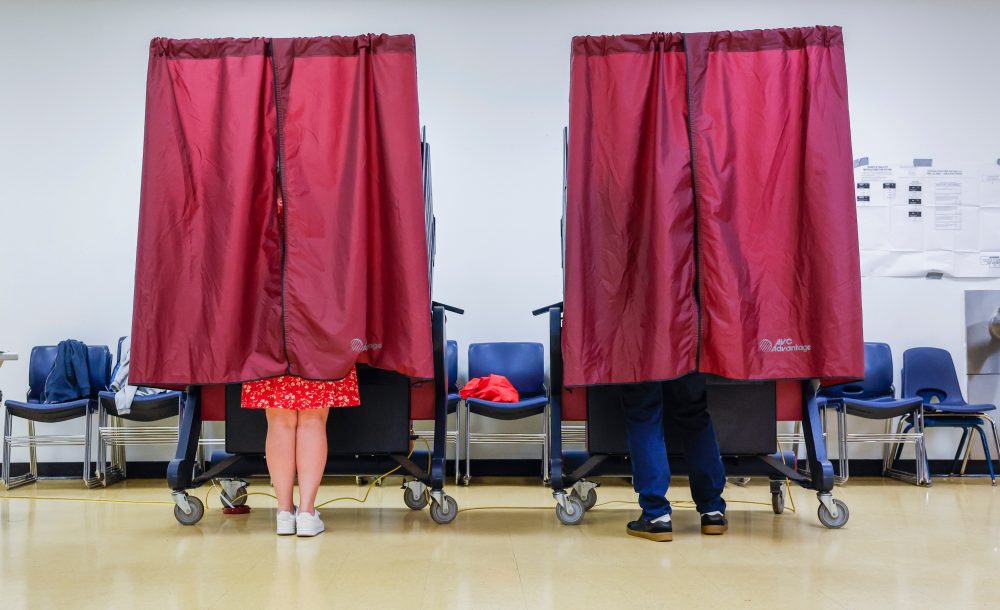

CONCORD, N.H. — A federal court has ordered New Hampshire to ease its voter registration process by permitting applicants to use sworn statements declaring their U.S. citizenship when they cannot provide required documentation.
The legal challenge marked the first significant court test of voting reforms championed nationally by President Donald Trump and embraced by numerous Republicans. U.S. District Court Judge Samantha Elliot clarified she wasn’t ruling on whether citizenship proof requirements are constitutional overall. However, her Thursday night decision on specific New Hampshire statutes highlighted potential problems with implementing rigid documentation demands for voters to verify their U.S. citizenship before casting ballots.
Elliot determined that 2024 modifications to the state’s voter registration statute unconstitutionally eliminated one verification method — specifically, sworn affidavits where voters attest to their citizenship status.
“The evidence shows that this is the only method of proof available to a significant number of New Hampshire voters,” she wrote.
The modifications became effective last year after former Gov. Chris Sununu, a Republican, signed the legislation two years prior. The attorney general’s office announced plans to challenge the judge’s decision, describing the citizenship requirements as a “common-sense approach to voter registration and election administration designed to protect the integrity of our elections.”
The decision represented a victory for the American Civil Liberties Union of New Hampshire and additional plaintiffs who contended the modifications that became effective last year created unnecessary obstacles.
“New Hampshire’s elections have always been safe, secure, and accurate — and this law could have unconstitutionally and needlessly prevented thousands of eligible voters from casting a ballot,” said Henry Klementowicz, deputy legal director of the ACLU of New Hampshire.
The legal action, brought on behalf of the Coalition for Open Democracy, the League of Women Voters of New Hampshire, the Forward Foundation and five voters, characterized the state’s voter registration statute as among the nation’s most restrictive. During municipal elections last fall, some voters encountered difficulties obtaining passports, birth certificates or alternative citizenship documentation.
New Hampshire joins other states with citizenship verification laws for voters. Arizona, South Dakota, Utah and Wyoming have comparable statutes currently in place, according to the Brennan Center for Justice. Florida enacted legislation this year mandating documentary citizenship proof for voting, though implementation is delayed until next year.
A comparable Kansas statute requiring citizenship proof for state and federal elections was determined in 2018 to violate both the U.S. Constitution and the National Voter Registration Act after blocking more than 31,000 citizens from voter registration.
Arizona created a dual-tier system following a 2013 U.S. Supreme Court decision preventing the state from mandating citizenship documentation for federal elections. In August 2024, the court permitted certain portions of the state’s citizenship proof statute to remain enforced while legal challenges continued in lower courts.
The decision arrives as Trump promotes a citizenship proof measure, the SAVE America Act, through Congress. Voting rights advocates warn such federal mandates could disenfranchise millions of people. A 2025 University of Maryland study calculated that 21.3 million Americans eligible to vote lack or cannot easily access documents proving their citizenship, including nearly 10% of Democrats, 7% of Republicans and 14% of people unaffiliated with either major party.