A 19-year-old basketball player from Italy has decided to forgo the 2026 NBA Draft and will instead play college basketball at Villanova, news outlets are reporting.
Luigi Suigo, who stands 7’3″ with a 7’5.5″ wingspan, put up 8.1 points, 5.3 rebounds and 1.1 blocks per game while playing 18.1 minutes nightly for Mega Superbet in the AdmiralBet ABA League during the previous season.
The young center from Tradate, Varese, Italy, had been considered by basketball analysts as a possible late first-round selection. ESPN placed him at No. 32 on their prospect rankings.
Suigo chose Villanova over scholarship offers from Illinois, Purdue and Indiana. He’ll be joining a Wildcats team that recently made the NCAA Tournament and finished with a 24-9 record during Kevin Willard’s inaugural season leading the program.
A Coastal Flood Advisory remains in effect for parts of the Delmarva Peninsula until midnight tonight, with up to one foot of flooding expected in low-lying coastal areas.
The National Weather Service warns that minor tidal flooding will impact vulnerable roads in coastal and bayside communities, as well as areas along inland tidal waterways. Some partial or full road closures are possible through the evening hours.
Locally, the advisory affects Kent County and Inland Sussex County in Delaware, along with Delaware’s beaches. In New Jersey, Cumberland, Atlantic, and Cape May counties are also under the advisory.
Officials urge residents to avoid parking vehicles in flood-prone locations and never attempt to drive through flood waters, which may be deeper than they appear. Such attempts put drivers at risk and can lead to costly vehicle damage.
Looking ahead, forecasters warn that another round of minor coastal flooding is likely with Sunday evening’s high tide, so residents should remain vigilant over the weekend.
The current advisory expires at midnight tonight. For the latest water level information and flood impacts at local tide gauges, residents can visit the National Water Prediction Service online.
Listen to the Evening Delmarva Farm Report Update — June 13, 2026
DELMARVA — Rootless corn syndrome has emerged as a major problem for growers this week as extreme weather conditions create ideal circumstances for the condition’s spread.
Robby Meeker, an agronomy manager with Wyffels Hybrids overseeing operations across eastern Illinois and Indiana, says extreme weather in June has severely impacted crop development. The combination of excessive heat, drought conditions, and persistent strong winds created a perfect storm for the syndrome’s spread. The condition has plagued corn crops across multiple states this growing season.
Drought has devastated hay crops across the region. Rosemary Life, an associate Extension agent in Rockingham County, Virginia, reports producers there saw first cutting yields at just 40% of normal. That shortfall comes on the heels of a long harsh winter that already strained hay supplies. Many farmers went into spring with fewer reserves than usual after feeding livestock through extended snow cover. Even if weather improves, the reduced first cutting means there will be less hay available heading into fall and winter.
Markets
Friday’s close saw corn finish steady to firm while soybeans and wheat weakened. Soybeans faced pressure from fund and technical selling. Locally, corn at Laurel Grain Company in Laurel, Delaware is bringing $4.58 a bushel for July delivery. Soybeans there are $10.54 for July.
Forecast
Saturday afternoon will reach 83° with sunny skies. Tonight drops to 69° and partly cloudy. Sunday brings 80° with partly sunny skies, then a slight chance of showers and thunderstorms.
This article is based on the Delmarva Farm Report Update Evening Edition, June 13, 2026. Hosted by Tom Bradley.
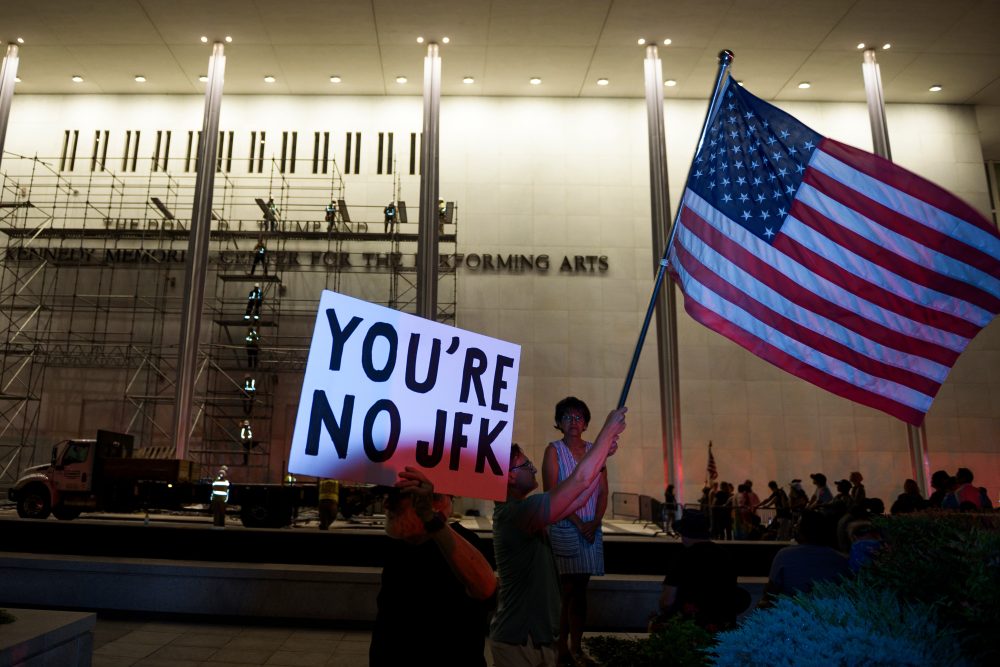
The Kennedy Center’s facade no longer displays President Trump’s name after workers removed it following a court directive, with the entire operation conducted in secrecy away from public scrutiny.
NPR correspondent Frank Langfitt witnessed the concealed removal process alongside other observers as crews took steps to shield their work from public view.
The name removal came as a result of a judicial order, though the specifics of the court’s decision and the reasoning behind the secretive nature of the operation remain unclear.
Exhausted teenagers, committed fathers, and countless bird species came together for an intensive competition that NPR followed for a complete day.
National Public Radio documented the full 24-hour experience at the World Series of Birding, observing how young participants worked together while battling fatigue during the demanding event.
The competition featured hundreds of different bird species as teams raced against time to spot and identify as many as possible throughout the marathon event.
Law enforcement officials in southern Mexico have launched an investigation into the deadly shooting of a municipal leader in Oaxaca state, according to the state prosecutor’s office on Saturday. Security forces have begun operations to locate those responsible for the crime.
Jose Angel Bravo Martinez lost his life after being gunned down during an incident in the Mixteca region, according to officials who classified the case as a high-impact crime requiring formal investigation. This marks the second killing of an Oaxaca municipal leader within the past month.
Crime scene investigators and forensic specialists were sent to the location following the shooting to collect evidence and retrieve the victim’s remains, according to a statement from the prosecutor’s office. The agency reported coordination efforts with federal security personnel.
Officials have not yet released additional information regarding potential reasons behind the killing of Bravo, who was affiliated with a coalition of opposition parties, including the PAN (National Action Party).
Attacks on municipal leaders continue to pose significant challenges across regions of Mexico, where criminal organizations frequently exercise control, especially in remote communities. Mario Hernandez Garcia, the mayor of another Oaxaca town, Santiago Amoltepec, was killed last month during an assault that claimed two additional lives.
Data compiled by the non-governmental organization Causa en Comun indicates that no fewer than 60 politicians or lawmakers were killed in deliberate attacks during the previous year.
Pittsburgh has completed a player exchange with Florida, trading defenseman Emil Pieniniemi to the Panthers in return for forward Oliver Okuliar.
The 26-year-old Okuliar spent last season with Skelleftea AIK in Sweden’s top professional hockey league, where he tallied 15 goals and 14 assists across 46 regular season contests. In playoff action, he shared the league lead with six goals and contributed to his team’s championship victory.
Most recently during the 2024-25 campaign, Okuliar suited up for the Charlotte Checkers in the American Hockey League, where he accumulated 19 goals and 22 assists over 69 games.
The departing Pieniniemi, age 21, was selected by Pittsburgh in the third round of the 2023 NHL Draft. He appeared in nine games for the Wilkes-Barre/Scranton Penguins last season, contributing three points.
A Coastal Flood Advisory remains in effect for much of the Delmarva Peninsula until midnight tonight, with up to one foot of flooding expected in low-lying coastal areas.
The National Weather Service issued the advisory at 4:20 PM, warning residents across Kent County, Inland Sussex, and Delaware’s beaches to prepare for minor tidal flooding. The advisory also covers parts of southern New Jersey, including Cumberland, Atlantic, and Cape May counties.
Flooding is expected to impact the most vulnerable roadways in coastal and bayside communities, as well as areas along inland tidal waterways. Some partial or full road closures are possible as water levels rise.
Officials urge drivers to avoid parking in flood-prone areas and never attempt to drive through standing water, which may be deeper than it appears. Such conditions can damage vehicles and put motorists in serious danger.
The current advisory expires at midnight, but forecasters warn that another round of minor coastal flooding is likely with Sunday evening’s high tide. Residents should continue monitoring conditions and avoid unnecessary travel in affected areas.
For the latest water level information and flood impact details, visit the National Water Prediction Service online or stay tuned to TV Delmarva for continued coverage.
Weather officials have issued a coastal flood advisory that went into effect Thursday afternoon and will remain active until midnight.
The National Weather Service office located in Mount Holly, New Jersey issued the advisory at 4:20 PM on June 13th, with the warning set to expire at 12:00 AM on June 14th.
Residents in affected coastal areas should monitor conditions and take appropriate precautions during the advisory period.
CHICAGO (AP) — Shohei Ohtani took his spot back in the Los Angeles Dodgers starting lineup Saturday following a one-game absence due to left knee inflammation.
The star player batted leadoff as designated hitter when the Dodgers faced the Chicago White Sox. Ohtani had exited Thursday evening’s 8-6 victory over Pittsburgh during the seventh inning, then sat out Friday’s 8-2 defeat in Chicago to open the series.
“We took him out of the game the other night just for precautionary,” manager Dave Roberts said Saturday. “Yesterday, treated it up, today he feels great. All the confidence that he can go out there and hit, feel good, not regress at all.”
The 31-year-old Ohtani is still set to take the mound Wednesday versus Tampa Bay. The 6-foot-4 right-hander checked how his knee responded to his pitching mechanics by throwing in the outfield prior to Saturday’s contest against the White Sox.
Ohtani, who underwent left knee surgery in September 2019, is hitting .305 with 13 home runs and 40 RBIs across 67 games for the NL West-leading team. As a pitcher, the defending NL MVP holds a 6-2 record with a 1.06 ERA through 11 starts.
Roberts also mentioned that Justin Wrobleski should make his next planned start Tuesday against the Rays. The left-handed pitcher departed Thursday night’s game in the fifth inning with a left hamstring contusion.
“Yesterday I talked to him and he is a little sore, which is understandable, but he’ll be ready to go on Tuesday,” Roberts said.
The 54-year-old Roberts will be absent for Sunday’s series conclusion against the White Sox. Bench coach Danny Lehmann will manage the team while Roberts attends his daughter’s college graduation.
SOFIA, Bulgaria (AP) — Thousands of advocates for LGBTQ+ rights filled the streets of Romania and Bulgaria’s capital cities Saturday during their yearly Pride celebrations, facing growing pushback from traditional groups in these Orthodox Christian nations.
Demonstrators paraded through Bucharest and Sofia, displaying rainbow banners and sounding horns while demanding equal treatment under the law.
Romania and Bulgaria both became European Union members in 2007. Before joining the bloc, each nation enacted human rights laws to satisfy EU requirements, though public polling frequently shows less acceptance of the LGBTQ+ community compared to other member nations.
According to ILGA-Europe’s 2025 Rainbow Map, which evaluates legal and policy conditions for LGBTQ+ individuals throughout Europe, Romania and Bulgaria placed at the bottom among all 27 EU member states.
“We still have a deeply conservative society, with very strong traditional values,” said Alina Purcaru, a writer who attended the Bucharest march. “We still live in a patriarchy, sometimes explicit … with a lot of prejudice and a lot of fear.”
Neither Romania nor Bulgaria permits same-sex marriage or civil unions, even though the EU forbids discrimination based on sexual orientation.
“That is why we are taking to the streets today … to demand the legalization of civil partnerships,” Vlad Viski, president of the nongovernmental organization MozaiQ, told The Associated Press.
“We are talking about essential rights, such as the right to inheritance, hospital visits, medical decisions, survivor’s pension,” he added.
Simeon Vassilev, one of the organizers of Sofia Pride, told journalists on Saturday that in Bulgaria, “thousands of same-sex couples live together, build homes, raise children, and care for one another … without the right to legal protection or recognition of their relationships.”
According to advocacy organizations, animosity and hateful rhetoric targeting LGBTQ+ communities in these two Eastern European nations have increased in recent years. Counter-demonstrations opposing LGBTQ+ rights occurred in both cities Saturday.
In Sofia, a “March of the Family” gathering — organized by conservative and faith-based organizations since 2021 — promoted “Christian, patriotic and traditional values” during Saturday’s event. The traditional Orthodox Church, representing approximately 80% of Bulgarians, stated its “disagreement with the ideas and messages” and supported the “traditional family.” In Bucharest, a “March for Normality” was conducted by a nationalist organization.
This year’s Pride celebration in Sofia operated under a “Different Together” theme, with organizers seeking to challenge widespread negative messaging about the community.
Furthermore, the “Progressive Bulgaria” party of Prime Minister Rumen Radev, which secured victory in an April general election, expressed backing for the “March of the Family” in Parliament, declaring it “a cornerstone of our national security, identity and future.”
The Bulgarian Helsinki Committee condemned the statement for “placing one type of citizens as more valuable than others.”
President Donald Trump revealed Saturday his intention to appoint James M. McDonald as the federal prosecutor for the Southern District of New York, filling the position left vacant by Jay Clayton, whom Trump selected earlier this week to head national intelligence.
McDonald previously served as an Assistant U.S. Attorney in the Southern District of New York and currently works as a litigation partner with Sullivan & Cromwell law firm. He also represented Trump personally, taking on the appeal of the former president’s Manhattan hush money case, which remains unresolved.
Trump faced conviction on 34 felony charges related to hiding a $130,000 payment made to adult film actress Stormy Daniels.
Should McDonald receive confirmation as Manhattan’s top federal prosecutor, he would lead one of the Justice Department’s most influential offices, handling cases that span from terrorism and espionage to securities fraud and government corruption.
Last month, McDonald was among the attorneys who achieved a positive result for Indian businessman Gautam Adani after the Trump administration’s Justice Department dismissed fraud and conspiracy charges that were filed during the Biden presidency.
During Trump’s initial presidency, McDonald held the enforcement director position at the Commodity Futures Trading Commission and previously worked as deputy associate counsel in the White House under President George W. Bush.
“I am confident that Jamie will deliver strong results for our Country,” Trump wrote about McDonald’s selection on Truth Social Saturday afternoon.
Clayton’s appointment followed mounting congressional pressure to select a permanent successor for Tulsi Gabbard, who stepped down as ODNI director last month. Trump encountered significant criticism for choosing Bill Pulte, who heads the Federal Housing Finance Agency, as interim director.
The Texas Rangers have moved outfielder Evan Carter to the 10-day injured list on Saturday after he sustained an oblique injury. The team brought up utility player Cody Freeman from Triple-A Round Rock to take his place on the roster.
Carter left Friday’s matchup with the Boston Red Sox because of right oblique discomfort. The injury has since been diagnosed as a right oblique strain.
This season, Carter has contributed six home runs, 21 RBIs, 10 stolen bases and posted a .172/.292/.321 batting line for the Rangers. However, his most valuable contribution has been his exceptional defense in center field. According to Baseball Savant, he ranks in the 94th percentile for Fielding Run Value.
Freeman appeared in 36 games for the Rangers during the previous season, posting a .228 batting average along with three home runs and 15 RBIs. This year in Triple-A, he’s performing well with a .341 batting average, two home runs and 11 RBIs across 10 games, and went 1-for-2 in his single appearance for Texas.
The versatile player has major league experience at left field, right field, second base, and third base.
In additional roster moves, Texas brought up right-handed pitcher Joe Ross from Triple-A Round Rock while sending right-hander Luis Curvelo down to the same club. The team also designated right-hander Michel Otanez for assignment.
WASHINGTON – President Donald Trump announced Saturday his selection of James McDonald to serve as the federal prosecutor for Manhattan’s Southern District of New York, replacing Jay in the position.
McDonald brings significant legal experience to the role, having previously worked as an assistant federal prosecutor and served as an enforcement chief at the CFTC.
NBA veteran James Harden of the Cleveland Cavaliers was taken into custody early Saturday morning in Houston, facing a misdemeanor charge for unlawfully possessing a weapon in a vehicle, the Harris County District Clerk’s Office confirmed.
Police arrested the basketball star at 3:41 a.m. and processed him into custody shortly before 5 a.m. He secured his release by posting a $100 bond, court records show. Charging documents indicate officers discovered a firearm in plain sight inside the vehicle that was not secured in a holster.
Court records show Harden’s arraignment date is set for June 22, and he is documented as living in Houston.
The Cleveland Cavaliers released a statement saying: “The Cleveland Cavaliers are aware of the arrest of James Harden this morning and are in the process of gathering additional information. We are in contact with James and his representation and will continue to monitor developments as they become available. At this time, we will have no further comment.”
Representatives for Harden did not respond to requests for comment from The Associated Press.
The 36-year-old athlete recently completed his 17th season in the NBA and holds a $42.3 million player option for the upcoming season with Cleveland. Following the Cavaliers’ playoff elimination by the New York Knicks in the Eastern Conference finals, Harden expressed interest in staying with the organization, suggesting he may decline the option to negotiate a longer-term deal.
Throughout his career, Harden has earned recognition as an 11-time All-Star and eight-time All-NBA team member. He captured the league’s Most Valuable Player award during the 2017-18 campaign while with the Houston Rockets.
The artificial intelligence company that created ChatGPT is facing a multistate investigation into user safety concerns as it moves toward its initial public stock offering.
State attorneys general have issued a subpoena to the tech firm as part of their examination into potential risks posed by the popular chatbot. Company representatives said they plan to cooperate fully with the investigation and emphasized their commitment to user protection.
“AI is a new and powerful technology, and we work every day to safely bring its benefits to people in a responsible way,” an emailed statement from a spokesperson said. “We take the concerns raised by state attorneys general seriously.”
The artificial intelligence company has faced mounting criticism after reports that ChatGPT provided supportive responses to users contemplating suicide or criminal activities. Additional concerns have emerged regarding the platform’s handling of medical information and personal user data.
Recent legal challenges include a lawsuit filed Thursday by a Canadian mother who claims the chatbot influenced her daughter’s decision to take her own life by hanging. In June, the Florida attorney general filed suit against the company following two separate shooting incidents where the alleged perpetrators reportedly consulted ChatGPT during their planning phases.
Company officials responded that their technology repeatedly urged those individuals to contact real-world support services, including mental health professionals. They also confirmed their cooperation with law enforcement agencies investigating both shooting cases.
This investigation emerges shortly after the company submitted paperwork to federal securities regulators for its much-anticipated stock market debut. Meanwhile, artificial intelligence competitor SpaceX completed its own public offering Friday. The rocket company, established by Elon Musk, also operates an AI division that developed a competing chatbot named Grok.
The appropriate governmental response to AI’s potential benefits and risks has emerged as a significant policy debate.
European regulators have launched their own investigations into Musk’s Grok platform over antisemitic content and sexually explicit material, including deepfake nude images. Additionally, another chatbot developer planning a public offering was ordered Friday by the Trump administration to discontinue two of its international online services due to national security concerns.
The Wall Street Journal first reported on the subpoena issued to the ChatGPT company.
When contacted Saturday, a dozen state attorneys general offices did not respond to requests for information about the investigation details.
In their public response, company officials outlined protective measures implemented for younger users of their chatbot service.
“Today’s ChatGPT includes a more protective experience for minors and people experiencing difficult situations, with safeguards that direct them to real-world resources and trusted human contacts,” the statement read in part. “We believe kids should be treated like kids, which is why we built age prediction, released parental tools to guide their children’s use of AI, and disallowed advertising that targets kids.”
The death of a Haitian woman seeking asylum has been classified as a homicide by a medical examiner following her release from federal immigration custody. The woman’s family attorney says relatives plan to file a lawsuit against Immigration and Customs Enforcement regarding her death.
Daphy Michel, age 31, passed away on March 2 after being discovered at a bus shelter. The Allegheny County Medical Examiner’s Office determined hypothermia caused her death and classified it as a homicide, “indicating the death was caused by the actions of another individual” and should not be interpreted as a declaration of criminal guilt, according to the office’s statement. These findings were made public on Friday.
Michel came from Haiti and was pursuing asylum in the United States following her 2022 arrival at the southern border, according to Joseph Patrick Murphy, the family’s legal representative. She had received humanitarian parole due to urgent humanitarian circumstances, though she passed away before attending a hearing that was set for two weeks following her death, he explained.
According to the medical examiner’s office, Michel was considered a vulnerable adult “suffering from untreated severe mental health issues and a significant language barrier” when she was released on February 27.
Murphy explained that Michel was taken into custody last summer for shouting at people who weren’t there due to her mental health condition. She remained in Washington County Jail for six months, during which time she received numerous psychiatric evaluations while waiting for her initial hearing, he stated.
A magistrate determined he couldn’t hold her for trial since she was threatening people who didn’t exist, Murphy reported. Following this decision, ICE took her from her jail cell, fitted her with an ankle monitor, and transported her 25 miles away to Pittsburgh, where she remained at a bus shelter during winter conditions for several days, he said.
“She was in September clothes and it was February, and the weather overwhelmed her and she went into hypothermia,” Murphy stated.
The medical examiner’s homicide determination differs from criminal charges, meaning “somebody did or failed to do something that brought about her demise,” Murphy explained. He anticipates Michel’s relatives will pursue legal action against ICE related to her death.
Department of Homeland Security spokesperson Lauren Bis responded via email, stating “ICE had NOTHING to do with this woman’s death. She passed away THREE days after ICE encountered her.”
Bis referred to Michel as “an illegal alien from Haiti” who entered removal proceedings following her arrest.
According to Bis, Michel possessed all her personal items and a charged phone upon release, with public transit options available. ICE discovered the day following Michel’s death that her ankle monitor “had been tampered with,” though county medical examiner personnel “refused to cooperate or even talk with” ICE representatives, she stated.
ICE contacted the U.S. Marshals Service, who collected the ankle monitor but were denied information regarding Michel’s condition, Bis reported. ICE became aware of her death through news reports, she added.
Allegheny County Executive Sara Innamorato released a statement calling Michel’s death “a tragedy and appears that with a little humanity, it could have been completely avoidable.”
U.S. Rep. Summer Lee, D-Pa., described her death as preventable, saying “she deserved care, shelter, language access, and medical support.”
ICE has discontinued reporting detainee deaths occurring within 30 days of custody release, terminating a 2021 Biden administration policy. Medical professionals argue this change will undercount actual deaths while failing to address healthcare concerns.
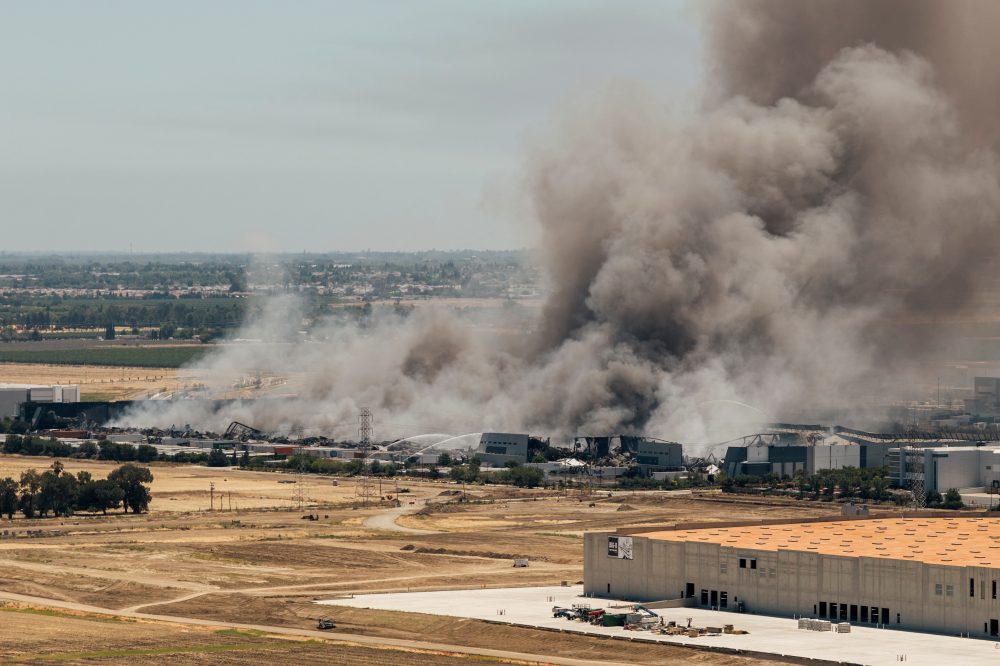
Authorities in a Northern California community are advising residents who are vulnerable to smoke exposure to remain inside their homes while emergency crews continue fighting a massive blaze at a medical supply warehouse that has been raging since Thursday.
The fire at the Medline facility in Tracy has created air quality conditions rated as “unhealthy” on the southern portion of the city, home to approximately 100,000 residents, based on readings from air quality monitoring equipment.
South San Joaquin County Fire Authority Fire Chief Randall Bradley indicated in a public statement that crews anticipate smoky conditions will persist for several more days as they work to extinguish the flames inside the structure.
“The local fire marshal was investigating, and officials are meeting with company representatives, structural engineers and others to assess the building,” Bradley said.
Arrangements are being developed to allow workers to collect their cars from the location. Fire officials are also warning residents to stay away from the vicinity and avoid handling any debris that may have scattered from the incident.
The company manufactures and distributes medical and surgical supplies including protective gloves made of latex, face coverings, and surgical tools.
The fire at the massive facility, spanning 1 million square feet and located roughly 55 miles east of San Francisco, has sent burning debris across a wide area.
Emergency responders have faced significant challenges due to malfunctioning sprinkler equipment and fire hydrants that provided minimal or no water flow. Officials determined the issue stemmed from problems with the building’s internal fire prevention systems rather than municipal water infrastructure.
An independent contractor had tested the sprinkler equipment in January and found no problems at that time, according to fire officials.
Atlanta’s baseball team has sidelined right-handed pitcher Spencer Strider for at least 15 days due to inflammation in his elbow, the organization announced Saturday.
The 27-year-old pitcher was forced to leave Friday’s game against New York in the fourth inning when he began experiencing discomfort. Atlanta ultimately lost that contest 7-5 to the Mets.
During his abbreviated outing, the former All-Star and previous 20-game winner allowed seven runs on six hits, including three home runs, across just over three innings of work.
This season, Strider holds a 4-2 record with a 5.31 earned run average across eight starts. In 39 innings pitched, he has recorded 46 strikeouts while issuing 20 walks and allowing nine home runs.
This injury represents another hurdle for Strider following his standout All-Star performance in 2023. Last year proved challenging as he managed only two starts before requiring season-ending elbow surgery. His current season also began with time on the injured list due to a strained left oblique muscle.
To fill the roster spot, Atlanta promoted right-hander Anthony Molina from their Triple-A affiliate in Gwinnett. The 24-year-old Molina has appeared once for Atlanta this season, throwing two scoreless innings during an 8-6 victory over Colorado on May 1.
Two-way baseball sensation Shohei Ohtani rejoined the Los Angeles Dodgers’ starting roster on Saturday for their matchup with the Chicago White Sox.
The superstar was scheduled to take the field as designated hitter while occupying the top spot in the batting order on Saturday.
Ohtani had been absent from Friday’s 8-2 defeat in the opening game of the series, missing action after knee inflammation forced his early exit from the Dodgers’ 8-6 victory against the Pittsburgh Pirates the previous day.
The 31-year-old is currently batting .305 this season while contributing 13 home runs and 40 RBIs. As a pitcher, the dual-threat athlete holds a 6-2 win-loss record with a 1.06 ERA through 11 mound appearances.
The four-time Most Valuable Player, who has claimed the honor in each of the past three seasons, carries a lifetime .283 batting average alongside 293 home runs and 709 RBIs over 1,081 career games split between the Los Angeles Angels from 2018-23 and the Dodgers.
Amazon’s chief executive Andy Jassy joined other technology industry leaders in expressing security concerns about Anthropic’s most sophisticated artificial intelligence systems to Trump administration officials this week, according to a source with knowledge of the discussions.
Amazon has not yet provided a response to requests for comment on the matter.
The Trump administration took action Friday, ordering Anthropic to prevent foreign nationals from accessing its newest AI models, Fable 5 and Mythos 5, regardless of whether they are located within the United States or abroad. The directive was based on national security considerations. Anthropic responded by announcing it would shut down worldwide access to these models.
According to Anthropic’s Friday blog post, federal officials believe there exists a technique to circumvent or “jailbreak” protective measures that would otherwise stop Fable 5 from being utilized to identify software security weaknesses.
The federal restrictions took the form of export control measures, as Anthropic explained in its online statement. The Commerce Department’s Bureau of Industry and Security, the agency responsible for overseeing export controls, has not yet responded to requests for comment.
Several experts who support export restrictions on cutting-edge AI technology expressed confusion about the Trump administration’s decision, noting it impacts friendly nations alongside potential adversaries.
“This was not well thought-out,” said Jimmy Goodrich, a senior fellow at the University of California’s Institute for Global Conflict and Cooperation. “It even bans Canadians and Brits employed at Anthropic from doing research and development.”
The directive was issued at a time when an earlier conflict between Trump administration officials and Anthropic appeared to be resolving within various parts of the federal government. Anthropic has privately submitted paperwork for a U.S. initial public offering.
Ken Morrow has long enjoyed being the answer to a unique trivia question – he remains the sole American hockey player to capture Olympic gold and claim the Stanley Cup within the same calendar year. Morrow achieved this rare feat as a member of the legendary 1980 U.S. “Miracle on Ice” squad before contributing to the New York Islanders’ initial championship in their four-year dynasty.
While six Canadian players have managed this accomplishment since NHL athletes began competing in Olympic competition, fewer Americans have achieved Morrow’s double than have set foot on the lunar surface. He stands alone in this exclusive category.
This unique distinction will inevitably change regardless of the Cup final’s outcome. Following the U.S. team’s first Olympic gold medal triumph in 46 years, Carolina’s Jaccob Slavin needs just one more win to match Morrow’s achievement, while Vegas could propel Jack Eichel and Noah Hanifin into this select group if they capture Games 6 and 7.
“I’ve had my 46 years,” Morrow told The Associated Press by phone Friday. “I’m always one that likes to see new people win the Cup, guys get a chance to do something that they’ll remember the rest of their lives. And for whoever does it this year, yes, I think it’s great.”
Morrow captured four consecutive Stanley Cup championships during the Islanders’ dominant era. Among U.S. players in the current final, only Eichel possesses a Cup championship, having played a crucial role in the Golden Knights’ 2023 title run.
Following his contribution to the U.S. gold medal victory in Milan during February, Eichel notes both parallels and contrasts between these championship pursuits.
“One’s nine, 10 months; one’s two weeks,” Eichel said. “One of them is winner-take-all of just one game at a time. These are seven-game series, so it’s different in that sense. I think from an emotional standpoint and a mentality, I think there’s a lot of similarities: just the investment in winning and the feeling in the room and everything that comes with it.”
While Eichel describes the single-elimination aspect as a useful way to approach playoff hockey, Hanifin emphasized the stark contrast between preparing for individual Olympic contests versus navigating a postseason’s emotional roller coaster.
“When you’re playing seven-game series, you can kind of build over time and if you hit a little bit of a setback or some adversity, you can kind of learn from it and build and come back better,” Hanifin said. “Whereas Olympics, when you get into those medal rounds, it’s a one-and-done situation, so it’s different in that regard.”
Should the Hurricanes prevail, it would provide some redemption for Seth Jarvis, who represented Canada in the Olympic final and fell to the U.S. in overtime on Jack Hughes’ decisive goal.
During a team photo session featuring Slavin, Jarvis, and bronze medalist Sebastian Aho displaying their Olympic medals while wearing their national jerseys, Jarvis joked in a behind-the-scenes video about revisiting his worst memories and mentioned the plush mascot toys that IOC representatives distributed to players following their devastating championship loss.
Prior to the final’s commencement, Jarvis recognized these competitions as separate entities.
“Obviously, losing in the gold medal is going to suck forever,” Jarvis said. “But now I get a chance to be a winner and win something big here with a group of guys that I’ve been grinding with for five years, been through the ups and downs of it and people that I just really care about.”
Two additional defeats would place Jarvis in an identical position, though without another commemorative stuffed animal. Another Golden Knights loss would mean experiencing two final defeats this year for Mitch Marner, Shea Theodore and Mark Stone.
Prior to the series’ start, Slavin worked diligently to prevent his thoughts from wandering to this historic possibility.
“It crosses my mind,” Slavin said. “But we’ve got to go out and do a job first, so not trying to give it too much thought.”
During the nearly five decades since Morrow achieved the Olympic gold-Stanley Cup combination, the entire landscape has transformed. The NHL has sent players to six Olympic Games since 1998, meaning today’s athletes are already established professionals.
At 23 years old, Morrow experienced less than 10 days between defeating the Soviet Union in the “Miracle on Ice” at Lake Placid, New York, visiting the White House, attending his initial Islanders practice, and making his NHL debut.
“I was trying to earn a living,” Morrow said. “I had to kind of really change focus quickly into trying to earn a job with the New York Islanders, and it wasn’t a sure thing for me when I first came to them right after the Olympics. Am I going to be able to play in the league? Those were questions that I was facing in trying to make a living. And these guys certainly didn’t have that facing them after the Olympics.”
They simply needed to return to their professional responsibilities, which presented its own set of challenges. Both Vegas and Carolina topped their respective divisions and advanced through three playoff rounds.
This success provided Eichel, Hanifin and Slavin the chance to join Morrow, Steve Yzerman and Brendan Shanahan from Detroit in 2002, Jonathan Toews, Brent Seabrook and Duncan Keith from Chicago 2010, and Drew Doughty from Los Angeles in 2014 in the record books.
“For myself, it’s been a pretty surreal year: Winning gold was awesome, and then having the chance to play for a Stanley Cup is awesome,” Slavin said. “I take it as a blessing and just thankful for it.”
ROME (AP) — Competing demonstrations brought tens of thousands of protesters to Rome’s streets Saturday, as opposing sides clashed over immigration policy following a controversial citizen petition that secured enough backing to reach Italy’s Parliament.
The citizen-led effort, called “Remigration and Reconquest,” collected the required 50,000 signatures to force legislative consideration, elevating the previously marginal “remigration” concept into mainstream political discourse. Parliamentary leaders have not yet set a voting schedule.
The initiative, championed by right-wing organizations, demands extensive actions against foreign nationals, including forced deportations, departure incentives, and broader policies that opponents warn could affect lawful residents.
The anti-migration rally drew several thousand participants from across Italy, who sang their national anthem during the event. Multiple times throughout the demonstration, many participants performed fascist salutes while chanting “Duce! Duce!”, referencing Italian dictator Benito Mussolini, who controlled Italy from 1922 to 1943.
A counter-demonstration supporting migration rights brought tens of thousands to Rome’s streets Saturday evening in a separate location. Left-wing organizations and labor unions participated in this march, with some protesters displaying Palestinian flags.
Law enforcement deployed thousands of officers to keep the opposing groups separated. Authorities reported no violent incidents.
The migration discussion presents complex challenges for Premier Giorgia Meloni’s right-wing coalition. The anti-migration League supports advancing the proposal, while Meloni’s Brothers of Italy and centrist partners have shown greater reluctance to embrace initiatives connected to extremist movements, citing legal concerns and potential internal conflicts.
Opposition politicians and legal scholars have condemned the proposal, claiming it would breach constitutional and international anti-discrimination standards by targeting individuals based on ethnic origin, including naturalized citizens and their families.
This debate unfolds as Meloni’s administration simultaneously pursues expanded legal immigration, having endorsed a multi-year strategy to welcome hundreds of thousands of non-EU workers to fill labor gaps in critical economic areas.
The Rome protests occurred one day after new European Union regulations took effect, establishing how the bloc’s 27 nations will handle irregular migration and asylum applications.
The European Migration and Asylum Pact represents the conclusion of extensive negotiations that reformed the previous framework, which was broadly viewed as ineffective and provided far-right movements with a powerful campaign issue.
Gunmen have abducted a high-ranking Haitian security official in what marks the most significant government kidnapping in the Caribbean nation in recent years, according to a source familiar with the situation.
James Boyard, who holds the position of cabinet director within the Defense Ministry and also functions as inspector general for Haiti’s police force, was taken by armed individuals, a person with knowledge of the incident confirmed to The Associated Press on Saturday.
The abduction represents the capture of the most senior government figure in the gang-dominated country in recent memory.
According to local news outlets, the kidnapping occurred Thursday in the Bourdon neighborhood, an area of Port-au-Prince typically viewed as one of the safer districts. Criminal organizations control roughly 70% of the capital through a coalition called Viv Ansanm, which received designation as a foreign terrorist organization by the United States in May of last year.
Boyard, who also holds credentials as a political scientist, has been working on efforts to reconstruct Haiti’s military forces and has participated in evaluating the National Police to implement necessary changes.
Authorities have not identified the kidnappers or confirmed whether ransom demands have been made.
“A person of this rank clearly has a fairly important security detail,” said Diego Da Rin, an analyst with the International Crisis Group.
Da Rin suggested the capture of Boyard likely indicates extensive planning went into the kidnapping and may have required assistance from someone within his security protection team.
According to Da Rin, criminal groups are increasingly conducting abductions in Port-au-Prince areas previously thought secure, with gang members sometimes wearing police clothing and conducting fraudulent traffic stops.
He observed that criminal organizations have been targeting individuals holding dual citizenship and focusing on government officials. This strategy could indicate they are demanding larger ransom payments and potentially attempting to prevent authorities from launching attacks on gang-held territories where victims are detained, Da Rin explained.
Law enforcement has recently conducted operations against Village de Dieu, an area under control of the 5 Segond gang, whose leader Johnson Andre goes by “Izo” and ranks among Haiti’s most influential gang commanders.
Da Rin pointed out that criminal groups have been bringing kidnapping victims to Village de Dieu.
Recent high-profile abductions have included Haitian media personnel and foreign missionaries among their targets. Between December 2025 and February 2026, at least 267 individuals were reported kidnapped, with men comprising the majority of victims, according to United Nations data. The year 2025 saw 1,268 reported kidnappings, representing nearly a 40% decrease from the 2,058 cases documented in the preceding year, the report indicated.
A Massachusetts federal judge issued a court order Friday requiring the Trump administration to reinstate museum displays and park exhibits that were eliminated following an executive directive aimed at preventing the nation’s cultural sites from showing materials that “inappropriately disparage Americans past or living.”
U.S. District Judge Angel Kelley’s preliminary injunction also halts any further modifications, stating that plaintiffs demonstrated these actions attempt “to rewrite the Nation’s history with a white-out pen.”
“History cannot be faithfully told while excluding the experiences of communities whose contributions, struggles, and achievements form an important part of our Nation’s story,” the judge stated.
The court also mandated that the Trump administration submit weekly status updates detailing their progress on reversing these modifications.
“Under the guise of promoting American dignity, this Administration seeks to share a limited history by ordering the removal of all signs, displays, and interpretive exhibits at National Parks that do not align with its preferred narrative, thereby telling half-truths,” Kelley stated in her ruling.
The decision responds to a February legal challenge brought by conservation and historical organizations targeting National Park Service policies that allegedly forced park personnel to eliminate or modify numerous exhibits containing factually correct and pertinent U.S. history and scientific information, including materials about slavery and climate change.
Numerous modifications occurred at Philadelphia’s Independence National Historical Park, where the administration eliminated displays about nine individuals who were enslaved at the location during the 1790s under George Washington, the first U.S. president. Additional changes involved removing signage at Sunset Crater Volcano National Monument in Arizona that described basalt bubbles because it featured an image of a visitor with a Pride flag, while labor history films were taken down from the Lowell National Historical Park in Massachusetts.
President Donald Trump enacted the executive order “restoring truth and sanity to American history” at the nation’s museums, parks and landmarks last year. Interior Secretary Doug Burgum subsequently directed the elimination of “improper partisan ideology” from museums, monuments, landmarks and other public displays under federal oversight.
A request for comment was sent to the Interior Department on Saturday.
Alan Spears, senior director for cultural resources for the National Parks Conservation Association, one of the organizations that filed the lawsuit, stated the decision will help shield national parks from the administration’s attempt “to erase history and science at these one-of-a-kind places.”
“National parks belong to the American people and censorship of any kind goes against the values these places represent,” he stated.
Bill Wade, executive director for the Association of National Park Rangers, another organization that filed the lawsuit, called this particularly positive news for National Parks employees who “have prided themselves for being able to provide truthful, accurate and unbiased information.”
NBA All-Star James Harden of the Cleveland Cavaliers was taken into custody in Houston early Saturday morning on a misdemeanor firearms charge and later released from jail.
The 36-year-old basketball player was part of a five-person group traveling through Houston’s downtown area when police conducted a traffic stop around 3:40 a.m. According to court documents, when Harden pulled up behind another car, a police officer observed a firearm in the cup holder of his Mercedes vehicle.
Court records show that Harden acknowledged ownership of the weapon and was subsequently taken into custody and processed at Harris County Jail.
The player posted bond and is scheduled to appear in court on June 22.
The veteran guard, who has earned six first-team All-NBA honors and captured the 2017-18 league MVP award, is currently playing for his sixth NBA franchise. Cleveland obtained his services on February 4 through a trade with the Los Angeles Clippers, sending guard Darius Garland and a 2026 second-round draft selection in return.
During his 26 appearances with Cleveland this season, all as a starter, he posted averages of 20.5 points, 7.7 assists and 4.8 rebounds per game.
His overall statistics for the current campaign include 23.6 points, 8.0 assists and 4.8 rebounds across 70 games, starting in each contest.
Throughout his 17-year professional career spanning 1,221 games with 1,007 starts, he maintains career averages of 24.0 points, 7.3 assists and 5.6 rebounds.
After being selected third overall in the 2009 NBA draft, Harden has suited up for the Oklahoma City Thunder, Houston Rockets, Brooklyn Nets, Philadelphia 76ers, Clippers and Cavaliers during his professional tenure.
Britain’s Prime Minister Keir Starmer and U.S. President Donald Trump held a telephone conversation Saturday focused on ongoing efforts to resolve the Iran conflict, according to an announcement from Downing Street.
During the call, Starmer expressed appreciation for the advancement achieved to date and emphasized Britain’s readiness to assist in implementing any potential peace deal while collaborating with global partners to guarantee its effectiveness.
Both leaders reached consensus on the importance of restoring navigational freedoms to help reduce worldwide economic consequences.
Residents across the Delmarva Peninsula should prepare for minor coastal flooding tonight as the National Weather Service issued a Coastal Flood Advisory affecting Delaware beaches, Kent County, and parts of southern New Jersey.
The advisory takes effect at 6 PM today and runs through midnight, with water levels expected to rise up to six inches above ground in low-lying areas near shorelines and tidal waterways.
Locally, Kent County, Inland Sussex, and Delaware’s coastal communities are under the advisory. In New Jersey, Cumberland, Atlantic, and Cape May counties are also affected.
The flooding will primarily impact the most vulnerable coastal and bayside roads, with some partial or complete road closures possible. Officials warn drivers not to attempt driving through flood waters, as depths can be deceptive and may cause costly vehicle damage.
The Weather Service advises residents to avoid parking in flood-prone areas during high tide periods.
Looking ahead, forecasters say another round of minor coastal flooding is likely Sunday evening with the next high tide cycle.
The advisory expires at 5 PM today, but residents should continue monitoring conditions throughout the weekend. For real-time water level information, visit the National Water Prediction Service website.
Motorists traveling northbound on Old Orchard Road are experiencing lane restrictions today due to ongoing construction work.
The right lane is currently closed to traffic in the stretch between E Edgemoor Street and Lewes Georgetown Trail. Officials say the lane closure is scheduled to remain in effect until 5 PM today.
Drivers are advised to plan for potential delays and consider alternate routes if possible during the afternoon rush hour period.
Thousands of Belfast residents assembled on Saturday to speak out against anti-immigrant violence that swept through parts of Northern Ireland earlier this week following a stabbing incident involving an asylum seeker.
The peaceful counter-demonstration took place after several nights of destructive unrest triggered by the arrest of a 30-year-old Sudanese man facing attempted murder charges in connection with a knife attack that left a victim partially blinded.
Violence escalated when groups wearing masks targeted residences they suspected housed immigrants, setting multiple homes ablaze along with a public bus, while hurling bricks, bottles and explosive devices at law enforcement. The destructive rampage displaced more than 24 residents and wounded a dozen police officers in what authorities described as “thuggery.”
Speaking to the crowd assembled near Belfast City Hall, Elaine Crory stated: “All it takes is for one person who’s not white and local to commit a crime and that fire of racism is rekindled.”
Those participating in the peaceful counter-protest displayed messages reading “The problem is evil & violence not race,” “Your racism is not patriotism” and “Protect people not prejudice.”
A newly married couple, Cara Bell and Matthew Richardson, described it as fortunate timing to exit their wedding ceremony at City Hall and immediately join the peaceful gathering following the disturbing violence they had witnessed days earlier.
“It’s important to note that things like today really show that this is not the general feeling of people in Belfast,” Bell remarked, calling it “a week where you’ve seen the worst of humanity and the best of humanity in Belfast.”
Even with appeals for peace from authorities and the stabbing victim’s relatives, far-right and anti-immigrant activists were accused of inciting demonstrations across multiple locations throughout the United Kingdom during the week.
Violence in Glasgow, Scotland, focused on minority communities and forced mosque attendees into protective lockdown, according to police reports.
Saturday also saw an anti-racism organization mobilize thousands in Glasgow to take back city streets and “stand up to the far right.”
This large group encountered a significantly smaller group of predominantly male counter-protesters who appeared to perform Nazi salutes while shouting anti-Muslim slogans.
The anti-racism demonstrators responded by chanting, “Nazi scum off our streets.”
The White House and French government confirmed Saturday that President Donald Trump and French President Emmanuel Macron will share an evening meal at the historic Palace of Versailles following next week’s G7 summit of major industrialized nations in France.
According to senior administration officials who spoke anonymously under White House guidelines, Trump faces a packed agenda of individual meetings with international leaders alongside the main summit activities in the French lakeside community of Evian-les-Bains. The president is working to advance negotiations on completing an Iran war agreement in the near future.
French officials stated that Macron will welcome Trump for Wednesday evening’s dinner to commemorate the 250th anniversary of American independence at the Palace of Versailles, which they described as “a historic symbol of Franco-American friendship.”
The magnificent palace served as home to French monarchs spanning from Louis XIV through Louis XVI and continues to welcome world leaders and international dignitaries for official functions.
Macron previously welcomed King Charles III and Queen Camilla to the palace in 2021 for its 400th anniversary celebration, hosting them for dinner in the renowned Hall of Mirrors, among the palace’s 2,300 rooms.
The French leader also received Russian President Vladimir Putin at Versailles in 2017 when Macron had just taken office, before their relationship soured due to the Ukraine conflict.
Trump’s schedule includes an initial meeting with Macron following his Monday afternoon arrival in France. The Republican president plans to leave Washington after marking his 80th birthday with a primetime mixed martial arts event on the White House lawn Sunday.
Administration officials revealed Saturday that Trump has scheduled individual discussions with leaders from Qatar, the United Arab Emirates, Egypt and India, nations participating in the summit as Macron’s guests.
The G7 nations — consisting of the United States, Britain, Canada, France, Germany, Italy and Japan — will address topics including economic expansion and development, securing supply chains for essential minerals, unauthorized immigration and artificial intelligence developments.
The conflicts in Ukraine and Iran will feature prominently in discussions. Ukrainian President Volodymyr Zelenskyy will attend the gathering, though officials indicated no formal Trump-Zelenskyy meeting is planned, although an informal encounter remains possible.
WASHINGTON, June 13 – Former President Donald Trump announced via social media on Saturday that an agreement with Iran is set to be finalized on Sunday, stating that the Strait of Hormuz would become immediately “open to all” following the signing.
The announcement came through Trump’s social media platform, though no additional details about the nature of the agreement were provided in the post.
New York Mets officials anticipate their star shortstop Francisco Lindor will rejoin the team before June concludes, although an exact comeback date remains undetermined.
The talented infielder has been sidelined since April 23 due to a left calf strain injury.
David Stearns, the team’s president of baseball operations, discussed Lindor’s status on Friday prior to the Mets’ 7-5 victory against the visiting Atlanta Braves.
“I don’t know exactly when this month, but that means we’re getting closer,” Stearns said. “We want to go as fast as possible and smart as possible, and that’s a delicate line.”
During his rehabilitation process, the 32-year-old participated in a simulated game on Friday at Citi Field, taking at-bats against a pitcher from the Mets’ High-A affiliate in Brooklyn. Lindor refrained from running after contact and completed defensive work equivalent to two innings, handling ground balls.
“More like a controlled environment (where) we’re simulating game action, but we’re controlling it,” Mets manager Carlos Mendoza said. “He’s going to do that again next week here, where instead of two innings, it’s more like three, five (innings). And then, we’ll revisit at the end of next week to see what’s the next step.”
Lindor will likely complete a minor league rehabilitation assignment following what represents his longest injured list period in his professional career. He has been absent for 44 games with this injury, compared to missing only 52 games during his initial five seasons with the Mets.
The Mets have compiled a 22-22 record during Lindor’s absence and currently hold a 31-38 overall record, placing them last in the National League East division.
Lindor is currently hitting .226 this season. Known as a typically slow starter, Lindor had begun finding his rhythm during the nine games preceding his injury, collecting 11 hits in 33 at-bats to improve his average from .188.
Lindor earned All-Star Game selection for the fifth time in his career and first time as a Met in 2025. He posted a .267 batting average with 31 home runs, 86 RBIs, a .346 on-base percentage, a .466 slugging percentage, a National League-leading 644 at-bats and major league-topping 732 plate appearances across 160 games.
Throughout his career, he maintains a .273 batting average with 281 home runs and 861 RBIs across 1,559 regular-season games with Cleveland (2015-20) and New York.
Lindor also carries a .263 batting average with eight home runs and 21 RBIs in 41 postseason games.
The New York Yankees made roster moves Saturday, adding outfielder Trent Grisham to the 10-day injured list while bringing back fellow outfielder Jasson Dominguez from the same list.
Grisham hurt his hamstring during the sixth inning of Friday’s 8-5 defeat to the Toronto Blue Jays in Toronto.
The injury occurred after Grisham delivered a two-run single to center field in the sixth inning. He exited the contest following a slide into second base while advancing on a throw to home plate. Team officials reported right hamstring tightness, with manager Aaron Boone indicating the injury happened as Grisham rounded first base.
The two-time Gold Glove recipient finished 1-for-4 with two RBIs before departing the game.
The 29-year-old Grisham carries a .232 batting average with eight home runs and 35 RBIs across 66 games this season.
Dominguez had been sidelined since May 8 due to a low-grade AC sprain in his left shoulder.
His injury occurred one day after he crashed into the outfield wall while making a leaping catch during the first inning of New York’s 9-2 win over the Texas Rangers.
The 23-year-old Dominguez holds a .200 batting average (6-for-30) with one home run and four RBIs in nine games with the Yankees this season.
New York Yankees manager Aaron Boone has made it clear he won’t be apologizing to former closer Aroldis Chapman, despite the pitcher’s demands for one.
Chapman has expressed dissatisfaction with how the Yankees handled his situation at the close of the 2022 season, stating that general manager Brian Cashman should apologize to him. The eight-time All-Star was excluded from New York’s American League Divisional Series matchup against Cleveland after he failed to attend a required workout.
“At the end of the day, he wasn’t at the workout,” Boone stated on Friday. “I made the decision, based on a lot of things and thought, to leave him off because I thought that was the right thing to do for our club at the time.”
“Chappy apologized, and really, it’s water under the bridge for me. I love Chappy. I have a really good relationship with him to this day, but the ending of the ’22 season is what it was. He wasn’t there, and I made the decision that I didn’t think it was best for him to come back at that point. He maintained that he was throwing and would be ready as the playoffs unfolded that year, but ultimately, I made that decision.”
When asked directly whether Chapman deserved an apology, Boone’s response was brief: “No.”
The 38-year-old Chapman accumulated 153 saves during his seven-year tenure with New York spanning 2016 through 2022.
Now playing for the rival Red Sox on a one-year contract worth $13.3 million, Chapman holds a 0-1 record with a 0.46 ERA and has converted 13 of 13 save opportunities for Boston.
Chapman ranks 10th in baseball history with 380 career saves, having played for seven different teams since 2010. He earned World Series rings with the Chicago Cubs in 2016 and the Texas Rangers in 2023.
Crews completed the task of stripping President Trump’s name from the Kennedy Center’s exterior in the early hours of Saturday morning, just hours past a court-mandated Friday deadline requiring all Trump references to be eliminated from the Washington building.
The removal work was finished on the facade of the John F. Kennedy Center for the Performing Arts, marking the end of Trump’s association with the prominent cultural institution.
JOHANNESBURG (AP) — A deadly shooting in South Africa this week represents the most recent incident in a pattern of violence targeting the nation’s most impoverished communities, which specialists attribute to criminal organizations exploiting law enforcement weaknesses and absence.
Multiple gunmen attacked an informal settlement made up of temporary structures in Johannesburg, resulting in 12 fatalities and a minimum of 15 injuries, officials reported.
No suspects have been taken into custody.
Earlier this year, South Africa’s president authorized military deployment to streets in various crime hotspots to address organized criminal activity — an uncommon decision that critics viewed as acknowledgment that law enforcement in Africa’s most economically advanced nation was failing in those regions.
Additionally, South Africa’s law enforcement agency has faced accusations of corruption and cooperation with criminal organizations. These allegations have led to arrests of over a dozen high-ranking officers and the suspension of top leadership, including the police minister and the national police commissioner.
Recent large-scale shootings — including two incidents in December that claimed over 20 lives — have taken place in economically disadvantaged areas distant from urban centers where criminal organizations exploit circumstances such as inadequate security, insufficient lighting and delayed police response times, specialists indicate.
“Criminal syndicates explicitly capitalize on this to hide weapons, execute hits, and vanish into the shadows,” Jacob Mofokeng, a professor of criminology at the University of South Africa, told The Associated Press.
South Africa experiences extremely elevated rates of violent crime, with current annual data indicating an average exceeding 60 murders daily.
However, the overwhelming majority of homicides happen in impoverished townships or temporary settlements. South Africa maintains a lengthy record of severe inequality that manifests in its criminal activity: wealthy neighborhoods experience significantly lower violent crime statistics.
Unauthorized mining organizations have persistently troubled Johannesburg and surrounding areas, the nation’s largest metropolitan region, which contains some of the world’s most extensive gold deposits.
These organizations are infamous and called zama zamas — a term meaning approximately “hustlers” or “chance-takers” in the Zulu language. They create headquarters in poverty-stricken and inadequately patrolled locations and engage in territorial conflicts with rival groups or employ violence to maintain dominance in those territories.
Mining organizations frequently consist of migrants from adjacent nations who are present in South Africa without legal status, according to officials.
This situation complicates police efforts to locate suspects since they possess “no legal identification, no registered address, and no fingerprints or DNA profile,” said Mofokeng. “They are effectively a ghost.”
South Africa’s government reports losing over $3 billion annually to unauthorized mining. Zama zamas have posed challenges for decades and contributed to South African President Cyril Ramaphosa’s authorization of a year-long military street deployment to combat organized crime in designated areas nationwide.
Community members in the Johannesburg area affected by this week’s mass shooting indicated that unauthorized mining organizations were known to function there. Law enforcement stated the shooting’s motivation remained unknown, but mining organizations were central to the investigation.
South Africa maintains stringent rules governing legal firearm possession, but approximately 2 million to 3 million unauthorized weapons circulate throughout the 62 million-person nation, according to independent research and civil society groups.
Firearms represent by far the most frequent cause of homicides.
Willem Els, an analyst at South Africa’s Institute for Security Studies, said the circulation of unauthorized weapons and police shortcomings created perfect conditions for criminal activity.
“In South Africa, we actually managed to create conditions that are very conducive for violent crime and also for organized crime syndicates to operate with impunity,” he told the AP. “We’ve got a lot of unregistered firearms that are not being controlled by the police.”
Specialists indicate South African police lack adequate resources, but corruption accusations within the force have also severely damaged its reputation.
South Africa has experienced police corruption issues previously. A new accusation last year by a provincial police commander that senior officers and officials were collaborating with organized criminals prompted President Ramaphosa to announce a national investigation into police corruption. This has resulted in numerous arrests of high-ranking police officers.
Private investigator and security specialist Mike Bolhuis said police corruption affects street-level policing in areas impacted by violent crime as residents sometimes hesitate to provide information or assist authorities.
“The public doesn’t trust the police, they don’t trust the authorities, and they don’t trust each other,” Bolhuis said.
DUBLIN (AP) — Speaking in Ireland’s capital on Saturday, Canada’s Prime Minister Mark Carney outlined his vision for middle-power nations to band together rather than vie for American approval, as he continues building stronger ties with European allies before the G7 summit begins.
During his address, Carney highlighted that when combined, Canada and the European Union represent a population more than double that of the United States, featuring an economy of comparable size and collective defense spending that exceeds China’s by twofold.
The Canadian leader emphasized how smaller nations can amplify their influence through partnerships with countries sharing similar values.
“In a world of great power rivalry, middle powers have a choice — to compete for favor or to combine to create a third path with impact,” Carney declared during his speech at Trinity College in Dublin.
These remarks echo statements he delivered at January’s World Economic Forum in Davos, Switzerland, where he proclaimed the end of the global rules-based order and criticized how major powers coerce smaller nations.
His Dublin audience responded with enthusiastic applause, and Trinity’s president praised his earlier Davos remarks.
Before his Dublin speech, Carney held discussions with Ireland’s Taoiseach Micheál Martin on Saturday and met with French President Emmanuel Macron on Friday, building momentum ahead of Monday’s Group of Seven summit in France.
U.S. President Donald Trump plans to depart for the G7 gathering following Sunday’s UFC event at the White House celebrating his 80th birthday.
Carney characterized the Canada-Europe partnership as a “force for good — because we safeguard the values of human rights, dignity, and pluralism that our people hold dear.”
The prime minister noted that the combined EU-Canada relationship represents one of the world’s most significant economic, cultural, technological, financial, and military partnerships.
“The new world order will be built starting with Europe,” Carney stated during his joint press conference with Martin. “Canada is the most European of non-European countries. We are transforming our cooperation with Europe.”
Canada made history in February by becoming the first nation outside Europe to join the SAFE mechanism, the EU’s defense procurement program. During this ninth European visit since taking office 15 months ago, Carney highlighted Canada’s 56 partnerships in critical minerals across more than 10 countries, mostly European.
These statements come despite Carney’s acknowledgment that the U.S. shows little interest in major modifications to the free trade agreement involving Canada and Mexico.
“The U.S. has been clear. They don’t want to go to change the fundamental architecture,” Carney explained.
The U.S.-Mexico-Canada Agreement (USMCA) faces its scheduled July 1 review, representing the current version of the North American trade pact that has connected these three economies since the early 1990s. Trump indicated this week he might not extend the agreement.
However, Carney pointed out that the Trump administration permits approximately 85% of Canadian exports to America to enter tariff-free under USMCA protection.
According to Carney, any fundamental changes to the agreement would require White House consultation with Congress, something the administration wants to avoid.
Following Trump’s repeated assertions this week that America doesn’t require Canadian goods, Carney has established an ambitious target to double Canada’s exports to non-U.S. markets within ten years, citing how Trump’s trade policies are dampening investment confidence.
A Coastal Flood Advisory is in effect for much of the Delmarva Peninsula from 6 PM this evening until midnight, with up to six inches of flooding expected in low-lying coastal areas.
The National Weather Service is warning residents in Kent County, Inland Sussex, and Delaware Beaches, along with parts of southern New Jersey including Cumberland, Atlantic, and Cape May counties, to prepare for minor tidal flooding.
The flooding will primarily affect vulnerable roads in coastal and bayside communities, as well as areas along inland tidal waterways. Some partial or full road closures are possible during tonight’s high tide cycle.
Officials are urging drivers to avoid leaving vehicles in flood-prone areas and never attempt to drive through flood waters, which may be deeper than they appear. Motorists who ignore these warnings risk costly vehicle damage and personal safety.
Looking ahead, forecasters say another round of minor coastal flooding is likely during Sunday evening’s high tide.
The Coastal Flood Advisory expires at midnight tonight, but residents should continue monitoring conditions through the weekend. For real-time water level information and flood impacts for your area, visit the National Water Prediction Service website.
Stay with TV Delmarva for continuing coverage of local weather conditions.
Officials with the New Castle County Division of Police have issued a public response concerning a video making rounds on social media platforms that shows their personnel working with U.S. Immigration and Customs Enforcement’s ERO officers during a vehicle stop.
The department stated they wish to clarify the circumstances surrounding the incident. According to their statement, the event took place on Sunday, May 31, 2026, around 11:00 a.m., involving New Castle County officers.
The police division acknowledged they are fully aware of the video’s circulation and the attention it has garnered online. They emphasized their commitment to transparency by providing an explanation of the events captured in the footage.
Armed assailants fatally shot at least 17 farmers and wounded at least 13 others while they were working in agricultural fields in Nigeria’s northwestern region, according to local officials and residents.
The deadly assault took place Friday in Goron Namaye, located in Zamfara state’s Maradun area. While no organization has taken credit for the violence, attacks by criminal gangs have escalated in recent months across the region.
“The farmers were working on their lands when the bandits suddenly attacked and killed 17 of them,” Shehu Musa, a resident of Maradun, told The Associated Press on Saturday, adding that the wounded were being treated at a hospital.
According to Sanusi Dosara, chairman of the Maradun local government, the assault resulted from Zamfara state government’s unwillingness to enter negotiations with the armed groups. In a statement, Dosara urged government forces to eliminate the Bayan-Ruwa enclave in the Maradun forest, where the attackers have established their base.
The violence follows Thursday’s kidnapping of 39 individuals in Magamin Diddi, another Maradun community, where residents had gathered with relatives of a suspected criminal leader to discuss peace negotiations and address ongoing abductions.
The United Nations reports that an insurgency in Nigeria’s northeast, combined with kidnapping for ransom schemes, has resulted in thousands of deaths and displaced millions of people over recent years, despite repeated commitments by President Bola Tinubu to address the security crisis.
WASHINGTON, June 13 – Senior administration officials announced Saturday that President Trump has scheduled meetings with Middle Eastern leaders and plans to participate in a working session featuring Ukrainian President Volodymyr Zelenskiy at next week’s G7 summit taking place in France.
The officials revealed these diplomatic plans as preparations continue for the international gathering of world leaders.
LONDON, June 13 – During a Saturday telephone conversation, British Prime Minister Keir Starmer informed NATO Secretary General Mark Rutte that the United Kingdom will release its defense investment strategy before the alliance’s scheduled summit in Ankara, according to a Downing Street spokesperson.
The two leaders discussed the need for alliance members to bolster collective defense capabilities and respond more rapidly to emerging and evolving security challenges during their conversation earlier that day.
“The prime minister updated on plans for the defence investment plan, underlining his commitment to publish it ahead of the NATO summit in Ankara,” the spokesperson said in a statement.
The spokesperson also noted that “The NATO Secretary General welcomed the UK’s increased investment in defence as an important contribution to the alliance and to meeting the threats we face.”
Former Hungarian Prime Minister Viktor Orban secured another year as head of the Fidesz party during Saturday’s leadership vote, even after his party suffered a significant electoral setback on April 12 when they lost control to the centre-right Tisza party.
The 62-year-old nationalist politician, who became a model for right-wing conservative movements throughout Europe and America through his self-described “illiberal” approach to democracy, faced questions about his political career following the electoral defeat.
For the first time since taking power in 2010, Orban encountered open criticism from former supporters who urged him to step away from political life after Fidesz lost its governing position.
During the party’s congress, 729 out of 737 delegates cast ballots in favor of keeping Orban as their leader, with no other candidates seeking the position, according to state news agency MTI.
“I do not give up, I never, never, never, never, never give up,” Orban declared to congress members during his pre-vote address, while acknowledging his complete accountability for the party’s electoral failure.
The former Prime Minister described Fidesz as having served as a “fantastic governing party” for 16 years, but emphasized the organization must transform itself into an effective opposition force capable of returning to power.
During April’s election, Prime Minister Peter Magyar’s Tisza party secured a two-thirds parliamentary majority, providing sufficient votes to overturn Orban’s previous constitutional modifications.
Public opinion surveys indicate Fidesz has continued losing ground since the election. The Publicus Institute’s May polling showed Tisza enjoying 55% public support, an increase from their 53% election result, while Fidesz dropped to 17% from their previous 39% showing.
LONDON, June 13 – With enthusiastic support from the home crowd, Emma Raducanu of Britain overcame an injury concern to defeat Kamilla Rakhimova of Uzbekistan and advance to the semi-finals of the Queen’s Club Championships on Saturday, earning a matchup against young American player Iva Jovic later that day.
The unseeded Raducanu appeared to be in command of the match until she slipped during the early portion of the second set, requiring medical attention for her thigh. Despite the setback, she persevered to secure a 6-3 7-5 win.
The quarter-final contest had been postponed from Friday due to poor weather conditions that disrupted the tournament schedule earlier in the week.
The sixth-seeded Jovic, age 18, presents a tough opponent for Raducanu in their upcoming semi-final, as the young American displayed strong form when she defeated compatriot and second seed Amanda Anisimova in a three-set match on Friday.
An all-British championship remains possible at the grass-court tournament, with Katie Boulter scheduled to play Croatia’s Donna Vekic, a lucky loser from qualifying, in the day’s first semi-final.
Drivers using southbound Route 1 should expect extended travel times this morning due to heavy traffic congestion between Route 24 and Camelot Drive.
The Delaware Department of Transportation reports that motorists can expect delays ranging from 10 to 15 minutes as they navigate through the backup caused by congestion in the corridor.
Commuters are advised to plan additional time for their trips or consider alternate routes to avoid the affected stretch of highway.
Delaware State Police’s Sex Offender Apprehension and Registration Unit (SOAR) has released public alerts regarding sex offenders who are either wanted by authorities or currently without housing.
Law enforcement officials are actively searching for several sex offenders who have not complied with registration requirements or failed to update their address information as required by law. Authorities are requesting community assistance in locating these individuals.
Anyone with information about the whereabouts of these wanted individuals should contact police at (302) 739-5882. Tips can also be submitted anonymously through Delaware Crime Stoppers at (800) 847-3333.
The wanted sex offenders include Shane Engelhardt, Charles Fulton, Christopher Gartner-Hunter, and Michael Viscount. Police note that these individuals represent only a partial list of currently wanted sex offenders, with the complete registry available on the Delaware Sex Offender Registry website.
Additionally, authorities are issuing public notifications about registered sex offenders who are currently experiencing homelessness. These individuals – Kennie McGhee, Allen Simms, and Alfred Smith III – are not wanted for registration violations but are required to report their homeless status.
If community members have information indicating that any of the listed homeless sex offenders are residing at a specific location, they should contact the same phone numbers provided for wanted offenders.
Police emphasize that the individuals mentioned represent only those recently reported as homeless and constitute a portion of the total number of homeless registered sex offenders in the state. The full database of both wanted and homeless sex offenders can be accessed through the official Delaware Sex Offender Registry website.
Economic pressures and inflation dominated headlines this past week, with Americans feeling the pinch at grocery stores and gas pumps more than they did a year ago. These escalating costs are forcing both families and businesses to make difficult financial choices.
Here’s what the major economic developments from the week mean for everyday Americans.
The planet’s wealthiest individual has achieved a historic milestone by becoming the first person to reach trillionaire status.
Stock prices for Elon Musk’s space exploration company SpaceX jumped 25% when trading began Friday, marking a promising debut for what represents the largest initial public offering in history and sufficient to elevate the founder and CEO’s wealth beyond the trillion-dollar threshold.
This valuation established the company’s market worth at $2.21 trillion. Musk, who serves as both a significant stockholder and chief executive of Tesla, now possesses an estimated net worth of $1.1 trillion, Forbes reported.
Escalating fuel costs drove inflation to a three-year peak last month, creating complications for the Federal Reserve and presenting political difficulties for the Trump administration with midterm elections approaching.
The Labor Department announced Wednesday that consumer prices increased 4.2% in May compared to the same period last year, climbing from April’s 3.8% and marking the third consecutive month of growth. Monthly price increases reached 0.5% in May, following substantial jumps of 0.6% in April and 0.9% in March.
Beyond energy expenses, price hikes were more moderate, indicating that inflation has not yet permeated the broader economy. If the Iran conflict concludes and petroleum costs decrease, overall inflation might start to moderate. Fuel prices have dropped this month.
American producer prices increased last month at their steepest rate since November 2022, driven by energy cost spikes following the Iran war’s beginning.
The Labor Department announced Thursday that its producer price index — measuring inflation before reaching consumers — surged 6.5% from May 2025. Monthly increases hit 1.1% from April, matching the previous month’s rise. Wholesale gasoline costs jumped over 23% between April and May, and nearly 70% year-over-year.
When removing unpredictable food and energy costs, core wholesale prices climbed 0.4% monthly and 4.9% from May 2025.
Social Security’s retirement trust fund faces a funding shortage by 2032, one year sooner than previous projections, according to Tuesday’s annual report, while Medicare’s hospital insurance fund will struggle to provide full benefits by 2033, unchanged from last year’s forecast.
Increasing healthcare expenses and government expenditures have accelerated the projected depletion timeline to under a decade away.
The approaching challenge represents a partial funding deficit, not complete system failure. Following trust fund exhaustion, benefit payments will continue, though at decreased levels.
Previously, Medicare’s hospital insurance trust fund insolvency date moved to 2033 from 2036 the prior year, the trustees’ report indicated.
Social Security’s combined trust funds — supporting retirement and disability beneficiaries — will face full benefit payment difficulties starting 2034, consistent with the 2025 report. Subsequently, incoming funds would support approximately 83% of planned benefits.
Previously owned American home sales accelerated last month to their quickest rate since December, representing a dramatic demand reversal after a disappointing spring buying season start.
Existing home transactions increased 3.2% in May from the prior month to a seasonally adjusted annual pace of 4.17 million units, the National Association of Realtors announced Tuesday. Sales also grew 3.2% compared to May of last year.
Home purchases rose annually in the Midwest, South and West regions, but declined in the Northeast, NAR reported.
The recent sales numbers exceeded economists’ anticipated 4.07 million pace, according to FactSet.
Home transactions have primarily remained near a 4 million annual rate since 2023, well below the historical average of approximately 5.2 million.
The average long-term American mortgage rate increased this week to nearly its yearly peak, demonstrating that home loan borrowing expenses remain high compared to pre-Iran war levels.
The standard 30-year fixed rate mortgage climbed to 6.52% from last week’s 6.48%, mortgage purchaser Freddie Mac reported Thursday. Even with this rise, the average rate stays under last year’s 6.84%.
Borrowing expenses for 15-year fixed-rate mortgages, frequently chosen by refinancing borrowers, also increased this week. That average rate reached 5.84% from 5.79% previously. One year ago, it stood at 5.97%, Freddie Mac stated.
Rising mortgage rates can increase monthly borrowing costs by hundreds of dollars, diminishing buyers’ purchasing capacity.
American unemployment benefit applications increased slightly last week, but remain at historically low levels despite economic challenges from the Iran war.
Americans filing for unemployment assistance during the week ending June 6 rose by 4,000 to 229,000, the Labor Department reported Thursday. This represents the highest level since early February, before American and Israeli attacks on Iran began, but still indicates economic health. It also exceeds the 216,000 new applications analysts surveyed by FactSet predicted.
Weekly unemployment benefit filings serve as a measure of American layoffs and provide near real-time job market health indicators.
American stock markets gained this week as oil prices continued declining.
The S&P 500 and Dow Jones Industrial Average both advanced. The Nasdaq composite decreased.
Stocks benefited from falling Brent crude oil prices, extending weekly losses. Oil costs have declined since President Donald Trump abandoned his Thursday threat to strike Iran and suggested a potential Iran agreement might be approaching.
Mixed martial arts is coming to America’s most famous address as the White House prepares to host an unprecedented sporting event on its South Lawn. UFC Freedom 250, scheduled for Sunday night and available on Paramount+ streaming, marks the first time cage fighting will take place at the presidential residence.
The event celebrates both Trump’s 80th birthday and America’s 250th anniversary milestone. Trump, who has been attending UFC matches for over two decades across venues from Florida to New York to New Jersey, will finally watch fights at his own residence – moving just steps from the Oval Office to witness the action.
The president initially proposed this concept during a July 2025 Iowa rally, promising a “full fight” experience for 20,000 to 25,000 attendees. While the actual venue will accommodate approximately 4,000 spectators in a temporary arena, an additional 120,000 fans who won lottery tickets can watch from the Ellipse, the public park adjacent to the White House.
The massive production, costing over $60 million, required constructing an elaborate setup on the traditional Easter egg roll location. The installation includes “the Claw,” a four-sided structure rising more than 90 feet into the sky, complete with lighting, sound systems, extensive wiring, and four large screens for distant viewers to follow the octagon battles.
Several high-profile fighters initially expressed interest, including Conor McGregor who posted on social media, “Count me in.” However, major stars like McGregor, Jon Jones, and Ronda Rousey ultimately won’t participate, with Rousey choosing Netflix for her return bout instead.
UFC CEO Dana White has dubbed this a “1 of 1 event,” emphasizing its unique nature rather than the fight lineup itself. “It’s going to be a pain in the ass getting in and out of there,” White acknowledged. “Once you’re in, it’s going to be incredible. As long as the weather is good, it’s going to be amazing.”
The outdoor event will proceed regardless of weather conditions, though Friday’s news conference at the Lincoln Memorial faced an hour-long delay due to lightning.
Critics have called the seven-fight card disappointing, but it features significant matchups including Alex Pereira of Brazil facing Ciryl Gane of France for the interim UFC heavyweight title. Spanish-Georgian lightweight champion Ilia Topuria will battle interim champion Justin Gaethje, one of only two Americans currently holding shares of UFC’s 11 championship belts.
Additional main card fights include former title contenders Michael Chandler and Derrick Lewis, plus former 135-pound champion Sean O’Malley. Middleweight Bo Nickal, a three-time NCAA Division I wrestling champion from Penn State, will face Philadelphia’s Kyle Daukaus.
Nickal has developed a personal relationship with Trump since meeting him at a 2019 White House ceremony honoring collegiate champions. “As somebody who is as powerful and busy and doing all the things that he’s doing, he does take time out of his day to give me a call once in a while,” Nickal explained. “I’ve been golfing with him a couple of times. It’s surreal to be able to do that. I grew up in a town of 5,000 people in Wyoming, and to be able to golf with the president and hang out with him is like, unbelievable.”
The event represents part of a $7.7 billion, seven-year agreement making Paramount the new home for UFC programming nationwide. Rather than broadcasting on CBS, the Freedom 250 serves as a subscription driver for Paramount’s streaming platform, controlled by the Ellison family, who maintain close ties with Trump.
While White initially projected Super Bowl-level viewership numbers (125.6 million this year), the streaming-only format will likely limit audience size significantly. However, organizers hope the unique patriotic appeal and curiosity factor might attract new subscribers and convert casual viewers into dedicated fans.
The president continues managing various challenges, including ongoing tensions with Iran and other domestic issues, while preparing for this historic sporting spectacle that transforms the traditional White House grounds into an arena for combat sports.
Approximately 200 demonstrators destroyed metal barriers and razor wire fencing at a high-end development location along Albania’s Adriatic coastline on Saturday, reflecting mounting opposition to construction projects in ecologically fragile zones.
For several weeks, Albanian citizens have been demonstrating against a proposed upscale resort supported by a firm connected to Jared Kushner, the son-in-law of U.S. President Donald Trump, close to Vlora, an area known for its flamingo population and turtle breeding grounds.
During Saturday’s action, residents of Rrjoll, situated in a region characterized by sandy coastlines and pine woodlands in northwestern Albania, demonstrated against a separate development, claiming construction was occurring on property taken from them.
Demonstrators carried Albanian flags and chanted “Revolution” while dismantling the barriers. Although minor confrontations with law enforcement occurred, officers did not prevent the fence removal.
“The protests will not stop until the residents of the village of Rrjoll are compensated. We are 200 families whose land has been seized,” said Zeke Nikolle Shullani, 56, one of the landowners who have been protesting for several months.
A domestic Albanian firm has been constructing a five-star luxury tourism facility at the location, with the Albanian government granting the project “special status investor” designation.
“What is happening in this country is madness,” said Nikolin Markpalaj, 60, another local landowner. “We asked the investors to come and consult with the people but they refused. They think they can take all this wealth without blood or anything else that might happen here?”
The Zaporizhzhia Nuclear Power Plant in Ukraine has been successfully restored to the electrical grid after maintenance work conducted during a temporary ceasefire arranged by the International Atomic Energy Agency, officials announced Saturday.
The nuclear facility had been operating without external electrical power for almost three full days before technicians were able to complete the necessary repairs under the locally-negotiated pause in hostilities, according to the International Atomic Energy Agency’s statement released on June 13.
Residents across the Delmarva Peninsula and South Jersey should prepare for minor coastal flooding tonight as the National Weather Service has issued a Coastal Flood Advisory effective from 6 PM this evening until midnight.
Up to six inches of water above ground level is expected in low-lying areas near shorelines and tidal waterways. The advisory covers Kent and Sussex counties in Delaware, Delaware’s beaches, and Cumberland, Atlantic, and Cape May counties in New Jersey.
Officials warn that the most vulnerable coastal and bayside roads may experience partial or full closures during tonight’s high tide. Inland tidal waterways are also at risk for minor flooding.
Residents should avoid parking vehicles in flood-prone areas and never attempt to drive through standing water. “The water may be deeper than you think,” warns the Weather Service, noting that flood waters can cause costly vehicle damage and put drivers in danger.
Another round of minor coastal flooding is possible with Sunday evening’s high tide cycle. The current advisory expires at midnight tonight, but residents should continue monitoring conditions throughout the weekend.
For real-time water level information, visit the National Water Prediction Service online.
Families searching for entertaining summer activities will have new options as the New Castle County Division of Police announces the return of their community Pop-Up Play Zones across the county.
These mobile entertainment hubs will visit various neighborhoods throughout the summer months, offering residents a chance to enjoy free family-friendly programming.
According to the police division, each mobile play zone will include games suitable for participants of all ages, along with police equipment displays that give community members a chance to learn more about law enforcement operations.
The events will also provide complimentary snacks and beverages for attendees, along with various family-oriented activities designed to bring neighbors together.
The initiative represents part of the department’s ongoing community outreach efforts, creating opportunities for positive interactions between officers and the residents they serve.
WASHINGTON — Mixed martial arts competitors walked past the imposing marble figure of the 16th president at the Lincoln Memorial, descending the steps to cheers from thousands of spectators who gathered for an unprecedented sporting event celebrating America’s 250th anniversary and President Donald Trump’s 80th birthday.
Friday evening’s news conference showcased the athletes preparing for Sunday’s matches in an Octagon constructed on the White House grounds. The event also highlighted the dedicated UFC supporters who traveled to Washington, weathering storms, sticky weather, and insects for this unique spectacle.
Tracy Philbeck traveled from Charlotte, North Carolina, with his son Levi and several friends to cheer for American fighter Justin Gaethje in his upcoming lightweight championship match against Georgian competitor Ilia Topuria.
“You will hear an eagle screaming when Justin Gaethje wins,” the elder Philbeck chuckled.
David Halstead made the journey from Albany, in Western Australia, to witness the sport he’s followed for ten years. Halstead credited Trump, who frequently attends these competitions, with putting “UFC on the map.”
The UFC invested $60 million in this weekend’s celebration, with the Republican president calling it “the greatest show on earth.”
However, not everyone supports the event.
The Public Integrity Project called the weekend “a private, commercial, corrupt use of our most sacred national monuments for private gain” in legal action the organization brought attempting to prevent it from occurring on government property. A federal judge decided Friday that the White House could proceed.
Approximately one in ten American adults consider themselves mixed martial arts enthusiasts, based on Ipsos Sports research from February and March. The survey indicates MMA supporters tend to be male and nonwhite, with more Republicans than Democrats among their ranks.
“One misconception is that everyone who watches UFC is a Trump supporter, but that’s not the case,” said Ricardo Rodriguez, 24, describing his attraction to the sport’s physical nature. “People also expect a knock out every time,” he added.
Ellie Louizes, who trains in Muay Thai and jujitsu martial arts, made the trip from Daytona Beach, Florida, with her boyfriend, Jacob Purvis.
Women represent a smaller portion of MMA’s audience. However, Louizes noted she’s acquainted with many women who became interested in the sport through their male companions. She observed that “female fighters are often way more aggressive” than their male counterparts.
Spectators at the Lincoln Memorial dismissed concerns about hosting matches at the White House.
Staging fights at the “People’s House,” Tracy Philbeck noted, “goes back to the days of Teddy Roosevelt.”
Roosevelt frequently conducted sparring sessions at the White House, although these weren’t official public competitions. He was a passionate amateur boxer who participated at Harvard and maintained the activity throughout most of his adult years.
Boxing enthusiasts also represent a significant portion of UFC’s audience.
During a UFC-sponsored community gathering this week at the District of Columbia’s Midtown Youth Academy, the boxing facility’s executive director assisted with a visit from UFC competitor Randy Brown, who practiced with over a dozen local young people.
Gloria Lee described meeting the athlete as significant for the children at her facility. “It’s just been a thrilling week, and I was about to fall out when he came in the door!” she exclaimed.
When asked about her own UFC interest, Lee admitted she hadn’t watched much. But following Brown’s visit, she entered the ring with the professional competitor and threw some punches herself.
When Ricky Resendez began using e-cigarettes during his eighth-grade year, the habit quickly escalated to daily use throughout high school.
“It was just kind of normal,” explained Ricky, now 17 and a recent graduate from Superior, Wisconsin. “Kids were vaping in class, in the bathrooms, wherever.”
Federal statistics reveal that approximately 6% of middle and high school students nationwide — totaling 1.63 million young people — reported electronic cigarette use in 2024. While this represents a decline from earlier years, e-cigarettes continue to be the top tobacco product choice among teenagers, with nearly 9 out of 10 youth selecting flavored varieties.
Medical professionals express concern that youth vaping numbers could climb again following the Food and Drug Administration’s recent approval of the first fruit-flavored vapes designed for adults seeking to quit or reduce traditional cigarette use. This policy change followed months of vaping industry appeals to President Donald Trump. An FDA document released this week indicated these fruit-flavored e-cigarettes show no significant advantage over tobacco-flavored versions in helping smokers quit.
“I understand the goal of giving adult smokers a less harmful off-ramp, but fruit and sweet flavors are precisely what draw young people in,” stated Dr. Scott Hadland at Mass General Brigham for Children and Harvard Medical School. “I worry this could erode the hard-won progress that brought teen vaping to its lowest level in roughly a decade.”
Medical professionals say parents have effective methods to combat e-cigarette appeal, educate children about vaping risks, and support quitting efforts.
Dr. Devika Rao regularly treats young patients with vaping-related breathing issues, including persistent coughing, aggravated asthma, bronchitis, and more serious lung conditions.
Research indicates teenagers who vape experience increased wheezing, breathing difficulties, and decreased exercise tolerance. Gaby Cuadra from Miami, who vaped for nine years beginning at 15, recalls how the habit damaged her high school track and field abilities.
“As the years kept going on and I would keep vaping, the distances that I used to be able to run, I, like, couldn’t do them anymore,” said Cuandra, now 25. “I would run out of breath.”
Although e-cigarette vapor lacks most of the 7,000 chemicals found in tobacco smoke, the majority of vapes “emit numerous potentially toxic substances,” according to a thorough 2018 consensus report from the National Academies of Sciences, Engineering and Medicine. Scientists noted that e-cigarettes’ long-term health impacts remain unclear.
Nicotine addiction represents one of vaping’s most serious risks, potentially disrupting developing brains and impacting attention, learning, and emotional regulation.
“The addiction factor cannot be overstated enough,” emphasized Rao at Children’s Health in Dallas. “Adolescent brains are primed for addiction.”
Medical professionals recommend beginning with questions. Parents might introduce the topic by mentioning a new vape shop they’ve noticed.
“Start open-ended conversations,” Rao advised.
Inquire about your child’s vaping knowledge and understanding of its dangers, whether they’ve encountered e-cigarettes, and if their peers use them.
If you discover your child is already vaping, Rao stressed staying calm and avoiding shouting. Maintain a non-judgmental approach.
Consider your child’s social media exposure, where some influencers promote nicotine as a “hack” for managing stress. Research shows many people mistake the relief of nicotine withdrawal symptoms for genuine stress or anxiety reduction, and that cessation actually decreases stress. A 2025 study in the journal Tobacco Control found vaping may connect to negative mental health outcomes, with those who quit experiencing “fewer urges to vape, reduced anxiety, and stabilized mood.”
Teen choices often depend on peer influence and social acceptance, noted Anthony Alberg of the University of South Carolina, who served on the expert committee creating the National Academies vaping report. Remind your teenager they can resist peer pressure and that genuine friends won’t base friendship on vaping participation.
Younger children, Alberg suggested, might respond better to health-focused arguments, such as describing vaping as “putting poison in your system.”
Providing children with information proves more effective than simply restricting vape access, experts noted, since age limits frequently fail to prevent youth acquisition.
“Most teens get e-cigarettes from friends, older peers or online sellers rather than buying them in a store,” Hadland explained.
Ricky initially tried e-cigarettes using his older cousin’s device. Subsequently, an older friend purchased e-cigarettes for him and his peer group. He especially enjoyed blue raspberry, strawberry, watermelon, and kiwi flavors.
Initially, he believed vaping assisted with his ADHD symptoms.
“What I didn’t realize is that because I was addicted to nicotine, when I didn’t have it, I’d be anxious and really couldn’t focus,” he explained. “Instead of being something that helped me, it just made things worse.”
Vaping also depleted his energy, disrupted his sleep, aggravated his asthma, and hindered his football and wrestling performance.
Eventually, school and parental consequences followed his vaping and selling vapes to classmates. He began working with a school social worker and participated in the American Lung Association’s Not On Tobacco program for teen cessation.
The initial weeks proved extremely challenging. However, he gradually reduced his vaping thoughts and permanently quit in 2022.
Similar to Ricky’s experience, research shows most middle and high school vaping students desire to quit.
Parents can assist by first consulting their doctor, who can arrange counseling or free text-based quit programs for young people.
For heavy vaping youth, Hadland noted doctors might consider medications like Chantix or nicotine replacement therapy within supervised cessation plans.
Cuandra quit after abandoning e-cigarettes for Lent, supported by a free program created by Truth Initiative and Mayo Clinic called EX, which offers text message support, guidance, and encouragement.
“The best thing I ever did for myself was quit vaping,” said Cuandra, who now shares her experience on social media.
Since abandoning vaping, Ricky also shares his lessons learned. Typically, he asks peers about their vaping triggers and avoidance strategies, as he practiced.
“I tell them, like, ‘I’m not here to judge you,’” he said. “‘I’m here to help you.’”
NEW YORK (AP) — Delaware residents might think they can avoid the buzz surrounding SpaceX, Elon Musk and initial public offerings, but their retirement accounts probably cannot.
Following its Wall Street debut, SpaceX achieved a $2.1 trillion valuation after shares surged 19.2% on the first trading day. Regardless of personal opinions about whether the company merits a value exceeding the combined worth of Exxon Mobil, Bank of America and Coca-Cola, the market has spoken. Should SpaceX sustain such a substantial valuation, it will likely secure positions in prominent stock indexes.
These indexes operate without consideration for a company’s realistic growth projections or chief executive leadership. Their purpose centers on reflecting the performance of market segments or the entire market. When SpaceX meets the size requirements for index inclusion, whether in weeks or months, it will gain automatic entry.
This development carries significance for Delaware investors and their retirement savings because they increasingly rely on funds that mirror these indexes. This investment approach reduces costs, enabling savers to retain more of their returns. Due partly to this advantage, index funds have typically outperformed funds that actively select individual stocks.
According to Morningstar’s data through 2025, only 21% of actively managed U.S. stock funds both survived and outperformed their average index counterparts over the past decade. These performance differences resulted in U.S. index funds attracting more investor dollars than actively managed funds starting in 2024, with the disparity continuing to widen.
Here’s an examination of the current situation:
The investment industry created these tools to address a simple question: How is the market performing? This question becomes difficult to answer quickly when thousands of U.S. stocks move in various directions simultaneously.
The S&P 500 stands as the most recognized and influential index. It monitors 500 of America’s largest stocks, with trillions of investment dollars either directly copying it or using it as a performance benchmark.
While the Dow Jones Industrial Average enjoys recognition due to its 19th-century origins, it only follows 30 large stocks, receiving minimal Wall Street attention.
Given that index funds serve as the primary vehicle for many investors entering the stock market, companies actively seek index inclusion. Stock prices often experience significant increases following announcements from S&P Dow Jones Indices, Nasdaq, FTSE Russell or other index providers about upcoming additions.
The investment industry has developed funds, encompassing both traditional mutual funds and exchange-traded funds, to follow nearly every index type. By the end of last year, more than 1,000 index funds existed, with 185 of them tracking the S&P 500, according to the Investment Company Institute.
Nasdaq modified its regulations to permit certain large companies to enter its Nasdaq 100 index after only 15 trading sessions. This represents a departure from previous practice, which involved waiting until December for annual reconstitution to ensure inclusion of the 100 largest non-financial Nasdaq companies.
Several popular funds follow the Nasdaq 100 index, including Invesco’s QQQ exchange-traded fund, which manages approximately $477 billion in total investments. This means QQQ shareholders could automatically become SpaceX owners without taking any personal action.
Anthropic and OpenAI represent two additional major AI-focused companies preparing to offer their stocks publicly on U.S. exchanges for the first time. Their IPOs could potentially value each company near $1 trillion.
Historically, companies would go public well before reaching such massive sizes. However, SpaceX, Anthropic and OpenAI grew to enormous valuations through private investor funding, including pension funds, corporations and wealthy individuals, outside public markets.
This trend forces the investment industry to reconsider how quickly companies should be added to indexes that claim to track the largest corporations.
The organization managing the S&P 500 refuses to modify rules for faster SpaceX and other “mega” IPO inclusion. Their requirements mandate that stocks trade on eligible exchanges for at least 12 months before index consideration.
Additionally, S&P Dow Jones Indices demands companies demonstrate profitability in their most recent quarter and across their last four quarters combined.
SpaceX recorded losses of $4.9 billion last year and an additional $4.3 billion during the first three months of 2026. The company admits it “may not achieve profitability in the future.” Long-term stock prices generally correlate with company profit generation.
California and New York pension fund officials representing firefighters, teachers and other workers sent SpaceX a letter last month criticizing its corporate governance, particularly Musk’s control through special voting-power stock ownership.
They indicated potential SpaceX stock ownership through their index fund holdings.
Should Musk control substantial voting power over the board of directors, he would wield tremendous influence over SpaceX, “essentially making him unfireable without his own consent,” wrote the CEO of California Public Employees’ Retirement System, the New York state comptroller and the New York City comptroller in their correspondence.
Index funds mirror indexes. When a stock joins an index, the fund purchases it automatically, regardless of investor sentiment.
Tesla has maintained its S&P 500 position despite years of overvaluation criticism, with Musk’s electric-vehicle company becoming one of Wall Street’s 10 largest corporations.
Some indexes exclude companies with poor corporate governance or other specific criteria, but investors must actively seek these options.
The S&P 500 ESG index notably removed Tesla in 2022, for instance.
NEW YORK (AP) — The world’s wealthiest individual and first person to achieve trillionaire status, Elon Musk, oversees numerous diverse enterprises.
His portfolio includes electric cars, neural implants, subterranean transportation systems, the social platform formerly known as Twitter, and a space exploration company that launched its stock market debut this week.
As time has passed, many of these operations have been consolidated under unified management. Musk combined SpaceX — which began trading publicly on Friday — with his AI venture xAI earlier this year. He continues serving as chief executive at multiple corporations while maintaining various leadership positions and ownership interests in others.
This overview examines Musk’s extensive corporate holdings.
As the chief executive of SpaceX, which he established in 2002, Musk has expanded the enterprise well beyond rocket manufacturing. The company operates Starlink, a satellite internet service that serves as a major revenue generator, producing $4.4 billion in operational profits last year. SpaceX also encompasses social platform X, previously Twitter, which Musk acquired for $44 billion in 2022 and placed under xAI, the developer of the Grok AI assistant.
While both xAI and X operate at losses (the artificial intelligence division reported $6.4 billion in operational losses last year), SpaceX managed to generate substantial investor enthusiasm despite losing $2.6 billion in operations annually. The company achieved the largest stock market launch in history on Friday, ending trading near $161 per share with a total valuation of $2.1 trillion.
Critics suggest this valuation may be excessive. SpaceX has pledged to become an artificial intelligence frontrunner and eventually enable human settlement on other planets — ambitious objectives that include establishing orbital data facilities and Mars colonies. However, these plans depend largely on untested technologies and require enormous financial investment.
Musk also leads Tesla as CEO, a position he has maintained at the electric vehicle manufacturer since 2008.
Tesla faces increasing competition in the electric vehicle market. The company surrendered its position as the world’s top EV producer to China’s BYD last year. Revenue also suffered during consumer boycotts related to Musk’s political activities. While figures have partially recovered, Musk has consistently downplayed these challenges — stressing that Tesla’s future depends more on autonomous taxi services than traditional vehicle sales.
Outside automotive manufacturing, Tesla has increased production of robotic systems for residential and commercial use. The company has also operated in renewable energy for approximately ten years following its acquisition of SolarCity, which Musk founded with two relatives. Tesla became publicly traded in 2010 and later achieved trillion-dollar status on the S&P 500. Its current market value hovers around $1.5 trillion.
Musk additionally serves as CEO of Neuralink, a brain-computer interface enterprise he helped establish in 2016.
Neuralink joins numerous organizations developing connections between human neural systems and computer technology. The company has initiated clinical testing for individuals with spinal injuries, ALS, and related medical conditions. The organization (and occasionally Musk personally) has revealed several brain implant developments in recent years. As of January, Neuralink reported having 21 trial participants globally.
Musk also created The Boring Company, a ten-year-old enterprise focused on tunnel construction and underground transit systems.
The Boring Company operates projects including the “Vegas Loop” — an underground network utilizing Tesla vehicles that initially launched at the Las Vegas Convention Center in 2021. The company has promised high-speed transportation networks with planned expansion to Dubai and Nashville. However, the venture has encountered significant opposition. The organization faces accusations of violating numerous safety and environmental regulations in Las Vegas, where the complete route remains incomplete, plus criticism from Nashville municipal leaders.
Musk built his original wealth through two early companies, Zip2 and PayPal (originally X.com). These former startups were sold to different buyers years ago — generating approximately $200 million for Musk, which he subsequently used to launch SpaceX and make Tesla investments.
KYIV, Ukraine — One person died and three others sustained injuries when Ukrainian drones struck Russia’s southern Krasnodar region on Saturday, according to local authorities, marking another chapter in Ukraine’s ongoing campaign targeting military and energy facilities far inside Russian territory.
The drone wreckage ignited a blaze at a maritime terminal, according to local Gov. Veniamin Kondratyev. While he provided limited specifics, Russian media outlets indicated that a Black Sea export facility handling crude oil, petroleum products and liquefied gas in the village of Volna suffered damage.
Ukraine’s General Staff remained silent about the Krasnodar incident Saturday, though they confirmed their forces had successfully targeted an oil preparation and pumping facility during overnight operations in Russia’s Volgograd region, along with Russian-controlled territories in Ukraine’s Donetsk and Zaporizhzhia regions.
This latest assault follows statements from Ukrainian President Volodymyr Zelenskyy regarding his nation’s forces striking multiple military and energy infrastructure locations deep within Russia, including a defense facility that he claimed manufactured components for Russian drones and missiles.
Speaking Wednesday, he revealed that Ukrainian FP-5 Flamingo long-range missiles had successfully struck the installation in Cheboksary, located in the Chuvashiya region, positioned more than 900 kilometers (560 miles) from active combat zones.
After more than four years since Russia launched its comprehensive invasion of Ukraine, the extensive 1,000-kilometer (620-mile) battle line has remained largely unchanged as drone swarms prevent significant territorial gains. Consequently, both nations have increasingly turned to long-distance strike operations.
Following Ukrainian attacks that ignited an oil facility in St. Petersburg and struck a nearby naval installation last week, Russian President Vladimir Putin pledged to enhance air defense systems, as these incidents overshadowed a prominent economic forum in his home city.
In other developments, Russian strikes wounded nine individuals in Ukraine’s Dnipropetrovsk region, igniting a local marketplace, regional officials reported.
According to regional head Oleksandr Hanzha’s Saturday Telegram post, Russia launched more than 20 attacks using drones and aerial bombs across three districts in the region. He noted that six people required hospitalization, including one man in critical condition.
Iran’s government-controlled media announced Saturday that memorial services for former Supreme Leader Ayatollah Ali Khamenei will take place in July, while diplomatic sources indicate a peace agreement to halt ongoing Middle East hostilities is approaching completion.
According to Iran’s state television network IRIB, the memorial ceremonies and burial rites for Khamenei are scheduled to occur from July 4 through July 9.
Khamenei died during the initial attacks of military action that the United States and Israel began against Iran in late February. His successor is his son Mojtaba, whom observers describe as taking a harder line than his predecessor.
Pakistan’s Prime Minister Shehbaz Sharif announced Saturday that a diplomatic accord to halt the Middle Eastern conflict is nearer to completion than at any previous point and could reach finalization within the next day. Pakistani officials are making preparations for electronic signature of the deal, with technical discussions planned for the following week.
Writing on X, Sharif stated: “We would like to thank United States of America and Islamic Republic of Iran for their ongoing commitment during the negotiations, and we extend our sincere appreciation to our brothers in the region for their support”.
This diplomatic progress follows three days of military exchanges between Iran and both the United States and Israel this week, raising concerns about potential widespread regional conflict.
Iranian Foreign Minister Abbas Araghchi posted Friday on X that a settlement “has never been closer”. U.S. President Donald Trump, who has repeatedly indicated in recent weeks that the nations are approaching an agreement, reshared Araghchi’s message on his platform.
The military campaign initiated by the United States and Israel on February 28 has destabilized the Middle East region and nearly eliminated petroleum and natural gas exports from the Persian Gulf area. A temporary ceasefire has remained in effect since April 7.
Three regional government officials, speaking anonymously due to the delicate nature of ongoing talks, indicated they anticipate a formal signing event for the accord in upcoming days pending approval from officials in Washington and Tehran.
Trump declared Thursday that substantial advancement had occurred in diplomatic discussions, shortly after issuing warnings about intensifying military action and taking control of Iran’s petroleum sector.
Memorial events for Khamenei will commence in Tehran before proceeding to Qom, an important center for senior Shiite religious leaders, and concluding in Mashhad, his place of birth, where burial will occur at the Imam Reza Shrine, regarded as the most sacred site for Shiite believers.
Memorial services for Khamenei’s daughter and son-in-law, who died in the February military strike, are also planned for the same date.
Khamenei significantly transformed the Islamic Republic during his leadership following Ayatollah Ruhollah Khomeini’s death in 1989. Khomeini was the passionate, influential thinker who directed the removal of the shah and established governance by Shiite Muslim religious authorities dedicated to promoting religious devotion.
His tenure exceeded Khomeini’s duration in power. He substantially grew the Shiite religious leadership and developed the paramilitary Revolutionary Guard into the primary organization supporting his authority. The Guard evolved into a military and commercial powerhouse, serving as the nation’s premier force and controller of its missile program, with influence throughout Iran’s economic areas.
Chinese authorities expressed strong disapproval Saturday regarding the Pentagon’s decision to designate several major Chinese corporations as military-linked entities, claiming the action contradicts agreements made during recent high-level diplomatic meetings between the two nations’ leaders.
Earlier this week, the Defense Department included multiple privately-owned Chinese corporations on its military company registry, among them automotive manufacturer BYD and technology corporations Alibaba and Baidu. This designation aims to identify Chinese businesses believed to maintain connections with China’s armed forces, which bars these companies from securing contracts with the U.S. military.
According to a statement released Saturday by a representative from China’s Ministry of Commerce, the inclusion of these companies on the list means “the U.S. side has ignored the consensus reached during the meeting between the heads of state of the two countries in Beijing.”
The ministry representative further stated that America has “disregarded the overall interests of bilateral economic and trade relations, continuously generalized the concept of national security, and abused state power to unjustifiably suppress Chinese enterprises.”
The affected companies BYD, Alibaba and Baidu previously stated there’s no basis to include them in the list.
The Chinese leader Xi Jinping and U.S. President Donald Trump held a highly anticipated meeting in Beijing during mid-May. During their discussions, both leaders committed to strengthening economic cooperation between their nations, with agreements including increased Chinese purchases of American farm goods and Boeing aircraft, plus the establishment of separate trade and investment committees.
WASHINGTON — A critical surveillance program has expired as Senate Democrats adopt increasingly aggressive tactics in their battle against President Trump’s policies, refusing to pass even traditionally bipartisan measures in their effort to resist his administration.
This confrontational stance represents a significant change from last year, when Senate Democratic Leader Chuck Schumer faced harsh criticism from within his own party for joining Republicans in a spring vote that prevented a government shutdown. In the months since, Democrats have forced multiple government shutdowns, delayed Trump’s nominee confirmations, and now allowed bipartisan intelligence legislation to lapse as they search for ways to exert influence in a Republican-controlled Congress.
While this aggressive approach carries risks when government operations cease, and Democrats have achieved few concrete policy wins, Republicans warn that allowing the surveillance law to expire poses serious national security dangers. They argue the law, designed to prevent terrorist attacks, is especially crucial as millions of visitors enter the country for World Cup events and as preparations begin for the nation’s 250th anniversary celebrations.
However, this confrontational strategy has succeeded in rallying Democrats both in Congress and across the country, with party members arguing they have no alternative options available and placing responsibility on Trump’s governing style.
“I don’t deny that this is dangerous,” Virginia Sen. Mark Warner, the top Democrat on the Senate Intelligence Committee, said Thursday about Democrats allowing the Foreign Intelligence Surveillance Act to expire starting Saturday. “But this didn’t have to happen.”
The Democrats’ increased boldness coincides with frequent Republican clashes with Trump, who has demonstrated little willingness to compromise with legislators from either party. Democrats are preventing the renewal of the surveillance law, called FISA, to protest Trump’s selection of federal housing regulator and loyalist Bill Pulte to temporarily oversee the nation’s intelligence operations. This choice has also frustrated Republicans, who argue Pulte doesn’t possess the necessary experience for such a position.
Throughout the week, legislators from both parties pressed Trump to withdraw the appointment, and on Thursday he announced a permanent replacement for the position just as lawmakers departed Washington for the weekend. However, the Senate confirmation process requires time, and Trump has refused to reconsider Pulte’s interim appointment.
Without any changes, Democrats “are going to use every tool we have to fight back,” said Schumer, D-N.Y.
The FISA dispute has earned Senate Democrats renewed respect from base voters who were disappointed a year ago. Schumer and his caucus have “shifted to more of a fight posture,” says Joel Payne, a Democratic strategist who served as an aide to former Senate Majority Leader Harry Reid, D-Nev.
Senate Majority Leader John Thune, R-S.D., accused Democrats of playing “fast and loose” with national security over the past year. He referenced the 43-day government shutdown last fall and months-long delays in funding Trump’s immigration enforcement operations.
“How did we get to the point where one party has completely abdicated any responsibility for our nation’s security?” Thune asked.
Democrats counter that Pulte, who has minimal national security experience, poses a greater danger. They highlight that in his role as a federal housing regulator, he has advocated for investigations targeting prominent political figures Trump views as adversaries.
“It’s not a close call,” Sen. Chris Murphy, D-Conn. “We cannot extend these capabilities if the president is making clear that he’s going to use them not to protect the nation, but to protect himself politically.”
Strategist Payne believes Democrats have secured some additional leverage since the fall shutdown.
Democrats failed to obtain the health care subsidy extension they demanded when a small group of moderate Democrats joined Republicans to resolve the standoff. They also didn’t achieve their desired changes to U.S. Immigration and Customs Enforcement and Border Patrol after delaying funding for those agencies for months. However, the White House did agree to enter negotiations, despite those discussions ultimately failing.
Democrats have also become more cohesive. While moderates ended the fall shutdown, the party remained united in blocking immigration funding and the surveillance authority.
“They’ve showed Republicans they are not going to fold,” Payne said.
Nevertheless, this approach may not satisfy some party base members or help Democrats secure a majority in November’s midterm elections.
Andrew O’Neill, national advocacy director for the Democratic resistance group Indivisible, expressed concern about seeing some Democrats praise Jay Clayton, Trump’s permanent choice for the intelligence position.
Republicans are working quickly to confirm Clayton, the U.S. attorney for the Southern District of New York and a former Securities and Exchange Commission chairman, before Tulsi Gabbard departs and Pulte assumes the interim director role on June 19.
It remains uncertain whether Democrats will support Clayton or permit Republicans to expedite the process and confirm him rapidly.
O’Neill said he approves of Democrats blocking FISA over Pulte’s appointment, but activists remain cautious.
“It’s a mixed bag,” O’Neill said of the past year. “The frustration is it took so long.”
Senate Republicans find themselves caught between these competing forces, having spent months securing funding for border enforcement agencies and now managing the FISA disagreement, despite lawmakers reaching a bipartisan agreement.
Republicans are also attempting to collaborate with Trump, who disrupted the intelligence legislation by announcing Pulte’s appointment just as senators were prepared to approve the deal.
Trump has undermined Republicans’ standing — and his own Senate support — by endorsing primary challenges against sitting senators. Republican Sens. John Cornyn of Texas and Bill Cassidy of Louisiana both lost their primaries to Trump-supported candidates last month and have joined Democrats in opposing Pulte.
Senate Democrats express hope their strategy will provide sufficient leverage to attract more Republican allies.
Being in the minority presents “a difficult dynamic for us,” said Sen. Peter Welch, D-Vt. “But I’m seeing the Republicans start to move a little bit.”
Groundbreaking legislation in New York could mandate that 3D printers designed for home and commercial use include built-in technology preventing the creation of firearms.
This unprecedented requirement, which California is also examining, aims to combat the newest method for creating untraceable ‘ghost guns’ that have appeared in criminal activities. However, questions remain about the technology’s effectiveness and potential impacts on privacy rights and constitutional freedoms.
Approximately one-third of states across the country have already implemented measures to prohibit or control do-it-yourself weapons that don’t carry serial numbers and bypass background check requirements for gun purchases from licensed federal dealers. This new approach stands apart because it focuses on the manufacturing equipment rather than the individuals creating the weapons.
The prevention technology being promoted in two of America’s largest states by population could establish manufacturing standards for 3D printing devices. It might also provide a framework for other states with Democratic leadership seeking to expand their firearm restrictions, which typically already prohibit specific semiautomatic weapons and permit temporary removal of guns from individuals considered dangerous to themselves or others.
Three-dimensional printing devices have gained widespread adoption over the last twenty years.
From 2012 onward, global 3D printer numbers have expanded from approximately 30,000 to more than 3 million units, while the sector’s worth has increased from roughly $2 billion to $26 billion per year, according to Bill Decker, executive chairman of the Association of 3D Printing. While premium printers cost thousands, some 3D printing devices are now available for just a few hundred dollars.
These machines can produce toys, artificial limbs, and even aircraft components. They can also manufacture firearms — or the components needed to build them — using digital blueprints found online. Self-made weapons without serial numbers are frequently termed ‘ghost guns’ because law enforcement finds them difficult to track.
Weapons created using 3D printers are appearing more frequently in criminal cases, based on a U.S. Department of Justice study published last year. Privately manufactured firearms recovered from crimes and sent to federal agencies increased from roughly 1,600 in 2017 to almost 27,500 in 2023, although the study didn’t detail how many originated from 3D printers.
In a notable New York incident, authorities believe a 3D-printed weapon was likely involved in the 2024 killing of UnitedHealthcare’s CEO.
New York legislation enacted last month and a California proposal would both establish expert committees to develop standards for firearm design detection algorithms. This technology would examine every design sent for 3D printing, match it against a digital database of weapon components, and refuse those showing similarities.
While the research phase would begin immediately, the requirement for 3D printers to include firearm-blocking technology wouldn’t take effect until 2029 — or later in New York’s situation if the study committee finds it’s not yet practical.
The idea resembles a mobile phone application that recognizes trees or flowers from uploaded photographs, explained Solomon Diamond, an associate engineering professor at Dartmouth College who participated in several expert presentations about the legislation during a recent online conference.
For 3D printers, one potential approach could employ geometric analysis of forms, measurements, and other structural characteristics to deny printing requests that closely match firearm components.
‘Geometric search is mature, it’s deployed, it is ready to be applied to this problem,’ said Julian Chultarsky, a technical account manager at Physna, a Columbus, Ohio-based company that develops such technology.
The Association of 3D Printing endorses the legislation in New York and California, but ‘it’s not going to work,’ Decker said. ‘It’s more of a political statement than anything else.’
Criminals will still find methods to manufacture weapons using 3D printers, either by modifying their blueprints or moving their printing operations to different locations, Decker explained.
The more intensive the technology becomes, the greater the likelihood it will also prevent unintended objects, said Rory Mir, director of open access and technology community engagement at the Electronic Frontier Foundation, a nonprofit digital rights group. Some innocent pipes might appear similar to gun components, or an S-shaped wall mounting device might look like an auto sear trigger used to convert a semiautomatic weapon into a machine gun.
‘These sort of censorship algorithms don’t work, and they wind up capturing and blocking a lot of lawful speech,’ Mir said.
When printing instructions are uploaded for cloud-based artificial intelligence analysis, it also threatens the privacy of individuals’ creative and proprietary designs, Mir explained.
Gun safety supporters argue 3D printers have established a new route for individuals who cannot legally buy firearms — such as minors or convicted criminals — to still acquire them. Eleven states already broadly ban 3D-printed weapons, and six more states mandate they receive serial numbers, according to Everytown for Gun Safety.
Preventing the actual 3D printing of weapons could make it more difficult for individuals to violate such regulations.
‘3D printing really is the new frontier of the fight against ghost guns,’ said Samuel Levy, director of policy advocacy at Everytown for Gun Safety.
The National Rifle Association might partially support that claim, though it opposes the policy.
‘Despite desperate fear-mongering campaigns, homemade firearms are nothing new — they are a proud, time-honored American tradition dating back to the founding of our Republic,’ John Commerford, executive director of the NRA Institute for Legislative Action, said in a statement. He added that ‘these measures only restrict responsible Americans — who do follow the law — from participating in constitutionally protected activities.’
Pakistan’s Prime Minister Shehbaz Sharif announced Saturday that America and Iran have reached a framework agreement aimed at resolving the ongoing Middle East crisis that has persisted for months.
According to Sharif, negotiators have completed the final language of the agreement. Pakistan is now making preparations for an electronic signing ceremony anticipated to occur within the coming day, followed by technical discussions scheduled for next week.
Residents across the Delmarva Peninsula should prepare for minor coastal flooding this evening as the National Weather Service has issued a Coastal Flood Advisory effective from 6 PM tonight through midnight.
Up to six inches of water above ground level is expected in low-lying areas near shorelines and tidal waterways throughout Kent County, Inland Sussex County, and Delaware Beaches. The advisory also affects parts of southern New Jersey, including Cumberland, Atlantic, and Cape May counties.
The flooding will primarily impact the most vulnerable coastal and bayside roads, with some partial or full road closures possible. Officials warn that another round of minor flooding is likely during Sunday evening’s high tide.
“Do not drive through flooded roadways,” emphasizes meteorologist guidance. “The water may be deeper than it appears, putting both you and your vehicle at risk.”
Residents should avoid parking in flood-prone areas and stay alert for changing conditions. The advisory expires at midnight tonight, but drivers should remain cautious of standing water on roadways.
For real-time water level information and flood impacts specific to your area, visit the National Water Prediction Service website. TV Delmarva will continue monitoring conditions and provide updates as needed.
Westbound traffic on Shiloh Church Road is being detoured around construction activity that has prompted authorities to close a section of the roadway until this afternoon.
The temporary shutdown affects the westbound lanes between Rockaway Acres Road and Koi Pond Drive, with the closure scheduled to remain in effect until 2:30 p.m. today.
Motorists traveling in the area should plan alternate routes or expect delays while the construction work is completed.
Multiple states nationwide are temporarily easing their alcohol regulations while the World Cup soccer tournament takes place. NPR’s Elissa Nadworny conducted an interview with Corean Reynolds, Boston’s Director of Nightlife Economy, discussing the city’s approach to managing these temporary policy adjustments.
A retired physician is preparing for an extraordinary birthday celebration that would challenge adventurers half his age. Art Ulene, who will turn 90 next month, has set his sights on reaching the summit of Mount Kilimanjaro, the tallest mountain on the African continent.
NPR’s Elissa Nadworny recently interviewed the retired doctor about his ambitious plans to tackle Tanzania’s famous peak as a way to commemorate his milestone birthday. The challenging climb represents an unusual way for someone approaching their tenth decade to mark such a significant occasion.
Reports from Tel Aviv indicate the United States and Iran may be nearing an agreement to conclude their conflict and restore access to the Strait of Hormuz.
Pakistan’s Prime Minister Shehbaz Sharif announced Friday that both nations have reached consensus on the language of a potential agreement designed to halt their Middle Eastern conflict, with mediators continuing efforts to complete the arrangement.
Past announcements of similar diplomatic breakthroughs have not come to fruition.
This potential diplomatic progress follows a three-day period of military exchanges between Iran, the U.S., and Israel earlier this week, raising concerns about regional escalation. U.S. Central Command reported Friday via social media that it successfully intercepted multiple Iranian attack drones targeting merchant vessels in the Strait of Hormuz.
The conflict, initiated by the U.S. and Israel on February 28, has destabilized the Middle East and essentially halted petroleum and natural gas transport from the Persian Gulf. A temporary ceasefire has remained in effect since April 7.
Key details of the potential agreement:
Iran’s Foreign Minister Abbas Araghchi stated Friday that nuclear program arrangements would be completed within 60 days following the initial agreement’s signing, with possible extensions available.
Tehran’s nuclear capabilities remain a central dispute. American and Israeli officials worry about potential weapons development — a primary justification they provided for military action. Iran maintains its nuclear activities serve civilian purposes.
A senior U.S. administration official, speaking anonymously under White House briefing protocols, confirmed Friday that the proposed agreement would initiate procedures for eliminating or relocating Tehran’s weapons-grade uranium.
The official explained the 60-day post-signing period would address technical aspects of uranium removal. Details remain unclear regarding oversight of the removal process for materials reportedly stored beneath three nuclear facilities damaged in American attacks last year.
The U.S. official confirmed the proposed agreement contains provisions for strait reopening.
Araghchi indicated Iran seeks terms allowing Tehran to collect fees “for services rendered” from vessels using the Strait of Hormuz. Iran implemented a fee structure during the conflict that the U.S. and other countries consider internationally illegal.
Disrupted passage through the Strait of Hormuz, essential for global oil and gas transport, has constrained worldwide energy availability, increased fuel costs, and raised prices for food and essential goods far beyond the immediate region.
Three regional officials, speaking anonymously due to negotiation sensitivity, reported the developing agreement likely includes gradual sanctions relief for Iran and release of frozen Iranian funds.
These sources anticipate a formal signing ceremony within days pending approval from Washington and Tehran officials.
BEIRUT (AP) — Lebanese military forces evacuated their position at a base in a southern village on Saturday as Israeli forces moved into the surrounding region, according to a military official.
The evacuation of the army facility in Kfar Tebnit occurred as Israeli forces issued orders for residents to leave approximately 20 areas, including the southern city of Nabatiyeh and surrounding communities.
Lebanon’s government-operated National News Agency documented air attacks on Saturday targeting various communities near Nabatiyeh, including a strike that resulted in two deaths in Deir al-Zahrani. The agency also reported that Nabatiyeh experienced artillery bombardment on Saturday.
A high-ranking Lebanese military official informed The Associated Press that Lebanese forces relocated from the Kfar Tebnit facility after Israeli troops entered the region. The official, who provided no additional details, requested anonymity according to standard procedures.
Israeli forces appeared to be attempting to seize the tactical Ali Taher hill located at Kfar Tebnit’s perimeter, which provides visibility over extensive areas of Nabatiyeh and several roadways connecting the city to neighboring communities.
Israeli forces maintained control of the Ali Taher hill for 18 years before departing Lebanon in May 2000.
During late May, Israeli troops seized a neighboring tactical mountain crowned by the Crusader-era Beaufort Castle in the most significant penetration into the nation since 2000.
The advance toward Kfar Tebnit’s border occurred one day after Pakistan’s prime minister announced that the United States and Iran have reached consensus on language for an accord designed to halt their Middle Eastern conflict, with negotiators assisting both parties to complete an agreement.
Iranian Foreign Minister Abbas Araghchi informed Iranian government television on Friday that both nations were pursuing the signing of a preliminary accord announcing the conflict’s conclusion “on all fronts, including Lebanon.”
Senior Hezbollah official Hussein Haj Hassan informed Al Jazeera TV that Iranian representatives have notified them that Lebanon would be included in a forthcoming ceasefire agreement between the U.S. and Iran.
Iran serves as Hezbollah’s primary supporter, providing the organization with various weapon types during the past four decades along with billions in funding.
Combat between Israel and Hezbollah has persisted despite a ceasefire implemented on April 17 that received multiple extensions but exists as a ceasefire only in title.
Israel maintains control over substantial portions of southern Lebanon while engaging Hezbollah militants, resulting in civilian deaths and infrastructure destruction. Hezbollah, which is excluded from the ceasefire accord between Israel and Lebanon, has conducted regular rocket and drone strikes.
The current Israel-Hezbollah conflict started on March 2, when Hezbollah launched rockets toward northern Israel two days following the commencement of U.S. and Israeli operations against Iran.
Over 3,700 individuals have died in Lebanon during the recent combat, based on Lebanese Health Ministry data. Additionally, 30 Israeli military personnel and one defense contractor have perished in or around southern Lebanon, while two civilians have been killed in northern Israel, according to Israeli Prime Minister Benjamin Netanyahu’s office.
Hundreds of LGBTQ+ community members and their allies gathered in Nepal’s capital city on Saturday for Pride Month festivities, taking part in a vibrant street demonstration.
The Himalayan nation has witnessed an expanding LGBTQ+ community and has achieved notable progress in advancing rights for sexual minorities over recent years.
Following March elections, the administration led by Prime Minister Balendra Shah established the Ministry of Women, Children, Gender and Sexual Minorities and Social Security, marking the first instance of a government department specifically created to address issues affecting women and sexual minorities.
The country achieved a milestone by becoming among the first Asian nations to permit marriages between same-sex couples. The nation’s 2015 constitution contains explicit language prohibiting discrimination based on sexual orientation.
Following a 2007 judicial ruling that mandated government reforms benefiting LGBTQ+ individuals, citizens who don’t identify as male or female can now select “third gender” as an option on passports and additional official documentation.
Iranian officials have announced the schedule for memorial ceremonies honoring their deceased Supreme Leader Ali Khamenei, according to state media reports released Saturday.
The services will commence in the capital city of Tehran on July 4 and will end with Khamenei’s interment in Mashhad, located in the country’s northeast, on July 9.
Khamenei lost his life during combined Israeli and American military operations against Iran this past February. His passing brought to a close over 30 years of leadership within the Islamic Republic.
Ukrainian forces successfully struck an oil processing and pumping facility located near Kotovo in Russia’s Volgograd region, sparking a fire at the installation, according to Ukraine’s General Staff on Saturday.
The Ukrainian General Staff announced via the Telegram messaging platform that the targeted facility is responsible for oil processing, transportation, and pipeline pumping operations that supply Russian oil refineries and export infrastructure.
Chinese cybersecurity officials announced new measures Saturday designed to strengthen data classification requirements for financial information services, saying the move will enhance security management and provide better industry oversight.
The Cyberspace Administration of China outlined a four-tier system that will categorize data as core, important, sensitive general, or routine general, with classifications determined by how critical the information is, its sensitivity level, and what damage could result if the data were compromised.
Six additional government departments collaborated on the announcement, including the People’s Bank of China.
The nation has been building up its data protection laws in recent years, progressing from broad legislative measures to more targeted regulations for specific industries.
According to the new guidelines, “Financial information services are developing in an orderly manner, and the volume of data is expanding … which urgently requires standardised, classified and graded management.”
The regulations will not cover information related to state secrets or military matters.
Motorists traveling northbound on Route 1 should expect delays this evening as officials have closed the right lane between New Orleans Street and King Charles Avenue.
The lane restriction is in effect to accommodate a special event and is expected to be lifted by 7:45 PM today.
Drivers are advised to allow extra travel time and use caution when navigating through the affected area.
Republican lawmakers are pressing President Donald Trump to provide financial backing for his endorsed candidate in Texas after creating what many see as an unexpectedly competitive Senate race.
Texas Attorney General Ken Paxton defeated incumbent four-term Senator John Cornyn in last month’s primary runoff, riding Trump’s last-minute endorsement to victory. The upset victory prompted political analysts to downgrade the race from a safe Republican hold to a competitive contest in a state Trump carried by nearly 14 points in 2024.
The attorney general now confronts a formidable Democratic challenger in state Representative James Talarico, who has emerged as a major fundraising force. Talarico’s campaign has collected $40 million through March and maintains $9.9 million in available funds. Meanwhile, Paxton has struggled financially, raising only $7.6 million through May 6 with just $2.3 million remaining in his campaign account. Paxton faces felony fraud charges and survived impeachment proceedings in the Texas House, though he maintains his innocence.
“It would be very helpful if the president would help the people he endorsed,” said Senator Cynthia Lummis, a retiring Republican from Wyoming, when questioned about Trump’s potential financial involvement.
The Lone Star State presents expensive campaign challenges with 20 separate television markets requiring significant advertising investment. Republican organizations already spent tens of millions supporting Cornyn, who was viewed as the stronger general election candidate. An internal strategy document from Senate Republicans’ campaign committee warned last August that a Paxton nomination would make Texas competitive for Democrats “and cause Republicans to divert hundreds of millions of dollars that would otherwise be spent winning key battlegrounds.”
“There is no doubt that Ken Paxton needs outside money to help him win this race,” commented a Texas political strategist.
Gregg Keller, speaking for the pro-Paxton Lone Star Liberty PAC, expressed confidence that Republican support is solidifying behind the attorney general as the campaign progresses toward Election Day.
“We are thankful to the president for his endorsement and leadership and look forward to joining the Senate majority next year,” Keller stated. “There is no amount of money Talarico can spend to erase his radical and dangerous record.”
Talarico has drawn audiences in traditionally Republican areas of Texas by discussing his Christian beliefs and proposing policies targeting billionaires he claims manipulate working-class anger to serve their own interests. Republican opponents have criticized his religious interpretations and attacked his positions on immigration and gender-related issues. A recent Texas Pulse poll from June 9 shows the candidates in a statistical tie.
“Paxton is now forcing the GOP to develop a completely new strategy for a state they never believed would be in play,” said Lauren French, representing Senate Democrats’ super PAC.
Republicans currently control the Senate with a 53-47 advantage. While targeting Democratic seats in Georgia and Michigan – states Trump won in 2024 – they must also defend positions in several competitive states including North Carolina, Ohio, Maine, Alaska, and potentially Iowa and Texas.
Trump’s affiliated super PAC, MAGA Inc., possesses a $356 million treasury but has not allocated funds for Paxton’s campaign. The organization invested nearly $377 million in Trump’s 2024 presidential campaign and has spent $1.7 million this cycle supporting Republicans Matt Van Epps and Clay Fuller in special congressional contests in Tennessee and Georgia.
The Senate Leadership Fund, Republicans’ primary super PAC for Senate races, plans to invest $342 million in battleground states this fall, but Texas is not included in their current strategy. The organization declined to provide comment.
“The assumption is that he is” planning to support Paxton financially, said one Senate Republican speaking anonymously about Trump’s intentions. “I think he should. He put his foot on the scale for his candidate that won. So we are assuming that he will.”
The outcome could affect Trump’s final two presidential years. A Democratic Senate majority would gain greater influence over presidential appointments and could launch investigations into the Trump administration through congressional committees.
Representatives for Senate Majority Leader John Thune and the White House did not respond to requests for comment.
Senate Republicans showed reluctance to publicly advise Trump on spending decisions during interviews.
“I won’t begin to tell the president what he should do,” stated Senator John Curtis of Utah.
When asked whether Trump’s potential Texas investment would benefit Senate Republicans, Curtis emphasized the president’s autonomy in the matter.
“That’s his funding,” Curtis said. “That’s his decision.”
Chris LaCivita, a senior adviser at MAGA Inc., told Politico the super PAC continues fundraising for campaign expenditures but does not reveal timing or locations for spending. He characterized Texas as an open Republican seat “that we’ll have to ensure that we win.”
Political observers suggest Paxton confronts substantial fundraising obstacles against Talarico, with some attributing responsibility to Trump for creating an unnecessarily close contest.
“National Republicans understand Paxton’s vulnerabilities – at least that he’s likely to run in a close race – and they want to be in a position to do what’s required to pull him through,” explained Cal Jillson, a political science professor at Southern Methodist University in Dallas, Texas.
“And lots of people are pointing the finger directly at Donald Trump because it was his endorsement that created that stampede to Paxton in the runoff.”
Texas Governor Greg Abbott represents another potential funding source. Abbott’s political committee, Texans for Greg Abbott, reported nearly $96 million available in February.
Eduardo Leal, press secretary for Texans for Greg Abbott, confirmed the governor supports all Republican candidates but would not specify whether Abbott plans to fund Paxton directly.
“Republicans are united and focused on delivering a decisive victory, and we’re confident Texans will once again reject the radical left’s agenda,” Leal said in a statement.
SpaceX made a dramatic entrance into public markets this week, achieving a valuation exceeding $2 trillion in what became the largest IPO in United States history. The space company’s market debut has now exceeded the value of two companies within Wall Street’s famous “Magnificent Seven” group – Tesla and Meta Platforms – sparking debate about whether this influential stock grouping needs a new identity.
The rocket company’s public offering has created complications for the widely-used market terminology, according to industry experts. “It becomes very hard to keep using Mag 7 as the clean shorthand for market leadership because one of the most important companies in the world would immediately be outside the label,” explained Shay Boloor, chief market strategist at Futurum Equities.
Market professionals are now scrambling to create fresh terminology for the evolving landscape of dominant technology stocks. One emerging option gaining popularity on social media platform X is “MANGOS,” representing Meta, Anthropic, Nvidia, Alphabet, OpenAI and SpaceX. However, this grouping remains inconsistent, with some analysts interpreting the “A” as Apple, which currently ranks as the third most valuable publicly-traded American company.
“We are already referring to it internally and the industry is picking up on it as well,” stated Aga Kuplinska, SVP of product development at Tidal Financial Group, which assists asset managers with ETF launches.
Alternative suggestions are also emerging. Dan Boardman-Weston, CEO at BRI Wealth Management, proposes “Magna Atoms” – combining the original Magnificent Seven with SpaceX, OpenAI and Anthropic.
These informal market categories serve as convenient labels created by strategists, investors and media outlets to identify the most prominent large-cap stocks during specific periods. Such naming conventions have deep historical roots, including the “Nifty 50” from the 1960s and 1970s era and the “Four Horsemen” during the late 1990s internet boom.
The “Magnificent Seven” designation was originally created by BofA Global Research Chief Investment Strategist Michael Hartnett in late 2023. This group encompassed seven major technology-focused companies: Nvidia, Apple, Amazon, Alphabet, Meta, Tesla and Microsoft.
Market leadership rankings frequently shift due to the artificial intelligence boom driving stock markets to unprecedented levels and the emergence of new trillion-dollar enterprises. In a May 22 research note, BofA discussed the “AI Big 10,” expanding the original seven by including Broadcom, Micron Technology and Advanced Micro Devices to reflect the semiconductor sector’s recent surge. This expanded group represents over 40% of the S&P 500’s total weight, based on LSEG information.
These market labels have transformed previously – evolving from FANG to FAANG to the Magnificent Seven – with each iteration reflecting changes among market-leading companies. The original FANG acronym included Facebook, Amazon, Netflix and Google. FAANG incorporated Apple, while Magnificent Seven removed Netflix and added Microsoft, Nvidia and Tesla, with each modification representing shifts in market dominance.
“It’s been Mag 7 for several years now. Maybe the markets are excited for something new,” observed Dustin Thackeray, chief investment officer at Crewe Advisors.
However, some industry professionals believe the established terminology will persist. “The Magnificent Seven label is not going away,” said Dave Mazza, CEO of Roundhill Investments. “It is too embedded in how investors and the media view large-cap tech leadership. What you will likely see is additive terminology rather than replacement.”
EAST RUTHERFORD, New Jersey – Just days before the 2026 FIFA World Cup begins, a seemingly unremarkable parking lot littered with debris in New Jersey is preparing to become one of the most expensive pieces of pavement in the region.
The recently renovated World of Blue hotel plans to charge soccer enthusiasts $450 just to park in this lot during the tournament’s championship game, scheduled for July 19 at MetLife Stadium just across the street. The venue will welcome eight World Cup matches over the coming five weeks.
Reserving a room at World of Blue for the final match will run guests approximately $2,300 based on the hotel’s website pricing – roughly seven times the cost you’d pay just one month afterward. The steep room rate does include a reduced parking fee of $383.
This industrial landscape of storage facilities and wetlands situated between New York City and Philadelphia typically serves as a pass-through destination – much like Tony Soprano’s commute in the famous HBO series opening – or a budget alternative for those priced out of Manhattan accommodations. Yet the area’s close proximity to MetLife prompted local hotel operators to anticipate a World Cup booking boom and adjust their rates upward accordingly.
However, customer demand appears to be falling short of expectations. According to front desk staff member Alexandra Sanchez, World of Blue’s occupancy has ranged between just 8% and 30% for preliminary tournament games. The hotel, which invested approximately $100 million in luxury renovations specifically for the World Cup, had secured bookings for only 4% of rooms for the final match and a single parking reservation as of Monday, Sanchez informed Reuters.
This represents the most recent evidence that the anticipated flood of soccer supporters to American host cities hasn’t fully developed, which travel industry experts and booking agents blame on several contributing elements, including exorbitant ticket costs and elevated airline prices. Additionally, there’s a shortage of reasonably priced lodging alternatives, even in areas that typically serve cost-conscious visitors.
A basic room at a two-star Super 8 motel positioned alongside a busy four-lane highway costs around $500 for the championship game night, while Extended Stay America, a budget-friendly extended stay hotel brand, was recently asking over $900.
Both establishments have already started reducing their room prices for earlier tournament rounds, based on a Reuters examination of their booking websites, while upscale hotels have maintained their premium pricing.
Hotel representatives contacted by Reuters declined to comment regarding their pricing strategies and reservation levels.
Chris Andraka, a 36-year-old manufacturing company operations director, discovered his usual accommodation choice – Marriott’s SpringHill Suites – had increased nightly rates from approximately $300 to $5,300 during the third week of July, prompting him to alter his travel plans.
“I’m not gonna work that week,” he commented while heading to his vehicle. When asked if he’d suggest the hotel to World Cup attendees, Andraka replied: “There’s a pool, there’s a small gym room, free breakfast — nothing to write home about.”
Apart from basic facilities, proximity to the stadium – which FIFA requirements mandated be temporarily renamed from MetLife to New York New Jersey Stadium for the tournament – only provides limited advantages. Visitors paying premium parking fees will still require shuttle transportation or ride-sharing services to reach the matches. Walking to the venue is strongly discouraged.
A notice posted at Extended Stay’s front desk, featuring a New Jersey police department emblem, warns guests: “It is illegal and dangerous to walk on the roadways surrounding the stadium.” The words “Illegal” and “dangerous” appeared in bold text with underlining for emphasis.
Numerous supporters will probably choose accommodations in New York City, where they can experience the metropolitan area’s entertainment venues and dining establishments between trips to New Jersey. However, even Manhattan may see smaller crowds than projected.
Data from CoStar analytics firm shows that as of June 1, only 28% of New York City hotel rooms were reserved for the July 19 final, compared to 40% booked for the same date the previous year.
Jan Freitag, who serves as CoStar’s director of U.S. hospitality, indicated there remains opportunity for improvement. “For some of the markets, the hotel demand will come once the later games in the World Cup will get seeded, and stronger teams survive, and those teams then will attract their crowds,” Freitag explained.
A Coastal Flood Advisory is in effect for much of the Delmarva Peninsula, with minor flooding expected this evening during high tide. The National Weather Service issued the advisory early this morning, warning residents to prepare for up to six inches of water in low-lying coastal areas.
The flooding is expected to begin around 6 PM tonight and continue until midnight. Areas under the advisory include Kent County and Inland Sussex County in Delaware, all Delaware beaches, and parts of southern New Jersey including Cumberland, Atlantic, and Cape May counties.
Officials warn that the most vulnerable coastal roads and those near tidal waterways will likely experience flooding, with some partial or complete road closures possible. Bayside communities should be particularly cautious during the evening high tide.
Residents are urged not to drive through flooded roads, as water depth can be deceiving and may cause vehicle damage or put drivers in danger. Additionally, avoid parking in areas prone to tidal flooding.
The Weather Service warns that another round of minor coastal flooding is likely Sunday evening during high tide. The current advisory expires at 5 PM today, but residents should continue monitoring conditions throughout the weekend.
Good morning, Delmarva! We’re starting off this beautiful Saturday with fantastic weather across the peninsula. Expect wall-to-wall sunshine today with temperatures climbing to a comfortable 88 degrees. A gentle northwest breeze around 5 mph will keep things pleasant, making it a perfect day for the beach, outdoor barbecues, or any weekend activities you have planned.
Tonight looks equally nice with mostly clear skies and temperatures dropping to a refreshing 68 degrees – ideal for keeping those windows open!
Now, Sunday brings a bit of a change. We’ll start partly sunny, but keep an eye on the sky as the day progresses. Afternoon and evening hours could bring scattered showers and thunderstorms as temperatures reach 89 degrees. Those storms may continue into Sunday night, with rain becoming more likely overnight as temps settle around 67.
Bottom line: enjoy today’s gorgeous weather, but you might want to have indoor backup plans for Sunday afternoon and evening activities. Stay weather-aware and have a wonderful weekend, Delmarva!
MOSCOW – In a Moscow coffee shop known for reliable Wi-Fi, a 41-year-old interior designer named Irina demonstrates the digital gymnastics now required for Russian internet users. She activates a virtual private network to message international friends through WhatsApp, which authorities have blocked domestically.
Minutes later, she disables the VPN to purchase train tickets from the national railway website, which refuses service to users masking their locations. Then she reaches for a separate phone to check client messages on MAX, the government-approved messaging platform.
“Of course this is all a huge pain in the backside, but what else can we do?” Irina said, requesting identification by first name only due to the topic’s sensitivity. “You get used to it and spend your days turning VPNs on and off, toggling between different messengers and switching between different virtual countries or phones to use the apps and websites you need.”
This year’s intensified internet controls represent the most severe digital restrictions under the current administration, affecting everything from banking to transportation and online shopping. The disruptions have frustrated citizens ahead of September parliamentary elections, drawing criticism from opposition groups, business executives, and even typically apolitical social media personalities.
Public approval ratings have declined amid the digital restrictions, combined with inflation, increased taxes, and conflict fatigue. State polling shows support dropping from 75.1% in February to 65.6% in April – the lowest since the Ukraine conflict began in 2022. Current ratings hover near 67%.
Government officials promote domestically-developed alternatives to foreign applications as part of a “digital sovereignty” initiative. However, many users remain skeptical of MAX after warnings from opposition figures and Western technology companies about potential surveillance capabilities, which the app’s owner VK denies.
Keeping the government app isolated on a secondary device provides peace of mind, Irina explained.
Virtual private networks function by routing internet traffic through external servers outside the country. March alone saw 9.2 million downloads of the five leading VPN services from Google Play – fourteen times the previous year’s volume, according to Digital Budget, a Moscow consulting firm tracking online behavior, as reported by newspaper Kommersant.
“We’ve never seen this kind of take-up rate before,” said Sarkis Darbinyan, an internet freedom advocate operating from Lisbon. Moscow has labeled Darbinyan a “foreign agent,” a designation applied to individuals viewed as conducting anti-state activities.
Presidential spokesman Dmitry Peskov has repeatedly justified internet controls as necessary during what officials characterize as an existential confrontation with Western nations over Ukraine. However, the president instructed government agencies in April to adopt a gentler approach, telling legislators it was “counterproductive” to “focus solely on bans and restrictions.”
Government representatives did not respond to inquiries for this report.
Although many authoritarian nations impose strict internet limitations, Russian citizens had grown accustomed to considerable online freedom. While security agencies have historically targeted domestic critics, authorities seldom interfered with foreign app usage or Western media access before the Ukraine war.
Since last year, the FSB security service – the Soviet KGB’s successor – has directed telecommunications companies to disable mobile internet for extended periods across various regions, claiming Ukrainian attack drones utilize these networks for navigation assistance.
Officials have also blocked or slowed connections to an expanding list of applications and websites that state communications regulator Roskomnadzor claims host illegal and extremist material.
WhatsApp and Telegram have accused the government of attempting to compel citizens toward less secure, state-mandated applications.
Disruptions escalated in March with nearly three weeks of outages in Moscow, frustrating senior bureaucrats who depend on internet access and Telegram for coordinating votes for the ruling United Russia party, according to two sources with Kremlin connections and various analysts.
“The issue is not whether the regime will be able to secure the outcome it wants (it will), but whether the electoral process will be a smooth one,” Tatiana Stanovaya, a senior fellow at the Carnegie Russia Eurasia Center, wrote in April.
Even loyal government employees download VPNs and maintain multiple phones to separate government-backed applications like MAX from their personal digital activities, sources informed Reuters.
Some officials also disable microphones and cameras on devices containing MAX installations in case the FSB can access them, one source revealed.
“Even if you’re not up to any mischief, nobody wants the FSB reading your messages,” the source explained.
The president’s special envoy, Kirill Dmitriev, openly demonstrates VPN usage by posting regularly on X, which requires such tools for domestic access.
While VPN use remains legal, Roskomnadzor has blocked access to hundreds of these services, creating an ongoing battle with users who must continuously download new services to reach desired content.
In April, government offices, financial institutions, and major online retailers – following regulator instructions – began blocking access for VPN-enabled users. This coincided with a 10% traffic decrease for Wildberries, the country’s equivalent to Amazon, according to Digital Budget.
“As market participants note, many users do not switch off their VPN to access the site and simply lose interest in making a purchase if they cannot open the product page,” Digital Budget stated in a Telegram post.
The percentage of citizens acknowledging VPN use rose from 23% in 2022 to 36% this year, according to the Levada Center, an independent polling organization on Moscow’s foreign agent list.
Tech-savvy younger adults sometimes purchase VPN subscriptions for their parents or create custom-designed VPNs. However, many citizens prefer applications and websites functioning without such tools.
MAX, launched last year, reported over 85 million daily users as of May, according to its owner.
Reuters TV interviewed half a dozen office workers and pedestrians near Moscow’s Bolshoi Theatre, revealing divided public opinion. Half expressed frustration with the digital environment, while others reported successful adaptation without VPN usage.
“Most Russians simply do not see the need to go to any extra trouble – what is readily available is quite sufficient for them,” Levada director Denis Volkov wrote in April.
When navigation applications failed in Moscow during March, delivery drivers for Flowwow, an online flower and gift marketplace, used vendors’ Wi-Fi connections to download customer directions, said Yuri Semichastnov, the company’s logistics head.
Paper map sales more than doubled in the capital during the shutdown, according to Wildberries data.
As frustration mounted, officials have moderated their messaging recently, assuring the public that mobile internet shutdowns are temporary.
A plan requiring mobile providers to charge customers extra for using more than 15 gigabytes of foreign data monthly was delayed in May, Russian media reported, suggesting the VPN-targeting requirement would likely be implemented after the election.
The president has also requested government agencies and the FSB collaborate to ensure critical services like healthcare platforms and online payment systems remain operational.
Irina, the interior designer, doesn’t anticipate her digital life improving soon.
“In Russia, we have a saying: Nothing is more permanent than the temporary,” she said.
Environmental authorities in India have accused a Tata Electronics manufacturing facility of polluting groundwater supplies for surrounding agricultural areas through improper wastewater disposal, according to regulatory documents.
The facility in question produces components and back panels for Apple’s iPhone and represents a key part of Apple’s strategy to expand manufacturing operations outside of China. Tata Electronics serves as Apple’s second-largest supplier in South Asia, trailing only Taiwan-based Foxconn.
Located in Hosur within Tamil Nadu state in southern India, the manufacturing plant has been the subject of ongoing complaints from local farmers who reported that industrial wastewater was damaging their property and contaminating their water wells.
These grievances prompted environmental officials to conduct five separate facility inspections spanning from December 2025 through May 2026, as documented in a regulatory warning dated May 25 that was obtained by Reuters.
According to the pollution control board’s findings, the company released wastewater into a rainwater collection pond within the facility grounds, which subsequently overflowed and contaminated “groundwater in the open wells located in the adjacent agricultural lands.”
The environmental agency noted that Tata had failed to implement remedial measures outlined in previous correspondence from December 23, 2025, as stated in their three-page warning document.
In response to inquiries, Tata Electronics stated it had arranged for independent testing through a certified laboratory, which concluded the company was “in full compliance with all regulatory norms.”
The company emphasized its “commitment to responsible business practices and protection of the environment and local communities,” noting it had provided responses to environmental regulators without elaborating on specifics.
The pollution authority’s May warning demanded Tata justify why the facility should not face power disconnection and closure due to alleged regulatory violations.
Neither Apple, which maintains stringent supplier requirements for wastewater management, nor Tamil Nadu state officials provided responses to Reuters’ requests for comment.
Environmental compliance issues are common among industrial operations in India. Mercedes-Benz enhanced its wastewater and air quality controls at its sole Indian manufacturing site in 2024 following official findings of environmental regulation violations.
Government data presented to parliament in February revealed that 4.4% of 544,364 industrial facilities failed to meet environmental compliance standards over the past five years, resulting in 3,600 facility closures by pollution control agencies.
This pollution allegation represents another challenge for Apple’s Indian supply network. Production at Tata’s Hosur facility was temporarily suspended in September 2024 due to a fire incident, while a September 2023 fire at former supplier Pegatron’s iPhone manufacturing plant caused several days of production delays.
Additionally, a 2024 Reuters investigation revealed that major Apple supplier Foxconn systematically prevented married women from obtaining iPhone assembly positions at one of its Indian facilities, though the company maintained it followed all applicable regulations.
Research firm Counterpoint projects that India will account for 26% of global iPhone production by 2026, representing a significant increase from just 6% four years earlier.
Celebrities like George Clooney and Nicole Kidman have made Omega’s Constellation timepiece a glamorous symbol at red carpet events and film premieres, but soaring gold values are now sending some of these luxury watches straight to the melting pot.
With gold reaching near-record peaks hit in January, certain classic timepieces are being destroyed because their precious metal worth exceeds what they could fetch at resale, according to more than a dozen industry professionals interviewed.
Timepieces from manufacturers like Omega and LVMH’s TAG Heuer face the greatest risk from this destructive trend, traders and investment specialists report.
Jon White, a British dealer with Gold Traders, destroyed an 18-carat Constellation from the late 1970s in excellent condition during May – just one of many mainstream luxury timepieces he has scrapped this year as investment gold demand climbs.
“Beautiful watch. But in reality, had the customer consigned that to auction, what would they have achieved?” White, who also manages an auction house, told Reuters.
The precious metal content in the Constellation timepiece was valued at £5,750 ($7,749), representing 35% more than its projected £4,000-4,500 auction price, White explained.
James Lamdin, founder of Watches of Switzerland’s second-hand unit Analog Shift, described the melting as “primarily happening with contemporary pre-owned and also with older vintage watches that are not already collectible.”
Company representatives for Swatch and Rolex declined to provide statements for this report. LVMH, Richemont, Patek Philippe and Audemars Piguet failed to respond to comment requests.
Gold values jumped to a record $5,600 per ounce in January as geopolitical tensions and trade uncertainties drove investors toward safe-haven precious metals. Current gold prices hover around $4,200 per ounce, nearly twice the 2024 average.
However, the secondary market for timepieces has not experienced similar price increases.
“I find it very sad, because obviously once something has been melted, it’s gone forever,” said Adrian Hailwood, a specialist in horological history.
Official statistics on luxury watch destruction remain unavailable. World Gold Council information indicates overall gold recycling increased 5% to 366 tonnes during the first quarter, while gold jewelry demand jumped 31% in value to $47 billion.
Timepieces contain anywhere from small gold amounts to more than 200 grams, creating scrap values potentially reaching tens of thousands of dollars. Omega Constellation models feature gold in both the case and band components.
With gold projected to reach between $5,400 and $6,300 per ounce this year, pressure to dismantle certain watches will persist, particularly since resellers must cover operational costs and warranty expenses.
Even new overproduced timepieces may face destruction.
“I’ve seen a lot of totally mediocre watches get melted down,” said Lamdin. “There’s a lot of unsold overstock in the Swiss market. And those watches are basically brand new, unworn, and they’re just getting stripped down… they made too many of them.”
“But when you have something that’s vintage and rare and has some story or some patina, that’s where it becomes a short-sighted tragedy.”
Premium brands that strictly control new production like privately owned Patek Philippe and Rolex maintain the highest premiums above melt value, three industry specialists noted.
For certain models “the wait lists are astronomical. You’re talking anything from two to eight years,” said Simon Lazarus, head of PR and content at online luxury watch platform Chrono Hunter.
Rolex represented 61% of new Swiss watch sales value above 3,000 Swiss francs ($3,770) last year, increasing from 57% in 2023 despite reduced volumes, according to Vontobel.
Less exclusive manufacturers like TAG Heuer, Breitling and Omega face challenges commanding high new retail prices, as consumers can purchase pre-owned models for significantly less.
Products like Omega’s Speedmaster frequently lose value sharply after initial purchase, making them vulnerable to scrapping, three specialists indicated.
Elevated gold prices motivated retired New York engineer Mitchell Talisman to sell two gold timepieces and a chain containing a total 35 grams of 58% purity gold for $2,660 cash in December.
“I’d had a bunch of stuff sitting in a safety deposit box for over 10 years,” he told Reuters.
For certain owners, however, the prospect of selling a timepiece only to have a dealer melt it proves unbearable.
“It may be a family piece, it may be their first watch,” said Hailwood.
“They don’t like the idea of it being destroyed, so they keep it.”
A Coastal Flood Advisory is in effect for much of the Delmarva Peninsula from 6 PM tonight through midnight, as the National Weather Service warns of minor tidal flooding in low-lying coastal areas.
Up to six inches of water above ground level is expected near shorelines and tidal waterways across Kent County, Inland Sussex, and Delaware Beaches. The flooding will also impact parts of southern New Jersey, including Cumberland, Atlantic, and Cape May counties.
The most vulnerable roads in coastal and bayside communities are expected to flood first, with some partial or full road closures possible. Officials warn that another round of minor flooding is likely during Sunday evening’s high tide.
“Minor tidal flooding often results in some road closures, usually affecting the most vulnerable roadways,” according to the National Weather Service advisory issued early Thursday morning.
Residents should avoid leaving vehicles in flood-prone areas and never attempt to drive through standing water, which may be deeper than it appears. The advisory expires at 5 PM Thursday, but drivers should remain cautious through the evening hours.
For additional water level information and local tide gauge data, visit the National Water Prediction Service website at water.noaa.gov.
Listen to the Morning Delmarva Farm Report Update — June 13, 2026
DELMARVA — Corn farmers across multiple states are dealing with rootless corn syndrome this growing season, according to agricultural experts monitoring the situation. Robby Meeker, an agronomy manager with Wyffels Hybrids overseeing eastern Illinois and Indiana, says extreme heat, drought, and persistent strong winds in June created a perfect storm for crop damage. The syndrome is affecting corn development in numerous locations across key farming regions.
Markets
Yesterday’s grain session showed mixed results. Corn finished steady to firm while soybeans and wheat weakened. Fund and technical selling pressured soybeans, extending weekly losses. Argentina’s harvest stands at 95% complete. Export sales data showed no significant developments in overseas demand.
Locally, corn at Laurel Grain Company in Laurel, Delaware is bringing $4.58 a bushel for July delivery. Soybeans there are running $10.54 for July.
Livestock
In Virginia, severe drought is hammering cattle producers. The Virginia Cattlemen’s Association has organized a drought sale next month for producers without adequate pasture or hay. A 2nd sale is planned for July 14 for calves. Hay prices have hit unprecedented levels as first cutting yielded only 1/3 to 1/2 of normal amounts. 48 Virginia localities are now declared drought disaster areas.
Forecast
Today looks sunny with highs reaching 85°. Tomorrow brings mostly sunny skies and 82°, with a slight chance of showers and thunderstorms developing later.
This article is based on the Delmarva Farm Report Update Morning Edition, June 13, 2026. Hosted by Tom Bradley.
Militants connected to al-Qaeda operating in Mali have dramatically altered their approach in controlled territories, moving away from violent intimidation toward more administrative governance, according to local residents.
In the village of Poutchi, fighters from Jama’at Nusrat al-Islam wal Muslimin (JNIM) now regularly gather community men at a mud-brick mosque to collect taxes on livestock and crops, then distribute food, medicine and animals to those in need.
This represents a stark change from five years ago, when the same militants threatened to kill anyone in Poutchi who challenged their religious interpretation, including the local imam, according to Amadou, a village herder.
“Now, they don’t talk like that,” Amadou explained, noting how the militants now emphasize spreading their religious teachings without using threats or violence. “The dynamic has really changed.”
JNIM pledged loyalty to al-Qaeda upon its formation in 2017 and has spent the past decade using fear and force to establish control across the Sahel region of West Africa, prohibiting music, smoking and wedding celebrations.
Originally limited to remote desert and mountain locations, JNIM has grown stronger since Malian military officers who took power in 2020 expelled approximately 15,000 French and U.N. troops and began relying on Russian mercenaries to combat insurgents.
The group displayed its increased capabilities through bold attacks across Mali in April, striking the airport in the capital Bamako, killing the defense minister and capturing multiple army bases in the north while coordinating with Tuareg-led separatists.
Mali’s government labels both organizations as terrorists responsible for violence and instability throughout the country. Moscow has committed to continuing its fight against insurgents in Mali.
However, the jihadist organization now occupies the center of an expanding network of militants allied with al-Qaeda and Islamic State that spans 3,000 km (1,900 miles) across West Africa. U.N. Secretary-General Antonio Guterres cautioned in November that these groups were connecting and posed an increasing global threat.
Beyond the prominent military victories, a transformation is occurring in regions where JNIM’s control is established, residents reported.
The group’s messaging has become less harsh. Militants are taking on administrative duties, settling long-standing land conflicts between herders and farmers, permitting aid organizations to operate and allowing some government workers to return to JNIM villages for holiday visits with family, according to seven people living under JNIM authority in central Mali who spoke to Reuters.
“The stronger they have become, the less brutal they have to be,” said Corinne Dufka, a Sahel expert who has studied jihadist expansion in Mali for over a decade.
Dufka noted that JNIM was successfully governing in its strongholds, but that residents’ compliance was also a survival tactic.
“There is a combination of coercion, fear and persuasion,” she explained. “For many villagers, including those who have lived, married, and grown up under the group, they have just accepted that this is the new reality.”
Due to concerns about retaliation, the residents spoke to Reuters anonymously or using only first names.
Neither Mali’s government nor the military’s spokesperson provided responses to requests for comment on this story.
The transformation demonstrates the development of the Islamist militant movement in Mali over the past 15 years.
Jihadist organizations initially captured large portions of Mali in 2012 after forming alliances with Tuareg separatists. The combination of local and foreign militants enforced a strict interpretation of Islamic law, conducting public executions, floggings and destroying centuries-old mausoleums in Timbuktu.
JNIM, created from four of those organizations, is increasingly attempting to demonstrate it can peacefully govern seized territories and thereby gain political legitimacy, according to Sahel experts and Tuareg-led separatists working with JNIM.
Bilal Ag Cherif, a veteran of the separatist movement that has maintained an intermittent alliance with the Islamist insurgents and partnered with JNIM in April, said he had observed “positive changes” within the group, including openness to local Islamic interpretations and calls for a more “inclusive” Mali.
“They were open to discussing peace and stability in this region, to discuss important factors for us about their view of the future, to talk with everyone, to have peace,” Cherif, leader of the separatists now called the Azawad Liberation Front (FLA), told Reuters by phone from northern Mali.
He also said the FLA was encouraging JNIM fighters to sever ties with al-Qaeda and concentrate on local issues.
“JNIM is dealing with this point positively, and we consider that very, very important,” he said, adding that it was difficult to envision a solution to the northern Mali conflict without JNIM’s participation.
JNIM has stated its immediate objectives are to force Russian troops out of Mali and to remove the army officers who seized power after coups in 2020 and 2021.
After the April attacks, JNIM modified its messaging, releasing an uncommon French-language statement urging Malians to join them in removing the government and establishing a new Mali based on Islamic law. JNIM increasingly uses videos featuring a Malian fighter speaking Bambara, a language primarily used in southern Mali, far from the jihadi strongholds.
JNIM doesn’t control major cities and does not currently appear focused on capturing the capital, unlike the Islamist rebels once aligned with al-Qaeda who took power in Syria in 2024.
Another video filmed by fighters and shared on social media after the April attacks shows JNIM fighters processing captured Malian troops for release in Tessit. Following previous victories, Islamist militants have executed captured soldiers.
Analysts say JNIM seeks a role in discussions about Mali’s political future – something the military government refuses.
“The government does not intend to engage in dialogue with the lawless armed terrorist groups who bear responsibility for the tragic events that our people have been experiencing for years,” Foreign Minister Abdoulaye Diop said in May, referring to JNIM and FLA.
Russia’s Ministry of Defence did not respond to a request for comment. Reuters was unable to reach JNIM for comment.
The group has been accused of massacres and remains capable of brutal violence.
In January, JNIM fighters killed 12 people in an attack on a fuel convoy – some had their throats cut – and areas that resist face collective punishment. The insurgents attacked two villages in central Mali in May, killing about 50 people.
Nevertheless, the residents living under JNIM rule who spoke to Reuters described a form of governance that is often more predictable, less corrupt and less violent than Mali’s military and allied forces.
“Since JNIM has controlled the area, we are safe. Even though their rule is difficult to respect, we have gotten used to it,” said Aminata, from Birga-Peul village in the Mopti region, which JNIM took over in 2017. “We are not killed.”
“They aren’t violent like the foreigners who were there at the beginning,” she said, referring to jihadists who had come from outside Mali. She said the movement was now much more embedded in the community. “They are tolerant and turn a blind eye to many things, like football and Android phones.”
Where JNIM has not taken control, it sometimes enforces blockades. In the village of Diafarabe, also in the Mopti region, one resident said 13 children and 40 adults, including the elderly, had died from a lack of food and medicine after JNIM imposed a blockade a year ago.
“People can’t even go 500 metres from the village … so there’s no more fish, no more meat, no more firewood,” the person said.
Reuters was unable to independently confirm the figures, nor reach JNIM for comment.
The restrictions on freedoms imposed by Islamist militants in Mali, such as banning wedding celebrations, are at odds with West Africa’s long history of Islam, where Islamic teaching was traditionally blended with local customs.
However, reformist movements have gained influence in recent decades, often by funding health and education in poor communities. Experts say this – coupled with the abuse of civilians by government troops, allied militias and Russian forces – has created opportunities for jihadists to exploit.
Hambarke, 57, who lives in a village in central Mali controlled by JNIM for seven years, recalled how they barred men from shaving and women from engaging in trade.
He said punishments were initially severe, including public whippings, but now the “radical rhetoric” had eased, with sermons focused on calls for unity and social cohesion and JNIM giving warnings before meting out punishments.
Mali’s military has been accused by the U.N. and human rights groups of executing civilians suspected of collaboration with JNIM and other insurgents.
Malian soldiers and their Russian partners have killed three to four times more civilians than jihadists have over the last two years, according to data from Armed Conflict Location & Event Data (ACLED), a conflict monitoring group.
Mali’s government has denied accusations its forces have targeted civilians, saying they had killed terrorists.
Six of the residents who spoke to Reuters reported abuse of civilians by the army or allied militias, with most saying this had driven young men in their villages to join JNIM.
“People have more faith in them, and it’s a good relationship,” said Amadou, the herder in Poutchi.
An 81-year-old Albanian man says he was blocked by barbed wire and security guards from entering what he believes is his own property along the southern Albanian coast last month.
Kostaq Konomi discovered through media coverage that his land had become part of a high-end resort development involving international investors, including Jared Kushner, the son-in-law of former U.S. President Donald Trump.
The scenic property features a hillside covered in blooming gorse that descends to an isolated bay where cattle wade in shallow waters. The state had previously confiscated this land during Albania’s communist era, and Konomi couldn’t stand watching it happen again.
“I was ready to get a rifle and start shooting,” the 81-year-old Konomi shared with Reuters. “I was a small boy when I put my feet in that water. Now I am an old man and they say I cannot.”
Konomi represents one of twelve Zvernec village residents who informed Reuters that their property was improperly sold for development beginning in 2024 by someone else claiming ownership. Multiple villagers presented Reuters with property documents and tax paperwork they believe validate their ownership claims. None received any payment.
Reuters discovered no evidence suggesting Kushner engaged in any misconduct, as he has no direct involvement in the villagers’ ownership dispute. The news organization could not establish which parties hold legitimate ownership of the various land parcels, which remain under legal contestation.
The villagers’ legal assertions add complexity to an already controversial multi-billion-euro development project on an island and pristine mainland area that encompasses protected wetlands where flamingos, seals and sea turtles migrate.
Large-scale demonstrations broke out this week in Albania’s capital city Tirana, with protesters demanding construction be stopped, while the European Union has voiced concerns regarding the project’s environmental impact.
Prime Minister Edi Rama, who promoted the agreement during a Reuters interview this week, maintains that the development follows legal requirements and will safeguard natural habitats.
Kushner failed to respond to comment requests made through his investment company, Affinity Partners.
Sazan Real Estate Development LLC, the firm handling the project development, declined to answer inquiries about the construction plans or the land ownership conflict. A company representative directed Reuters to a Friday statement posted on X by the firm’s chairman, Asher Abehsera.
“Our goal is simple: celebrate Albania’s natural beauty, create jobs, and build something future generations can be proud of,” Abehsera stated.
The representative indicated that Sazan’s partners, including Kushner, were making personal investments rather than investing through Affinity. Reuters could not verify this information independently.
Zvernec sits on a thin peninsula divided from the mainland by a lagoon where flamingos gather during summer months. The ocean-facing side features vacant beaches, olive tree groves and dramatic cliff formations.
This landscape captivated Kushner and his spouse, Ivanka Trump, when they viewed the area from a yacht several years ago.
Rama encountered them during that visit, and Kushner expressed investment interest when they met again at the World Economic Forum in Davos, according to Rama’s account to Reuters.
“You are an American investor, and this country is open to every American investor,” Rama recalled saying to Kushner.
During 2024, Kushner revealed the development plans on social media, sharing an artist’s concept depicting the land transformed with a hotel, residential buildings, swimming pools and yacht docking facilities.
The group of villagers, all in their 70s and 80s, have different intentions. Their attorney, Kostandin Beko, announced they intend to file a court injunction to stop the project.
Their ownership assertions underscore the challenges of investing in Albania, where inadequate documentation, complicated historical background and local corruption make property disputes frequent, according to legal professionals and government officials.
Albania remained under Ottoman control for centuries until 1912, then became isolated from the global community for fifty years following World War Two under a communist regime that collapsed in the early 1990s.
Family properties handed down through generations were seized by the government during communist rule. Following democracy’s return, efforts were made to restore confiscated land, but ownership of plots was frequently contested.
Zvernec’s residents have engaged in ongoing legal proceedings with Artur Shehu, who sold the contested property. Shehu claims his family’s ownership rights extend back to Ottoman Empire times.
Reuters could not contact Shehu or his legal representative, but he stated on an Albanian television program last week that his land ownership claim was “undisputed.”
Shehu, who mentioned living in Miami for 26 years, told the program he sold the disputed property to investors through an unnamed intermediary and was unaware of the buyers’ identities.
Reuters could not verify Shehu’s statements regarding his property rights or the sale details.
The Zvernec residents maintain he lacked authority to sell. A 2013 Albanian court decision determined they owned the land. Shehu filed an appeal, and the case remains pending, according to the residents’ attorney Beko and legal documents he provided to Reuters.
During a Friday phone conversation with Reuters, Rama dismissed these concerns.
“Just because there is a court trial does not automatically mean that the property is frozen,” he explained.
The residents displayed what they described as property deeds from local authorities dated in the 1990s, when land was returned to residents following communism’s end.
The residents and their lawyer stated they were not informed before the land sale and received no compensation.
“We thought Rama would offer us money,” said 84-year-old Thoma Kola.
He and others argued the land should not have been sold while under legal dispute.
Demonstrations began when fencing was installed in May, cordoning off a substantial area surrounding Zvernec and limiting ocean access. Multiple individuals sustained injuries during confrontations with private security personnel, and video of the incident became widely shared.
The fencing has been removed and the bulldozers that carved a new road through the property last month have departed. The timeline for resuming construction remains uncertain.
Stavri Hysa operates a beachside business renting chairs and selling beer and food to visitors in the area. The temporary shoreline closure reminded him of communist times, when authorities would permit access for only a few months annually.
“When I found out that they had blocked access to the sea, I couldn’t sleep for 15 days,” he shared with Reuters while holding back tears. “I do not agree with giving away parts of the beach. This should be public.”
Milwaukee’s Jacob Misiorowski delivered a dominant performance Friday night, recording 15 strikeouts in his first complete game while allowing just one hit in the Brewers’ 6-0 victory over the visiting Philadelphia Phillies.
The right-hander surpassed his previous career bests of seven innings pitched and 12 strikeouts. Misiorowski (8-2) has been exceptional in recent outings, posting a 0.17 ERA across his last eight starts by surrendering just one earned run over 54 1/3 innings.
Working efficiently with 95 pitches (74 strikes), Misiorowski faced the minimum number of batters without issuing a walk, dropping his season ERA to 1.34. His 104.5 mph fastball established a new record for starting pitchers in the pitch-tracking era.
Philadelphia managed only Kyle Schwarber’s fourth-inning single as their lone hit, ending a strong stretch where they had won seven of nine games. Phillies opener Tanner Banks (0-4) surrendered a run in the opening frame.
Jake Bauers provided offensive support for Milwaukee with a three-run home run.
Astros 10, Royals 8
Houston’s Yordan Alvarez launched both a two-run homer and grand slam during a massive nine-run first inning, helping the Astros hold off Kansas City for the victory.
Alvarez became just the third Astros player to homer twice in one inning, joining Lee May (1974) and Jeff Bagwell (1994). ESPN noted that only Alvarez and David Ortiz (2008) have hit two home runs with six RBIs in a first inning since 1920. Christian Walker and Brice Matthews also went deep for Houston.
Kansas City answered with five runs in their half of the first, as both starting pitchers failed to escape the opening inning. The Royals’ Luinder Avila (1-3) was tagged for eight runs on five hits in two-thirds of an inning, while Houston’s Tatsuya Imai allowed five runs on four hits in the same amount of work.
Mets 7, Braves 5
Bo Bichette powered New York with two home runs and matched his career high with six RBIs in the Mets’ home victory over Atlanta.
Juan Soto also homered for the Mets, who extended their winning streak to two games. Reliever Cionel Perez (3-3) got the win, while Devin Williams closed out the final 1 1/3 innings for his 10th save.
Atlanta’s Matt Olson homered, but the Braves suffered their third consecutive defeat, matching their worst stretch of the season. Spencer Strider (4-2) was roughed up for seven runs on six hits in just over three innings.
Marlins 8, Pirates 3
Miami’s Liam Hicks collected three hits including a two-run homer, while Sandy Alcantara earned his third straight victory to power the Marlins past Pittsburgh.
Alcantara reached a career milestone by recording his 1,000th strikeout when he caught Tyler Callihan looking to close the fourth inning. He finished with 1,002 career strikeouts, surpassing Ricky Nolasco (1,001) as the franchise’s all-time leader. Owen Caissie drove in two runs with a double during a four-run seventh inning, extending Miami’s season-high winning streak to six games.
Pittsburgh got home runs from Endy Rodriguez in the fifth inning and Brandon Lowe in the eighth, with Lowe’s blast being his team-leading 17th. The Pirates dropped their sixth game in seven contests.
Guardians 3, Tigers 2
Cleveland’s Tanner Bibee struck out eight batters over seven-plus innings in a combined two-hitter, while Brayan Rocchio delivered an RBI triple as the Guardians never trailed against visiting Detroit.
Patrick Bailey and Steven Kwan contributed run-scoring singles for Cleveland, which snapped a four-game losing streak. The victory moved the Guardians within percentage points of first-place Chicago White Sox in the American League Central.
Detroit managed just two hits against Bibee (2-7), both solo home runs from James Outman in the third and Spencer Torkelson leading off the eighth. The right-hander walked two and threw 91 pitches while winning his second consecutive start.
Diamondbacks 5, Reds 2
A crucial ninth-inning error by Cincinnati left fielder Blake Dunn allowed the go-ahead run to score as visiting Arizona defeated the Reds.
With runners on first and second and two outs, Geraldo Perdomo hit a sinking liner to Dunn against Reds reliever Brock Burke (2-3). The misplayed ball scored Gabriel Moreno for a 3-2 lead, and Jordan Lawlar followed with a two-run single to make it 5-2.
Five Arizona relievers combined to shut out Cincinnati over the final 6 1/3 innings, with Kevin Ginkel (2-2) earning the victory and Paul Sewald recording his 16th save. Noelvi Marte homered for the Reds, who have dropped seven of eight games.
Orioles 7, Padres 3
Samuel Basallo’s two-run first-inning home run gave Baltimore the lead permanently in their victory over visiting San Diego.
Gunnar Henderson also homered among his three hits, and Shane Baz (4-6) allowed two earned runs over five innings for the Orioles, who scored six runs in the first two innings to build a 6-2 advantage.
San Diego’s Gavin Sheets drove in two runs with two hits, and Manny Machado also had two hits. Griffin Canning (0-5) was charged with seven runs over five innings.
Blue Jays 8, Yankees 5
Alejandro Kirk collected three hits, a walk and two RBIs in his return from a fractured thumb as Toronto defeated visiting New York.
Kazuma Okamoto and George Springer each hit two-run homers for the Blue Jays, who have won four of their last six games. Trey Yesavage (3-3) allowed five runs on four hits and six walks in five-plus innings. Louis Varland pitched a perfect ninth for his 12th save.
New York’s Cody Bellinger hit a two-run homer, but the Yankees saw their four-game winning streak end. Ryan Weathers (2-5) gave up six runs on five hits in 4 1/3 innings.
Red Sox 10, Rangers 1
Willson Contreras, Wilyer Abreu and Ceddanne Rafaela each homered to lead Boston to a dominant victory over visiting Texas.
All three players recorded three hits in the win. Sonny Gray (8-1) pitched six innings for the Red Sox, limiting Texas to one run on five hits as Boston ended a four-game losing streak and improved to 11-21 at home this season.
Texas starter Jack Leiter (3-6) worked five innings, allowing six runs (five earned) on eight hits. The Rangers got two hits each from Joc Pederson and Wyatt Langford, with Langford providing their only RBI on a first-inning single.
White Sox 8, Dodgers 2
Tristan Peters capped a seven-run fifth inning with a two-run triple, and Anthony Kay pitched five strong innings as surging Chicago defeated visiting Los Angeles.
Bryan Hudson, Trevor Richards and Chris Murphy combined for four perfect relief innings after Kay (6-1) scattered two runs and four hits in five innings. Chase Meidroth and Miguel Vargas each had three hits for the White Sox, who outhit the Dodgers 10-4.
Los Angeles’ Miguel Rojas collected two hits, including an RBI double. Roki Sasaki (3-4) was tagged for seven runs on seven hits in 4 1/3 innings. Shohei Ohtani sat out after leaving Thursday’s game with left knee inflammation, but manager Dave Roberts said he isn’t expected to go on the injured list.
Twins 9, Cardinals 8
Royce Lewis and Brooks Lee homered in the eighth inning, lifting Minnesota to victory over St. Louis in Minneapolis.
Kody Clemens belted a three-run home run for the Twins, who won the series opener for just their second victory in six games. Byron Buxton doubled twice and hit a solo homer.
St. Louis’ Jordan Walker hit a three-run double and Alec Burleson homered and drove in two runs for the Cardinals, who have lost two straight immediately following a six-game winning streak.
Mariners 10, Nationals 2
Dominic Canzone homered for the second consecutive game and added a two-run triple, while Bryce Miller pitched eight strong innings as visiting Seattle beat Washington.
Colt Emerson and Josh Naylor also homered for the Mariners, who had lost two straight but took control early with a five-run second inning. Miller (3-0) allowed two runs on four hits and has now gone five or more innings in each of his six appearances this season while giving up two or fewer runs each time.
Washington’s James Wood had two hits including a homer, and Dylan Crews also went deep for the Nationals, who fell back to .500 after their fourth straight home loss. Starter Zack Littell (6-5) allowed five runs on four hits over 1 2/3 innings, taking his first loss since April 28.
Athletics 6, Rockies 4
Shea Langeliers and Nick Kurtz slugged consecutive mammoth home runs, and Lawrence Butler scored the tiebreaking run on an error before adding an RBI single as the Athletics beat Colorado in Las Vegas.
The Athletics won their third straight game and improved to 3-1 on their six-game Las Vegas “homestand.” Reliever Mason Barnett (1-0) allowed one hit in 1 2/3 innings, and Hogan Harris retired all four batters he faced for his sixth save.
Colorado’s Cole Carrigg hit a three-run homer, but the Rockies lost for the sixth time in eight contests. Reliever Zach Agnos (0-2) permitted four runs, three earned, in 2 2/3 innings.
Cubs 5, Giants 1
Michael Busch launched a three-run homer into San Francisco Bay, and Javier Assad combined with two relievers on a four-hitter as Chicago opened a three-game road series with a victory.
Assad (4-1) yielded three hits in six scoreless innings. Seiya Suzuki had two doubles and an RBI as the Cubs won their second straight game.
San Francisco starter Landen Roupp (5-7) was charged with four runs on four hits in 4 2/3 innings. Bryce Eldridge collected three of the Giants’ four hits, including a ninth-inning homer.
Angels 4, Rays 3
Trey Mancini hit a two-run triple and Logan O’Hoppe had two hits and an RBI to lead Los Angeles to victory over Tampa Bay in Anaheim, California.
Nick Madrigal went 2-for-3 with a walk, stolen base, RBI and run for the Angels, who won their third consecutive game. Starter Sam Aldegheri (2-1) allowed two runs, one earned, on three hits over five innings. Ryan Zeferjahn struck out Cedric Mullins with the bases loaded in the ninth to earn his second save.
Tampa Bay’s Jonathan Aranda went 2-for-5 with three RBIs, but the Rays had their three-game winning streak snapped. Starter Shane McClanahan (6-4) gave up four runs on eight hits in four innings.
An unmanned aircraft attack by Ukrainian forces resulted in one fatality and ignited a blaze at a maritime terminal in Temryuk, a port city located in Russia’s Krasnodar region, according to governor Veniamin Kondratiev, who made the announcement via the Telegram messaging platform.
The ongoing conflict has seen Ukraine persistently targeting Russia’s energy infrastructure while diplomatic efforts to end the war remain at an impasse.
This marks the second time Temryuk has faced Ukrainian drone attacks, with the previous incident occurring in late May when Kyiv’s security service reported hitting a gas terminal at the same location.
Regional officials also reported another incident on Saturday, where a separate attack ignited a fire in an industrial zone within the Kotovo district of the Volgograd region, according to statements attributed to governor Andrei Bocharov.
Bocharov refrained from providing specifics about the extent of damage or naming which facilities were impacted.
Earlier this month, Reuters documented that the Lukoil-owned Volgograd oil refinery in southern Russia halted its oil processing operations on May 29 after sustaining damage from a Ukrainian drone assault.
Chicago dominated San Francisco 5-1 in Friday night’s series opener, with Michael Busch launching a three-run blast into the bay while Javier Assad teamed with two relief pitchers to limit the Giants to just four hits.
The contest remained scoreless through three frames as Assad (4-1) and Giants starter Landen Roupp (5-7) traded zeros early on. Chicago broke through in the fourth inning, taking a 2-0 advantage on Seiya Suzuki’s RBI double followed by Nico Hoerner’s sacrifice fly.
Busch delivered the decisive blow one inning later, connecting for his eighth home run of the year after Roupp was removed with two runners aboard and two outs following Alex Bregman’s double. Facing left-handed reliever Erik Miller in a southpaw matchup, Busch watched two sliders before crushing the third pitch over the towering right-field barrier for a commanding 5-0 cushion.
Assad, making just his second appearance since returning from a May demotion to Triple-A Iowa, surrendered a leadoff single to Luis Arraez in the opening frame and base hits to Bryce Eldridge in both the fourth and sixth innings before departing after 85 pitches through six frames. The right-hander issued one walk while recording five strikeouts.
Hoby Milner worked a perfect seventh inning, and Trent Thornton handled the first four batters he encountered across the eighth and ninth before allowing Eldridge’s solo shot – his fifth of the campaign – that prevented the complete shutout.
Suzuki collected two doubles for Chicago, which had dropped two of three games when hosting San Francisco the previous week. The Cubs recorded six hits total, with five going for extra bases including four two-baggers.
Roupp was tagged for four earned runs on four hits across 4 2/3 innings of work. He issued two free passes and fanned five batters.
Eldridge, recently moved up to the second spot in the lineup following a hot stretch that featured a walk-off grand slam Wednesday versus Washington, accounted for three of San Francisco’s four hits. The performance marked his eighth multi-hit effort this season.
The defeat extended San Francisco’s recent home struggles, as they’ve now lost six of their past seven contests at their ballpark.
Weather officials have issued a coastal flood advisory that took effect early Thursday morning and will remain active until midnight Thursday night.
The National Weather Service office in Mount Holly, New Jersey issued the advisory at 2:49 AM on June 13th, with the warning period extending until 12:00 AM on June 14th.
Residents in affected coastal areas should monitor conditions and take appropriate precautions during the advisory period.
Residents along the Delmarva Peninsula should prepare for minor coastal flooding tonight as tidal waters are expected to rise up to six inches above ground level in low-lying areas.
The National Weather Service has issued a Coastal Flood Advisory effective from 6 PM this evening through midnight tonight for Kent County, Inland Sussex, and Delaware Beaches. The advisory also extends to parts of southern New Jersey, including Cumberland, Atlantic, and Cape May counties.
The flooding will primarily impact vulnerable coastal roads, bayside communities, and areas near inland tidal waterways. Some partial or full road closures are possible as water levels rise with the evening high tide.
Officials urge residents to avoid parking vehicles in flood-prone areas and never attempt to drive through standing water. “The water may be deeper than you think,” warns the Weather Service, noting that driving through flood waters puts both drivers and vehicles at risk.
Looking ahead, another round of minor coastal flooding is likely Sunday evening with the next high tide cycle.
The Coastal Flood Advisory expires at midnight tonight, but residents should continue monitoring conditions as tidal flooding remains a concern through the weekend.
MELBOURNE, Australia — A swimmer is fighting for her life after being mauled by a shark at one of Sydney’s most frequented beaches on Saturday morning.
The victim, thought to be in her thirties, sustained severe injuries to her leg and arm during the attack that occurred at 11:15 a.m. near Coogee Beach, authorities reported.
Since mid-May, three individuals engaged in spearfishing have lost their lives to shark attacks along Australia’s coastline, pushing this year’s death toll to four.
Data from the Australian Shark Incident Database, a collaborative effort between the Taronga Conservation Society Australia, Flinders University and the New South Wales state government, shows the country typically experiences two to three deadly shark encounters annually since 2000.
According to police reports, the woman was swimming when the attack occurred on Saturday. Good Samaritans rescued her from the water and began emergency care on shore until medical personnel could respond.
Emergency crews transported the injured swimmer to a nearby rugby field, where a helicopter airlifted her to a medical facility. Authorities continue to list her condition as critical.
Just one week prior, Daniel Turpin, 35, lost his life to a 4.5-meter (15-foot) white shark while spearfishing with relatives near Michaelmas Island, close to the port city of Albany in Western Australia state.
On May 24, spearfishing enthusiast Michael Jensz, 39, died from severe head trauma following an attack at the Great Barrier Reef along Australia’s northeastern waters. Bull sharks had been spotted in the area.
Seven days before that incident, on May 16, Steve Mattabonni, 38, was killed by a four-meter (13-foot) white shark while spearfishing near Perth, Western Australia.
The country’s first shark fatality of the year happened in January, when a 12-year-old boy succumbed to injuries sustained from a bull shark attack in Sydney Harbor.
Australia documented five deadly shark attacks in the previous year. Such incidents have increased over recent decades as population growth coincides with rising participation in water activities like surfing and scuba diving.
WASHINGTON — The facade of the Kennedy Center still displayed President Donald Trump’s name on Saturday morning, missing a court-mandated Friday deadline for removing all references to Trump from the renowned performing arts facility and its operations.
Workers had positioned scaffolding around the area bearing Trump’s name on Friday, but just after midnight, Kennedy Center officials petitioned a judge for additional time until Saturday at noon Eastern Time, citing thunderstorms that had moved through Washington and disrupted their timeline.
In their court submission, the Kennedy Center provided assurance that “removal work is presently ongoing” and would “conclude in the early hours of the morning.”
Hours later, crews started covering the scaffolding with protective tarps.
Throughout Friday, dozens of spectators gathered on the plaza facing the Kennedy Center, snapping photos and periodically erupting in celebration while chanting “take it down.” Rep. Joyce Beatty, D-Ohio, an ex-officio board member who filed the lawsuit demanding Trump’s name be stripped from the facility, was observed at the plaza during the demonstration.
Earlier on Friday, a judge denied a motion to delay the court-imposed deadline. The venue’s management appealed this decision, but that effort was also rejected Friday night.
Following years of minimal involvement with the Kennedy Center during his initial presidency, Trump has exercised significant control over the institution since returning to office. Within just one month of beginning his second term, he removed the center’s existing leadership and installed a new board of trustees that appointed him as chairman. Trump’s name was promptly displayed on the building.
In his decision stating that only Congress has authority to alter the Kennedy Center’s name, U.S. District Judge Christopher Cooper also prevented the administration from shutting down the cultural facility for extensive renovations scheduled to begin in July and continue for two years.
The Kennedy Center’s leadership contended in their Friday appeal that the renovation was critically necessary and criticized the lower court, using language that echoed Trump’s speaking style, for obstructing their efforts.
“The District Court is not allowing us to close in order to properly fix up and repair the Building, including potentially life threatening structural damage like beams and parking garage ceilings that are rusted, and in serious danger of falling onto people below,” the appeal stated. “Indeed, total collapse!”
While the Kennedy Center has resisted attempts to strip Trump’s name from the structure, it has implemented measures to follow Cooper’s original order.
A June 4 staff memorandum from the Kennedy Center’s Office of General Counsel instructed that email signatures, letterhead and other materials must show the name as “The John F. Kennedy Center for the Performing Arts” or “Kennedy Center.”
The Kennedy Center’s website has removed Trump’s name. Additionally, an earlier email to members promoting ticket packages for the June 28 Mark Twain Award for American Humor ceremony was sent from the Kennedy Center without referencing Trump’s name.
Seattle Mariners outfielder Randy Arozarena is listed as day-to-day after sustaining a hamstring strain during Friday’s 10-2 victory over the Washington Nationals, forcing him to exit the game in the third inning.
The injury happened as Arozarena tried to reach first base on an infield hit, stretching toward the bag as the throw beat him out. Victor Robles took over his defensive position in left field.
“He’s okay,” manager Dan Wilson told reporters following the game. “I think a little bit of a hamstring strain, might have been more of a spasm or a cramp kind of a thing. He’s day-to-day at this point, and we’ll kind of assess a little bit more in the morning and see how he’s doing.”
Wilson noted that imaging tests for Arozarena’s injury aren’t currently planned, though that decision will depend on how the player feels on Saturday.
Before getting hurt, Arozarena contributed a single that helped spark a five-run rally in the second inning. The 31-year-old outfielder is currently hitting .291 this season with seven home runs, 33 RBIs and 19 stolen bases across 71 games.
Large crowds converged on South Korea’s capital Saturday for competing demonstrations, with an annual LGBTQ pride celebration taking place alongside a conservative Christian counter-protest, according to event organizers and local authorities.
The Seoul Queer Culture Festival has consistently attracted both advocates for LGBTQ rights and strong resistance from conservative religious organizations in South Korea, a nation where marriage between same-sex couples lacks legal recognition and comprehensive anti-discrimination legislation has faced repeated setbacks.
Event coordinators established a performance stage and approximately 70 vendor booths starting at 11 a.m. local time in downtown Seoul, with the main festivities launching later in the day.
The march, serving as the event’s highlight, was set to begin at 4 p.m. and cover approximately 3 kilometers, event planners and police confirmed.
Festival organizers informed police they anticipated 50,000 attendees, according to reports from Yonhap news agency.
A conservative Christian organization staged their opposing demonstration beginning in the early afternoon, positioned roughly 700 meters away from the pride celebration location. This group projected attendance of 30,000 participants and also scheduled a march.
Previous years have seen no violent confrontations between the opposing gatherings.
By 2 p.m., approximately 15,000 people had assembled in the vicinity for both competing events, based on live urban population tracking data from Seoul’s city government.
Following the United States’ dominant 4-1 World Cup opening match triumph against Paraguay, head coach Mauricio Pochettino emphasized that collective teamwork, rather than standout individual displays, drove the historic result.
The match represented a milestone for American soccer, marking the nation’s first four-goal performance in World Cup competition. Forward Folarin Balogun netted a pair of goals, becoming the first US player to achieve a World Cup brace since the 1930 tournament.
While players like Balogun, Christian Pulisic and Weston McKennie delivered standout performances, Pochettino chose to highlight the squad’s unified approach and the contributions of team personnel.
“It was the collective approach,” Pochettino explained to media, noting how the team drew inspiration from supporter enthusiasm.
“Amazing, they were amazing. We can do amazing things if the fans are in this way.”
The decisive win demonstrated the American squad’s offensive capabilities, though Pulisic’s halftime substitution due to a calf injury raised fitness concerns.
Pochettino emphasized that while the team celebrated the victory, they understood it represented just the tournament’s beginning.
The extended training period before World Cup competition allowed coaching staff to develop players rather than simply making roster selections, which typically occurs during brief preparation windows for most international matches, Pochettino noted.
The United States will complete Group D play against Turkey and Australia.
A confidential internal investigation by Doctors Without Borders has revealed widespread sexual exploitation and abuse by staff members working with refugees along Chad’s border with Sudan, according to documents obtained by The Associated Press.
The humanitarian organization’s investigation, which concluded in July and was first disclosed by the AP on Saturday, documented 59 accusations of misconduct and resulted in the termination of 18 employees who have been banned from future work with the group. The organization reported that some incidents involved minors and staff members exchanging food or employment opportunities for sexual favors with refugees. Some cases suggested organized “sexual trafficking,” according to the findings.
The medical aid group initiated the extensive investigation following AP coverage that exposed allegations from women who claimed staff members sexually exploited them at displacement facilities in Chad, where hundreds of thousands have sought refuge from Sudan’s ongoing civil conflict, now entering its fourth year. The organization acknowledged the AP’s “fundamental role as an external whistleblower” in bringing these issues to light.
The results from Doctors Without Borders — among the largest employers and most significant aid providers in eastern Chad’s refugee settlements — suggest the abuse was more extensive than initially understood.
Humanitarian emergencies have repeatedly been marred by sexual exploitation scandals, despite ongoing efforts by relief organizations to eliminate such misconduct.
During AP’s 2024 investigation in Chad, women reported that individuals supposed to safeguard them — including aid workers and local security personnel — demanded sexual favors in return for money, improved access to services, and employment. This type of sexual exploitation violates Chadian law.
The Doctors Without Borders investigation highlighted that the Chad situation was particularly concerning because the organization had dedicated additional resources specifically to prevent and address abuse. The internal document also indicated the findings likely represent only a fraction of actual incidents, as many women were reluctant to come forward.
When questioned about the internal document, Doctors Without Borders — known by its French initials MSF — described it as “a candid internal analysis” that identified systemic failures.
The 59 misconduct allegations encompassed sexual harassment, exploitation, and abuse and “represent a serious breach of MSF’s values and responsibilities, and we deeply regret the harm caused,” MSF stated in its written reply.
MSF acknowledged that working in environments where people depend on humanitarian aid creates power disparities and abuse risks that require attention. The organization said its investigations aimed to proactively address the misconduct.
The group noted that identifying perpetrators proved impossible in some instances due to the emergency’s magnitude and population displacement.
Following the report’s completion, MSF has enhanced its hiring processes, background verification procedures, and complaint mechanisms, according to its statement to AP.
However, the organization admitted in its response that substantial work remains to achieve permanent reform.
MSF began its investigation in autumn 2024 and uncovered allegations involving exploitation and abuse of Chadian citizens, Sudanese refugees, and MSF personnel and contractors.
The document details investigations into multiple cases where female refugees were sexually exploited in exchange for basic necessities like food, water, and milk. Additional cases involved sex traded for employment opportunities and the prostitution of female refugees, including minors. The report describes an area within a refugee camp where staff members were observed seeking girls, prompting community leaders to establish a curfew to protect young girls from “visiting” MSF personnel.
One documented incident involved seven refugee girls, reportedly employed as day laborers, who were placed in an MSF vehicle under the pretense of going to water distribution and construction locations. Instead, the girls were transported elsewhere and “exposed to” sexual abuse and demands for sex, the investigation found.
The probe also revealed that some female Chadian employees faced job termination threats if they refused sexual advances from supervisors or coworkers.
During focus group sessions with investigators, women explained they frequently remained silent due to concerns about losing access to medical care. Some indicated they were unaware of their right to voice concerns or provide feedback, the report stated.
MSF personnel and community leaders informed investigators they feared reporting abuse due to potential loss of employment or aid. The document noted that six community leaders chose not to report incidents to MSF despite their daughters or sisters being victimized.
The investigation also found that some individuals who did report abuse received no assistance, with multiple alerts going unanswered.
The document criticized certain feedback systems, including complaint boxes, as largely ineffective.
MSF employs thousands of workers across numerous countries in roles spanning medical professionals like doctors, nurses, midwives, and epidemiologists to support staff in human resources, logistics, construction, and sanitation. The report did not identify which positions the accused individuals held. In its correspondence with AP, MSF declined to provide employment details citing privacy and safety considerations.
MSF’s response highlighted implementation of enhanced reporting procedures and integrated prevention and detection measures in current operations — including confidential reporting systems in its response to Congo’s Ebola outbreak.
According to the report, MSF was unaware of most abuse cases before AP’s coverage.
In 2023, the organization conducted extensive training sessions with staff and community leaders focused on prevention. However, these efforts failed to create lasting change and were weakened by high employee turnover, the report stated.
The document indicated that urgent staffing needs and lack of background checks resulted in hiring individuals with histories of misconduct or abuse.
Following the investigation, 18 staff members — including international, local, and contract workers — received or were scheduled to receive “Do Not Hire” classifications. However, the report revealed no system existed to share these flagged names, particularly for local staff, allowing them to potentially secure positions at other MSF locations.
The investigation produced several recommendations: clearly communicating behavioral expectations to staff, implementing “serious reference checks,” and establishing a comprehensive “Do Not Hire” database.
MSF acknowledged in the report having faced similar allegations previously — during the 2021 Ebola outbreak in Congo and reports of extensive exploitation and abuse by aid workers and peacekeepers in multiple West African nations in 2002 — with minimal overall improvement.
“As a reminder, a rather similar diagnosis and recommendations were made in 2021,” the document stated. “Yet this led to no significant change.”
Switzerland’s captain Granit Xhaka believes his squad is positioned to achieve their finest World Cup performance to date, expressing eagerness ahead of Saturday’s match against Qatar in Santa Clara, California.
Speaking at a press conference on Friday, the veteran midfielder – competing in his fourth World Cup – described his teammates as enthusiastic and “yearning for it like never before” as they prepare to face the two-time Asian champions.
“In football we always talk about tactical things, but you also have to enjoy the moment and I think this is one of the most important things in football, that you go on the pitch, that you feel free,” Xhaka stated during the media session.
The 33-year-old team leader emphasized his squad’s determination, saying: “We just want to bring our ‘A’ game tomorrow. We will want to perform for Switzerland, for our families. Tomorrow we will take the first big step. This is going to be the best World Cup.”
“We are now impatient,” he continued. “We are primed and ready. We are physically ready, we are mentally ready.”
The Swiss national team has qualified for six consecutive World Cup tournaments, an achievement that only France, Spain, England, Portugal and Germany can match among European nations.
However, their tournament history shows limited success, with five round-of-16 eliminations in their last six appearances. Their most recent quarter-final advancement dates back to 1954.
Victory against Qatar would position Switzerland at the top of Group B, ahead of Bosnia and co-hosts Canada, who finished their Friday match in a 1-1 tie.
Xhaka serves as Switzerland’s central player and holds the record as the nation’s most internationally capped athlete. He is anticipated to surpass 150 caps during this World Cup, and if selected for Saturday’s game, both he and defender Ricardo Rodriguez will establish a new national record with 13 tournament appearances.
Head coach Murat Yakin expressed confidence in his current roster’s capabilities and outlined his strategy to pressure Qatar from the opening minutes.
The coach noted that 17 squad members participated in the previous World Cup, where Switzerland was eliminated in the round of 16 following a decisive 6-1 defeat to Portugal.
“Two thirds of the players of my team have already played in a big tournament,” Yakin explained. “We learned our lessons from the past. Now, four years later, we have more experience. We do things better.”