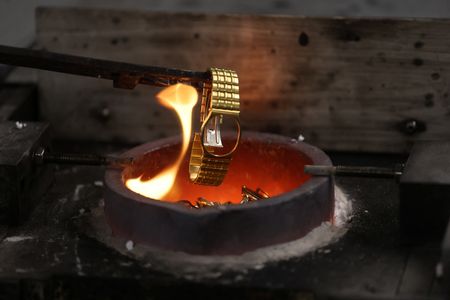

Celebrities like George Clooney and Nicole Kidman have made Omega’s Constellation timepiece a glamorous symbol at red carpet events and film premieres, but soaring gold values are now sending some of these luxury watches straight to the melting pot.
With gold reaching near-record peaks hit in January, certain classic timepieces are being destroyed because their precious metal worth exceeds what they could fetch at resale, according to more than a dozen industry professionals interviewed.
Timepieces from manufacturers like Omega and LVMH’s TAG Heuer face the greatest risk from this destructive trend, traders and investment specialists report.
Jon White, a British dealer with Gold Traders, destroyed an 18-carat Constellation from the late 1970s in excellent condition during May – just one of many mainstream luxury timepieces he has scrapped this year as investment gold demand climbs.
“Beautiful watch. But in reality, had the customer consigned that to auction, what would they have achieved?” White, who also manages an auction house, told Reuters.
The precious metal content in the Constellation timepiece was valued at £5,750 ($7,749), representing 35% more than its projected £4,000-4,500 auction price, White explained.
James Lamdin, founder of Watches of Switzerland’s second-hand unit Analog Shift, described the melting as “primarily happening with contemporary pre-owned and also with older vintage watches that are not already collectible.”
Company representatives for Swatch and Rolex declined to provide statements for this report. LVMH, Richemont, Patek Philippe and Audemars Piguet failed to respond to comment requests.
Gold values jumped to a record $5,600 per ounce in January as geopolitical tensions and trade uncertainties drove investors toward safe-haven precious metals. Current gold prices hover around $4,200 per ounce, nearly twice the 2024 average.
However, the secondary market for timepieces has not experienced similar price increases.
“I find it very sad, because obviously once something has been melted, it’s gone forever,” said Adrian Hailwood, a specialist in horological history.
Official statistics on luxury watch destruction remain unavailable. World Gold Council information indicates overall gold recycling increased 5% to 366 tonnes during the first quarter, while gold jewelry demand jumped 31% in value to $47 billion.
Timepieces contain anywhere from small gold amounts to more than 200 grams, creating scrap values potentially reaching tens of thousands of dollars. Omega Constellation models feature gold in both the case and band components.
With gold projected to reach between $5,400 and $6,300 per ounce this year, pressure to dismantle certain watches will persist, particularly since resellers must cover operational costs and warranty expenses.
Even new overproduced timepieces may face destruction.
“I’ve seen a lot of totally mediocre watches get melted down,” said Lamdin. “There’s a lot of unsold overstock in the Swiss market. And those watches are basically brand new, unworn, and they’re just getting stripped down… they made too many of them.”
“But when you have something that’s vintage and rare and has some story or some patina, that’s where it becomes a short-sighted tragedy.”
Premium brands that strictly control new production like privately owned Patek Philippe and Rolex maintain the highest premiums above melt value, three industry specialists noted.
For certain models “the wait lists are astronomical. You’re talking anything from two to eight years,” said Simon Lazarus, head of PR and content at online luxury watch platform Chrono Hunter.
Rolex represented 61% of new Swiss watch sales value above 3,000 Swiss francs ($3,770) last year, increasing from 57% in 2023 despite reduced volumes, according to Vontobel.
Less exclusive manufacturers like TAG Heuer, Breitling and Omega face challenges commanding high new retail prices, as consumers can purchase pre-owned models for significantly less.
Products like Omega’s Speedmaster frequently lose value sharply after initial purchase, making them vulnerable to scrapping, three specialists indicated.
Elevated gold prices motivated retired New York engineer Mitchell Talisman to sell two gold timepieces and a chain containing a total 35 grams of 58% purity gold for $2,660 cash in December.
“I’d had a bunch of stuff sitting in a safety deposit box for over 10 years,” he told Reuters.
For certain owners, however, the prospect of selling a timepiece only to have a dealer melt it proves unbearable.
“It may be a family piece, it may be their first watch,” said Hailwood.
“They don’t like the idea of it being destroyed, so they keep it.”