
Groundbreaking legislation in New York could mandate that 3D printers designed for home and commercial use include built-in technology preventing the creation of firearms.
This unprecedented requirement, which California is also examining, aims to combat the newest method for creating untraceable ‘ghost guns’ that have appeared in criminal activities. However, questions remain about the technology’s effectiveness and potential impacts on privacy rights and constitutional freedoms.
Approximately one-third of states across the country have already implemented measures to prohibit or control do-it-yourself weapons that don’t carry serial numbers and bypass background check requirements for gun purchases from licensed federal dealers. This new approach stands apart because it focuses on the manufacturing equipment rather than the individuals creating the weapons.
The prevention technology being promoted in two of America’s largest states by population could establish manufacturing standards for 3D printing devices. It might also provide a framework for other states with Democratic leadership seeking to expand their firearm restrictions, which typically already prohibit specific semiautomatic weapons and permit temporary removal of guns from individuals considered dangerous to themselves or others.
Three-dimensional printing devices have gained widespread adoption over the last twenty years.
From 2012 onward, global 3D printer numbers have expanded from approximately 30,000 to more than 3 million units, while the sector’s worth has increased from roughly $2 billion to $26 billion per year, according to Bill Decker, executive chairman of the Association of 3D Printing. While premium printers cost thousands, some 3D printing devices are now available for just a few hundred dollars.
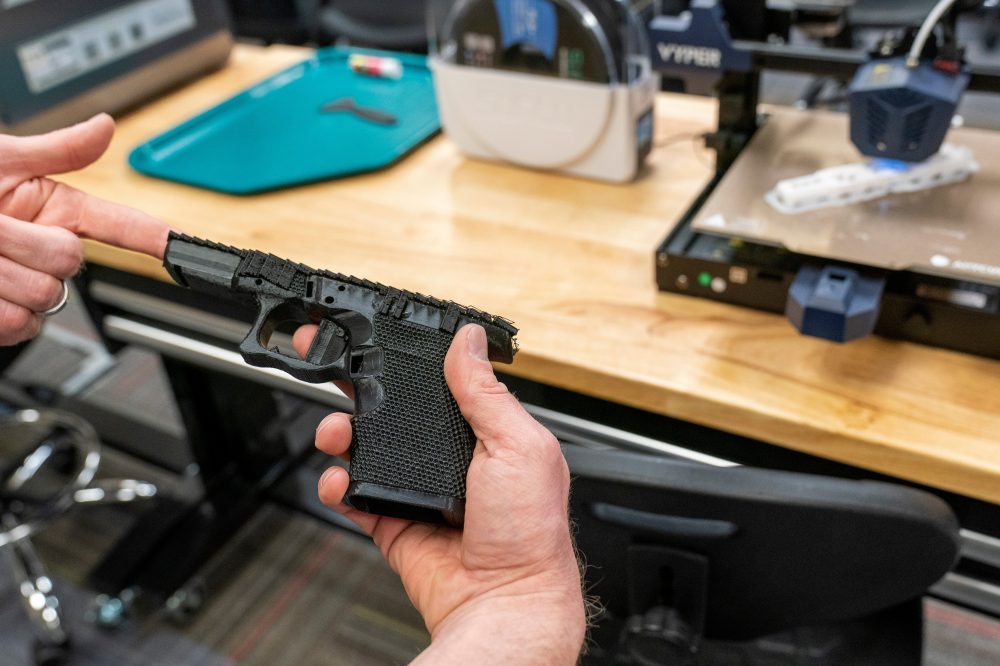
These machines can produce toys, artificial limbs, and even aircraft components. They can also manufacture firearms — or the components needed to build them — using digital blueprints found online. Self-made weapons without serial numbers are frequently termed ‘ghost guns’ because law enforcement finds them difficult to track.
Weapons created using 3D printers are appearing more frequently in criminal cases, based on a U.S. Department of Justice study published last year. Privately manufactured firearms recovered from crimes and sent to federal agencies increased from roughly 1,600 in 2017 to almost 27,500 in 2023, although the study didn’t detail how many originated from 3D printers.
In a notable New York incident, authorities believe a 3D-printed weapon was likely involved in the 2024 killing of UnitedHealthcare’s CEO.
New York legislation enacted last month and a California proposal would both establish expert committees to develop standards for firearm design detection algorithms. This technology would examine every design sent for 3D printing, match it against a digital database of weapon components, and refuse those showing similarities.
While the research phase would begin immediately, the requirement for 3D printers to include firearm-blocking technology wouldn’t take effect until 2029 — or later in New York’s situation if the study committee finds it’s not yet practical.
The idea resembles a mobile phone application that recognizes trees or flowers from uploaded photographs, explained Solomon Diamond, an associate engineering professor at Dartmouth College who participated in several expert presentations about the legislation during a recent online conference.
For 3D printers, one potential approach could employ geometric analysis of forms, measurements, and other structural characteristics to deny printing requests that closely match firearm components.
‘Geometric search is mature, it’s deployed, it is ready to be applied to this problem,’ said Julian Chultarsky, a technical account manager at Physna, a Columbus, Ohio-based company that develops such technology.
The Association of 3D Printing endorses the legislation in New York and California, but ‘it’s not going to work,’ Decker said. ‘It’s more of a political statement than anything else.’
Criminals will still find methods to manufacture weapons using 3D printers, either by modifying their blueprints or moving their printing operations to different locations, Decker explained.
The more intensive the technology becomes, the greater the likelihood it will also prevent unintended objects, said Rory Mir, director of open access and technology community engagement at the Electronic Frontier Foundation, a nonprofit digital rights group. Some innocent pipes might appear similar to gun components, or an S-shaped wall mounting device might look like an auto sear trigger used to convert a semiautomatic weapon into a machine gun.
‘These sort of censorship algorithms don’t work, and they wind up capturing and blocking a lot of lawful speech,’ Mir said.
When printing instructions are uploaded for cloud-based artificial intelligence analysis, it also threatens the privacy of individuals’ creative and proprietary designs, Mir explained.
Gun safety supporters argue 3D printers have established a new route for individuals who cannot legally buy firearms — such as minors or convicted criminals — to still acquire them. Eleven states already broadly ban 3D-printed weapons, and six more states mandate they receive serial numbers, according to Everytown for Gun Safety.
Preventing the actual 3D printing of weapons could make it more difficult for individuals to violate such regulations.
‘3D printing really is the new frontier of the fight against ghost guns,’ said Samuel Levy, director of policy advocacy at Everytown for Gun Safety.
The National Rifle Association might partially support that claim, though it opposes the policy.
‘Despite desperate fear-mongering campaigns, homemade firearms are nothing new — they are a proud, time-honored American tradition dating back to the founding of our Republic,’ John Commerford, executive director of the NRA Institute for Legislative Action, said in a statement. He added that ‘these measures only restrict responsible Americans — who do follow the law — from participating in constitutionally protected activities.’