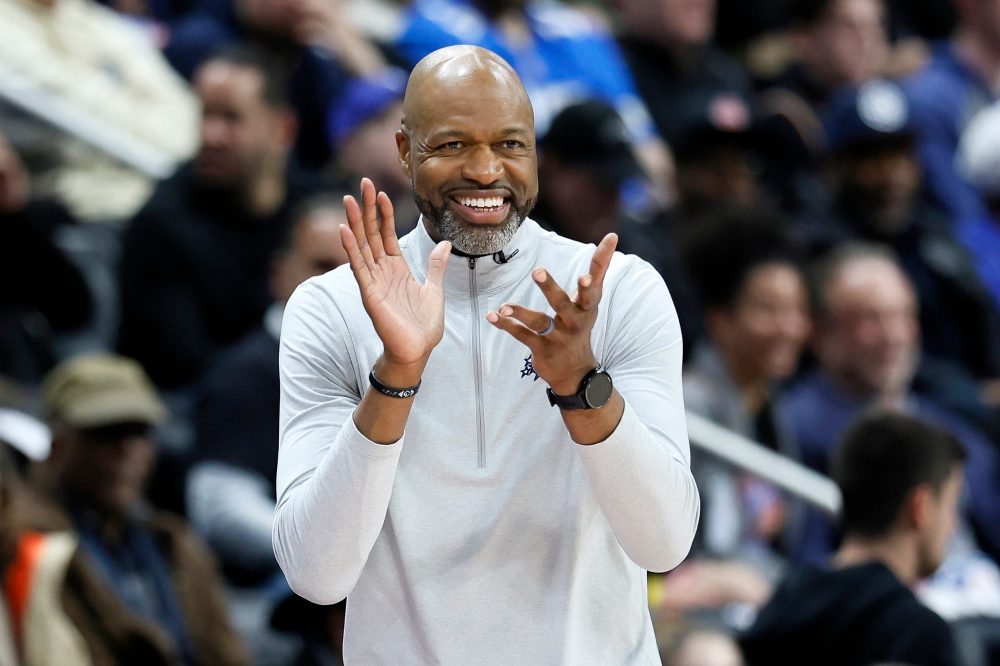
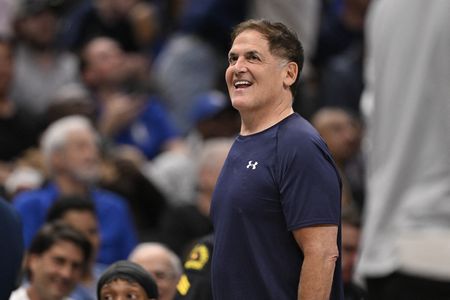
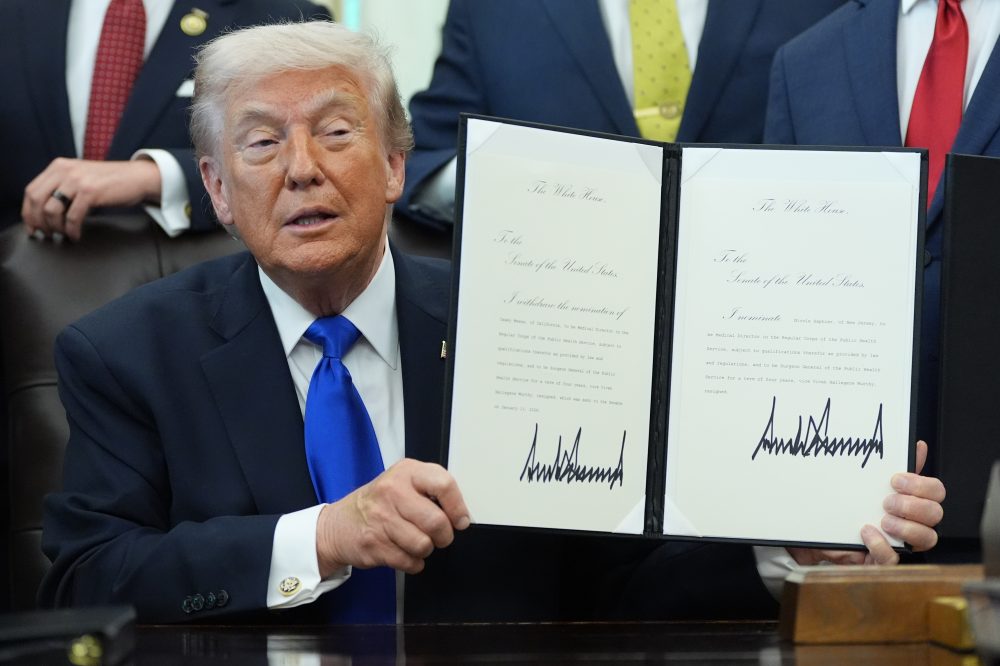
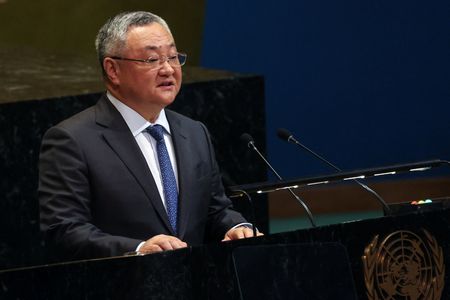
Toronto Raptors star forward Brandon Ingram will miss tonight’s pivotal Game 6 matchup against the Cleveland Cavaliers due to a sore right heel injury, head coach Darko Rajakovic announced Friday.
The All-Star player exited during the middle portion of the second quarter in Toronto’s 125-120 defeat in Cleveland earlier this week. Ingram managed just one point during his 11 minutes on the court before leaving the game.
Following a stellar regular season debut with Toronto where he posted 21.5 points per contest, Ingram has faced challenges in postseason play, managing only 12 points per game through five contests versus Cleveland. His shooting performance has been below par, connecting on 19 of 58 field goal attempts and hitting 5 of 13 three-point shots.
The Cavaliers hold a commanding 3-2 series advantage and have the opportunity to close out the Eastern Conference first-round matchup with a victory on their home court Friday evening. Notably, the host team has emerged victorious in all five previous games of this playoff series.
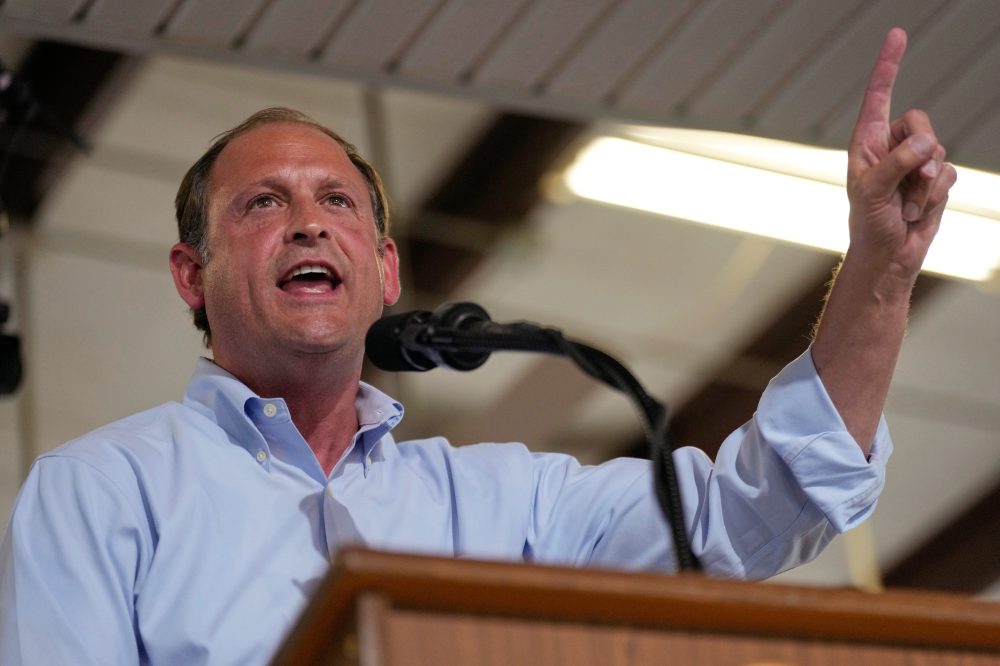
Former President Donald Trump announced his backing of Kentucky Representative Andy Barr on Friday for the Republican nomination to succeed retiring Senate Minority Leader Mitch McConnell in the U.S. Senate.
“Andy Barr has my Complete and Total Endorsement to be the next United States Senator from Kentucky,” Trump declared on his Truth Social platform.
The congressman will compete against former state Attorney General Daniel Cameron and businessman Nate Morris in the Republican primary scheduled for May 19th.
Trump’s backing was highly sought after by all three GOP contenders in Kentucky, a deeply conservative state where the former president secured 64% of votes in the 2024 election. Both Barr and Morris have featured Trump prominently in their television advertisements, while Morris has also gained financial backing from conservative supporter Elon Musk.
Notably absent from the Republican campaign rhetoric has been any significant discussion of McConnell, highlighting how the party has shifted under Trump’s influence.
Interestingly, all three candidates have personal ties to McConnell. Cameron previously served as a staff member for the senator, Barr has described McConnell as his mentor, and Morris once worked as an intern in McConnell’s office. While Trump previously lauded McConnell as a political partner, he has become increasingly critical of the seven-term senator in recent years.
On the Democratic side, the primary features former state legislator Charles Booker and ex-Marine pilot Amy McGrath. Booker defeated McGrath in a close 2020 Democratic primary before going on to challenge McConnell in the general election.
Kentucky Democrats have not secured a U.S. Senate victory since 1992.
The Pentagon announced Friday that approximately 5,000 American military personnel will be removed from Germany within the next six to twelve months, making good on President Donald Trump’s recent warning following tensions with German leadership over the ongoing Iran conflict.
The troop reduction comes after Chancellor Friedrich Merz stated that Iranian leadership was “humiliating” the United States and criticized Washington’s approach to the war earlier this week.
Pentagon spokesman Sean Parnell released a statement explaining that the “decision follows a thorough review of the Department’s force posture in Europe and is in recognition of theater requirements and conditions on the ground.”
Germany currently houses multiple American military installations, including European and Africa command headquarters, Ramstein Air Base, and the Landstuhl medical facility that has treated wounded soldiers from Iraq and Afghanistan conflicts. The country also hosts U.S. nuclear weapons.
The planned departure represents 14% of the roughly 36,000 American service members currently based in Germany.
According to Nico Lange from the Center of European Policy Analysis, who spoke with The Associated Press this week, these forces mainly advance U.S. strategic goals, including “the projection of American power globally,” rather than providing German defense.
When reporters questioned Trump about the withdrawal Friday as he departed Ocala, Florida following an economic rally, the president declined to respond while boarding Air Force One.
This marks Trump’s second attempt at reducing German troop levels. During his previous presidency, he proposed removing about 9,500 of the approximately 34,500 troops stationed there at the time, though the plan never moved forward and President Joe Biden officially canceled it after taking office in 2021.
Trump has consistently questioned the American military footprint in Germany and criticized NATO members for not supporting Washington in the Iran war, which started February 28 with joint U.S.-Israeli attacks on Iran.
The president posted on social media Wednesday that his administration was examining potential German troop cuts, promising a “determination” would come soon. By Thursday, he continued targeting Merz online, suggesting the German leader should focus on “ending the war with Russia/Ukraine” and “fixing his broken Country” instead of commenting on Iran.
NATO allies have anticipated possible U.S. troop withdrawals since Trump returned to office, as Washington has indicated Europe must take greater responsibility for regional security, including Ukraine’s defense.
Between 80,000 and 100,000 American personnel are typically deployed across Europe, depending on ongoing operations, training exercises, and rotation schedules. For over a year, NATO partners have expected that troops sent after Russia’s February 2022 invasion of Ukraine would likely be withdrawn first.
Ed Arnold, a European security specialist at London’s Royal United Services Institute (RUSI), noted that Europe is more worried about potential U.S. transfers of Patriot missile systems and ammunition from Germany to Middle Eastern operations.
In October, the United States confirmed it would reduce forces along NATO’s Ukrainian borders. The sudden decision to cut 1,500-3,000 troops created concern among NATO ally Romania, where the alliance operates an air base.
United Parcel Service’s chief executive believes the company’s expanding prescription medication delivery operations will provide financial protection during economic turbulence, as global conflicts threaten to impact business conditions.
CEO Carol Tome explained that the specialized healthcare delivery sector offers better stability than traditional industries during economic downturns. The business involves careful handling of temperature-controlled medications and radioactive treatments, commanding premium pricing.
“There have been lots of challenges over the past several years – high inflation, contractions in markets – but healthcare continues to grow,” Tome told Reuters this week. “I would argue that healthcare is pretty recession-proof.”
The pharmaceutical shipping segment has become a cornerstone of UPS’s multi-year restructuring effort as the company competes with FedEx while shifting toward fewer but more profitable deliveries.
Through strategic acquisitions, UPS now controls the largest share of the outsourced healthcare logistics industry, valued at over $80 billion. Industry experts predict this market could more than double within ten years, while competitors FedEx and Germany’s DHL Group also seek expansion in this area.
Tome emphasized that companies pursue complex healthcare logistics due to the substantial fees and strong profit margins these specialized services command.
She noted that shipping expensive medications generates profit margins in the mid-to-high teen percentages, while online retail delivery margins fall into very low single-digit ranges.
This strategy is already producing positive results as lightweight package deliveries for retailers like Amazon and Walmart continue pressuring company profits.
“We’ve just reported our first $3 billion healthcare revenue quarter in our company history and we’ve taken share in this space since 2021,” Tome said.
UPS generated $11.2 billion in healthcare revenue for 2025, representing nearly 13% of total company revenue. Healthcare comprised more than 14% of UPS’s consolidated revenue during the first quarter of 2026.
When asked about impacts from the Iran conflict, Tome indicated UPS’s core operations remain stable despite rising fuel costs affecting consumer and business spending due to Strait of Hormuz disruptions.
Industry observers are monitoring one healthcare business segment that could face recession vulnerability – home delivery of weight-loss medications that patients purchase directly rather than through insurance coverage.
UPS recruited Tome from retirement in June 2020, bringing the former Home Depot financial chief aboard as the company’s first external CEO in over a century of operations.
Her “better, not bigger” approach has transformed the world’s largest package delivery service, reducing Amazon’s portion of UPS business from over 13% to 8.8% in the most recent quarter while funding acquisitions to expand healthcare capabilities.
The Atlanta-headquartered company has been shuttering facilities and reducing staff, including unionized drivers earning over $100,000 annually, to offset the loss of millions of Amazon shipments.
UPS transferred its budget-priced Ground Saver service to the U.S. Postal Service as tariff policies reduced millions of low-value shipments from Chinese-connected retailers like Temu and Shein.
The company has also invested in hub upgrades featuring automation, package monitoring systems and efficiency tools designed to reduce delivery costs.
Most transformation work is approaching completion, generating billions in operational savings and positioning the company for improved profitability. Stifel analyst Bruce Chan described the progress in a research report titled: “Home Stretch: Heaviest Lift of Transformation Complete … Now for the Benefits to Materialize.”
The Pentagon has given the green light to defense equipment sales worth more than $8.6 billion to four Middle Eastern partner nations, the State Department announced Friday.
The major arms deals were revealed as the conflict between the U.S., Israel and Iran enters its ninth week, with a delicate ceasefire now in place for over three weeks.
Qatar received approval for the largest portion of the sales, including $4.01 billion for Patriot air and missile defense maintenance services and an additional $992.4 million for Advanced Precision Kill Weapon Systems.
Kuwait was authorized to purchase an integrated battle command system valued at $2.5 billion, while Israel received approval for $992.4 million worth of Advanced Precision Kill Weapon Systems.
The United Arab Emirates was cleared to buy Advanced Precision Kill Weapon Systems for $147.6 million.
According to the State Department, BAE Systems will serve as the primary contractor for the precision weapons sales to Qatar, Israel and the UAE.
For Kuwait’s battle command system and Qatar’s Patriot defense services, RTX and Lockheed Martin will handle the contracts as principal contractors. Northrop Grumman will also participate as a main contractor in the Kuwait deal.
American agricultural production of noncitrus fruits and nuts experienced a modest decline in 2025, according to new federal data released this week.
The United States Department of Agriculture’s National Agricultural Statistics Service reported that farmers across the country harvested 15.8 million tons of 21 different noncitrus fruit crops during 2025. This represents a one percent decrease compared to production levels recorded in 2024.
The annual summary tracks production of various crops including apples, grapes, berries, and tree nuts, providing insight into agricultural trends affecting American farming operations.
The slight reduction in overall production comes as farmers continue to navigate various challenges affecting crop yields nationwide.
Manufacturing operations utilizing cotton processing equipment consumed 23.7 million pounds of synthetic fibers throughout March 2026, according to new federal data.
The figure represents the total amount of artificial fiber materials processed through cotton system machinery during the month, as tracked by the U.S. Department of Agriculture’s National Agricultural Statistics Service.
This measurement reflects industry activity where synthetic materials are processed using equipment traditionally designed for cotton fiber production, indicating continued adaptation in textile manufacturing methods.
The statistics are part of ongoing federal monitoring of fiber consumption patterns across various processing systems in the American textile industry.
A federal appeals court has significantly limited reproductive healthcare access nationwide by prohibiting the postal delivery of mifepristone, a medication commonly used for abortion procedures.
The court decision impacts what has become one of the most frequently used methods for terminating pregnancies in the United States. The ruling prevents the medication from being sent through the mail system, creating new barriers for patients seeking abortion care.
Mifepristone is widely prescribed as part of a two-drug regimen for medication abortions, which account for a substantial portion of abortion procedures performed across the country.
Commercial activity between Colombia and Ecuador has ground to a virtual halt as both South American nations enacted steep tariffs this week, according to business organizations operating along their shared border.
Ecuador’s President Daniel Noboa implemented a sweeping 100% tariff that became effective Friday, though his administration has not disclosed which specific goods will be subject to the levy. Meanwhile, Colombia’s government under President Gustavo Petro officially established varying tariff rates of 35%, 50%, and 75% on approximately 190 Ecuadorian products Thursday.
President Noboa has defended these measures, which were initially introduced at reduced rates in February, citing Colombia’s trade surplus and alleging that the neighboring country has failed to address drug trafficking concerns along their 586-kilometer shared frontier. President Petro has consistently denied these claims.
Colombia’s trade minister stated Thursday that the nation’s response represents a measured approach designed to minimize the economic impact of Ecuador’s tariffs on Colombian businesses.
“It’s a whim, the very inflated egos of the two presidents have kept escalating this,” Carlos Bastidas, the head of the Heavy Transport Association of Carchi in Ecuador, told Reuters. “The movement of goods is minimal, but from next week this drops to zero.”
Bastidas noted that the Rumichaca International Bridge typically sees up to 150 trucks awaiting passage, but Friday’s count showed only about five vehicles present.
“This is generating unemployment and people have to look for alternatives. There are many crossings here, so what are people going to do? Turn to smuggling,” he warned.
Ecuador’s administration did not provide immediate comment when contacted.
Government officials in Ecuador have claimed that the original tariffs succeeded in creating the country’s first-ever positive trade balance with Colombia, generating a combined $62.9 million surplus during February and March compared to a $146 million deficit during the same period in 2024.
“The measure practically shuts down exports,” said Ivan Florez, head of the Ipiales Chamber of Commerce on the Colombian side of the border. “What you see along the border is very different from the view in Quito and Bogota.”
In response to the dispute, Colombia has halted electricity exports to Ecuador, which also relies heavily on its northern neighbor for medical supplies and agricultural chemicals.
ORLANDO, Fla. — The fire alarm system at Orlando’s Kia Center apparently didn’t want to hear discussions about a potential Game 7 between the Magic and Detroit Pistons on Friday night.
During head coach Jamahl Mosley’s pregame press conference before Game 6, loud alarm horns suddenly began echoing through the arena. The timing couldn’t have been more ironic — a reporter had just asked whether injured forward Franz Wagner could potentially return for a seventh game.
As the question was posed, the emergency sirens kicked in.
“That’s not a good sign,” Mosley remarked.
The coach attempted to continue answering, noting that Wagner’s availability would depend on his response to ongoing treatment. Meanwhile, an automated announcement system began broadcasting evacuation procedures to anyone inside the facility.
When the alarms sounded again moments later, Mosley decided to wrap up the session.
“All right, that’s good, thank you, appreciate it,” Mosley said as he concluded the interview.
A team representative later verified the alarms were malfunctioning. Detroit head coach J.B. Bickerstaff’s media session, which began roughly ten minutes after Mosley’s concluded, proceeded without any emergency interruptions.
Orlando entered Friday’s contest holding a 3-2 series advantage over the Pistons.
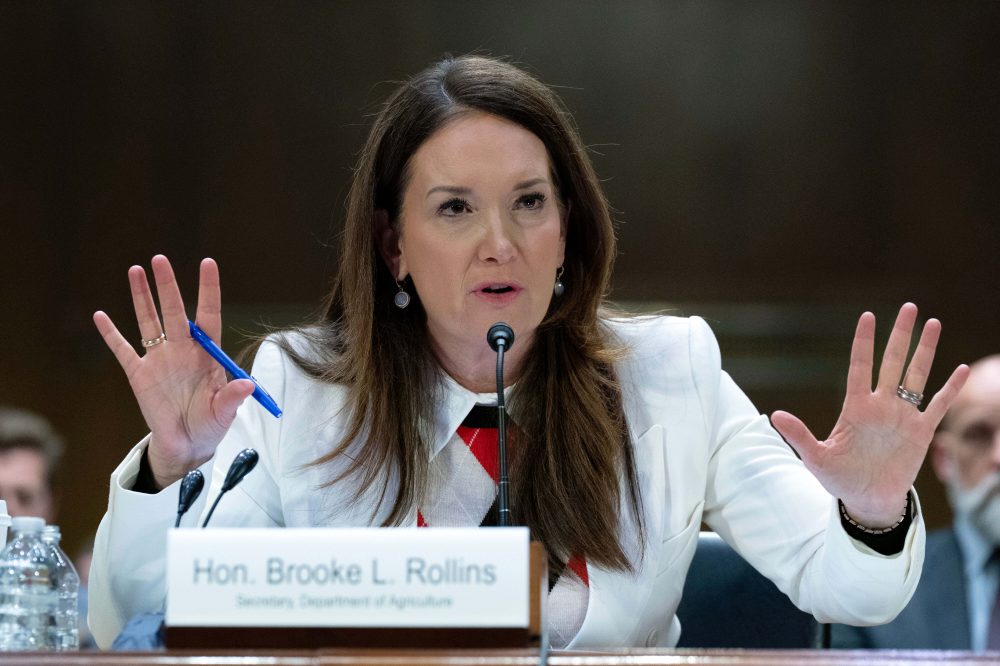
Agriculture Secretary Brooke Rollins recently claimed that a dramatic reduction in food stamp recipients stems from cracking down on fraudulent claims and economic improvements. However, food policy researchers are challenging this explanation, pointing instead to recent congressional legislation that tightened program requirements.
The data shows a significant decline in participation numbers, but the underlying causes tell a different story than what officials suggest.
During a recent statement, Rollins explained: “As of just a couple of days ago, we now have moved 4.3 million Americans off of the food stamp program. A lot of that is fraud. A lot of it is people taking the program that shouldn’t have been. And a lot of it is just a better economy. We’ve had wage growth that has outpaced inflation for the first time since early 2021. This is a really big day. So people don’t need food stamps.”
Government statistics confirm that SNAP participation dropped by approximately 4.3 million individuals between January 2025 and January 2026. However, academic researchers studying food insecurity point to legislative changes as the main factor driving this reduction.
The spending reduction legislation passed by Republicans last summer is expected to slash $186 billion from SNAP funding over a decade, representing a 20% decrease according to Congressional Budget Office projections.
“What we’ve seen in terms of the data is that the trend in participation declines seems to be related to the program being harder to access,” explained Roger Figueroa, a Cornell University assistant professor specializing in food insecurity research from a public health angle.
Research indicates that fraudulent activity within SNAP represents a minimal portion of overall cases, far too small to explain such a substantial participant reduction.
According to the most recent available statistics from fiscal year 2023, authorities disqualified 41,476 individuals for fraudulent activity. This figure encompasses both applicants who provided incorrect information and those who illegally traded benefits for cash or ineligible items. Among the total 42,176,946 participants, fraud cases represented less than one percent.
“I don’t see any evidence supporting a significant reduction in fraud as a driver of what we’re seeing as far as declining SNAP participation,” stated Caitlin Caspi, a University of Connecticut associate professor who researches food insecurity issues.
When asked to provide supporting data for Rollins’ fraud-related claims, USDA officials referred reporters to coverage from the New York Post and Foundation for Government Accountability regarding broad-based categorical eligibility policies. This policy allows SNAP applicants in most states to qualify if they receive non-cash benefits from federal Temporary Assistance for Needy Families programs or similar state initiatives.
Critics have targeted this eligibility approach for giving states excessive flexibility in determining qualification standards by eliminating asset limits, raising gross income thresholds, or implementing both changes. While the current administration aims to eliminate this policy, it remains legally permissible for now.
Economic performance in 2025 showed mixed results after initial challenges. The gross domestic product contracted during the first quarter for the first time in three years, but recovered during the latter half. Growth slowed in the fourth quarter but picked up momentum in early 2026, expanding at a moderate 2% rate from January through March following recovery from a record 43-day government shutdown.
Despite overall economic strength, food costs continue climbing. Prices increased 3.1% throughout 2025 and are projected to rise another 2.9% in 2026. For families experiencing persistent financial difficulties, broader economic improvements typically provide little relief.
“We have a persistent poverty problem in this country,” noted Kate Bauer, a University of Michigan associate professor of nutritional sciences. “And we have huge economic disparities. And most people, even in good economic times, are not able to pull their families out of poverty.”
While wage increases of 3.4% did exceed inflation rates of 3.3% in March, this wasn’t the first occurrence since 2021 as Rollins suggested. Additionally, higher-income Americans saw greater benefits in 2025 compared to lower-income families, who faced weaker income growth and continued high prices. Employment growth remained slow and unemployment rates increased.
“We’re not seeing a linear kind of drop-off,” Caspi observed. “We are not seeing, if you look at the unemployment rates, things that might be an indicator that a strong economy was driving this change. We don’t see, for example, a pattern of decline in unemployment that would match the pattern of decline in SNAP participation.”
Researchers identify the 940-page “One Big Beautiful Bill Act,” also called H.R. 1, as containing the primary factors behind reduced SNAP enrollment. The legislation imposed work requirements on certain adults who previously qualified for exemptions.
SNAP includes two categories of work requirements for eligibility. Standard rules cover most individuals aged 16-59, while able-bodied adults without dependents must meet more demanding criteria that H.R. 1 made even stricter, unless they qualify for specific exemptions. Participants can satisfy these enhanced requirements by working or joining work programs for at least 80 hours monthly, with payment not required.
Previously, able-bodied adults over 54 without dependents were exempt from enhanced requirements. This age threshold has been raised to 64. The legislation also lowered the age of dependent children that qualifies someone for exemption from 18 to 14. Homeless individuals, veterans, and former foster children 24 or younger also lost their exempt status.
“Families have lots of really complicated situations and you can’t just say to people, in 10 days or in one month, go find 80 hours a week of work when you don’t have the skills and those jobs aren’t available in your community,” Bauer explained.
SNAP eligibility covers U.S. citizens and certain lawful immigrants, though H.R. 1 removed qualification for groups including refugees and asylum seekers.
When Trump began his second presidential term in January 2025, approximately 42.83 million people participated in SNAP. This number fell nearly 10% by January 2026 to roughly 38.55 million. Most of this decline occurred during the year’s second half, following Trump’s signing of H.R. 1 in July. Participation decreased by only 743,572 people from January through June 2025, but dropped by about 3.47 million from July 2025 through January 2026.
Congressional Budget Office analysts had predicted this sharp reduction, estimating in an August 2025 report that specific provisions would “reduce participation in SNAP by roughly 2.4 million people in an average month over the 2025-2034 period.”
“It shouldn’t be surprising that we are seeing this decline and it shouldn’t be a leap in logic to think that these declines are attributable to H.R. 1.,” Caspi concluded.
A federal appeals court has significantly limited nationwide abortion access by prohibiting the mail distribution of mifepristone, one of the most widely used abortion medications.
The New Orleans-based 5th U.S. Circuit Court of Appeals panel mandated that the abortion medication can only be dispensed through in-person visits to medical facilities.
The court’s decision stated: “Every abortion facilitated by FDA’s action cancels Louisiana’s ban on medical abortions and undermines its policy that ‘every unborn child is human being from the moment of conception and is, therefore, a legal person.’”
Historically, federal judges have typically respected the Food and Drug Administration’s expertise regarding medication safety and regulatory standards.
Under the Trump administration, FDA officials have indicated they are conducting a fresh safety evaluation of mifepristone following presidential directives.
The court noted that the FDA “could not say when that review might be complete and admitted it was still collecting data.”
Louisiana’s attorney general, along with a woman claiming she was pressured into using abortion medication, filed court documents seeking to reverse FDA regulations back to when the pills required in-person prescription and distribution.
Last month, a Louisiana federal judge determined that current regulations conflicted with the state’s abortion restrictions but declined to immediately overturn the rules.
Following the Supreme Court’s 2022 decision eliminating Roe v. Wade protections and enabling state abortion bans, mail-order prescriptions have emerged as a primary method for providing abortions, including in states with prohibitions.
“This is going to affect patients’ access to abortion and miscarriage care in every state in the nation,” said Julia Kaye, an ACLU lawyer. “When telemedicine is restricted, rural communities, people with low incomes, people with disabilities, survivors of intimate partner violence and communities of color suffer the most.”
The ruling is anticipated to prompt an appeal to the Supreme Court.
While the conservative-dominated Supreme Court eliminated constitutional abortion protections in 2022, it unanimously maintained mifepristone access two years afterward.
However, that 2024 ruling avoided addressing fundamental issues by determining that the anti-abortion physicians who brought the lawsuit lacked proper legal standing to pursue the case.
Comic book industry veteran Gerry Conway, the creative mind behind the iconic Punisher character and numerous other beloved superheroes, has passed away at the age of 73.
Conway died Sunday at his residence in Thousand Oaks, California, after battling pancreatic cancer, according to his wife’s statement to The New York Times. Marvel Comics announced his passing on Monday, calling him a legendary figure with an extraordinary career spanning decades.
“From Spider-Man to the Avengers, Iron Man to Captain Marvel, Gerry Conway has deftly written almost every character in the Marvel Universe,” stated Marvel Comics Editor-in-Chief C.B. Cebulski. “Gerry Conway’s legacy has made an undeniable and indelible impact on the Super Hero stories we know and love. He will be dearly missed.”
The comic book community paid tribute across social media platforms following news of his death.
“While many know his Marvel accomplishments … Gerry’s contributions to DC were equally impactful and significant: shaping Batman, Superman, the Justice League of America, and co-creating Firestorm, Jason Todd and Power Girl and so many more,” wrote Jim Lee, chief creative officer and president of DC Comics, in an Instagram tribute. “Thank you, Gerry, for the worlds imagined and the heroes created.”
Born September 10, 1952, in Brooklyn, Conway developed a passion for comics early in life. He began crafting comic stories during his teenage years and secured a position writing for “The Amazing Spider-Man” at just 19 years old — a role Marvel described as transformative for both his career and the entire comic book world.
Conway’s storytelling included groundbreaking narrative choices that fundamentally altered the Spider-Man series, including the controversial death of Gwen Stacy, Peter Parker’s love interest. He also helped develop the Punisher, the skull-emblazoned vigilante anti-hero who became one of Marvel’s most recognizable characters.
The distinctive skull symbol has generated debate in recent years due to its adoption by some law enforcement agencies. Conway previously criticized police departments for using Punisher imagery on their vehicles, explaining on social media that the character represented “a complex morally compromised anti-hero, not to be emulated by cops,” according to the Syracuse Post-Standard’s reporting.
Marvel praised Conway’s ability to create multi-dimensional characters with emotional complexity.
“Gerry Conway brought real stakes to his writing, able to weave together sensational super heroics with the human and relatable, and in doing so created some of the most memorable stories and characters of all time,” said Marvel Studios President Kevin Feige.
Conway’s work extended far beyond Spider-Man, encompassing major titles like “Fantastic Four,” “Thor,” and “The Incredible Hulk.”
Speaking with The Comics Journal in 1981, Conway reflected on comic books’ broad appeal across age groups.
“I’m writing for the youthful part of myself, the primitive part of myself,” he explained to the publication. “If an adult likes the books it’s because of a nostalgic feeling for that primitive, easy conceptualization of heroic purpose.”
Conway leaves behind his wife, Laura Conway, and two daughters from earlier marriages.
The San Diego Padres activated right-handed pitcher Jeremiah Estrada from the 15-day injured list on Friday after a three-week absence due to right elbow tendinitis.
Estrada, 27, had been out of action for the past three weeks dealing with the elbow issue that has limited his early season availability.
This season, the relief pitcher holds a 1-1 record with a 5.14 earned run average across seven appearances, recording eight strikeouts while issuing five walks over seven innings of work.
To make space on the active roster for Estrada’s return, San Diego sent right-handed pitcher David Morgan down to their Triple-A affiliate in El Paso.
Morgan, 26, compiled a 2-0 record this season with a 6.08 earned run average over 11 games, tallying 15 strikeouts and 11 walks in 13 1/3 innings pitched.
Delaware Department of Transportation crews are conducting construction work that has forced the closure of one westbound lane on Garfield Parkway (Route 26) at Tree Top Lane.
The lane restriction began earlier today and is expected to continue until 4 PM this afternoon, according to DelDOT traffic officials.
Motorists traveling westbound on Route 26 should expect delays in the area and may want to consider alternate routes or allow extra travel time to reach their destinations.
DelDOT continues to monitor the construction progress and will reopen the lane once work is completed safely.
Delaware Department of Transportation crews are performing inspection activities today underneath the Brandywine River bridge situated between Lovering Avenue and North Park Drive.
The maintenance work is part of DelDOT’s regular infrastructure assessment program to ensure bridge safety and structural integrity. Officials have not indicated any specific concerns that prompted today’s inspection.
Motorists traveling in the area should expect potential minor delays as crews complete their assessment work. The inspection is expected to be completed today.
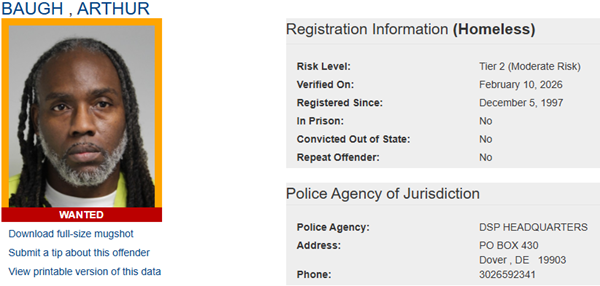
Delaware State Police’s Sex Offender Apprehension and Registration Unit (SOAR) has released public notifications regarding multiple registered sex offenders who are either missing from the system or currently homeless.
Authorities are actively searching for seven individuals who have violated registration requirements by failing to update or confirm their residential information with the state registry.
The wanted individuals include Arthur Baugh, Stefan Ewell, Charles Fulton, Deangelo Hoskins, Tori Lied, Michael Viscount, and Brian Walker. These cases represent a fraction of the total number of sex offenders currently being sought by law enforcement.
Police emphasize that anyone with knowledge of these individuals’ whereabouts should immediately contact SOAR at (302) 739-5882. Citizens can also submit anonymous tips through Delaware Crime Stoppers by calling (800) 847-3333.
Additionally, authorities have issued a separate notification regarding Benjamin Perchalski Sr., a registered sex offender who has recently reported being homeless. While Perchalski is not considered wanted for registration violations, police are requesting information if anyone knows of him occupying a specific residence.
The same contact numbers are available for reporting information about homeless sex offenders. State Police note that both the wanted and homeless individuals mentioned represent only partial lists of current cases.
Complete profiles and updated information for all registered sex offenders can be accessed through the Delaware Sex Offender Registry website, which maintains separate searchable databases for wanted and homeless offenders.
Two former Israeli Prime Ministers have announced they will join forces for the country’s upcoming election, creating a unified opposition front against current Prime Minister Benjamin Netanyahu. Naftali Bennett and Yair Lapid revealed their partnership under the framework called Beyachad, with Bennett positioned to head the ticket and Lapid taking a supporting role.
The collaboration reunites the same duo who previously led Israel’s brief unity government from 2021 to 2022. This time around, the leadership structure is more clearly defined, with Bennett expected to spearhead the joint list while Lapid, who leads the Yesh Atid party, assumes a secondary position.
Political analysts suggest this alliance could significantly impact how Washington views Israel’s political landscape. Ofir Dayan, a researcher at the Institute for National Security Studies, believes Netanyahu’s perceived indispensability in American circles has diminished. “I think that ship has sailed,” Dayan explained to The Media Line. “When Bennett and Lapid replaced Netanyahu in 2021, I think it became clear that Netanyahu is not irreplaceable.”
Michael Koplow, chief policy officer at Israel Policy Forum and a senior research fellow at the Shalom Hartman Institute of North America, offered a nuanced perspective on U.S.-Israel relations. “At the institutional level, under this administration, it’s very stable, and I don’t think that will change no matter who’s leading the Israeli government,” Koplow told The Media Line. “But when you get past the level of the president and the administration, there are definitely warning signs in Congress … and that’s where it probably makes a difference who the prime minister is.”
While the partnership appears straightforward on the surface, it introduces complex questions about governance and international relations, particularly regarding how a Bennett-led government might interact with President Donald Trump. Israel’s parliamentary system requires coalition-building after elections to form a governing majority, making the path to power uncertain despite the clear opposition leadership.
Dr. Assaf Shapira from the Israel Democracy Institute views the merger as strategically beneficial for both politicians involved. “If we are talking about the particular interests of Lapid and Bennett and their parties, then it is a success,” Shapira told The Media Line. “It will bring them only gains.”
For Lapid specifically, Shapira noted the alliance provides crucial protection against electoral decline. “The party, according to the polls, was about to crash,” he explained, referencing surveys that showed Yesh Atid approaching the electoral threshold. “Now, Lapid secures his place in the next Knesset. He secures the fact that he will be the deputy of a list that will certainly be a large list.”
The partnership could also position Lapid for a return to international diplomacy. “If Bennett forms a government, I think there is a good chance that we will see Lapid as foreign minister,” Shapira predicted. “You cannot know, but that seems a little like his natural role in the next government, and that may also be relevant to the United States.”
Bennett’s advantages from the merger are equally significant. Before the alliance, he faced competition for opposition leadership, including from Gadi Eisenkot, the former military chief who entered politics with strong security credentials. “Now, with this union, Bennett is the leader of the bloc,” Shapira observed. “There are still six months until the election, but at the moment it looks like Bennett is completely the leader of the bloc, and he positions himself as the main, almost the only, competitor to Netanyahu.”
However, Shapira expressed skepticism about the alliance’s ability to expand beyond existing opposition voters. “I don’t see how this union can bring additional voters from Likud,” he stated. “There is probably no one who was debating whether to vote Bennett or Likud and now says, after Bennett united with Lapid, I will definitely vote Bennett.”
The merger’s impact may be more psychological than electoral, according to Shapira. Strong polling performance could generate momentum and enthusiasm among opposition supporters. “The very fact that people will suddenly see in the polls a list, the Beyachad list, that is like Likud, maybe even in some polls bigger than Likud, that is something that can create enthusiasm,” he explained. “And that enthusiasm is important. It has importance in itself.”
Several political questions remain unresolved, particularly regarding other opposition figures like Benny Gantz, the former defense minister who leads National Unity. “We don’t know what will happen, for example, with Gantz—whether he runs separately, whether he unites,” Shapira noted. Other potential moves involving Yoaz Hendel, Avigdor Liberman, or Eisenkot could further reshape the political landscape.
The alliance also highlights the evolving nature of Israeli political divisions. Shapira argues that traditional left-right distinctions have given way to divisions centered on Netanyahu, judicial authority, and democratic institutions. “You can call it the Bibi bloc and the anti-Bibi bloc,” he said. “You can call it a bloc that supports the Supreme Court and a bloc that opposes the Supreme Court.”
In this context, Lapid’s centrist positioning becomes complicated. “Lapid defines himself as a center party. That is nice. It is not a center party,” Shapira stated bluntly. “There is almost no center today in Israel.”
Regarding U.S.-Israel relations, the personal dynamics between leaders could prove crucial. Dayan emphasized the importance of the existing Netanyahu-Trump relationship. “You can’t underestimate the value of personal connection,” she said. “President Trump and Prime Minister Netanyahu are good friends. They have been working together for many years, so it has influence.”
While Bennett could potentially work effectively with Trump, the relationship would lack the established history. “Even if future Prime Minister Bennett will have great relations with President Trump, still he doesn’t have that advantage of working with President Trump and being friends with him for so many years,” Dayan explained. “So, obviously, that’s going to change.”
The current opposition faces challenges in building Washington connections due to the close Trump-Netanyahu relationship. “There is no light between Prime Minister Netanyahu and President Donald Trump,” Dayan observed. “So, the opposition is not really very much in touch with the American administration.”
Nevertheless, Bennett and Lapid are not unknown quantities in Republican circles, and Trump has previously praised Lapid publicly. “They are aware of them and have some sort of relations with them, even if not working directly together,” Dayan noted.
Koplow highlighted the unprecedented nature of the Trump-Netanyahu bond. “I don’t think there’s ever been a president and a prime minister who were so tightly linked … and who went out of their way to also give each other such high levels of political support,” he said. “They seem to have this bond that I don’t think you’ll see with Trump and a different Israeli prime minister.”
On security matters, institutional relationships may prove more durable than personal ones. Dayan argued that military and intelligence cooperation remains strong regardless of leadership changes. “In terms of security, the relationship is super close, super intimate,” she said. “And I think it will stay this way for the near future, again, unless something drastic changes in the administration.”
Political dynamics present different challenges. Netanyahu’s image has become polarizing in certain American circles, potentially limiting his effectiveness with future Democratic administrations. “Netanyahu’s image became toxic in certain American circles,” Dayan explained. “Not necessarily just the policies of the Netanyahu government, but Netanyahu himself. He is portrayed as the prototype of an illiberal leader.”
Interestingly, Dayan suggested Bennett might be better positioned to resist certain American pressures than Netanyahu. “Netanyahu has a soft spot with Trump,” she said. “Trump knows he can pressure Netanyahu, and there are many things that Bennett might be better positioned to refuse Trump than Netanyahu is, because Netanyahu feels like he owes Trump for things they did together in the past.”
The possibility of American intervention in Israeli elections remains open. “I think it is likely,” Dayan said when asked about potential Trump involvement. “I don’t know that it will happen.” At minimum, she expects Trump to publicly express support for Netanyahu’s continued leadership.
For now, the Bennett-Lapid partnership has clarified opposition leadership without guaranteeing electoral success. The alliance provides structural advantages for both leaders while raising new questions about governance and international relations. As Shapira concluded, “It’s good for both Bennett and Lapid. In terms of the blocs, I don’t think it changes very much.”
International relief organizations are requesting the establishment of a protected humanitarian pathway through the Strait of Hormuz following regional conflicts that have caused shipping disruptions, increased fuel expenses, and delayed critical food and medical deliveries to at-risk populations throughout Africa, the Middle East, and Asia.
Relief agencies report that the current crisis has interrupted supply chains from key distribution centers in Dubai and India, impacting shipments to Sudan, Somalia, Ethiopia, Nigeria, and Afghanistan. According to The Guardian’s reporting, these appeals have come from organizations such as the International Rescue Committee, Save the Children, and the World Food Programme.
The Strait of Hormuz serves as a crucial global maritime passage, handling approximately 20 percent of worldwide oil and gas transportation. Disruptions to this waterway have caused significant increases in energy costs, driving up expenses for shipping essential items including food, medical supplies, fuel, and emergency aid. Relief organizations report that these additional costs are putting pressure on already limited budgets, compelling some programs to cut services, postpone shipments, or shift resources away from direct assistance.
The World Food Programme has issued warnings that supply chain interruptions and escalating costs could exacerbate worldwide hunger during a period when hundreds of millions of individuals are already experiencing serious food shortages. Relief organizations identify malnourished children, displaced populations, and communities relying on imported grain, fertilizer, and fuel as being particularly vulnerable.
This situation develops as humanitarian efforts face additional challenges from ongoing conflicts in Sudan and Yemen, regional instability in the Horn of Africa, and reduced funding from major contributors. Elevated fuel prices also impact medical facilities, water infrastructure, refrigeration systems for medications, and transportation for aid personnel.
European Commission President Ursula von der Leyen cautioned this week that the broader consequences of the Iran conflict “may echo for months or even years to come.”
Relief officials indicate that establishing a humanitarian corridor through Hormuz would not end the broader regional conflict, but could help maintain the flow of life-saving supplies while diplomatic solutions are pursued.
A new Israeli public opinion survey has revealed that two prominent political figures currently outperform Prime Minister Benjamin Netanyahu when citizens evaluate leadership qualifications, according to research published on Friday.
The study, carried out by Lazar Research in partnership with Panel4All, discovered that 46% of those surveyed considered former Prime Minister Naftali Bennett qualified for the top government position, while 44% expressed similar confidence in former Israel Defense Forces Chief of Staff Gadi Eisenkot. In contrast, only 41% of respondents rated Netanyahu as suitable for the role.
When participants were asked to choose directly between Bennett and Eisenkot, the results showed a virtual tie: 33% favored Eisenkot, 32% supported Bennett, and 35% remained undecided.
The research also examined support for the newly created Together coalition, which combines Bennett’s political organization with that of Opposition Leader Yair Lapid. While this alliance would maintain its position as the dominant political group in hypothetical elections, its projected parliamentary representation decreased to 28 seats, down from the combined 31 seats the two parties held individually in previous polling.
Public opinion remains divided regarding whether Eisenkot should accept an invitation to join the Together movement. The survey found that 34% believe he should take Lapid’s offer to serve as the second-ranking candidate on their joint ticket, while 30% think he should maintain his independent political path. Another 36% expressed uncertainty about the best course of action.
Current parliamentary projections show the governing coalition gaining ground with 50 seats, while opposition parties, not including Arab political groups, would hold 60 seats. National Security Minister Itamar Ben-Gvir’s Otzma Yehudit party saw an increase to nine seats within the coalition. Among opposition forces, Yair Golan’s Democrats party climbed to 10 seats, while Eisenkot’s Yashar party experienced a decline to 14 seats.
The poll also tested support for a potential centrist right-wing political list that could include former Likud party members such as Yuli Edelstein, Moshe Kahlon, and Gilad Erdan. This hypothetical group garnered 3.5% backing, placing it near the minimum threshold required for parliamentary representation.
Researchers conducted the survey on April 29-30, interviewing 501 Israeli adults. The study carries a margin of error of 4.4 percentage points.
Sources within Iran report that President Masoud Pezeshkian and Parliamentary Speaker Mohammad Bagher Ghalibaf want to remove Foreign Minister Abbas Araghchi from his position. The officials allegedly believe Araghchi has been following orders from the Islamic Revolutionary Guard Corps instead of implementing official government policy, according to Thursday reports.
The Jerusalem Post referenced Iran International, an opposition news source, stating that both Pezeshkian and Ghalibaf have become frustrated with how Araghchi manages diplomatic affairs and international negotiations. According to these sources, the two leaders suspect Araghchi operates under guidance from Ahmad Vahidi, who commands the Islamic Revolutionary Guard Corps, rather than answering to presidential authority.
Sources indicate that Pezeshkian has privately told associates he might fire Araghchi if the foreign minister keeps acting without proper supervision. This conflict appears to be connected to a larger internal battle within Iran’s government regarding diplomatic relations with America and policies concerning Tehran’s allied groups throughout the region.
These tensions allegedly emerged during recent negotiations between the United States and Iran. Iran International reported that internal disagreements within Iran’s negotiating team led to their departure from talks on April 12. According to the report, Araghchi had appeared open to potentially reducing or ending Iran’s financial and military assistance to what they call the Axis of Resistance, which includes Hezbollah, but this drew criticism from Mohammad Bagher Zolghadr, who serves as secretary of Iran’s Supreme National Security Council and previously commanded Revolutionary Guard forces.
US Vice President JD Vance subsequently appeared on Fox News, explaining that American negotiators discovered the Iranian delegation lacked authority to complete any agreement without first returning to Tehran for approval “from the supreme leader or somebody else.”
This reported division illustrates the ongoing power struggle within Iran between democratically elected government bodies and security organizations that remain loyal to the late Supreme Leader Ali Khamenei. The Islamic Revolutionary Guard Corps maintains significant influence over Iran’s international relations, regional military activities, and assistance to armed allies across Lebanon, Iraq, Syria, Yemen, and Gaza.
A senior Israeli military official has cautioned government leaders that escalating attacks by radical settlers in the West Bank could spark a fresh Palestinian uprising, while the European Union unveiled Thursday a new assistance initiative for Palestinians impacted by settler aggression.
Major General Avi Bluth, commander of the Israel Defense Forces’ Central Command, recently addressed a private gathering where he described violence by Jewish extremists as creating security, moral, and political dangers, according to Haaretz. The commander reportedly cautioned Prime Minister Benjamin Netanyahu and his cabinet that while Palestinian attacks remain relatively subdued, the situation could rapidly worsen.
“The coffee brewing is a good coffee—the level of terrorism is at its lowest—but there’s a constant simmer, and we don’t know where it will spill over. And when it spills over, it spills quickly,” Bluth stated according to the report.
The general also connected settler aggression to subsequent Palestinian retaliation, noting: “We know today of people [Palestinians] who were harmed in ‘price tag’ attacks and immediately afterward went out to carry out an attack.”
Meanwhile, Alexandre Stutzmann, the European Union’s representative to the West Bank and Gaza Strip, unveiled an assistance program for those targeted in settler attacks, as reported by the Palestinian Authority’s official WAFA news agency. Stutzmann characterized the escalating violence as a “wake-up call” and indicated the EU was considering additional political responses.
The aid announcement followed Stutzmann’s visit with international diplomats to al-Mughayyir, located northeast of Ramallah, where Palestinians documented destruction from recent settler incidents.
Both Israeli and Palestinian advocacy organizations have extensively recorded physical assaults, property destruction, vandalism, and harassment by extremist settlers throughout the West Bank. Palestinian officials and human rights organizations claim Israeli authorities fail to prevent such incidents or hold perpetrators accountable. Israel maintains it investigates violent acts and denies allegations that its security forces shield attackers.
The West Bank has remained under Israeli administration since the 1967 conflict. Between 470,000 and 500,000 Israelis reside in the region, which Israel refers to as Judea and Samaria. The majority of the global community views Israeli communities in the West Bank as violations of international law, though Israel contests this interpretation.
Pakistani officials have initiated a federal investigation following a significant security breach involving a Cambridge International A-level mathematics examination that impacted roughly 25,000 students across the country.
On Thursday, the Inter Board Committee of Chairmen announced it would request a comprehensive report from Cambridge International Education after receiving numerous complaints from concerned parents and students regarding the lack of transparency in the examination process.
Cambridge Pakistan acknowledged that the Advanced Subsidiary Mathematics examination materials were distributed prematurely, breaking established protocols. The organization released a statement saying, “We confirm that the Cambridge International AS Level Mathematics exam 12 (9709), conducted across Africa, Europe, the Middle East, Pakistan, and South Asia, was shared ahead of time in violation of our regulations.”
The statement further explained, “we immediately and thoroughly investigate such incidents, and we are now working to understand the extent of the leak and determine the future course of action in this regard.”
Cambridge officials emphasized their commitment to student welfare, stating: “Our priority is to ensure that students do not suffer any loss due to this incident, and we continue to take all possible measures to protect the integrity of our examinations.”
The scandal unfolded when the AS-Level Mathematics Paper 1 (Pure Mathematics 1, syllabus code 9709/12) for the May/June 2026 examination session appeared on various social media channels, including WhatsApp, YouTube and Google Drive, hours before students were scheduled to take the test on Wednesday, April 29, 2026.
Both students and their families have voiced serious concerns about the financial and educational ramifications of this breach. Arbab Iqbal, an education expert from Rawalpindi, spoke with The Media Line about the scale of the problem, noting that approximately 25,000 students invested $180 each for the subject, creating a total financial impact of around $4.5 million and raising serious questions about examination security measures.
Reports suggest that some individuals sold access to the examination materials online before the leak became widespread. Student Amir Hamza from Rawalpindi shared his frustration with The Media Line, saying, “Hours of preparation and the hundreds of thousands of rupees spent on tuition fees over the course of a year were all wasted.”
Both Pakistani authorities and Cambridge International continue to investigate the full extent of the security violation.
Listen to the Evening Delmarva Farm Report Update — May 1, 2026
DELMARVA — Corn and soybean prices are drawing close attention from Delmarva farmers as planting acreage shifts continue across the region.
Markets
December corn futures climbed to $4.96 today, gaining ground since early April. Market analysts say the increase stems from oil market concerns and potential disruptions through the Strait of Hormuz, not supply and demand fundamentals.
November soybeans settled at $11.68 yesterday, up $0.25 since late March despite heavy ending stocks and limited Chinese buying interest.
USDA projects corn plantings at 95.3 million acres nationwide, down from last year’s 98.8 million. Soybean acreage is expected to jump from 81.2 million to 84.7 million acres this season.
Locally, corn at Laurel Grain Company in Laurel, Delaware is bringing $5.25 a bushel for July delivery. Soybeans there are at $11.44 for July.
Livestock
Livestock markets ended the week lower Friday. August live cattle dropped $0.85 to $247.82 per hundredweight. August feeder cattle fell $1.35 to $372.17.
Forecast
The forecast calls for mostly sunny conditions this afternoon with highs near 62°F. Tonight will be mostly cloudy with a chance of rain showers developing, lows around 49°F. Saturday looks for a slight chance of showers with highs near 60°F.
This article is based on the Delmarva Farm Report Update Evening Edition, May 1, 2026. Hosted by Tom Bradley.
Washington is pushing for a face-to-face summit between Lebanese President Joseph Aoun and Israeli Prime Minister Benjamin Netanyahu, with American officials arguing Thursday that such a meeting could lead to Israeli forces pulling out of southern Lebanon and returning control to the Lebanese government.
The proposal emerged from the US Embassy in Lebanon as the Biden administration works to transform the current fragile ceasefire with Hezbollah into a lasting peace agreement. Embassy officials stated: “A direct meeting between President Aoun and Prime Minister Netanyahu, facilitated by President Trump, would give Lebanon the chance to secure concrete guarantees on full sovereignty, territorial integrity, secure borders, humanitarian and reconstruction support, and the complete restoration of Lebanese state authority over every inch of its territory—guaranteed by the United States.”
American diplomats characterized Lebanon as standing “at a crossroads,” emphasizing that direct discussions with Israel “can mark the beginning of a national revival.”
The two neighboring countries have never established official diplomatic ties and continue to exist in a technical state of war. Their border has been managed under a 1949 armistice deal for decades, though Hezbollah’s armed presence in Lebanon’s south has repeatedly sparked conflicts with Israel. Israeli officials justify their current military operations as necessary to stop Hezbollah from reestablishing threatening positions along the frontier that could endanger Israeli border communities.
The American initiative comes amid sharp disagreements within Lebanon’s government about engaging with Israel. While Aoun and Prime Minister Nawaf Salam have expressed openness to discussions that might bring border stability and restore government authority, Parliament Speaker Nabih Berri, who maintains ties to Hezbollah, has rejected normalization efforts and instead advocates for a limited non-aggression pact.
President Donald Trump has expressed willingness to host both Netanyahu and Aoun for talks, with US officials identifying the dismantling of Hezbollah’s military capabilities as essential to any permanent agreement. Lebanon’s key priorities include Israeli troop withdrawal, release of prisoners, reconstruction assistance, and establishing Lebanese state control throughout the south instead of continued Hezbollah dominance.
The United Arab Emirates implemented a complete travel prohibition Thursday, preventing its nationals from visiting Iran, Lebanon, and Iraq while instructing citizens currently in these nations to depart without delay due to escalating regional tensions and safety concerns.
According to the UAE’s Ministry of Foreign Affairs, this prohibition represents preventative action as Middle Eastern conflicts continue to intensify. Officials are requesting that all Emirati nationals currently in these three nations return home at the earliest opportunity while adhering to official travel advisories.
The government has directed UAE citizens currently in Iran, Lebanon, and Iraq to reach out to the ministry using the emergency contact number +971 800 44444 for support. Ministry officials stated they are actively tracking situations that could impact Emiratis traveling internationally.
This action occurs during a time of increased regional instability involving Iran, Lebanon’s Hezbollah organization, Iraqi militant organizations, and broader security issues throughout the Gulf region. The UAE has previously released safety warnings related to missile and drone attacks, while flight restrictions and security advisories have impacted multiple regional nations.
Iran, Lebanon, and Iraq are all positioned at the heart of interconnected regional conflicts. Iran continues to be a central point of tension with Israel and the United States; Lebanon has experienced fresh instability connected to Hezbollah and Israeli military operations; and Iraq remains home to armed groups linked to wider regional conflicts.
The UAE, which established diplomatic ties with Israel through the Abraham Accords in 2020 while continuing diplomatic relations with Iran, has frequently attempted to balance conflict reduction with security readiness. This travel prohibition demonstrates Abu Dhabi’s worry that regional situations could rapidly worsen and endanger Emirati nationals.
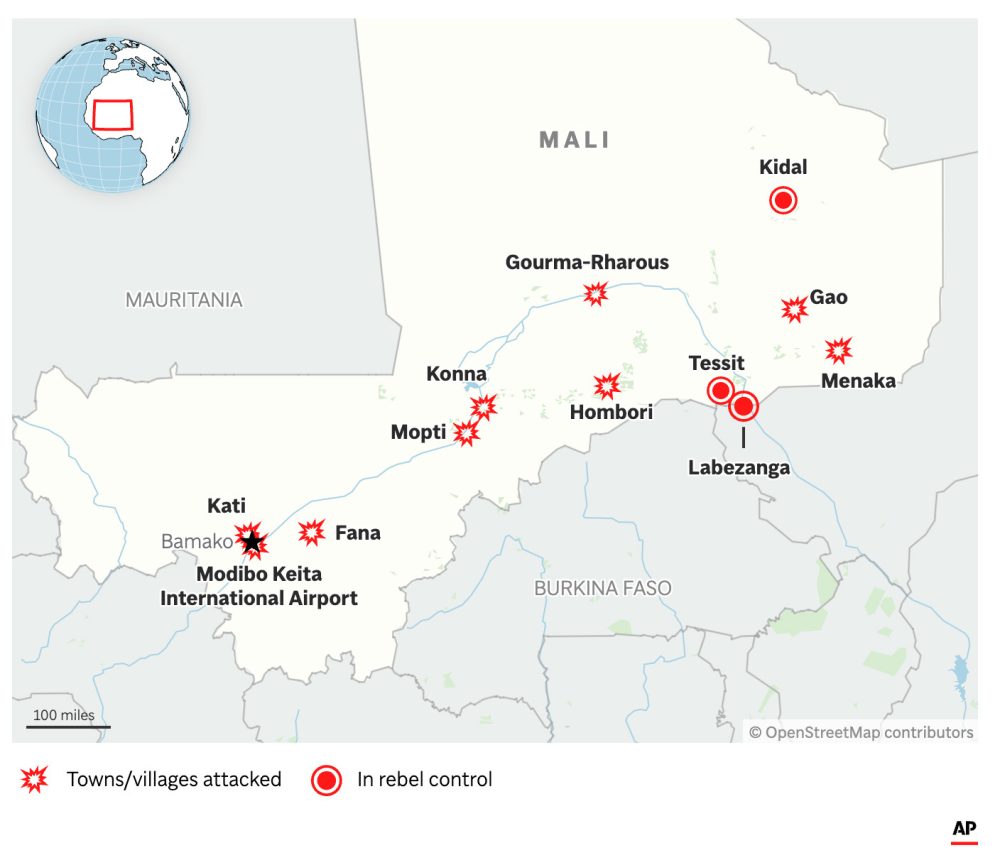
BAMAKO, Mali — Separatist fighters in Mali announced Friday they have seized control of a crucial military installation in the northern community of Tessalit following the departure of government forces and their Russian partners, marking another significant blow during the most extensive militant offensive in more than a decade.
The announcement from the Azawad Liberation Front represents the newest challenge facing Mali’s military leadership, which earlier this week lost control of the major urban center of Kidal during coordinated strikes that resulted in the death of Defense Minister Sadio Camara.
Regional sources indicated that government troops and Russia’s Africa Corp personnel began evacuating Tessalit on Thursday. The Azawad Liberation Front, known as FLA, has been conducting operations alongside the al-Qaeda-affiliated Jama’at Nusrat al-Islam wal-Muslimin, referred to as JNIM.
Top FLA commander Achafghi Ag Bouhanda declared the takeover of the Tessalit installation through an online video statement. The facility holds significant importance due to its proximity to an airfield and the Algerian border.
The Associated Press was unable to verify independently the circumstances at the installation, situated in a region with limited internet connectivity. Government officials in Mali have not yet provided responses to inquiries seeking comment.
The broader Sahel area below the Sahara Desert, encompassing Mali and other conflict-affected states, has become a center for violent extremism. Jihadi organizations have intensified their campaigns against Mali’s military government and the military leadership of neighboring Burkina Faso and Niger in recent years.
These three nations, governed by military leaders who overthrew civilian administrations through recent takeovers, have ended security partnerships with Western allies and shifted toward Russia for defense assistance.
The current offensive in Mali commenced Saturday when jihadist and separatist groups coordinated to strike the primary international airport in Bamako, the capital, along with additional communities in synchronized assaults using motorcycles and vehicles.
Since that time, militants have targeted no fewer than 10 locations, compelling Malian and Russian troops to abandon the strategic northern city of Kidal, previously a separatist stronghold.
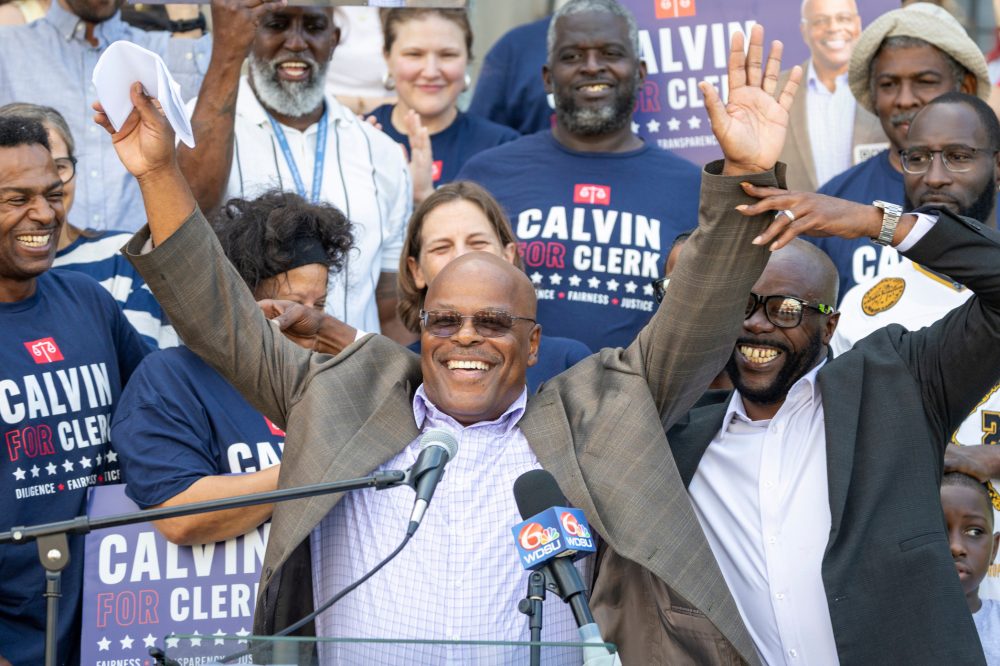
BATON ROUGE, La. — Days before a wrongfully convicted man was scheduled to begin his new role as an elected court official, Louisiana’s Republican leadership has dissolved the position entirely.
Governor Jeff Landry signed legislation on Thursday that wipes out the Orleans Parish criminal court clerk office, according to Trey Williams, a spokesperson for Louisiana’s Secretary of State.
The GOP maintains this move represents a streamlining initiative designed to boost efficiency within the local court system while reducing expenses. However, Democratic officials characterize the action as excessive governmental interference that undermines the voting choices of a primarily Black community.
Calvin Duncan, who endured almost three decades of imprisonment for a murder he never committed, secured a decisive victory for the criminal court clerk role last November. He defeated the sitting officeholder with more than two-thirds of voter support and was scheduled to begin his duties this coming Monday. Duncan has petitioned a federal court to permit him to assume office as originally planned.
“It’s a sad thing to see the state government repeating what happened to Black public officials during Reconstruction,” Duncan said. “They will do what they do, and I will do whatever I have to do to vindicate the voters of New Orleans and make sure that what happened to me never happens to anybody else.”
Governor Landry has not responded to media inquiries seeking comment.
The 63-year-old Democrat, whose murder conviction was thrown out in 2021 when evidence surfaced showing police officers had provided false testimony, has pledged to reform the judicial system that wronged him. Duncan’s name appears on the National Registry of Exonerations.
Duncan and his allies believe he’s being singled out by Louisiana’s most influential Republican politicians, including some who continue to question his innocence despite his official exoneration.
“We’re doing something because powerful people don’t like him,” Rep. Mandie Landry, a New Orleans Democrat, told fellow legislators during an April committee session. The representative, who shares no family connection with the governor, called the Republican initiative “atrocious” and expressed concern about potential impacts on other elected offices statewide.
Republican supporters argue the new law merges Orleans Parish’s separate civil and criminal court clerk operations, bringing the parish in line with every other Louisiana parish that operates a single clerk’s office. The civil clerk position will continue and take on the criminal clerk’s responsibilities.
Dissolving the clerk role will save the state approximately $27,000 and the city $233,000, according to legislative auditor estimates, though the analysis notes that future consolidation costs remain “unknown.” The legislation also transfers roughly $1.17 million in state spending to parish responsibility. The civil and criminal clerk offices currently operate from different locations with separate case management systems.
In a statement to The Associated Press, the governor said eliminating Duncan’s elected position focused on enhancing governmental efficiency and “cleaning up a system in Orleans Parish that has been plagued by dysfunction and corruption for years.”
This consolidation represents part of a wider Republican initiative during the current legislative session to restructure New Orleans’ judicial system, including proposals to eliminate several other elected judicial positions within the parish. Those additional positions, however, would be phased out later, allowing current officials to complete their terms.
The legislation’s Republican sponsor, Sen. Jay Morris, whose district lies several hours away from New Orleans, stated his objective was implementing the clerk merger before Duncan assumes office, preventing him from beginning a four-year term. Morris has acknowledged anticipating legal challenges to the new law but believes it passes constitutional scrutiny.
“It’s unfortunate for Mr. Duncan, I concede that,” Morris told lawmakers in April. “He seems very nice, but we don’t make policy around here for just one person.”
While discussions have centered on Duncan, many observers express concerns about how this change might effectively nullify voter choices — a particularly sensitive issue in a heavily Republican state that has championed efforts to weaken the Voting Rights Act. Orleans Parish serves as a Democratic stronghold with a majority Black voting population.
“Mr. Duncan was elected by 68% of the vote in a city that’s majority African American. This is the will of the people, and what your bill attempts to do is usurp the will of the people,” Rep. Edmond Jordan, a Democrat, told Morris.
Even before the legislation reached the governor for signature, Duncan anticipated the outcome. Prior to the final decision, Duncan’s supporters organized a symbolic inauguration ceremony. Hundreds of people assembled on the Orleans Parish criminal courthouse steps to demonstrate support for the exoneree.
Duncan informed legislators that during his campaign last year, he encountered many individuals who typically avoid participating in elections: “Now, this bill tells people exactly what they had believed — that their vote doesn’t count.”
A Manhattan federal judge issued an emergency ruling Friday preventing the Trump administration from deporting roughly 3,000 Yemeni refugees, temporarily extending their protective status that was scheduled to expire Monday.
Judge Dale E. Ho granted the temporary extension while litigation challenging the deportation proceeds. In his emergency decision, Ho emphasized that those receiving this protection are law-abiding individuals whom federal officials previously determined would face safety risks if returned to Yemen during its ongoing armed conflict.
The Trump administration has eliminated Temporary Protected Status for individuals from nine nations, including Haiti, Venezuela and Ethiopia, as part of its broader immigration enforcement efforts. Without Ho’s intervention, protections for Yemeni refugees would have ended Monday, according to U.S. Citizenship and Immigration Services.
Those holding Temporary Protected Status can legally remain in the United States, cannot be deported, and may obtain work permits and travel documents.
Ho sharply criticized former Homeland Security Secretary Kristi Noem in his decision, stating that Congress established specific procedures for modifying or ending Temporary Protected Status, which she failed to follow.
The judge specifically condemned a December social media post where Noem stated she had met with President Donald Trump and was recommending a comprehensive travel ban “on every damn country that’s been flooding our nation with killers, leeches, and entitlement junkies.”
On February 13, Noem announced through a news release that Yemen’s Temporary Protected Status would end, declaring that allowing them to remain was “contrary to our national interest.”
“TPS holders from Yemen are not ‘killers, leeches, and entitlement junkies,’” Ho stated at the beginning of his conclusion in the 36-page ruling.
The judge highlighted specific cases among the 2,810 Yemenis with current TPS status and 425 applicants, including a 33-year-old pregnant Detroit woman expecting to deliver this month whose unborn child has a heart defect untreatable in Yemen, and a 50-year-old former human rights advocate in Brooklyn who faces targeting by Houthi-aligned militias in Yemen.
“Temporary means temporary and the final word will not be from activist judges legislating from the bench,” the U.S. Department of Homeland Security responded in a statement.
“Allowing TPS Yemen beneficiaries to remain temporarily in the United States is contrary to our national interest,” the department continued, stressing that the Trump administration is “returning TPS to its original temporary intent.”
Razeen Zaman, director of immigrant rights at the Asian American Legal Defense and Education Fund, praised Ho’s decision, stating that “the court has made clear that humanitarian statutes like TPS cannot be used as a deportation pipeline.”
Zaman noted in a statement that Homeland Security had acknowledged the danger of returning Yemeni refugees to their homeland “but terminated their protection anyway.”
Zaman said Ho’s decision “affirms that protection must be based on facts and conditions on the ground, not on the political appetite to end it.”
Noem made her announcement to terminate Yemen’s Temporary Protected Status in February. The Department of Homeland Security stated Friday that she had assessed conditions in Yemen and consulted with government agencies before concluding that Yemen no longer satisfied the legal criteria for temporary status.
The Asian American Legal Defense and Education Fund shared statements from several lawsuit participants in its press release celebrating Ho’s decision.
One plaintiff, using a pseudonym for safety reasons, wrote that those fighting to maintain protections for Yemenis were “doctors, engineers, and pilots like myself, and also drivers, deli workers, and countless other people who contribute meaningfully every day, supporting not just our own families but the broader fabric of society.”
He continued that their presence “represents resilience, skill, and dedication — values that strengthen the nation as a whole.”
Another plaintiff, also using a pseudonym, called Ho’s ruling “a lifeline for my family.” She added: “It is the moment we finally breathed a sigh of relief after months of existential anxiety.”
Yemen first received Temporary Protected Status designation in 2015, approximately one year after the country’s civil conflict commenced.
As the warfare continued, both the Obama and Biden administrations renewed the designation repeatedly, most recently in 2024, when officials calculated that 2,300 Yemenis were eligible to reregister for protected status and that 1,700 Yemenis qualified for the first time.
Ho referenced additional recent court decisions that have allowed individuals fleeing other nations under various circumstances to remain in the United States.
Apple executives are expressing confidence about a potential follow-up to the blockbuster Brad Pitt Formula One racing film, while also revealing ambitious plans to expand their motorsports broadcasting reach beyond the United States.
Speaking at the Miami Grand Prix on Friday, Apple Senior Vice President of Services Eddy Cue indicated strong likelihood for another installment of the racing movie produced by Apple Original Films.
“I hope and expect there will be one,” Cue told Reuters when questioned about sequel possibilities for the production.
The original racing film required approximately $200 million in production costs and brought in $634 million at the box office worldwide, based on IMDb figures.
This season marked Apple TV’s takeover of exclusive U.S. Formula One broadcasting rights, replacing Walt Disney’s ESPN network. The streaming service now provides live coverage for all 24 racing events throughout the season.
Cue expressed satisfaction with viewer response to their coverage and emphasized Apple’s commitment to expanding the sport’s popularity.
“The sport doesn’t get licensed on a global basis,” he noted. “Do I hope that we are able to grow into other areas and markets? Yeah, I do.
“But starting in the U.S. which is a huge market for us, and being able to build from there, is definitely the right way to do it. And that’s what we are focused on right now. The easiest way for us to continue to grow is to make sure we make this a huge success.
“And then of course it would be great to expand it.”
The Apple executive also discussed how upcoming leadership changes at the company will benefit their Formula One partnerships. John Ternus, who will replace Tim Cook as Apple CEO, brings personal racing experience to the role.
“John actually drives a Porsche and does amateur racing,” Cue explained. “He would actually be here this weekend but he’s at Laguna Seca.
“So rest assured if anything he’s going to be at more races even than Tim. He’s a huge, huge fan of F1 and he’s known about this, he’s a huge supporter. So you’ll continue to see full support from him.
“When we do something, we don’t do things halfway. The things that we do we go all in. So we believe without a doubt that this is going to make a huge difference in what we can do to help motorsports.”
Professional golfer Bryson DeChambeau maintains his loyalty to LIV Golf despite mounting uncertainty about the league’s financial future, according to a report from Flushing It Golf released Friday.
The league faces significant challenges after learning that the Saudi Arabia Public Investment Fund will cease providing financial backing following the current season. This development has raised questions about the future of top players including DeChambeau, Jon Rahm, and Cameron Smith, who represent some of LIV’s most prominent talent.
When asked about potential discussions with the PGA Tour, DeChambeau firmly dismissed such speculation.
“I’m working as hard as I can to find a solution,” DeChambeau explained to Flushing It Golf. “I’m committed to making team golf work in the best way possible. I think there’s a place for it in the ecosystem and I want to continue to grow the game across the world. That’s always been our mission, and it’s never been more true than now.”
The 32-year-old golfer revealed that LIV is developing youth programs as part of its expansion efforts.
“We’re building a bunch of junior golf events right now and each (LIV) team is looking to build junior golf academies,” he explained. “That’s something that we’ve been working on for almost three or four months now. We’re looking to host an event here coming up, probably in the next, I’d say, couple of months.”
DeChambeau originally signed with LIV in June 2022 under a deal reportedly worth $125 million, which concludes at the season’s end. Before the funding complications emerged, he had allegedly pursued a $500 million extension agreement.
“We’re still working on a potential contract,” DeChambeau stated. “I haven’t given up on that and I think there will be a solution. But as of right now, my job is to help make the league work after this year. I just feel like I have a responsibility. I’ve put a lot of effort into it. So that’s what I’m going to do, we’re going to make this work.”
While LIV has reportedly increased its revenue during its five-year existence, these earnings likely fall far short of what’s needed to sustain operations at previous levels.
“There’s a lot of moving parts like in any business,” DeChambeau commented to Flushing It Golf following his withdrawal from last month’s Mexico City tournament. “It’s a startup, right? And so there’s going to be times where we’re squeezed and punched. This is one of those moments. But I’m going to do everything in my power to make it work and I really see the value in franchise golf.”
The two-time U.S. Open winner has achieved considerable success in LIV competition, capturing five individual tournament victories. His most recent triumphs came during back-to-back playoff wins in March at LIV Golf Singapore and LIV Golf South Africa.
Earlier this year, DeChambeau had the option to rejoin the PGA Tour through the Returning Member Program but chose not to pursue it. This program was established as Brooks Koepka left LIV to return to PGA Tour competition.
President Donald Trump announced Friday that Medicare will begin covering GLP-1 medications used for weight loss and diabetes treatment starting July 1st.
The President made the announcement while speaking in The Villages, Florida, stating that the federal government is taking steps to make these drugs accessible to elderly Americans enrolled in the Medicare program.
The move would expand coverage for medications that have gained popularity for their effectiveness in treating both diabetes and obesity among seniors.
WASHINGTON – Following Britain’s decision to elevate its terrorism alert status to the second-highest level, the American embassy in London issued a security advisory Friday urging US citizens to exercise heightened caution while in the United Kingdom.
The embassy instructed Americans to remain vigilant in public areas, maintain a low profile, and reassess their personal safety measures after British authorities announced the threat level increase.
“The recent increase in terrorist threats is driven by a rise in Islamist and extreme right-wing terrorist threats in the UK,” the U.S. embassy said in a security alert on Friday.
British officials elevated the country’s terrorism alert status from “substantial” to “severe” on Thursday following an antisemitic knife attack that occurred earlier this week in northern London.
According to the threat classification system, the “severe” designation means authorities believe an extremist attack is highly likely to occur within the coming six months.
SALISBURY, Md. – Salisbury University’s baseball squad wrapped up their regular season in spectacular fashion Friday afternoon, delivering a commanding no-hit shutout against Cairn University at Donnie Williams Sea Gull Baseball Stadium.
The nationally seventh-ranked Sea Gulls dominated the Highlanders 10-0 in a seven-inning contest, marking their tenth consecutive victory to close out regular season play.
The impressive performance showcased the team’s depth and skill as they head into postseason competition, having maintained their winning momentum throughout the final stretch of the regular season.
Motorists traveling on southbound Route 13 should expect to see cleanup activity in the median area today as maintenance crews conduct litter removal operations.
The work zone is located between the New Castle Department of Motor Vehicles office and Pulaski Highway, also known as Route 40. Delaware Department of Transportation crews will be working in the median strip through 5 p.m. this afternoon.
Drivers are advised to use caution when passing through the area and watch for workers and equipment near the roadway.
Motorists traveling on Route 15 northbound are experiencing traffic delays today as construction crews have closed the right lane between Bison Road and Willow Grove Road, also known as Route 10.
The Delaware Department of Transportation reports the lane restriction is part of ongoing construction activities in the area. Officials expect the right lane to reopen by 4 PM this afternoon.
Drivers are advised to allow extra travel time and exercise caution when passing through the work zone. Traffic is being maintained in the left lane during the closure.
Motorists traveling eastbound on Lockmeath Way are facing traffic restrictions today as construction work has forced the closure of the right lane.
According to DelDOT, the lane shutdown affects the stretch of roadway between Peachtree Run and Brookfield Drive. Officials say the construction-related closure will remain in place until 3 p.m. this afternoon.
Drivers in the area should plan for potential delays and consider alternate routes if possible during the affected timeframe.
NEW YORK (AP) — A woman accusing Harvey Weinstein of rape returned to the witness stand Friday to continue her testimony, one day after expressing difficulty concentrating due to emotional stress.
Jessica Mann faced additional cross-examination from defense attorneys representing the former Hollywood producer, who focused their questioning on her messages and meetings with him following the alleged sexual assault in March 2013.
“I’m not doing too good right now, so I’m really trying to remember,” Mann told the court. She later added: “I feel like I said a lot, and I’m trying to get through this.”
Despite her emotional state, Mann answered questions for several hours, though she appeared tired at times and occasionally requested that questions be restated.
The 40-year-old accuser and 73-year-old Weinstein are now participating in their third trial regarding her allegations that he sexually assaulted her in a Manhattan hotel room. Defense attorneys maintain that all interactions between the pair were consensual and occurred within a four-year romantic relationship.
Weinstein received a conviction in 2020, but an appellate court reversed the decision. A subsequent retrial ended without resolution last year when jurors halted deliberations on the rape charge after the jury foreperson refused to continue participating. This situation necessitated the current proceedings.
The former film executive enjoyed significant success in Hollywood before accusations against him sparked the #MeToo movement addressing sexual misconduct in 2017. Weinstein has stated he “acted wrongly, but I never assaulted anyone.”
Mann and Weinstein first encountered each other in early 2013, when he held a studio executive position and she was a 27-year-old hairstylist and aspiring actress seeking to advance her film career. According to her testimony, he began pursuing her romantically shortly after their introduction, and despite feeling uncomfortable, she chose to enter into a relationship with the married producer.
She claims that several weeks into their acquaintance, he cornered her in a midtown Manhattan hotel room, angrily demanded she remove her clothing while standing over her, disregarded her objections, and sexually assaulted her.
Their association persisted intermittently for years following the alleged incident. Mann testified that she had feelings for “a part of him” and “always tried to see the good in him,” while also being cautious about opposing a powerful, well-connected individual who demonstrated his influence. She recalled him claiming that his “enemies don’t step a foot in this town.”
During Friday’s proceedings, defense attorney Teny Geragos presented Mann with numerous cordial and complimentary messages she had sent to or about Weinstein throughout their relationship. One text from May 2013 showed her telling a friend that “I like the Harvey we know. I feel some sense of protection.”
Mann explained to jurors that Weinstein assisted her in understanding the film industry and “there was a time when I felt he did protect me.”
The Associated Press maintains a policy of not identifying individuals who report sexual assault unless they consent to being named publicly, which Mann has agreed to do.
American producers of liquefied natural gas experienced a dramatic surge in Asian sales during April, as ongoing Middle Eastern conflicts disrupted regional supply chains and created new market opportunities for US exporters, according to shipping data released by financial analytics firm LSEG.
Asian destinations received approximately 25% of all American LNG shipments last month, representing a significant jump from levels seen before regional tensions escalated in late February. This increase highlights America’s expanding role as a flexible supplier during periods of global energy market stress.
The numbers tell a striking story of rapid growth. US deliveries to Asian markets climbed from roughly 970,000 metric tons in February to 1.99 million metric tons in March, then reached 2.71 million metric tons by April – an increase exceeding 175% since US and Israeli military actions against Iran began.
Energy pricing reflected the market tensions, with Asian spot LNG costs staying high throughout the period. The Japan Korea Marker benchmark reached an average of $17.92 per million British thermal units during April, declining slightly from March’s $18.27 but remaining about 17% higher than European prices. Europe’s TTF benchmark averaged $15.34 per mmBtu in April, dropping from $17.99 the previous month.
Despite the Asian export boom, America’s total LNG shipments actually decreased from March’s record levels, falling to 10.97 million metric tons in April compared to 11.7 million metric tons in March. This decline resulted primarily from April having fewer days than March, plus some cargo loading delays at terminals.
Natural gas flowing into US export facilities hit a new record of 18.8 billion cubic feet daily during April, surpassing February’s previous high of 18.7 billion cubic feet per day, LSEG reported.
April marked a milestone for the Golden Pass terminal, which shipped its inaugural LNG cargo to Belgium. The facility – operated jointly by QatarEnergy and Exxon Mobil – processed nearly 300 million cubic feet of gas daily but managed only one export shipment, potentially explaining the gap between record gas intake and lower overall export volumes.
European markets continued dominating US LNG destinations, receiving 6.14 million metric tons representing just under 56% of April’s total exports. Egypt emerged as another significant buyer, importing approximately 710,000 metric tons of American LNG – exceeding the combined 500,000 metric tons sent to all Latin American countries.
In an unusual development, one shipment reached South Africa, a rarely-served destination for US LNG. Ship tracking revealed nine LNG vessels that departed American ports in April were still searching for buyers, including two anchored near the Suez Canal awaiting purchase agreements.
OTTAWA – Canadian health authorities announced Friday they have given approval to a second generic alternative to the popular diabetes medication Ozempic, expanding treatment options for patients across the country.
The regulatory approval went to Apotex, a Canada-based pharmaceutical company, for their version of semaglutide, the active ingredient in Ozempic. This marks the second time Canadian officials have authorized a copycat version of the highly successful diabetes treatment originally developed by Danish pharmaceutical company Novo Nordisk.
The decision by Canadian health regulators could provide patients with more affordable access to the diabetes medication that has gained widespread attention not only for blood sugar management but also for its weight loss effects.
LONDON, May 1 – The selection of Seydou Traore by the Miami Dolphins during the fifth round of last week’s NFL Draft marked a milestone moment for Kris Durham, the former Seattle Seahawks wide receiver who leads the UK-based NFL Academy.
Traore, who grew up in South London, was among the first students enrolled at the Academy in 2019 and demonstrates that non-traditional routes to professional football can succeed.
“Seydou’s paved a path for the future generations and the generations after that,” Durham told Reuters.
The Academy’s mission involves discovering and developing international athletes who can transition into the American college football system. For Traore, who had been a promising soccer goalie, the program offered an ideal opportunity.
Following his transfer to Clearwater Academy in Florida for his senior year of high school, Traore built a successful college football career playing tight end. He started at Arkansas State before transferring to Mississippi State Bulldogs, where he recorded 35 catches and five touchdowns in his final season.
According to Traore, hearing his name called by the Dolphins felt like a dream, while Durham, who has overseen the NFL Academy since 2025, viewed it as confirmation of the program’s effectiveness.
“It’s just an incredible story that shows it doesn’t matter where you come from, you can be an international kid and make it to the NFL,” he said.
Before discovering American football, Traore participated in Premier League club Fulham’s youth development program as a goalkeeper. His interest in American football began while watching games on television, then progressed to playing for the London Warriors in front of small crowds.
Standing 6 feet 3 inches tall and weighing 244 pounds, Traore possesses remarkable athletic ability, excellent ball-tracking skills, and reliable hands. However, Durham believes Traore’s mental approach sets him apart from other players.
“He’s always had the measurables, the size, the speed, the hands. But it’s the intangible things, his ability to understand what’s happening before it happens,” he said. “He’s almost playing chess instead of checkers. That’s what’s elevated him beyond his peers.”
Currently housed at Loughborough University, the NFL Academy program includes 68 students representing 20 nations, with 40 former students now competing in NCAA college football.
Data indicates that only 1.6% of American college football players eventually reach the NFL. The odds are even steeper for international players, but Traore’s achievement provides encouragement for aspiring athletes from outside football’s traditional strongholds.
“Being American myself, having played the game, I’ve seen what Europeans and international students bring to it,” Durham said. “It’s a level of maturity, a level of determination because they’ve had to fight stereotypes.
“When they’re going through the recruiting process, the question is why should they recruit somebody from England over a kid from Mississippi or Texas? Seydou’s answered those questions. He’s changing the narrative.
“He’s kind of the godfather of what we’re doing.”
During the draft ceremony in Pittsburgh, Efe Obada announced Traore’s selection. Obada, another London native who successfully transitioned to the NFL and played notably for the Carolina Panthers, served as an inspiration for Traore.
“He was like a pioneer for international guys,” Traore said. “He showed what’s possible. It meant a lot for him to kind of pass the torch to me.”
While Traore has a challenging path ahead to match Obada’s accomplishments or those of his hero Travis Kelce, Durham considers Traore’s draft selection already represents a triumph for the NFL Academy.
“Do I think we’re going to start having an influx of NFL Academy players into the league. Absolutely, I 100% do,” he said. “If we can get players into those locker rooms to showcase who they are, then that’s where they’re going to really accelerate their careers.”
Motorists traveling on Main Street should be aware of ongoing traffic adjustments in the area today.
A temporary lane shift is currently active on Main Street in the section between Jersey Road and Truitt Alley. The traffic pattern modification is expected to remain in place while crews continue their work operations.
The lane shift is scheduled to be lifted by 4 PM this afternoon, according to traffic officials.
Drivers are advised to exercise caution when traveling through the affected area and allow extra time for potential delays.
Delaware State Police have shut down the right lane of southbound Interstate 495 at Terminal Avenue due to ongoing police activity in the area.
The lane closure is currently in effect, and motorists traveling through the corridor should anticipate potential delays and slower traffic conditions.
Drivers are advised to use caution when approaching the area and may want to consider alternative routes to avoid congestion.
No additional details about the nature of the police activity have been released at this time.
A longtime champion of civil rights is expressing confusion and concern following the Supreme Court’s latest decision regarding voting rights protections.
Leslie McLemore, who has dedicated decades to advancing civil rights causes, is weighing in on how the high court’s recent ruling on the Voting Rights Act could affect African American political participation throughout Southern states.
The activist describes the court’s decision as puzzling, raising questions about the future of voting protections that have been cornerstones of civil rights progress.
McLemore’s perspective comes as communities across the region grapple with understanding what changes the Supreme Court ruling might bring to electoral processes and minority representation in government.
New economic analysis shows that everyday living expenses in Israel have reached levels that surpass Europe’s most affluent nations, creating significant financial pressure for residents across the country.
Data from recent economic studies and reporting by Globes indicates that costs for essential needs like housing, groceries, and basic services have escalated beyond what residents pay in many of Europe’s wealthiest economies. This dramatic increase results from a combination of limited resources, concentrated market control, and governmental decisions that have driven prices upward while wages have grown at a slower pace.
The housing market has experienced particularly intense pressure over the last ten years, with restricted land availability, bureaucratic delays in development approvals, and high consumer demand creating a perfect storm for rapidly rising property values. Grocery expenses have also come under examination, as a small number of major import companies and food producers control significant market segments, reducing competitive pricing and maintaining costs well above those seen in other developed nations.
Officials within the government have recognized the financial burden this places on citizens. Data from the Finance Ministry demonstrates that Israeli residents now allocate a greater portion of their earnings to essential items compared to people living in numerous Western European countries. Economic experts identify several contributing factors including substantial indirect taxation, import regulation obstacles, and geographical challenges that create supply chain complications.
This economic challenge has remained a contentious political topic for years. Major public demonstrations focused on living expenses took place in 2011, and the concern has consistently reappeared in national political discussions. While recent administrations have promised changes to boost market competition, reduce import barriers, and speed up home construction projects, implementation has shown mixed results.
The nation’s overall economic environment adds complexity to addressing these issues. Israel’s technology industry has generated substantial economic expansion and increased salaries in certain areas, though these benefits have not reached all population segments equally. Additionally, the country’s security requirements and defense budget obligations influence government spending priorities in ways that may restrict comprehensive cost-reduction initiatives.
When measured against European standards, the situation becomes more concerning. While nations like Switzerland and Norway have historically held positions among the world’s most expensive places to live, Israel now equals or surpasses their costs in multiple consumer areas, creating questions about future affordability and economic viability.
VOORHEES, N.J. — A Philadelphia Flyers player’s celebratory moment turned into a heartwarming story about fan loyalty when his game-winning stick found its way back to him.
Defenseman Cam York launched his hockey stick into the crowd after netting the decisive overtime goal that defeated the Pittsburgh Penguins 1-0 in Game 6 of their opening playoff round, marking the team’s first postseason advancement since 2020.
In the heat of celebration, York immediately had second thoughts about his spontaneous gesture, joking afterward that he “definitely don’t want a lawsuit” following the lengthy throw into the stands.
“I figured even if it did hit him, that he was going to still enjoy the moment and be happy,” York commented on Friday.
The stick landed near Jack Brod, a devoted Flyers supporter sitting in Section 113’s lower level, who initially planned to give the memorable keepsake to a family friend. However, when Brod discovered York’s desire to reclaim the stick, he willingly brought it back.
During Friday’s practice session, Brod — sporting the identical Flyers sweatshirt from Game 6 — was invited as a special guest and had the opportunity to meet York personally.
York admitted his immediate post-goal reaction was questioning his decision: “why did I do that?”
“When my career is done and over with, I want to have some things to look back on, remember and cherish,” York explained Friday. “This was obviously a special moment for me. Super nice guy. Just met him. For me to just give it back for kind of nothing, I really appreciate that. That’s one of the best things about Philly fans is, they love their players and they want their players to perform at the highest level they can.”
Brod’s generosity didn’t go unrewarded — he walked away with a replacement stick and an autographed York No. 8 jersey. York mentioned plans to display the returned stick in a frame.
The Flyers begin their second-round playoff series Saturday when they face Carolina on the road.
This year’s Stanley Cup Playoffs showcase an influx of fresh talent, with three franchises reaching the second round after missing last year’s postseason entirely.
Four teams have successfully navigated the opening round: Colorado, Minnesota, Philadelphia, and Anaheim. The Flyers are celebrating their first playoff appearance in six seasons, while the Ducks ended an eight-year drought. Both the Avalanche and Wild participated last year but fell in the initial round.
Additional newcomers are guaranteed to emerge from ongoing matchups: Teams competing in the Boston-Buffalo and Montreal-Tampa Bay series all failed to reach the second round in the previous campaign. Buffalo concluded the NHL’s longest playoff absence at 14 seasons, Boston returns following a single-year absence, and both Montreal and Tampa Bay suffered early exits in 2025.
Remarkably, seven of the eight second-round participants could be new if Utah manages to overcome Vegas. Only Carolina, which will welcome Philadelphia for Saturday’s Game 1, reached this stage last season.
“That’s the exciting part of where the league is at and where these teams are at,” Hall of Fame defenseman Chris Pronger said recently. “New teams (are) getting into the playoffs and showcasing some of these young players that are on the rise that maybe haven’t had that experience. And now they get a chance to kind of understand what it’s all about and what it means to play in the playoffs.”
A fresh champion became inevitable when defending back-to-back titleholder Florida was eliminated during a disappointing injury-plagued campaign.
Two new finalists are now assured after Edmonton suffered a first-round defeat to the Ducks. Oilers captain Connor McDavid acknowledged they “were an average team all year” and failed to meet elevated expectations.
The Hurricanes, who have consistently advanced each of the past eight seasons under Rod Brind’Amour’s coaching tenure beginning in 2018, will face one of the tournament’s surprise stories: Philadelphia last competed in playoffs during the 2020 pandemic season.
“There was never a doubt,” said Flyers goaltender Dan Vladar, who delivered a 42-save shutout in the Game 6 overtime victory against Pittsburgh. “Good things happen to good people, and we are good people here.”
In the Western Conference, the Presidents’ Trophy-winning Avalanche have been resting since completing a sweep of Los Angeles. Making their ninth consecutive playoff appearance, they’ll battle the Wild, who defeated Dallas in a six-game clash between Central Division contenders.
“It’s going to be a hard-fought series,” Colorado captain Gabriel Landeskog said. “High-quality teams, high-quality players, good goaltending and special teams. It’s going to be a battle.”
Minnesota finally captured its opening series after eight consecutive first-round defeats, advancing to the second round for the first time since 2015. Rookie goalie Jesper Wallstedt spotted an emotional fan during their clinching Game 6 victory, helping him understand the broader impact of their success.
“There’s so many more people who are with us on this road and this journey,” Wallstedt said. “The excitement and joy to get past the first round is huge.”
The Ducks advanced for the first time since their 2017 Western Conference Final appearance, marking coach Joel Quenneville’s successful debut season.
“Now we’ve got a taste of playoff hockey,” Quenneville said. “I think we can feel at this moment that it’s so much fun playing games that have the meaning and the building being as loud and excited as it is. It seems to grow from this level on.”
CHARLESTON, W.Va. — Pope Leo XIV has selected an immigrant advocate who has spoken out against President Trump’s border enforcement efforts to lead West Virginia’s Catholic community.
The Vatican announced Friday that Most Rev. Evelio Menjivar-Ayala, currently serving as an auxiliary bishop in Washington D.C., will become the new bishop of the Wheeling-Charleston Diocese, overseeing all Catholic parishes across West Virginia.
The 55-year-old religious leader was born in El Salvador and escaped that country’s civil conflict as a teenager during the late 1980s. He crossed into America without documentation in 1990, according to his previous interview with The Associated Press, but received humanitarian protection within weeks and eventually obtained religious worker status before becoming a U.S. citizen twenty years ago.
His personal immigration experience has shaped his ministry, particularly his empathy for those facing deportation raids. Speaking about recent federal enforcement actions in Washington, he noted that situation “could have been me.”
The Catholic Church has maintained its position supporting compassionate treatment of migrants globally, and Menjivar-Ayala has joined other church officials in criticizing the current administration’s mass deportation efforts while recognizing nations’ sovereignty over border security.
During Friday’s announcement, Menjivar-Ayala avoided discussing immigration matters or the president, instead emphasizing his commitment to serving West Virginians and learning from the community. Speaking partly in Spanish, he expressed his priorities.
“I have much to learn, but my heart is ready and wide-open,” he said. “Above all, I want to listen to the poor. Those in the margins of the church and society. To workers, to the immigrants, because as Matthew 25 says, the way we treat the least is the way we treat Jesus.”
The demographic contrast between his current and future assignments is significant. More than 40% of parishioners in the Washington archdiocese are Latino, while West Virginia’s population is 92.6% white with only 2.4% Latino residents among its 1.77 million people, Census data shows.
Menjivar-Ayala will succeed Most Rev. Mark Brennan, 79, who has led the diocese since 2019. Brennan assumed leadership following a controversy involving his predecessor’s inappropriate conduct with adults and misuse of church funds. During Friday’s joint announcement in Wheeling, Brennan assured residents about the incoming bishop’s inclusive approach.
“But he loves all the people here. He’s not going to be bishop just for one group within the diocese. He’ll be bishop for all the people. I can assure you of that.”
The incoming bishop, whose ministry has centered in the nation’s capital region, will transition to leading a more rural, less Catholic area with 61,000 Catholics across 92 parishes throughout West Virginia.
While recognizing West Virginia’s scenic mountains and natural wealth, he acknowledged that residents of one of America’s economically struggling states “continue to endure hardship, marginalization and inequality.”
Cardinal Robert McElroy of Washington commended Menjivar-Ayala’s immigrant advocacy work, stating that “his passion for justice and sensitive care for the Hispanic and immigrant communities of our Archdiocese have planted seeds of grace that will yield a harvest here for decades to come.”
In a piece published last year in the Catholic Standard, the Washington archdiocese’s official publication, Menjivar-Ayala criticized the Trump administration’s immigration enforcement approach.
“Each day this situation is getting worse and more ominous,” Menjivar-Ayala wrote. “For weeks now, the federal government has pursued a ‘shock and awe’ campaign of aggressive threats and highly visible operations of questionable legality that go far beyond mere immigration ‘enforcement.’”
The appointment occurs weeks after Pope Leo disagreed with Trump regarding the U.S. conflict with Iran. Menjivar-Ayala’s installation ceremony is scheduled for July 2. The White House has not responded to requests for comment about the appointment.
Friday also brought another Latin American-born priest’s elevation to bishop. Rev. John Gomez, originally from Colombia who arrived on a student visa in 2002 and gained citizenship in 2021, will begin leading the Laredo, Texas diocese on June 30. His current bishop in Tyler, Texas praised his “commitment to Hispanic Ministry.”
Pope Leo’s initial American episcopal appointment following his May 2025 election was also a former refugee: Michael Pham, born in Vietnam, who became San Diego’s bishop.
Declining ordination numbers in America have made foreign-born clergy increasingly vital for parishes nationwide.
A Justice Department panel established by President Donald Trump has released findings claiming Christians faced widespread bias during Joe Biden’s presidency, pointing to incidents involving education policies, tax regulations, and prosecutions of abortion clinic protesters.
The Task Force to Eradicate Anti-Christian Bias released its 200-page findings on Thursday, drawing immediate pushback from progressive organizations who characterized the document as political advocacy masquerading as legitimate investigation.
According to the task force, which included multiple Cabinet officials, conflicts arose “When Christian beliefs about morality and human nature conflicted with the Biden Administration’s views, religious rights often suffered.”
While the panel stopped short of claiming Biden’s team suppressed churches or worship services directly, it argued his administration took aggressive stances against faith-based advocates promoting conservative positions on abortion access, gender policies, educational content, and vaccination exemptions.
The document states: “The Biden Administration generally tolerated religious beliefs that were privately held but zealously pursued actions to limit Christians’ ability to act in accordance with their faith.”
Georgetown University’s Center on Faith and Justice executive director Jim Simpson dismissed the findings as “advocacy dressed up as investigation.” Simpson argued the report incorrectly treats policy disputes as “evidence of anti-Christian bias rather than the normal functioning of a pluralistic democracy.” He also questioned framing Christians, who comprise nearly two-thirds of Americans, as “a persecuted minority despite being the country’s largest and most politically influential religious group.”
The task force highlighted Justice Department prosecutions of anti-abortion demonstrators who illegally blocked clinic access, suggesting these cases received harsher treatment than threats against pregnancy resource centers, which are frequently operated by Christian organizations encouraging women to avoid abortions. The report referenced a group convicted in federal court and imprisoned after invading a Washington abortion facility, whom Trump pardoned in 2025.
One controversial section accused Biden of “replacing Easter” with Transgender Day of Visibility, which occurs annually on March 31st and happened to coincide with Easter in 2024. The report called this a “profound lack of consideration for the Christian faith,” though Biden actually issued proclamations recognizing both observances.
The document criticized the Biden administration for displaying Pride flags at U.S. embassies, including at the Vatican, despite varying Christian perspectives on LGBTQ+ matters, with some progressive congregations embracing Pride symbols while conservative denominations typically oppose same-sex marriage and transgender rights.
Melissa Rogers, who directed the White House Office of Faith-Based and Neighborhood Partnerships under Biden, contrasted the presidents’ Easter communications. “President Biden spent Easter and Orthodox Easter wishing Christians worldwide joyful Resurrection Sundays, not by pretending to be Jesus, by tweeting profanities, and by attacking the pope,” she stated.
Rogers emphasized Biden’s Catholic faith and noted his administration regularly collaborated with Christian and other religious leaders on various issues, from sanctuary security to immigration to COVID-19 clinic support.
The report criticized a Biden-era Justice Department memorandum addressing potential violence and threats against school boards. Though these discussions never resulted in federal action, then-Attorney General Merrick Garland defended the initiative as violence prevention, not policy debate suppression. The task force didn’t explicitly explain how this constituted anti-Christian bias, though many school board meetings during that period featured conservative Christians and others opposing policies and curricula regarding gender and race topics.
Additional criticisms included federal agencies denying Christians exemptions from COVID-19 vaccination requirements and regulators instructing a Catholic hospital in Oklahoma to extinguish its chapel candle due to fire hazards near oxygen equipment. The hospital ultimately retained the candle after installing barriers and warning signs.
The report also highlighted what it characterized as disproportionate fines against two Christian universities by Biden’s Department of Education: Grand Canyon University for allegedly misleading students about program costs, and Liberty University for failing to properly disclose crime statistics. The Trump administration has cleared Grand Canyon University and eliminated its fine.
Amanda Tyler, executive director of the Baptist Joint Committee for Religious Liberty, criticized the report for presenting “cherry-picked anecdotes” that don’t demonstrate systematic persecution. “To the extent that the government ever did overreach or violate the law in any of these examples, the courts of law, not a partisan political report, provide the right venue to settle any legal disputes,” she said. “Focusing government resources on this narrow issue while ignoring or discounting the much more widespread instances of anti-religious discrimination against other faith groups in the U.S. further harms religious freedom for all.”
The findings emerge as another Trump-created entity, the Religious Liberty Commission, prepares its own report featuring similar complaints heard during its hearings.
Chicago Cubs infielder Nico Hoerner was forced to exit Friday’s matchup with the Arizona Diamondbacks at Wrigley Field after experiencing stiffness on the left side of his neck.
The second baseman started the game on a positive note, leading off the bottom of the first with a double. However, when the Cubs came to bat in the second inning, Hoerner was nowhere to be found in the batter’s box. Matt Shaw stepped in as a pinch hitter and grounded out, then remained in the game to handle second base duties.
The 28-year-old Hoerner has been performing well this season, posting a .297 batting average along with four home runs and 26 RBIs across 32 games. Throughout his eight-year major league career, which he has spent entirely in a Cubs uniform, Hoerner has maintained a .283 batting average with 40 home runs and 304 RBIs over 736 games.
Shaw, who took over for the injured player, brought his own solid numbers into the contest. The 24-year-old has been hitting .301 with three home runs and 10 RBIs in 28 games this season.
The pharmaceutical company responsible for OxyContin announced Friday that it has officially shut down operations and finished its bankruptcy process, transforming into a nonprofit organization dedicated to fighting opioid addiction under new leadership featuring government and healthcare professionals.
The company, which entered Chapter 11 bankruptcy proceedings in 2019, had previously outlined plans to become the new nonprofit entity Knoa Pharma through a $7.4 billion bankruptcy agreement designed to direct all company resources toward addressing opioid crisis damages. Thousands of legal cases targeted the pharmaceutical giant for its contribution to America’s opioid epidemic, and the company has admitted guilt twice to federal criminal charges related to OxyContin marketing practices.
The completion of the company’s criminal sentencing earlier this week cleared the last obstacle for implementing the bankruptcy restructuring plan.
During Tuesday’s sentencing proceedings, numerous opioid crisis survivors shared personal accounts of addiction struggles, family losses, and heartbreak. Court documents reviewed by Reuters and victim interviews highlighted significant dissatisfaction with the bankruptcy settlement’s complicated payment process for those harmed, with approximately 40% of individual compensation requests already denied.
In 2020, the company admitted guilt to charges involving misleading federal oversight agencies about efforts to prevent illegal OxyContin abuse and acknowledged providing financial incentives to physicians to increase drug prescriptions. This followed a previous 2007 guilty plea for deceiving medical professionals and regulators about OxyContin’s addictive properties.
The new nonprofit’s board of trustees features Rahul Gupta, former director of the White House Office of National Drug Control Policy during the Biden administration; Paul Rothman, previous Johns Hopkins University School of Medicine CEO; and David Saltzman, Atria Health and Research Institute co-founder.
The transformed organization plans to distribute overdose reversal medications and addiction treatment drugs at production cost or below.
“Through not-for-profit access to overdose reversal medicines and treatments for opioid use disorder, Knoa Pharma is committed to providing care and saving lives in communities most affected by the opioid crisis,” Rothman said in a statement.
The majority of settlement funds will be distributed to state and municipal governments that absorbed opioid addiction costs in their areas, while $865 million has been designated for individual claimants who developed opioid dependencies or lost family members.
The Trump administration is moving forward with plans to shut down a U.S. military facility in Israel that was established to oversee the Gaza ceasefire and coordinate humanitarian aid delivery, according to multiple sources with knowledge of the decision.
The Civil-Military Coordination Centre, which has faced widespread criticism for its ineffectiveness in monitoring the Israel-Hamas truce and facilitating aid to Palestinians, will be dissolved as part of broader changes to U.S. Gaza policy, seven diplomatic sources told reporters.
This development represents another significant setback for President Trump’s Gaza reconstruction initiative, which has already been hampered by ongoing Israeli military operations despite the October ceasefire agreement and Hamas’s refusal to disarm.
Foreign policy experts indicate the decision highlights the substantial challenges confronting American efforts to supervise the fragile truce and manage aid distribution, particularly as Israeli forces continue expanding into Gaza territory while Hamas strengthens its control over remaining areas under its authority.
The closure could further strain relationships with Washington’s international partners, many of whom Trump had urged to contribute personnel and funding to the CMCC and his Gaza rebuilding program, which has been essentially suspended since the U.S. began its joint military campaign with Israel against Iran.
Sources reveal that the CMCC’s responsibilities for aid coordination and ceasefire monitoring will be transferred to an international security mission under U.S. command that is scheduled to deploy to Gaza, though that deployment has yet to materialize.
While U.S. officials have characterized this transition as a reorganization rather than a closure, diplomatic sources indicate the International Stabilization Force will effectively assume all CMCC functions, bringing the center’s mission to an end.
According to a diplomat briefed on the restructuring plan, American military personnel assigned to the reformed ISF would be reduced from approximately 190 to just 40 troops. The U.S. intends to fill the gap with civilian personnel from partner nations, sources said, speaking anonymously due to lack of authorization for public comment.
However, diplomatic observers question whether incorporating the CMCC into the ISF will produce meaningful improvements on the ground, given that the center lacked enforcement powers for the ceasefire or aid guarantees.
Following publication of the initial report, Trump’s Board of Peace issued a social media statement disputing that the CMCC was closing, though they did not address whether the ISF would absorb its duties.
A Board of Peace representative had earlier declined to discuss the center’s future but emphasized that it serves a “critical role in ensuring aid deliveries and coordinating efforts” while advancing Trump’s Gaza strategy.
Both the White House and U.S. Central Command directed comment requests to the Board of Peace.
Once the transition occurs, the restructured organization is expected to operate under the name International Gaza Support Centre, with U.S. Major General Jasper Jeffers, the White House-appointed ISF commander, likely assuming leadership, two sources indicated.
The ISF was originally intended for immediate Gaza deployment to establish territorial control and maintain security. However, only a limited number of countries have committed troops, and none have agreed to security responsibilities.
U.S. officials have maintained that American forces will not be stationed within Gaza itself.
The ISF has established a secured section within the CMCC, which operates from a warehouse facility in southern Israel, but U.S. military personnel strictly limit access to this area and frequently deny entry to allied nation representatives, three sources reported.
Establishing the CMCC was a cornerstone of Trump’s comprehensive 20-point Gaza plan, developed following the ceasefire designed to end Israel-Hamas hostilities and enable reconstruction of the territory after extensive destruction during two years of warfare.
Multiple nations, including Germany, France, Britain, Egypt, and the United Arab Emirates, deployed personnel such as military strategists and intelligence officers to the center as they sought influence over Gaza’s future governance discussions.
However, continued Israeli military strikes and the expansion of Israel’s armistice boundary deeper into Gaza territory have diminished the CMCC’s effectiveness, according to diplomatic sources. Hamas has simultaneously reestablished governmental control over a coastal section of Gaza within its territory.
Participation from member countries has declined significantly, with some nations sending representatives only monthly while others attend sporadically, diplomats reported.
Israeli officials justify their Gaza operations as necessary to counter Hamas threats and prevent unauthorized approaches to the armistice line. Palestinian authorities contend this reasoning serves as cover for territorial expansion aimed at forcing them from land intended for a future Palestinian state.
Since the ceasefire implementation, more than 800 Palestinians and four Israeli soldiers have died, despite the agreement’s purpose to halt warfare that began with Hamas’s October 7, 2023 attack on Israel.
The preceding conflict devastated much of Gaza’s infrastructure, displacing nearly all 2 million residents and destroying essential systems for water distribution, sanitation, and electrical power.
The CMCC’s mandate included ensuring humanitarian aid reached Palestinians in need. Diplomatic sources report that aid volumes have remained essentially unchanged despite increased commercial goods entering Gaza, as Israel prohibits many items it considers to have potential military applications alongside civilian uses.
Restricted items include tent poles required for displaced persons’ camps and heavy equipment necessary for debris removal operations.
COGAT, the Israeli military agency controlling Gaza access, stated that 80% of daily truck deliveries carry commercial goods purchased in Israel, though these are meant to supplement humanitarian supplies.
The Board of Peace official emphasized that Gaza ultimately requires “a sustainable civilian administration to truly transform from the years of aid dependency and cycles of violence that have clouded its past.”
The St. Louis Cardinals strengthened their pitching staff Friday by promoting left-handed pitcher Jared Shuster from their Triple-A Memphis affiliate as they prepare to face the Los Angeles Dodgers.
To make room on the roster, the Cardinals sent rookie right-hander Hunter Dobbins back to Memphis after a difficult major league debut Thursday. Dobbins struggled against the Pittsburgh Pirates, allowing three runs while giving up two hits and issuing five walks across 4 1/3 innings of work.
The 27-year-old Shuster posted a 4.91 ERA during two previous appearances with St. Louis this season. At the Triple-A level, he has recorded an 8.38 ERA through five outings.
Throughout his four-year major league career, Shuster holds a 6-8 record with a 5.26 ERA across 64 games, including 17 starts. He has played for the Atlanta Braves in 2023, the Chicago White Sox in 2024-25, and now the Cardinals.
St. Louis has struggled with relief pitching this year, as their bullpen carries a 5.15 ERA that ranks 26th among all major league teams entering Friday’s action.
The Cardinals completed a four-game sweep of Pittsburgh on Thursday and will now welcome the two-time defending champion Dodgers for a three-game homestand. Los Angeles has posted a 5-7 record since April 18.
The University of Delaware women’s ice hockey program has secured its first transfer addition of the offseason with the commitment of forward Hailey Anderson, as announced Friday by head coach Allison Coomey.
Anderson, who hails from Greer, South Carolina, brings two years of collegiate experience from Franklin Pierce University. During her time with the Ravens, she played a key role in helping the program capture a conference title and make history with their inaugural NCAA Tournament qualification in 2026.
The forward’s addition marks an important recruiting victory for the Fightin’ Blue Hens as they continue building their roster for the upcoming 2026-27 campaign.
The Boston Red Sox have promoted left-handed pitcher Jake Bennett from Triple-A Worcester for his first major league appearance when they face the Houston Astros on Friday at home.
This roster adjustment follows Boston’s decision to place star pitcher Garrett Crochet on the 15-day injured list due to left shoulder inflammation earlier this week. Bennett fills the roster opening created when utility player Nate Eaton was sent down to the minors on Thursday.
The 25-year-old Bennett had his scheduled Tuesday start for Worcester canceled in preparation for this call-up.
“Big-time strike thrower,” Boston interim manager Chad Tracy said. “The velocity and the fastball has obviously ticked up. He was coming off an arm injury when he was with Washington. But when he’s sitting there 94 (mph) — another guy kind of like (Payton) Tolle, doesn’t throw as hard, but big guy that really gets down the mound with big extension. So he tends to get in on hitters, too, because the fastball plays up.”
Bennett was selected in the second round of the 2022 draft by the Washington Nationals and has compiled impressive numbers this season, posting a 2-1 record with a 0.86 ERA across five Worcester starts. In 21 innings pitched, he has recorded 16 strikeouts while issuing just three walks.
The Red Sox obtained Bennett in a December trade with Washington, sending pitching prospect Luis Perales in exchange. Bennett sat out the entire 2024 campaign while recovering from Tommy John surgery.
“He’s in the zone a lot,” Tracy said. “Does a good job of holding runners. He can go from a slide step, he can use a leg kick, lands all stuff. But he’s really, really good, at least down there has been, getting the ball in the strike zone. And he gets a lot of weak contact.”
China’s representative at the United Nations is pushing for the Security Council to reconsider its plan to withdraw peacekeepers from Lebanon, citing escalating violence in the region.
Ambassador Fu Cong made the statement Friday as China assumed the rotating presidency of the Security Council for May. The diplomat expressed alarm over the deteriorating security situation along Lebanon’s southern border with Israel.
The United Nations Interim Force in Lebanon, known as UNIFIL, has monitored the Israeli-Lebanese border since its creation in 1978. Security Council members voted unanimously last year to phase out the peacekeeping operation by the end of 2026.
However, Fu questioned that timeline given current conditions, describing the situation as having “lesser fire” rather than a genuine ceasefire. “It is incumbent on Israel to stop this bombardment of Lebanon,” the ambassador stated during a press briefing.
The violence has intensified dramatically since early March, when Hezbollah militants launched attacks on Israel in solidarity with Iran. Israel responded with extensive ground operations and airstrikes that have devastated large portions of southern Lebanon. The conflict has claimed more than 2,500 lives since March 2.
Israeli officials at the UN have not yet commented on China’s remarks, though Israel maintains its military actions target Hezbollah fighters to prevent further attacks.
When asked directly about the peacekeeping mandate, Fu stated: “We do believe we should revisit the decision actually to withdraw the UNIFIL.”
The Chinese ambassador revealed he had recently discussed the matter with UN Secretary-General Antonio Guterres. According to Fu, UN leadership is considering a comprehensive review and plans to present various options in June for implementing Resolution 1701, which ended the 2006 war between Hezbollah and Israel.
“I think at least the view of the overwhelming majority of the Security Council is that this is not the time to redraw UNIFIL,” Fu explained.
Jean-Pierre Lacroix, who heads UN peacekeeping operations, indicated last month that some form of international presence could remain in Lebanon even after the current mandate expires.
The World Health Organization announced Friday that member nations have extended negotiations on critical pathogen-sharing guidelines, delaying implementation of a pandemic treaty that was approved last year.
The ongoing discussions center on establishing a framework that would require nations to rapidly share disease samples that could trigger pandemics, while guaranteeing those countries receive equitable access to vaccines, testing, and medical treatments developed from their contributions.
This framework, called the Pathogen Access and Benefit-Sharing annex, establishes protocols for how nations exchange pathogen data and specimens that threaten public health, while ensuring fair distribution of resulting medical interventions.
The pandemic agreement cannot take effect until nations reach consensus on these pathogen-sharing rules. The accord was designed to improve global readiness and response capabilities for future health emergencies following lessons learned from the COVID-19 crisis.
The World Health Assembly approved the Pandemic Agreement in May 2025 as part of efforts to bolster worldwide prevention, preparedness, and response strategies for upcoming pandemic threats.
WHO Director-General Tedros Adhanom Ghebreyesus acknowledged advances in the talks but emphasized the need for continued urgent collaboration, stating the next pandemic was “a matter of when, not if.”
Negotiators will present their findings to the World Health Assembly later this month. The assembly will be requested to authorize continued talks, with any final agreement to be submitted at the next assembly in May 2027 or potentially at a special session in 2026.
Countries had previously agreed to postpone this particular section when they adopted the primary treaty last year following difficult negotiations.
Saudi Arabia’s Energy Minister Prince Abdulaziz bin Salman is confronting a significant challenge to his leadership of OPEC following the unexpected withdrawal of the United Arab Emirates from the oil cartel.
The departure comes at a particularly difficult time, as the ongoing Iran conflict has severely disrupted global oil supplies and prevented Saudi Arabia and other OPEC members from utilizing their emergency production reserves typically deployed during crises.
The UAE’s abrupt exit this week removes OPEC’s fourth-largest oil producer from last year, along with the second-largest spare production capacity after Saudi Arabia. This development presents a major test for the first Saudi royal to serve as energy minister, whose approach has evolved from careful diplomatic negotiations to more independent decision-making, according to two OPEC+ alliance delegates.
“The UAE has been chafing inside OPEC for years and never got a fair hearing over its…quota. So now the chickens have come home to roost,” said Jim Krane, a fellow at Rice University’s Baker Institute.
Prince Abdulaziz, commonly referred to as ABS, derives his influence within OPEC+ from Saudi Arabia’s enormous oil reserves and production capacity. Unlike previous energy ministers, he holds royal status and enjoys support from his half-brother, Crown Prince Mohammed bin Salman, the kingdom’s de facto leader.
In 2020, ABS successfully engaged in a pricing conflict with Russia when Moscow initially declined to reduce output amid falling demand. He later reflected in a Saudi documentary: “It was an issue of to be or not to be – who is the boss of this sector.”
The 66-year-old minister also consistently rejected former U.S. President Joe Biden’s requests to increase production. OPEC members granted ABS extraordinary authority in 2022, allowing him as chairman to convene meetings whenever necessary.
His emphasis on market control now faces a new challenge. If the Strait of Hormuz reopens and Gulf oil production returns to normal levels, an independent UAE—which represented 12% of OPEC’s output last year—becomes a factor beyond the Saudi prince’s influence.
Neither the Saudi government communications office, Saudi energy ministry, nor the UAE’s energy and foreign ministries responded to requests for comment.
During the 2020 oil market collapse caused by the pandemic, ABS demanded complete consensus for unprecedented OPEC+ production reductions, leading to lengthy negotiations until a diplomatic solution involving the United States helping cover Mexico’s output cuts was achieved.
However, that exhaustive commitment to unity has since become more rigid, according to the two OPEC+ delegates.
Saudi representatives now typically notify ministers from smaller OPEC+ nations about final agreements just one day before scheduled meetings, the sources indicated. During a recent gathering, calls were made first to Russia’s Alexander Novak, then to representatives from the other six countries committed to voluntary reductions, totaling less than thirty minutes, one delegate noted.
Multiple delegates have recognized that Saudi Arabia shoulders most of the production cuts. Nevertheless, one source mentioned that the absence of consultation on major decisions represented an irritating change from previous procedures, while observing that OPEC+ had also diminished the importance of its technical expert evaluations in late 2022, essentially moving decisions directly to ministers with minimal discussion opportunities.
“We appreciate what His Royal Highness is doing for the oil price,” the delegate commented, requesting anonymity.
While recent developments have raised questions about OPEC’s future and its partnership with Russia, one delegate and another source knowledgeable about the organization’s perspective told Reuters that the crisis would ultimately strengthen unity and improve decision-making processes.
The geopolitical tension between Saudi Arabia and the UAE escalated at the beginning of the year when conflict erupted in Yemen between opposing groups backed by Riyadh and Abu Dhabi respectively.
An ongoing oil disagreement within OPEC had already intensified in 2021, when Abu Dhabi requested a larger production quota. An agreement providing a 300,000 barrel-per-day increase was only reached after complaints were made public.
“It is unreasonable to accept further injustice and sacrifice – we have been patient,” UAE Energy Minister Suhail al-Mazrouei told Sky News Arabia at that time.
A frustrated ABS responded to Al Arabiya that “a bit of rationality and a bit of compromise saves OPEC+,” stating he had “never seen such a demand” during his 34 years of participating in OPEC meetings.
The UAE’s quota had increased by approximately 500,000 barrels per day, representing 0.5% of global demand since 2019, exceeding increases for other group members. This included raising the UAE’s target in June 2023, while Angola and Nigeria saw their quotas reduced. Angola departed months later in frustration.
Saudi Arabia had granted these concessions as the UAE pledged to invest $150 billion in expansion plans to develop additional capacity, but the nation left the organization anyway on Tuesday.
For oil markets, the UAE’s departure and production goals have limited immediate impact while the Strait of Hormuz remains essentially blocked.
Iraq and Kuwait have experienced the greatest export losses, while the UAE has maintained some supply through the Gulf of Oman. Saudi Arabia has successfully redirected 60-70% of its exports to the Red Sea using a pipeline constructed in 1981 during the Iran-Iraq conflict.
At an OPEC conference last year, which Reuters and other media were prohibited from covering, Mazrouei indicated the UAE was prepared to increase capacity an additional 20% to 6 million barrels per day after 2027—half of Saudi capacity—presenting a clear challenge to ABS’s efforts to control excessive production.
Delaware’s public transit system has revealed the champions of its yearly student artwork competition celebrating public transportation.
The Delaware Transit Corporation selected six top performers in its statewide poster competition, with one student earning the coveted grand prize title after being chosen from the group of first-place winners.
The winning students will receive recognition prizes provided by DART along with contributions from the agency’s corporate partners.
The annual competition encourages students across Delaware to create artistic works that promote public transit and showcase their creative talents while supporting the state’s transportation initiatives.
Connor McDavid’s quest for his first Stanley Cup championship hit another roadblock this week, and the Edmonton Oilers captain now finds himself fielding questions about whether he’ll remain with the franchise long-term.
The player many consider hockey’s top talent saw his team eliminated in the opening round of the NHL playoffs Thursday when the Anaheim Ducks ended Edmonton’s season. This latest disappointment compounds the frustration from the previous two postseasons, where the Oilers reached the Stanley Cup final only to fall to the Florida Panthers both times.
At 29 years old, McDavid may need to evaluate his options with a playoff-struggling Edmonton organization as he continues chasing hockey’s ultimate prize.
McDavid’s contract extension announced last October begins with the 2026-27 campaign and runs through the 2027-28 season – a relatively brief commitment that some interpret as sending a message to team management.
Hockey Hall of Fame inductee Ray Bourque, a former NHL defenseman who famously requested a trade late in his career to pursue a championship, believes McDavid’s shorter deal carries significance.
“That told the Oilers that ‘I’m giving you three years, more or less’ (to) see if he could be surrounded possibly (by) a touch better (players) and to give him a real opportunity to win,” Bourque said Thursday at a Toronto charity event supporting Alzheimer’s research.
Bourque understands the challenge of capturing a Stanley Cup title. The longtime Boston Bruins captain sought a trade to a championship contender after suffering through two Cup final defeats, ultimately claiming the trophy with Colorado in 2001 at age 40.
“For the longest time, you have a great career and all that, but it seemed like there was something missing,” he reflected on his decision to leave Boston.
Since Edmonton selected him first overall in the 2015 NHL Draft, McDavid has remained with the organization throughout his professional career. His exceptional speed and remarkable talent have built a Hall of Fame-caliber resume.
Beyond numerous individual NHL honors, McDavid became the fourth-fastest player in league history to achieve 1,000 career points. He currently ranks second on Edmonton’s all-time scoring list, trailing only hockey legend Wayne Gretzky.
These accomplishments establish McDavid as the world’s premier player according to many observers, including three-time Stanley Cup champion and Hall of Fame member Chris Chelios. However, Chelios agrees with Bourque regarding a player’s ultimate desire to have their name engraved on what he considers professional sports’ most difficult trophy to earn.
“Amazing skill,” Chelios said of McDavid. “But he’d probably trade all those points right now for a Stanley Cup in a minute.”
Though Bourque thinks the Oilers captain still has reasonable prospects for winning with Edmonton, he wouldn’t be surprised if McDavid begins considering his personal legacy and pursuing his championship dreams with another organization.
“For him, it’s gonna be the only thing left for him to accomplish,” Bourque explained. “He’s done pretty much everything so far, and then when you’re at that point, it’s about winning a Cup and putting yourself in a situation that you have a chance.”
Delaware Department of Transportation crews are currently removing litter from the median area along northbound Route 1, also known as Korean War Veterans Memorial Highway, in the stretch between Smyrna and Middletown.
The cleanup operation is expected to wrap up by 4 PM this afternoon. Motorists traveling through the area may notice the work crews but should continue to exercise caution while passing through the work zone.
Drivers traveling through the area should plan for alternative routes as construction work has forced the closure of the northbound lane on Old Orchard Road.
The affected stretch runs from East Chesapeake Street to the Lewes-Georgetown Trail, with the lane restriction expected to last until 5 o’clock this evening.
DelDOT officials are advising motorists to allow extra travel time or consider using alternate routes to avoid potential delays in the construction zone.
BOSTON — What seemed like a smooth path to the NBA playoffs’ second round for Boston has turned into a potential disaster, as the Philadelphia 76ers have forced a decisive seventh game after the Celtics dominated with a commanding 32-point victory on the road in Game 4.
Philadelphia’s consecutive dominant performances in Games 5 and 6 have pushed Boston — previously viewed as a top contender to represent the Eastern Conference — to the edge of a stunning downfall.
Should the second-seeded Celtics fall in Saturday night’s winner-take-all contest, it would mark their quickest playoff departure since the 2020-21 campaign.
Boston may face this challenge while managing concerns about star player Jayson Tatum, who temporarily exited Game 6 during the third quarter for treatment of what appeared to be a left calf problem. This comes just 22 games after Tatum’s return from the torn right Achilles tendon that sidelined him during last season’s playoffs.
The Celtics organization has minimized concerns about the situation, with Tatum describing his leg as feeling only “a little stiff” following the game. He explained that after a brief evaluation and some time on an exercise bike, he remained on the bench because the contest was already decided and the starting lineup had been removed.
Head coach Joe Mazzulla dismissed injury concerns entirely and reinforced that position during Friday’s conference call.
“He’ll play,” Mazzulla stated.
However, Philadelphia’s track record in elimination games doesn’t favor the 76ers.
The Flyers’ recent NHL playoff appearance highlighted that they remain the sole Philadelphia franchise to capture a Game 7 since defeating Boston in the 2010 Eastern Conference semifinal.
Following that victory, the 76ers suffered Game 7 defeats in 2012, 2019, 2021, and 2023; the Flyers fell short in similar situations in 2014 and 2020; while the Phillies lost Game 7 of the NLCS in 2023.
The Phillies also suffered elimination in a decisive Game 5 during the 2011 playoffs.
Boston has historically dominated this playoff rivalry, capturing the previous six series matchups. Philadelphia’s last playoff series victory over the Celtics came during the 1982 Eastern Conference semifinals.
“I’ve been playing these guys for so long,” 76ers star Joel Embiid commented. “I’m tired of losing to them. We have a chance to accomplish something special.”
Game 7 is scheduled for 7:30 p.m. EDT on NBC and Peacock, with the series deadlocked at 3-3. Boston enters as 7.5-point favorites.
The Celtics hold a 27-10 all-time record in Game 7 situations, while the 76ers stand at 6-12 in such contests and haven’t won one since 2001. This marks the ninth Game 7 between these organizations, with Boston holding a 6-2 advantage in previous decisive games. Philadelphia joins 37 teams in league history to force a Game 7 after falling behind 3-1, though only 13 have completed the comeback. For Boston to prevent Philadelphia from becoming the 14th, their offensive efficiency must return. The 76ers have limited the NBA’s second-ranked regular season offense to under 100 points in consecutive games. Boston shot a combined 30.5% from three-point range across those contests, making 11 attempts in each game despite leading the league with an average of 16 three-pointers per game during the regular season.
A political earthquake in Maine has delivered a sharp rebuke to Democratic Party leadership nationwide.
Governor Janet Mills withdrew from her U.S. Senate race on Thursday after failing to build adequate financial support or voter excitement to challenge Graham Platner, an oyster farmer with no previous political experience. The development represents a significant blow to Senate Democratic leader Chuck Schumer, who had personally recruited Mills for the party’s long-standing effort to unseat Republican Senator Susan Collins.
The rapid political downfall of a sitting two-term governor at the hands of a complete political outsider underscores a growing trend emerging at a crucial time — Democratic voters are turning away from their party’s established figures and embracing untested alternatives, even as confidence builds around potential November midterm gains.
Democratic voters appear nearly as frustrated with their own party’s aging, entrenched leadership as they are with President Donald Trump.
“Rank-and-file Democrats don’t want the Democratic Party as we know it,” said Ezra Levin, co-founder of the Democratic resistance group Indivisible. “Rank-and-file Democrats want fighters.”
Progressive leaders including Vermont Senator Bernie Sanders, along with local Indivisible chapters, had already thrown their support behind Platner, who now appears virtually guaranteed to secure the Democratic nomination in what many consider one of the party’s top Senate pickup opportunities nationwide.
Speaking Friday, Platner vowed to maintain his criticism of party leadership, including Schumer, despite acknowledging a private conversation between the two the previous evening.
“The fact that we’ve been able to do all of this without the help of the establishment, it puts us in such an amazing position,” Platner said on MS NOW’s “Morning Joe.” “My criticisms of the party leadership, my criticisms of the party, they have not changed, and I’ve been very vocal about that since the beginning. But we will absolutely take the help that we can get.”
Republicans are celebrating the development, while some moderate Democratic strategists express concern that this anti-establishment movement could damage the party’s chances of regaining Congressional control in November.
“Chuck Schumer has officially lost the first battle in his proxy war with Bernie Sanders,” said Bernadette Breslin, spokesperson for the Senate Republicans’ campaign arm. “As Sanders hits the campaign trail to prop up progressives in messy Democrat primaries in Michigan and Minnesota, Schumer’s chances of getting his preferred candidates through look grim.”
The Maine situation is not an isolated incident.
Similar anti-establishment battles are unfolding in major Senate contests throughout Michigan, Minnesota and Iowa, alongside House races in multiple states.
Sanders, who identifies as a democratic socialist, continues supporting Platner and other critics of Democratic Party national leadership. The Vermont senator plans to campaign this weekend in Detroit alongside Michigan Senate candidate Abdul El-Sayed, who faces a three-way primary battle against Representative Haley Stevens and state Senator Mallory McMorrow.
“There’s a desire to turn the page on the old guard,” Sanders’ political adviser Faiz Shakir said. “It’s not even just the Democratic electorate. There’s a populist mood in this country. You’d have to be blind not to see it.”
McMorrow has been actively emphasizing to voters that she would oppose Schumer as Democrats’ Senate leader if given the opportunity.
“Frankly, I was the first person in this country to say no,” McMorrow said in a video she posted Thursday on social media. “It is a different moment. This is no longer a Republican Party we’re dealing with, it is a MAGA party that has been taken over by Trump loyalists. … You need to respond in a very different way.”
Experienced Democratic strategists like Lis Smith, who advises candidates nationally, connected this anti-establishment movement to the party’s devastating 2024 losses, when President Joe Biden was compelled to end his reelection campaign and Vice President Kamala Harris subsequently lost to Trump.
“After 2024, voters are sick of the gerontocracy, sick of the status quo, and Chuck Schumer has completely misread that,” Smith said.
Behind closed doors, Schumer’s supporters minimize the significance of the anti-establishment pushback.
The Senate Democratic leader’s preferred candidates in North Carolina, Ohio and Alaska have not encountered the same difficulties Mills experienced in Maine. These four states constitute the party’s most viable pathway to a chamber majority, which currently consists of 53 Republicans, 45 Democrats and two independents who align with Democrats.
Mills, at 78, would have become the oldest freshman senator in history and had committed to serving just one term if elected. Platner is only 41 years old.
Schumer’s team refuses to apologize for supporting Mills over Platner.
“Leader Schumer’s North Star is taking back the Senate,” Schumer spokesperson Allison Biasotti said. “When no one thought a Senate majority was possible just a year ago, he made it a reality by recruiting great candidates across the country and laying out an agenda for lower costs and better lives for Americans.”
Members of the Democratic Party’s moderate faction are expressing anxiety.
Matt Bennett, co-founder of the center-left organization Third Way, stated that Platner’s rise in Maine “without a doubt” will complicate Democratic efforts to defeat Collins in November. He cautioned that similar outcomes could occur elsewhere if Democratic primary voters continue supporting anti-establishment candidates.
“Our message is if you would like to beat Donald Trump’s Republicans, you better nominate people who can win,” Bennett said.
New York Mets leadership is maintaining confidence in manager Carlos Mendoza even as the team endures one of its most challenging starts in franchise history, according to statements made by baseball operations president David Stearns to MLB.com on Friday.
The organization decided to retain Mendoza for his third campaign following a disappointing previous season that saw the team fail to reach postseason play. As they prepare for their weekend matchups in Anaheim, the Mets carry the majors’ poorest record at 10-21, marking the third-most difficult beginning through 31 games in the team’s entire history.
“We know our record is not what we want, and we know we are capable of more,” Stearns said. “We don’t view this as a manager problem, and we don’t intend to make a change.”
While two other skippers have already lost their positions during the season’s opening weeks – Boston’s Alex Cora and Philadelphia’s Rob Thomson – Mets ownership apparently attributes the team’s struggles more to early-season injuries affecting star players Juan Soto and Francisco Lindor rather than any shortcomings in Mendoza’s leadership approach.
The franchise now faces an unprecedented challenge in baseball history: attempting to recover from a 12-game losing streak and still secure a playoff berth, something no major league team has ever accomplished.
The 46-year-old Mendoza is currently in his third year under the contract he inked before the 2024 campaign began. The organization holds an option to keep him under contract through the 2027 season.
Former Dallas Mavericks majority owner Mark Cuban has disclosed his unsuccessful attempt to regain control of the NBA franchise he sold to the Adelson family in 2023.
During an upcoming interview on Front Office Sports’ “Portfolio Players” podcast, Cuban revealed that concerned parties approached him about potentially reclaiming the team from its current ownership.
“What happened was a bunch of people had contacted me; they weren’t happy with the way things were,” Cuban explained to FOS. “And I was like, ‘Look, if you can get them to sell, I would be more than happy to contribute my equity, et cetera, et cetera, and help.’ But I didn’t expect that to materialize. I told them I didn’t think it would happen, that I didn’t think the Adelsons had any interest in selling. And they don’t.”
Currently, Cuban retains a 27% ownership stake after divesting 73% of the franchise in December 2023. The Adelson family holds the option to purchase an additional 20% from Cuban over the next four years, which would reduce his ownership to just 7%.
The new ownership’s decisions have included trading superstar player Luka Doncic to the Los Angeles Lakers in February 2025, coming less than a year after the team’s NBA Finals run.
Cuban’s dissatisfaction with the sale became apparent in previous interviews. “I don’t regret selling. I regret who I sold to,” he stated on the “Intersections” podcast earlier this year. “I made a lot of mistakes in the process, and I’ll leave it at that.”
Reports from TheSteinLine.com indicated that a group of investors had approached Cuban about partnering to regain control from the current ownership structure.
“If there was any chance of being able to (buy the franchise back) anymore I would, but that’s just not the game anymore,” Cuban acknowledged.
The 67-year-old entrepreneur hasn’t ruled out purchasing another NBA team, though he has specific geographical preferences for any future acquisition.
“I wouldn’t want a cold-weather team, because flying from Dallas to where it’s freezing cold, I just couldn’t handle it,” Cuban noted. “But if it was a warm-weather team I would seriously consider it.”
NEWARK, Del. – The Blue Hens women’s basketball team has welcomed a new addition to their program with the signing of transfer student Kennise Johnson from Iowa, as announced by head coach Sarah Jenkins on Friday.
Johnson joins the University of Delaware basketball program after her time at Iowa, bringing her experience to Newark as the team continues building their roster.
The announcement was made by Coach Jenkins, marking another recruitment success for the Blue Hens women’s basketball program.
The University of Delaware women’s lacrosse squad has secured their spot in the ASUN Conference Championship final as the tournament’s number one seed.
The Blue Hens will take on Jacksonville, which holds the second seed in the conference tournament, in what promises to be a competitive championship showdown.
Delaware successfully navigated through the semifinal round to earn their place in the title game, positioning themselves for a potential conference championship victory.
The championship matchup represents the culmination of the ASUN tournament, with both teams having demonstrated strong performance throughout the postseason to reach this point.
JACKSONVILLE, Fla. – Officials have shifted the start time for the University of Delaware women’s lacrosse team’s Atlantic Sun Conference Championship Game to avoid anticipated severe weather conditions.
The championship match, initially set to begin at 1 p.m. on Saturday, has been rescheduled to start at 11 a.m. The two-hour adjustment was made after forecasters predicted poor weather conditions would arrive in the Jacksonville area during the early afternoon hours.
The Blue Hens will now take the field Saturday morning as they compete for the ASUN Conference title in the earlier time slot.
The United States flour milling industry processed a total of 222 million bushels of wheat during the initial three months of 2026, according to newly released agricultural data.
The production statistics cover all wheat that was converted into flour throughout American milling facilities from January through March of this year.
These quarterly figures provide insight into the nation’s flour production capacity and wheat consumption patterns within the domestic milling sector.
The nation’s flour milling industry saw a modest decrease in wheat processing during 2025, according to newly released federal agriculture statistics.
Mills across the United States processed 907 million bushels of wheat for flour production last year, marking a 1 percent decline compared to 2024 figures. The industry’s total flour output measured 419 million hundredweight for the year.
The annual milling summary provides key insights into America’s flour production capacity and wheat utilization trends that impact food manufacturers and consumers nationwide.
Agricultural producers nationwide saw their peanut earnings decline during the week that concluded on April 25, according to new federal data.
Farmers received an average payment of 21.2 cents per pound for all categories of farmer stock peanuts during that period, representing a drop of 2.0 cents from earlier pricing.
The pricing information comes from the latest agricultural market report tracking commodity values paid to farming operations across the country.
The United States processed 523 million bushels of corn for ethanol production and other industrial applications during March 2026, according to new federal data.
The monthly grain processing report covers consumption patterns across the nation’s agricultural sector. March 2026 spanned 31 days, while the previous month of February included 28 days in the calendar period.
These figures represent the latest snapshot of how America’s corn crop gets utilized beyond traditional food production, with ethanol fuel manufacturing representing a significant portion of industrial corn demand.
The data comes from the National Agricultural Statistics Service, which tracks grain processing trends to help farmers, commodity traders, and policymakers understand market conditions in the agricultural sector.
Agricultural processors across the United States handled 6.82 million tons of soybeans for crude oil extraction during March 2026, according to federal agricultural data.
The processing volume translates to roughly 227 million bushels of soybeans that were crushed to produce crude soybean oil during the month.
The figures represent the latest monthly data on soybean processing activities nationwide, tracking how much of the crop is being converted from raw beans into oil products used in food production and other industrial applications.
A Sussex County Grand Jury has handed down a murder indictment against 30-year-old Dempsey Fritchey of Lewes in connection with the death of his grandmother following a violent attack at a local hotel this past January.
Delaware State Police responded to the Hyatt House at 17254 Five Points Square in Lewes on January 29, 2026, around 5:45 p.m. after hotel employees were told by a guest that he had fatally attacked his grandmother in their room. Officers encountered Fritchey near the hotel lobby, where he informed them he believed he may have killed his grandmother. Police took him into custody without resistance. Inside the hotel room, officers discovered 72-year-old Elizabeth Fritchey unconscious with severe facial and head trauma. Emergency responders provided immediate medical care before transporting her to a local hospital in critical condition. She succumbed to her injuries on February 10, 2026.
The Sussex County Grand Jury issued the first-degree murder indictment against Fritchey on April 13, 2026. He continues to be held at the Delaware Department of Correction.
Crime victims, witnesses, or families affected by sudden death can access support through the Delaware State Police Victim Services Unit and Delaware Victim Center. Services are available around the clock via their toll-free helpline at 1-800-VICTIM-1 (1-800-842-8461), or by contacting [email protected].
Local authorities had hoped the arrival of May would bring an end to recent scam activity, but fraudsters appear to be maintaining their deceptive practices targeting area residents.
Law enforcement officials report they are continuing to receive complaints about suspicious phone calls where individuals are making false representations to community members.
The scam activity has persisted despite the transition into the new month, with police urging residents to remain vigilant against these ongoing fraudulent schemes.
Authorities encourage anyone who receives suspicious calls to report them immediately and remind the public to never provide personal information to unsolicited callers.
Drivers in Townsend should prepare for potential delays this week as the Delaware Department of Transportation begins maintenance work at a railroad crossing.
DelDOT officials have notified the public that construction activities will commence at 7:00 am on Monday, May 11th at the railroad crossing located on Blackbird Station Road. The project will necessitate periodic lane restrictions at the crossing site.
Transportation officials anticipate the construction project will wrap up by 5:00 pm on Wednesday, May 13th. Motorists are advised to plan alternate routes or allow extra travel time when passing through the area during the work period.
ISTANBUL — More than 500 demonstrators were arrested by Turkish police on Friday as they tried to gather in prohibited zones during International Workers’ Day activities.
Each year, events commemorating International Workers’ Day in Turkey — recognized as a public holiday — often result in confrontations between demonstrators and law enforcement. Officials have banned protests in Istanbul’s iconic Taksim Square, citing safety concerns related to the tragic events of May 1, 1977, when over 30 individuals lost their lives during violent incidents at the location.
Throughout Friday, small clusters of demonstrators repeatedly emerged around the restricted Taksim Square area, working to break through police barriers while displaying labor union signs and demanding access to the square.
The primary assembly location shifted to the Mecidiyekoy neighborhood, where law enforcement used water cannons and pepper spray against hundreds of participants before making arrests.
These arrests occurred just one day after Turkey’s highest Constitutional Court determined that three individuals who spent 58 days in custody during 2024’s May Day events had their constitutional right to peaceful demonstration violated, establishing a legal precedent for future May Day gatherings.
Istanbul’s governor’s office defended the actions, stating that citizens had received advance notice about security measures. “Certain marginal groups dismissed the precautions, and clashed with police officers as they do every year,” officials said, reporting that 575 individuals were in custody by 6 p.m. on Friday.
Nobel Peace Prize winner Narges Mohammadi was rushed to a hospital in northwestern Iran following a severe medical emergency while serving time in prison, according to her foundation’s announcement Friday.
The 53-year-old human rights attorney experienced two episodes where she completely lost consciousness along with a serious heart crisis, the Narges Mohammadi Foundation reported.
The medical emergency occurred Friday at Zanjan prison in northwestern Iran, where Mohammadi collapsed twice before being transported for emergency care. Her legal team revealed she likely experienced a heart attack in late March, with lawyers noting during a subsequent visit that she appeared frail, significantly underweight, and required nursing assistance to walk.
According to the foundation, the hospital transport happened following “140 days of systematic medical neglect” dating back to her December 12 arrest.
“This transfer was done as an unavoidable necessity after prison doctors determined her condition could not be managed on-site, despite standing medical recommendations that she be treated by her specialized team in Tehran,” the foundation stated.
For weeks, Mohammadi’s relatives had pushed for her relocation to proper medical facilities.
The foundation, citing family members, described Friday’s hospital transfer in Zanjan as “a desperate, ‘last-minute’ action that may be too late to address her critical needs.”
Her legal team disclosed that on March 24, fellow prisoners discovered Mohammadi unconscious in her cell. During a lawyer visit days afterward, she recounted how a prison clinic physician informed her she had likely suffered a heart attack. Since that incident, she has experienced ongoing chest discomfort and difficulty breathing.
Chirinne Ardakani, her French legal representative, previously stated that prison officials refused Mohammadi’s requests for hospital treatment or visits to her heart specialist. Prison staff monitored the entire brief meeting with her attorneys.
Mohammadi, who received the Nobel Peace Prize in 2023 while incarcerated, was taken into custody in December while visiting Mashhad in eastern Iran and received an additional seven-year prison term.
Her relatives reported in February that her physical condition was declining behind bars, partly due to violence she suffered during her December arrest. They described how several men struck and kicked her in the side, head, and neck areas. The Nobel committee issued a February statement condemning the “ongoing life-threatening mistreatment” of Mohammadi.
“In recent days, her blood pressure has experienced severe fluctuations, going very high and low, and today she suddenly fainted due to a sudden drop in blood pressure,” attorney Mostafa Nili wrote on X.
Initially, prison medical staff administered medication to Mohammadi, but she declined hospital transport, insisting on seeing her heart doctor. Hours later, she lost consciousness again. At that point, a neurologist demanded her immediate hospitalization, Nili explained.
Medical personnel rushed Mohammadi to the hospital where she was placed in cardiac intensive care, “but her blood pressure continues to fluctuate severely,” Nili documented. He noted that a Zanjan medical official suggested suspending her sentence for one month to allow treatment, but the local prosecutor forwarded the decision to Tehran authorities.
Before her December 12 detention, Mohammadi was already completing a 13-year, nine-month sentence on charges of conspiring against state security and spreading anti-government propaganda, though she had been granted medical furlough since late 2024 due to health issues.
Throughout her temporary release, Mohammadi continued her advocacy work through public demonstrations and international media interviews, including protests outside Tehran’s infamous Evin Prison where she had been detained.
In February, a Revolutionary Court in Mashhad imposed the additional seven-year sentence on Mohammadi. These courts routinely deliver judgments with minimal or no chance for defendants to challenge the accusations.
According to her supporters, Mohammadi experienced several heart attacks during previous imprisonments before requiring emergency surgical intervention in 2022.
In 2023, Mohammadi joined four other individuals who received the Nobel Peace Prize while imprisoned, further highlighting her advocacy for the widespread demonstrations that erupted across Iran following Mahsa Amini’s death. Amini died after being detained by Iran’s morality police for allegedly violating mandatory headscarf regulations.
Her Nobel selection infuriated Iran’s conservative Shiite leadership, which extended her prison sentence and later deployed guards to physically assault her and other inmates who were protesting within Evin Prison.
Despite these challenges, Mohammadi continued her resistance, including calling for boycotts of the 2024 election that brought President Masoud Pezeshkian to power. She has consistently maintained that Iran’s government will eventually fall due to public pressure.
More than 7,000 Delaware students received recognition for their environmental creativity during the annual statewide Arbor Day celebration held at Lewes Public Library on Thursday.
The Delaware Forest Service organized the ceremony, which drew students, teachers, community leaders and forestry experts together to emphasize the critical role trees play in environmental conservation throughout the state.
The yearly event showcases student environmental awareness and creativity while promoting forest stewardship across Delaware. Participants gathered to honor both the students’ contributions and the importance of maintaining healthy tree populations in communities statewide.
Thousands of Cuban workers gathered along Havana’s iconic waterfront Friday to honor their colleagues, particularly those struggling to maintain power across the socialist nation.
Workers from Cuba’s Electric Union are operating in continuous shifts as the country’s electrical infrastructure deteriorates, causing widespread blackouts compounded by fuel shortages linked to U.S. energy sanctions.
“We are living through difficult times,” stated Yunier Meriño Reyes, an Electric Union accountant who participated in Friday’s demonstration supporting his coworkers. “We are carrying out a very tough, arduous and relentless effort — day and night — to provide electricity to the people who need it.”
Cuba’s energy emergency intensified following U.S. actions against Venezuela in early January, which stopped vital petroleum deliveries from the South American nation. Subsequently, President Donald Trump issued threats of tariffs against any nation selling or delivering oil to Cuba.
Consequently, the island endured more than three months without any oil deliveries until a Russian vessel carrying 730,000 barrels reached Cuban ports in late March.
Prior to that arrival, Cuba depended entirely on natural gas, minimal solar energy, and deteriorating thermal power facilities.
“It was brutal,” Vicente de la O Levy, Cuba’s energy and mines minister, recently informed journalists.
Following the Russian oil’s arrival, refining was necessary, requiring approximately two weeks to complete.
“We have been working eight hours a day without stopping,” explained Rafael Martínez, a worker at Cuba’s Petroleum Union refinery.
He described his excitement upon learning the Russian vessel had arrived.
“Our job is to push ahead, that’s all you can do,” he commented while colleagues celebrated around him Friday, making music with cowbells and drums during their observance.
Cuba’s Petroleum Union released a recent video featuring its employees, including driver José Antonio Báez.
“Our work generates the entire economy of the country. We drive the country’s economy,” he stated.
Pedro Luis López Manzano, an engineer and maintenance director at the Cienfuegos refinery, explained in the video that teams implemented multiple measures to ensure functionality after the facility remained closed for four months.
“It’s a challenge, but we always thought it was possible,” he commented.
Additionally, Gustavo Rodríguez Cordero, an engineer and general director at Cuba’s Petroleum Union in Villa Clara, condemned the U.S. energy sanctions in a company video.
“No one has the international right to oppress a people in this manner,” he declared.
Following the oil refining process, de la O Levy explained the government decided to focus on essential sectors including farming and food manufacturing.
“This enabled the irrigation of tobacco, corn and soybeans,” he noted. “There were more hours of power outages than anticipated because we diverted a portion of the energy supply toward production; we could not allow factories to remain idle.”
He reported that some petroleum was processed into roughly 6,000 tons of diesel and fuel oil used for hospitals, generators, and transportation.
De la O Levy indicated Cuba’s circumstances started improving April 17: “not the desired one, but significant.”
He noted the government allocated 800 tons of fuel daily from the required 1,600 tons.
“If we used 1,600 tons, there would be fewer blackouts, but the (fuel) would last half as long,” he explained.
De la O Levy cautioned that Russian oil supplies were projected to end by April’s conclusion, emphasizing the priority of maintaining the island’s thermal power plants using domestic crude oil.
“Without this fuel, we would face a total, systemwide blackout,” he warned.
Cuba generates 40% of its necessary fuel and relies significantly on foreign supplies.
As the island’s difficulties continue, Katiusca Carreño, 53, who operates at the Electric Union’s command center, expressed her dedication to serving Cuba’s citizens.
“Resources aren’t reaching us, but all of us workers are still here,” she said following Friday’s demonstration. “It’s hard, but not impossible. We work 24 hours a day.”
The City of Rehoboth Beach has released their newest newsletter installment for May 1, 2026, as part of their ongoing community communication efforts.
The newsletter, part of the city’s regular publication series, was posted to the official Rehoboth Beach government website. This edition continues the city’s practice of keeping residents and stakeholders informed about municipal matters and community updates.
The publication represents the latest in the city’s efforts to maintain transparent communication with the public through their official channels.
Formula 1’s American expansion strategy should focus primarily on boosting television viewership numbers, according to McLaren team principal Zak Brown, speaking at a motorsports business conference in Miami this week.
While the racing series has experienced tremendous growth in the United States recently – driven by Netflix’s popular ‘Drive to Survive’ documentary series, three domestic race events, and Apple’s upcoming Brad Pitt F1 film – television ratings remain modest compared to established American sports leagues.
Speaking at the Autosport Business Exchange event held at Miami’s Hard Rock Stadium, Brown addressed what he sees as the sport’s primary growth opportunity going forward.
“I think it’s going to be TV ratings,” Brown explained when discussing potential expansion paths.
The American executive expressed satisfaction with the current three U.S. Grand Prix events, though he acknowledged room for more. “I think we’ve got three fantastic grands prix and while I think we could definitely support four and five, that would come at the cost of other markets that I think we need to get into,” he stated.
“So I’m happy where we are, because I do think there’s some other growth areas in South Africa, Korea, things of that nature,” Brown continued. “I think TV ratings are still relatively small compared to the NFLs of the world. I think that’s the biggest area of growth, getting the TV ratings up.”
This season marks a significant broadcasting shift, with Apple TV replacing ESPN as Formula 1’s exclusive American television partner. The streaming service now provides live coverage of all 24 race weekends and offers expanded mobile and app accessibility.
Recent fan demographic data reveals encouraging trends for the sport’s American future. According to the 2025 Global F1 Fan Survey, nearly half of new U.S. Formula 1 followers – defined as fans following the sport for five years or fewer – fall within the 18-24 age bracket, with more than half being female viewers.
ESPN concluded their final season with record-breaking numbers, averaging 1.3 million viewers across their ESPN, ESPN2, and ABC broadcasts throughout 24 races. This figure surpassed their previous 2022 record of 1.21 million viewers and represents the highest live U.S. television average in Formula 1 history.
However, these numbers pale beside traditional American sports viewership. The NFL averaged 18.7 million viewers per game across television and digital platforms during their 2025 regular season, approaching their all-time record of 19 million set in 1989.
Apple’s Senior Vice-President of Services Eddy Cue reported positive early results from their broadcasting partnership, noting ratings increases over the previous year for their first three race broadcasts.
“Not only did we see more viewers, but we also saw more viewers throughout the weekend,” Cue explained. “I always thought there was a huge opportunity to grow viewership, not just on Sunday but all weekend. And we’ve seen that early on in the results that we have.”
Formula 1 CEO Stefano Domenicali emphasized the sport’s long-term American commitment during the conference.
“We will stay there. We know that the biggest sports in the U.S. are still far away but we are racers. And so we are not shy when we’re going to attack. Attack respectfully, of course, the other sports but we’re going to be in the culture of American fans,” Domenicali declared.
The World Trade Organization is implementing significant budget reductions of approximately 10% following the United States’ return to delinquent status and mounting payment delays from multiple member countries, according to internal WTO documents obtained by Reuters.
The Geneva-based organization, which has overseen global trade regulations since 1995, faces renewed financial strain after already weathering challenges from former President Donald Trump’s extensive tariff policies and more than six years of operational gridlock that began when Trump’s initial administration blocked key appointments to the organization’s appellate tribunal in 2019.
The United States, typically the organization’s largest financial contributor, has joined nine other nations in Category 1 delinquency status, indicating contributions have remained unpaid for at least twelve months but less than twenty-four months, according to internal Committee on Budget, Finance and Administration records from March 12 and February 18.
The timing and likelihood of U.S. payment remains uncertain.
During March discussions, U.S. Trade Representative Jamieson Greer indicated the WTO would assume a diminished position in future global trade policy, with Washington prioritizing regional, bilateral, and when required, unilateral trade approaches following unsuccessful ministerial negotiations in Cameroon.
Cost-reduction strategies outlined in classified documentation include eliminating 39 short-term full-time equivalent roles, implementing hiring freezes for fixed-term positions, expanding low-cost internship programs, and reducing energy expenditures.
The organization currently confronts its most severe payment crisis in ten years, with 20 member nations facing administrative penalties as of late 2025.
“In response to this situation, the Secretariat has planned a 10% reduction in spending in 2026,” according to a classified budget committee report from a March 2 meeting.
Updated documentation from the committee chairperson dated March 12 indicates 29 members are now subject to administrative measures, including the United States.
WTO officials declined to provide comment, while the U.S. Trade Representative’s office did not respond to requests for statement.
The organization has proposed reducing expenditures from the approved 2026 budget of 204.9 million Swiss francs ($263 million) to 183.4 million Swiss francs to address the funding shortfall until member contributions are received, based on restricted February 18 documentation.
Budget discussions are scheduled for Wednesday’s WTO General Council session in Geneva.
WTO regulations mandate that members failing to meet assessed contributions for over twelve months face “administrative measures” – escalating penalties that intensify with prolonged payment delays.
The United States, Russia, and several developing nations currently fall under the initial penalty category, restricting their representatives from leading WTO committees or accessing specific official materials.
As Reuters previously documented, the U.S. held Category 1 delinquent status last year but was removed from the list by December 2025’s conclusion following a payment. However, classified March documentation confirms its return to Category 1 status.
Separate WTO records based on December assessments show the United States owes 23.09 million francs, representing approximately 11% of the organization’s yearly budget.
Although advance payments from certain members provided the WTO with “much-needed cash flow” early this year, outstanding debts require resolution “as soon as possible,” according to the internal documents.
Houston Texans officials confirmed Friday they have locked up Pro Bowl linebacker Azeez Al-Shaair with a three-year contract extension.
While the team did not reveal financial details, multiple sources indicate the deal is worth $54 million total.
Al-Shaair becomes the third crucial defensive player Houston has secured with a long-term deal during this offseason. The organization previously extended All-Pro defensive end Will Anderson Jr. with a three-year, $150 million contract and signed five-time Pro Bowl edge rusher Danielle Hunter to a one-year, $40.1 million agreement.
The 28-year-old linebacker, whose previous contract was scheduled to end following the 2026 campaign, will now remain with Houston through the 2029 season.
“This place is special. The people are special,” Al-Shaair told KPRC2. “A sense of family is hard to come by. Who would have thought I would make it to the NFL? I went through homelessness. I went to several schools. I couldn’t see myself putting on a uniform with anybody else.”
During the most recent regular season, Al-Shaair served as team captain and earned his first Pro Bowl recognition in 2025. He compiled 103 tackles, defended nine passes, and intercepted two passes across 16 games, starting every contest.
Throughout his NFL career spanning 100 games with 75 starts, Al-Shaair has accumulated 535 tackles, six sacks, five forced fumbles, five fumble recoveries, and four interceptions. His professional journey included stops with the San Francisco 49ers from 2019-22 and the Tennessee Titans in 2023 before joining Houston. He originally joined the league as an undrafted free agent.
Maryland’s Seafood Marketing Advisory Commission has scheduled a meeting for Thursday, May 21st at 3 p.m., with commissioners gathering both at the Maryland Department of Agriculture headquarters and through virtual participation.
The commission’s agenda features several key discussion points, including promotional campaign updates with comprehensive reports covering the recent Sip & Shuck event and Chesapeake Oyster Week activities.
Additional agenda items will cover legislative developments affecting the seafood industry, progress reports on international marketing initiatives, and individual commissioner updates on their respective areas of focus.
FREDERICKSBURG, Va. – Salisbury University’s men’s tennis squad saw their postseason hopes dashed Friday morning as they fell 4-0 to Christopher Newport University in the Coast-to-Coast Athletic Conference Tournament semifinals.
The Sea Gulls, who entered the tournament as the third seed, were unable to overcome the second-seeded Captains, who hold the No. 25 national ranking. The match took place at the University of Mary Washington’s Battleground Athletic Complex, which served as host for the conference tournament.
The decisive loss eliminates Salisbury from championship contention and brings their 2026 season to a close. Christopher Newport advances to the tournament final with the shutout victory.
NEWARK, Del. – The University of Delaware women’s basketball program has added Kristina Baugh to its coaching staff, filling the position of assistant coach and recruiting coordinator, according to an announcement made Friday by head coach Sarah Jenkins.
Worcester County officials have announced plans for roadway improvement projects set to begin in early May, focusing on milling and paving operations throughout the area.
The infrastructure work represents part of the county’s continued commitment to maintaining and upgrading local roadways for residents and visitors.
Details about specific roads, timelines, and potential traffic impacts from these improvement projects have not yet been fully disclosed by county officials.
Residents can expect to see construction crews working on various county roads as part of this seasonal maintenance initiative.
Following a Supreme Court ruling that eliminated a predominantly Black congressional district in Louisiana, Republican leaders across multiple states are launching efforts to redraw electoral boundaries, escalating nationwide redistricting conflicts.
Louisiana postponed its May 16 congressional primary to give legislators time to create new U.S. House districts. Former President Donald Trump is pushing additional states to pursue redistricting changes before November’s midterm elections, which will decide Republican control of the narrowly divided House.
Trump previously encouraged Texas Republicans to redesign House districts for partisan advantage. California Democrats followed suit with similar actions. Additional states subsequently entered the redistricting fight, with lawmakers, commissions, or courts establishing new House districts across eight states.
This number may increase following the Supreme Court’s ruling that substantially diminished a key section of the federal Voting Rights Act.
Here’s how various states are reacting to the Supreme Court decision:
LOUISIANA Current House composition: two Democrats, four Republicans
Early voting was scheduled to start Saturday for Louisiana’s primaries. However, Republican Governor Jeff Landry acted swiftly Thursday to delay the congressional primary while permitting other office elections to proceed.
A federal lawsuit filed Thursday on behalf of a Democratic congressional candidate and voter requested court intervention to stop Landry’s directive and maintain the original House primary schedule. The lawsuit noted that thousands of absentee ballots had already been distributed and many returned completed.
Additionally, a three-judge federal court panel that handled the case appealed to the Supreme Court issued Thursday orders suspending Louisiana’s congressional primary.
Republican legislative leaders in both chambers indicated readiness to enact new U.S. House districts and establish a fresh primary date before their session concludes in one month.
ALABAMA Current House composition: two Democrats, five Republicans
Alabama officials Thursday submitted an emergency Supreme Court motion requesting expedited review of a pending redistricting appeal.
A 2023 federal court mandated creation of a new near-majority Black district in Alabama, leading to election of a second Black U.S. House representative. Alabama must use this new map through the 2030 census under court order.
A Supreme Court appeal claims the map constitutes illegal racial gerrymandering, similar to arguments made regarding Louisiana.
The state seeks removal of an injunction preventing use of the 2023 Republican-controlled Legislature map that excluded the new district.
State primaries are scheduled for May 19. Republican Governor Kay Ivey stated Wednesday that the state cannot “hold a special session at this time” for redistricting.
FLORIDA Current House composition: eight Democrats, 20 Republicans
Within hours of the Supreme Court decision, Florida’s Republican-controlled Legislature passed new U.S. House districts potentially helping the GOP secure up to four additional November seats.
Republican Governor Ron DeSantis convened a special legislative session before knowing the Supreme Court’s Louisiana ruling timing. However, DeSantis expressed certainty about the court’s eventual decision. The new map modifies a southeastern Florida district that DeSantis claimed was designed to elect a Black representative for federal Voting Rights Act compliance.
A 2010 Florida constitutional amendment approved by voters prevents districts from being drawn to reduce racial or language minorities’ ability to choose their representatives. DeSantis considers this amendment unconstitutional under federal law. Courts are expected to resolve this issue.
TENNESSEE Current House composition: one Democrat, eight Republicans
The Tennessee General Assembly recently concluded its annual session. Nevertheless, pressure is mounting to recall lawmakers for congressional district revisions.
Trump posted on social media Thursday about speaking with Republican Governor Bill Lee, who Trump said would work diligently for a new map potentially helping Republicans gain another seat. Democrats currently hold just one seat – a Memphis-centered district with a Black majority.
Tennessee House Speaker Cameron Sexton, a Republican, confirmed ongoing discussions with the White House and others while examining the court’s ruling.
The state’s candidate filing period ended in March. Primary elections are set for August 6.
MISSISSIPPI Current House composition: one Democrat, three Republicans
Mississippi conducted its U.S. House primaries in March. The Supreme Court decision may impact other office elections.
Republican Governor Tate Reeves previously announced plans to call a special legislative session for redrawing state Supreme Court voting districts, beginning 21 days after the U.S. Supreme Court’s Louisiana ruling. This timeline places the special session start around May 20.
A federal judge last year required Mississippi to redesign its Supreme Court voting districts after determining they violated the Voting Rights Act by weakening Black voter influence. Mississippi lawmakers awaited the Louisiana decision before proceeding, but their legislative session ended in April.
Reeves stated in his proclamation that the Supreme Court decision would guide lawmakers on whether “race-conscious redistricting” violates the U.S. Constitution.
GEORGIA Current House composition: five Democrats, nine Republicans
Early voting began April 27 and continues for several weeks before Georgia’s May 19 primary elections.
Republican Governor Brian Kemp said it’s too late for Georgia officials to modify congressional districts for this year’s elections since voting has already started. However, he indicated the Supreme Court decision’s reasoning “requires Georgia to adopt new electoral maps before the 2028 election cycle.”
President Donald Trump has selected Dr. Nicole Saphier, a radiologist and former Fox News contributor, as his new nominee for U.S. Surgeon General following the collapse of his previous candidate’s confirmation process.
The nomination comes after Dr. Casey Means withdrew from consideration when it became apparent she lacked sufficient Senate committee support to move forward with her confirmation.
Saphier works as director of breast imaging at Memorial Sloan Kettering Monmouth and holds credentials including a medical degree from Ross University School of Medicine in Barbados and fellowships from the Mayo Clinic. She has received endorsement from medical organizations, with American College of Radiology President Dr. Dana Smetherman describing her Thursday as a “tireless advocate for women’s health.”
The radiologist has expressed support for various elements of Health Secretary Robert F. Kennedy Jr.’s Make America Healthy Again initiative, particularly efforts to eliminate food additives, reduce consumption of ultraprocessed foods, and promote physical activity.
However, Saphier has demonstrated stronger support for vaccination programs compared to Kennedy and has occasionally criticized the Trump administration’s health policy management as “embarrassing.”
Should the Senate confirm her appointment, Saphier would gain authority to issue public health advisories and warnings. The surgeon general position traditionally serves as a platform for advocating vaccination policies, though it doesn’t establish vaccine requirements.
Means, the failed previous nominee who graduated from Stanford University but didn’t complete her surgical residency in Oregon and maintains an inactive medical license, faced intense questioning from senators across party lines regarding her qualifications and vaccination positions. She attributed her unsuccessful nomination to what she called a “yearlong smear campaign.”
Saphier joins several Fox News personalities Trump has recruited for his administration. His initial surgeon general selection, Dr. Janette Nesheiwat, also worked as a network contributor before her nomination collapsed amid questions about her academic background.
Beyond her medical practice, Saphier hosts a podcast called “Wellness Unmasked with Dr. Nicole Saphier” and has authored books. She actually used the phrase “Make America Healthy Again” years before Kennedy adopted it, featuring it as the title of her 2020 book that criticized government healthcare management and the Affordable Care Act.
As a mother of three sons, Saphier frequently discusses her decision to continue an unexpected pregnancy at age 17 and advocates for increased support for mothers making similar choices.
Like Means, Saphier has raised questions about certain aspects of childhood vaccination schedules, specifically questioning the universal hepatitis B vaccine given at birth – a long-standing recommendation the Trump administration has attempted to modify.
She shares Kennedy’s opposition to COVID-19 vaccination mandates in schools, stating on her September podcast that such requirements were “a complete disaster” and contributed to declining vaccination confidence.
While supporting immunization generally, Saphier argues patients should retain autonomy over medical decisions. In March, she commended acting CDC Director Dr. Jay Bhattacharya for encouraging Americans to receive measles vaccinations.
“The more vaccine confusion we create, the more preventable disease we will see,” she stated in September, urging the administration to establish clearer policies “because it’s really upsetting.”
Despite generally supporting the Trump administration, Saphier has publicly criticized several health-related missteps. Last summer, she condemned the administration’s initial MAHA report, which referenced hundreds of studies, including some that didn’t exist.
“There were a lot of flaws in this report,” she said on her podcast. “In fact, it was pretty embarrassing.”
She also called Kennedy’s dismissal of his first CDC director, Susan Monarez, after less than a month “a mess.”
“When we keep hearing radical transparency and we’re going to regain trust, I can tell you these shenanigans are taking us farther away from that mission,” Saphier said on her podcast.
In correspondence with the Associated Press last year, Saphier characterized Trump’s advice discouraging pregnant women from taking Tylenol due to unproven autism connections as overly simplistic. She emphasized that Trump’s message failed to acknowledge that untreated fever or severe pain can also create serious risks for mothers and babies.
Following Means’ confirmation hearings earlier this year, Saphier expressed confidence that Means would perform well as surgeon general but wished she were “a little bit less involved with MAHA.”
“I’d really like to see a little bit more reaching across the aisle when it comes to public health,” Saphier said. “That doesn’t mean it has to be some Democratic nominee for surgeon general, maybe just someone a little less aligned with the MAHA movement who, I don’t know, finished their residency and has an active medical license.”
Some prominent MAHA supporters have expressed skepticism about Saphier. Turning Point USA podcaster and anti-pesticide activist Alex Clark posted Friday that Saphier “gets an F when it comes to all things MAHA.”
WASHINGTON — President Donald Trump announced Friday that his administration continues to evaluate a potential government-funded rescue of Spirit Airlines.
Speaking to reporters before departing the White House for Florida, Trump provided few specifics about the proposal but indicated an announcement could come within the next day or two.
“We’re looking at it. If we could do it, we’ll do it. But only if it’s a good deal,” Trump stated.
The president expressed interest in preserving employment at the budget carrier and revealed his administration has presented Spirit with “a final proposal.”
“We’re looking at Spirit and if we can help them, we will. But we have to come first,” he explained.
Trump drew comparisons to his administration’s previous arrangement that made the federal government a significant shareholder in Intel, the semiconductor company, though he noted this situation was “a different kind of a thing.”
The president initially suggested this taxpayer-funded acquisition concept the previous week, proposing the government could eventually sell the airline at a profit once fuel prices decline following the Iran conflict.
According to court proceedings, a Spirit representative informed a U.S. Bankruptcy Court seven days ago that the airline was engaged in serious negotiations with federal officials regarding a financing arrangement that could help the company emerge from Chapter 11 bankruptcy.
The potential rescue has garnered support from labor organizations representing Spirit’s cockpit crews and cabin staff, who contend that the low-cost airline’s failure would eliminate jobs and drive up ticket prices for consumers.
However, legislators from both major political parties have voiced opposition, expressing concern about using public funds and questioning whether federal intervention would essentially rescue a company with poor recovery prospects.
The airline known for its distinctive bright yellow aircraft has faced financial difficulties for an extended period. Spirit entered bankruptcy proceedings in November 2024 and filed again in August 2025.
As the Iran conflict continues to inflate jet fuel expenses across the aviation industry, Spirit’s creditors recently questioned the company’s operational viability, suggesting the airline might need to liquidate its assets and cease operations entirely.
The Defense Department announced Friday it has formed partnerships with seven major technology companies to integrate artificial intelligence capabilities into classified military operations, marking a significant expansion of AI use in warfare.
The companies involved in the initiative include Google, Microsoft, Amazon Web Services, Nvidia, OpenAI, Reflection and SpaceX. These firms will supply resources designed to enhance decision-making capabilities for military personnel operating in challenging battlefield conditions, according to Pentagon officials.
Military leaders have been dramatically increasing their reliance on artificial intelligence technology in recent years. According to a March report from the Brennan Center for Justice, AI systems can significantly decrease the time needed to locate and engage battlefield targets, while also improving weapons maintenance operations and supply chain management.
The announcement follows ongoing tensions with Anthropic, a technology firm not included in the partnership list, which has taken the Pentagon to court over AI usage restrictions. The company sought contractual guarantees that its technology would not be deployed in fully autonomous weapons systems or for domestic surveillance purposes. Defense Secretary Pete Hegseth insisted the military must retain the right to use the technology for any lawful purpose.
Legal action by Anthropic began after President Donald Trump moved to prohibit federal agencies from using the company’s Claude chatbot, while Hegseth attempted to classify the firm as a supply chain security risk – a designation typically reserved for potential foreign threats to national security infrastructure.
OpenAI previously secured a Pentagon contract in March to substitute its ChatGPT technology for Anthropic’s services in classified settings.
Military officials stated Friday that personnel are currently utilizing AI tools through the official GenAI.mil platform.
“Warfighters, civilians and contractors are putting these capabilities to practical use right now, cutting many tasks from months to days,” Pentagon officials said, emphasizing that enhanced AI capabilities will “give warfighters the tools they need to act with confidence and safeguard the nation against any threat.”
A federal jury in Miami delivered guilty verdicts Friday against former Republican Representative David Rivera and political consultant Esther Nuhfer for their roles in an undisclosed $50 million influence campaign benefiting Venezuela’s government during Donald Trump’s first presidency.
The convictions encompass multiple charges, including violations of foreign agent registration requirements and conspiracy to launder money while working for former Venezuelan President Nicolás Maduro’s administration.
Rivera maintained his stoic demeanor as jurors announced their decision, mirroring his behavior throughout the proceedings.
Despite previously being released on bail, Rivera was immediately detained after Judge Melissa Damian determined he presented an escape risk due to his substantial financial resources, potential lengthy imprisonment, and pending federal charges in Washington, D.C., connected to similar foreign lobbying violations.
The seven-week proceedings provided an unusual window into Miami’s position as a hub for international influence operations targeting U.S. Latin American policy, emphasizing the city’s status as a center for both corruption and anti-Communist activism within its substantial exile community.
Testimony came from notable figures including Rubio, Texas Representative Pete Sessions, and a prominent Washington lobbyist — all expressing surprise upon discovering Rivera’s consulting agreement with a domestic subsidiary of Venezuela’s national oil corporation, PDVSA.
According to an 11-count federal indictment made public in 2022, Rivera was recruited by then-Foreign Minister Delcy Rodríguez — currently Venezuela’s acting president — to leverage his Republican congressional relationships to persuade Trump’s first administration to soften its aggressive position and reduce devastating economic sanctions against Venezuela.
Federal prosecutors contended that Rivera and Nuhfer manipulated prominent contacts, including Rubio and Sessions, treating them like “pawns on a chess board” in their influence campaign. Their objective was normalizing diplomatic ties with Trump’s team while the Maduro administration faced severe human rights allegations.
“As long as the money kept coming in, they didn’t care from where,” prosecutor Roger Cruz told jurors during final arguments regarding the defendants.
However, the pair maintained their “massive secret” and failed to report their lobbying activities as legally required, fearing disclosure would destroy Rivera’s political reputation as an anti-Communist leader, Cruz explained.
To conceal his activities, federal authorities claim Rivera established an encrypted messaging group named MIA — representing Miami — with his primary connection to Maduro’s government: Venezuelan media mogul Raúl Gorrín, who later faced U.S. bribery charges for corrupting top Venezuelan officials.
Group participants employed coded language for their operations: Maduro became the “bus driver,” Sessions was “Sombrero,” Rodríguez was “The Lady in Red,” and millions of dollars were “melons,” based on text message evidence shown to jurors.
“It was all about La Luz,” Cruz stated, referencing the Spanish term for light, which Rivera’s group repeatedly used when discussing payments from Caracas.
Defense lawyers for Rivera and Nuhfer argued their clients operated honestly and believed disclosure wasn’t necessary. They claimed the three-month, $50 million agreement with Rivera’s individual consulting business exclusively focused on encouraging oil corporation ExxonMobil to return to Venezuela — commercial activity typically excluded from Foreign Agents Registration Act requirements.
They maintained Rivera’s discussions with Rubio and Sessions were completely separate from his consulting work, occurring after the contract ended and aimed at promoting Venezuelan leadership change that would improve U.S. relations.
“He was working every possible angle to get Nicolás Maduro out,” defense attorney Ed Shohat argued in closing statements. “There was not a word in the chats about normalizing relations.”
Nuhfer’s lawyer, David Oscar Markus, compared the prosecution’s case to Salem’s 17th-century witch trials, suggesting prosecutors assumed malicious intent based on weak evidence.
“My client does not have a dark heart,” he declared.
Federal prosecutors maintained Rivera exploited his contract with New York-based PDV USA to disguise illegal lobbying activities.
After exposure, the defendants attempted concealing their work by falsifying document dates and creating fraudulent agreements, including one justifying a $3.75 million wire transfer to a South Florida business managing Gorrín’s luxury yacht.
Their political activities included arranging Rodríguez meetings in New York, Caracas, Washington and Dallas. During this effort, they involved Sessions, who later attempted facilitating a meeting between Rodríguez and ExxonMobil’s CEO, who had succeeded Trump’s former secretary of state, Rex Tillerson. Following a private Caracas meeting with Maduro, Sessions also agreed to deliver correspondence from the Venezuelan president to Trump.
The outreach effort collapsed rapidly. Within six months of assuming office, Trump imposed sanctions on Maduro and branded him a “dictator,” initiating a “maximum pressure” strategy to remove the president.
Nevertheless, nearly ten years later, Rodríguez has become the second Trump administration’s reliable partner following the U.S. military’s removal of Maduro.
Prior to his 2010 congressional election, Rivera served as a senior Florida state legislator. During that period, he lived with Rubio in Tallahassee, who later became Florida House speaker.
Rivera’s past includes various controversies, such as accusations of secretly financing a Democratic spoiler candidate in a 2012 congressional election. Federal prosecutors dismissed that case last year after an appeals court overturned a substantial fine from a lower court. Rivera also faced investigation — though no charges — for alleged campaign finance violations and a $1 million gambling company contract while serving in Florida’s legislature.
Federal cybersecurity authorities are exploring dramatically reducing the time government agencies have to repair critical computer system vulnerabilities, according to sources with knowledge of the discussions. The proposed changes come as officials grow increasingly worried about hackers leveraging advanced artificial intelligence capabilities to launch attacks.
The potential policy shift would reduce the current two-week timeframe for addressing actively exploited security weaknesses to just three days, sources revealed. This represents the first public disclosure of these deliberations.
Growing alarm surrounds the capabilities and widespread availability of AI systems like Anthropic’s Mythos and OpenAI’s GPT-5.4-Cyber. While cybercriminals have utilized AI technology since 2023, these latest iterations reportedly can rapidly discover unknown security gaps or quickly weaponize newly revealed vulnerabilities for sophisticated cyber operations. What previously required hackers months, weeks, or days to accomplish can now be done in hours in certain situations.
This acceleration is forcing cybersecurity professionals to dramatically increase their response speed, according to Stephen Boyer, who founded cybersecurity firm Bitsight and has previously assisted CISA in documenting vulnerabilities.
“If you’re going to protect civil agencies, you’re going to have to move faster,” Boyer explained. “We don’t have as much of a window as we used to have.”
Two informed sources indicated that Nick Andersen, who currently leads the Cybersecurity and Infrastructure Security Agency, and Sean Cairncross, the national cyber director, are examining these deadline modifications. Reuters was unable to confirm whether officials have reached a final determination or establish a timeline for any decision. Both CISA and the Office of the National Cyber Director have not yet provided statements.
For several years, CISA has maintained a database of known and exploited vulnerabilities, commonly called KEVs, which receive priority status because they are publicly known and actively targeted by criminals or foreign intelligence operatives. Current policy typically allows civilian government departments two weeks to address such security flaws after they appear in the database. While deadlines are sometimes shortened for exceptionally severe threats, the new proposals would establish three days as the standard timeframe, sources indicated.
These CISA conversations occur as corporate executives and cybersecurity professionals wrestle with consequences from increasingly sophisticated AI releases. Banking sector leaders have been particularly affected as regulatory agencies rush to assess the potential dangers of this emerging technology.
Stricter CISA deadlines will probably influence standards for state and local governments, private companies, and other organizations, said Nitin Natarajan, who previously served as CISA’s deputy director during the Biden administration.
“This is a signal to others that says, ‘Hey you need to do this more quickly,’” he noted.
Natarajan, who currently operates cyber consulting firm NN Global, believes accelerating these deadlines makes sense given the rapid advancement of AI-enabled threats. However, he cautioned that CISA requires adequate resources to manage the pressure of compressed timelines, particularly after experiencing significant staff reductions and disruptions from government shutdowns during the Trump presidency.
“We’ve seen a reduction in their resources, both in funding and expertise,” Natarajan observed.
Kecia Hoyt, a vice president at threat intelligence company Flashpoint, emphasized that fixing software vulnerabilities often involves complex procedures requiring extensive testing before implementation. “Realistically, three days is simply impossible for some environments,” she stated.
John Hammond, senior principal security researcher at Maryland-based Huntress, described the potential shift from two weeks to three days as “quite a change.” Although he expressed cautious optimism about faster operations, he added that “only time will tell how well the industry keeps up.”
BRUSSELS, May 1 – A leading European Union trade official has sharply criticized President Donald Trump’s proposal to raise automotive tariffs on European vehicles, describing the United States as an unreliable partner in international commerce.
Bernd Lange, who chairs the EU parliament’s trade committee, delivered his rebuke on Friday following Trump’s tariff announcement. “This latest move demonstrates just how unreliable the U.S. side is,” Lange stated. “This is no way to treat close partners. Now we can only respond with the utmost clarity and firmness, drawing on the strength of our position.”
The trade committee chairman characterized Trump’s actions as “unacceptable” and pointed to what he described as ongoing violations of existing trade agreements between the two economic powers.
Lange emphasized that the European Union has been following through on a framework agreement negotiated with the United States in Scotland during the previous year. That deal established a 15% import duty on the majority of European goods and helped prevent a more extensive trade conflict.
According to Lange, American officials have consistently violated the terms of that agreement. He specifically cited “over 400 products containing steel and aluminium, which are now subject to an average tariff of 26 percent” as examples of U.S. breaches of the trade framework.
President Donald Trump announced Friday that he held a conversation with Ali al-Zaidi, Iraq’s newly nominated prime minister, during which he pledged America’s complete backing for the incoming leader.
Speaking to members of the press prior to his departure from the White House for Florida, Trump expressed enthusiasm about the development. “With our help, he won, and we want him to do very well. And I told him that the United States is with him all the way. It was a great victory, the new head of Iraq is somebody that we support, very strongly,” the president stated.
Earlier this week on Monday, Iraq’s Coordination Framework, which represents an alliance of Shiite political groups, announced Zaidi as their selection for the prime ministerial position, according to a statement from the coalition.
The United States continues its efforts to strengthen diplomatic relationships with Baghdad as the region faces persistent tensions and ongoing security challenges.
China’s representative to the United Nations stressed Friday that preserving the current ceasefire in the Iran conflict represents a critical priority, warning that the Strait of Hormuz situation could become a major topic when President Donald Trump visits China later this month if the waterway remains blocked.
Ambassador Fu Cong addressed reporters at the United Nations, emphasizing the importance of quickly reopening the strategic strait. The Chinese diplomat expressed alarm over recent statements suggesting the ceasefire might be temporary and that additional military action could follow.
“Iran needs to lift its restrictions on the Strait of Hormuz, and the U.S. needs to lift its naval blockade,” Fu stated.
“The most urgent issue is to keep the ceasefire. And the ceasefire needs to last, and there has to be a good-faith negotiation between the two sides,” he continued.
“I think the international community should be mobilized and raise our voices against the resumption of fighting,” the ambassador added.
When questioned about Trump’s planned China visit this month, Fu responded: “I’m sure if Hormuz is still closed by the time President Trump goes to China, this issue will be high on the agenda of the bilateral talks.”
The Chinese official also dismissed claims from certain American government representatives regarding military collaboration between Beijing and Tehran, calling such allegations “false.”
Fu delivered these remarks while briefing reporters as China begins its month-long leadership of the U.N. Security Council. He announced that Chinese Foreign Minister Wang Yi will oversee a Security Council meeting scheduled for May 26.
The State Department has not yet responded to inquiries about whether Secretary of State Marco Rubio plans to meet with Wang during his time in the United States.