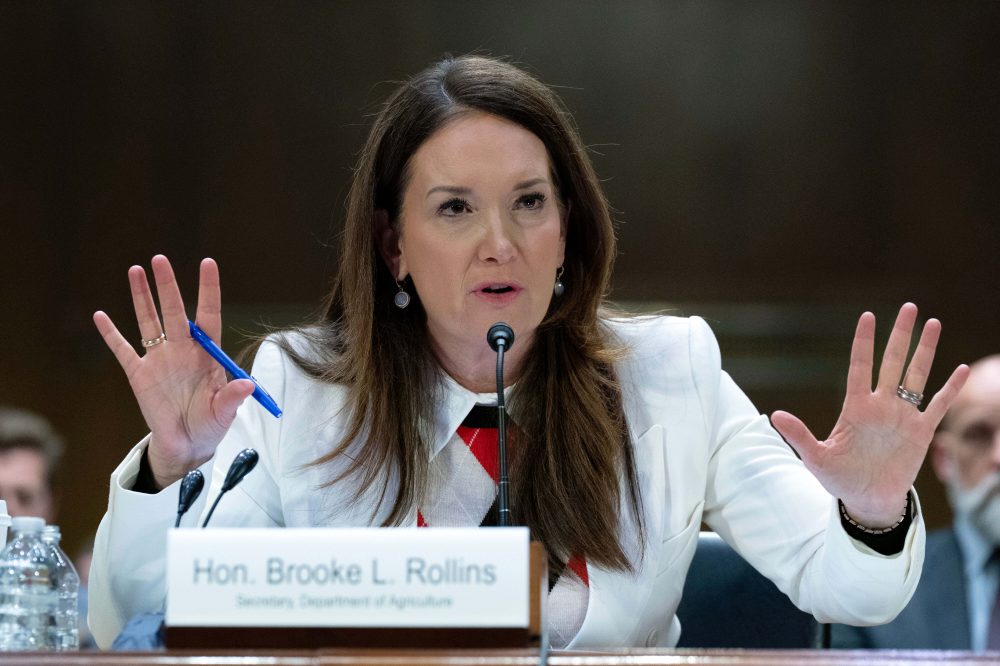

Agriculture Secretary Brooke Rollins recently claimed that a dramatic reduction in food stamp recipients stems from cracking down on fraudulent claims and economic improvements. However, food policy researchers are challenging this explanation, pointing instead to recent congressional legislation that tightened program requirements.
The data shows a significant decline in participation numbers, but the underlying causes tell a different story than what officials suggest.
During a recent statement, Rollins explained: “As of just a couple of days ago, we now have moved 4.3 million Americans off of the food stamp program. A lot of that is fraud. A lot of it is people taking the program that shouldn’t have been. And a lot of it is just a better economy. We’ve had wage growth that has outpaced inflation for the first time since early 2021. This is a really big day. So people don’t need food stamps.”
Government statistics confirm that SNAP participation dropped by approximately 4.3 million individuals between January 2025 and January 2026. However, academic researchers studying food insecurity point to legislative changes as the main factor driving this reduction.
The spending reduction legislation passed by Republicans last summer is expected to slash $186 billion from SNAP funding over a decade, representing a 20% decrease according to Congressional Budget Office projections.
“What we’ve seen in terms of the data is that the trend in participation declines seems to be related to the program being harder to access,” explained Roger Figueroa, a Cornell University assistant professor specializing in food insecurity research from a public health angle.
Research indicates that fraudulent activity within SNAP represents a minimal portion of overall cases, far too small to explain such a substantial participant reduction.
According to the most recent available statistics from fiscal year 2023, authorities disqualified 41,476 individuals for fraudulent activity. This figure encompasses both applicants who provided incorrect information and those who illegally traded benefits for cash or ineligible items. Among the total 42,176,946 participants, fraud cases represented less than one percent.
“I don’t see any evidence supporting a significant reduction in fraud as a driver of what we’re seeing as far as declining SNAP participation,” stated Caitlin Caspi, a University of Connecticut associate professor who researches food insecurity issues.
When asked to provide supporting data for Rollins’ fraud-related claims, USDA officials referred reporters to coverage from the New York Post and Foundation for Government Accountability regarding broad-based categorical eligibility policies. This policy allows SNAP applicants in most states to qualify if they receive non-cash benefits from federal Temporary Assistance for Needy Families programs or similar state initiatives.
Critics have targeted this eligibility approach for giving states excessive flexibility in determining qualification standards by eliminating asset limits, raising gross income thresholds, or implementing both changes. While the current administration aims to eliminate this policy, it remains legally permissible for now.
Economic performance in 2025 showed mixed results after initial challenges. The gross domestic product contracted during the first quarter for the first time in three years, but recovered during the latter half. Growth slowed in the fourth quarter but picked up momentum in early 2026, expanding at a moderate 2% rate from January through March following recovery from a record 43-day government shutdown.
Despite overall economic strength, food costs continue climbing. Prices increased 3.1% throughout 2025 and are projected to rise another 2.9% in 2026. For families experiencing persistent financial difficulties, broader economic improvements typically provide little relief.
“We have a persistent poverty problem in this country,” noted Kate Bauer, a University of Michigan associate professor of nutritional sciences. “And we have huge economic disparities. And most people, even in good economic times, are not able to pull their families out of poverty.”
While wage increases of 3.4% did exceed inflation rates of 3.3% in March, this wasn’t the first occurrence since 2021 as Rollins suggested. Additionally, higher-income Americans saw greater benefits in 2025 compared to lower-income families, who faced weaker income growth and continued high prices. Employment growth remained slow and unemployment rates increased.
“We’re not seeing a linear kind of drop-off,” Caspi observed. “We are not seeing, if you look at the unemployment rates, things that might be an indicator that a strong economy was driving this change. We don’t see, for example, a pattern of decline in unemployment that would match the pattern of decline in SNAP participation.”
Researchers identify the 940-page “One Big Beautiful Bill Act,” also called H.R. 1, as containing the primary factors behind reduced SNAP enrollment. The legislation imposed work requirements on certain adults who previously qualified for exemptions.
SNAP includes two categories of work requirements for eligibility. Standard rules cover most individuals aged 16-59, while able-bodied adults without dependents must meet more demanding criteria that H.R. 1 made even stricter, unless they qualify for specific exemptions. Participants can satisfy these enhanced requirements by working or joining work programs for at least 80 hours monthly, with payment not required.
Previously, able-bodied adults over 54 without dependents were exempt from enhanced requirements. This age threshold has been raised to 64. The legislation also lowered the age of dependent children that qualifies someone for exemption from 18 to 14. Homeless individuals, veterans, and former foster children 24 or younger also lost their exempt status.
“Families have lots of really complicated situations and you can’t just say to people, in 10 days or in one month, go find 80 hours a week of work when you don’t have the skills and those jobs aren’t available in your community,” Bauer explained.
SNAP eligibility covers U.S. citizens and certain lawful immigrants, though H.R. 1 removed qualification for groups including refugees and asylum seekers.
When Trump began his second presidential term in January 2025, approximately 42.83 million people participated in SNAP. This number fell nearly 10% by January 2026 to roughly 38.55 million. Most of this decline occurred during the year’s second half, following Trump’s signing of H.R. 1 in July. Participation decreased by only 743,572 people from January through June 2025, but dropped by about 3.47 million from July 2025 through January 2026.
Congressional Budget Office analysts had predicted this sharp reduction, estimating in an August 2025 report that specific provisions would “reduce participation in SNAP by roughly 2.4 million people in an average month over the 2025-2034 period.”
“It shouldn’t be surprising that we are seeing this decline and it shouldn’t be a leap in logic to think that these declines are attributable to H.R. 1.,” Caspi concluded.