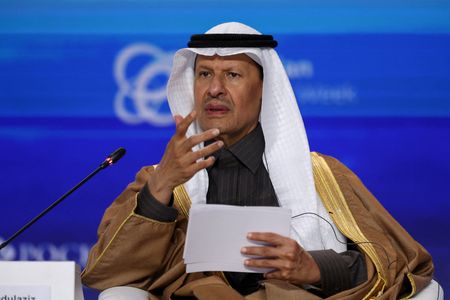

Saudi Arabia’s Energy Minister Prince Abdulaziz bin Salman is confronting a significant challenge to his leadership of OPEC following the unexpected withdrawal of the United Arab Emirates from the oil cartel.
The departure comes at a particularly difficult time, as the ongoing Iran conflict has severely disrupted global oil supplies and prevented Saudi Arabia and other OPEC members from utilizing their emergency production reserves typically deployed during crises.
The UAE’s abrupt exit this week removes OPEC’s fourth-largest oil producer from last year, along with the second-largest spare production capacity after Saudi Arabia. This development presents a major test for the first Saudi royal to serve as energy minister, whose approach has evolved from careful diplomatic negotiations to more independent decision-making, according to two OPEC+ alliance delegates.
“The UAE has been chafing inside OPEC for years and never got a fair hearing over its…quota. So now the chickens have come home to roost,” said Jim Krane, a fellow at Rice University’s Baker Institute.
Prince Abdulaziz, commonly referred to as ABS, derives his influence within OPEC+ from Saudi Arabia’s enormous oil reserves and production capacity. Unlike previous energy ministers, he holds royal status and enjoys support from his half-brother, Crown Prince Mohammed bin Salman, the kingdom’s de facto leader.
In 2020, ABS successfully engaged in a pricing conflict with Russia when Moscow initially declined to reduce output amid falling demand. He later reflected in a Saudi documentary: “It was an issue of to be or not to be – who is the boss of this sector.”
The 66-year-old minister also consistently rejected former U.S. President Joe Biden’s requests to increase production. OPEC members granted ABS extraordinary authority in 2022, allowing him as chairman to convene meetings whenever necessary.
His emphasis on market control now faces a new challenge. If the Strait of Hormuz reopens and Gulf oil production returns to normal levels, an independent UAE—which represented 12% of OPEC’s output last year—becomes a factor beyond the Saudi prince’s influence.
Neither the Saudi government communications office, Saudi energy ministry, nor the UAE’s energy and foreign ministries responded to requests for comment.
During the 2020 oil market collapse caused by the pandemic, ABS demanded complete consensus for unprecedented OPEC+ production reductions, leading to lengthy negotiations until a diplomatic solution involving the United States helping cover Mexico’s output cuts was achieved.
However, that exhaustive commitment to unity has since become more rigid, according to the two OPEC+ delegates.
Saudi representatives now typically notify ministers from smaller OPEC+ nations about final agreements just one day before scheduled meetings, the sources indicated. During a recent gathering, calls were made first to Russia’s Alexander Novak, then to representatives from the other six countries committed to voluntary reductions, totaling less than thirty minutes, one delegate noted.
Multiple delegates have recognized that Saudi Arabia shoulders most of the production cuts. Nevertheless, one source mentioned that the absence of consultation on major decisions represented an irritating change from previous procedures, while observing that OPEC+ had also diminished the importance of its technical expert evaluations in late 2022, essentially moving decisions directly to ministers with minimal discussion opportunities.
“We appreciate what His Royal Highness is doing for the oil price,” the delegate commented, requesting anonymity.
While recent developments have raised questions about OPEC’s future and its partnership with Russia, one delegate and another source knowledgeable about the organization’s perspective told Reuters that the crisis would ultimately strengthen unity and improve decision-making processes.
The geopolitical tension between Saudi Arabia and the UAE escalated at the beginning of the year when conflict erupted in Yemen between opposing groups backed by Riyadh and Abu Dhabi respectively.
An ongoing oil disagreement within OPEC had already intensified in 2021, when Abu Dhabi requested a larger production quota. An agreement providing a 300,000 barrel-per-day increase was only reached after complaints were made public.
“It is unreasonable to accept further injustice and sacrifice – we have been patient,” UAE Energy Minister Suhail al-Mazrouei told Sky News Arabia at that time.
A frustrated ABS responded to Al Arabiya that “a bit of rationality and a bit of compromise saves OPEC+,” stating he had “never seen such a demand” during his 34 years of participating in OPEC meetings.
The UAE’s quota had increased by approximately 500,000 barrels per day, representing 0.5% of global demand since 2019, exceeding increases for other group members. This included raising the UAE’s target in June 2023, while Angola and Nigeria saw their quotas reduced. Angola departed months later in frustration.
Saudi Arabia had granted these concessions as the UAE pledged to invest $150 billion in expansion plans to develop additional capacity, but the nation left the organization anyway on Tuesday.
For oil markets, the UAE’s departure and production goals have limited immediate impact while the Strait of Hormuz remains essentially blocked.
Iraq and Kuwait have experienced the greatest export losses, while the UAE has maintained some supply through the Gulf of Oman. Saudi Arabia has successfully redirected 60-70% of its exports to the Red Sea using a pipeline constructed in 1981 during the Iran-Iraq conflict.
At an OPEC conference last year, which Reuters and other media were prohibited from covering, Mazrouei indicated the UAE was prepared to increase capacity an additional 20% to 6 million barrels per day after 2027—half of Saudi capacity—presenting a clear challenge to ABS’s efforts to control excessive production.