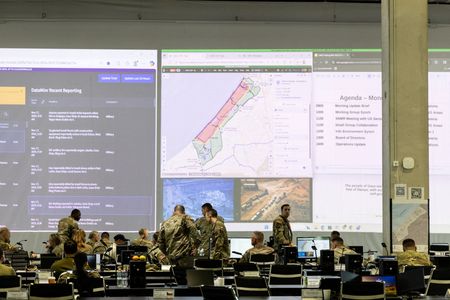

The Trump administration is moving forward with plans to shut down a U.S. military facility in Israel that was established to oversee the Gaza ceasefire and coordinate humanitarian aid delivery, according to multiple sources with knowledge of the decision.
The Civil-Military Coordination Centre, which has faced widespread criticism for its ineffectiveness in monitoring the Israel-Hamas truce and facilitating aid to Palestinians, will be dissolved as part of broader changes to U.S. Gaza policy, seven diplomatic sources told reporters.
This development represents another significant setback for President Trump’s Gaza reconstruction initiative, which has already been hampered by ongoing Israeli military operations despite the October ceasefire agreement and Hamas’s refusal to disarm.
Foreign policy experts indicate the decision highlights the substantial challenges confronting American efforts to supervise the fragile truce and manage aid distribution, particularly as Israeli forces continue expanding into Gaza territory while Hamas strengthens its control over remaining areas under its authority.
The closure could further strain relationships with Washington’s international partners, many of whom Trump had urged to contribute personnel and funding to the CMCC and his Gaza rebuilding program, which has been essentially suspended since the U.S. began its joint military campaign with Israel against Iran.
Sources reveal that the CMCC’s responsibilities for aid coordination and ceasefire monitoring will be transferred to an international security mission under U.S. command that is scheduled to deploy to Gaza, though that deployment has yet to materialize.
While U.S. officials have characterized this transition as a reorganization rather than a closure, diplomatic sources indicate the International Stabilization Force will effectively assume all CMCC functions, bringing the center’s mission to an end.
According to a diplomat briefed on the restructuring plan, American military personnel assigned to the reformed ISF would be reduced from approximately 190 to just 40 troops. The U.S. intends to fill the gap with civilian personnel from partner nations, sources said, speaking anonymously due to lack of authorization for public comment.
However, diplomatic observers question whether incorporating the CMCC into the ISF will produce meaningful improvements on the ground, given that the center lacked enforcement powers for the ceasefire or aid guarantees.
Following publication of the initial report, Trump’s Board of Peace issued a social media statement disputing that the CMCC was closing, though they did not address whether the ISF would absorb its duties.
A Board of Peace representative had earlier declined to discuss the center’s future but emphasized that it serves a “critical role in ensuring aid deliveries and coordinating efforts” while advancing Trump’s Gaza strategy.
Both the White House and U.S. Central Command directed comment requests to the Board of Peace.
Once the transition occurs, the restructured organization is expected to operate under the name International Gaza Support Centre, with U.S. Major General Jasper Jeffers, the White House-appointed ISF commander, likely assuming leadership, two sources indicated.
The ISF was originally intended for immediate Gaza deployment to establish territorial control and maintain security. However, only a limited number of countries have committed troops, and none have agreed to security responsibilities.
U.S. officials have maintained that American forces will not be stationed within Gaza itself.
The ISF has established a secured section within the CMCC, which operates from a warehouse facility in southern Israel, but U.S. military personnel strictly limit access to this area and frequently deny entry to allied nation representatives, three sources reported.
Establishing the CMCC was a cornerstone of Trump’s comprehensive 20-point Gaza plan, developed following the ceasefire designed to end Israel-Hamas hostilities and enable reconstruction of the territory after extensive destruction during two years of warfare.
Multiple nations, including Germany, France, Britain, Egypt, and the United Arab Emirates, deployed personnel such as military strategists and intelligence officers to the center as they sought influence over Gaza’s future governance discussions.
However, continued Israeli military strikes and the expansion of Israel’s armistice boundary deeper into Gaza territory have diminished the CMCC’s effectiveness, according to diplomatic sources. Hamas has simultaneously reestablished governmental control over a coastal section of Gaza within its territory.
Participation from member countries has declined significantly, with some nations sending representatives only monthly while others attend sporadically, diplomats reported.
Israeli officials justify their Gaza operations as necessary to counter Hamas threats and prevent unauthorized approaches to the armistice line. Palestinian authorities contend this reasoning serves as cover for territorial expansion aimed at forcing them from land intended for a future Palestinian state.
Since the ceasefire implementation, more than 800 Palestinians and four Israeli soldiers have died, despite the agreement’s purpose to halt warfare that began with Hamas’s October 7, 2023 attack on Israel.
The preceding conflict devastated much of Gaza’s infrastructure, displacing nearly all 2 million residents and destroying essential systems for water distribution, sanitation, and electrical power.
The CMCC’s mandate included ensuring humanitarian aid reached Palestinians in need. Diplomatic sources report that aid volumes have remained essentially unchanged despite increased commercial goods entering Gaza, as Israel prohibits many items it considers to have potential military applications alongside civilian uses.
Restricted items include tent poles required for displaced persons’ camps and heavy equipment necessary for debris removal operations.
COGAT, the Israeli military agency controlling Gaza access, stated that 80% of daily truck deliveries carry commercial goods purchased in Israel, though these are meant to supplement humanitarian supplies.
The Board of Peace official emphasized that Gaza ultimately requires “a sustainable civilian administration to truly transform from the years of aid dependency and cycles of violence that have clouded its past.”