WASHINGTON — The American economy experienced a notable deceleration during the last three months of the previous year, with federal data showing growth hampered by a lengthy government shutdown and diminished household spending patterns.
According to Friday’s Commerce Department release, the country’s gross domestic product expanded at an annualized 1.4% clip during the October-December period. This represents a sharp decline from the robust 4.4% expansion recorded in the summer months and the 3.8% growth seen in the spring quarter.
Household expenditures managed only a 2.4% increase, marking a considerable retreat from the stronger 3.5% advancement witnessed during the July-September timeframe.
The data highlights a puzzling characteristic of America’s current economic landscape: steady expansion coupled with minimal job creation. While the economy posted a respectable 2.2% annual growth rate in 2025, recent employment figures revealed that businesses created fewer than 200,000 positions throughout the year — representing the weakest job growth since the pandemic’s onset in 2020.
Economic analysts identify multiple factors contributing to this disconnect. The current administration’s immigration enforcement policies have significantly curtailed population increases, limiting the pool of available workers. This dynamic helps explain why joblessness climbed modestly from 4% to 4.3% despite the virtual absence of new hiring.
Additionally, some enterprises may be postponing workforce expansion while evaluating whether artificial intelligence technologies could boost productivity without additional personnel. Trade barrier costs have also squeezed corporate profits, potentially prompting companies to restrict their recruitment efforts.
The current economic environment presents another contradiction: while growth remains stable, price pressures have eased somewhat, and joblessness stays contained, polling indicates Americans maintain a pessimistic outlook about economic conditions. Consumer confidence measurements dropped to their lowest point since 2014 in January, yet spending continues to drive economic expansion.
This purchasing activity may be concentrated among higher-earning households, creating what experts call a “K-shaped” recovery pattern. However, banking sector information suggests lower-income consumers are also increasing their expenditures, albeit at a more modest pace.
WASHINGTON — Consumer prices accelerated at their swiftest pace in nearly 12 months during December, according to federal data released Friday that highlights how costs continue climbing beyond what most families want to see.
The Commerce Department reported that monthly prices jumped 0.4% in December compared to November’s 0.2% increase, marking the steepest monthly climb since February of last year. The report’s release was postponed due to the recent six-week federal government shutdown. When measured against December of the previous year, consumer costs surged 2.9%, exceeding November’s 2.8% annual rate and representing the largest yearly jump since March 2024.
When examining core pricing data — which strips out unpredictable food and fuel costs — the monthly increase also hit 0.4% in December, doubling November’s 0.2% figure and matching the highest level since last February. Annual core inflation climbed to 3% in December, surpassing the prior month’s 2.8% rate.
These numbers demonstrate that price pressures remain stubbornly high, despite falling from the nearly 7% peak witnessed in 2022. Since many everyday costs continue rising more rapidly than pre-pandemic levels, this data helps explain why numerous Americans feel dissatisfied with economic conditions, even with unemployment staying low and economic expansion remaining steady.
The data reflects the personal consumption expenditures price index, which Federal Reserve officials favor over the more widely recognized consumer price index. Government figures released last week showed the CPI moderated significantly in January.
However, the PCE measurement runs higher than the consumer price index because it assigns less importance to sectors where price growth has dramatically slowed, including apartment rental rates and vehicle costs.
Friday’s data also revealed that consumer spending maintained strong momentum in December, with expenditures rising 0.4% from the previous month, matching November’s pace.
During December, costs increased for home furnishings, apparel, and food items. While gasoline prices declined, electricity expenses grew and natural gas bills skyrocketed 3.7% in just one month.
The Federal Reserve’s rate-setting panel convened in late January and decided to maintain its benchmark interest rate at approximately 3.6%, despite persistent pressure from President Donald Trump to lower borrowing costs. Meeting notes released Wednesday indicated that most policymakers prefer to see inflation move closer to the Fed’s 2% goal before considering additional rate reductions.
Wall Street futures tumbled Friday morning following the release of disappointing economic data that showed the nation’s economy expanded less than anticipated during the final three months of last year, while December inflation figures came in above projections.
According to the Commerce Department’s latest report, the U.S. economy expanded at an annual rate of 1.4% during the October-December period, a significant slowdown from the robust 4.4% growth recorded in the third quarter. Financial analysts surveyed by Reuters had predicted economic expansion would reach 3% for the fourth quarter.
Meanwhile, inflation data released simultaneously painted a concerning picture for consumers. The Personal Consumption Expenditure index, which serves as the Federal Reserve’s primary tool for measuring inflation, climbed 0.4% from November to December, surpassing economist predictions of a 0.3% monthly increase. The core PCE measure, which strips out volatile food and energy costs, also jumped 0.4% month-over-month, exceeding the anticipated 0.3% rise.
Financial markets reacted negatively to the mixed economic signals. As of 8:34 a.m. Eastern Time, S&P 500 E-mini futures had declined 19.25 points, representing a 0.28% drop. Nasdaq 100 E-mini contracts fell more sharply, losing 96.5 points or 0.39%, while Dow E-mini futures decreased by 115 points, down 0.23%.
WASHINGTON – The United States economy hit significant headwinds during the final three months of last year, with growth falling well short of projections as the lengthy government shutdown and weakened consumer activity took their toll on the nation’s financial performance.
According to the Commerce Department’s Bureau of Economic Analysis, the economy expanded at just a 1.4% annual rate during the fourth quarter – a sharp decline from the robust 4.4% growth recorded in the previous quarter. Financial experts had anticipated a much stronger 3.0% growth rate, though their predictions were made before December trade data revealed the deficit had reached a five-month peak.
The nonpartisan Congressional Budget Office determined that the government shutdown reduced fourth-quarter economic output by 1.5 percentage points due to decreased federal worker services, reduced government purchases, and temporary cuts to food assistance benefits. While the CBO projects most of this lost economic activity will eventually return, they estimate between $7 billion and $14 billion in permanent losses.
Before the economic data was released, President Donald Trump took to social media, stating: “Shutdown cost the U.S.A. at least two points in GDP. That’s why they are doing it, in mini form, again. No Shutdowns! Also, LOWER INTEREST RATES.”
The delayed report – held up by the unprecedented 43-day government closure – revealed an economy struggling with what experts describe as a “K-shaped” recovery pattern, where wealthy Americans continue to prosper while working-class families face mounting financial pressures from rising costs due to import duties and stagnant wages.
This economic divide has sparked what analysts and political critics term an affordability emergency. Employment growth remained weak throughout the year, with only 181,000 new positions created – the smallest increase outside of the pandemic era since the 2009 financial crisis and a steep drop from the 1.459 million jobs added in 2024.
Consumer spending, which had surged at a 3.5% rate during the third quarter, showed notable deceleration. Economic researchers indicate that purchasing activity has been concentrated among affluent households, often funded by depleting savings as inflation continues to erode household purchasing power.
Looking ahead, consumer expenditures may receive support from anticipated larger tax refunds resulting from recent tax legislation. Economic analysts estimate that artificial intelligence sectors – including data facilities, computer chips, software development, and research initiatives – contributed roughly one-third of overall economic growth during the first nine months of 2025, helping to offset negative impacts from trade tariffs and reduced immigration levels.
Given the outdated nature of this economic report, financial experts believe it will likely have minimal influence on Federal Reserve policy decisions.
Construction has officially begun on a major new apartment development in Georgetown, with state and local officials gathering yesterday to mark the groundbreaking ceremony.
The Savannah Grove residential project will deliver 106 apartment units to the Sussex County community, with 16 of those homes designated as affordable housing options priced below current market rates.
Governor Matt Meyer joined representatives from the Delaware State Housing Authority and Apennine Development Co. LLC at yesterday’s ceremony to launch construction on the new community.
The development represents a significant addition to Georgetown’s housing inventory as the area continues to experience growth and demand for both market-rate and affordable rental options.
Apennine Development Co. LLC is serving as the primary developer for the Savannah Grove project, working in partnership with state housing officials to bring the mixed-income community to fruition.
A major petrochemical corporation announced Friday it will dramatically reduce payments to shareholders, blaming an extended slump in the chemicals sector.
LyondellBasell revealed its first-quarter dividend will drop to 69 cents per share, marking a steep 68-cent decrease from what shareholders received in the previous quarter.
Company CEO Peter Vanacker acknowledged the challenging business environment while defending the company’s recent performance.
“Despite one of the longest downturns in our industry, LYB was able to return approximately $2 billion to our shareholders from existing cash and operations in 2025,” Vanacker stated.
The chief executive explained the reasoning behind the dividend adjustment, pointing to continued market difficulties ahead.
“With markets expected to remain challenged, we have made the decision to recalibrate the dividend to better position the company to thrive once markets recover,” he said.
Wall Street futures showed minimal movement Friday morning as traders held their breath for crucial economic indicators that could shape Federal Reserve policy decisions throughout the year, while also keeping watch on rising Middle East tensions and a possible Supreme Court ruling on Trump administration tariffs.
Friday’s lineup of economic reports includes the initial fourth-quarter GDP estimate, the Personal Consumption Expenditure index that the Fed relies on for inflation tracking, plus February’s business activity and consumer confidence numbers — all designed to reveal how the American economy is performing.
Economic forecasters predict the 8:30 a.m. GDP data will reveal the economy expanded at a 3.0% annual rate during the final three months of last year, down from the robust 4.4% growth seen between July and September, based on a Reuters survey.
Goldman Sachs analysts noted in their research that “Market pricing of growth has been choppier relative to the signal from the data.”
The investment firm added: “We think there is scope for cyclical assets to continue to draw support from ongoing tailwinds from a US economy that is heating up, while protecting against risks and valuation challenges in other areas.”
Tech companies have faced headwinds recently as investors question whether their expensive stock prices are justified and whether massive artificial intelligence spending will generate returns. Multiple industries from software development to property management saw sharp declines last week amid fears that emerging AI technology could disrupt their operations.
Investor confidence remained relatively steady this week, except for Thursday’s session when declining private equity shares along with drops in Apple and Walmart stock created market jitters.
The Supreme Court may also deliver a verdict Friday on whether President Trump’s sweeping emergency tariffs were legal. Should the court overturn them, the government might need to return over $175 billion in collected tariff revenue, according to Penn-Wharton Budget Model researchers.
Energy markets saw oil prices retreat from their six-month peaks as traders evaluated escalating friction between Washington and Tehran. President Trump issued a stark warning to Iran, stating the country must negotiate on its nuclear activities or face consequences where “really bad things” would occur.
Early morning trading showed S&P 500 futures down 3 points or 0.04%, Nasdaq 100 futures up 3.25 points or 0.01%, and Dow futures declining 39 points or 0.08% as of 6:09 a.m.
Cloud computing company Akamai Technologies dropped 10.9% in pre-market activity after projecting first-quarter earnings below analyst expectations.
Digital currency-related stocks gained ground as bitcoin climbed 1.4% to $67,840. Cryptocurrency exchange Coinbase rose 1.5%, while bitcoin investment firm Strategy increased 1.6%.
Financial markets experienced a turbulent week despite shortened trading schedules, with oil prices taking center stage as geopolitical tensions escalated in the Gulf region.
Crude oil costs have climbed 6% this week, reaching their highest point since August, as diplomatic efforts between the U.S. and Iran failed to produce concrete results. Energy market analysts are growing increasingly concerned about potential supply disruptions in the Gulf, while sanctioned Russian oil remains absent from global markets.
The price surge comes despite reports suggesting OPEC+ nations may consider boosting production in April. However, supply concerns aren’t the only factor driving costs higher.
Economic data reveals the global economy gained momentum entering 2026, with U.S. manufacturing posting its strongest monthly increase in nearly a year during January. This industrial growth aligns with robust employment figures and suggests the economic upturn isn’t limited to a single sector.
Weekly unemployment claims dropped again, while the Philadelphia Federal Reserve’s February business survey showed activity levels nearly double what economists had predicted. December trade figures also revealed a significant spike in U.S. imports.
Much of this economic activity stems from massive artificial intelligence investments planned by major technology companies for 2026. As markets prepare for Nvidia’s upcoming quarterly earnings report next week, the world’s most valuable company continues securing major contracts, including a recent deal with Meta.
Meta has already announced plans to nearly double its AI capital expenditure buildout this year. However, investors are expressing growing anxiety about what appears to be circular investing among a small group of leading tech firms, with Nvidia approaching a $30 billion investment in OpenAI, one of its biggest customers.
Market participants are becoming increasingly skeptical about potential AI overspending, while recent AI developments have raised concerns about the future of various industries, from software companies to wealth management firms.
Adding to these worries is mounting global political opposition to social media’s impact on children. The S&P 500, ‘Magnificent Seven’ stock indices, and even Nvidia shares remain negative for the year.
These concerns intensified when Blue Owl Capital’s stock fell 6% Thursday after announcing it would sell $1.4 billion in assets from credit funds to return investor capital and reduce debt, while permanently stopping redemptions at one fund. Other private credit companies also saw their share prices decline.
The oil price increase has sparked inflation worries in bond markets, pushing Treasury yields higher throughout the week. Federal Reserve meeting minutes from January revealed most policymakers weren’t ready to resume interest rate cuts, with divided opinions on whether the AI boom would strain economic capacity before delivering productivity gains.
European Central Bank leadership changes may be on the horizon, with speculation arising after reports suggested President Christine Lagarde might resign early this year, well before her October 2027 term expires. The reported reasoning would allow French President Emmanuel Macron to influence her successor selection before leaving office in May.
The ECB initially pushed back against these reports, stating no decision had been made. Sources indicated Lagarde assured colleagues she wasn’t departing immediately. She later told the Wall Street Journal that her ‘baseline’ remained completing her full term.
Potential successor names have already begun circulating, with Bank for International Settlements chief Pablo Hernadez de Cos appearing as a frontrunner, though former Dutch central bank leader Klaas Knot and Bundesbank head Joachim Nagel are also mentioned as candidates.
Bank of England rate cut speculation increased following softer UK inflation data and private sector wage growth numbers, though persistent core price increases tempered some enthusiasm.
This week concludes Friday with fourth-quarter U.S. GDP data, while some observers watch for a possible Supreme Court decision regarding Donald Trump’s emergency tariff powers. Next week features Trump’s State of the Union address, expected to focus on his election-year ‘affordability’ campaign, alongside Wednesday’s highly anticipated Nvidia earnings report.
Energy markets will continue monitoring Iranian tensions over the weekend, particularly after Trump warned Tehran it has 10 to 15 days to reach a nuclear agreement or face serious consequences.
Stringent cybersecurity compliance requirements implemented by the Defense Department are causing smaller suppliers to walk away from military contracts due to overwhelming costs and complexity.
The Pentagon’s Cybersecurity Maturity Model Certification program launched in November after years of delays, designed to safeguard controlled unclassified information within the defense supply chain.
Defense contractors must now complete cybersecurity self-evaluations as the initial step in a three-tier certification system. The more demanding second tier, which includes mandatory audits, is scheduled to roll out by November.
Industry executives, speaking anonymously due to the sensitive nature of the topic, report that lengthy audit waiting periods and unclear guidelines about which information requires protection have complicated compliance efforts.
According to an industry insider, contractors are demanding heightened compliance measures even from suppliers who don’t handle sensitive materials like technical blueprints for fighter jet components.
The financial burden is particularly challenging for smaller companies, with compliance costs reaching hundreds of thousands of dollars per firm, industry sources indicate.
Margaret Boatner, vice president of national security policy at the Aerospace Industries Association, explained the impact: “Some of these firms, particularly those that also compete in commercial markets, report that the accumulation of complex and costly regulatory requirements is forcing them to reconsider—if not exit—the defense marketplace altogether, further challenging the health and resilience of the industrial base.”
Statistics from a 2022 House Small Business Subcommittee show that 88% of aerospace companies qualify as small businesses.
Reuters spoke with three aerospace firms—two American and one Canadian—who each reported having multiple suppliers unwilling to meet the stricter certification requirements, including the audit process.
One U.S. company president revealed that half of their suppliers haven’t committed to compliance. Another company executive, whose firm is the exclusive manufacturer of a component for a U.S. fighter jet program, remains uncertain about supplier participation.
The Defense Department chose not to provide comment on the matter.
Small suppliers play a crucial role in the defense supply chain, with investors closely monitoring their stability following years of production delays. Many serve as the sole manufacturers of essential components needed by larger contractors for weapons and equipment assembly.
Alex Major, a defense contractor attorney at McCarter & English specializing in certification compliance, warned that these requirements might unintentionally limit competition among smaller defense supply chain participants.
The certification program, originally introduced in 2019, faced significant delays due to industry pushback and confusion that required extensive Pentagon consultations.
International suppliers face additional challenges, particularly those already complying with European data privacy regulations and other regional cybersecurity standards, Major noted.
“You’re telling these contractors to hold data a particular way or identify it as controlled information pursuant to the United States government, and (other) data privacy laws might differ,” he explained.
A Canadian company executive estimated needing to spend C$500,000 ($365,176.75) to satisfy both European and American regulatory requirements.
Dave Trader, CEO of nonprofit aerospace supplier Pathfinder Manufacturing, questioned whether compliance costs justify the investment given his company’s limited defense work producing wire harnesses, especially with strong demand from Boeing.
WASHINGTON – Federal officials face the possibility of refunding more than $175 billion in collected tariff revenue if the Supreme Court strikes down President Trump’s emergency trade duties, according to new calculations from University of Pennsylvania researchers released Friday.
The analysis, conducted by the Penn-Wharton Budget Model at Reuters’ request, examined tariff collections made under the International Emergency Economic Powers Act (IEEPA) since Trump began implementing these measures in February 2025.
Senior economist Lysle Boller from the non-partisan fiscal research organization explained that their comprehensive forecasting system analyzes tariff rates across approximately 11,000 product categories from 233 nations. The model estimates roughly $500 million in IEEPA-related revenue is collected each day.
A Supreme Court decision on these emergency tariff powers could come as soon as Friday. Should the justices rule against the administration, importers are expected to quickly seek refunds from U.S. Customs and Border Protection for duties paid throughout the past year.
To put the potential refund amount in perspective, $175 billion surpasses the combined annual spending of the Transportation Department ($127.6 billion) and Justice Department ($44.9 billion) for fiscal 2025.
The administration has highlighted revenue from all tariff programs, with Congressional Budget Office projections showing approximately $300 billion annually over the coming decade. However, this analysis demonstrates that a significant portion could require repayment depending on the court’s ruling.
Boller detailed how the Penn-Wharton system cross-references Census Bureau import information using eight-digit tariff classifications and applies statistical forecasting techniques. As of Thursday, their model calculated $179 billion in total IEEPA collections since the emergency tariffs began.
The research team also examined historical Customs and Border Protection assessment data as a percentage of ongoing Treasury customs collections, producing a comparable estimate between $175 billion and $176 billion.
CBP’s most recent public disclosure of IEEPA-based customs assessments came December 14, showing $133.5 billion at risk since the law’s first implementation. Actual collections typically run slightly below assessments due to adjustments and corrections that generate refunds.
The Penn-Wharton analysis accounts for rapid tariff modifications implemented by the Trump administration, including trade agreements that reduced import duties for specific nations. South Korea, for instance, saw its U.S. tariff rate decrease from 25% to 15% in November.
The model also tracks punitive duty changes under IEEPA, such as the 40% tariff imposed on Brazil last August following the prosecution of Trump associate and former President Jair Bolsonaro, and the subsequent removal of duties on Brazilian coffee, beef and cocoa in November.
Treasury Secretary Scott Bessent expressed confidence to Reuters in January that his department can handle any required tariff refunds, while maintaining optimism that the Supreme Court will support the IEEPA tariffs. Treasury borrowing plans anticipate substantial cash reserves of $850 billion by March’s end and $900 billion by June’s conclusion.
Recent Treasury reports show significant increases in customs revenue, with monthly gains of approximately $20 billion compared to pre-tariff periods. January’s total customs receipts reached $27.7 billion. Administration officials indicate they would pursue alternative tariff authorities to reinstate duties if the court invalidates IEEPA-based tariffs.
Investment funds focused on American stocks experienced their most significant cash influx in over five weeks during the period ending February 18, as market participants showed renewed confidence following encouraging inflation data that raised hopes for Federal Reserve interest rate reductions.
Data from LSEG Lipper reveals that investors channeled a net total of $11.77 billion into domestic stock funds, marking the strongest weekly investment activity since January 14.
Mark Haefele, who serves as chief investment officer at UBS Global Wealth Management, offered his perspective on current market conditions. “We maintain an attractive view on the overall U.S. equity market, but investors should consider diversifying concentrated tech positions,” Haefele stated.
“Within technology, selectivity is key,” he added.
Value-focused stock funds continued their popularity streak for the second consecutive week, drawing $2.65 billion in fresh investments. In contrast, growth-oriented funds experienced withdrawals totaling $2.28 billion during the same period.
Sector-specific investment funds captured $1.82 billion in new money, representing their second straight week of positive cash flow. Industrial and technology sectors led the way, securing $1.3 billion and $1.19 billion in new investments respectively.
Bond funds also proved attractive to investors, collecting $10.27 billion in the seventh consecutive week of net contributions. Short-to-intermediate investment-grade funds drew the most interest with $3.61 billion, followed by general domestic taxable fixed income funds at $2.56 billion, and short-to-intermediate government and treasury funds at $2.26 billion.
Money market funds rounded out the investment activity with $12.79 billion in net contributions, representing their third positive week out of the past four.
International stock markets moved upward Friday, shrugging off rising tensions between the United States and Iran that have driven oil prices to their highest point in more than six months.
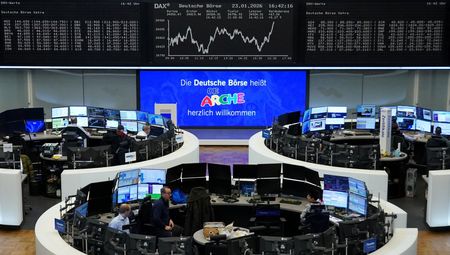
Europe’s STOXX 600 index gained 0.5% and was positioned for its fourth straight week of increases. U.S. S&P 500 futures also advanced 0.4%.
The trading session concluded a turbulent week for worldwide investments, as market participants navigated a mix of international conflicts, political uncertainties, and changing economic indicators.
“Clearly, equity investors are getting used to the noisy geopolitical environment,” said Mabrouk Chetouane, head of global market strategy at Natixis Investment Managers.
“They are still focusing on economic fundamentals instead of geopolitical risks. And when you look at metrics such as valuations, earnings and interest rate expectations, things look pretty stable.”
Data from LSEG I/B/E/S showed that among 163 STOXX 600 companies reporting quarterly earnings through Wednesday, 57.1% surpassed analyst projections.
In the S&P 500, approximately 73% of companies that announced earnings through last week beat revenue forecasts, according to the data. Next week’s spotlight will be on Nvidia’s earnings announcement.
Friday’s economic calendar included worldwide business activity reports, fourth-quarter U.S. economic growth numbers, and the Federal Reserve’s favored inflation measure – the core personal consumption expenditures price index.
The U.S. dollar was positioned for its biggest weekly increase in four months, boosted by moderately positive American economic data and Fed meeting notes indicating policymakers aren’t rushing to reduce interest rates.
Weekly dollar performance showed a roughly 1% gain against the euro, driving the shared European currency down to $1.1767.
“The dollar’s safe haven appeal is generally diminished, but is fully restored when geopolitical tensions trigger oil shocks,” said ING FX strategist Francesco Pesole.
In Japan, the yen weakened after inflation data revealed the country’s core price growth at 2% in January – the slowest rate in two years – potentially complicating the central bank’s interest rate increase plans.
The dollar rose 1.8% for the week to 155.4 yen.
U.S. Treasury bonds remained stable with 10-year yields at 4.07%, while disagreement shown in Fed minutes about whether and how quickly to reduce rates pushed two-year yields up five basis points for the week to 3.47%.
Germany’s 10-year government bond yields, the eurozone standard, were set for a 2 basis point weekly decline.
Brent crude oil futures reached 6-1/2-month highs above $72 per barrel after U.S. President Donald Trump established a 10 to 15-day timeframe for Iran to negotiate on its nuclear program or face consequences he described as “really bad things.”
“The political rhetoric has escalated sharply. Even limited disruption or credible threats to shipping lanes could cause an immediate supply shock,” said Capital.com senior market analyst Daniela Hathorn.
The combined developments prompted investors to avoid risky positions, according to Kenji Abe, chief strategist at Daiwa Securities in Tokyo.
“There does not seem to be much point in adding risk ahead of this weekend’s uncertainty surrounding the Middle East,” said Spectra Markets’ President Brent Donnelly.
“Today feels like a good day to stay out of trouble.”
The co-founder of the well-known fashion retailer ASOS has died following a tragic fall from a high-rise balcony at a Thai resort, according to local authorities.
Thai police confirmed Friday that Quentin Griffiths, age 58, fell from the 17th story of an apartment building in Pattaya, a popular coastal resort destination, on February 9th.
Authorities discovered the British man’s body on the ground directly beneath the balcony after responding to the scene. Police have identified the victim as Quentin John Griffiths.
Preliminary findings point to suicide, with investigators finding no evidence of criminal activity, according to police statements. Security camera footage revealed no one had entered Griffiths’ residence, where he resided by himself, though officials have ordered an autopsy examination.
Law enforcement officials reported that a Thai acquaintance of Griffiths told them the British businessman had been experiencing stress over legal disputes involving his former spouse, who is Thai.
Police discovered paperwork connected to these legal proceedings inside his apartment.
The incident went largely unnoticed by local media in Pattaya, which hosts a substantial population of international residents, until a British publication covered the story on Thursday.
Griffiths helped establish ASOS in 2000 and continued to hold significant ownership stakes in the company even after his departure.
An Indian pharmaceutical company announced Friday it will dramatically expand its workforce next year, adding more than 700 new positions as global demand for drug manufacturing services continues to surge.
Sai Life Sciences revealed plans to grow its employee base by approximately 20% during the upcoming financial year, bringing new jobs to meet increasing international orders. The company currently maintains a workforce of roughly 3,400 people spread across facilities in India, the United States, and the United Kingdom.
The pharmaceutical firm generates the majority of its revenue from clients in America, Europe, and Britain, positioning it well to capitalize on the industry’s current expansion.
This workforce expansion reflects broader trends in India’s pharmaceutical sector, which has experienced rapid growth as international drug companies increasingly relocate high-value operations to the country. Companies are drawn by India’s lower production costs, skilled workforce, and efforts to diversify their supply chains beyond traditional markets.
Industry analysts project significant growth ahead for India’s contract drug research and manufacturing sector, with market research firm Mordor Intelligence forecasting the industry will more than double to reach $57.94 billion between 2025 and 2031.
The new positions at Sai Life Sciences will focus on scientific, technical, and management roles based in Hyderabad, a major southern Indian city. The company operates its primary research and development facility there, supporting drug development projects, data-driven drug discovery efforts, and large-scale commercial manufacturing operations.
Company CEO and Managing Director Krishna Kanumuri described the expansion as part of ongoing “global supply-chain rebalancing” taking place across the pharmaceutical industry.
Over the past six years, Sai Life Sciences has committed more than $219 million toward expanding its manufacturing capabilities to support this growth strategy.
American officials are currently working with India on arrangements to sell Venezuelan crude oil to the Asian nation, according to U.S. Envoy Sergio Gor, who spoke to reporters Friday in New Delhi.
The discussions are part of Washington’s broader push to help India reduce its reliance on Russian oil imports, a move that’s connected to recent trade negotiations between the two countries.
“The Department of Energy is speaking to the Ministry of Energy here, and so we’re hoping to have some news of that very soon,” Gor explained during a media briefing on the sidelines of an event where India joined America’s Pax Silica program focused on semiconductor supply chains.
The oil arrangement comes as President Donald Trump recently finalized an interim trade agreement with India this month, reducing tariffs on Indian imports to 18 percent. Trump also eliminated a 25 percent penalty tax after India committed to stopping purchases of Russian crude oil.
According to the agreement, India will increase its oil purchases from American sources and potentially from Venezuela as well.
Trade Minister Piyush Goyal announced Friday that the interim deal will take effect in April, with formal notification of the tariff reduction expected this month. Gor indicated that a comprehensive trade agreement will be completed “sooner than later,” noting only minor details need to be resolved. He also mentioned that Prime Minister Narendra Modi has extended an invitation to Trump to visit India.
The push for oil diversification stems from sanctions imposed by America and its allies on Russia’s energy sector following Moscow’s 2022 military action in Ukraine. Following those sanctions, India became Russia’s largest buyer of seaborne crude oil, purchasing it at significantly discounted prices, which frustrated Western governments.
“On the oil, there’s an agreement… We have seen India diversify on their oil. There is a commitment. This is not about India. The United States doesn’t want anyone buying Russian oil,” Gor stated.
Reuters previously reported last month that American officials had proposed Venezuelan oil sales to India as a replacement for Russian imports. Washington has issued permits to trading companies Vitol and Trafigura to handle the marketing and sale of millions of barrels of Venezuelan crude following recent political changes in Venezuela.
Several major Indian energy companies, including state-owned Indian Oil Corp, Hindustan Petroleum, and Bharat Petroleum, along with private refiners Reliance Industries and HPCL-Mittal Energy, have already placed orders for Venezuelan oil, according to industry reports.
French consumer goods company Danone has reported financial results for 2025 that surpassed Wall Street projections, with the maker of popular brands like Evian water and Activia yogurt crediting strong baby formula sales in China for driving growth.
The Paris-based company announced revenues of 27.28 billion euros (equivalent to $32.07 billion) for 2025, representing a 4.5% increase on a like-for-like basis. This performance topped analyst forecasts of 4.4% growth.
Chief Executive Antoine de Saint-Affrique acknowledged current global market challenges but expressed optimism about the company’s direction. “We enter the year with confidence, aligned with the mid-term ambition we have set out,” de Saint-Affrique stated, despite describing the world as “volatile.”
The company’s strong showing came from robust sales of medical nutrition products and infant formula in the Chinese market, which helped compensate for declining coffee creamer sales in the highly competitive American marketplace.
Danone’s profit margins also improved, climbing to 13.4% of total sales in 2025 from 13% the previous year, matching analyst predictions exactly. The company generated cash flow of 2.8 billion euros, exceeding the 2.5 billion euro forecast, prompting management to announce a 4.7% dividend increase to 2.25 euros per share.
Looking ahead to 2026, company leadership projects sales growth between 3-5% on a like-for-like basis, with operating income expected to grow at a faster pace than revenues.
Fourth-quarter performance was particularly strong, with sales climbing 4.7% compared to analyst estimates of 4.3%. Again, Chinese demand for baby formula and medical nutrition products offset weakness in the U.S. coffee creamer segment.
However, the company faces potential challenges related to recent infant formula recalls linked to contamination concerns involving the toxin cereulide. Danone indicated the financial impact remains “not material” at this point, noting that “Impact assessment will be finalized once the recalls have been completed.”
While the recalls have been limited to European markets and haven’t affected Chinese operations, industry analysts worry about possible reputation damage in China, where Danone generates approximately 17% of its total profits from baby formula sales. This exposure is significantly higher than competitor Nestle, which derives less than 2% of profits from Chinese infant formula, according to Jefferies analysts.
Like other major consumer goods companies including Unilever and Nestle, Danone has moderated its price increases after three years of significant hikes following the COVID-19 pandemic. This strategy aims to attract back consumers who switched to lower-priced alternatives during the recent inflationary period.
A major trade agreement between the United States and Indonesia has been finalized, bringing significant reductions in American tariffs on goods from the Southeast Asian nation. The deal lowers U.S. import duties from 32% down to 19% on Indonesian products.
Indonesia’s senior economic minister Airlangga Hartarto and U.S. Trade Representative Jamieson Greer completed the signing ceremony in Washington following extensive negotiations that lasted several months.
“This deal respects the sovereignty of both countries,” Airlangga stated during a virtual news briefing, characterizing the arrangement as a “win-win” for both nations.
A key victory for Indonesia was securing duty-free status for palm oil, which represents approximately 9% of the country’s total export revenue. Additional Indonesian products that will enter the U.S. market without tariffs include coffee, cocoa, rubber and various spices, according to Airlangga.
The 19% tariff rate puts Indonesia on equal footing with other Southeast Asian trading partners like Malaysia, Cambodia, Thailand and the Philippines in their commercial relationships with America. Vietnam faces a slightly higher 20% rate.
This trade breakthrough arrives during a challenging period for Indonesian financial markets. Recent setbacks include MSCI’s warning last month about potentially downgrading the country’s equity market to “frontier” classification due to transparency concerns, plus Moody’s decision two weeks ago to lower Indonesia’s credit rating outlook over policy-making predictability issues.
Yose Rizal Damuri, executive director of CSIS Indonesia, believes investor confidence could rebound if Jakarta leverages this U.S. agreement to drive broader reforms.
“If Indonesia could multilateralize some of its commitments to the United States and use them as a basis for deregulation, that would increase trust in Indonesia and that’s something that should be taken advantage of, optimized,” he explained.
The agreement establishes a quota system for Indonesian textile imports that will face zero tariffs. The specific quota amounts will depend on how much American cotton and synthetic fibers are incorporated into the textile production.
According to Airlangga, the United States withdrew demands to include non-economic clauses in the deal, such as provisions concerning nuclear reactor development and South China Sea matters.
In exchange, Indonesia has committed to eliminating tariff obstacles on most American goods across various industries and addressing non-tariff trade barriers including domestic content mandates, based on White House documentation.
Indonesia will also adopt American product standards for automotive safety, emissions controls, medical equipment and pharmaceutical products.
The agreement appears designed to address Washington’s concerns about China’s dominance in critical mineral markets and Chinese companies relocating operations to countries like Indonesia.
Under the new terms, Indonesia will impose limits on “excess production” at foreign-controlled mineral processing plants by ensuring output aligns with Indonesian mining quotas. These restrictions apply to minerals such as nickel, cobalt, bauxite, copper and manganese.
Jakarta has also committed to taking measures against foreign government-controlled companies operating within Indonesia when their activities damage U.S. commercial interests.
Additionally, Indonesia will promote American investment in critical minerals and energy resources while collaborating with U.S. firms to accelerate development of its rare-earth mineral industry.
The trade deal will become effective 90 days after both countries complete necessary legal processes, Airlangga noted, adding that modifications remain possible if both parties reach mutual agreement.
Indonesian President Prabowo Subianto traveled to Washington for the agreement signing and to participate in the inaugural meeting of President Donald Trump’s Board of Peace.
On Friday, Prabowo and Trump signed a document called “Implementation of the Agreement Toward a NEW GOLDEN AGE for the U.S.-Indonesian Alliance,” which the White House says will help both nations strengthen economic security and promote growth.
Earlier this week, Indonesian and American companies announced business deals totaling $38.4 billion.
Major technology companies are now defending themselves in courtrooms nationwide after years of denying claims that their platforms deliberately harm young users’ mental wellbeing. Companies like Meta and TikTok are battling accusations that they intentionally create addictive features while failing to shield children from predators and harmful material.
Multiple lawsuits have emerged from various sources including educational institutions, government entities at all levels, and thousands of affected families. These legal challenges aim to establish corporate accountability for alleged damage to children’s psychological health.
Currently, two significant trials are proceeding in Los Angeles and New Mexico, with additional cases scheduled ahead. These legal confrontations represent the peak of years-long examination into platform safety practices and whether intentional programming decisions create dependency while promoting content linked to depression, eating disorders, and suicidal behavior.
Legal analysts compare this situation to previous litigation against tobacco manufacturers and opioid producers, with plaintiffs hoping for similar accountability outcomes that forced major changes in those industries.
The results could potentially weaken companies’ First Amendment protections and Section 230 safeguards from the 1996 Communications Decency Act, which currently shields tech firms from responsibility for user-generated content. Beyond expensive legal costs and potential settlements, companies might face operational changes that could reduce both user engagement and advertising revenue.
In the Los Angeles proceedings, a landmark case centers on a 20-year-old plaintiff known only as “KGM,” whose situation will likely influence thousands of similar legal actions. This case, along with two others, serves as a test trial to evaluate how legal arguments perform before juries.
“This represents a crucial turning point for social media,” stated Matthew Bergman from Seattle’s Social Media Victims Law Center, representing over 1,000 plaintiffs in similar cases. “Four years ago, nobody believed we would reach trial stage. Now we’re presenting our arguments to an impartial jury.”
During Wednesday testimony, Meta CEO Mark Zuckerberg maintained previous positions, including detailed discussion about age verification processes. “I don’t see why this is so complicated,” he stated, emphasizing company policies that restrict access for users under 13 and efforts to identify those who misrepresent their ages.
When plaintiff attorney Mark Lanier questioned whether addictive products increase usage, Zuckerberg responded, “I’m not sure what to say to that. I don’t think that applies here.”
New Mexico’s case, led by Attorney General Raúl Torrez who sued Meta in 2023, involved investigators posing as minors online to document sexual solicitations and evaluate Meta’s responses to such incidents.
Torrez seeks stronger age verification systems and more aggressive removal of dangerous users. He also demands changes to algorithms that distribute harmful content and has criticized encryption features that prevent monitoring communications with children for safety purposes. Meta defends encrypted messaging as a privacy measure supported by various government authorities.
The New Mexico trial began in early February. Prosecutor Donald Migliori argued in opening statements that Meta misrepresented platform safety while deliberately programming algorithms to maximize youth engagement despite knowing children faced exploitation risks.
“Meta clearly understood that youth protection wasn’t their corporate priority… that youth safety mattered less than growth and user engagement,” Migliori told jurors.
Meta’s attorney Kevin Huff countered these claims, describing extensive company efforts to eliminate dangerous content while acknowledging that some harmful material still bypasses safety measures.
A summer trial scheduled in Oakland, California before U.S. District Judge Yvonne Gonzalez Rogers involves six public school districts from across the nation in a consolidated legal action against social media companies.
Jayne Conroy, a plaintiffs’ attorney who previously worked on opioid litigation against pharmaceutical companies, identifies addiction as the central issue in both cases.
“In social media litigation, we’re concentrating on children and their developing minds, examining how addiction threatens their welfare and the resulting harm from excessive usage and targeted content,” she explained.
The medical research, she noted, “surprisingly shows similarities to opioid or heroin addiction. We’re all discussing dopamine responses.”
Both social media and opioid cases allege defendant negligence.
“In opioid cases, we proved manufacturers, distributors, and pharmacies understood risks, minimized them, oversupplied products, and people died,” Conroy said. “Here, it’s very similar. These companies recognized risks, ignored them, prioritized advertiser profits over child safety. Children were harmed and children died.”
Social media companies reject claims their products are addictive. During Los Angeles trial questioning Wednesday, Zuckerberg maintained his previous statement that existing scientific research hasn’t proven social media causes mental health damage.
Some researchers question whether addiction appropriately describes heavy social media usage. Social media addiction lacks official recognition in the Diagnostic and Statistical Manual of Mental Disorders, the psychiatric community’s standard reference.
However, companies face growing opposition regarding social media’s impact on youth mental health from academics, parents, schools, and legislators.
“While Meta has increased safety features to address rising concerns, recent reports indicate the company continues aggressively targeting teenage users and doesn’t always follow its own policies,” said Emarketer analyst Minda Smiley.
With potential appeals and settlement negotiations, social media company cases could require years to resolve. Unlike Europe and Australia, U.S. technology regulation advances extremely slowly.
“Parents, educators, and other stakeholders increasingly hope lawmakers will take stronger action,” Smiley said. “Despite momentum at state and federal levels, Big Tech lobbying, enforcement difficulties, and lawmaker disagreements about proper social media regulation have hindered meaningful progress.”
BANGKOK (AP) — Financial markets across Asia displayed varied results Friday as investor anxiety mounted over massive artificial intelligence spending and escalating tensions between the United States and Iran.
American market futures showed modest upward movement while petroleum prices continued their upward trajectory. Energy costs have been rising as both Washington and Tehran indicate readiness for military action should nuclear negotiations collapse.
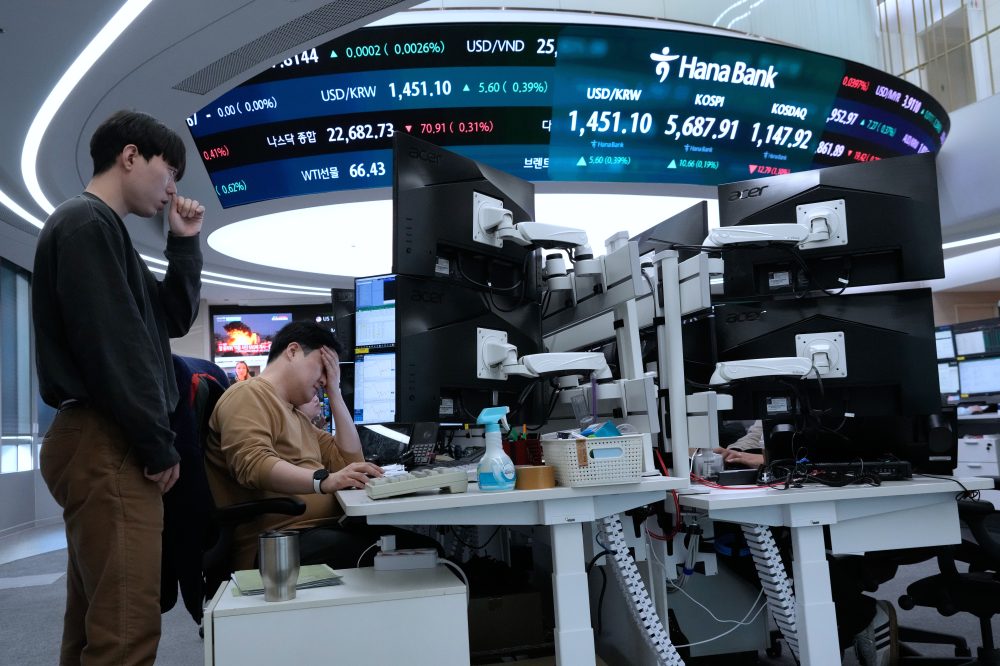
Japan’s Nikkei 225 dropped 1.2% to close at 56,797.22, with banking and financial sector stocks tumbling due to concerns about weakening private lending firms that have extended credit to businesses vulnerable to AI disruption.
Major financial players like Mitsubishi UFJ Financial Group felt the pressure, with its stock falling 2.6% in Tokyo trading after its partner Blue Owl Capital declined 5.9% on Thursday. MUFJ maintains a business relationship with the private-credit firm.
Toyota Motor Corp. experienced a 3.9% decline while Sony shares dropped 3.3%.
Hong Kong’s Hang Seng index decreased 0.6% to 26,544.62 as trading resumed after Lunar New Year celebrations. Chinese mainland and Taiwan exchanges remain shuttered until next week.
However, South Korea’s Kospi surged 2.2% to 5,803.40, driven by defense industry stocks including Hanwha Aerospace, which jumped 8.6%. The company represents many firms capitalizing on increased global military expenditures.
Regional performance varied elsewhere, with Australia’s S&P/ASX 200 slipping 0.1% to 9,075.70.
India’s Sensex gained 0.2%, while Bangkok’s SET declined 0.7%.
Thursday’s U.S. trading saw the S&P 500 fall 0.3% to 6,861.89. The Dow Jones Industrial Average retreated 0.5% to 49,395.16, and the Nasdaq composite decreased 0.3% to 22,682.73.
Booking Holdings suffered a significant 6.1% decline despite reporting quarterly earnings that slightly exceeded analyst projections. The parent company of Booking.com, Priceline and OpenTable faces mounting pressure from AI-powered competitors threatening to disrupt the travel industry and capture market share. The stock has already lost approximately 25% of its value this year.
Carvana plummeted 7.9% even after the online car retailer posted quarterly profits above analyst expectations.
Walmart’s stock experienced volatility, initially climbing 2.7% before reversing to a 1.4% loss. While the retail giant exceeded quarterly expectations, its annual profit outlook disappointed investors.
Energy sector stocks provided some of the S&P 500’s strongest gains, rising alongside crude oil prices. Benchmark U.S. crude increased 1.9% to $66.43 per barrel, while Brent crude added 1.9% to reach $71.66.
Early Friday trading showed U.S. benchmark crude up 29 cents at $66.69 per barrel. International standard Brent gained 30 cents to $71.96 per barrel.
Occidental Petroleum soared 9.4% after delivering quarterly profits that surpassed analyst forecasts.
Rising energy costs may influence Federal Reserve interest rate decisions. Fed officials indicated at their recent meeting they want to observe further inflation declines before supporting additional rate reductions this year.
Conversely, data showing fewer Americans filing for unemployment benefits suggests the pace of job cuts may be slowing.
Additional economic indicators revealed accelerating manufacturing growth in the mid-Atlantic region, though the U.S. trade deficit expanded in December beyond economist predictions.
Currency markets saw the dollar strengthen to 155.24 Japanese yen from 154.99 yen. The euro weakened to $1.1752 from $1.1775.
Precious metals gained ground with gold prices rising 0.5% and silver advancing 0.8%.
WASHINGTON – The nation’s economic expansion probably decelerated to a more moderate but still healthy rate during the final three months of last year, as the prolonged government shutdown and cooling consumer purchases weighed on overall activity, according to economic forecasts.
This anticipated deceleration in the country’s gross domestic product would mark a shift after two consecutive quarters of strong economic performance. The Commerce Department plans to release its preliminary fourth-quarter GDP figures on Friday, with the report delayed due to the unprecedented 43-day federal government closure.
The upcoming data is projected to reveal a complex economic landscape featuring what analysts describe as a “K-shaped” recovery, where wealthy Americans continue to prosper while middle and lower-income families face financial strain from elevated prices linked to import duties and stagnant wages. These circumstances have sparked what economic experts and critics of President Donald Trump’s policies describe as a cost-of-living emergency.
“We’ll end the year still on a solid note in terms of growth, but it doesn’t really translate to feel as good as it looks on paper to most Americans,” said Diane Swonk, chief economist at consulting firm KPMG.
Economic analysts surveyed by Reuters anticipate GDP expanded at a 3.0% annual rate during the October-December period, marking a decline from the 4.4% growth recorded in the third quarter. However, this forecast was prepared before Thursday’s trade data revealed the trade gap had widened to its largest level in five months during December.
The worsening trade balance for the second month running prompted the Atlanta Federal Reserve to lower its GDP projection to 3.0% from its earlier 3.6% estimate.
The nonpartisan Congressional Budget Office calculated that the government shutdown would reduce fourth-quarter GDP by 1.5 percentage points through diminished federal services, reduced government purchases, and temporary cuts to food assistance benefits.
While the CBO projected most economic losses would eventually be recouped, between $7 billion and $14 billion in activity would be permanently lost. Economic researchers estimate the economy grew 2.2% for all of 2025 following 2.8% expansion in 2024. Employment gains totaled just 181,000 last year, representing the smallest increase outside the pandemic era since the 2009 recession and a sharp drop from 1.459 million new jobs in 2024.
“You have a confluence of shocks affecting the U.S. economy,” said Gregory Daco, chief economist at EY-Parthenon. “You have on the one hand the drag from higher prices, tariffs, trade restrictions and reduced immigration, but also the boost from AI investment and the continued strong momentum in terms of stock prices supporting ongoing spending by the more affluent consumers.”
Consumer spending growth is forecast to have moderated from the third quarter’s robust 3.5% rate. Economists note that purchasing activity has been primarily fueled by upper-income families and has come at the cost of savings as inflation has diminished purchasing power.
“Getting richer is one thing, but most households rely on incomes to pay bills, and real disposable income pretty much stalled in the quarter,” said Sal Guatieri, a senior economist at BMO Capital Markets.
Household spending may receive support from what economists expect will be larger tax refunds this year due to tax reductions. Business investment is anticipated to maintain a steady pace, driven largely by artificial intelligence initiatives. The surge in December imports was partially attributed to capital equipment purchases, including computer components and telecommunications gear amid a data center construction surge to support AI operations.
This investment activity should counterbalance any negative impact on GDP from trade flows.
Economists calculate that AI-related activities, encompassing data centers, semiconductors, software development, and research, contributed one-third of GDP growth during the first nine months of 2025, helping to cushion the economic impact of tariffs and immigration restrictions.
“It’s a significant contribution from a sector that traditionally has represented a small share of the economy,” said EY-Parthenon’s Daco. “It’s also been a key source of volatility in the trade data, because a lot of what we are building here and creating is imported.”
Economic analysts estimate that international trade provided minimal contribution to GDP after supporting growth for two consecutive quarters. Business inventories remained unpredictable, having reduced GDP for two straight quarters.
Housing investment is expected to have declined for the fourth consecutive quarter as construction companies and potential buyers grappled with elevated financing costs.
The delayed economic report will likely have minimal influence on Federal Reserve policy decisions. However, central bank officials will closely monitor December’s Personal Consumption Expenditures inflation figures, scheduled for release alongside the GDP data.
Economists surveyed by Reuters predict core PCE inflation, which excludes volatile food and energy prices, increased 0.3% monthly. Core PCE inflation advanced 0.2% in November compared to the previous month. Annual core PCE inflation was projected to reach 2.9% after climbing 2.8% in November. The Federal Reserve maintains a 2% inflation objective.
“The year-on-year growth rate of the core has shown essentially no progress since mid-2024,” said Lou Crandall, chief economist at Wrightson ICAP. “Many Fed officials anticipate at least some improvement in the coming months, but they will want to see that show up in the actual numbers.”
European Central Bank President Christine Lagarde has firmly dismissed speculation about an early departure from her position, stating in a Wall Street Journal interview Thursday that she plans to serve her complete term.
The ECB chief’s remarks directly counter reports suggesting she might step down prematurely. “When I look back at all these years, I think that we have accomplished a lot, that I have accomplished a lot,” she said, adding, “We need to consolidate and make sure that this is really solid and reliable. So my baseline is that it will take until the end of my term.”
The clarification follows a Financial Times report Wednesday claiming Lagarde was considering an early exit before France’s upcoming presidential election, potentially allowing departing French President Emmanuel Macron to influence the selection of her replacement.
Following the speculation, Lagarde privately contacted her fellow policymakers Wednesday evening to reaffirm her commitment to leading Europe’s premier financial institution, according to Reuters sources. She assured them they would receive any resignation news directly from her, not through media reports.
In her interview with the Journal, Lagarde described her core responsibilities as maintaining price and financial stability, along with “protecting the euro, making sure that it is solid and strong and fit for the future of Europe.”
Regarding her post-ECB plans, Lagarde mentioned the World Economic Forum as “one of the many options” she’s exploring for her eventual departure from the central bank.
Switzerland-based pharmaceutical giant Novartis announced Friday its decision to divest its majority ownership in its Indian subsidiary through a transaction valued at $159 million.
The company will sell its 70.68% controlling interest in the publicly-traded Indian operation for 14.46 billion rupees to an investment group comprising WaveRise Investments, ChrysCapital and Two Infinity Partners.
According to regulatory requirements, the purchasing consortium has extended an additional offer to acquire a 26% stake from public shareholders of Novartis India, as mandated by takeover rules when acquiring more than 25% of a company’s shares.
Exchange documents reveal the consortium is offering public shareholders 860.64 rupees for each share, which represents a 3.6% increase above Thursday’s closing market price.
President Donald Trump disclosed Thursday that he recently held a meeting with Vas Narasimhan, the top executive of Swiss pharmaceutical giant Novartis, at the White House on Wednesday.
Speaking to employees at a steel manufacturing facility in Rome, Georgia, Trump revealed that Narasimhan informed him the company is constructing 11 manufacturing facilities across the United States, crediting the president’s tariff strategies for spurring this investment.
In response to inquiries, a Novartis representative provided a statement to Reuters saying, “We appreciate the opportunity to update the U.S. government on our progress, including recent groundbreakings for manufacturing and research facilities in North Carolina and California and plans to expand our radioligand therapy manufacturing network with a new site in Florida.”
However, the company’s official response did not confirm specific numbers regarding how many facilities are planned for construction on American soil.
Previously, the Swiss pharmaceutical company announced intentions to invest $23 billion in constructing and expanding 10 facilities throughout the United States following the Trump administration’s warnings about potential import tariffs on pharmaceutical products.
Employees at Volkswagen’s Tennessee manufacturing facility have overwhelmingly endorsed their inaugural United Auto Workers contract, with Thursday’s vote showing 96% approval for the labor agreement.
The decisive vote represents a major triumph for UAW President Shawn Fain, who has prioritized expanding union presence throughout Southern states since taking office in 2023. Historically, the region has presented significant challenges for labor organization efforts.
The four-year contract delivers substantial benefits to workers, including 20% salary increases alongside enhanced healthcare coverage and strengthened job security provisions.
“Volkswagen workers have moved yet another mountain,” Fain declared in his official response to the vote.
This organizing success builds on the union’s momentum from their 2023 Detroit victories, which followed a six-week work stoppage at Ford Motor, General Motors and Stellantis that secured 25% wage hikes and cost-of-living protections.
Contract discussions between the union and company spanned approximately 18 months before reaching a preliminary agreement earlier this month. The negotiations covered operations at the German manufacturer’s only U.S. production facility, where the electric ID.4 SUV is assembled.
“This milestone reflects our shared commitment to competitive wages, strong benefits, and the long‑term success of our employees and operations,” Volkswagen stated in their official announcement.
The Chattanooga plant workforce previously voted 73% in favor of UAW representation in April 2024, marking a breakthrough after narrow defeats in similar votes during 2014 and 2019.
However, union expansion efforts in Southern states have faced setbacks since losing a representation vote at a Mercedes facility in Alabama last year.
The world’s largest automaker is making a surprising leadership change as Toyota announces CEO Koji Sato will step down after just three years in the top position, one of the shortest tenures in company history.
Sato, who took over as chief executive in 2023, was initially viewed as the perfect leader to accelerate Toyota’s electric vehicle development. However, Chief Financial Officer Kenta Kon will assume the CEO role in April, while Sato transitions to vice chairman and chief industry officer.
Despite achieving record-breaking sales and profits during his leadership, three sources familiar with the situation indicate that Chairman Akio Toyoda believes his chosen successor no longer fits the company’s current needs amid rising cost challenges.
The leadership transition comes as Toyota faces increased financial pressure from U.S. tariffs and the need for substantial technology investments. Company insiders noted that Sato had been notably absent from several major events that Toyoda attended in recent months, sparking internal speculation about his future.
However, Toyota maintains that Toyoda played no role in the personnel decision. Senior analyst Seiji Sugiura from Tokai Tokyo Intelligence Laboratory offered a different perspective: “Toyota keeps emphasising, over and over, that Akio Toyoda wasn’t involved in the personnel decision. Mr. Sato also says the same thing very carefully – which means he probably was involved.”
The company stated that an executive appointment committee had been considering succession plans since last year, with discussions intensifying when Sato’s appointment to lead Japan’s automotive industry association was confirmed in late 2025.
Kon brings extensive experience as Toyoda’s former secretary for eight years and is recognized for developing a proposed acquisition of forklift manufacturer Toyota Industries. This deal would strengthen the Toyoda family’s control over a crucial supplier, though minority shareholders have criticized it as lacking transparency and being undervalued.
The leadership change reflects Toyota’s growing emphasis on cost management, particularly its “break-even” metric – the minimum vehicle sales needed to cover operational expenses. The company has pledged to absorb additional costs affecting its suppliers, adding financial strain since new tariffs took effect in April.
“Over the past year or so, they’ve been talking a lot about needing to lower the break‑even point,” Sugiura explained, suggesting more aggressive cost-reduction measures under Kon’s leadership.
During the leadership announcement, Kon emphasized that Toyota must remain “vigilant” to survive challenging external conditions. The incoming CEO currently serves dual roles as CFO for both Toyota and its technology division, Woven by Toyota, where Chairman Toyoda’s son Daisuke holds a senior executive position.
Toyota expects to invest 360 billion yen ($2.3 billion) this fiscal year supporting suppliers, viewing this expenditure as competitive investment rather than merely operational costs. The automaker recently increased its annual profit forecast by 12%, aided by cost-reduction efforts and its successful focus on hybrid vehicles while other manufacturers struggled with pure electric vehicle strategies.
The management transition occurs as Toyota executives express concern about falling behind competitors in software development, even as electric vehicle demand has cooled globally, making EVs a less immediate competitive threat.
Electric vehicle giant Tesla has slashed the cost of its top-tier Cybertruck variant by $15,000, according to updated pricing displayed on the company’s official website Thursday.
The Cyberbeast model, which represents Tesla’s premium pickup truck offering, now carries a price tag of $99,990 — down from its previous $114,990 sticker price. The significant markdown appears to coincide with Tesla’s decision to eliminate its “Luxe Package” option for the vehicle.
That premium package, which Tesla had introduced to its product lineup last August alongside a price increase, featured Supervised Full Self-Driving capabilities and complimentary access to the company’s Supercharger network. The automaker appears to be phasing out this bundled option entirely.
Other variants in the Cybertruck lineup remain at their current pricing levels without any adjustments.
This pricing move follows Tesla’s recent introduction of a new all-wheel drive configuration for its popular Model Y SUV earlier this month. That variant is positioned at $41,990, placing it above the more affordable rear-wheel drive “Standard” option.
Industry analysts suggest these pricing adjustments align with Tesla’s broader 2026 business approach, which focuses on making vehicles more accessible to budget-minded consumers by reducing entry-level prices rather than waiting to launch an entirely new affordable model.
Cassava Sciences announced Thursday that federal investigators have wrapped up their examination of the company following accusations of research misconduct related to its experimental Alzheimer’s treatment, simufilam.
The biotechnology firm revealed that the Department of Justice concluded its investigation four months following the dismissal of criminal charges in Maryland against Hoau-Yan Wang, a medical professor and former company consultant. Wang had been accused of providing fraudulent data concerning the Alzheimer’s drug.
The closure of the federal investigation marks the end of scrutiny that had surrounded the company’s research practices and the development of its potential Alzheimer’s therapy.
Financial markets across Asia experienced declines Friday as tensions in the Middle East and concerns about private equity investments created uncertainty among traders worldwide.
Markets in Japan saw the Nikkei index fall by 1%, while Hong Kong’s Hang Seng declined 0.3% as trading resumed following the Lunar New Year holiday break.
Oil prices surged to their highest levels in six and a half months, with Brent crude futures climbing above $72 per barrel. The increase came after President Donald Trump issued an ultimatum to Iran, giving the country between 10 and 15 days to reach an agreement on its nuclear program or face consequences he described as “really bad things.”
The escalating Middle East situation coincided with significant losses in private equity stocks on Wall Street. Blue Owl, a private equity manager, triggered sector-wide concerns after selling assets and permanently halting quarterly withdrawals from one of its investment funds. Blue Owl’s stock price dropped approximately 6%, while larger competitors Apollo Global Management and Blackstone each fell more than 5%.
According to Kenji Abe, chief strategist at Daiwa Securities in Tokyo, these developments pushed investors toward safer investments as they also prepare for next week’s earnings announcement from Nvidia, currently the world’s most valuable company.
Reports emerged Thursday that the chip manufacturer is close to completing a $30 billion investment in OpenAI, which would replace a previous $100 billion long-term agreement between the two companies, according to Financial Times sources.
Retail giant Walmart saw its shares decline 1.4% after newly appointed CEO John Furner expressed cautious views about American consumer spending patterns.
Economic data revealed that the U.S. trade deficit expanded significantly in December, with the goods deficit reaching record levels in 2025, indicating that Trump’s tariff policies have shown limited effectiveness so far.
Currency markets saw the dollar on track for its strongest weekly performance in four months, supported by marginally positive U.S. economic indicators and Federal Reserve meeting notes suggesting officials are in no rush to reduce interest rates.
The dollar gained approximately 0.9% against the euro this week, pushing the European currency down to $1.1762. Meanwhile, the Japanese yen weakened after inflation data showed core prices rising at just 2% in January, the slowest rate in two years, potentially complicating the Bank of Japan’s plans for interest rate increases.
Against the yen, the dollar climbed 1.6% for the week to reach 155.2 yen.
Australia’s currency maintained stability at $0.7047 due to favorable yield differences, while New Zealand’s dollar struggled amid reduced expectations for early rate hikes, heading toward its largest weekly decline of 2026.
U.S. Treasury bonds remained relatively unchanged, with 10-year yields holding at 4.06%. However, disagreement among Federal Reserve officials about the timing and pace of potential rate cuts pushed two-year yields up five basis points to 3.46% over the week.
Brent Donnelly, President of Spectra Markets, advised caution given the current environment. “There does not seem to be much point in adding risk ahead of this weekend’s uncertainty surrounding the Middle East,” Donnelly stated.
“Today feels like a good day to stay out of trouble,” he added.
The U.S. dollar is on track for its most impressive weekly gains in four months, powered by encouraging economic reports, shifting Federal Reserve policy signals, and escalating geopolitical tensions with Iran that have investors seeking stability.
Fresh unemployment data released Thursday evening showed fewer Americans applied for jobless benefits than economists predicted, reinforcing signs of a resilient employment market and giving the greenback additional momentum.
The currency maintained its strength during early Friday trading in Asian markets, pushing the British pound down to a one-month low of $1.3457, marking a weekly decline of nearly 1.5%. The euro also struggled, dropping slightly to $1.1768 and facing a 0.8% weekly loss, with additional pressure from uncertainty surrounding European Central Bank leadership under Christine Lagarde.
Measured against a collection of major currencies, the dollar remained close to Thursday’s one-month high at 97.89, positioning itself for a weekly increase exceeding 1% – its strongest showing in over four months.
Commonwealth Bank of Australia strategist Joseph Capurso expressed confidence in the dollar’s continued rise, stating: “It wouldn’t surprise me if the U.S. dollar keeps lifting for a while longer.” He pointed to this week’s Federal Reserve meeting minutes, which revealed several policymakers’ willingness to raise interest rates if inflation remains persistent.
Growing concerns about potential U.S.-Iran military conflict have also boosted the dollar’s appeal as a safe investment this week.
President Donald Trump issued a stern warning to Iran Thursday, demanding the country negotiate on its nuclear program or face consequences, saying “really bad things” will happen. Trump established a 10 to 15-day timeline, prompting Tehran to threaten retaliation against American military installations in the region if attacked.
“That could really affect oil markets and currency markets if things go bad there. It’ll be a test also about whether or not the U.S. dollar is still a safe haven,” Capurso explained. “A major attack would call that into question.”
Market attention now shifts to upcoming releases of the U.S. core PCE price index and preliminary fourth-quarter GDP numbers, which could significantly influence currency movements.
Current investor expectations still anticipate approximately two Federal Reserve rate reductions this year, though the likelihood of a June cut has decreased to about 58% from 62% the previous week, based on CME FedWatch tool data.
Chris Zaccarelli, chief investment officer for Northlight Asset Management, outlined the central bank’s dilemma: “The big argument within the Fed is whether or not to proactively lower rates to support the job market, or to keep rates higher for longer in order to fight inflation.” He noted that Friday’s PCE report will “add to the debate.”
The Australian dollar declined 0.08% to $0.7055 but is positioned for only a 0.2% weekly loss, supported by expectations of tighter monetary policy domestically.
New Zealand’s currency faced greater challenges, heading toward a 1.2% weekly decline following dovish signals from the Reserve Bank of New Zealand. Investors betting on stricter policy were caught off guard after a series of rate cuts over recent months. The kiwi traded 0.12% lower at $0.5967.
In Japan, the yen weakened 0.05% to 155.08 against the dollar, erasing earlier session gains after Friday data showed the country’s annual core consumer inflation reached 2.0% in January, the slowest rate in two years.
Abhijit Surya, senior APAC economist at Capital Economics, analyzed the implications: “Today’s data won’t exactly instil a sense of urgency in the (Bank of Japan) to resume its tightening cycle, especially given the lacklustre rebound in activity last quarter.” However, he added: “If we’re right that the recent slump won’t prove enduring, while wage growth picks up and underlying price pressures remain relatively firm, there is still a strong case for the bank to hike rates again in June.”
Energy giant Santos announced Friday it has reached a 10-year deal with South Australia’s government to deliver natural gas that will help convert the Whyalla Steelworks into an environmentally sustainable iron production plant.
Beginning in 2030, the Australian company will provide 20 petajoules of natural gas each year sourced from its Cooper Basin operations. This commitment equals approximately one-third of Santos’ existing gas output from that region.
According to Santos Managing Director and Chief Executive Kevin Gallagher, the natural gas will power new technology at the facility. “Santos gas will be used to enable Whyalla to deploy direct reduced iron technology that can process local magnetite ore to produce low-carbon iron,” Gallagher explained.
The executive emphasized the environmental and economic benefits of the partnership. “This will keep jobs in Whyalla and the Cooper Basin, and reduce emissions by approximately 50% compared to the former coal-fired blast furnace operations,” he stated.
The gas supply announcement comes just days after Santos revealed plans to cut its workforce by 10% as part of its annual financial results released Wednesday.
Energy markets jumped Friday amid escalating tensions between the United States and Iran, after President Trump issued an ultimatum giving Tehran just 10 to 15 days to reach a nuclear agreement.
Crude oil futures climbed during trading, with Brent crude increasing 21 cents to reach $71.87 per barrel, while West Texas Intermediate gained 23 cents to hit $66.66. These prices marked six-month peaks following Trump’s warning Thursday.
The President warned that “really bad things” would occur if Iran fails to negotiate regarding its nuclear program, which Tehran claims serves peaceful purposes but Washington suspects has military applications.
Adding to regional tensions, Iran has scheduled joint naval operations with Russia, according to local media reports. This announcement comes just days after Iran temporarily shut down the Strait of Hormuz for military exercises.
The strategic waterway sits between Iran and the oil-rich Arabian Peninsula, serving as a critical passage for approximately 20 percent of worldwide petroleum supplies. Any military conflict in this region could severely restrict global oil availability and drive energy costs higher.
Additional factors boosting petroleum prices include declining crude stockpiles and reduced exports from major oil-producing nations worldwide.
Thursday’s Energy Information Administration data revealed U.S. crude reserves decreased by 9 million barrels, as refinery operations and export activity increased.
Saudi Arabia, the globe’s top oil exporter, saw shipments drop to 6.988 million barrels daily in December – the lowest level since September, according to Joint Organizations Data Initiative figures.
Meanwhile, Japan’s core inflation rate slowed to 2.0 percent annually in January, marking the weakest pace in two years and potentially affecting central bank interest rate policies.
Lower interest rates in oil-importing nations like Japan typically provide support for crude oil pricing.
A new trade agreement between the United States and Indonesia was signed on Thursday, creating opportunities for reduced tariffs and expanded agricultural commerce between the two nations.
The bilateral agreement focuses on lowering trade barriers on products from both countries while encouraging increased agricultural purchases. The deal represents a step forward in strengthening economic ties between the U.S. and the Southeast Asian nation.
Japan’s central banking officials face a challenging decision after new data revealed the country’s core inflation dropped to its lowest point in two years during January, exactly meeting the Bank of Japan’s 2% target.
The inflation slowdown creates uncertainty around when Japanese monetary authorities will implement their next interest rate increase, as weakening price pressures suggest the economy may not be ready for higher borrowing costs.
However, a different measurement that economists consider more reliable for tracking underlying price trends remained significantly above the 2% benchmark, indicating that strong wage growth could still push the central bank toward raising rates from their current low levels.
These latest figures contribute to conflicting economic signals, as Japan’s economy showed minimal growth during the fourth quarter of last year, while exports surged and manufacturing sentiment improved in recent months.
“With price pressures showing signs of softening, the Bank of Japan won’t be in a rush to resume its hiking cycle. However, we still believe conditions will be in place for the Bank to raise rates by the middle of the year,” said Abhijit Surya, senior APAC economist at Capital Economics.
The core consumer price index, which removes volatile fresh food costs from calculations, aligned with market predictions and represented a decrease from December’s 2.4% increase.
Government fuel subsidies, eliminated gasoline tax surcharges, and the lingering effects of last year’s food price surge primarily drove the inflation decline, according to the data.
Bank of Japan officials have acknowledged that temporary factors will likely push core inflation temporarily below their target, but emphasized their focus remains on achieving sustainable, wage-driven price increases of approximately 2% before implementing additional rate hikes.
A separate inflation measure excluding both fresh food and fuel costs, which the central bank monitors closely as a superior gauge of demand-driven price changes, remained well above target at 2.6% year-over-year in January.
This figure declined from December’s 2.9% increase and matched a low reached in February 2025, as food price increases began to stabilize.
Services inflation held steady at 1.4%, with private services price increases moderating to 1.9% from 2%, suggesting businesses have been hesitant to pass rising labor costs onto consumers.
Overall inflation decelerated to 1.5% in January from December’s 2.1%, dropping below the Bank of Japan’s 2% target for the first time in nearly four years and creating communication difficulties for the central bank’s rate increase strategy.
The Japanese yen initially weakened following the data release, then recovered to trade at 155.10 per dollar on Friday.
Japan’s central bank concluded a decade of massive economic stimulus in 2024 and implemented several rate increases, including one in December, based on their assessment that the country was making consistent progress toward sustainably achieving the 2% inflation goal.
Economic analysts anticipate core inflation will remain below 2% in upcoming months due to government fuel subsidies, which may counteract upward pressure from increased import costs caused by the weakened yen.
These competing inflation influences could affect the timing of the Bank of Japan’s next rate adjustment. Most economists surveyed by Reuters predict the central bank will increase its key interest rate to 1% from the current 0.75% by the end of June. Financial markets have assigned roughly a 70% probability to a rate hike by April.
Prime Minister Sanae Takaichi, known for supporting accommodative monetary policy, expressed hope Wednesday that the Bank of Japan would collaborate with government initiatives to achieve lasting 2% inflation alongside wage increases, though she stopped short of explicitly requesting continued low rates.
The leader of Japan’s banking association stated Thursday he saw a “reasonable possibility” of a rate increase as soon as March or April, marking an unusual direct comment on potential central bank actions.
Toru Suehiro, chief economist at Daiwa Securities, suggested the Bank of Japan may reduce its inflation projections in April as weak-yen pressures have diminished since their January forecasts.
“The hurdle for additional rate hikes is high. I see the chance of a rate hike in March or April as low,” he said.
Computer chip manufacturer Nvidia is reportedly on the verge of completing a $30 billion investment in OpenAI, the company behind ChatGPT, according to a Financial Times report released Thursday.
The investment would take the place of a larger $100 billion partnership that the two technology companies had previously announced but never completed, sources told the Financial Times.
According to the report, the agreement could be wrapped up as soon as this weekend and would be part of OpenAI’s latest effort to secure additional funding.
When contacted for comment, Nvidia representatives declined to provide a statement about the reported deal.
Earlier reports from January indicated that OpenAI was seeking to raise as much as $100 billion in fresh funding, which would put the artificial intelligence company’s value at approximately $830 billion.
The Financial Times report suggests that while OpenAI plans to use a significant portion of its new funding to purchase Nvidia’s computer hardware, the companies have decided not to move forward with the multi-year $100 billion investment agreement they had announced in September.
Independent oil refineries are mounting opposition to modified legislative proposals that would enable continuous, nationwide distribution of E15 ethanol fuel throughout all seasons. This resistance from smaller industry players, including companies such as Delek US and Monroe Energy owned by Delta Air Lines, creates challenges for congressional representatives from agricultural regions who have been advocating for the expanded ethanol program. The pushback highlights ongoing tensions within the petroleum industry regarding biofuel requirements and market regulations.
Shares of Mexican restaurant chain Guzman y Gomez tumbled to their lowest point ever on Friday, falling 16% despite the company posting first-half earnings that exceeded Wall Street expectations.
The fast-casual dining company went public on Australia’s stock exchange in June 2024 in what became the country’s largest public offering in three years. The initial public offering brought in A$335.1 million (equivalent to $236.45 million) and valued the business at A$2.2 billion, making it the third-largest IPO in Australia over a five-year period.
Investors have grown increasingly skeptical of the chain’s aggressive U.S. expansion strategy as American consumers pull back on dining spending due to rising prices and economic uncertainty. The company has become a bellwether for how Australia’s fast-food industry is performing overall.
During early Friday trading, GYG stock dropped as low as A$17.00 per share. This represents a decline of roughly 23% from its original IPO pricing of A$22 and sits 63% below the peak price of A$45.99 it reached twelve months ago.
Analysts at Citi observed that while “the company is executing well,” the pace “is not as fast as the market is expecting.”
They added: “It’s hard to see what’s new in this result that would make investors chase the stock higher, especially given the valuation.”
The company’s American operations saw network sales surge 67% to reach A$8.2 million during the first six months, though this figure fell short of analyst projections of A$9.2 million from Visible Alpha. Bad weather conditions around Chicago during the December quarter also negatively impacted comparable store sales performance.
Looking ahead, GYG anticipates that losses from its U.S. operations will grow modestly through June, building on the A$13.2 million deficit recorded in fiscal 2025. The company also warned of potential near-term sales challenges as it transitions from its DoorDash delivery partnership to working with Uber Eats instead.
In Australia, which remains the company’s primary revenue source, first-half network sales climbed to A$673.6 million ($475.29 million), representing a 17.5% increase from the previous year. Management projects full-year profit margins could reach 6.2%, up from 5.7% in the prior year.
For the six-month period ending December 31, the restaurant operator posted net profit after taxes of A$10.6 million. This beat analyst consensus estimates of A$9.2 million and improved upon last year’s A$7.3 million result.
Overall group network sales rose 18% to A$681.8 million, though this missed the Visible Alpha consensus forecast of A$687.3 million.
The company announced an interim dividend payment of 7.4 Australian cents per share.
Delaware State University’s College of Business recently wrapped up its fourth annual Black Male Initiative Conference, continuing a tradition aimed at supporting and empowering Black male students in their academic and professional journeys.
The conference represents an ongoing effort by the Dover-based university to address educational and career development needs within the Black male student population, particularly in business-related fields.
This marks the fourth consecutive year that DSU’s business college has organized this specialized conference, demonstrating the institution’s sustained commitment to diversity and inclusion initiatives.
The Black Male Initiative Conference serves as a platform for networking, mentorship, and professional development opportunities specifically tailored to Black male students pursuing business education at the historically black university.
Citigroup announced Thursday that it has named Chad Reddy to serve as market executive for the western region of its Private Bank North America division.
Reddy brings extensive experience in wealth management, having spent a quarter-century in the industry. His most recent position was as managing director and market leader at Bank of America Private Bank, where he worked for over 15 years.
Prior to his tenure at Bank of America, Reddy held executive positions at Wells Fargo Private Bank.
In his new role, Reddy will work under Chris Biotti, who leads Citi Private Bank North America.
The appointment represents part of Citigroup’s ongoing efforts to strengthen its private banking presence across North America.
International banking giant HSBC has eliminated jobs within its United States debt capital markets division, according to a Bloomberg News report published Thursday.
The layoffs affected roughly one-tenth of the team’s workforce, with a minimum of six employees losing their positions at the New York office on Thursday, sources with knowledge of the situation told Bloomberg.
These job cuts represent part of HSBC’s broader effort to reduce expenses following the bank’s announcement last October that it would restructure this particular business unit.
When contacted for verification, Reuters was unable to independently confirm the Bloomberg report’s details.
HSBC has not yet provided a response to requests for comment regarding the reported layoffs.
The globe’s biggest gold mining corporation exceeded financial analysts’ expectations for fourth-quarter earnings on Thursday, as historic gold price surges compensated for decreased output levels. The company also announced a $1.4 billion investment plan for developing properties obtained from its Newcrest acquisition.
Following the earnings announcement, Newmont’s stock price climbed 2% to $127.96 during after-hours trading sessions.
The precious metal has reached numerous all-time highs in recent months, fueled by anticipated Federal Reserve interest rate reductions, increased global political tensions, and widespread economic instability.
During the final quarter of 2025, gold averaged $4,135 per ounce, representing a 56% increase compared to the same period the previous year.
The mining company reported an average selling price of $4,216 per ounce, marking nearly a 60% year-over-year improvement, though production decreased by almost 24% to 1.45 million ounces.
According to Newmont, output declined due to scheduled mining operations at several locations including Peñasquito, Ahafo South, Yanacocha, Brucejack and Cadia facilities.
The mining giant will allocate $1.4 billion toward advancing immediate development initiatives, encompassing the Cadia Panel Caves project, Tanami Expansion 2, and feasibility research for Red Chris.
These Australian projects and the Canadian Red Chris operation became part of Newmont’s portfolio through its $17 billion Newcrest purchase completed in 2023.
Additionally, the company intends to invest approximately $1.95 billion in maintenance capital expenditures, including essential tailings infrastructure improvements at Cadia and Boddington sites to prolong operational lifespans across its mining portfolio.
When asked about operational improvements, CEO Natascha Viljoen stated: “The focus on operational improvement is high on our agenda and we have teams on the ground continuously supporting at Nevada Gold Mines.”
The mining company also projected reduced 2026 gold output at 5.3 million ounces, down from the previous year’s production of 5.89 million ounces.
Newmont delivered adjusted earnings of $2.52 per share, significantly outperforming the $2.00 average analyst projection compiled by LSEG data.
America’s trade imbalance with other nations decreased slightly in 2025, according to new federal data released Thursday, even as President Donald Trump imposed significant tariffs on imports from most countries around the world. The Commerce Department announced that the difference between what the United States exports versus what it imports dropped to approximately $901 billion from $904 billion the previous year.
In positive employment news, fewer Americans applied for unemployment benefits last week, with jobless claims continuing at historically low numbers. Weekly unemployment applications for the period ending February 14 decreased by 23,000 to reach 206,000, the Labor Department announced Thursday. This figure came in well below economist predictions of 225,000 new claims. Meanwhile, the total count of Americans receiving ongoing unemployment benefits rose to 1.87 million for the week ending February 7, representing an increase of 17,000 from the prior week.
Homebuyers received welcome news as the typical 30-year mortgage rate dropped to 6.01% this week, marking the lowest point in over three years, according to mortgage purchaser Freddie Mac. The rate declined from 6.09% the previous week and compares favorably to 6.85% from one year ago. This represents the most affordable mortgage rates since September 8, 2022, when rates stood at 5.89%.
Retail giant Walmart reported strong quarterly performance Thursday, crediting low prices and fast delivery options for attracting customers across income levels during the holiday shopping season. However, the Bentonville, Arkansas-based retailer expressed caution about future conditions, citing concerns about consumer confidence, employment stability, and student loan payment difficulties.
The federal Equal Employment Opportunity Commission filed a discrimination lawsuit against a regional Coca-Cola bottling company, claiming the business violated male employees’ rights by hosting a women-only networking event. The legal action stems from a complaint by a male worker at Coca-Cola Beverages Northeast regarding a two-day business trip to Mohegan Sun Casino in Connecticut during September 2024 that included approximately 250 female employees.
Meta CEO Mark Zuckerberg faced questioning in a Los Angeles courtroom Wednesday regarding Instagram’s impact on young users. The case involves a 20-year-old plaintiff seeking to hold social media platforms accountable for potential harm to children who use their services. Meta and YouTube remain as defendants after TikTok and Snap reached settlements.
Indian Prime Minister Narendra Modi promoted his country as a global center for artificial intelligence development during a summit in New Delhi Thursday. Modi emphasized India’s goal to “design and develop in India” while serving worldwide needs. The gathering featured international leaders and technology executives, including French President Emmanuel Macron and Google’s Sundar Pichai, with U.N. Secretary-General António Guterres proposing a $3 billion international AI fund.
Indonesian President Prabowo Subianto finalized a mutual trade agreement with President Trump Thursday during a visit to Washington for the inaugural Board of Peace meeting. The deal eliminates most Indonesian tariffs on American products while establishing a 19% U.S. tariff on Indonesian exports. The White House described the agreement as beneficial for both nations’ economic security.
White House economic advisor Kevin Hassett called for consequences against Federal Reserve economists Wednesday following their research showing that American businesses and consumers bear most of the cost from new tariffs. Hassett’s remarks represent the latest tension between the Trump administration and the traditionally independent Federal Reserve, highlighting ongoing concerns about consumer prices for essentials and major purchases.
Facebook’s parent company Meta has trimmed its yearly stock option payouts to the majority of workers by roughly 5%, according to a Financial Times report released Thursday.
The decrease in employee equity compensation comes as CEO Mark Zuckerberg channels billions of company dollars into expanding the tech giant’s artificial intelligence capabilities and infrastructure.
The stock option reduction affects most Meta employees as the social media company shifts its financial priorities toward AI development and related technology investments.
A senior Federal Reserve official expressed optimism Thursday about the current state of the nation’s monetary policy, saying recent interest rate reductions have helped strengthen employment conditions.
Mary Daly, who leads the San Francisco Federal Reserve, indicated during a Thursday discussion that the central bank’s strategy appears to be working effectively. She noted that job market conditions have improved following last year’s rate reductions, while inflation is anticipated to continue moving downward as tariff effects fade.
“Our price stability and full employment both seem to be in a good place; policy is in a good place,” Daly stated during her streamed discussion with Robert Kaplan, who previously headed the Dallas Fed. “And we have the opportunity now to think through what information is coming in, what impact will AI have, how will productivity evolve, how will demand strength evolve and how should we manage policy going forward.”
The comments came as Federal Reserve officials continue monitoring economic indicators to guide future policy decisions.
An Australian healthcare company announced Friday it will divest its majority ownership in its French subsidiary by distributing shares directly to investors.
Ramsay Health Care revealed plans to give shareholders its controlling 52.79% ownership stake in Ramsay Sante, which operates as a separate publicly-traded entity in France. The distribution will complete a full separation between the Australian parent company and its French healthcare division.
The announcement came as part of the company’s strategic restructuring efforts, though specific details about the timeline for the distribution were not immediately provided.
NEW YORK – Stock markets across the United States closed Thursday with slight declines, mirroring losses seen in European markets as ongoing diplomatic tensions between America and Iran contributed to rising oil prices and market uncertainty.
Economic data released Thursday painted a mixed picture, with the nation’s goods trade deficit reaching an all-time high while unemployment claims dropped more than analysts had predicted, offering positive signals about job market strength.
Among major market sectors, technology and financial companies saw the largest declines, while utility and energy stocks posted gains. Defense and aerospace companies outperformed the broader market, contrasting sharply with travel-related businesses including airlines, hotels, restaurants, and cruise operators, which experienced significant drops.
The dollar strengthened against other currencies as economic indicators suggested underlying stability in the American economy. Treasury bond yields showed mixed results as investors evaluated potential Federal Reserve policy changes, coinciding with the government’s sale of $9 billion in 30-year inflation-protected securities.
Gold prices climbed as traders balanced concerns over international conflicts against positive domestic economic news.
Several major developments shaped market sentiment Thursday. European Central Bank President Christine Lagarde reportedly assured colleagues she intends to remain in her position, contradicting earlier speculation about her potential early departure.
President Trump issued warnings to Iran regarding its nuclear program, stating that “bad things” would occur if the country fails to negotiate a deal, apparently setting a 10-day timeframe for action.
In Federal Reserve news, Minneapolis Fed President Neel Kashkari criticized recent comments from White House economic advisor Kevin Hassett, calling Hassett’s suggestion that New York Fed officials should “be disciplined” for tariff research an assault on central bank independence.
Trump also announced the formation of a “Board of Peace” for Gaza reconstruction, revealing that multiple countries have pledged $7 billion toward rebuilding efforts contingent on Hamas disarmament.
Looking ahead, investors will monitor several key economic reports Friday, including personal consumption data, fourth-quarter GDP figures, manufacturing surveys, consumer confidence measures, and new home sales numbers.
NEW YORK – Investment management company Blue Owl Capital issued a clarification Thursday, stating it has not suspended investor access to funds from one of its private debt investment vehicles, following a decline in the firm’s stock price after announcing changes to withdrawal procedures.
The company emphasized in its Thursday statement that it is “not halting investor liquidity in” its non-traded debt fund Blue Owl Capital Corp II. This clarification came one day after Blue Owl announced it would distribute 30% of the fund’s net asset value back to investors while discontinuing its quarterly withdrawal options.
Rather than continuing its previous tender offer system that allowed investors to withdraw up to 5% of their investment capital, Blue Owl explained its revised approach would deliver greater returns. “We are returning six times as much capital and returning it to all shareholders over the next 45 days. In the coming quarters we will continue to pursue this plan to return capital to OBDC II investors,” the company stated.
A Wall Street brokerage firm has completely scrapped its plans to go public on Thursday, becoming the latest casualty of turbulent market conditions that are making it increasingly difficult for companies to launch successful stock offerings.
Clear Street announced it was pulling its registration statement for a U.S. stock market debut, following a week of delays that the company attributed to unfavorable “market conditions.” The firm had already dramatically reduced the amount of money it hoped to raise before making the decision to abandon the effort entirely.
The withdrawal comes as concerns about artificial intelligence disrupting traditional business models have triggered widespread selling across multiple sectors. Financial services companies and technology firms have been particularly hard hit by the recent market downturn.
The challenging environment has forced numerous companies to scale back or delay their public offering plans throughout 2026. Market instability, increased scrutiny of company valuations, and poor performance of recently public companies have all contributed to a weakened pipeline of new stock listings.
Recent examples highlight the difficulties facing companies seeking to go public. Brazilian financial technology company Agibank cut its offering size by more than half last week and is now trading below its initial stock price. Meanwhile, Liftoff Mobile, backed by investment firm Blackstone, postponed its IPO earlier this month before refiling new paperwork on Tuesday, only hours after withdrawing its previous attempt.
These rapid changes in listing strategies demonstrate the uncertainty currently gripping financial markets.
The year began with concerns that excessive enthusiasm for AI technology was creating a stock market bubble. However, artificial intelligence has since become viewed as a disruptive threat, with entire industries experiencing sell-offs following product announcements from AI-focused startups.
Clear Street, established in 2018, initially operated as a prime brokerage service before expanding into additional areas including investment banking services.
Financial documents from the company’s IPO filing showed Clear Street projected its net revenue would grow to between $1.04 billion and $1.06 billion in 2025, up significantly from $463.6 million the previous year.
The decision to abandon its public offering plans highlights the ongoing difficulties companies face when trying to access public markets. These challenges follow setbacks last year when U.S. trade policies and political divisions disrupted what many had hoped would be a recovery in the IPO market.
Technology company Akamai Technologies announced Thursday that it expects 2026 revenues to surpass Wall Street projections, demonstrating strong confidence that its cloud infrastructure business will maintain robust growth momentum.
The Massachusetts-based firm is benefiting from rising demand in both security and computing sectors, as businesses focus on protecting their digital operations and applications while moving to cloud-based systems.
Companies are increasingly implementing multi-cloud approaches to reduce expenses and prevent dependency on single vendors, which has opened new opportunities for Akamai’s specialized edge-computing solutions.
Corporate spending on cybersecurity tools has also risen sharply due to escalating sophisticated cyber attacks and government-backed digital threats, driving higher demand for Akamai’s protective services.
The technology firm projects 2026 revenues will range from $4.40 billion to $4.55 billion, with the middle estimate exceeding the analyst consensus of $4.42 billion compiled by LSEG data.
Chief Executive Officer Tom Leighton noted in a Reuters interview that the company is observing rising memory costs in the current market.
He indicated that Akamai may consider price adjustments to offset these increased expenses, though any such changes would be implemented cautiously.
The widespread expansion of artificial intelligence infrastructure by major technology companies has consumed significant portions of global memory chip inventory, driving up prices as manufacturers focus on higher-profit data center components rather than consumer products.
During the final quarter ending December 31, Akamai recorded $1.10 billion in revenue, exceeding the anticipated $1.08 billion estimate.
The Washington Supreme Court delivered a unanimous ruling Thursday allowing grieving families to pursue legal action against Amazon over the suicide deaths of their loved ones who purchased sodium nitrite through the online marketplace.
The state’s highest court overturned a lower appeals court decision that had blocked the families from suing Amazon for negligence, with that earlier court claiming suicide represented an intervening cause that broke the chain of responsibility.
In the majority opinion, Justice G. Helen Whitener determined that Amazon bears a responsibility to exercise reasonable care toward its customers and must prevent exposing them to “harm from the foreseeable conduct of a third party.”
Whitener stated that a jury should determine whether suicide deaths were a predictable outcome of the Seattle company’s alleged failure to meet this standard of care.
The legal challenge involves 28 families who claim Amazon has been aware for years of sodium nitrite’s connection to suicide deaths but has permitted unrestricted sales of the chemical along with other items that could facilitate self-harm. The plaintiffs refer to these combined products as “suicide kits.”
These families are pursuing damages under Washington state’s product liability statutes following their relatives’ deaths.
Thursday’s ruling specifically addressed appeals from four families whose relatives, ranging in age from 17 to 27, consumed sodium nitrite with purity levels of 98% or 99.6% during 2020 and 2021.
Amazon responded by stating its disagreement with the court’s decision while reaffirming its dedication to customer safety and offering sympathy to families impacted by suicide.
This case represents part of a broader legal trend attempting to hold online marketplaces like Amazon accountable for items sold by independent vendors on their platforms.
“Amazon is one of the world’s biggest companies, and shouldn’t be profiting from products they know people use to harm themselves,” said Carrie Goldberg, an attorney representing the families.
Sodium nitrite serves as a legitimate chemical compound commonly employed as a food preservative in meat and fish products. The substance also has applications in research facilities and as a treatment for cyanide poisoning.
Amazon acknowledged in its response that highly concentrated sodium nitrite “is not intended for direct consumption, and unfortunately, like many products, it can be misused.”
The company has since implemented restrictions prohibiting the sale of sodium nitrite products with concentrations exceeding 10%.
Rehoboth Beach city officials are working to clarify confusion surrounding potential modifications to business licensing fees following recent budget discussions. City representatives emphasize that these proposed adjustments are not intended to address any budget deficit, as the fiscal year 2027 budget is already balanced.
The conversation around modifying business license costs began in 2024 but was temporarily paused while the city developed a comprehensive fee and penalty structure. With that framework now in place, municipal leaders believe this budget cycle is appropriate to revisit these licensing discussions along with other fee considerations.
City officials have provided additional context regarding the proposed modifications:
The suggested changes remain under consideration and have not received final approval. Current business licensing costs span from $35 to $1,500, while the proposed structure would range from $45 to $750. The majority of licenses would see approximately 23% increases, such as a fee rising from $325 to $400.
A significant change involves the elimination of complimentary seasonal parking permits historically provided to licensed businesses. These transferable permits carry a $325 value and have been included at no charge with annual licenses. Under the new proposal, businesses would need to purchase parking permits separately, though they could obtain them at a reduced rate of $260, representing a 20% discount.
The Building and Licensing Department distributed 1,480 complimentary permits to business license holders in 2024, followed by 1,454 permits in 2025. Business license revenue represents approximately 1.9% of General Fund budgeted income and 1.1% of total budgeted revenue.
Any approved fee increases would become effective in January 2027, coinciding with the annual business license renewal period. The review encompasses more than just business licenses, extending to building permits, code enforcement fees, water and sewer charges, convention center pricing, traffic fines, and various code violation penalties.
Entertainment giant Live Nation Entertainment exceeded Wall Street’s revenue expectations for the fourth quarter on Thursday, driven by continuing strong appetite for live concerts and performances.
The entertainment industry leader, which serves as a key indicator of consumer discretionary spending and the overall health of the global entertainment market, saw benefits from steady demand for live performances at major venues including arenas and amphitheaters, where consumers continued to spend their entertainment dollars.
In an unexpected development, Live Nation accidentally released its financial results on its corporate website before the scheduled announcement time.
The company welcomed 159 million concert-goers worldwide in 2025, representing an increase from 151 million attendees the previous year. Live Nation reported that advance ticket purchases for 2026 events have climbed by double-digit percentages to approximately 67 million fans, with more than 80% of major venue performances already secured.
Market analysts noted that investors are demonstrating renewed enthusiasm for businesses considered “AI-resistant,” providing additional support for the company’s performance.
In related legal developments, a federal judge ruled Wednesday to allow an antitrust case against Live Nation to move forward, following government allegations that the company leveraged its dominance in concert promotion and ticket sales to stifle competition. The decision sets the stage for a trial scheduled for March.
Live Nation’s fourth-quarter earnings climbed 11.1% to reach $6.31 billion, surpassing analyst predictions of $6.11 billion based on LSEG data compilation.
The company’s concert division saw revenue jump 12% to $5.15 billion during the quarter, outperforming forecasts of $4.93 billion. Meanwhile, ticketing division revenue remained relatively stable, rising just 1% to $846.2 million compared to $841.1 million in the same period last year.
ARLINGTON, Virginia – The chief executive of the organization that represents America’s major airlines warned on Thursday that President Trump’s plan to limit credit card interest rates to 10% could severely impact the aviation sector, potentially resulting in reduced air travel and aircraft operations.
Airlines for America CEO Chris Sununu expressed concerns during an aviation industry conference, stating the proposed restrictions could create widespread economic consequences for airlines. “If they start capping credit cards at 10% or start minimizing the small 2% fee that they get charged on the credit cards, it’ll have a massive repercussion, economic effect across this industry,” Sununu explained at the Virginia gathering.
The warning comes after President Trump announced on January 10th his intention to implement a temporary one-year limit on credit card interest rates, set to begin on January 20th. The proposed policy would establish the 10% ceiling across the financial sector.
Financial services company Charles Schwab facilitated the transfer of approximately $27.7 million for Jeffrey Epstein as the disgraced financier attempted to acquire an elaborate palace in Morocco during the 10 days leading up to his 2019 arrest, according to newly released Department of Justice documents.
The transactions, being disclosed publicly for the first time, reveal how the major U.S. brokerage managed Epstein’s funds during a period when he faced heightened public attention following investigative reporting by the Miami Herald in 2018.
Seven days after Epstein’s arrest, on July 13, Schwab reported the transfers as suspicious activity to the U.S. Treasury Department’s Financial Crimes Enforcement Network, the records indicate.
Analysis of over 100 documents reveals that Schwab established three accounts for Epstein’s business entities in April 2019, including one for Southern Trust, the company seeking to purchase the luxurious Bin Ennakhil palace located in Marrakesh, Morocco.
The Schwab business account designated Richard Kahn, who served as Epstein’s accountant, as the authorized representative, while Epstein was listed as Southern Trust’s president and sole beneficial owner.
From June 26 through July 9, 2019, Southern Trust directed Schwab to transfer approximately $12.7 million in euros for the property acquisition, but subsequently canceled the order. Schwab later received a new wire request bearing Epstein’s signature and processed $14.95 million for the same property, despite insufficient account funds while awaiting the return of the initial payment.
When contacted by Reuters, Schwab refused to discuss account specifics, citing federal regulations, privacy laws, and company policies requiring confidentiality.
“An associate of Epstein opened accounts in April 2019. Shortly after, our Risk team began investigating the accounts and within 60 days of starting the review, we notified the client of our decision to close and terminate the relationship. We also referred the matter to federal law enforcement,” the company stated in an email response.
Schwab would not elaborate on the exact timing of when its risk assessment team initiated its investigation.
Federal Bank Secrecy Act regulations require financial institutions to submit suspicious activity reports within 30 days of discovering concerning facts, in addition to reporting daily cash transactions exceeding $10,000 to help detect and prevent money laundering activities.
FinCEN representatives declined to provide comments. An attorney representing Kahn did not respond to inquiries from Reuters.
Marc Leon, the Morocco-based real estate agent, informed Reuters via email that Epstein initially attempted to purchase Bin Ennakhil in 2011, with negotiations over terms and pricing continuing for years.
According to a property description found in the DOJ’s document collection, Bin Ennakhil features gold-adorned walls, a hammam steam spa, 60 marble fountains, and outdoor pool and jacuzzi facilities, spanning a total area of 4.6 hectares. The listing describes multiple gardens containing hundreds of olive trees and over 2,000 palm trees, covering an area larger than New York’s Washington Square Park or approximately six standard soccer fields.
Leon also justified his involvement in facilitating Epstein’s property purchase attempt.
“Epstein had been convicted of sex crimes (in 2008) and had served his sentence. There was therefore nothing to prevent him from attempting to purchase property in Morocco. We had no way of knowing that he had continued his terrible crimes,” he explained.
Epstein died by suicide in jail during August 2019 while awaiting trial on federal sex trafficking charges.
Epstein approached Schwab in 2019 as Deutsche Bank was closing accounts belonging to the convicted sex offender, who had entered a guilty plea in 2008 for soliciting prostitution from a minor and served prison time.
Schwab was among at least seven financial institutions subpoenaed by the U.S. Virgin Islands in 2020 for documents related to Epstein’s estate co-executors. The subpoena did not identify Schwab as a defendant and included no allegations of misconduct against the brokerage.
Email communications and wire transfer documentation within the DOJ files, which may be incomplete, demonstrate that Epstein discussed acquiring the luxury Marrakesh property with his associates during spring 2019.
Southern Trust, Epstein’s company, agreed to purchase the property through Leon in March of that year.
After evaluating various financing options, the records show Epstein directed associates to transfer funds to Leon.
Schwab subsequently received instructions from Southern Trust to wire 11.15 million euros, approximately $12.7 million at that time’s exchange rate, to Leon on June 26, 2019, according to Schwab’s suspicious activity report reviewed by Reuters.
The money was sent to Leon’s Julius Baer account in Switzerland, where Leon was based at the time, the report indicates.
The following day, Schwab received a phone call from an individual whose identity is redacted in the report, requesting cancellation of the transfer. When asked for the reason, they informed Schwab that the real estate deal terms were not “agreeable.”
The caller also mentioned that another payment for a larger amount would be sent to a different account, according to the report.
Schwab successfully reversed the transaction, with funds scheduled to be credited back on July 10, the report shows.
Two days prior to Epstein’s arrest, Southern Trust instructed Schwab through a July 4 wire transfer request signed by Epstein and his co-signatory to send Leon $14.95 million, the report indicates.
Schwab stated the funds were directed to Leon’s Julius Baer account, according to the report.
However, Epstein’s Southern Trust account lacked adequate funds because Schwab had not yet returned money from the earlier transaction, the report notes.
While Schwab could reasonably expect the payment to be transferred back to Epstein’s account, the bank would have faced risk exposure until the funds were returned.
Reuters could not determine when the $12.7 million ultimately returned to Epstein’s account, but the funds were scheduled to arrive on July 10, according to the July 13-dated report.
When asked about its policy at that time for processing international wire transfers with insufficient account funds, Schwab declined to comment.
Reuters was unable to confirm whether Julius Baer accepted the transfers. A Julius Baer spokesperson declined to provide comments.
Leon stated: “The anti-money laundering checks in force were carried out by the banking institutions involved in the future transaction, which ultimately never took place.”
Not until July 9, three days following Epstein’s arrest, did Schwab cancel the second transfer at the request of an individual acting for Epstein whose name is redacted, the report shows.
An email within the other DOJ documents shows Epstein’s accountant Kahn requested the transfer cancellation on July 9.
Kahn has been ordered to appear before Congress next week to answer questions about whether he assisted in facilitating Epstein’s crimes through his oversight of the deceased sex offender’s financial matters, House Oversight Committee member Robert Garcia announced in a January media statement.
Reuters has no evidence indicating Kahn engaged in wrongdoing.
In subsequent communication with Schwab after Epstein’s arrest, an unidentified Epstein associate inquired whether future Southern Trust account transfers would still require two signatures, as additional money would be sent soon, the report shows.
Epstein had been charged with sex trafficking of minors and remained incarcerated, the DOJ announced on July 8.
Schwab informed FinCEN in the July 13 report that it had “concerns with attempted wires for the purpose of real estate, in light of negative media surrounding Jeffrey Epstein” and worries about him potentially being a flight risk before a bail hearing.
“This investigation is the result of an internal referral,” the document shows Schwab stating.
While Epstein’s transaction failed to complete, the Bin Ennakhil palace — meaning “amidst the palms” — in Marrakesh is no longer unoccupied.
“The property has since been sold to another buyer,” Leon informed Reuters.
FRANKFURT – JPMorgan’s European division faces a substantial financial penalty after banking regulators discovered years of incorrect capital reporting, officials announced Thursday.
The European Central Bank imposed a 12.18 million euro fine (equivalent to $14.32 million) on the American banking giant’s European operations for improperly calculating and reporting their capital requirements over an extended period.
According to the ECB’s findings, the violations spanned from 2019 through 2024, during which JPMorgan consistently underreported the risk levels of certain assets on their books.
“Between 2019 and 2024, the bank reported lower risk-weighted assets than it should have done,” the ECB said. “This occurred because, for 15 consecutive quarters, the bank misclassified corporate exposures and applied a lower risk-weight for credit risk to them than what banking rules prescribe.”
Banking officials also determined that JPMorgan inappropriately left out specific transactions when computing their risk-weighted assets, further compounding the reporting errors.
The financial institution has the option to appeal this regulatory decision through the Court of Justice of the European Union.
In response to the penalty, JPMorgan accepted responsibility for the violations and confirmed they have addressed the underlying problems.
“J.P. Morgan SE proactively identified and self-reported the issues, which have now been fully remediated,” a spokesperson said in a statement.
“JPMSE has consistently maintained strong capital buffers, and our robust, prudent approach to capitalization remains unchanged.”
The penalty represents the latest enforcement action by European banking authorities as they continue monitoring compliance with post-financial crisis regulations designed to ensure banks maintain adequate capital reserves.
Brazil’s transportation leadership is pushing to make it easier for airlines to access government-backed financing through a multi-billion dollar aviation fund, according to official government documents.
Transportation Minister Silvio Costa Filho sent a formal request to Finance Minister Fernando Haddad last week seeking to relax loan requirements for the National Civil Aviation Fund (FNAC), which is set to distribute approximately $765 million beginning in 2026.
“It will be necessary to adjust the resolution to make FNAC credit more attractive,” Costa Filho wrote in an official letter to Finance Minister Fernando Haddad.
The February 13 correspondence, reviewed by Reuters, outlines several significant modifications to current lending terms. The proposals would broaden loan eligibility beyond aircraft purchases to include pilot training and aviation worker education programs. Currently, the fund only supports buying domestically-built planes, engines, parts and related equipment.
Another major change would dramatically increase financing limits from 10% to 30% of an aircraft’s total value. The proposal also seeks explicit permission for airlines to use loan money for contractual guarantees.
Brazil’s leading aircraft manufacturer Embraer stands to gain from the expanded government-supported financing options.
The minister additionally wants to reduce regional flight requirements that airlines must meet to qualify for funding. His plan would cut the mandatory annual flight increase in Brazil’s Amazon and northeastern areas from 30% to 15% compared to pre-financing request levels. Alternatively, airlines could ensure 17.5% of total yearly departures serve those regions, down from the current 20% requirement.
Neither the transportation ministry nor finance ministry provided immediate responses regarding the proposal’s timeline or review process by Brazil’s National Monetary Council, the country’s primary economic policy authority.
The lending program emerged in October following sustained airline industry lobbying. Government officials justified the support as necessary recovery assistance after COVID-19 impacts on aircraft purchases, maintenance operations, and sustainable fuel acquisition.
Brazil’s aviation market is dominated by three major carriers: Gol, LATAM, and Azul, ranked by market share.
The fund offers loans at 6.5% to 7.5% annual interest rates depending on the credit type, significantly below Brazil’s 15% benchmark rate.
The national pharmacy chain Walgreens is eliminating more than 600 positions throughout the country after its recent acquisition by private equity company Sycamore Partners, according to a Bloomberg News report published Thursday that referenced internal company correspondence.
According to the report, the pharmacy giant is eliminating 469 positions in Illinois while planning to cut an additional 159 jobs in Texas, where the company is shutting down a distribution facility.
Reuters reached out to Walgreens for a statement but did not receive an immediate response.
The struggling retail chain was purchased by the private equity firm for $10 billion in 2024, following a series of expensive strategic errors and intense competition from discount competitors like Amazon and Walmart that pressured profit margins.
According to the Bloomberg report, Sycamore Partners intends to reduce operational expenses through workforce reductions and eliminating paid holiday benefits for certain workers, while simultaneously working to increase store revenue by introducing new merchandise like electronic cigarettes.
The private equity company focuses on retail and consumer sector investments and has a history of purchasing struggling retail businesses for financial gain, with previous acquisitions including well-known brands like Staples, Talbots, and Nine West.
Healthcare giant Johnson & Johnson is considering selling its orthopedics division rather than spinning it off as a separate company, with the unit potentially worth more than $20 billion, Bloomberg News reported Thursday.
The division, called DePuy Synthes, has attracted attention from major private equity firms who are already evaluating a possible acquisition, according to sources familiar with the discussions.
Johnson & Johnson has not yet responded to requests for comment about the potential sale.
The pharmaceutical company announced last year its intention to split off the orthopedics division as an independent entity over the following 18 to 24 months. This move represents J&J’s second significant spinoff in recent years as the company concentrates on faster-growing areas of healthcare.
According to Bloomberg’s report, J&J is currently compiling documentation and financial records for DePuy Synthes ahead of scheduled meetings with prospective purchasers in the upcoming weeks.
Multiple major private equity companies are reportedly considering joining forces to acquire the division, though the sale might also attract competing medical device manufacturers, Bloomberg noted.
DePuy Synthes specializes in manufacturing hip, knee and shoulder replacement devices, surgical tools and related medical products, bringing in $9.3 billion in revenue during 2025.
J&J’s Chief Financial Officer Joe Wolk had previously indicated the company was evaluating various approaches for the separation, with preference given to a tax-free spinoff while keeping other alternatives available.
Wolk also mentioned that the separation process had already begun, and the company doesn’t anticipate providing significant updates on the transaction until the middle of 2026.
A federal judge in Brazil has restored a court directive requiring authorities to remove indigenous demonstrators who have been blocking entry to a grain terminal operated by American agricultural giant Cargill, according to court documents obtained by Reuters.
For multiple days, indigenous activists have prevented truck access to Cargill’s grain facility in Santarem, located in northern Brazil, as they oppose proposed dredging operations on the Tapajos river.
A federal court initially issued a mandate last Friday requiring Brazilian authorities to take action within 48 hours to clear the demonstrators and restore normal operations at the Para state facility.
However, federal prosecutors challenged that initial ruling, telling Reuters they filed an appeal. The prosecutors contended the court’s decision violated National Council of Justice guidelines requiring direct involvement of indigenous communities and mandatory mediation sessions before any forced removal.
Their appeal succeeded on Sunday when the original order was overturned, prosecutors confirmed. But Wednesday’s renewed court decision represents a victory for the grain trading company.
Federal prosecutors indicated they are reviewing the most recent judicial ruling.
Cargill representatives chose not to provide comment on the situation.
Washington’s highest court delivered a unanimous decision Thursday allowing grieving families to proceed with legal action against Amazon.com over the deaths of loved ones who used sodium nitrite purchased through the e-commerce giant to end their lives.
The state Supreme Court overturned a previous lower court decision that had blocked the families from pursuing negligence claims under Washington’s product liability statutes. The earlier ruling had determined that suicide served as an intervening cause that broke the chain of liability for the deaths.
The legal challenge involves four separate families who allege that Amazon actively encouraged sodium nitrite sales through its website while also marketing additional items that could help individuals complete suicide attempts.
According to the plaintiffs, the Seattle-headquartered company has been aware of sodium nitrite’s role in suicide deaths for multiple years but has chosen to continue offering the substance for purchase without implementing safety restrictions.
Representatives for Amazon and the company’s legal team have not yet provided responses to media inquiries seeking comment on the court’s ruling.
A German pharmaceutical company has taken legal action against Moderna in Delaware’s federal courthouse, claiming the American drugmaker stole patented technology for its latest coronavirus vaccine.
BioNTech filed the patent infringement case on Thursday, targeting Moderna’s newly approved COVID-19 vaccine called mNEXSPIKE. According to court documents, BioNTech claims this next-generation vaccine – which received FDA approval in 2025 – uses proprietary technology without permission.
The disputed technology involves an advanced messenger RNA vaccine formula that allows for smaller doses to be administered to patients while maintaining effectiveness. BioNTech developed this innovation alongside partner Pfizer for their Comirnaty vaccine.
This legal battle represents the latest chapter in an ongoing patent war between the two pharmaceutical giants. Moderna previously filed its own lawsuit against BioNTech and Pfizer back in 2022, which remains unresolved in the courts.
These competing lawsuits are part of a broader trend across the biotechnology industry, where companies are pursuing legal claims seeking compensation for intellectual property used in the highly profitable COVID-19 vaccines.
Neither Moderna nor BioNTech provided immediate responses when contacted about the new legal filing. Pfizer representatives, who are not named as defendants in this particular case, also declined to comment.
The chief financial officer of Japan’s largest steelmaker says the company anticipates improved performance from its U.S. Steel operations without implementing workforce reductions, according to statements made this week.
Takahiko Iwai, CFO of Nippon Steel, told reporters the company foresees U.S. Steel contributing to profits during fiscal 2026, a significant improvement from zero earnings projected for the current year. The turnaround is expected to come from rising steel prices and technology sharing between the companies.
Unlike capacity cuts Nippon Steel made in Japan during the early 2020s, similar measures won’t be necessary for the American operations due to expanding demand in the U.S. steel market, Iwai explained during the interview.
“U.S. Steel’s operation has been steadily improving through capital expenditure effects,” Iwai said, noting that approximately 100 Nippon Steel employees have been deployed to American facilities to implement proven methods and advanced technology.
The Japanese company finalized its $15 billion purchase of U.S. Steel in June following lengthy negotiations. However, Nippon Steel revised its earnings projection for the American business downward in November, dropping expectations from 80 billion yen ($515 million) to zero for the nine-month period ending March 2026.
Iwai attributed the disappointing forecast to challenging market conditions, customers delaying purchases due to U.S. tariff policies, and shipping delays caused by severe winter weather.
Looking ahead, facility upgrades are expected to boost next year’s financial results. The CFO highlighted that the Big River 2 plant is now operating near maximum capacity and will contribute for a complete fiscal year after beginning operations in late 2024.
The primary obstacle facing U.S. Steel is its expensive variable-cost framework, which resulted from insufficient investment over many years, Iwai noted. Nippon Steel aims to establish a system that can maintain steady profitability even when market conditions weaken.
The company plans to complete investment initiatives over four years to increase production of high-profit specialty products, which should “significantly improve quality and cost competitiveness,” according to Iwai.
He emphasized that the United States represents the world’s biggest market for premium steel grades and faces less competition from Chinese manufacturers compared to other regions.
Regarding financing, Iwai said 1.3 trillion yen of the 2 trillion yen bridge loan used for the acquisition must be refinanced by June, after excluding 700 billion yen already secured through subordinated loans and similar financial instruments. The company is evaluating multiple refinancing approaches.
When asked about reports that Nippon Steel might issue up to 500 billion yen in convertible bonds, Iwai declined to provide details.
A Chinese electric vehicle manufacturer has officially launched operations in Italy, marking another milestone in the growing presence of Asian automakers across Europe.
Zeekr, a premium electric car brand owned entirely by Geely Holding Group, announced its Italian market debut on Thursday through a partnership with distributor Jameel Motors. The company plans to begin delivering its complete lineup of four electric vehicle models when retail locations open this spring.
Lothar Schupet, who serves as acting CEO of Zeekr Europe, described Italy as a “key market” for the brand’s continental expansion strategy. He noted that the launch timing aligns with surging consumer interest in high-end electric vehicles and ongoing improvements to charging networks across the country.
The electric vehicles carry price tags between roughly 38,000 and 73,000 euros, which translates to approximately $44,680 to $85,833 depending on the specific model and available features.
This Italian launch follows Zeekr’s December entry into Germany’s automotive market. The brand has already established operations across several European nations, including Sweden, Norway, Denmark, Belgium, and the Netherlands.
Looking ahead, Schupet revealed plans to Reuters in January for additional market expansions scheduled for 2026, targeting France, Britain, and Spain.
Geely, which stands as BYD’s primary Chinese competitor, announced ambitious goals in January to achieve worldwide vehicle sales exceeding 6.5 million units by 2030. This target would position the company among the globe’s five largest automakers amid fierce rivalry with established international manufacturers.
Chinese automotive companies have made significant inroads throughout Europe by offering more competitive pricing than European competitors, while benefiting from government incentives supporting the transition away from fossil fuel vehicles.
Streaming service Netflix possesses substantial financial resources to boost its current bid for Warner Bros Discovery should competing bidder Paramount Skydance decide to raise its own proposal, according to two individuals familiar with the situation.
The entertainment industry titans have engaged in an intense competition for Warner Bros and its legendary content library, featuring beloved properties such as the Harry Potter series, Game of Thrones, DC Comics universe, and Superman.
While Warner Bros plans to proceed with a shareholder vote on March 20 regarding Netflix’s current proposal, the company has provided Paramount with one week to present a superior offer.
Netflix’s current proposal stands at $27.75 per share, totaling $82.7 billion, targeting Warner Bros’ film studio and streaming operations. Meanwhile, Paramount has put forward a $108.4 billion offer for the entire corporation, encompassing Discovery Global which operates CNN, HGTV, and additional television properties.
Both Netflix and Warner Bros representatives chose not to provide statements regarding the ongoing negotiations.
Brazilian government officials are moving forward with a proposal that would establish minimum export quotas for beef companies shipping to China, guaranteeing each exporter access to at least 8,000 metric tons annually.
The initiative emerged after China implemented substantial 55% additional tariffs on beef imports that surpass established quota thresholds from major suppliers including Brazil. This tariff structure, which also impacts exporters from Australia and the United States, became effective January 1st and will remain in place for three years.
According to a legal assessment obtained by Reuters and prepared by law firm Barral Parente Pinheiro on February 5th, the proposal aims to ensure export opportunities for smaller meat processing facilities. The firm stated in its analysis for industry organization ABIEC that the plan would establish “a minimum quota of 8,000 tons per year per company, to make exports viable for smaller meat processing plants.”
Under China’s new protective measures, the total import quota for affected countries will reach 2.7 million tons in 2026, closely matching the record 2.87 million tons China imported in 2024. Brazil specifically has been allocated quotas of 1.106 million tons for 2026, increasing to 1.128 million tons in 2027 and 1.151 million tons in 2028.
The Brazilian government is also considering establishing a technical reserve system to support beef exporters who were previously ineligible for Chinese markets but may qualify moving forward. The legal document explains that “the technical reserve comprises 3% of 1.1 million tons, equivalent to 33,000 tons, and is intended for new exporters who did not export in 2025 but are authorized to export in 2026.”
Additionally, the proposal includes provisions for expanding individual company quotas when other exporters cannot meet their shipping commitments.
Agriculture Ministry officials confirmed last week that the government intends to distribute specific export quotas among individual beef exporters to better manage shipment flows. The proposal has garnered broad industry support, though not universal agreement, and requires approval from Brazil’s Foreign Trade Chamber (CAMEX).
Luis Rua, foreign trade secretary at the Agriculture Ministry, forwarded a memorandum to CAMEX on February 6th explaining that regulated shipments would prevent Brazilian exporters from rushing to sell beef to China.
The legal opinion indicates that individual company quotas for 2026 beef shipments should mirror the volumes each company exported in 2025. The document further states that “from 2027 onwards, the quota will be calculated based on a two-year moving average of the volumes actually exported, promoting gradual adaptation and long-term stability.”
Industry group ABIEC declined to provide comments on the proposal.
America’s trade imbalance expanded dramatically in December as foreign goods poured into the country, reaching a five-month peak despite President Donald Trump’s aggressive tariff policies aimed at reducing such deficits.
The Commerce Department reported Thursday that the trade gap jumped 32.6% to $70.3 billion in December, far exceeding economists’ predictions of $55.5 billion. This marked the second consecutive month of worsening trade performance.
The disappointing trade figures suggest international commerce provided minimal boost to the nation’s economic output during the final quarter of 2025. However, much of the import increase consisted of business equipment, which economists say should strengthen corporate investment and maintain expectations for robust economic expansion.
Trump implemented extensive tariffs on trading partners throughout 2025, seeking to shrink trade imbalances and shield American industries. Yet these protective measures haven’t sparked a manufacturing revival, with factory jobs dropping by 83,000 positions between January 2025 and January 2026.
“There just isn’t any evidence out there in the economic research literature to suggest that tariffs have materially impacted trade deficits historically when countries have implemented them,” explained Chad Bown, a senior fellow at the Peterson Institute for International Economics.
For the full year 2025, the overall trade deficit decreased slightly by 0.2% to $901.5 billion. However, the goods-only deficit climbed 2.1% to an unprecedented $1.24 trillion, with record shortfalls recorded against Mexico, Vietnam, Taiwan, Ireland, Thailand and India. The goods deficit with China fell to $202.1 billion from $295.5 billion in 2024.
December imports climbed 3.6% to $357.6 billion, driven by a $7.0 billion surge in industrial materials including precious metals, copper and petroleum. Business equipment imports rose $5.6 billion, powered by computer components and communications gear likely connected to artificial intelligence data center construction.
Consumer product imports declined, primarily due to reduced pharmaceutical purchases affected by tariff fluctuations.
Annual goods imports reached a record $3.44 trillion in 2025, with historic levels from 46 nations led by Mexico, Taiwan and Vietnam. Some Taiwanese and Vietnamese products received tariff exemptions. The import growth spanned most categories, particularly business equipment like computers and telecommunications gear, while automotive imports fell.
December exports dropped 1.7% to $287.3 billion, with goods shipments falling 2.9% to $180.8 billion due to an $8.7 billion decline in industrial materials, especially precious metals.
Capital equipment exports increased, boosted by semiconductor sales, along with consumer products including pharmaceuticals. Annual goods exports hit a record $2.20 trillion in 2025, up 5.7%.
Wall Street stocks traded lower following the report, while the dollar strengthened and Treasury yields increased.
The goods-specific trade gap widened 18.8% to $99.3 billion in December. Service imports grew $2.0 billion to $77.4 billion on higher transportation and travel activity, while service exports increased $0.5 billion to $106.5 billion.
The larger-than-anticipated deficit prompted the Atlanta Federal Reserve to reduce its fourth-quarter economic growth projection to 3.0% annually from 3.6%.
“But strong imports should also imply strength in details like inventories or business investment,” noted Veronica Clark, a Citigroup economist. “Surging computer imports in particular should correspond with stronger business equipment investment and could remain strong due to AI-related demand.”
The Bureau of Economic Analysis will release delayed fourth-quarter growth data Friday. The economy expanded at a 4.4% rate during July through September.
In employment news, the job market showed signs of stability. New unemployment benefit applications fell 23,000 to 206,000 for the week ending February 14, the Labor Department reported.
This represented a substantial improvement from the 232,000 claims filed in late January. Economists had anticipated 225,000 applications for the most recent week.
Federal Reserve meeting minutes from January 27-28, published Wednesday, revealed the “vast majority of participants judged that labor market conditions had been showing some signs of stabilization.”
Nevertheless, concerns about employment risks persist. Some policymakers noted “the possibility that a further fall in labor demand could push the unemployment rate sharply higher in a low-hiring environment or that the concentration of job gains in a few less cyclically sensitive sectors was potentially signaling heightened vulnerability in the overall labor market.”
The unemployment data covers the survey period for February’s jobs report. January employment growth accelerated, though nearly all gains occurred in healthcare and social services.
Officials and economists attribute hiring constraints to immigration policies. Tariff uncertainty and artificial intelligence concerns add additional caution among employers.
Continuing unemployment benefits, which indicate hiring activity, rose 17,000 to 1.869 million during the week ending February 7. These ongoing claims reflect sluggish recruitment, with median unemployment duration near four-year highs.
Limited hiring particularly affects recent college graduates, who lack work history for unemployment benefits and don’t appear in claims statistics.
“Most Americans want to see hiring pick up, but policymakers are focused on ensuring firing doesn’t pick up,” said Heather Long, chief economist at Navy Federal Credit Union.
New York Governor Kathy Hochul has abandoned her initiative to bring self-driving taxi services to smaller communities throughout the state, according to a statement from her office released Thursday.
A spokesperson for the governor explained that after discussions with various interested parties, including state legislators, it became apparent there wasn’t sufficient backing to move forward with the plan. “Based on conversations with stakeholders, including in the legislature, it was clear that the support was not there to advance this proposal,” the spokesperson said.
The decision represents a significant disappointment for Alphabet’s autonomous vehicle division, Waymo, which last year obtained its initial authorization to test self-driving cars in New York City, though still requiring a trained operator in the driver’s seat.
Waymo currently operates fee-based autonomous ride services for customers in multiple metropolitan areas, including the San Francisco Bay region, portions of Los Angeles, Phoenix, Austin, Atlanta, and several other locations. The company had been looking forward to expanding its substantial presence in the robotaxi industry and reaching additional customers.
A Waymo representative expressed disappointment with the governor’s choice but emphasized the company’s continued commitment to serving New York residents. “While we are disappointed by the Governor’s decision, we’re committed to bringing our service to New York and will work with the State Legislature to advance this issue,” the spokesperson said.
The representative also noted strong interest from New York residents who have used the service elsewhere. “We hear from thousands of New Yorkers who have experienced Waymo in other cities and want access to it at home,” the spokesperson added.
The autonomous vehicle industry continues to encounter significant hurdles in achieving widespread commercial adoption, particularly as the technology faces intense examination regarding safety issues following various incidents involving self-driving cars.
Adam Kovacevich, who leads the Chamber of Progress, criticized the governor’s withdrawal of the proposal, arguing that autonomous vehicles have demonstrated safety benefits in other states. “Autonomous vehicles are already driving down accident rates and improving pedestrian safety in Arizona, California, and Texas. It’s disappointing that Governor Hochul is withdrawing her proposal, because New Yorkers deserve the same proven protections,” Kovacevich said.
Home mortgage rates dropped this week to their lowest point in more than three years, though they continue hovering around the 6% mark where they’ve stayed throughout this year.
According to mortgage giant Freddie Mac’s Thursday report, the standard 30-year home loan rate decreased to 6.01% from the previous week’s 6.09%. This represents a significant drop from the 6.85% rate recorded one year ago.
This slight reduction marks the lowest mortgage rate since September 8, 2022, when it stood at 5.89% — the last time rates dipped below the 6% threshold.
The timing of this rate decrease could benefit the upcoming spring homebuying season, offering encouraging news for potential buyers who can manage purchases at these current rates.
Additionally, 15-year fixed-rate mortgages, which homeowners often choose when refinancing, also saw a decrease this week. These rates dropped to 5.35% from 5.44% the previous week, compared to 6.04% one year ago, according to Freddie Mac’s data.
Several elements affect mortgage rates, including Federal Reserve policy decisions and bond market investors’ economic and inflation forecasts. These rates typically mirror the movement of the 10-year Treasury yield, which lenders reference when setting home loan prices.
On Thursday at midday, the 10-year Treasury yield stood at 4.08%, slightly down from approximately 4.09% seven days earlier.
While mortgage rates have been declining for several months and contributed to increased home sales during the final four months of 2025, this improvement hasn’t been sufficient to revive the housing market from its downturn that began in 2022 when rates started rising from pandemic-era record lows.
Home sales for previously owned properties remained at 30-year low levels last year. Despite more favorable mortgage rates this year, home sales couldn’t maintain momentum last month, experiencing their largest monthly decline in nearly four years and the slowest annual sales rate in over two years.
NEW YORK — Financial pressures have forced New York’s Metropolitan Opera to announce its most limited season in more than six decades, with only 17 productions planned for 2026-27.
The opera company revealed Thursday that this upcoming season will feature the smallest number of productions since the Met relocated to Lincoln Center in 1966. The schedule includes just five brand-new stagings, while three crowd-favorite operas will dominate the calendar with 71 out of 187 total performances: Puccini’s “Tosca” and “La Bohème,” plus Verdi’s “Aida.”
“It makes more sense for us, and this is an experiment — to present these works in extended runs,” explained Met general manager Peter Gelb. “And by double-casting them, it also is more economic in terms of how many different shows are playing in one week.”
The company is seeing some positive signs at the box office, with ticket sales reaching 72% this season compared to 70% during the first half of 2024-25.
“Basically, it’s back to pre-pandemic levels,” Gelb noted. “We’re not grossing as much money because the average price per ticket is slightly less than it was, because we have a younger audience and more discounted tickets.”
The current season’s opener, Mason Bates’ “The Amazing Adventures of Kavalier & Clay,” proved particularly successful with 84% ticket sales for its world premiere, leading the Met to add four extra performances this month.
“One of my goals at the Met is to stimulate new audiences with new works,” Gelb said. “This one was one of the most successful we’ve presented so far.”
Other strong performers this season included an English-language holiday version of Mozart’s “The Magic Flute” at 83% capacity, Bellini’s “I Puritani” at 82%, and Puccini’s “Turandot” at 77%. Puccini’s “Madama Butterfly” reached 74%, “The Gershwin’s Porgy and Bess” hit 73%, while Donizetti’s “La Fille du Régiment,” Bizet’s “Carmen,” Bellini’s “La Sonnambula” and “Bohème” each sold 68% of available seats.
Less successful were Mozart’s “Don Giovanni” and Strauss’ “Arabella,” both at 64%, and Giordano’s “Andrea Chenier” at 57%.
The upcoming season launches September 22 with a fresh staging of Verdi’s “Macbeth” featuring soprano Lise Davidsen under the direction of Louisa Proske.
Composer Missy Mazzoli’s “Lincoln in the Bardo,” adapted from George Saunders’ acclaimed novel, will have its world premiere October 19. The production stars Christine Goerke, Stephanie Blythe, Anthony Roth Costanzo and Peter Mattei, with staging by Lileana Blain-Cruz.
Three productions new to the Met’s repertoire are also planned: Janáček’s “Jenůfa” starring Asmik Grigorian in Claus Guth’s staging that first appeared at London’s Royal Opera in 2021 (November 16); Puccini’s “La Fanciulla del West” with Sondra Radvanovsky and SeokJong Baek in Richard Jones’ production that debuted at English National Opera in 2014 (December 31); and the company premiere of Kevin Puts’ “Silent Night” featuring Elza van den Heever and Rolando Villazon in James Robinson’s staging, recently seen at Houston Grand Opera (March 8, 2027).
A star-studded gala featuring more than two dozen performers is set for May 25, 2027, celebrating the company’s 60th anniversary at Lincoln Center.
“We’re in a kind of golden age of opera singing,” Gelb observed. “The only difference between today and 30 or 40 years ago is that 30 or 40 years ago opera was much more in the cultural mainstream.”
“Lincoln” won’t be among the eight productions broadcast to movie theaters, as post-pandemic audiences for these simulcasts have declined.
“A title that is unknown, even with whatever maximum efforts of marketing and publicity that are done, will underperform to a degree where it is not really financially viable for the movie theaters or for us,” Gelb explained.
Budget constraints forced the postponement of Simon McBurney’s staging of Mussorgsky’s “Khovanshchina,” part of cost-cutting measures that included 22 layoffs and temporary salary reductions of 4-15%.
“Unfortunately, I have to wear two hats,” Gelb said. “I have to wear my artistic hat, and I have to wear my financial hat.”
The upcoming season marks Gelb’s 20th year as general manager, and he plans to step down when his current contract ends in 2030.
“That certainly is our current plan,” Gelb confirmed.
Federal civil rights officials have taken legal action against a regional Coca-Cola bottling company, claiming the business engaged in sex-based discrimination by hosting a work event that barred male employees from attending.
The Equal Employment Opportunity Commission brought the lawsuit on behalf of a male worker at Coca-Cola Beverages Northeast, who raised concerns about being shut out of a two-day professional networking gathering in September 2024. The event, held at Connecticut’s Mohegan Sun casino resort, welcomed approximately 250 female staff members but excluded men entirely.
Federal prosecutors filed the case Tuesday in New Hampshire’s district court, arguing that the Bedford, New Hampshire-based bottling operation violated the Civil Rights Act of 1964 by preventing male workers from participating in the company-sponsored event.
This legal challenge represents part of a broader pattern under the Trump administration’s restructured EEOC, which has increasingly scrutinized diversity initiatives. The timing follows closely behind the agency’s announcement that it’s examining Nike for potential discrimination against white workers through its diversity programs.
Acting EEOC General Counsel Catherine L. Eschbach stated Wednesday: “Excluding men from an employer-sponsored event is a Title VII violation that the EEOC will act to remedy through litigation when necessary.”
Court filings reveal that federal officials pursued the lawsuit after unsuccessful attempts to negotiate a settlement with Coca-Cola Beverage Northeast, an independent bottling operation covering New England and upstate New York territories.
However, company representatives pushed back against the federal action. In a response to The Associated Press, Coca-Cola Northeast expressed disappointment, saying the agency “did not conduct a full investigation and we look forward to having our day in open court when we can tell the full story and expect to be vindicated.”
The bottling company refused to provide additional details about the legal proceedings.
Social media posts from Coca-Cola Northeast highlighted what the company termed its inaugural “Women’s Forum,” featuring 250 female team members at what was described as a professional networking gathering. Event programming included discussions about succeeding in male-dominated fields, managing work-life balance, and related professional development topics.
According to the EEOC’s complaint, the company covered accommodation costs, meals, and additional expenses for participants while maintaining their regular pay during the event and excusing them from normal job responsibilities. Federal officials are pursuing financial damages for male employees who were left out, arguing they experienced both monetary harm and “emotional pain, suffering, inconvenience, mental anguish.”
The EEOC accompanied its announcement with guidance about diversity-related discrimination, highlighting concerns about training programs, employee groups, and fellowship initiatives. While the document doesn’t label specific practices as unlawful, it cautions that such programs could cross into discriminatory territory based on their design.
EEOC Chair Andrea Lucas, selected by Trump, has consistently criticized many corporate diversity efforts. Last month, Lucas used social media to encourage white male workers who believe they’ve faced workplace discrimination to speak up.
Former Democratic EEOC members and civil rights advocates have criticized her approach, arguing it threatens established practices that courts have supported and that aim to prevent discrimination while removing barriers for women and minorities.
David Glasgow, who co-founded NYU School of Law’s Meltzer Center for Diversity, Inclusion, and Belonging and tracks anti-diversity lawsuits, noted that targeted demographic programs like networking events face particular vulnerability to legal challenges.
Glasgow recommended that organizations “shift ‘from cohorts to content,’ meaning that instead of limiting participation based on cohort, they could open it up to anyone who is committed to the content of the program.” He co-authored “How Equality Wins,” offering guidance for organizations dealing with diversity policy backlash.
Most lawsuits targeting such focused programs end in settlements after organizations agree to open participation to all employees, Glasgow explained.
He questioned the current EEOC’s priorities, telling AP via email: “It’s a bit odd that the current iteration of the EEOC thinks that going after regional companies for hosting a two-day women’s retreat is a good use of limited resources at a time when there is still extensive discrimination against women in the workplace.”
The EEOC did not respond to requests for additional comment regarding the lawsuit.
Wall Street’s enthusiasm for major artificial intelligence companies is cooling off, prompting investors to redirect their focus toward infrastructure businesses expected to profit from AI-related spending, according to a new Reuters analysis.
Following massive growth in previous years, technology giants like Alphabet and Amazon have experienced significant stock price drops as market participants question whether returns from their enormous AI investments will support current high valuations. Investment managers report that to capitalize on this spending boom, investors are now targeting the businesses receiving those investment dollars — semiconductor manufacturers, data center construction companies, and utility providers supplying the essential infrastructure powering the AI transformation.
Several infrastructure-related stocks, including Caterpillar, optical communications firm Lumentum, and data storage company Western Digital, have achieved double-digit percentage increases this year. Meanwhile, the S&P 500 has delivered just 0.52% returns, and the Roundhill Magnificent 7 ETF, tracking major AI companies, has dropped 7.3%.
This market performance is driving exchange-traded fund companies including BlackRock, VistaShares, and Impax Asset Management to redesign their investment products and introduce new offerings, with some focusing on diverse and increasingly specialized AI infrastructure investments.
Adam Patti, CEO of VistaShares, explained their strategy for the Artificial Intelligence Supercycle ETF launched in December 2024: “Our goal is that every time someone like Meta or Amazon invests in a data center, the cash registers ring across our portfolio.” The fund gained 58.4% in 2025 and has risen 16.87% this year.
Though the VistaShares ETF holds AI leader Nvidia, the semiconductor company’s portfolio weight is less than half of South Korea’s SK Hynix, whose processors power data centers. Other major holdings include chip manufacturers Micron and Intel.
“When Meta says that it’s going to spend $100 billion, it’s going into these companies,” Patti noted.
Similarly, BlackRock’s iShares A.I. Innovation and Tech Active ETF now allocates 74% of its $8.8 billion in assets to AI infrastructure investments, spanning from chip companies training AI systems to power providers, increasing from 59% twelve months ago. Jay Jacobs, BlackRock’s U.S. head of equity ETFs, said this shift reflects “where the revenues are right now.”
Strong performance from holdings such as Fabrinet and Monolithic Power Systems has driven the fund’s returns to 3.2% this year. The BlackRock fund has attracted $7.9 billion in fresh investment over the past year, based on VettaFi data.
February alone saw two infrastructure ETF launches. Impax Asset Management transformed one of its mutual funds into the Impax Global Infrastructure ETF, while alternative investment manager Harrison Street Asset Management introduced an AI-focused ETF emphasizing electrification.
Robert Becker, chief investment strategist at Harrison Street, emphasized the power challenge: “Securing reliable power sources is one of the biggest constraints in moving forward with all the AI data centers needed.”
Ed Farrington, Impax’s president of North America operations, described infrastructure as a method to diversify overall stock portfolios and what has been a highly concentrated investment strategy for years.
While the major technology companies have maintained strong revenue growth, investors note this success primarily stems from their established business operations, which finance AI capital expenditures expected to reach approximately $630 billion this year.
The search for undervalued infrastructure companies positioned to benefit is directing some investors toward specialized market segments.
Ari Sass, president and portfolio manager of M.D. Sass Investor Services, said companies he previously considered “stealth” AI investments are gaining attention, particularly those helping supply the massive energy requirements for semiconductor manufacturing facilities and data centers.
Quanta Services, providing construction and maintenance for electric utilities, has climbed 24.17% year-to-date.
The Tortoise AI Infrastructure ETF, launched in October, invests in companies like century-old Wisconsin-based Modine Manufacturing, which began by producing radiators for agricultural equipment and has transitioned to supplying data center cooling systems. Its stock has increased 19.25% this year.
As more investors enter the AI infrastructure market, some experts are issuing cautionary warnings. They reference the fiber optic network companies that failed after excessive investment to support internet companies in the 1990s as a historical warning.
Michael Reynolds, vice president of investment strategy at Glenmede, offered this perspective: “It looks as if the spending on AI buildout is coming from financially stronger companies, but at the same time, valuations for anything with AI exposure are getting a bit rich. Everyone needs to exercise some caution.”
State officials are organizing a job fair next month designed to help young people explore career options within Delaware government while addressing workforce development needs.
The event is scheduled for February 25, 2026, at Paul M. Hodgson Vocational Technical High School in Newark, according to state officials. Delaware’s Human Resources and Labor departments are collaborating to organize the fair.
The initiative aims to bridge the gap between students seeking career direction and state agencies looking to fill positions. Attendees will have the chance to learn about internship programs, apprenticeship openings, and various career tracks available within state government.
Officials say the fair represents part of broader efforts to strengthen Delaware’s workforce pipeline by introducing young job seekers to public sector employment opportunities.
Credit card giant Visa announced Thursday its plans to acquire two payment processing companies, Prisma and Newpay, from private equity firm Advent International in a move designed to strengthen its operations in Argentina.
The acquisition is intended to accelerate the implementation of advanced payment technologies including tokenization, biometric authentication, and sophisticated risk management tools for both consumers and businesses throughout Argentina.
“We see significant opportunities to expand digital payments adoption and modernize financial services, capabilities and infrastructure across the country,” said Gabriela Renaudo, group country manager, Visa Argentina and Southern Cone.
Financial details of the acquisition were not revealed. The transaction is anticipated to be completed during the first quarter of 2026.
A major dessert manufacturing company could soon hit the stock market or change hands in a massive deal worth over $3 billion, according to industry insiders.
Investment firm Bain Capital is weighing its options for Dessert Holdings, which produces cakes, pies and cookies for grocery stores and restaurants throughout North America. Three sources with knowledge of the situation say the company is exploring both a public stock offering and a potential sale.
To handle the process, Bain Capital has brought on major investment banks Goldman Sachs and Bank of America to explore both possibilities simultaneously, the sources revealed. They spoke on condition of anonymity due to the private nature of the discussions.
When contacted for comment, representatives from Bain Capital, Dessert Holdings, Goldman Sachs and Bank of America all declined to provide statements.
The dessert company has grown significantly since Bain Capital purchased it in 2021. At that time, the business operated just three brands after being founded in St. Paul, Minnesota by private equity firm Gryphon Investors in 2016.
Today, Dessert Holdings has expanded to encompass seven different dessert brands and generates approximately $1 billion in yearly revenue. The company also produces more than $200 million in annual earnings before accounting for interest, taxes, depreciation and amortization, according to the sources.
The portfolio of brands under Dessert Holdings includes Steven Charles, The Original Cakerie, Lawler’s Desserts, Atlanta Cheesecake Company, Dianne’s Fine Desserts, Kenny’s Great Pies and Willamette Valley Pie Company.
French automotive manufacturer Renault delivered disappointing financial results Thursday, reporting operating profits fell 15% while warning shareholders to expect further margin compression through 2026.
The automaker’s stock tumbled nearly 6% by mid-morning as investors reacted to the sobering outlook from the company now under the leadership of CEO Francois Provost, who took the helm last summer.
Renault had previously signaled weakening profitability in July when market conditions soured during the second quarter, particularly impacting the European commercial van sector where the French brand holds a dominant position.
Although the company anticipates its van division will recover by 2026, intense competition in the passenger vehicle segment is expected to persist as additional Chinese manufacturers enter European markets and larger competitor Stellantis implements aggressive pricing tactics to reclaim market position.
“Last year, several competitors pushed a lot on price. This is not our strategy,” Provost explained during an analyst conference call, emphasizing that Renault was “ready to fight” Chinese competition through cost reductions and accelerated product launches including the upcoming Clio 6 and redesigned Twingo models.
“I don’t underestimate the strong Chinese push … but I think that with our strategy, our recipe, we will be capable to sustain growth in Europe in the coming years,” the CEO added.
The French manufacturer recorded operating profits of 3.6 billion euros ($4.24 billion) for 2025, meeting analyst expectations compiled by the company. However, pricing pressures alone accounted for over 700 million euros of the profit decline.
Renault’s group operating margin dropped to 6.3% last year from a record 7.6% the previous year, with management projecting approximately 5.5% for 2026 and targeting between 5% and 7% over the medium term.
International market expansion helped boost Renault’s vehicle sales by 3.2% in 2025 to 2.34 million units, driving revenues up 3% to 57.9 billion euros compared to the prior year.
The company is leveraging its Duster SUV to expand its Indian operations while also growing its South American presence, seeking to achieve greater economies of scale and reduce European market dependence.
However, overseas profitability also declined, prompting Renault to continue pursuing variable cost reductions of approximately 400 euros per vehicle, according to Chief Financial Officer Duncan Minto, who noted the company achieved this target in 2025.
Renault reported a full-year net loss of 10.9 billion euros on a group basis, marking its first loss in five years, primarily attributed to a 9.3 billion euro writedown in July related to its stake in struggling partner Nissan.
Despite the challenging results, the company maintained its dividend at 2.20 euros, unchanged from 2024.
Renault shares declined 25% throughout 2025 and have dropped approximately 8% year-to-date, though performing better than rival Stellantis, which has fallen 30%.
Stock prices for online used car dealer Carvana dropped approximately 8% Thursday following disappointing fourth-quarter earnings results that showed rising vehicle repair expenses cutting into company profits.
The decline came after Carvana reported that costs for preparing used vehicles for sale exceeded expectations during the final quarter of 2024. The company explained that expenses for inspecting, fixing and cleaning cars at multiple facilities throughout their network were higher than anticipated.
Economic pressures from ongoing inflation and tariff-imposed price increases on new vehicles have pushed American car buyers toward alternative purchasing strategies. Many consumers are postponing new car purchases, choosing less expensive vehicle models, or turning to the used car market instead.
Although used vehicle sales have remained steady, automotive retailers are facing financial challenges from tariffs and inflation that have increased both reconditioning expenses and vehicle depreciation rates.
Following Wednesday’s after-hours earnings announcement, at least four financial firms including J.P. Morgan and RBC Capital Markets reduced their stock price predictions for Carvana.
The company stated that expenses were impacted by larger-than-projected costs associated with vehicle preparation activities across several production facilities during the quarter. Additionally, increased retail depreciation rates created additional financial pressure on a per-vehicle basis.
These disappointing financial results arrive just months after the retailer, recognized for its distinctive multi-story car vending machines, concluded 2024 by earning inclusion in Wall Street’s prestigious S&P 500 index, having previously dismissed criticism from short-selling investors.
Stephens financial analyst Jeff Lick described the stock decline as a possible buying opportunity for investors, noting that even minor disappointments can cause significant price swings in highly-valued companies like Carvana.
The company’s shares have historically attracted individual investors, driving multiple social media-fueled trading surges in recent years that have consistently caught hedge funds with negative positions off guard.
On Wednesday, Carvana dismissed new accusations from short-selling firm Gotham City Research claiming the company inflated its 2023-2024 earnings by over $1 billion.
Short-selling positions in Carvana stock remain high but have decreased slightly since January began, with approximately 14.84 million shares sold short, accounting for roughly 10.7% of the company’s available trading shares as of February 17, according to Ortex data analytics.
Delaware residents are part of a nationwide trend that saw Americans take out personal loans at unprecedented levels in 2024, according to a new financial industry report.
TransUnion’s Credit Industry Insights Report reveals that outstanding balances for unsecured personal loans jumped 10% last year, reaching an all-time record of $276 billion. The number of Americans carrying these loans also climbed from 24.5 million to 26.4 million by December’s end.
The dramatic increase stems largely from borrowers with lower credit scores seeking financial alternatives as living expenses continue outpacing income growth.
“As interest rates began to fall, many consumers are consolidating their credit card balances into unsecured loans,” explained Michele Raneri, vice president and head of U.S. research and consulting at TransUnion.
Raneri noted that consumers with limited income are increasingly turning to these financial products as temporary solutions while struggling with elevated costs of living that haven’t been offset by comparable salary increases.
Meanwhile, credit card companies expanded their lending to lower-income customers, pushing total credit card debt up 4% to $1.15 trillion. However, these same lenders implemented stricter initial credit limits to manage potential losses, while delinquency rates have gradually climbed in recent months.
Looking ahead, TransUnion anticipates the lending market will experience more modest expansion this year as conditions return to typical patterns following years of pandemic-related volatility.
“The credit markets are now going back to more ‘normal’ growth levels, after strong fluctuations since the pandemic,” Raneri stated.
The credit reporting agency recently updated its 2026 projections, now predicting an 11.2% increase in new unsecured loan originations, up from their earlier forecast of 5.7%. They also expect mortgage activity to rise 4% while home refinancing applications climb 4.2%.
“People that have recent mortgages taken with higher interest rates are starting to have access to refinancing and we expect that demand to grow,” the TransUnion executive added.
Auto lending presents a different picture, with TransUnion forecasting a 1.5% decline this year after approximately 5% growth in 2024, when buyers rushed to make purchases ahead of potential import tariff impacts.
A family feud over one of the world’s largest eyewear companies may be coming to a resolution as one heir attempts to buy out two of his siblings in a deal worth billions of dollars.
Leonardo Maria Del Vecchio is working to purchase an additional 25% ownership in Delfin, the family holding company that controls eyewear giant EssilorLuxottica, according to a source familiar with the situation who spoke to Reuters.
The late Leonardo Del Vecchio, who founded the Ray-Ban eyewear empire and passed away in 2022, left his Luxembourg-based holding company equally divided among his eight children. This arrangement has created ongoing conflicts that have blocked major financial decisions for the past three years.
Internal disagreements among the family members have stopped the company from distributing dividends beyond 10% of net profits and have prevented any modifications to how the business is managed. Francesco Milleri currently holds dual roles as both EssilorLuxottica’s CEO and Delfin’s chairman.
Leonardo Maria, who serves as EssilorLuxottica’s Chief Strategy Officer and leads the Ray-Ban brand, hopes this acquisition will end the prolonged deadlock, the source explained. The transaction would likely be completed at a reduced price compared to Delfin’s current asset value, following standard market practices.
When contacted for comment, Delfin representatives declined to provide a statement.
Italian publication La Repubblica first reported Thursday that Leonardo Maria Del Vecchio had formally notified Delfin and fellow shareholders of his plans to exercise his right of first refusal on shares owned by his brother Luca and sister Paola. Each sibling owns a 12.5% portion, and together their stakes are valued at roughly 14 billion euros based on current market assessments.
The newspaper also revealed that Luca and Paola had previously tried to move their shares into different corporate structures but couldn’t obtain the necessary shareholder approval during a Delfin meeting. Additionally, another sibling, Marisa, had requested that the holding company itself acquire the shares and asked for additional time to arrange a possible deal.
Beyond its controlling interest in EssilorLuxottica, Delfin maintains investments in several major companies including Covivio, Banca Monte dei Paschi, Generali, and UniCredit.
Canada saw its international trade deficit shrink substantially in December, with export growth outpacing import increases, according to new government data released Thursday. Meanwhile, the proportion of Canadian goods shipped to the United States reached a historic low point.
The northern nation recorded a trade deficit of C$1.31 billion ($957 million) last month, a significant improvement from November’s revised C$2.59 billion shortfall, Statistics Canada reported. Financial analysts had projected the December deficit would be approximately C$2 billion.
Export revenues climbed 2.6% to reach C$65.63 billion, with metals and non-metallic mineral shipments driving much of the increase through an 18% surge in December. Unwrought gold exports led this category with gains exceeding 37%, boosted by rising commodity prices.
When metals and non-metallic products are excluded from calculations, Canadian exports actually declined by 0.2%. The statistics agency noted that total export volumes increased 1.4%.
Import spending grew more modestly at 0.6% to C$66.93 billion, with increases recorded across six of eleven product categories. Gold, passenger vehicles, and energy products accounted for most of the import growth.
Regarding trade with America, shipments to Canada’s primary trading partner increased 1.1%, representing just over 67.4% of all exports compared to 76.2% during the same period last year.
While this marked the first quarterly percentage increase in southbound shipments in three months, the American share of Canadian exports dropped to its lowest point since data tracking commenced, with only two pandemic months in 2020 showing lower figures.
The US export share stood at 68.4% in November and 67.5% in October.
American imports into Canada rose at a faster 3.5% rate, reducing Canada’s trade surplus with its southern neighbor from C$6.5 billion in November to C$5.7 billion.
Conversely, Canadian exports to non-US destinations maintained their upward trend, setting a new record high in December. Gold shipments to the United Kingdom generated most of these gains.
Imports from nations other than the United States decreased 3% in December, and Canada’s trade deficit with non-US countries improved from $9 billion in November to $7 billion, according to StatsCan.
The Canadian dollar strengthened slightly, trading up 0.03% at 1.3690 against the US dollar, equivalent to 73.05 cents. Two-year government bond yields rose 0.9 basis points to 2.236%.
WASHINGTON – Americans seeking unemployment benefits filed fewer new claims than anticipated last week, signaling potential stabilization in the nation’s job market.
New filings for state unemployment assistance decreased by 23,000 to a seasonally adjusted 206,000 during the week ending February 14, according to Thursday’s Labor Department report. Economic analysts surveyed by Reuters had predicted 225,000 new claims for that period. This represents a substantial improvement from late January when claims spiked to 232,000.
Federal Reserve meeting records from January 27-28, released Wednesday, revealed that the “vast majority of participants judged that labor market conditions had been showing some signs of stabilization.” However, officials continue to worry about potential risks facing employment.
The Fed minutes also highlighted concerns from some officials who “pointed to the possibility that a further fall in labor demand could push the unemployment rate sharply higher in a low-hiring environment or that the concentration of job gains in a few less cyclically sensitive sectors was potentially signaling heightened vulnerability in the overall labor market.”
This unemployment data comes from the same period when government officials conducted their employer survey for February’s employment statistics. While January showed improved job creation, healthcare and social assistance sectors accounted for nearly all new positions.
Both policymakers and economic experts cite immigration policies as factors limiting job expansion. Ongoing uncertainty surrounding import tariffs continues to discourage hiring decisions, while artificial intelligence technology adds another element of employer hesitation, analysts noted.
Meanwhile, Americans collecting unemployment benefits beyond their first week – an indicator of hiring activity – rose by 17,000 to a seasonally adjusted 1.869 million for the week ending February 7.
These continuing benefit claims indicate that unemployed workers are struggling to secure new employment opportunities.
The typical length of unemployment has reached near four-year peaks. This hiring shortage particularly affects recent college graduates, who often lack sufficient work history to qualify for unemployment benefits and therefore don’t appear in claims statistics.
When Debra Whitman received an urgent call that her father had been rushed to the hospital in severe pain, she immediately flew back to Maryland from a business trip and spent several days helping him recover in his rural Washington state community, including setting up mobility equipment to help him get around.
What made this family crisis manageable for Whitman, who works as AARP’s chief public policy officer, was her employer’s paid caregiving leave program – a workplace benefit that employment specialists say is becoming increasingly common as America’s population grows older.
“Instead of having to take all my vacation, I could take several days of caregiving leave while I was out there,” Whitman said. “That’s been a huge godsend for a lot of my staff.”
According to AARP data, more than 63 million Americans currently provide care for adult family members while also maintaining regular employment. These dual responsibilities create significant challenges for workers, particularly those in the “sandwich generation” who are simultaneously caring for aging parents and raising their own children.
Research from New York Life Group Benefit Solutions shows that typical caregivers dedicate approximately six hours daily to assisting elderly relatives, according to company vice president Meghan Shea, whose firm handles life insurance and leave administration for employers.
“The challenge is that leave isn’t unlimited,” Shea said. “The average caregiving role spans about six years. So really, it’s a life change for these employees, and they need to figure out how to balance responsibilities in a new way, and that’s very stressful.”
Currently, federal law through the Family and Medical Leave Act allows eligible workers up to 12 weeks of unpaid time off annually to care for immediate family members. This protection applies to government agencies and private companies with 50 or more employees, requiring them to maintain health coverage and job security during leave periods, the Department of Labor reports.
However, this federal protection has limitations – it doesn’t cover all workplaces and fails to address the financial hardship many families face when taking unpaid leave.
More than a dozen states have implemented paid family leave programs that cover caregiving situations, whether for newborns or family members with serious medical conditions. These state programs typically provide partial salary replacement, though the duration and specific benefits differ by location.
“Many people have to quit their jobs in order to care for somebody, and that not only affects their income but their retirement benefits, and then there’s a loss of productivity for the employer who may have lost a great person,” Whitman said. “Finding ways to support family caregivers is a huge employment issue right now.”
As demand grows, numerous employers are introducing comprehensive caregiving support programs, including flexible work schedules and resource assistance. Employment experts suggest job seekers prioritize companies that offer caregiver-friendly policies.
Shea advises asking specific questions during job interviews when caregiving benefits matter to you, including inquiries about leave duration, payment status, usage flexibility, and what additional support the company provides beyond federal and state requirements.
Most employers offering paid caregiving leave provide between two and six weeks annually, though some extend coverage up to 12 weeks, reports Meghan Pistritto, a vice president at Prudential Financial’s group insurance division.
“Caregiving is a reality for a significant portion of the workforce,” Pistritto said. “The positive news is that employers are stepping up and they’re supporting their teams here. We’re seeing a lot of growth both in the employer-provided as well as in state-mandated paid leave programs that are showing up across the U.S.”
AARP provides qualified staff members up to two weeks of paid caregiving time annually for family members or domestic partners with serious health issues, or those over 50 who need assistance with daily activities like meal preparation, medical appointments, and financial management.
Remote work capabilities and flexible scheduling prove especially valuable when companies actively promote and normalize these arrangements, Pistritto noted. She emphasizes that managers should encourage open discussions about caregiving needs and regularly check on employee wellbeing, creating an environment where workers feel comfortable sharing their situations without fear of workplace stigma.
“Comprehensive paid leave is just the starting point. Genuine caregiver-friendly employers also provide practical resources such as access to counseling, backup care services, and caregiver support groups,” Pistritto said.
Many companies now provide access to “care concierges” – specialists who help employees locate healthcare providers, understand available benefits, and navigate complex systems like Medicare.
Whitman utilized AARP’s concierge service to find local caregivers who could assist her father when she couldn’t be present. “Just having that list was a really important step,” she said. These services also help workers locate medical equipment and arrange home modifications.
When taking time off isn’t possible, advancing technology offers new solutions for caregivers to monitor loved ones while maintaining their professional responsibilities.
Susan Hammond, who lives across from her mother with dementia in rural Vermont, spends four to five hours daily helping with meals, medication, and personal care while operating the War Legacies Project, a nonprofit addressing environmental and health impacts from conflicts in Vietnam, Laos, and Cambodia.
During work hours and overnight, Hammond relies on cameras and motion sensors installed throughout her mother’s home that send alerts to her phone or watch when doors open. Her mother sometimes wanders outside, confused about her location.
“The concern really is wandering. And she has said to me, ‘Why am I here? I’ve got to go home.’ At times from the camera, I can see she’s trying to get out and leave the house,” Hammond said.
Her work requires travel throughout the United States and Asia, and the monitoring system allows her to oversee her mother’s safety from distant locations while siblings provide hands-on care. During one medical emergency while Hammond was traveling, the technology enabled her to communicate with both her mother and emergency responders.
“I can always know where she is just by looking at my watch,” Hammond said. “Because we can monitor the cameras and monitor the alarms, I know she’s safe.”
Weekly unemployment benefit applications dropped significantly last week, continuing a trend of relatively low job losses nationwide, according to federal data released Thursday.
Claims for unemployment assistance declined by 23,000 during the week that concluded February 14, reaching 206,000 total applications, the Labor Department announced. This figure came in well below the 225,000 new claims that economists polled by FactSet had predicted.
These weekly unemployment filings serve as a key gauge of job market stability and provide near real-time insight into employment trends across the country.
The Labor Department revealed earlier this month that employers nationwide created an unexpectedly robust 130,000 positions in January, while the jobless rate dropped from 4.4% to 4.3%. However, significant revisions to employment data slashed 2024-2025 job creation figures by hundreds of thousands, bringing last year’s total to merely 181,000 new positions. This represents roughly one-third of the initially reported 584,000 jobs and marks the poorest performance since 2020’s pandemic year.
Although weekly job losses have consistently stayed within the historically modest range of 200,000 to 250,000 over recent years, several major corporations have recently declared workforce reductions, including UPS, Amazon, Dow, and the Washington Post.
The growing number of layoff declarations throughout the past year, coupled with government employment reports showing sluggish growth, has contributed to rising economic pessimism among Americans, despite the economy’s continued solid expansion.
Recent Labor Department findings also indicated that available job positions dropped in December to their lowest point in over five years.
Information gathered over the past year has consistently shown an employment landscape where new hiring has noticeably decelerated, hampered by economic uncertainty driven by President Donald Trump’s tariff policies and the ongoing impact of elevated interest rates implemented by the Federal Reserve during 2022 and 2023 to combat pandemic-related inflation.
Economic experts remain divided on whether January’s unexpectedly strong job growth represents an isolated occurrence or potentially signals the beginning of labor market recovery, which might prompt the Federal Reserve to postpone additional interest rate reductions.
Several Federal Reserve officials have specifically contended that last year’s weak employment growth demonstrates that current borrowing costs are hampering economic expansion and deterring business growth. Sustained improvement in hiring patterns could challenge this assessment.
Thursday’s Labor Department data revealed that the four-week rolling average of unemployment claims, which smooths out weekly fluctuations, decreased by 1,000 to reach 219,000.
The overall count of Americans receiving unemployment benefits for the week ending February 7 rose to 1.87 million, representing an increase of 17,000 from the prior week, according to government figures.
WASHINGTON — America’s trade deficit experienced a slight reduction in 2025, dropping to just over $901 billion as President Donald Trump implemented sweeping tariffs that disrupted international trade patterns, according to Commerce Department data released Thursday.
The difference between what America sells overseas versus what it purchases from foreign nations decreased from $904 billion in 2024, representing a marginal improvement of $3 billion.
American exports climbed 6% during the year, while incoming imports increased by nearly 5%.
The trade imbalance expanded significantly during the first quarter as American businesses rushed to bring in foreign products before Trump’s new taxes took effect, then contracted throughout most of the remaining months.
These tariffs function as taxes that American importers must pay, costs that are frequently transferred to consumers through increased prices. However, the inflationary impact has been less severe than economists initially predicted. Trump contends that these trade barriers will shield American industries, encourage domestic manufacturing, and generate revenue for federal coffers.
Southern Company announced Thursday that it anticipates annual earnings will fall below what Wall Street analysts predicted, while simultaneously increasing its infrastructure investment plan as the utility prepares for extraordinary electricity demands from major industrial clients and data centers.
The nation’s utility companies have been pouring significant resources into modernizing electrical infrastructure as they confront severe weather events and surging power consumption from energy-intensive data centers supporting artificial intelligence and cryptocurrency operations, plus growing adoption of electric heating systems and vehicles by consumers and businesses.
The company plans to invest approximately $81 billion between 2026 and 2030, an increase from its previous five-year investment plan of $76 billion.
Southern Company announced it has secured agreements for 10 gigawatts of major customer load throughout Alabama, Georgia and Mississippi, with clients including tech giants Google, Meta, Microsoft and Compass Datacenters. Company stock prices climbed more than 2% during pre-market trading.
Serving 9 million customers across Alabama, Georgia, Illinois, Mississippi, Tennessee and Virginia, Southern Company holds the position as America’s second-largest utility provider.
During the fourth quarter ending December 31, the company reported adjusted earnings of 55 cents per share, falling short of the 57-cent expectation from analysts surveyed by LSEG.
Operating costs increased 14.7% during the quarter, while company revenue grew 10%.
The Atlanta-based utility company projects adjusted earnings for 2026 will range from $4.50 to $4.60 per share, with the middle estimate slightly under analyst projections of $4.56 per share.
American Airlines announced Thursday that it has chosen CFM International to supply engines for its future fleet of Airbus A321neo aircraft.
The major U.S. airline had ordered 260 new planes in March 2024, with 85 of those being A321neo aircraft. The remaining orders were divided between Boeing and Brazil-based Embraer.
CFM International, a joint venture between GE Aerospace and France’s Safran, faces competition from Pratt & Whitney, which is owned by RTX, in providing engines for Airbus’s single-aisle aircraft.
The new contract also includes CFM providing ongoing maintenance services for the engines over the long term. American’s current A321neo aircraft already use CFM LEAP engines.
Aviation industry experts note that airlines typically prefer using the same engine model across similar aircraft types to streamline their operations and reduce maintenance expenses.
Neither company revealed the financial details of their agreement.
Stock market futures retreated Thursday morning, ending a three-day rally for the S&P 500, as major technology companies saw their shares decline and retail giant Walmart issued a cautious business forecast.
The Arkansas-based retailer projected annual sales and earnings below what Wall Street analysts had anticipated, causing its stock price to fall 3% before regular trading hours began. Despite this setback, Walmart achieved a historic milestone earlier this month by becoming the first American retailer to reach a $1 trillion market valuation.
Major technology companies including Apple, Nvidia, and Meta Platforms all saw their stock prices retreat after posting gains in the prior trading session.
Wednesday’s trading session had concluded with all three primary U.S. stock indices posting positive results, driven largely by technology sector gains including Nvidia and Amazon.com, as investors moved past recent concerns about artificial intelligence investments.
Technology stocks tied to AI development and large-cap companies experienced volatility earlier in February as investors questioned whether massive AI spending would translate into meaningful revenue and profit increases, given their elevated stock valuations.
Various industries from software development to transportation have also faced pressure amid worries that advancing AI technology could threaten their established business operations.
Tom Nelson, who serves as head of market strategy at Franklin Templeton, observed the changing market dynamics in a research note: “The rotation in sectors, styles, and country leadership suggests that equity markets may no longer be driven by a singular theme; instead, a meaningful broadening appears to have emerged.”
Pre-market trading at 7:15 a.m. Eastern Time showed the Dow E-minis declining 131 points or 0.26%, while S&P 500 E-minis dropped 16.25 points or 0.24%, and Nasdaq 100 E-minis fell 97.5 points or 0.39%.
Several companies posted strong results in earnings-driven trading moves. Food delivery service DoorDash surged 9.9% after projecting first-quarter marketplace gross order value that exceeded Wall Street forecasts.
Online marketplace eBay gained 9.2% following its forecast of first-quarter revenue above analyst projections and its announcement of acquiring fashion platform Depop from Etsy. Etsy’s shares jumped 19% on the news.
Used car retailer Carvana tumbled 14.5% after reporting fourth-quarter profits that missed expectations due to increased operational costs.
Federal Reserve meeting minutes released Wednesday revealed that central bank officials reached near-consensus agreement to maintain current interest rates unchanged.
However, policymakers showed divided opinions regarding future monetary policy direction, with “several” officials open to raising rates if inflation persists at elevated levels, while others favored additional cuts should inflation decline as projected.
Four Federal Reserve officials, including Chicago Fed President Austan Goolsbee and Fed Vice Chair for Supervision Michelle Bowman, are expected to deliver public remarks Thursday.
Weekly unemployment claims data will be released later Thursday, followed by Friday’s personal consumption expenditure report, which represents the Federal Reserve’s preferred inflation measurement.
Telehealth company Hims & Hers saw its shares climb 7.5% after announcing plans to acquire Australian digital health firm Eucalyptus for as much as $1.15 billion.
Energy giants Exxon Mobil and Chevron both rose over 1% as crude oil prices increased amid growing concerns about potential military confrontation between the United States and Iran.
Occidental Petroleum jumped 4.6% after the shale oil producer reported fourth-quarter earnings that surpassed analyst expectations.
Financial institutions throughout Europe are looking at substantial implementation expenses as the continent prepares to launch its digital euro currency, according to new cost projections from European Central Bank leadership.
Speaking to Italian lawmakers on Thursday, ECB Governing Council member Piero Cipollone revealed that banking sector expenses for rolling out the digital currency are projected to range from 4 billion to 6 billion euros, equivalent to $4.7 billion to $7.1 billion, distributed across a four-year timeframe.
The central bank itself anticipates spending approximately 1.3 billion euros on establishing the digital payment infrastructure, with ongoing operational expenses estimated at around 300 million euros, though Cipollone did not clarify whether this represents yearly costs.
European monetary authorities are currently waiting for legislative approval from the European Union to move forward with the digital euro initiative. Officials view this electronic currency as essential for maintaining public money’s relevance in an increasingly digital marketplace, creating unity across Europe’s currently divided payment systems, and reducing reliance on payment companies based outside the EU to safeguard the region’s financial independence.
“Estimates we’ve come up with based on indications we received from banks point to implementation costs of between 4 and 6 billion (euros) over four years: that is about 3% of what they spend every year on IT-system maintenance,” Cipollone explained during his testimony to the Italian parliamentary banking committee.
Cipollone, who leads the digital euro initiative as part of his payments responsibilities at the ECB, indicated that financial institutions will have opportunities to recover their investment costs through merchant fees collected for digital euro services.
Under the planned system, banks will distribute smartphone applications that consumers will use to make digital euro transactions. However, these institutions will benefit from not having to pay the typical fees to private payment networks, since the ECB will provide its network services without charge.
The central bank is currently in the process of identifying financial institutions interested in participating in trial runs of the digital euro before its scheduled 2029 official debut.
Business owners are expected to see savings under the new system, as digital euro transaction fees will be subject to caps set below current rates charged by major international payment companies like Mastercard and Visa.
An energy infrastructure company announced Thursday that it anticipates 2026 earnings will surpass Wall Street predictions, fueled by the artificial intelligence data center construction boom driving demand for electrical services.
Quanta Services saw its stock value climb 6% during early morning trading following the announcement.
The Texas-based contractor projects annual adjusted earnings per share will fall between $12.65 and $13.35 for the full year, beating the $12.44 per share that analysts had predicted, based on LSEG data.
“The convergence of utility, power generation, and large-load industries continues to create significant opportunities,” Quanta Services CEO Duke Austin said.
During its previous quarterly earnings presentation, the company indicated it was strategically positioned to capitalize on increasing electricity and infrastructure needs from data centers, manufacturing operations returning to the U.S., industrial expansion, electrification efforts, and power grid improvements.
The contractor – which delivers infrastructure solutions across utility, renewable energy, technology, communications, pipeline and energy sectors – is capitalizing on substantial AI data center investments from major technology companies.
For the quarter ending December 31, Quanta’s adjusted earnings climbed to $3.16 per share, up from $2.94 per share during the same period last year. Wall Street analysts had projected earnings of $3.02 per share on average.
Fourth-quarter revenue increased to $7.84 billion, compared to $6.55 billion in the previous year. Analysts had estimated revenue would reach $7.37 billion.
A telehealth company’s ambitious attempt to break into the lucrative weight-loss drug market has spectacularly collapsed, triggering increased federal oversight of medication compounding operations nationwide.
Hims & Hers Health, an online healthcare platform, quickly withdrew its announcement to sell a compounded weight-loss pill for $49 after facing immediate pushback from both federal regulators and a major pharmaceutical manufacturer.
The company had planned to offer an oral version of semaglutide, the active ingredient found in popular weight-loss medications, even as established drugmakers Novo Nordisk and Eli Lilly were already working to reduce prices on their branded products.
Within just two days of the announcement, Hims reversed course after FDA Commissioner Marty Makary publicly criticized the offering and similar medications as “illegal copycats.”
Danish pharmaceutical giant Novo Nordisk then escalated the situation by filing a patent infringement lawsuit against the telehealth company over its injectable weight-loss products.
The oral medication could have provided Hims access to patients who prefer pills over injections, according to industry analysts. However, the company’s future growth strategy now remains uncertain.
“They probably looked at this as their next big driver of growth in the business,” explained Needham analyst Ryan McDonald. He noted that Hims’ other recent service additions, including testosterone treatments and cancer screenings, were “nice add-ons” but wouldn’t generate substantial new customer subscriptions independently.
Hims representatives declined to provide comment on the situation.
The company, led by entrepreneur Andrew Dudum, has marketed itself as an affordable healthcare alternative, including through an expensive Super Bowl advertisement campaign.
Hims has also worked to increase its political influence, contributing $1 million to President Donald Trump’s inauguration – matching donations from much larger pharmaceutical companies like Pfizer and Gilead.
The telehealth platform’s recent expansion has been largely driven by injectable weight-loss treatments. Company sales were under $900 million in 2023, before introducing the injection services, but Wall Street projects revenues will surpass $2.3 billion when 2025 results are announced Monday. Analysts anticipate fourth-quarter sales of $620 million, representing a 28% increase.
While Hims has maintained sales growth rates between 59% and 94% over the past four years, forecasts suggest growth will slow to approximately 17% over the next two years.
Company stock prices have dropped to less than 25% of their mid-2023 peaks and have fallen more than 45% since the weight-loss pill announcement.
Industry experts project the obesity medication market will reach roughly $100 billion in annual sales by 2030. Novo Nordisk executives believe oral medications could account for one-third or more of that market, with Eli Lilly potentially launching its oral treatment as early as April.
Compounding pharmacies gained temporary permission to market their own versions of GLP-1 medications during widespread shortages in recent years. After branded medication supplies stabilized last year, companies like Hims continued selling what they termed personalized compounded versions, adjusting dosages or ingredients to address side effects and allergies.
However, analysts suggest Hims may have overstepped regulatory boundaries with its pill proposal.
GLP-1 compounds are fragile peptides requiring specialized technology to remain effective when taken orally. Hims couldn’t utilize Novo’s patented absorption technology for oral semaglutide, the primary component in Wegovy and Ozempic. Instead, the company planned to employ complex liposomal technology to enhance absorption.
Manufacturing experts indicated this technology would likely prove difficult to produce in personalized doses and could raise safety concerns with regulators, particularly since the manufacturing process lacked prior FDA approval.
“It’s a tricky technology,” said Prashant Yadav, a professor of technology and operations management at INSEAD business school. Yadav likened liposomal particles to bubbles, explaining that incorrect application could render the medications ineffective.
“Each of those bubbles has to be precisely the right size,” Yadav detailed. “If some are too big or are too small, then it has the problem that it won’t carry the payload, or it may carry the payload, and when it’s time to release, it may not release it in the right quantity.”
BMO Capital Markets pharmaceutical analyst Evan Seigerman, who follows Lilly, predicts compounded GLP-1 sales will continue declining as branded medication prices decrease, insurance coverage expands, and regulatory oversight intensifies.
“That’s the problem with a platform that’s kind of based on selling of a gray-market product,” Seigerman observed. “Lilly and Novo are always going to be able to make their product more efficiently. They have the scale, so they’re going to win.”
While major airlines chase after big-spending travelers, Frontier Airlines is taking a different approach by betting on budget-conscious passengers who are watching their wallets more carefully.
The airline’s newly appointed CEO James Dempsey shared with Reuters that concentrating on lower fares and encouraging travel during slower periods remains a viable approach for 2026. This strategy aims to grab customers previously served by Spirit Airlines, which entered bankruptcy protection for the second time in August 2025.
After taking over as CEO in January following the sudden exit of former chief executive Barry Biffle, Dempsey addressed recent media speculation about Frontier’s future. Reports had surfaced suggesting passengers couldn’t reserve flights beyond April, raising concerns about potential bankruptcy.
“They are categorically untrue,” Dempsey stated regarding the bankruptcy speculation. He explained that booking limitations were actually the result of schedule restructuring in preparation for spring and summer seasons. “We are very focused on the go-forward plan on Frontier and right-sizing our fleet,” he added. “It puts us in a very strong position to bring the airline back to profitability.”
However, Wall Street remains doubtful about the carrier’s strategy of returning to its traditional high-utilization approach, where airlines maximize aircraft usage to spread operational expenses across more flights and reduce per-unit costs. Frontier’s stock has plummeted 19% over five days and dropped 44% during the past year.
“We offer value to customers at fares that enable people to travel who would not otherwise travel,” Dempsey explained. “We think that the model is phenomenally beneficial to consumers.”
Aviation industry experts note that this high-utilization strategy has faced difficulties since the pandemic began, as operational expenses have increased while established airlines have moved into discount carriers’ territory. Should demand for budget travel weaken, Frontier could see deeper financial losses under growing investor scrutiny.
JP Morgan equity analyst Jamie Baker wrote in a research report: “Frontier’s deeply negative margins are second only to Spirit’s, and remain among the worst peacetime margins we’ve ever witnessed.”
These difficulties have sparked industry discussions about potential consolidation, including possible partnerships between Frontier and Spirit.
CHALLENGING CONDITIONS
Baker’s estimates show Frontier’s fourth-quarter earnings dropped 9.6% when excluding profits from sale-leaseback deals, while costs per available seat mile without fuel increased 7% compared to the previous year. A company representative attributed higher expenses in 2025 to reduced aircraft utilization.
Data analytics company Cirium reported that Frontier expanded seating capacity by 18% at the start of 2024. However, the airline operated 3.5% fewer seats in 2025 versus 2024 due to weakened demand conditions.
Speaking after the February 11 quarterly earnings report, Dempsey expressed optimism about recent demand improvements as the company enhances its loyalty program and Spirit withdraws from competing markets.
Frontier reported a 10% increase in revenue per available seat mile during the current quarter, suggesting stronger pricing capabilities.
“It’s a testament to some of the changes that we’ve made around disciplined pricing and giving customers clarity and transparency around what they’re purchasing,” Dempsey noted.
Despite focusing on budget travelers, the airline still pursues higher-paying customers through plans to launch first-class seating later this year and install Wi-Fi service by the end of 2027.
“We’re very focused on having a diversified product in the cabin,” he said. “You’ve seen post-COVID the change in customers’ appetites to pay for premium products.”
Following the pandemic’s end, numerous U.S. carriers including Delta Air, United Airlines, and American Airlines have emphasized luxury travel to boost profits and minimize exposure to economic fluctuations.
Dempsey announced Frontier’s intentions to shrink its fleet size while pursuing $200 million in yearly cost reductions by 2027 to improve operational performance. According to Cirium data, Frontier ranked at the bottom among 10 North American airlines for on-time performance in 2025.
SPIRIT NEGOTIATIONS
Merger discussions between Spirit and Frontier have continued since 2022 without reaching a final deal. Dempsey refused to comment on whether negotiations remain active.
During Spirit’s initial Chapter 11 bankruptcy process, the airline turned down multiple Frontier proposals in early 2025, including a $2.16 billion bid. After Spirit’s second bankruptcy filing in August 2025, Frontier submitted another offer that sources described to Reuters as unfeasible.
“We look at opportunities as they arise, and we’ll be disciplined in how we assess those opportunities,” Dempsey said. “If it’s favorable to Frontier, we would pursue it.”
In January, smaller airlines Sun Country and Allegiant revealed merger plans, as post-pandemic changes in pricing dynamics have highlighted weaknesses among low-cost carriers.
Jeff Potter, who served as Frontier’s CEO from 2002 to 2007, commented: “Sun Country and Allegiant make business sense, and I’m not sure that same box is checked when you look at a Frontier-Spirit.”
“You have two companies that for lack of better terms are finding their way through some financial challenges and I don’t think that improves if there were a combination now,” Potter added.
The Arkansas-based retail giant continued its winning streak during the holiday shopping season, attracting customers across all income levels with its commitment to affordable prices, the company announced Thursday.
Despite the strong performance, Walmart’s stock dropped nearly 3% in pre-market trading after the company provided a conservative outlook for the months ahead, suggesting potential economic headwinds.
For the quarter ending January 31st, Walmart posted profits of $4.24 billion, translating to 53 cents per share. When adjusted for one-time items, earnings reached 74 cents per share, slightly beating analyst predictions of 73 cents according to FactSet data.
This represents a decline from the previous year’s net income of $5.25 billion, or 65 cents per share.
Revenue climbed 5.6% to reach $190.7 billion, up from $180.6 billion in the same period last year, surpassing Wall Street forecasts.
Same-store sales, which include both physical locations and online purchases, increased 4.6% following a 4.5% gain in the prior quarter.
The company’s worldwide online business surged 24%.
This marks the first quarterly report under new leadership in over ten years. John Furner, age 51, who previously oversaw the company’s domestic operations, replaced Doug McMillon as CEO earlier this month. McMillon had transformed the nation’s largest retailer into a technology-driven powerhouse and led a period of strong revenue growth since taking the helm in 2014.
Walmart’s stock value has jumped more than 25% since its previous quarterly announcement, and the company recently achieved a historic milestone by becoming the first non-technology corporation to surpass a $1 trillion market valuation.
This success comes as American consumers remain cautious about their spending due to persistent inflation, making Walmart’s performance a key indicator of overall consumer health given its enormous customer reach. The retailer serves more than 150 million shoppers weekly across its digital platforms and physical locations.
Although inflation has moderated, consumer costs have climbed approximately 25% over the last five years. Economic experts anticipate that additional companies may start transferring increased expenses from higher U.S. import duties to consumers in the coming months.
Walmart’s focus on competitive pricing has expanded its customer demographic to include more affluent buyers, with the most significant market share increases coming from families earning more than $100,000 annually.
The retailer has navigated rising costs through strategic product mix adjustments while absorbing some increased expenses internally.
Looking forward, Walmart projects current quarter sales growth between 3.5% and 4.5%, with earnings per share expected to fall between 63 and 65 cents. For the full year, the company anticipates reaching $706.4 billion in sales with earnings per share of $2.64.
These projections fall slightly below Wall Street expectations. Financial analysts surveyed by FactSet had predicted first-quarter earnings of 68 cents per share and annual earnings of $2.64 per share on revenues of $712.6 billion.
Walmart’s newly appointed CEO John Furner is taking a measured stance on future growth projections, setting expectations below what Wall Street analysts had hoped for as he begins leading the retail giant.
Despite strong performance during the holiday shopping season, Furner’s team announced Thursday they anticipate annual sales growth between 3.5% and 4.5% for the upcoming year. This forecast falls short of analyst predictions, which had estimated roughly 5% growth.
The cautious projections come as Furner steps into his leadership role, having previously guided Walmart’s domestic operations through the pandemic. Market observers had anticipated this conservative approach as the new CEO establishes his strategy.
However, the company’s recent performance tells a positive story. Fourth-quarter revenue climbed 5.6% to reach $190.66 billion, slightly exceeding projections. Same-store sales in the United States jumped 4.6%, surpassing the 4.2% increase that analysts had expected.
“The pace of change in retail is accelerating… For our customers and members, the future is fast, convenient, and personalized,” Furner stated. The company simultaneously revealed plans for a substantial $30 billion share repurchase program.
Walmart’s digital commerce division particularly impressed investors, with online sales climbing 27% during the quarter. This marked the fifteenth consecutive quarter of double-digit e-commerce growth for the Arkansas-based retailer.
The company has successfully attracted higher-income shoppers, with households earning over $100,000 annually driving much of the market share gains over the past two years. These more affluent customers have embraced Walmart’s expanded delivery options, including same-day service and curbside pickup.
Store-fulfilled delivery services experienced explosive growth, increasing more than 50% during the quarter. Foot traffic data from Placer.ai showed customer visits to Walmart’s 4,600 locations rose every month of the reporting period.
While other retailers have struggled with consumers avoiding higher-priced merchandise, Walmart has maintained its appeal through competitive pricing and grocery dominance. The influx of wealthier shoppers has boosted sales of profitable items including apparel, kitchen goods, furniture, and toys.
Furner takes over as Walmart becomes the first retailer to surpass $1 trillion in market capitalization, with shares gaining 22% over the past year. David Guggina now leads the U.S. division, which generates nearly 70% of the company’s total revenue.
The retailer’s resilience stands out amid broader economic pressures, including tariff impacts on imported goods from China and other countries. While overall U.S. retail sales showed weakness in December, Walmart continued attracting value-seeking customers across all income levels.
Looking ahead, the company projects adjusted earnings per share between $2.75 and $2.85, which also trails analyst expectations of $2.96. Walmart shares dropped 2.6% in pre-market trading following the announcement.
Software services company EPAM Systems announced Thursday that its projected first-quarter financial performance matches Wall Street expectations, driven by continued corporate investment in artificial intelligence system upgrades that increase demand for the firm’s technology services.
The Pennsylvania-based business offers comprehensive information technology solutions, including advisory services, cloud computing, artificial intelligence transformation, and software development.
Even with widespread economic concerns, companies have maintained their spending on software creation and AI-powered modernization initiatives as they work to stay competitive in the artificial intelligence marketplace.
EPAM projects first-quarter earnings between $1.38 billion and $1.40 billion, with the middle estimate matching analyst predictions compiled by LSEG data.
The company anticipates adjusted earnings per share ranging from $2.70 to $2.78, which also aligns with Wall Street forecasts.
During the fourth quarter, EPAM reported $1.41 billion in revenue, surpassing analyst expectations of $1.39 billion, along with adjusted earnings per share of $3.26, which also exceeded predictions.
Stock prices for the Newtown, Pennsylvania-headquartered company dropped more than 4% during pre-market trading sessions.
Agricultural equipment manufacturer John Deere announced Thursday it has increased its yearly earnings projections, driven by recovering construction and compact farming equipment sectors along with expense reductions that helped offset sluggish machinery demand. The news boosted the company’s stock price by 4.7% in pre-market trading.
The Illinois-based equipment giant had previously reduced manufacturing output to address declining demand for new machinery, as farmers face lower commodity prices and increased operating expenses that delay major equipment investments.
Deere is collaborating with its dealer network nationwide to decrease stockpiled inventory levels.
American agricultural producers are preparing for another year of depressed crop values and high operational costs, creating difficult choices about continuing their farming operations amid abundant grain supplies that keep market prices low.
The machinery manufacturer now projects 2026 net earnings between $4.5 billion and $5 billion, an increase from the previous estimate of $4 billion to $4.75 billion.
“While the global large agriculture industry continues to experience challenges, we’re encouraged by the ongoing recovery in demand within both the construction and small agriculture segments,” CEO John May said.
“These positive developments reinforce our belief that 2026 represents the bottom of the current cycle.”
The company has revised its 2026 revenue expectations for its Small Agriculture & Turf and Construction & Forestry divisions, anticipating approximately 15% growth in each sector compared to the earlier projection of roughly 10% increases.
President Donald Trump’s extensive tariff policies have impacted the company’s operational earnings, placing Deere among numerous industrial firms affected by recent White House policy changes.
The Moline, Illinois-headquartered manufacturer has faced difficulties from increased production expenses due to tariffs, as the company depends heavily on imported raw materials for producing its signature green and yellow tractors.
Quarterly net earnings reached $656 million, equivalent to $2.42 per share, representing a decline from the previous year’s $869 million, or $3.19 per share.
First-quarter revenue for Deere increased 13% to $9.61 billion, compared to $8.50 billion in the same period last year.
Technology stocks found some relief Wednesday following news that Nvidia secured a significant multi-year agreement to provide artificial intelligence chips to Meta Platforms, though rising oil prices are creating new market concerns.
The chip manufacturing giant, currently the world’s most valuable company, will supply Meta with millions of both existing and next-generation AI processors. While financial terms weren’t disclosed, Nvidia shares climbed 1.6% on the announcement, building momentum ahead of the company’s earnings report scheduled for next Wednesday.
The partnership highlights the massive capital expenditures planned by major technology companies through 2026, with Meta preparing to nearly double its AI-focused investment spending. The deal also addresses recent investor worries about increasing competition facing Nvidia in the semiconductor market.
However, the agreement underscores how concentrated artificial intelligence development remains among a small group of companies. Nvidia’s most recent financial results revealed that four customers alone accounted for 61% of the company’s revenue growth.
Market sentiment appears to be shifting again, with S&P 500 futures trading lower ahead of Thursday’s opening bell. Adding pressure to equities, crude oil prices surged more than 4% Wednesday, approaching yearly highs amid escalating tensions between the United States and Iran, plus ongoing diplomatic discussions involving Ukraine and Russia.
Parallel negotiations in Geneva addressed both international conflicts this week. The Ukraine-Russia talks concluded Wednesday without significant progress, while U.S.-Iran discussions continue despite both nations increasing military activities and exercises.
Oil prices also gained support from data showing U.S. industrial production and manufacturing posted their largest monthly increase in nearly a year during January.
Rising energy costs contributed to higher U.S. Treasury yields after Federal Reserve meeting minutes revealed strong opposition to additional interest rate cuts. The central bank documents also showed divided opinions on how the AI revolution might affect productivity and inflation rates.
The dollar retreated but remained above recent lows.
Thursday’s economic calendar includes Walmart’s quarterly earnings, weekly unemployment claims, and the Philadelphia Federal Reserve’s latest business activity surveys.
In commodity markets, prices for two critical rare earth elements used in electric vehicle magnets and defense equipment have doubled over seven months due to supply constraints and growing demand. The price surge for neodymium and praseodymium has risen above the $110 per kilogram threshold established by the U.S. government, meaning taxpayers won’t need to subsidize domestic miner MP Materials’ production.
These four-year price highs also benefit other rare earth companies that Western governments hope will reduce dependence on China, the world’s dominant producer.
Key economic data releases Thursday include December trade balance figures, weekly jobless claims, and Philadelphia Fed business surveys, all at 8:30 AM. Several Federal Reserve officials are scheduled to speak, including Michelle Bowman, Atlanta Fed President Raphael Bostic, and Chicago Fed President Austan Goolsbee.
WASHINGTON — Mid-sized American companies saw their import tax payments increase threefold during the past year, according to fresh research from the JPMorganChase Institute released Thursday. The findings add to mounting evidence that President Donald Trump’s strategy of imposing higher levies on foreign goods is creating economic challenges.
These additional costs have impacted businesses employing a total of 48 million Americans — precisely the type of companies Trump pledged to strengthen. These firms are now being forced to manage the increased expenses by raising customer prices, reducing their workforce, or accepting smaller profit margins.
“That’s a big change in their cost of doing business,” said Chi Mac, business research director of the JPMorganChase Institute, which published the analysis on Thursday. “We also see some indications that they may be shifting away from transacting with China and maybe toward some other regions in Asia.”
While the study doesn’t detail how these extra expenses are rippling through the broader economy, it demonstrates that American companies are bearing the cost of import taxes. This research joins a mounting collection of economic studies that challenge the administration’s assertions that foreign entities shoulder the tariff burden.
The JPMorganChase Institute examination focused on payment records from businesses that may not possess the market influence of major international corporations to counteract tariff impacts, yet might be agile enough to rapidly adjust their supply networks to reduce exposure to tax hikes. These enterprises typically generated revenues ranging from $10 million to $1 billion and employed fewer than 500 workers — a sector referred to as the “middle market.”
The findings indicate that the Trump administration’s objective of reducing direct dependence on Chinese manufacturing is taking effect. Payments to China from these businesses dropped 20% below their October 2024 figures, though it remains uncertain whether this reflects China redirecting products through other nations or actual supply chain relocations.
The study’s authors stressed during interviews that businesses are still adapting to the tariff environment and indicated they will continue monitoring this situation.
The Trump administration maintains that import taxes benefit the economy, businesses, and workers. Kevin Hassett, director of the White House National Economic Council, strongly criticized research by the New York Federal Reserve on Wednesday that found nearly 90% of Trump’s tariff costs fell on American companies and consumers.
“The paper is an embarrassment,” Hassett told CNBC. “It’s, I think, the worst paper I’ve ever seen in the history of the Federal Reserve system. The people associated with this paper should presumably be disciplined.”
Trump raised the average tariff rate from 2.6% to 13% last year, according to New York Fed researchers. He justified taxes on various products including steel, kitchen cabinets and bathroom vanities as essential to national security — and proclaimed an economic emergency to circumvent Congress and establish a baseline tax on goods from much of the world last April during an event he termed “Liberation Day.”
The elevated rates triggered financial market turmoil, leading Trump to reduce his rates and subsequently enter negotiations with various countries that resulted in new trade agreements. The Supreme Court is anticipated to decide soon whether Trump exceeded his legal powers by declaring an economic emergency.
Trump won the 2024 election promising to control inflation, yet his import taxes have added to voter concerns about affordability. Although inflation hasn’t surged during Trump’s current term, job growth has slowed significantly, and academic economists estimate consumer prices are approximately 0.8 percentage points higher than they would be otherwise.
LAS VEGAS – The entertainment capital is experiencing a tourism downturn that mirrors nationwide economic concerns, as visitor numbers dropped to their lowest levels since the pandemic.
Las Vegas welcomed 3.1 million fewer tourists in 2025 compared to the previous year, marking a 7.5% decline that represents the steepest drop since record-keeping started in 1970, excluding pandemic years. The Las Vegas Convention and Visitors Authority released the concerning figures this week.
James Chrisley, who directs the Clark County Aviation Department, described the pattern at Harry Reid International Airport: “Our peaks are still peaks, and our valleys are softer.”
The decline becomes most apparent during weekdays, when Friday’s bustling crowds with rolling luggage and packed ride-share lines give way to a much quieter Monday atmosphere at the airport.
Airport passenger volumes dropped approximately 6% in 2025, with December seeing a particularly sharp 10.3% decrease despite typically strong holiday travel patterns. Major airlines including American, Southwest, and Allegiant serve the facility.
University of Nevada economist Andrew Woods believes the situation reflects consumer behavior rather than broader economic trends. “I think this is more of a microcosm of where the American consumer is than necessarily telling us where the American economy is going,” Woods explained.
Unlike other major vacation destinations such as Honolulu, Orlando, and Disneyland, Las Vegas faces unique challenges from escalating costs and additional fees that particularly impact budget-conscious travelers, according to Woods.
The tourism decline primarily affects leisure travel, while business conventions continue performing well. This distinction matters significantly since leisure visitors form the backbone of the city’s economy.
Federal Reserve surveys and airline earnings reports indicate a growing divide between high-income travelers who maintain their booking patterns and middle-income households reducing travel expenses due to financial pressures.
Tourist Fernanda Loiza from Guatemala suggested that current immigration policies under the Trump administration may discourage some international visitors who fear complications during their stays. “Some people are afraid of coming and openly and freely enjoying Las Vegas,” she observed.
Tour guide Michael Hillman pointed to pricing concerns among visitors he encounters. “Ten bucks for a bottle of water,” he noted. “People don’t see a deal anymore.”
The financial impact appears clearly in casino company earnings. MGM Resorts reported decreased revenue and profits at Las Vegas properties during the fourth quarter and full year 2025, with budget-oriented hotels like Luxor and Excalibur showing particular weakness.
Caesars Entertainment announced similar results Tuesday, with Las Vegas segment profits falling roughly 20% year-over-year on approximately 5% lower revenue for 2025.
Hotels have responded with increased promotional offers and dining credits since late 2025, while CoStar Group data shows midweek revenue per available room declined about 11% during the year.
“Las Vegas remains a predominantly leisure-driven hotel market,” said CoStar senior market analyst Michael Stathokostopoulos, noting that inflation and economic uncertainty push travelers to cancel trips, reduce stay lengths, or choose less expensive options.
Airlines have adjusted schedules accordingly, with U.S. carriers scheduling approximately 7% fewer seats into Las Vegas for the first quarter of 2026 compared to the same period last year.
International travel shows similar patterns, particularly from Canada, a crucial overseas market. Canadian airlines have reduced capacity by roughly 30% for the quarter, partly due to political tensions including tariff disputes and immigration policy concerns.
Casino workers experience the downturn most directly through reduced tips and fewer available hours. Joe Spica, a Cosmopolitan bellman and Culinary Workers Union representative, described the impact on his family of three.
“They’re not tipping as much,” Spica said. “Tips have gone ridiculously down. And then when I go to the grocery store, every single thing I buy has somehow gone up.”
Ted Pappageorge, secretary-treasurer of Culinary Workers Union Local 226, explained that economic slowdowns typically begin with disappearing extra shifts rather than major layoffs, affecting part-time and on-call employees first.
Federal statistics highlight the local economic squeeze, with Las Vegas wages remaining below national averages while local inflation and unemployment rates exceed national levels.
Job seekers like 26-year-old Shuang Woo face particular challenges, receiving multiple automated rejections and struggling to secure interviews. She recently enrolled in dealer training as an alternative.
“It’s been really tough,” Woo explained. “The entire city runs on tourism.”
Industry observers note that Las Vegas follows two consecutive record-breaking years and may be adjusting to more sustainable levels. The crucial test period approaches this spring as families make summer vacation decisions.
Drive-in traffic from Southern California, a key visitor source, will provide an early indicator of recovery prospects for the tourism-dependent economy.
French spirits manufacturer Pernod Ricard announced Thursday that revenue declined across all five of its key markets during the first six months of its fiscal year, with company earnings taking a hit from currency fluctuations and increased expenses alongside struggles in American and Chinese operations.
The company, which produces Absolut vodka and Martell cognac, saw results that matched analyst predictions and demonstrated second-quarter improvements thanks to stronger performance in markets like India and international duty-free sales. Management anticipates stronger results in the year’s second half.
Despite facing an industry-wide downturn in consumer demand, Pernod Ricard maintained its projection for sales increases between 3% and 6% from 2027 through 2029.
Chief Executive Alexandre Ricard stated the company can achieve this target range even if American and Chinese markets, where revenues have declined due to stretched consumer budgets, inventory reductions, and China’s sluggish economic conditions, expand by less than 3%.
“Beyond the U.S. and China, we have the rest of the world,” Ricard explained during a phone interview with Reuters.
Company stock prices rose 0.32% at 0931 GMT Thursday, though shares have dropped more than 22% over the past year.
The spirits industry is experiencing a prolonged sales decline that has caused company valuations to fall, executive departures, and corporate restructuring including asset sales and expense reductions.
Pernod Ricard has implemented a reorganization strategy aimed at achieving 1 billion euros ($1.18 billion) in cost reductions between 2026 and 2029, which resulted in workforce reductions during the first half.
Ricard denied reports suggesting the company plans to take its Indian operations public, contradicting Wednesday media speculation about a potential stock listing review.
The company is pursuing additional measures to safeguard earnings and boost sales, including reducing finished product inventory levels and introducing more affordable options such as smaller package sizes.
Pernod Ricard’s organic operating earnings decreased 7.5%, performing slightly better than forecasts, but the decline reached 18.7% on a reported basis when including factors like currency exchange impacts.
Chris Beckett, an analyst at Pernod investor Quilter Cheviot, noted that even this “strikingly negative” financial performance failed to trigger share price declines because investor expectations for the sector have become so pessimistic.
“It says quite a lot about where we are,” Beckett observed.
German pharmaceutical company Bayer announced Thursday that global supplies of glyphosate will remain unaffected following a presidential executive order that invoked the Defense Production Act to secure domestic herbicide availability.
The company stated that the executive order highlights the critical importance of ensuring American farmers maintain access to the widely-used weedkiller, but emphasized that the action will not create supply disruptions in international markets.
Last August, Bayer warned it might halt glyphosate manufacturing in the United States without regulatory reforms to address ongoing litigation that has significantly impacted the German corporation. While Bayer remains the sole domestic producer of glyphosate, American agriculture also relies heavily on generic versions imported from China.
The pharmaceutical giant has spent years defending against disputed liability claims alleging the herbicide causes cancer. This week, Bayer announced a settlement agreement worth up to $7.25 billion to resolve thousands of related lawsuits.
In a separate legal development, Bayer successfully petitioned the U.S. Supreme Court to review an appeal that could substantially reduce the company’s exposure to future litigation, primarily filed by residential gardening consumers.
The Supreme Court agreed to consider the case after the Trump administration endorsed Bayer’s position that federal glyphosate regulations, which generally favor the company, should override state laws cited by lawsuit plaintiffs.
A prominent economist is warning that Japan’s anticipated interest rate increase to 1% could spark a major reshuffling of money that might make monetary policy more difficult to manage for the country’s central bank.
Japan’s central bank ended its decade-long massive economic stimulus program in 2024 and has increased rates multiple times, reaching 0.75% in December – the highest level in three decades. Financial markets expect another possible increase to 1.0% as early as March or April.
Ikuko Samikawa, the chief economist at Japan Center for Economic Research, explained that as Japan moves away from its extended period of zero interest rates, the country could witness massive fund movements as citizens transfer money into interest-earning bank accounts.
According to Samikawa, who serves on a finance ministry advisory panel and regularly participates in central bank discussions, historical patterns show households typically move cash into bank deposits when the policy rate climbs above 0.5%.
Such an increase in bank deposits would boost the total reserves that financial institutions maintain with Japan’s central bank, creating downward pressure on money market rates.
“The next anticipated rate hike to 1% could be a trigger point of such inflows… If the flow of funds back to bank accounts turns out to be big, it could complicate the BOJ’s effort to guide short-term interest rates around its target,” Samikawa explained.
She noted that the extended period of aggressive money printing has made it extremely difficult to forecast how funds might shift as interest rates climb.
Japan’s central bank is working to reduce its balance sheet, which expanded five times larger over the past twenty years to approximately 756 trillion yen ($4.88 trillion), primarily due to stimulus measures implemented in 2013.
Currently, financial institutions maintain reserves of about 454 trillion yen with the central bank.
Samikawa estimates the central bank could decrease this balance to around 280 trillion without causing short-term rates to spike, though she cautioned these figures could change based on future bank lending activity.
Mining heavyweight Rio Tinto delivered disappointing annual financial results on Thursday, with profits remaining unchanged from the previous year despite strong performance in its copper operations.
The global mining giant, recognized as the world’s top iron ore producer, announced underlying profits of $10.87 billion for the year ending December 31. This figure matched the previous year’s earnings but came in below analyst forecasts of $11.03 billion.
The company announced it would pay shareholders a final dividend of 254 cents per share, representing 60% of underlying profits and an increase from the 225 cents distributed in 2024.
Trading in London saw Rio Tinto shares drop 3.4% by mid-morning, performing slightly worse than other mining companies in the market.
The earnings report underscores the mining industry’s growing emphasis on copper production as demand surges from artificial intelligence data centers and renewable energy infrastructure development.
This strategic shift toward copper has sparked numerous acquisition attempts throughout the mining sector as companies compete for long-term copper assets.
Rio Tinto’s potential merger discussions with Glencore fell apart in February when both companies couldn’t reach agreement on company valuation and control structure. The failed deal would have formed the world’s biggest publicly traded mining operation and substantially increased copper production capacity.
Competitor BHP, the world’s largest publicly listed mining company, reported earlier this week that copper revenues exceeded iron ore income for the first time in company history.
“A good result, perhaps as not as impressive as BHP, particularly with capital liberation,” said Andy Forster of Argo Investments in Sydney, commenting on Rio’s asset divestiture strategy.
Both mining leaders have committed to liquidating existing assets to generate funds for reinvestment and shareholder returns. BHP announced this week a $4.3 billion agreement with Wheaton Precious Metals for future silver production from a Peruvian mining operation.
Rio Tinto revealed it is exploring market interest in selling its titanium and borates business units while examining opportunities to monetize portions of its infrastructure holdings across all operational divisions.
“Without M&A, we expect freed up cash to be used to strengthen Rio’s balance sheet and maintain returns within its 40-60% dividend payout range,” analysts at Jefferies said.
Iron ore earnings dropped to approximately 60% of total company profits, declining from 70% in the previous year. Meanwhile, copper division earnings doubled annually to represent roughly 30% of total profits, with aluminum and lithium operations accounting for the remaining portion.
The iron ore business faced challenges from increased annual production costs at the company’s Pilbara operations in Western Australia, rising about $0.50 per metric ton compared to 2024 due to inflation and weather-related operational interruptions.
Pilbara production costs are projected to climb further this year, reaching between $23.50 and $25 per ton.
The copper division reported average selling prices increased 17% year-over-year in 2025, while production volume grew 11% from 2024, boosted by expanded operations at the Oyu Tolgoi facility in Mongolia.