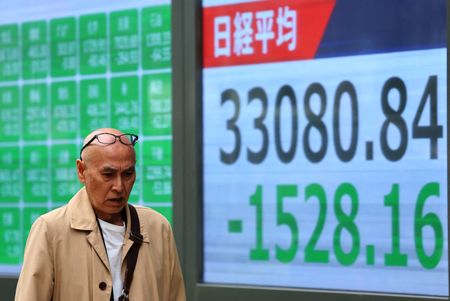

Financial markets across Asia experienced declines Friday as tensions in the Middle East and concerns about private equity investments created uncertainty among traders worldwide.
Markets in Japan saw the Nikkei index fall by 1%, while Hong Kong’s Hang Seng declined 0.3% as trading resumed following the Lunar New Year holiday break.
Oil prices surged to their highest levels in six and a half months, with Brent crude futures climbing above $72 per barrel. The increase came after President Donald Trump issued an ultimatum to Iran, giving the country between 10 and 15 days to reach an agreement on its nuclear program or face consequences he described as “really bad things.”
The escalating Middle East situation coincided with significant losses in private equity stocks on Wall Street. Blue Owl, a private equity manager, triggered sector-wide concerns after selling assets and permanently halting quarterly withdrawals from one of its investment funds. Blue Owl’s stock price dropped approximately 6%, while larger competitors Apollo Global Management and Blackstone each fell more than 5%.
According to Kenji Abe, chief strategist at Daiwa Securities in Tokyo, these developments pushed investors toward safer investments as they also prepare for next week’s earnings announcement from Nvidia, currently the world’s most valuable company.
Reports emerged Thursday that the chip manufacturer is close to completing a $30 billion investment in OpenAI, which would replace a previous $100 billion long-term agreement between the two companies, according to Financial Times sources.
Retail giant Walmart saw its shares decline 1.4% after newly appointed CEO John Furner expressed cautious views about American consumer spending patterns.
Economic data revealed that the U.S. trade deficit expanded significantly in December, with the goods deficit reaching record levels in 2025, indicating that Trump’s tariff policies have shown limited effectiveness so far.
Currency markets saw the dollar on track for its strongest weekly performance in four months, supported by marginally positive U.S. economic indicators and Federal Reserve meeting notes suggesting officials are in no rush to reduce interest rates.
The dollar gained approximately 0.9% against the euro this week, pushing the European currency down to $1.1762. Meanwhile, the Japanese yen weakened after inflation data showed core prices rising at just 2% in January, the slowest rate in two years, potentially complicating the Bank of Japan’s plans for interest rate increases.
Against the yen, the dollar climbed 1.6% for the week to reach 155.2 yen.
Australia’s currency maintained stability at $0.7047 due to favorable yield differences, while New Zealand’s dollar struggled amid reduced expectations for early rate hikes, heading toward its largest weekly decline of 2026.
U.S. Treasury bonds remained relatively unchanged, with 10-year yields holding at 4.06%. However, disagreement among Federal Reserve officials about the timing and pace of potential rate cuts pushed two-year yields up five basis points to 3.46% over the week.
Brent Donnelly, President of Spectra Markets, advised caution given the current environment. “There does not seem to be much point in adding risk ahead of this weekend’s uncertainty surrounding the Middle East,” Donnelly stated.
“Today feels like a good day to stay out of trouble,” he added.