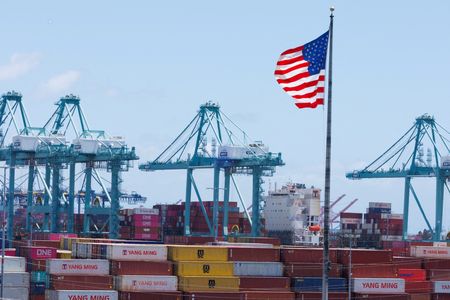

America’s trade imbalance expanded dramatically in December as foreign goods poured into the country, reaching a five-month peak despite President Donald Trump’s aggressive tariff policies aimed at reducing such deficits.
The Commerce Department reported Thursday that the trade gap jumped 32.6% to $70.3 billion in December, far exceeding economists’ predictions of $55.5 billion. This marked the second consecutive month of worsening trade performance.
The disappointing trade figures suggest international commerce provided minimal boost to the nation’s economic output during the final quarter of 2025. However, much of the import increase consisted of business equipment, which economists say should strengthen corporate investment and maintain expectations for robust economic expansion.
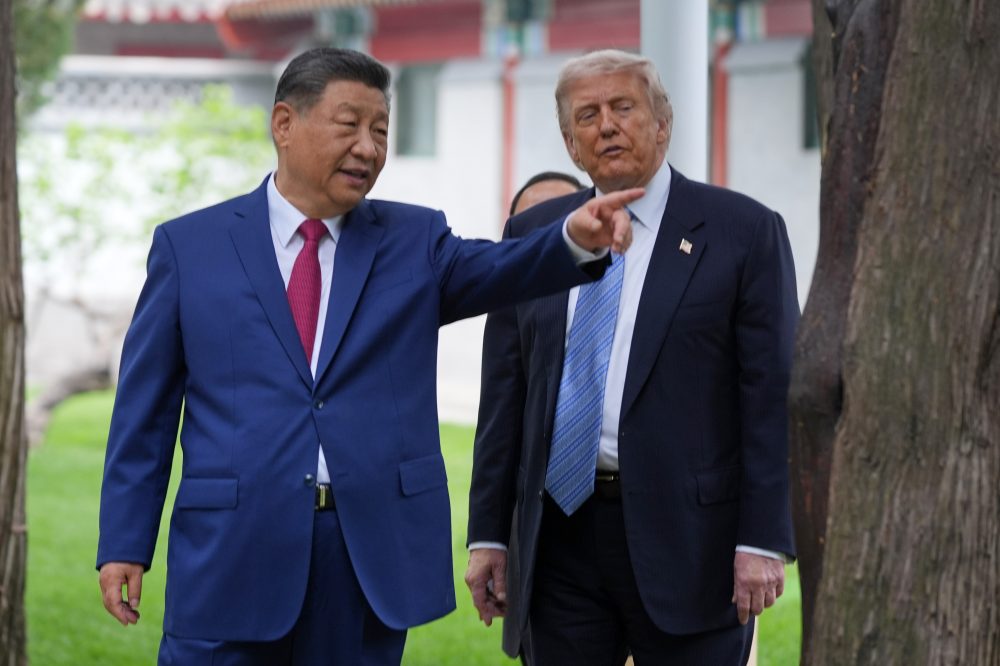
Trump implemented extensive tariffs on trading partners throughout 2025, seeking to shrink trade imbalances and shield American industries. Yet these protective measures haven’t sparked a manufacturing revival, with factory jobs dropping by 83,000 positions between January 2025 and January 2026.
“There just isn’t any evidence out there in the economic research literature to suggest that tariffs have materially impacted trade deficits historically when countries have implemented them,” explained Chad Bown, a senior fellow at the Peterson Institute for International Economics.
For the full year 2025, the overall trade deficit decreased slightly by 0.2% to $901.5 billion. However, the goods-only deficit climbed 2.1% to an unprecedented $1.24 trillion, with record shortfalls recorded against Mexico, Vietnam, Taiwan, Ireland, Thailand and India. The goods deficit with China fell to $202.1 billion from $295.5 billion in 2024.
December imports climbed 3.6% to $357.6 billion, driven by a $7.0 billion surge in industrial materials including precious metals, copper and petroleum. Business equipment imports rose $5.6 billion, powered by computer components and communications gear likely connected to artificial intelligence data center construction.
Consumer product imports declined, primarily due to reduced pharmaceutical purchases affected by tariff fluctuations.
Annual goods imports reached a record $3.44 trillion in 2025, with historic levels from 46 nations led by Mexico, Taiwan and Vietnam. Some Taiwanese and Vietnamese products received tariff exemptions. The import growth spanned most categories, particularly business equipment like computers and telecommunications gear, while automotive imports fell.
December exports dropped 1.7% to $287.3 billion, with goods shipments falling 2.9% to $180.8 billion due to an $8.7 billion decline in industrial materials, especially precious metals.
Capital equipment exports increased, boosted by semiconductor sales, along with consumer products including pharmaceuticals. Annual goods exports hit a record $2.20 trillion in 2025, up 5.7%.
Wall Street stocks traded lower following the report, while the dollar strengthened and Treasury yields increased.
The goods-specific trade gap widened 18.8% to $99.3 billion in December. Service imports grew $2.0 billion to $77.4 billion on higher transportation and travel activity, while service exports increased $0.5 billion to $106.5 billion.
The larger-than-anticipated deficit prompted the Atlanta Federal Reserve to reduce its fourth-quarter economic growth projection to 3.0% annually from 3.6%.
“But strong imports should also imply strength in details like inventories or business investment,” noted Veronica Clark, a Citigroup economist. “Surging computer imports in particular should correspond with stronger business equipment investment and could remain strong due to AI-related demand.”
The Bureau of Economic Analysis will release delayed fourth-quarter growth data Friday. The economy expanded at a 4.4% rate during July through September.
In employment news, the job market showed signs of stability. New unemployment benefit applications fell 23,000 to 206,000 for the week ending February 14, the Labor Department reported.
This represented a substantial improvement from the 232,000 claims filed in late January. Economists had anticipated 225,000 applications for the most recent week.
Federal Reserve meeting minutes from January 27-28, published Wednesday, revealed the “vast majority of participants judged that labor market conditions had been showing some signs of stabilization.”
Nevertheless, concerns about employment risks persist. Some policymakers noted “the possibility that a further fall in labor demand could push the unemployment rate sharply higher in a low-hiring environment or that the concentration of job gains in a few less cyclically sensitive sectors was potentially signaling heightened vulnerability in the overall labor market.”
The unemployment data covers the survey period for February’s jobs report. January employment growth accelerated, though nearly all gains occurred in healthcare and social services.
Officials and economists attribute hiring constraints to immigration policies. Tariff uncertainty and artificial intelligence concerns add additional caution among employers.
Continuing unemployment benefits, which indicate hiring activity, rose 17,000 to 1.869 million during the week ending February 7. These ongoing claims reflect sluggish recruitment, with median unemployment duration near four-year highs.
Limited hiring particularly affects recent college graduates, who lack work history for unemployment benefits and don’t appear in claims statistics.
“Most Americans want to see hiring pick up, but policymakers are focused on ensuring firing doesn’t pick up,” said Heather Long, chief economist at Navy Federal Credit Union.