
LAMPEDUSA, Sicily — While Americans celebrated the 250th anniversary of the Declaration of Independence with parties and fireworks back home, Pope Leo XIV chose the Fourth of July to make a deeply symbolic journey to one of Europe’s most contested migration flashpoints.
The first pope born in the United States — who has clashed with the Trump administration over its immigration enforcement policies — flew to the Sicilian island of Lampedusa on Saturday to honor the tens of thousands of migrants who have lost their lives trying to reach Europe in search of freedom and a better life.
On the occasion of the July 4th anniversary, Leo sent a letter to Americans arguing that protecting human life — including the unborn — also means “welcoming protecting and assisting immigrants, whose hopes, sacrifices and contribution have formed part of the history of this country from its very beginning.”
“To receive them with compassion and generosity is not only an act of charity, but also a recognition of the dignity that belongs to every human person,” Leo wrote.
Lampedusa is a small, treeless strip of rock measuring about 9 kilometers — roughly 5.6 miles — long. Sitting closer to the African coast than to the Italian mainland, it serves as the primary entry point into Europe for hundreds of thousands of migrants smuggled by boat from Libya and Tunisia.
The island has become the symbolic center of Europe’s heated migration debate, as the continent wrestles with enforcing its borders while meeting its legal obligations to shelter refugees escaping conflict, poverty, and climate change.
The International Organization of Migration has documented more than 35,000 migrants who have gone missing in the Mediterranean Sea since 2014. Experts believe the true death toll is considerably higher, as countless shipwrecks go unrecorded.
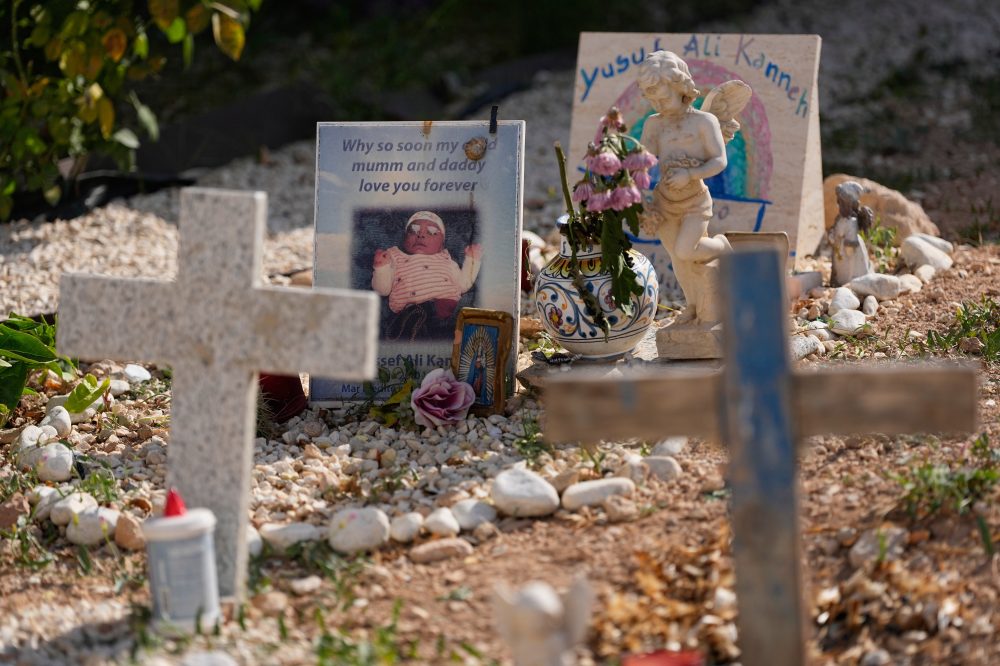
After landing on the island, Leo visited the local migrant cemetery to pay tribute to those who died and unveiled a plaque dedicated to Pope Francis at the main dock. He then celebrated Mass in the main town square.
Tareke Brhane, a migrant from Eritrea who serves as president of the October 3rd Committee — a nonprofit created by relatives of victims of a deadly 2013 shipwreck off Lampedusa that killed 368 people — called the pope’s gestures a “strong message” of solidarity.
“It is a strong sign for our battle with Italy and with Europe in order to register the deaths, because as of today we still do not have a registry (of those deceased),” Brhane told The Associated Press.
He added that Leo’s visit honors the dead and “gives a message to the relatives, so many of them still waiting and suffering.”
Leo’s trip echoes the legacy of Pope Francis, who made the welfare of migrants and refugees a central theme of his papacy. Francis himself visited Lampedusa in July 2013 — his first trip outside Rome after becoming pope — where he threw a wreath into the sea in memory of those who had drowned and condemned what he called the “globalization of indifference” toward migrants.
Leo has also recently visited another European migration hotspot in Spain’s Canary Islands, where he criticized leaders who turn migrants away without compassion and warned people smugglers of divine consequences for exploiting desperate individuals.
Salvatore Sortino, the head of mission for Italy and Malta with the International Organization of Migration, noted that while the number of migrants crossing the central Mediterranean has dropped this year, the proportion of deaths has actually risen.
“That speaks about the vulnerability that remains,” Sortino said. “So the visit of the pope here, where all this happens, I think is a very important reminder of that element.”
The International Rescue Committee estimates that 118 million people worldwide have been forcibly displaced in 2025 alone.
The papal visit comes roughly two weeks after the European Union began enforcing a new framework determining how each of its 27 member states handles irregular migration and asylum requests. Under the updated rules, migrants will be screened at EU borders for up to seven days before being admitted. Those considered a security risk or from designated “safe” countries will face an expedited review process, and rejected asylum seekers will automatically receive return orders.
Human rights organizations have pushed back against the new regulations, arguing they compromise the fundamental right to seek asylum by rushing the evaluation process. Critics say the accelerated procedures risk racial profiling and could deny protection to people with legitimate claims, while also warning of a likely surge in extended border detentions.
Italy’s Interior Ministry reported 14,464 migrant arrivals as of Friday this year — a sharp decline compared to 30,598 during the same period last year and 26,202 in 2024. Meanwhile, the number of both voluntary and forced deportations has increased under the current Italian government’s push to crack down on migration and the criminal networks behind it.