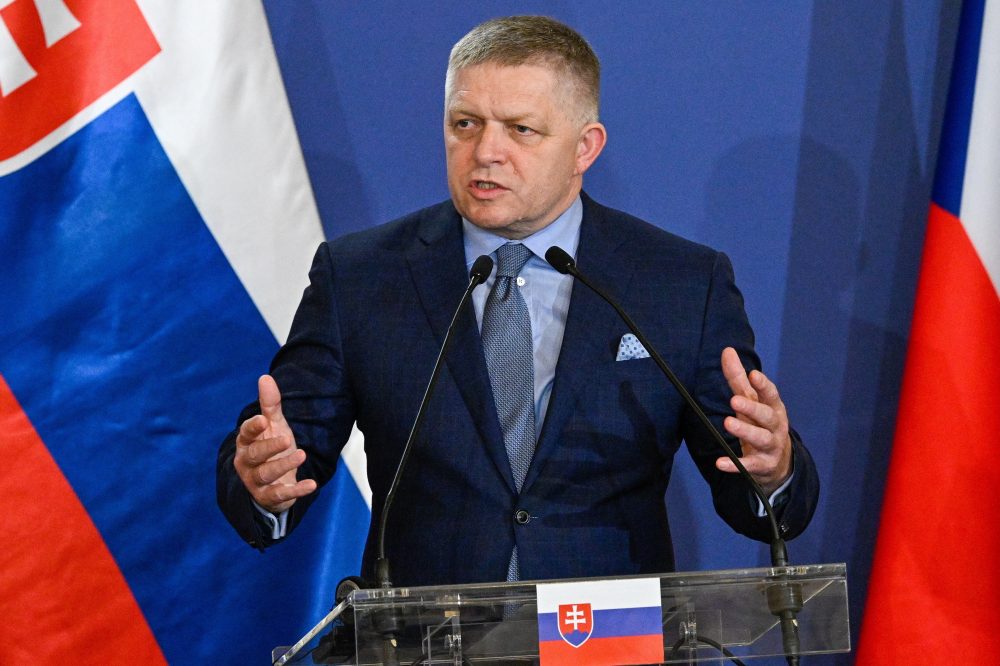

BRATISLAVA, Slovakia — Citizens across Slovakia cast their ballots Saturday in a national referendum addressing two major questions: whether to eliminate lifelong monthly payments granted to Prime Minister Robert Fico and other senior officials after they leave their posts, and whether to bring back a special anti-corruption prosecutor’s office and related police unit that were shut down.
Under current law, Slovak prime ministers and parliament speakers who have served at least two terms are entitled to receive a monthly payment for life — equivalent to a lawmaker’s salary — once they leave office. The benefit was created as a security measure following a 2024 assassination attempt on Fico, in which he was shot and seriously wounded after a government meeting. The attack sent shockwaves through the small nation and drew widespread attention across Europe. Prior to 2024, only former presidents received such a benefit.
The referendum was triggered by a petition organized by the Democrats, a pro-Western opposition party that does not hold seats in parliament. More than 350,000 Slovaks signed the petition — the number required by law to force a national vote — in a country of 5.4 million people.
Despite the large number of signatures, polls ahead of Saturday’s vote indicated that turnout was unlikely to reach the 50% participation rate required for the referendum results to be binding. Slovakia has a difficult history with referendums — only one has ever succeeded, the 2003 vote on joining the European Union. All others failed because not enough voters showed up.
Earlier in 2024, Fico’s coalition government pushed through legislation dissolving the special prosecutor’s office, which had been responsible for investigating serious offenses including corruption, organized crime, and extremism. The government also disbanded the police unit that handled similar cases. The move drew fierce backlash both within Slovakia and internationally, with thousands of citizens taking to the streets in repeated protests. Several individuals connected to Fico’s political party had faced prosecution in corruption-related cases.
Fico has been a polarizing political figure since returning to power in 2023, with his pro-Russian stance and other policy positions sparking ongoing demonstrations. On the day of the referendum, Fico announced he would not be casting a vote.