
CAIRO (AP) — Egypt has announced two major archaeological discoveries, including the uncovering of a remarkably well-preserved residential city from the Byzantine era buried in the country’s western desert.
The Egyptian government revealed the findings at two separate sites — the Dakhla Oasis and the Marina el-Alamein archaeological site near Alexandria — hoping the discoveries will give a boost to the nation’s critical tourism industry, which depends significantly on visitors drawn to ancient sites.
Tourism, along with the Suez Canal, is one of Egypt’s primary sources of foreign currency, making such discoveries economically significant for the financially strained country.
According to the Tourism and Antiquities Ministry, the Dakhla Oasis discovery sheds light on everyday life, city planning, and commerce during the fourth century, when Egypt was under Byzantine rule.
Hisham el-Leithy, secretary general of the supreme council of antiquities, described the excavated city layout as featuring north-south main roads crossed by east-west streets, creating open plazas and communal spaces throughout the settlement.
Mahmoud Massoud, who leads the archaeological mission, said a basilica church dating to the middle of the fourth century sits at the top of the settlement, looking out over the main roads below. The remains of two watchtowers, built to protect the edges of the city, were also found.
The Dakhla Oasis is located in Egypt’s western province of New Valley and is currently on UNESCO’s Tentative List, placing it one step away from being designated a World Heritage Site.
Massoud also noted the discovery of a heavily fortified structure with thick walls, as well as numerous homes featuring reception areas and arched ceilings.
Among the most notable residential finds was the house of Tisous, identified as a church deacon. The structure dates to the second half of the fourth century and is believed by archaeologists to have functioned as a house of worship before the city’s main basilica was built.
Excavators also uncovered bread ovens, cooking areas, and stone tools used for grinding food. Well-preserved bronze coins were found bearing images of Byzantine emperors, Latin text, and Christian symbols. A collection of gold coins from the reign of Roman Emperor Constantius II — who ruled from 337 to 361 — was also recovered, according to the ministry.
Diaa Zahran, head of the Islamic, Coptic and Jewish Antiquities department, said archaeologists discovered roughly 200 pottery fragments that were once used as writing surfaces. These fragments, known as ostraca, contain inscriptions recording business dealings, personal correspondence, and glimpses of daily life.
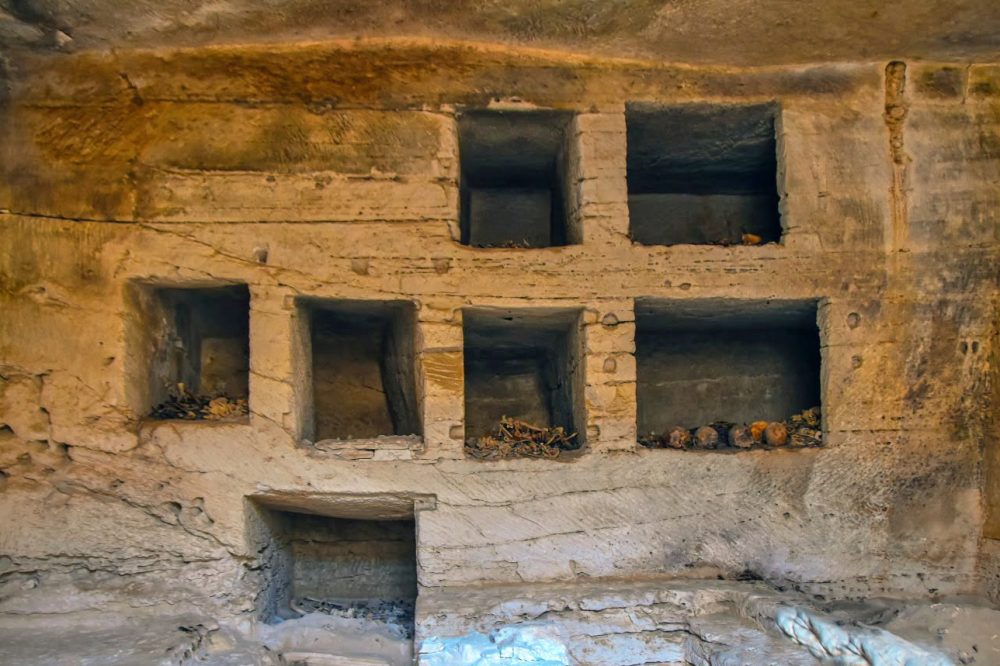
In a separate announcement, archaeologists reported uncovering 18 ancient tombs at the Marina el-Alamein site, located approximately 100 kilometers — or about 62 miles — west of the Mediterranean city of Alexandria.
The newly found tombs include 11 carved directly into rock at an average depth of 8 meters, and seven others constructed above ground using limestone. With these additions, the total number of tombs discovered at the site now stands at 48, the ministry said.
Items found within the tombs included pottery vessels, amphorae, oil lamps, plates, altars, and limestone basins.
Mission chief Eman Abdel-Khaliq reported finding a granite sarcophagus measuring 2.5 meters in length containing skeletal remains that are currently being analyzed. Near the sarcophagus, researchers also found the remnants of a plaster sphinx statue.
Abdel-Khaliq added that four gold pieces were discovered placed inside the mouths of some of the deceased — a practice known as “the golden tongue,” which was tied to the funerary traditions of that period.
Marina el-Alamein, situated near the city of Alamein along Egypt’s Northern Coast, was first uncovered in 1986. Researchers believe it was once the ancient Greco-Roman port city of Leukaspis, a Mediterranean settlement built in the second century that flourished through the fourth century.
Egypt’s tourism sector has been on a steady path to recovery following years of political instability and unrest after the 2011 uprising, as well as the disruption caused by the coronavirus pandemic.
Official figures show that a record 19 million tourists visited Egypt last year, marking a 21% jump compared to 2024. The first four months of 2026 welcomed 6.1 million visitors, up from 5.7 million during the same stretch in 2025.