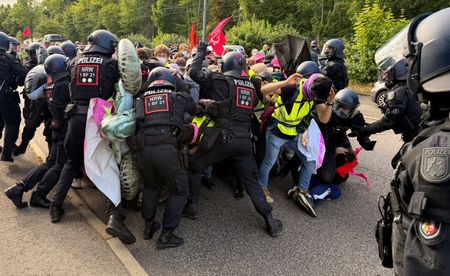

ERFURT, Germany — Tens of thousands of people marched through the eastern German city of Erfurt on Saturday, working to block access to the venue hosting the far-right Alternative for Germany party’s annual conference, as the group prepares for regional elections that could hand it control of a state government for the very first time.
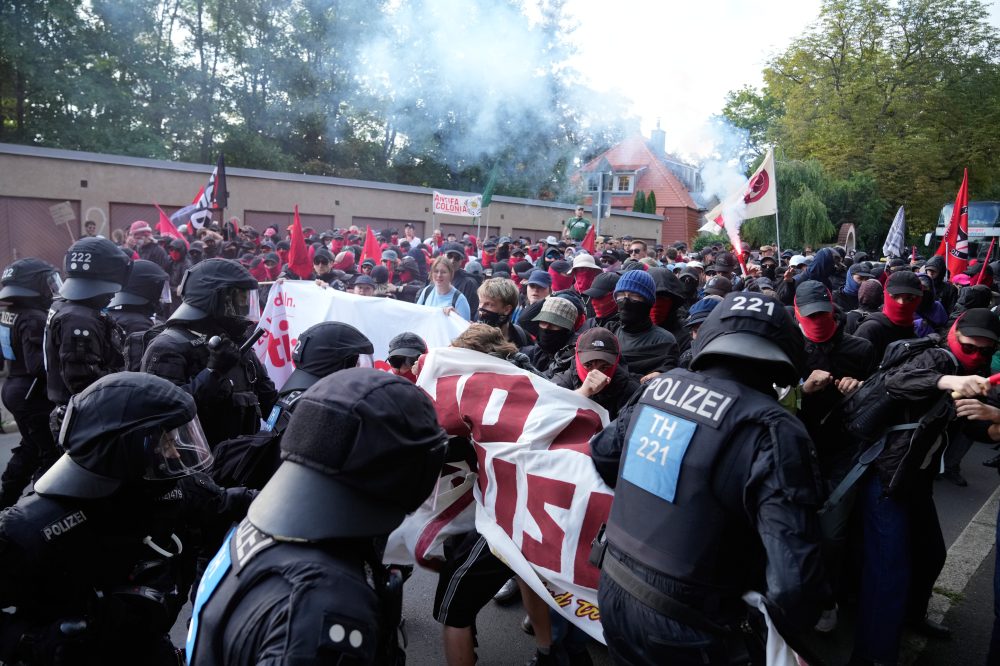
Demonstrators representing labor unions, civil society organizations, and left-leaning political parties joined the protest, while police — including officers brought in from other parts of the country — were deployed in large numbers to manage the crowds. Authorities estimated approximately 15,000 people participated in demonstrations in and around Erfurt.
Protesters sat down in rows across roads and highways leading to the convention center, with officers in riot gear watching on. Georg Becker, a spokesperson for the anti-AfD coalition group Widersetzen — which translates to “Resist” — explained the motivation behind the demonstrations. “We want to make it clear that we simply won’t tolerate this, that fascism is on the rise here in Germany,” he said.
The conference is expected to see the party’s co-leaders, Alice Weidel and Tino Chrupalla, re-elected to their positions. It comes just before elections in the eastern German states of Saxony-Anhalt and Mecklenburg-Vorpommern, contests the AfD hopes will help build momentum toward success at the national level.
The AfD, which was established more than ten years ago, has surged ahead of Chancellor Friedrich Merz’s conservative bloc in national opinion polls. The party has built its following through nationalist messaging, calls for stricter immigration controls, and by appealing to voters who feel let down by years of economic stagnation and a string of governments that failed to address their concerns.
Critics of the AfD charge that the party promotes racist policies and holds views that are at odds with Germany’s democratic principles, arguing it poses a danger to the country’s constitutional framework. Established political parties have agreed not to work with the AfD under what is known as a “firewall” policy — a coordinated effort to keep the party isolated and out of governing coalitions.
AfD officials reject the claim that they stand against Germany’s democratic foundations. Earlier this year, the party won a court ruling requiring the country’s domestic intelligence agency to pause its classification of the AfD as an “extremist” organization.
The latest polling shows AfD support at roughly 29%, compared to around 22% for Merz’s CDU/CSU conservative alliance. The party also posted strong results in two regional elections held in western Germany earlier this year.
The AfD’s most significant base of support lies in the former communist eastern regions of Germany, where voter frustration with the established party system runs highest. In Saxony-Anhalt, recent polling places the AfD at 41%, far ahead of the Christian Democrats at 23%, as the party pursues an outright victory. It is also hoping to emerge as the top party in Mecklenburg-Vorpommern.