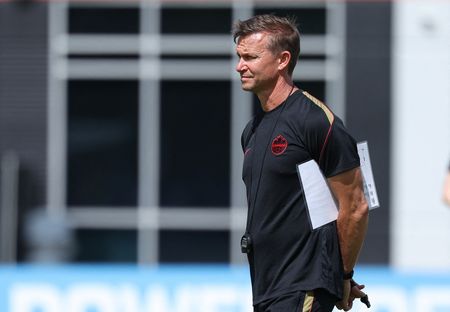

HOUSTON — Canada’s remarkable World Cup journey came to a painful close Saturday, as they fell 3-0 to Morocco in the round of 16. But head coach Jesse Marsch refused to let the scoreline define what his team accomplished, saying he could not be more proud of the way his players competed.
The Canadian squad had already made history during the tournament, earning their first-ever World Cup point, their first victory, and their first knockout-stage win. Against the seventh-ranked Moroccan side, Canada controlled long stretches of play but ultimately could not convert their opportunities, and the absence of their biggest star loomed large over the result.
“I’m very proud to be the Canadian national team coach, and as proud as I am, I’m even more proud of the way our boys played today,” Marsch told reporters after the match.
Wing-back Alphonso Davies, who plays for Bayern Munich, sat out the contest after suffering a hamstring injury, having appeared for only a few minutes throughout the entire tournament.
“We want players on the pitch that are 100% to play the game, I wasn’t there yet,” Davies said. “It was tough sitting there, watching the game, knowing that I’m not 100%.”
Marsch said that heading into the match, he felt his team was capable of winning based on how they were playing.
“Before today, if you would have said your team’s going to play like that, I would have said, ‘okay, there’s a good chance we’re going to win the match,’” he said.
“Thought we totally controlled the number seven team in the world in the first half, total control. There was one team on the pitch. And then we weren’t able to make the play. Even at the start of the second half, we were the aggressor, we were the ones that looked more likely to score.”
Marsch noted that Morocco’s opening goal shifted the dynamic of the game, allowing the North African side to drop back and defend while Canada chased an equalizer.
On the Davies injury, Marsch explained the decision to keep him out was made with the player’s long-term health in mind.
“He didn’t feel right yesterday in training, and we got an MRI, and it was clear, but his hamstring didn’t feel right,” Marsch said. “It killed him more than anyone, but I think it was the right decision to preserve him and his career and get him fully healthy.”
The American coach encouraged his players and Canadian soccer broadly to treat the tournament as a launching pad going forward. After gathering his team on the field for a post-game huddle — waving off television cameras in the process — Marsch challenged them to maintain the level they had shown throughout the competition.
“I challenged them to understand that we can play like this all the time,” he said. “Against the best teams in the world, we can be better on the day. The challenge is, can we hold that standard for 90 minutes? Can we continue to build the depth of what we’re doing with the team? Can we build a real Canadian DNA into the kind of football we want to play?”
Marsch said the tournament marked the beginning of a new chapter for Canadian soccer.
“It is a privilege to have now a Canadian national team competing at levels that had never been dreamed of 10 years ago,” he said. “With that excitement comes higher expectations. Nobody is more disappointed than us, but we have to continue to think about how to get better and commit ourselves to it every time we’re together.”
Canada’s Prime Minister Mark Carney also weighed in on social media platform X, writing: “Nothing but pride … An incredible run and a sign of what’s to come.”