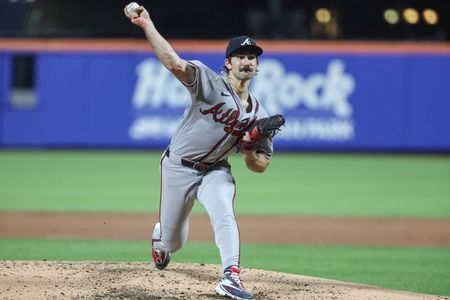
Atlanta Braves pitcher Spencer Strider is set to be examined by Dr. Keith Meister following his placement on the 15-day injured list Saturday due to right elbow inflammation. Braves manager Walt Weiss shared the news with reporters ahead of Sunday’s game against the New York Mets.
The trouble began during Friday’s 7-5 defeat to the Mets, when Strider was pulled after completing just over three innings. He surrendered a career-high seven earned runs in the outing, and his fastball speed fell sharply — dropping from 96 mph earlier in the game down to just 88 mph by the fourth inning.
Weiss expressed measured concern when speaking to reporters Sunday. “You always expect to see inflammation when somebody’s hurting,” he said. “So we just want to let Dr. Meister get a look at it and get his diagnosis.”
This is not Strider’s first brush with injury this season — he opened the year on the injured list while recovering from a left oblique strain. Through eight starts, he holds a 4-2 record with a 5.31 ERA. His elbow history is significant: he underwent Tommy John surgery while playing at Clemson in 2019, and in April 2024 had a brace placed in the UCL of his right elbow, a less invasive version of the same procedure.
The 27-year-old has been a consistent performer for Atlanta over the past six seasons, compiling a 43-26 record and 3.86 ERA across 98 appearances, including 85 starts. In 494 career innings, he has recorded 672 strikeouts against 180 walks.
KINSHASA — Government data released Sunday shows the Democratic Republic of Congo’s ongoing Ebola outbreak has grown to 782 confirmed cases, following a surge of 72 new infections recorded within a single 24-hour period — one of the largest one-day increases seen during this outbreak.
The government’s most recent situation report also confirms that 181 people have died from the disease among those confirmed cases.
According to the data, this outbreak — the country’s 17th — continues to be limited to three eastern provinces: Ituri, North Kivu, and South Kivu.
However, the report reveals that Ebola has now been detected for the first time in two additional areas: the Nia-Nia health zone in Ituri province and the Mabalako health zone in North Kivu province.
The disease has now spread to 20 of Ituri’s 36 health zones and 10 of North Kivu’s 34 health zones, along with one health zone in South Kivu.
A tragic accident claimed the lives of 12 people Sunday after a plane transporting a group of skydivers went down and caught fire in Missouri.
Authorities confirmed that the pilot and 11 other individuals aboard the aircraft were all killed in the crash. The group had been on a skydiving outing when the plane went down.
Officials have not yet released the identities of those who died or provided details on what may have caused the aircraft to crash.
RIO DE JANEIRO — A deadly midair collision between two helicopters over Rio de Janeiro on Sunday morning left all six people aboard dead, according to firefighters at the scene.
Rio de Janeiro’s Military Fire Department reported that one of the aircraft came down on top of a car dealership, where a number of electric vehicles were parked. The impact triggered a fire that crews were eventually able to put out.
Authorities have launched an investigation to determine what led to the collision, though no cause has been identified yet.
Police confirmed that American singer and comedian Oliver Tree appeared on the passenger manifest that had been submitted to aviation authorities. However, officials said they have not yet been able to identify the bodies of those who died in the crash.
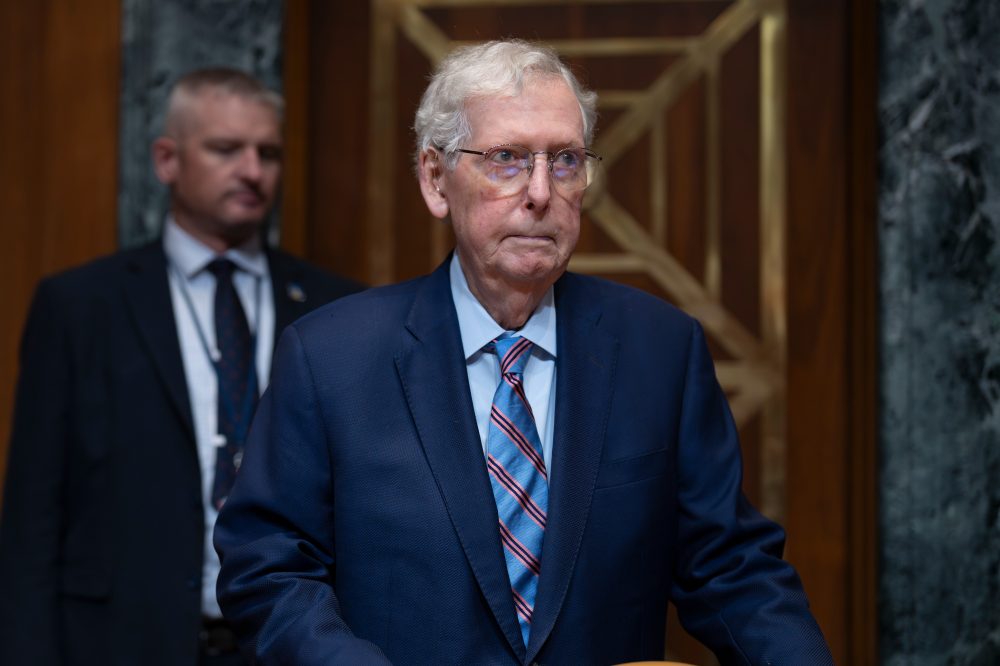
WASHINGTON — Republican Sen. Mitch McConnell was admitted to a hospital on Sunday, according to a statement from his spokesperson, but the reason for the hospitalization and details about his condition remain largely unknown.
McConnell, 84, made history as the longest-serving Senate leader before stepping down from that leadership position while completing his final term in office, which concludes in January.
“Senator McConnell was admitted to the hospital this morning. He is receiving excellent care,” spokesperson David Popp said in a brief statement that offered no further details. It remains unclear whether the Kentucky senator was hospitalized in Washington, back home in Kentucky, or somewhere else entirely.
The senator’s health has drawn public attention for a number of years. In December 2024, he sprained his wrist after falling while leaving a Republican luncheon. Before that, in March 2023, he suffered a concussion and missed several weeks of Senate duties after a fall at a Washington hotel. Following his return to work, he experienced two separate incidents that summer in which he appeared to freeze during news conferences, staring blankly until colleagues and staff stepped in to help him.
McConnell contracted polio as a young child and has long acknowledged that walking and climbing stairs have been a physical challenge throughout his adult life. Beyond his 2023 fall, he also fell at his Kentucky home in 2019, requiring surgery for a fractured shoulder.
First elected to the Senate in 1984, McConnell served as the Republican leader from 2007 until last year, holding both the majority and minority leader positions during that span.
Despite stepping back from leadership, McConnell has remained an active presence in the Senate, continuing to attend sessions and recently leading public hearings in his role as chairman of the Senate Appropriations subcommittee on defense. He has occasionally used a wheelchair to get around the Capitol and, as a former congressional leader, is routinely accompanied by a security detail.
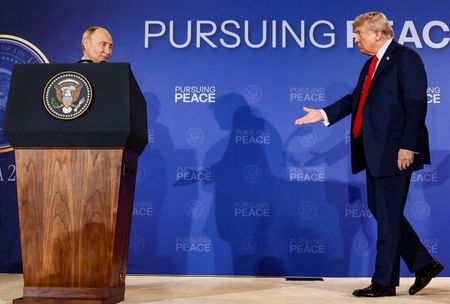
Russian President Vladimir Putin reached out to U.S. President Donald Trump on Sunday with birthday congratulations, praising him as an exceptional leader and expressing optimism about the future of relations between their two countries.
“Dear Mr. President, dear Donald, I wholeheartedly congratulate you, such a bright, remarkable person and politician, on your 80th birthday!” Putin wrote in a message posted to the Kremlin’s official website, which was also cited by Russian news outlets.
The two heads of state spoke over the phone for 55 minutes, according to Kremlin foreign policy aide Yuri Ushakov, who described Putin’s congratulations during the call as delivered in an “informal” way.
In his written message, Putin said he “valued the mutual understanding between us, which allows us to discuss … even the most complex issues on the bilateral and international agenda openly and frankly.”
Putin went on to express confidence in what the two leaders could accomplish together, writing: “I am certain that together we could truly give Russian-American relations a new quality, and also do much to ensure security and stability on the world stage.”
The last time the two presidents met face-to-face was in Alaska in August 2025, as part of efforts to work toward a resolution to the ongoing conflict between Russia and Ukraine.
Inclement weather forced the cancellation of Sunday’s series finale between the Cleveland Guardians and the visiting Detroit Tigers, cutting short what could have been a series sweep for Cleveland.
The two American League Central rivals will now make up the game as part of a split doubleheader scheduled for September 4 in Cleveland.
The Guardians had been on the verge of sweeping the three-game series after posting a 3-2 win on Friday and following it up with a 3-1 victory on Saturday. The postponement denied Cleveland the chance to complete the sweep.
Adding to the team’s challenges, the Guardians placed star third baseman Jose Ramirez on the 10-day injured list earlier Sunday after he suffered a broken bone in his hand.
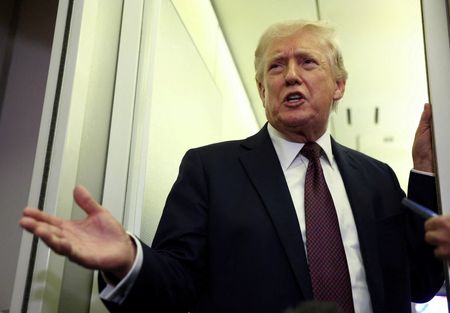
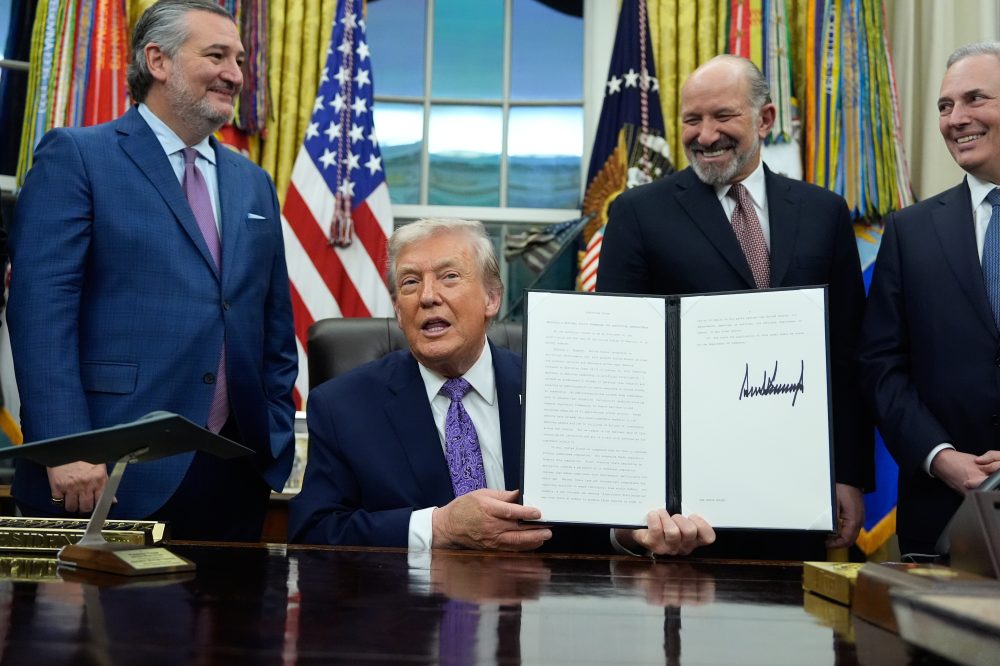
President Donald Trump declared on Sunday that he opposes extending the Foreign Intelligence Surveillance Act unless lawmakers attach his Save America Act to the legislation.
The Save America Act, which Trump has championed, would require individuals to provide proof of citizenship in order to vote. Trump made clear he is unwilling to support a FISA renewal without that voting measure included.
Even as Gay Pride Month celebrations continue, LGBT advocates are facing significant headwinds. In recent years, a strong public backlash has emerged — particularly around efforts to promote gender transition to minors. Numerous states have passed laws barring males from competing in women’s sports, and others have prohibited sex-change procedures on children. At least nine states have introduced resolutions aimed at reversing the legal recognition of same-sex marriages, with most calling on the U.S. Supreme Court to reconsider its 2015 ruling on the issue. While these resolutions would not have the force of law, they could lay the groundwork for a new legal challenge before the high court.
America has always been a deeply religious nation. When the thirteen original colonies united and declared independence in 1776, there were already 3,228 houses of worship across the land — and the country was remarkably diverse in its faiths. Congregationalists were the largest group, with roughly 670 congregations making up just over 20 percent of the total. Presbyterians ranked second, followed by Baptists, Episcopalians, and Quakers. Methodists accounted for about two percent, Catholics came in just under that figure, and there were also a small number of synagogues along with more than a dozen Mennonite congregations.
The Vatican has announced that Pope Leo met with six survivors of clergy sexual abuse during his visit to Spain, holding the meeting in Madrid. The pontiff pledged to take their recommendations into consideration as the Catholic Church works to improve how it handles abuse cases. Spain’s Catholic leadership has only recently begun confronting its own history of abuse and cover-up, having long downplayed the severity of the scandal — one that was brought to public attention largely through reporting by the newspaper El País (pronounced pie-EES). Sexual abuse by Catholic clergy remains a worldwide crisis that has pushed many people away from the church and threatens to financially devastate some dioceses.
Violence against Christians in India is intensifying once again. According to International Christian Concern, a mob of Hindu nationalists stormed a church service in the Sukma District, leaving 25 people injured — some of them critically. Local clergy say conditions in the district have deteriorated since local officials enacted an anti-conversion law. The persecution of Christians in India has been growing for more than two decades, dating back to when a Hindu nationalist political party rose to power in the national government. Although India’s constitution guarantees freedom of religion, government officials are accused of failing to uphold that protection.
WESTPORT, Ireland — Canadian Prime Minister Mark Carney is warning that the United States’ decision to restrict access to Anthropic’s newest artificial intelligence models is a wake-up call about the risks of depending too heavily on a small number of American technology providers.
AI company Anthropic announced Friday that it has taken its two latest AI models — known as Fable 5 and Mythos 5 — offline in response to a directive from the Trump administration barring their use by foreign nationals.
The move represents the most sweeping step the U.S. government has taken to date to limit foreign access to cutting-edge AI technology. Anthropic released Fable broadly this week. That model is a scaled-down version of the more powerful Mythos, which the company had already been restricting due to serious cybersecurity concerns.
“The situation we’re in collectively right now with Mythos and Fable is something that can happen with overreliance on certain models,” Carney said. “Nobody has done anything wrong in the situation. But we will have done something wrong if we just accept this, don’t take the lesson, don’t build out and diversify.”
Carney delivered those remarks while in Ireland ahead of the upcoming G7 summit in Evian-les-Bains, France, where he said artificial intelligence is expected to be a major topic of discussion on Monday night.
Anthropic, headquartered in San Francisco, California, announced the Mythos model on April 7, describing it as so “strikingly capable” that the company has limited access to select customers only. The company cited the model’s ability to outperform human cybersecurity experts at identifying and exploiting computer vulnerabilities.
“You’ll hear me say this over and over again. It is never a good idea to have one option,” Carney said.
Carney also revealed he spent 45 minutes discussing artificial intelligence with French President Emmanuel Macron on Friday evening. He cautioned that there “will not be a mission accomplished banner” coming out of the summit, given the complexity of the issues involved.
The Canadian prime minister drew a direct connection between the U.S. AI restrictions and Canada’s ongoing effort to broaden its trade relationships. More than 70% of Canada’s exports currently go to the United States, and Carney has set a goal to double Canada’s non-U.S. exports over the next decade. He noted that Trump’s trade war has already been dampening investment.
Carney does not have a one-on-one meeting scheduled with Trump at the G7, even as the free trade agreement between the U.S., Canada, and Mexico is up for renewal. He said trade discussions under the USMCA framework will instead take place between Canada’s minister responsible for U.S. trade Dominic LeBlanc, Canada’s chief negotiator Janice Charette, U.S. Trade Ambassador Jamieson Greer, and Treasury Secretary Scott Bessent.
“The right way to do it at this stage, will be between the principal negotiators, which is going to happen in Evian,” he said.
Earlier Sunday, Carney visited the Irish village of Aghagower, where his family has ancestral roots. His grandfather, Robert Carney, and grandmother, Nora Moran, both hailed from the County Mayo town and emigrated to Canada in the 1920s.
Local resident Owen Morgan, who was there with his 17-month-old son Malachy — dressed in a Montreal Canadiens jersey — said the community is proud of the Canadian leader. “People are very impressed,” Morgan said. “He’s very much standing up for Canadians and I think that’s very much admired.”
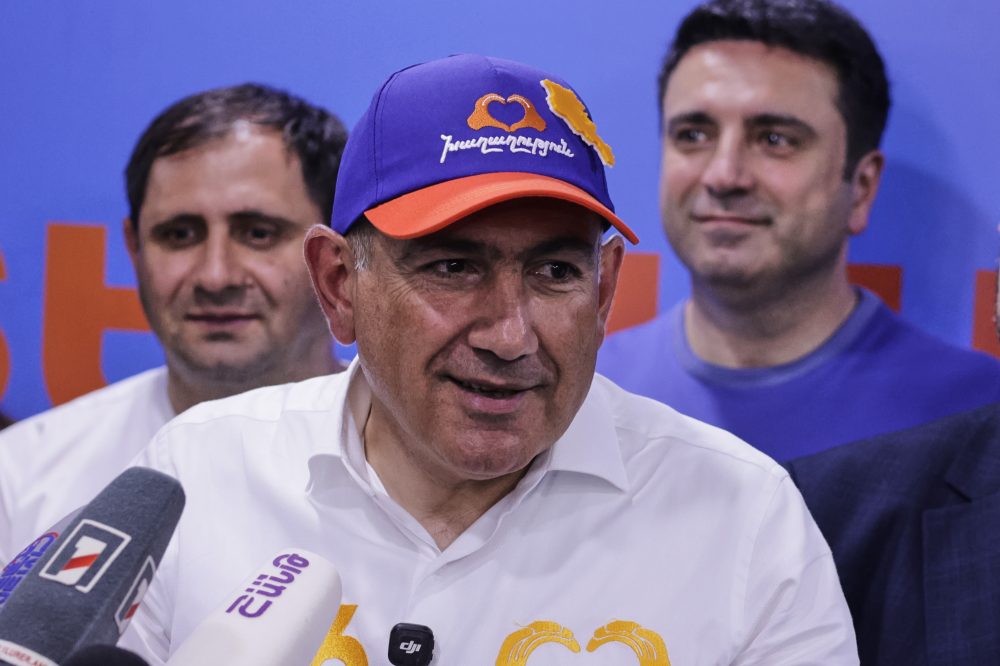
Armenia’s Central Electoral Commission has officially confirmed that Prime Minister Nikol Pashinyan’s party came out on top in the country’s recent general election — a vote seen as a defining moment for the nation’s future alignment between Russia and the West.
Final results released by the commission for the June 7 election showed Pashinyan’s ruling Civil Contract party capturing 49.7% of the vote, giving it enough support to form a government. The outcome reflects the Pashinyan administration’s push to deepen ties with the European Union and the United States, even as critics argue the country should maintain its longstanding relationship with Russia.
The pro-Russian opposition group Strong Armenia had urged the commission to throw out the results, claiming there were “widespread violations” during the voting process. Supporters of Strong Armenia and other opposition parties gathered outside the commission’s offices while officials worked to finalize the tallies.
The window between the June 8 preliminary results and the final certification gave political parties time to file formal complaints about any perceived problems with the election.
International election monitors from the Organization for Security and Co-operation in Europe (OSCE) said Armenian voters were given a “genuine choice” but noted the election took place amid “highly confrontational…divisive rhetoric” and “uneven campaign opportunities.” Armenian investigators had issued six arrest warrants against Strong Armenia members the day before the election, alleging they had been paying voters for their support.
Samvel Karapetyan, the billionaire leader of Strong Armenia — who built his wealth in Russia — is currently under house arrest. Authorities accuse him of calling for the overthrow of the government, a charge he has denied, calling it politically motivated.
Under Armenian law, the National Assembly must have at least 101 members, each serving five-year terms. Individual parties need at least 4% of the vote to gain entry, while coalitions of three or more parties must reach 8%. Civil Contract’s vote share translates to 64 seats in the assembly. Strong Armenia earned 29 seats, and the Armenia Alliance — led by former President Robert Kocharyan — received 12 seats.
Geopolitical questions dominated the campaign. As he cast his ballot on June 7, Pashinyan declared, “The European Union is our main partner in democratic reform implementation, and we will continue that path.” Armenia formally announced its ambition to join the EU last year.
Most opposition parties, Strong Armenia among them, ran on platforms favoring closer ties with Russia.
Russia, which maintains a military base inside Armenia, has cautioned that the country’s pivot toward the West could bring serious political and economic consequences. President Vladimir Putin has drawn comparisons between Armenia’s trajectory and Ukraine’s, making thinly veiled threats and suggesting Russia’s conflict with Ukraine began with Ukraine’s efforts to align with the EU.
In the weeks leading up to the vote, Moscow rolled out a series of trade restrictions targeting Armenian goods — including flowers, certain cognacs and wines, eggplant, potatoes, dried fruits, and fish. OSCE election monitors described these measures as “direct pressure” on Armenia’s election. Russia maintained the bans were tied to violations of agricultural import regulations.
European Commission President Ursula von der Leyen accused Russia of “weaponizing” economic relations and called the import bans “nothing short of economic coercion.” She announced that the EU would provide 50 million euros — roughly $58 million — in support of Armenia.
The relationship between Moscow and Yerevan deteriorated significantly after Azerbaijan reclaimed control of the Karabakh region, a mountainous area that had been held for decades by ethnic Armenian forces with backing from Armenia, stemming from a prolonged conflict between the two neighboring nations. Armenia blamed Russian peacekeepers stationed in the region for failing to prevent Azerbaijan’s military operation. Moscow, occupied with its war in Ukraine, rejected those accusations.
Pashinyan has taken gradual steps to distance Armenia from Russia, including joining the International Criminal Court in 2023 and suspending Armenia’s participation in the Moscow-led Collective Security Treaty Organization in 2024. Armenia also hosted the European Political Community summit and its first-ever summit with the EU in Yerevan in early May.
In August 2025, U.S. President Donald Trump brought Pashinyan and Azerbaijan’s President Ilham Aliyev together to sign an agreement aimed at ending their decades-long conflict, which included provisions for a new transit corridor connecting Azerbaijan to its exclave of Nakhchivan.
The victory of Graham Platner in last week’s Democratic Senate primary has added yet another candidate with a sharply anti-Israel stance to the list of contenders heading into November’s midterm elections.
Platner, who has a Nazi tattoo and has publicly referred to Israel’s military operations in Gaza as a “genocide,” is not an isolated case. Across the country, a rising number of Democratic primary candidates holding strongly anti-Israel positions are winning their races — and political observers are now asking whether views once seen as politically toxic have become increasingly mainstream within parts of the party.
Shmuel Rosner, a senior fellow at the Jewish People Policy Institute, told The Media Line that “it is becoming less and less of a liability for people to express views [about Israel or the Jews] that were once considered harmful for a political candidate.”
Just under a decade ago, such candidates were rare. The group that became known as the Squad — made up of Rep. Alexandria Ocasio-Cortez of New York, Rep. Ilhan Omar of Minnesota, Rep. Ayanna Pressley of Massachusetts, and Rep. Rashida Tlaib of Michigan — were frequently criticized for remarks that opponents characterized as antisemitic or hostile toward Israel. At the time, they were widely regarded as outliers.
By last November, however, Zohran Mamdani had been elected mayor of New York City — the American city with the largest Jewish population. Mamdani has accused Israel of genocide in Gaza and of operating an apartheid system.
Now, even more candidates with comparable views are winning Democratic primaries for seats in Congress and the Senate. Prof. Eytan Gilboa of Bar-Ilan University and Reichman University warned that if enough of these candidates win in November, the consequences for both U.S.-Israel relations and the future direction of the Democratic Party could be profound.
“This would be the first time in American history that we would have an anti-Israel Democratic president elected,” Gilboa told The Media Line. “And in general, if Congress is very anti-Israel, this would mean a disaster for Israel and American Jewry. I think we should really be very concerned.”
Gilboa pointed out that progressive Democratic candidates are increasingly being pushed to state clearly whether they believe Israel’s actions in Gaza amount to genocide. He recalled an incident in January when California State Senator Scott Wiener initially refused during a debate to use the word genocide and was met with loud booing and heckling. He later reversed course and said he did consider it a genocide following significant backlash.
Another candidate Gilboa highlighted is Chris Rabb, who won his Philadelphia primary and is expected to join the Squad. Rabb made his opposition to Israel and to AIPAC — the American Israel Public Affairs Committee — central themes of his congressional campaign.
In Michigan, Abdul El-Sayed, a Muslim and self-described progressive Democrat, is also running, with that state’s primary set for August. El-Sayed has repeatedly accused Israel of committing genocide in Gaza and has stated that he considers both Israel and Hamas to be “evil.”
Gilboa said American Jews who lean Democratic now face a difficult choice: vote for a candidate they view as anti-Israel, cast a ballot for a Republican who may not align with their other values, or stay home on Election Day.
Recent polling data reflects a broader shift in how Americans view Israel. According to the latest Pew Research Center survey, 60% of U.S. adults now hold an unfavorable opinion of Israel — up from 53% in 2025 and 42% in 2022. The same Pew report found that 59% of Americans have little or no confidence in Prime Minister Benjamin Netanyahu to act responsibly in world affairs.
Gilboa noted that while roughly two-thirds of Americans once viewed Israel favorably, that trend has now largely flipped. He added that “people especially don’t like Netanyahu and equate Netanyahu with Israel and with the Israeli people and with the Israeli state, and criticism went from criticizing certain Israeli policies to rejecting Israel’s right to exist.”
Rosner echoed that concern, pointing to a historical comparison: when President Gerald Ford moved in the 1970s to reassess U.S. relations with Israel, 80 senators signed a letter urging him to reconsider.
“I don’t see 80 senators doing similar things today for Israel or in support of an Israeli position and resisting the president,” Rosner said. “I think Israel is now much more dependent on the goodwill of the commander in chief.”
Gilboa also raised alarms about how many American Jews are responding to the trend. He cited polling showing that roughly 30% of American Jews voted for Mamdani, whom Gilboa regards as both anti-Israel and antisemitic.
“American Jews are not even understanding that antisemitism in the United States has very little to do with Israel and much to do with being a Jew in America,” Gilboa said. “They think that if Israel disappears, then their situation is going to be improved. And that’s complete nonsense.”
Rosner urged caution against drawing overly dire conclusions, but said action is needed. He argued that Israel must work to rebuild goodwill among both the American public and political leaders.
“If there’s a way for Israel to improve its image with the American public and with the American political elite, I think it is essential that Israel do such a thing sooner rather than later,” Rosner told The Media Line.
He also said Israel needs to prepare for a future in which it cannot count on American backing to the same degree it once did — though he does not believe U.S. support will disappear entirely.
Rosner further noted that Israel will hold its own elections before the U.S. midterms, and suggested that a change in government and the departure of Netanyahu could help improve the country’s image internationally.
“We could say it is a different era for Israel, and everything you thought about Israel in the last four years, let’s forget about it and start from scratch,” Rosner said. “I’m not sure this is going to work, but at least it will provide Israel with an opportunity for a restart.”
Whether that reset happens remains uncertain. But with a growing number of candidates running on platforms sharply critical of Israel, this November’s midterm elections may serve as one of the clearest signals yet of how dramatically the American political landscape has shifted.
Qatari mediators flew to Tehran on Sunday as part of an urgent diplomatic mission coordinated with the United States, aimed at keeping a proposed peace agreement from collapsing, according to CNN.
The negotiators departed from Doha in an effort to close the remaining gaps between Washington and Tehran after a breakdown in the ceasefire raised fears that talks aimed at ending the conflict and reopening the Strait of Hormuz could fall apart.
A source with knowledge of the talks told CNN that plans for an in-person signing ceremony between both sides were scrapped due to logistical hurdles and concerns that any delays could threaten the already fragile ceasefire. The two sides shifted instead to the idea of an electronic signing process.
Several major issues remain unresolved, including the size of Iran’s uranium enrichment stockpile and Tehran’s reported push to charge ships a fee for passing through the Strait of Hormuz — a proposal the United States has rejected.
The mediation push comes as Iranian officials and media organizations publicly disputed claims that a memorandum of understanding would be signed Sunday.
President Donald Trump posted on Truth Social Saturday that a deal was “scheduled to get signed” the following day. Pakistani Prime Minister Shehbaz Sharif echoed that optimism, writing on X: “We are closer to a peace deal than ever before. With finalisation likely expected in the next 24 hours.”
But a media outlet connected to the Revolutionary Guards flatly rejected that timeline, saying senior Iranian negotiators had made clear the agreement “has not yet been finalized and will certainly not be done on Sunday.”
That same outlet took aim at what it described as President Trump’s “unusual insistence” on a Sunday signing, suggesting the push was tied to the president’s 80th birthday.
President Trump had previously indicated that Vice President JD Vance would attend a signing ceremony in Europe. The president is set to travel to France for the G7 summit.
According to CNN, Qatar’s active role in the mediation reflects the stakes Doha has in reaching an agreement, after Iranian missile strikes hit critical Qatari energy infrastructure during the conflict. The report noted that Qatar has pursued diplomatic channels with Tehran in hopes of preventing further damage to its energy facilities and helping bring the regional blockade to an end.
Twelve people lost their lives when a plane went down Sunday in Butler, Missouri, according to the Missouri State Highway Patrol.
The highway patrol announced the fatalities via social media, though no additional details about the circumstances of the crash have been made public at this time.
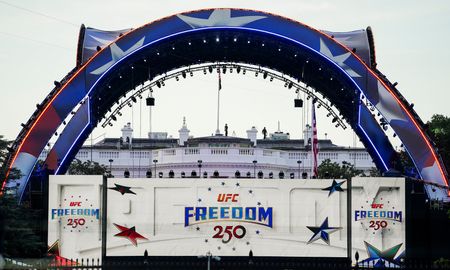
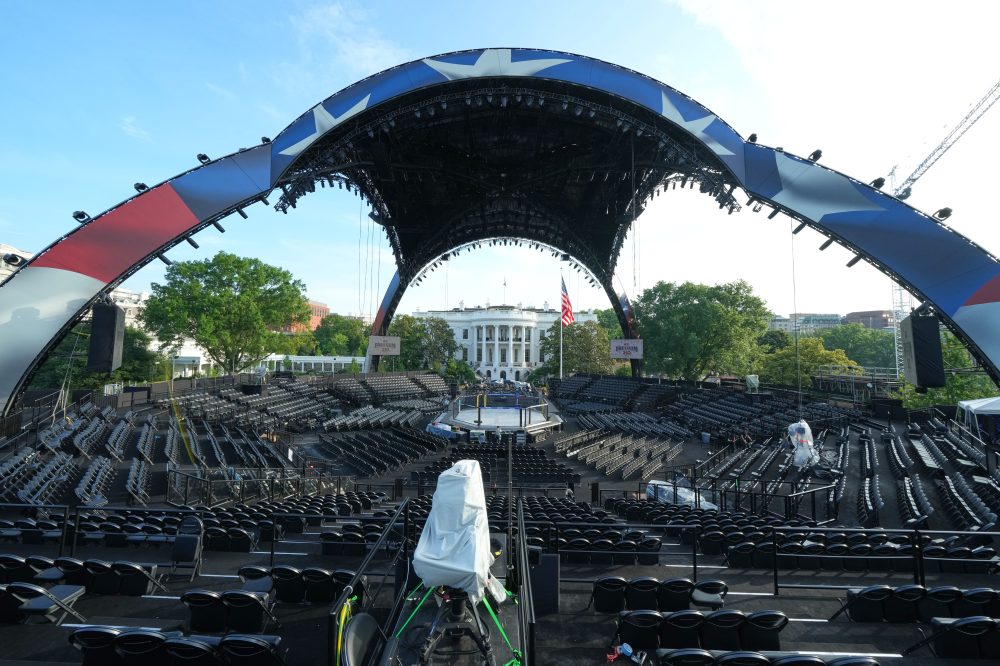
Three major events are set to converge on June 14 — Flag Day, a high-profile UFC fight event at the White House, and President Donald Trump’s 80th birthday.
A formal proclamation from the White House has designated June 14 as Flag Day and the seven days that follow as National Flag Week. The declaration recognizes the Stars and Stripes as a powerful symbol of American freedom, democracy, and national unity.
As part of the observance, the president has instructed appropriate government officials to raise the US flag over all federal buildings. Citizens across the country are also being encouraged to display the flag at their homes and businesses and to recite the Pledge of Allegiance.
The proclamation traces the holiday back to June 14, 1777, when the Second Continental Congress formally adopted the first official Flag Resolution.
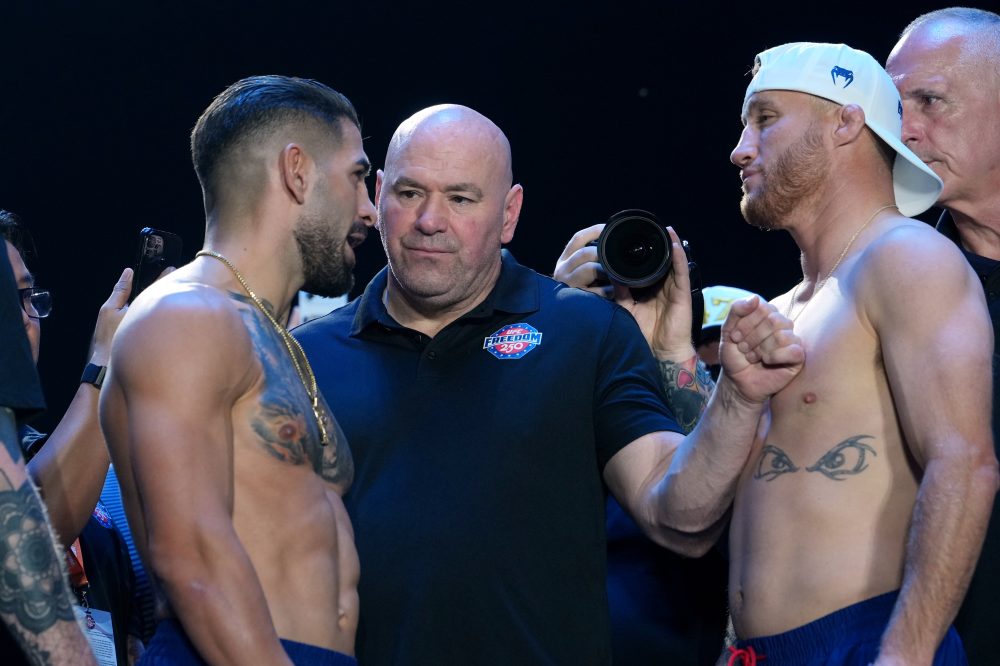
Also taking place that Sunday is Freedom 250, a mixed martial arts event organized by the Ultimate Fighting Championship (UFC) on the South Lawn of the White House in Washington, DC. The event’s name is a nod to the 250th anniversary of the United States Declaration of Independence, a milestone often referred to as the semiquincentennial.
During the Freedom 250 event, the Department of War is set to unveil its very first television commercial, a short video titled “Peace Through Strength.” Organizers say the ad is designed to celebrate the men and women of the US armed forces and will be shown to the audience during the program.
The festivities round out with a personal milestone — June 14 also marks President Trump’s 80th birthday, making it a day packed with national, sporting, and personal significance.
Colonel Netanel Lasri, known to colleagues as Nati, has died at the age of 40 following a three-year struggle with cancer. At the time of his passing, he was serving as head of the Planning Department within the Israel Defense Forces Ground Forces Command and had previously led the Golan and Hermon Brigade. He is survived by his wife and three children.
Throughout his military career, Lasri was considered one of the most talented and well-respected officers within the IDF’s Armored Corps and combat divisions.
Lasri was born in Lod and participated in the city’s Scouts movement before enlisting in the IDF in 2004, joining the 401st Armored Brigade. Over the course of more than two decades of service, he took part in numerous significant Israeli military operations.
During the Second Lebanon War, he served as a tank crewman. He went on to fill several command roles within the Gaza Division, including serving as a battalion operations officer during Operation Cast Lead and as a deputy company commander during Operation Hot Winter.
While leading an operational company in the 52nd Battalion, Lasri directed forces in halting a complex terrorist attack near the area where the borders of Israel, Egypt, and Gaza converge. That mission earned him a formal commendation from the Gaza Division commander.
His leadership during Operation Pillar of Defense as a company commander was recognized with a certificate of excellence presented by the IDF chief of staff.
Lasri also took part in Operation Protective Edge, this time commanding the Tank Commanders Course training company. He later served as deputy commander of the 52nd Battalion and as an aide to the head of the Operations Directorate.
From 2019 through 2021, he commanded the 9th Battalion, and afterward served as operations officer of the 162nd Division.
In August 2023, Lasri was appointed to lead the Golan and Hermon Brigade, a post he held through April 2024. Despite his ongoing illness, he took on his final assignment in May 2025, heading the Planning Department within the Ground Forces Command.
Over the course of his service, Lasri received the IDF chief of staff’s citation along with several other military honors and commendations.
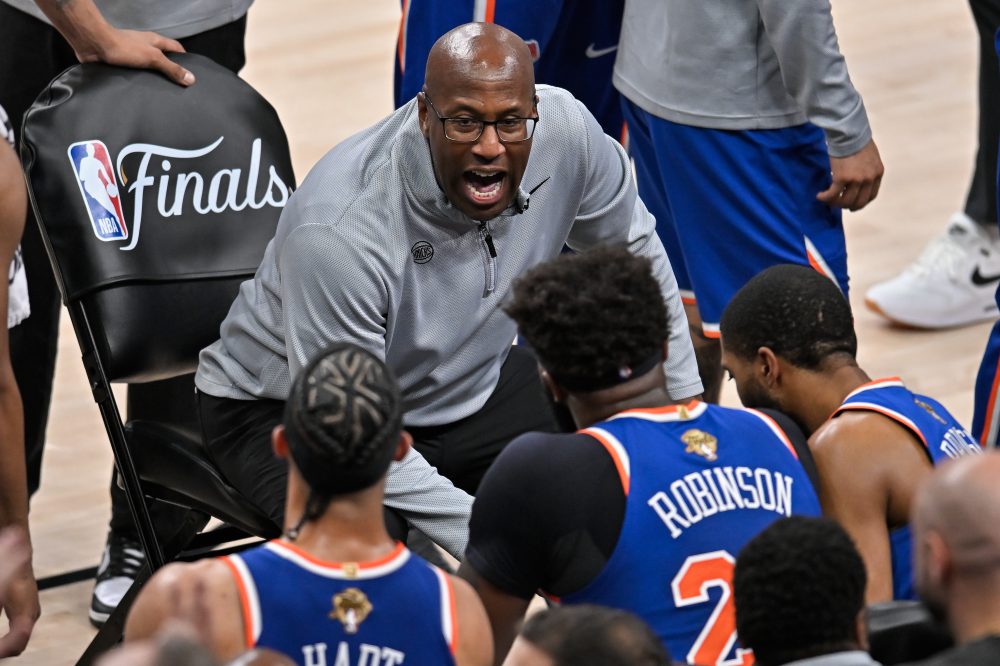
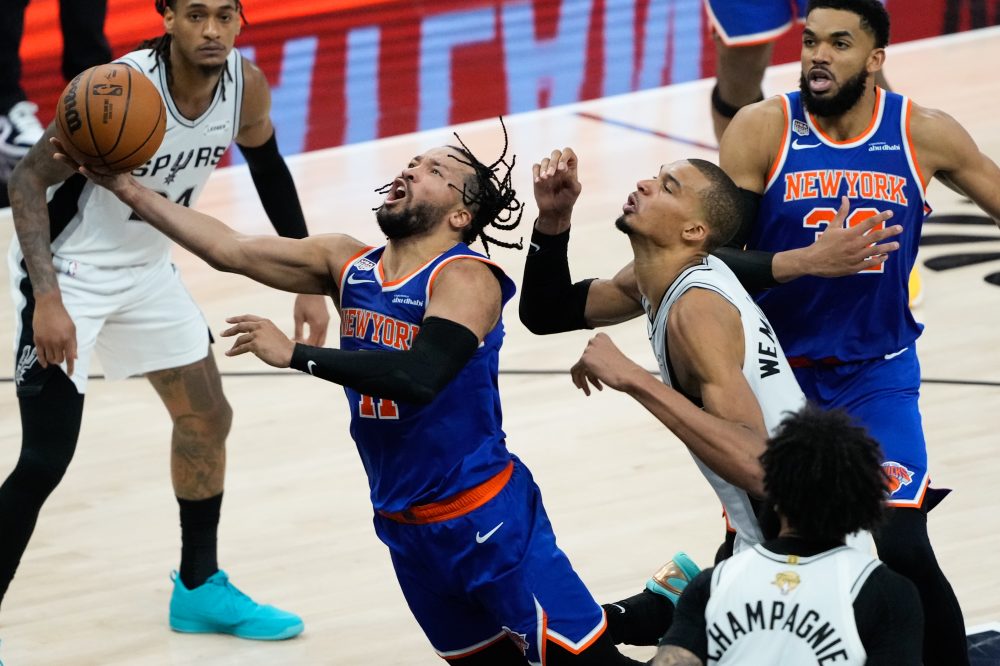
SAN ANTONIO — When the New York Knicks fired Tom Thibodeau last spring and began searching for a new head coach, Mike Brown did not appear to be at the top of their list. Reports linked the franchise to at least six other candidates from around the league before Brown ultimately got the job.
Looking back now, it’s hard to argue with the decision.
Brown has now been part of five NBA championship teams — four as an assistant coach and one as a head coach. His latest ring came with the Knicks, making him just the second coach in franchise history to win a title with New York, joining the legendary Red Holzman. In a remarkable coincidence, Brown claimed the championship on June 13 — a date that carries deep meaning for the organization. Madison Square Garden features a banner reading “Holzman 613” honoring his career win total with the team. Brown’s title came on 6/13.
“I’m pretty good at trying to control what I can control,” Brown said. “I had zero control over who else was interviewing, who was denied permission. I had zero control over that. I just did the best I could in the interview process. I went about my business and waited until it was either going to progress or end. … I was pretty nonchalant about it as time went on. I just let it unfold the way it unfolded.”
Brown has deep roots in San Antonio, where his family still lives, and where the Knicks wrapped up the championship by beating the Spurs in five games. He credits his time working under Gregg Popovich in San Antonio and alongside Steve Kerr in Golden State as formative experiences in his coaching career.
His championship résumé stretches back to 2003, when he was an assistant on the Spurs’ title-winning squad. He later collected three more rings as an assistant with the Warriors. Along the way, he was named the NBA’s Coach of the Year twice — once with Cleveland in 2009 and again with Sacramento in 2023 — yet both franchises eventually let him go.
In New York, however, his legacy is now cemented forever.
“Mike was invaluable to this run,” said Knicks forward Josh Hart. “He understands what it is to be a champion. He understands how to build a team, how to build habits that will put you in this position. We’re so grateful, so thankful to have him at the top. He kept us even so many times. He’s brought the best out of us, as people first. I’m so happy for him. He’s the reason why we’re here. He’s the reason why we’re here, and we’ve got love for him.”
Brown remained steady throughout the postseason, even when the Knicks fell behind 2-1 in the first round against Atlanta following back-to-back one-point losses. Critics flooded social media questioning whether he was the right person for the job. Brown never wavered.
New York went 15-1 the rest of the way, ending a 53-year championship drought for the franchise.
“I am so tired. I mean, I’m gassed,” Brown admitted. “You know, this stuff is harder than what you think.”
He may say that, but from the outside, he made it look effortless.
NEW YORK (AP) — Steven Spielberg’s newest film, “Disclosure Day,” kicked off its theatrical run with an estimated $44 million in domestic ticket sales over its opening weekend, according to studio figures released Sunday.
The film performed largely in line with projections, pulling in $92.9 million globally during its debut weekend. For the 79-year-old Spielberg, who developed the story behind the film, it marks his best opening weekend ever for an original movie — not adjusted for inflation.
Spielberg is widely credited with creating the modern blockbuster era, but “Disclosure Day,” released by Universal Pictures, is his first summer film in a decade. The movie arrives in a vastly changed theatrical landscape compared to the days of “Jaws” or “Jurassic Park.” Its closest box office rival was the independent horror film “Obsession,” helmed by YouTuber-turned-director Curry Barker — who is more than 50 years younger than Spielberg.
Jim Orr, Universal’s distribution chief, noted the film’s broad appeal across North America. “It played very, very evenly across all of the U.S. and Canada,” he said. “It did not come across as a coastal big-market movie. It resonated with everybody.”
Despite concerns that a widely watched NBA Finals game might pull viewers away from theaters — particularly in New York — Orr said Saturday night ticket sales in the city showed no notable drop-off.
While younger moviegoers have been driving attendance in recent weeks, “Disclosure Day” attracted a somewhat older crowd. About 41% of the film’s audience was 45 years of age or older.
Orr expressed optimism about what that demographic means for the film’s long-term performance. “What’s encouraging is that we had this big an opening with that audience demographic and with the fact that it’s an original film,” he said. “So if we’re opening this well, and we think we’re going to have great word-of-mouth, and we have an older audience that doesn’t necessarily rush out on opening weekend, all of that points to a great run through the summer.”
The movie brings Spielberg back to the topic of extraterrestrial life. Emily Blunt, Josh O’Connor, and Colman Domingo lead the cast in a story centered on a race to expose government-held evidence of UFO encounters. The film carried a production budget of $115 million.
Like most original films, “Disclosure Day” will need to hold strong at the box office over the coming weeks to be considered a full success. Critics have responded positively — the film holds an 80% approval rating on Rotten Tomatoes — though general audiences were somewhat less enthusiastic, giving it a “B” grade on CinemaScore.
Paul Dergarabedian, head of marketplace trends for Rentrak, offered a measured take on the debut. “It’s off to a solid start,” he said. “Let’s see how it plays in the coming weeks. If it holds like some of these other films have, like ‘Project Hail Mary,’ ‘Michael,’ ‘Obsession,’ it will be in good shape. Staying power has been the bread and butter of this year and this summer.”
The indie sensation “Obsession” shows no signs of fading. The Focus Features release, which originally opened to $17.2 million, has now topped that figure in four consecutive weekends. This past weekend it brought in $19 million, lifting its total North American earnings to $188.3 million and its worldwide gross to $286.5 million. The film cost less than $1 million to produce, and Focus acquired it for $15 million — making it one of the most profitable releases in recent memory.
Last weekend’s chart-topper, “Scary Movie,” slipped to third place with $14.5 million. The Paramount Pictures release — the sixth installment in the horror spoof franchise, produced by Miramax — fell sharply from its opening weekend, down 73%. Still, with a production budget of just $30 million, the film has already proven to be a notable financial success, accumulating $88.6 million domestically over two weeks.
A24’s “Backrooms” added $11.3 million in its third weekend of domestic release, bringing its global total to $262.3 million. Amazon MGM’s “Masters of the Universe” continued to struggle in its second weekend, dropping 71% to $8.7 million. Its two-week domestic total now stands at $46.7 million.
Looking ahead, The Walt Disney Co.’s “Toy Story 5” is set to open next weekend with considerable box office expectations.
The following estimated ticket sales cover Friday through Sunday at U.S. and Canadian theaters, per Rentrak, with final domestic figures due Monday:
1. “Disclosure Day” — $44 million 2. “Obsession” — $19 million 3. “Scary Movie” — $14.5 million 4. “Backrooms” — $11.3 million 5. “Masters of the Universe” — $8.7 million 6. “Star Wars: The Mandalorian and Grogu” — $4.7 million 7. “Michael” — $4.1 million 8. “The Furious” — $2.8 million 9. “Stop! That! Train!” — $2 million 10. “The Amazing Digital Circus: The Last Act” — $1.8 million
WASHINGTON — An oil tanker disabled by the U.S. military while attempting to break through America’s blockade of Iran had brushed off nearly 60 verbal warnings and multiple demonstrations of military force before U.S. forces ultimately opened fire, a U.S. official has revealed to The Associated Press.
According to the official, who was not authorized to speak publicly on the sensitive matter and requested anonymity, the ship’s crew also disregarded eight shows of force from military aircraft — including flares and flyovers — along with two final warnings before shots were fired on Wednesday.
Earlier in the week, the U.S. military disclosed that an American aircraft fired what it called “precision munitions” into the engine room of the Palau-flagged vessel M/T Settebello. Indian officials confirmed that three Indian sailors lost their lives in the strike, which took place in the Gulf of Oman.
The U.S. official characterized the vessel as part of a so-called shadow fleet used to illegally move Iranian oil and sidestep international sanctions. The official also noted the ship had been observed attempting to breach the blockade on multiple occasions, and that U.S. forces had communicated with the vessel dozens of times over a two-week period leading up to the day it was disabled.
In an official statement, U.S. Central Command said American forces gave the ship’s crew a 15-minute window to evacuate the engine room before firing the shots that put the vessel out of commission.
“After being in place for more than 60 days, it should be clear by now that U.S. forces will strictly enforce the blockade,” the statement read.
India’s foreign ministry announced that New Delhi had filed a “strong protest” with the United States over the deaths of its citizens.
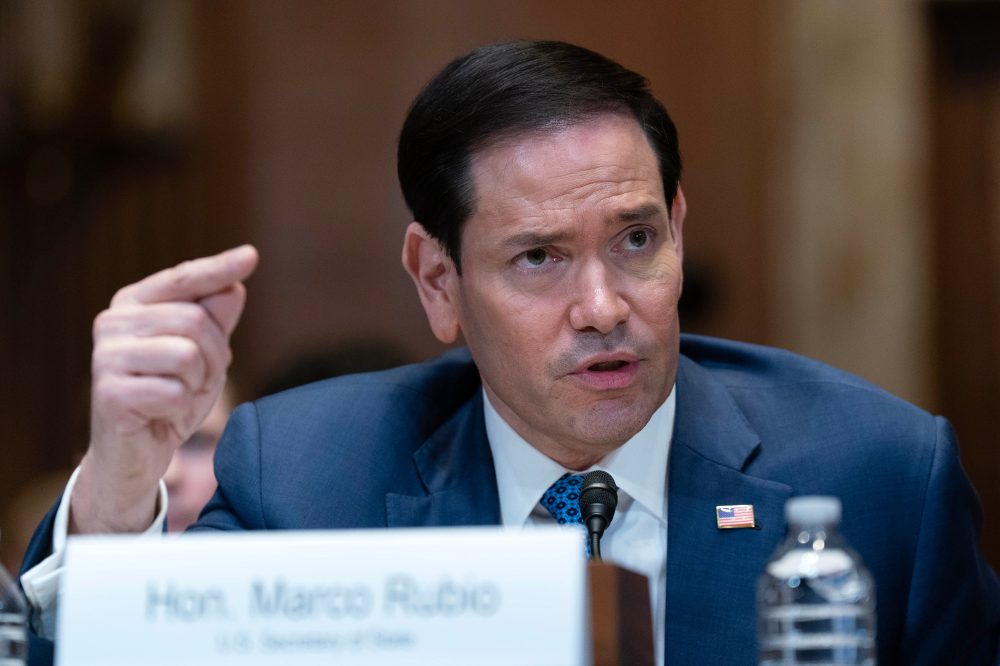
Secretary of State Marco Rubio spoke by phone with his Indian counterpart on Friday, conveying “that all commercial vessels should immediately comply with orders from U.S. forces as they seek to uphold peace and security in the Strait,” according to a summary of the conversation released by the State Department on Saturday.
A federal judge has thrown out a lawsuit filed by a former Yosemite National Park ranger who was let go after hoisting a massive transgender pride flag on one of the California park’s most recognizable landmarks.
U.S. District Judge Jennifer Thurston issued her ruling on Friday, determining that Shannon “SJ” Joslin — who identifies as nonbinary and uses the pronoun they — is required to work through the process established under the Civil Service Reform Act. Because Joslin was still in a probationary period when they were terminated last year, that process means filing a complaint with the Office of Special Counsel, which Joslin has already done.
According to court documents, the Office of Special Counsel rejected Joslin’s initial request to pause their termination while an investigation into potential Park Service violations takes place. A final decision is expected in August.
Joslin, who worked as a biologist studying bats, said they helped hang a 66-foot-wide transgender pride flag on El Capitan for roughly two hours on May 20, 2025, before voluntarily taking it down. The flag was displayed on Joslin’s day off, not during working hours.
In a previous interview with The Associated Press, Joslin explained their motivation, saying the act was their way of expressing, “We’re all safe in national parks.”
The termination letter Joslin received in August 2025 accused them of “failing to demonstrate acceptable conduct” and pointed to the flag display as the reason. The letter stated, “You participated in a small group demonstration in an area outside the designated protest and demonstration area without a permit … and thus circumvented rules applicable to all park visitors.”
Many national parks have set aside designated “First Amendment areas” where groups of 25 or fewer people may demonstrate without needing a permit. Yosemite has several such zones, including one in Yosemite Valley, the area where El Capitan stands.
Joslin’s lawsuit names the National Park Service, the Department of Interior, and other defendants, alleging constitutional violations including infringement of free speech rights. Court filings describe the termination as “vindictive, retaliatory, intended to communicate disapproval of a particular point of view.” Joslin also noted that while others have flown flags on El Capitan before, they are unaware of anyone else facing punishment for doing so.
In her ruling, Judge Thurston acknowledged that the federal civil service process leaves probationary workers like Joslin with very few options when a termination decision goes against them. However, she noted that allowing probationary employees to bypass that process and go straight to the courts would actually give them more avenues than employees with full tenure have.
The day after Joslin’s flag display, Yosemite put in place a new rule banning the hanging of banners, flags, or signs larger than 15 square feet in areas of the park classified as “wilderness” or “potential wilderness.” According to Yosemite’s website, that classification covers 94% of the park.
The new rule came in the wake of another notable demonstration that took place in February 2025, when a group of protesters hung an upside-down American flag on El Capitan to protest the dismissal of National Park Service employees by President Donald Trump’s administration.
The Kansas City Royals announced Sunday that first baseman Vinnie Pasquantino has been placed on the 10-day injured list after sustaining a right hamate fracture.
The injury occurred during Saturday’s 8-7 defeat against the Houston Astros, when Pasquantino appeared to hurt himself while taking a swing in the fifth inning and had to leave the game.
Following his departure, the Royals reshuffled their lineup. Isaac Collins entered the game in left field, while Jac Caglianone moved from right field to cover first base. Lane Thomas then shifted from left field to right field to round out the adjustments.
Catcher Carter Jensen expressed how much the team will miss Pasquantino’s presence. “It stinks a lot. He’s a big part of our team,” Jensen said. “He’s a leader on this team, so seeing him go down, it’s never fun. But we’re backing him up and wishing him a speedy recovery [so he can] get back and help us win some games just like he does every night.”
Through 68 games this season, Pasquantino, 28, is posting a career-low .224 batting average with six home runs and 32 RBIs. Over five seasons with Kansas City, he carries a .260 career average with 76 homers and 294 RBIs. His standout 2024 campaign saw him slug 32 home runs and drive in 113 runs across 160 games.
In a corresponding move, the Royals called up outfielder John Rave from their Triple-A affiliate in Omaha. The 28-year-old Rave has been productive at that level this season, batting .278 with 10 home runs and 32 RBIs in 60 games. Last year with Kansas City, he hit .196 with four homers and 14 RBIs in 72 games.
Oklahoma City Thunder guard Nikola Topic has had surgery on his lower back and is anticipated to be healthy and ready when training camp opens for the 2026-27 NBA season.
The team announced Topic underwent a minimally invasive lumbar microdiscectomy, a procedure that, according to Johns Hopkins Medicine, corrects a bulging disk in the lower back. Dr. Andrew Dossett carried out the operation at the Carrell Clinic in Dallas, with Thunder medical staff present throughout.
Topic was selected by Oklahoma City with the 12th overall pick in the 2024 NBA Draft. The 6-foot-6 point guard came to the league from Serbia, but his early professional career has been marked by significant health challenges.
He was unable to play his entire rookie season after suffering a knee injury before the draft. Then, heading into the 2025-26 season, he was diagnosed with testicular cancer and had to undergo treatment before returning to the court.
The 20-year-old eventually appeared in 10 games for the Thunder last season, putting up averages of 5.2 points and 4.4 rebounds in 16.0 minutes per outing. In his limited playing time, he connected on 40.0 percent of his three-point attempts, going 9-for-15 from beyond the arc.
Topic is not expected to participate in the NBA summer league in July as he recovers from the procedure.
Brooks Koepka has officially withdrawn from the RBC Canadian Open after a hand injury made it nearly impossible for him to grip his golf club during the tournament’s third round.
The 36-year-old five-time major champion announced his withdrawal Sunday morning from the event held in Caledon, Ontario. The decision came after he battled through a difficult 2-over-par 72 on Saturday, during which he was seen receiving medical treatment on the 11th tee box at TPC Toronto at Osprey Valley’s North Course.
Koepka described the frustrating situation with his grip. “Yeah, I don’t know what it is. I’m struggling to grip the club with my ring finger and pinkie finger, so can’t grip it,” he said.
He added that the problem persisted throughout the day. “So the club is kind of just, my fingers would come loose, it was kind of numb. I don’t know what the deal was but hopefully we’ll figure it out.”
What made the injury especially puzzling was that Koepka felt completely healthy during his warm-up. “Yeah, the whole warm-up, I felt fine, I was absolutely good,” he explained. “Then got to the range and went to grip the club and I just couldn’t even grip it.”
“So it lasted — it was all day. Felt better the last few holes. I don’t know if that’s just the meds kicked in or what it is. But hopefully we’ll figure it out now,” he continued.
Koepka had entered Saturday’s round in strong form, having posted rounds of 64 and 68 to open the tournament.
The injury comes at a particularly critical time — the U.S. Open tees off next week at Shinnecock Hills in Southampton, New York. That course holds special significance for Koepka, as it was the site of his second consecutive U.S. Open title back in 2018.
Koepka returned to the PGA Tour in January after spending more than three years competing with LIV Golf. While he has finished in the top 20 in six events this season, his last victory in a standard PGA Tour event dates back to the 2021 WM Phoenix Open.
U.S. President Donald Trump reached out to Russian President Vladimir Putin by phone on Sunday, expressing that bringing the war in Ukraine to a close is critically important and that he stands ready to play a role in making that happen, according to Kremlin adviser Yuri Ushakov, as reported by Russian news agencies.
Ushakov further revealed that during the call, Trump informed Putin that a deal to end the conflict with Iran was close to being finalized. The Russian leader reportedly expressed relief that the fighting would be coming to an end.
In addition to the weighty diplomatic discussions, Ushakov noted that Putin took a moment to wish Trump a happy 80th birthday in what was described as an “informal” manner.
Swiss authorities deployed tear gas Saturday against protesters who descended on United Nations buildings in Geneva, according to a Reuters witness on the scene.
The demonstrators, who were rallying in opposition to a G7 summit being held across the border in France, directed their anger at UN facilities in the Swiss city. Some in the crowd hurled stones at a UN telecommunications building, while others threw flares as police worked to push them away from the site.
Northbound Route 1 is closed at the Drawer Creek Bridge due to an incident, according to transportation officials.
Motorists traveling in the area are advised to avoid the roadway and plan for alternate routes until the closure is lifted. No further details regarding the nature of the incident have been released at this time.
Drivers should monitor traffic conditions and allow for extra travel time as crews work to address the situation.
The Dover Police Department is looking into a shooting that took place in the early morning hours of Saturday, June 13, 2026, in the Emerald Pointe neighborhood on Topaz Circle.
Officers were called to the 300 block of Topaz Circle at around 4:56 a.m. after reports of gunfire in the area. Investigators determined that one or more unknown suspects opened fire on an occupied home at approximately 4:52 a.m. Three people were inside the residence at the time — a 66-year-old man, a 51-year-old woman, and a 20-year-old man. Fortunately, none of them were injured. A closer look at the home revealed at least 21 bullet strikes on the outside of the structure. Officers searching the surrounding area also recovered multiple spent shell casings from a nearby property.
The investigation remains active and ongoing. Anyone who may have information about this incident is encouraged to reach out to the Dover Police Department at (302) 736-7111. Callers who wish to stay anonymous may do so. Tips can also be submitted through Delaware Crime Stoppers by calling 800-TIP-3333 or by visiting www.delaware.crimestoppersweb.com online. A cash reward could be available for any tip that leads to an arrest.
Investment bank Lazard is reportedly making a late move to push out Centerview Partners as Venezuela’s financial advisor, offering to handle one of the largest sovereign debt restructurings ever recorded — and at a significantly reduced cost, according to a Bloomberg News report published Sunday.
According to Bloomberg, Lazard has put forward a fee of $25 million, which is a small fraction of the $150 million or more that Centerview had been negotiating with the Venezuelan government as recently as last month. Bloomberg cited a letter sent Friday to interim Venezuelan President Delcy Rodriguez as the basis for the report.
Reuters was unable to independently verify the information. Lazard, Centerview, and Venezuela’s Ministry of Communication and Information had not responded to requests for comment at the time of publication.
Venezuela announced in May that it had brought on U.S.-based financial services firm Centerview to help manage the restructuring of both its sovereign debt and the debt of state oil company PDVSA. That announcement gave a boost to bond prices at the time.
Bloomberg reported, citing a draft contract, that Centerview had discussed terms including a monthly retainer of $750,000 along with a success fee equal to 0.1% of the total debt restructured — a figure that would amount to somewhere between $150 million and $200 million.
However, Reuters had previously reported that concerns were raised among investors and government officials about the fairness and transparency of Centerview’s appointment, given that no formal competitive bidding process was held.
Venezuela ranks among the world’s largest cases of sovereign default, with approximately $60 billion in outstanding defaulted bonds between the government and PDVSA. Analysts believe total liabilities — including arbitration judgments and accumulated interest — could surpass $150 billion.
Whoever serves as Venezuela’s financial advisor will be responsible for shaping the country’s debt strategy and guiding negotiations with creditors. Venezuela first defaulted on its debt under former President Nicolas Maduro in 2017. The outcome of these negotiations will determine how much creditors are repaid and will play a major role in shaping Venezuela’s long-term financial stability.
The confetti has barely settled, and the NBA is already looking ahead to next season.
The New York Knicks are set to be honored with a championship parade through the streets of Manhattan on Thursday, capping off a postseason run in which they overcame six double-digit deficits to win games, including all four of their victories in the NBA Finals against the San Antonio Spurs.
The title adds to a remarkable stretch of parity across the league. Eight different franchises have won championships over the past eight seasons — Toronto in 2019, the Los Angeles Lakers in 2020, Milwaukee in 2021, Golden State in 2022, Denver in 2023, Boston in 2024, Oklahoma City last year, and now New York.
NBA Commissioner Adam Silver reflected on what that means for the sport. “To me, it just really speaks to the state of NBA basketball and the state of the future of the game,” Silver said. “And now with this draft class coming in this year — again, not just the first pick, but a draft that’s considered the deepest in many years — there’s so much talent everywhere. … So, it’s a really bright future ahead for the league.”
While the Knicks celebrate, the other 29 franchises are left searching for answers heading into the offseason. Here are some of the biggest questions facing the league this summer.
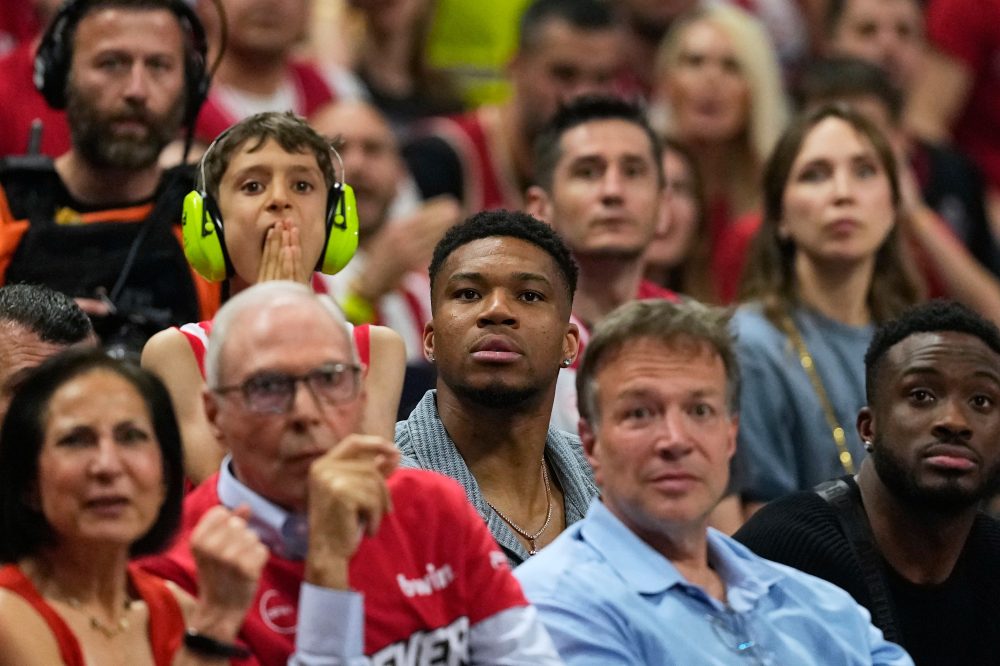
Will Milwaukee actually move on from Giannis Antetokounmpo? The superstar forward has spent 13 seasons with the Bucks, earned 10 All-Star selections, won two Most Valuable Player awards, and helped deliver a championship to Milwaukee in 2021. This fall, he becomes eligible for a contract extension worth as much as $275 million. But the Bucks currently don’t have a roster capable of competing for a title, and it appears Antetokounmpo’s primary focus is on winning more championships.
Bucks co-owner Jimmy Haslam addressed the situation in May when the team introduced new head coach Taylor Jenkins — who was informed that Antetokounmpo’s status with the franchise heading into next season remains uncertain. “I just think before the draft is a natural time, right, because if Giannis does play somewhere else we’re going to get a lot of assets. … You’ve got to get it right,” Haslam said.
The NBA Draft is scheduled for next week, and if Milwaukee intends to trade Antetokounmpo, doing so before the draft would give the team a clearer picture of how to use whatever assets they receive in return. Miami has been part of trade discussions involving Antetokounmpo for months, and the Heat are once again in talks with the Bucks.
Meanwhile, LeBron James has never entered an offseason with more options. The Lakers star could return to Los Angeles for a ninth season, seek a new team for what would likely be a final chapter in his career, or even retire. He could push for a maximum contract or accept less money to help a contender. He could also, apparently, keep posting golf videos on social media — James has developed quite the passion for the game.
“When the time comes, you guys will know what I decide to do,” James said after the Lakers were eliminated in a 4-0 sweep by Oklahoma City this spring.
Los Angeles has other roster decisions to work through as well, including a potential extension for Austin Reaves. But clarity on James’s plans will likely set the tone for everything else the franchise does this summer.
In San Antonio, Victor Wembanyama is eligible for a four-year extension that would exceed $250 million, beginning in the 2027-28 season. There is no indication the Spurs would hesitate to lock up the league’s most captivating player. With most of their starters already under contract, San Antonio is expected to enter next season as one of the top favorites — if not the frontrunner — for the 2027 NBA title.
“Competitiveness, that’s what makes you better,” Spurs coach Mitch Johnson said. “That’s what pushes you to continue to improve in the dark, long hours when nobody is around. We improved a whole lot this year. We have … more motivation to continue to get better.”
Oklahoma City’s general manager Sam Presti offered some perspective on just how difficult it is to repeat as champions after the Thunder’s own title defense came up short. “The history of the NBA is littered with teams that were not able to find ultimate success again,” Presti said. “I think there have only been three teams that have repeated since we’ve been in Oklahoma City, and the reasons for that are many, probably too many to list. But the fact is that it helps illustrate how rare and how special it is when you do have a chance to win at the highest level in this league or in professional sports in general. However, NBA history is also built on the backs of those teams that saw their losses as a continued quest for improvement and progress.”
Other notable offseason storylines include Washington holding the No. 1 pick in the upcoming draft, coaching vacancies in Chicago, Dallas, and Portland — where interim coach Tiago Splitter remains a candidate — and an ongoing league investigation into whether a $28 million endorsement deal between Kawhi Leonard and a California-based sustainability services company allowed the Los Angeles Clippers to get around salary cap rules. The NBA has not yet announced any findings from that inquiry.
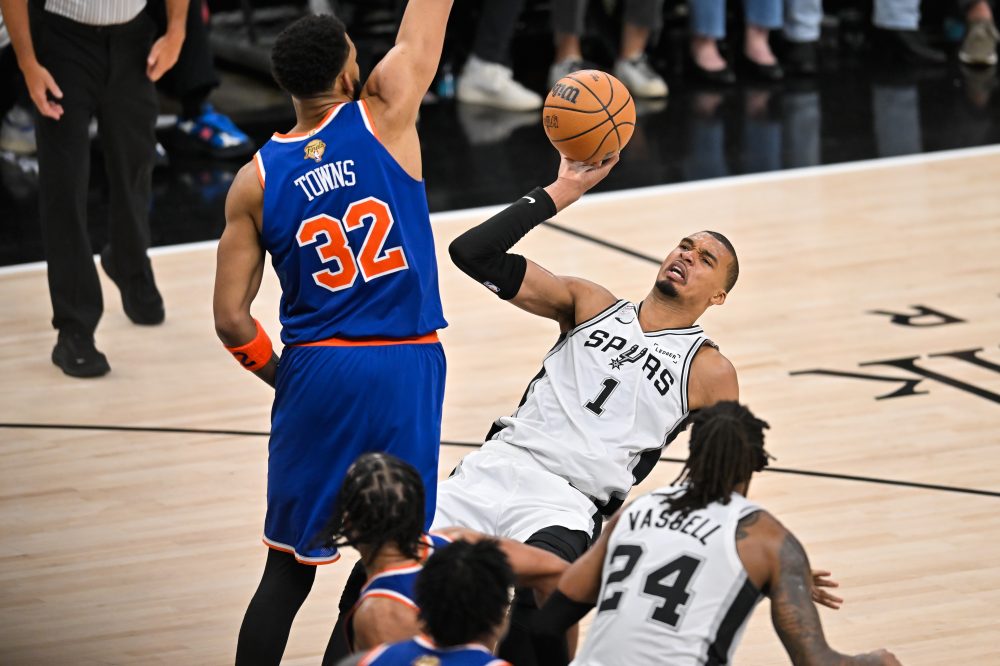
SAN ANTONIO — For the second time in three years, Victor Wembanyama had to stand and watch another team celebrate a championship on his turf.
There is no question the Wemby era has arrived in the NBA. The 7-foot-4 French phenom swept the Defensive Player of the Year voting unanimously this season, landed third in MVP consideration, and earned a first-team All-NBA selection — the first of what could be many if his plans come to fruition.
But the one thing he wants most continues to slip away. Back in 2024, he watched through tears as the United States celebrated Olympic gold at the Paris Games. Now, he had to endure a similar scene as the New York Knicks popped champagne in San Antonio on Saturday night, winning Game 5 of the NBA Finals to claim their first championship in 53 years.
“This is the biggest lesson of my life, the biggest learning moment,” the 22-year-old said. “I can’t tell you exactly what the lesson is, but we’re learning from that, for sure. I’m learning more than any other time in my life before.”
Wembanyama’s Finals numbers were impressive — 26 points, 11.2 rebounds, and 3.6 blocks per game — but they weren’t enough to bring home a title.
The series will also be remembered for some critical miscues. In Game 2, a Wembanyama turnover set up the go-ahead free throw for Jalen Brunson, and he also missed a buzzer-beating jump shot in that same contest. In Game 4, he missed two key free throws with 1:47 remaining as San Antonio squandered a 29-point advantage — the largest collapse in NBA Finals history. The Spurs threw away double-digit leads in all four of their losses, including a 16-point cushion in the series finale.
“The margin of error is very thin,” Wembanyama said. “Our domination stints are absolute. We absolutely dominated for most of the series. But our errors, our mistakes, are punished so hard that we can’t have ups and downs like this. … The ups are OK. The downs are the reason we lost.”
Still, this is only his third year in the league. History shows that even the greatest players had to wait for a title. Michael Jordan went seven seasons before winning his first ring. LeBron James waited nine years. Jerry West played 12 seasons before earning his only championship. Hall of Famers John Stockton, Karl Malone, Charles Barkley, Chris Paul, and Carmelo Anthony never won one at all.
Knicks legend Larry Johnson offered high praise for the young star during the series. “He’s definitely the future of this league, man,” Johnson said. “He’s a heck of a ballplayer.”
Wembanyama is well aware of that history. That doesn’t make the sting any easier to bear.
“It’s painful. It’s painful,” he said. “But I’m not running away from that. I’m using it to fuel me. … I’m not satisfied with not winning. But as I said, this is the biggest lesson of my life. As a team, there’s no better experience than what we just lived.”
The numbers he is putting up are nearly unprecedented. Only four times in NBA history has a player recorded at least 150 blocks, 150 assists, and 100 three-pointers in a single season. Chet Holmgren did it for Oklahoma City in 2023-24 — and Wembanyama has done it in each of his first three seasons, accounting for the other three instances.
NBA Commissioner Adam Silver spoke glowingly of the young star on Saturday. “I think for a lot of people, this team seems to be ahead of schedule,” Silver said on NBA TV. “I don’t think they feel that way. I’m amazed at Victor. Not just his play on the floor, but he’s such a curious young man. He’s a pleasure to talk to. He’s very worldly. I mean, he’s got amazing interests off the floor. He’s really dedicated to his craft and he’s got such a bright future ahead of him.”
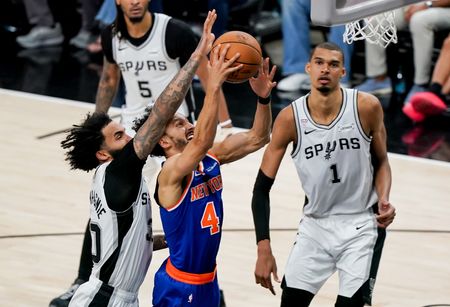
SAN ANTONIO — After more than five decades of waiting, New York Knicks fans finally have something to celebrate. The Knicks claimed the NBA championship Saturday night, defeating the San Antonio Spurs 94-90 in Game 5 to secure the title — their first since 1973.
Team owner James Dolan didn’t wait for anyone to hand him the 30-pound gold-plated trophy. He grabbed it himself and raised it into the air with a shout directed at his city.
“I want to say something to New York,” Dolan yelled. “Hey New York! I’m sorry it took so long! But here we are, and hopefully it won’t take that long again!”
The championship ends a 53-year drought for the storied franchise, and it came in dramatic fashion. Saturday’s clinching win was the Knicks’ fourth comeback victory of the series. Earlier in the finals, the team rallied from 29 points down to win Game 4 at Madison Square Garden.
“Of course I’ve never seen anything like it, because it’d never happened before,” NBA Commissioner Adam Silver said of the Game 4 comeback in an interview on NBA TV Saturday. “But it’s been amazing.”
Some are calling it the first major professional sports title for New York in more than 14 years — counting only Major League Baseball, the NFL, the NHL, and the NBA. That said, the New York Liberty won the 2024 WNBA title and New York City FC captured the MLS Cup in 2021. The last time one of New York’s traditional big-four franchises won a championship was the Giants’ Super Bowl victory following the 2011 season.
The Yankees haven’t won a World Series since 2009. The Mets last won it in 1986. The Rangers hoisted the Stanley Cup in 1994, the Islanders in 1983, and the Jets haven’t won a Super Bowl since 1969.
None of that is the focus right now. The Knicks — who rattled off 13 straight wins at one point during the playoffs — are the talk of New York.
The franchise has now joined an elite group, becoming the ninth team in NBA history to win at least three championships. Boston leads the way with 18, followed by the Los Angeles Lakers with 17, Golden State with seven, Chicago with six, San Antonio with five, and Philadelphia, Detroit, and Miami each with three.
Knicks legend Larry Johnson summed up the moment simply: “I enjoy watching these guys. The Garden is back. … It’s back like when we played and made our little run. The city is behind us.”
The road to this title was anything but easy. Since their last championship, the Knicks cycled through 24 different head coaches and more than 400 players. Stars like Patrick Ewing, Allan Houston, Bernard King, and Carmelo Anthony all called Madison Square Garden home without ever delivering a title.
The franchise came heartbreakingly close in 1994, losing a Game 7 to Hakeem Olajuwon and the Houston Rockets. Then in 1999, the Knicks made a surprising run to the finals in a shortened season, only to fall to San Antonio in five games — the first of what became five titles for that Spurs organization.
“We didn’t get it done. … I always say the third time is the charm,” former Knicks guard John Starks said.
Starks turned out to be right. Twenty-seven years after that 1999 loss to San Antonio, the Knicks faced the Spurs again in the finals — and this time, New York won in five games, completely flipping the script.
Finals MVP Jalen Brunson, who came to New York after being acquired from Dallas, was the driving force behind the championship run. During a stretch spanning 25 years that ended with the 2021-22 season, the Knicks had the worst record in the NBA. In the four seasons since Brunson arrived, the team has posted the league’s fifth-best record.
“It means the world to me,” Brunson said.
First-year Knicks head coach Mike Brown guided the team to the title in his debut season with the club. He reflected on what the championship means to the city.
“There are a couple of franchises that are pretty iconic just because of the history that they have, the location that they’re in, sometimes even the building that they’re in,” Brown said. “New York is definitely one of the few that you could say that to in all three facets.”
“Everybody goes through their ups and downs. I don’t really think much about the tough times that they had, because everybody has tough times, including individuals. You just want to try the best you can to be a part of whatever you can to bring joy to the city, to the organization. At the end of the day, the chips are going to fall how they fall. I feel blessed, fortunate, lucky, to be a part of what is going on now.”
Madison Square Garden — which has hosted farewell tours from Billy Joel, Elton John, and Harry Styles more recently than it hung a Knicks championship banner — will now add a new piece of hardware to its rafters.
The contrast between this title and the last one in 1973 is striking. Back then, the NBA had just 17 teams. The top salary in the league was around $380,000, equivalent to roughly $2.9 million today. There was no three-point line, no massive television contract, and no international players. When the Knicks flew home from the 1973 title clincher in Inglewood, California, officials at Kennedy Airport braced for what they called a “rabid” crowd — expecting “hundreds” of fans to meet the plane.
This celebration figures to be considerably larger.
“To have the fans that we have in New York City and be able to bring home a championship after all these years is absolutely amazing,” Brown said. “It’s a surreal feeling.”
Authorities in Yemen are reporting the death of a well-known daredevil adventurer who went by the nickname “The Spider-Man of Yemen,” after he plunged into a volcanic crater while scaling its walls without any safety gear.
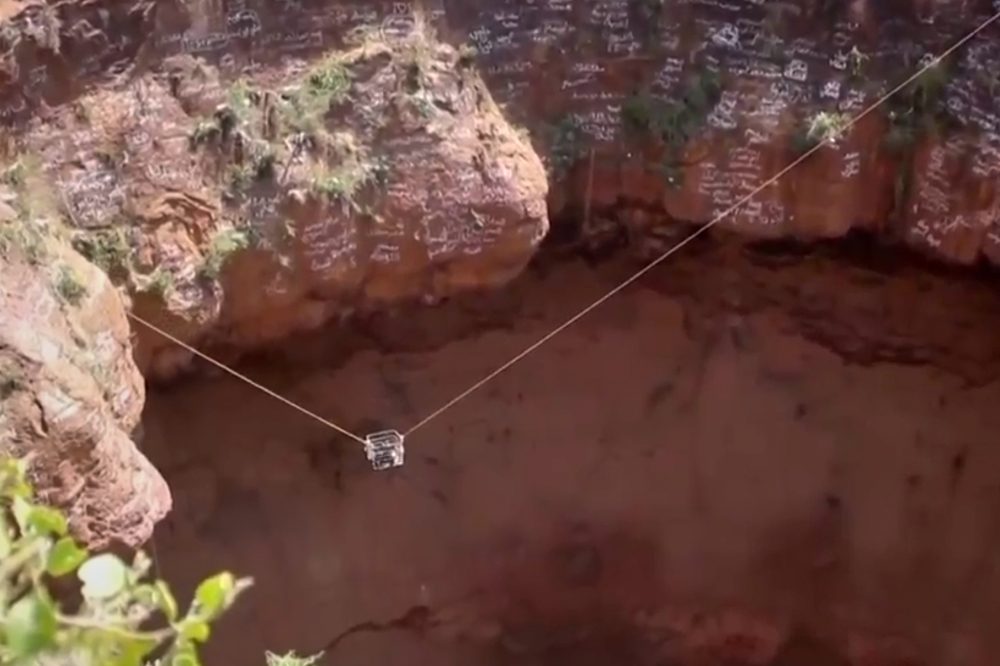
Al-Qaqa Ibn Antar, 30 years old, was attempting to climb the sheer rock faces of the Hardah Dam volcanic crater in Yemen’s southern Dhale province on Friday when he lost his grip and fell 120 meters — roughly 393 feet — into the crater below, according to the Civil Defense Authority. The agency also released a brief video capturing the terrifying moment.
The 10-second clip shows Antar making his way up a rocky cliff face with no protective equipment. Names written in Arabic appear in white lettering on the rock wall he is scaling. The footage then shows him clinging to the cliff with his right hand while his left arm reaches out into the air — before his right-hand grip gives way and he falls.
Search and rescue teams, including divers and water specialists, were deployed to recover Antar’s body. Divers eventually found him at a depth of 30 meters — about 100 feet — beneath the water’s surface. The Civil Defense Authority described the four-hour recovery effort as “complex,” citing the steep, rocky terrain that made reaching the site extremely difficult.
The Hardah Dam — also referred to as the Haradhat Damt — is a distinctive volcanic crater situated near the city of Damt in Yemen’s southern Dahle province. The landmark features sharply rising rock walls surrounding a hot, sulfurous lake at its bottom.
Antar had developed a significant following on social media by posting footage of himself taking on high-risk climbs across some of Yemen’s most challenging terrain. His videos frequently went viral. In one widely-shared clip, he was seen gripping the edge of a rocky cliff with only his bare hands while his legs dangled over a steep drop below — all without any safety equipment.
In the wake of the tragedy, the Civil Defense Authority called on climbers and adventure sports enthusiasts to follow proper safety protocols. The agency issued a formal warning urging people to use “appropriate protective gear to avert similar incidents.”
Canadian Prime Minister Mark Carney spent part of his Sunday in Aughagower, a village in western Ireland, where he connected with distant relatives and paid tribute to his family’s roots before heading to the G7 summit in France.
Carney’s grandparents, Robert Carney and Nora Moran, were both born in that village before emigrating to Canada in 1925. The couple married in Vancouver, where Robert took a position with the Canadian Pacific Railway Police and later joined the Royal Canadian Mounted Police. Carney’s father was born in 1933 and eventually became a professor at the University of Alberta.
After attending Sunday Mass at the local Catholic church in Aughagower — the same church his grandparents would have known — Carney also visited the family grave and planted a tree in their honor. Speaking with reporters afterward, he joked about the unexpected size of his extended family: “I have a lot more cousins than I realised.”
The personal visit followed a more formal appearance on Saturday, when Carney addressed students at Trinity College Dublin. There, he called on nations like Canada and Ireland to build a “dense web of connections … ad hoc coalitions” as the global order established after the Cold War continues to unravel.
“Ireland and Canada are navigating a global rupture, not a quiet transition,” he told the students. He added, “I suggest that amidst this change, amidst this disruption, Canada, Ireland, and Europe can be pivotal, powerful, and purposeful, a force for good.”
Irish Prime Minister Micheal Martin, whose country is set to assume the six-month rotating presidency of the Council of the European Union on July 1, echoed the sentiment. He told reporters that his government would work to “put flesh on the bone of an enhanced European Union-Canadian relationship.”
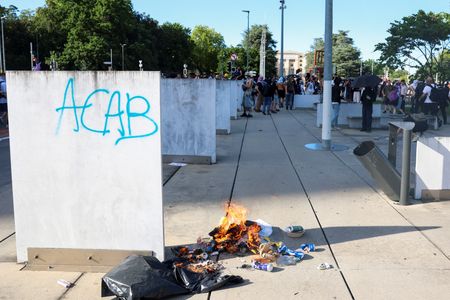
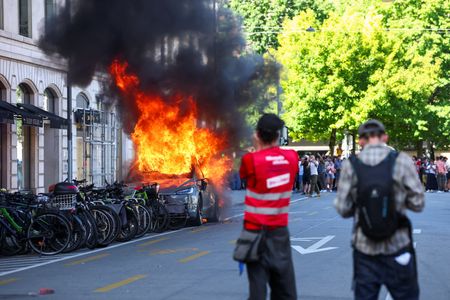
GENEVA — A demonstration in Geneva, Switzerland turned partially violent Sunday when protesters set a Tesla on fire and smashed the windows of a bank, expressing outrage ahead of an upcoming Group of Seven summit scheduled just over the border in France.
Despite those incidents, police described the overall march as largely peaceful. Authorities estimated attendance at up to 7,000 people and said they confiscated a number of knives and pyrotechnic devices from those in the crowd.
Demonstrators said their target was the G7 as a symbol of concentrated wealth and political power. The protest came shortly after Tesla owner Elon Musk, who has served as an advisor to U.S. President Donald Trump, became the world’s first trillionaire — a milestone that many say has intensified public concern over growing inequality.
Protester Pippa Saugy explained her motivation for attending: “To me, it’s a meeting of the rich that shows once again how the rich can become even richer while the poor are left behind.”
The G7 summit is scheduled for June 15 through 17 in Evian-les-Bains, a town situated along the shore of Lake Geneva. It will bring together the leaders of France, Britain, Canada, Germany, Italy, Japan, and the United States, as well as the European Union.
The agenda is expected to be dominated by the ongoing wars in Ukraine and the Middle East. World leaders will also be navigating their relationship with President Trump as he works toward finalizing a framework peace agreement with Iran.
Back in Geneva, storefronts were boarded up and hundreds of riot officers were positioned throughout the city in anticipation of potential unrest. Protests at G7 summits are nothing new — demonstrators have long used these gatherings as a platform to speak out against capitalism, globalization, climate change, and economic inequality.
One demonstrator, Mattia Piccard, expressed frustration at the heavy law enforcement presence on the streets. “This is an attempt to frighten demonstrators, to frighten people and discourage them from coming out to protest,” Piccard said.
Another participant, Clélia Colin, said she was there to draw attention to gender inequality. “The values represented by the G7 are completely misogynistic, and they contribute to inequality because there is absolutely no equality,” Colin said.
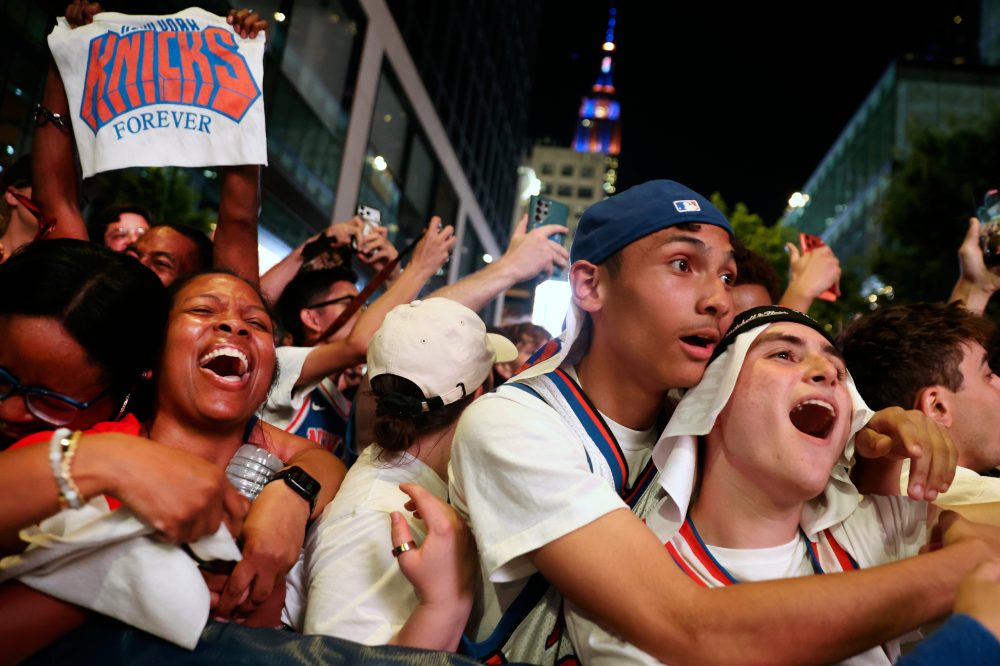
New York City is buzzing after the Knicks brought home the NBA championship for the first time in 53 years, and city leaders are already making big plans to celebrate.
New York City Mayor Zohran Mamdani wasted no time after Saturday night’s victory, posting just three words to his constituents early Sunday morning: “PARADE THURSDAY MANHATTAN.”
The Knicks pulled off yet another remarkable comeback, defeating the San Antonio Spurs 94-90 in Game 5 of the NBA Finals — a road win that ended decades of heartbreak for millions of fans across the city’s five boroughs.
Head coach Mike Brown was still processing the moment when he spoke with reporters after the final buzzer. “To have the fans that we have in New York City and be able to bring home a championship after all these years is absolutely amazing. It’s a surreal feeling,” he said.
Brown added, “I mean, I don’t know how long it’s been since that final buzzer went off but I still don’t believe it. I’m pinching myself.”
The championship celebration is expected to be massive, befitting the country’s largest sports market. The win also comes during a packed weekend of major events in the region. New York New Jersey stadium — a facility jointly shared by two longtime rivals — hosted its first-ever game Saturday, a 1-1 draw between Morocco and Brazil in World Cup soccer action. The match wrapped up around the same time the Knicks and Spurs were tipping off.
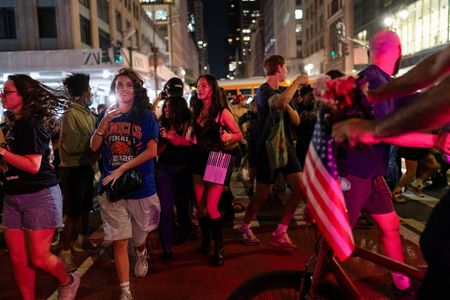
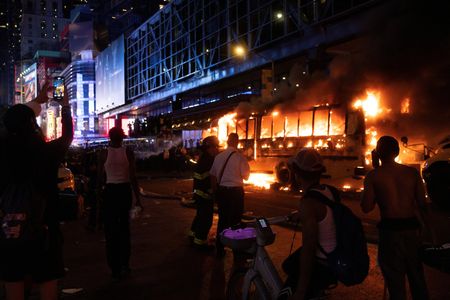
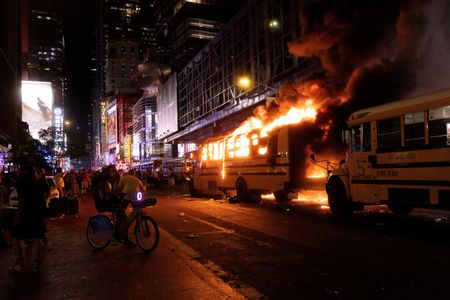
The post-game atmosphere in the city turned chaotic in some areas. Hundreds of people rushed a convoy of roughly 15 shuttle buses in Times Square after they had dropped off fans from the soccer match. One of the buses was set ablaze during the unrest, which saw thousands of New Yorkers flooding the streets. A teenager also suffered a gunshot wound during the disorder.
Thursday’s victory parade will coincide with another major regional sporting event — the U.S. Open golf tournament is set to begin the same day in Southampton. To handle the expected surge of golf fans, the Long Island Rail Road has built a temporary train platform right next to the golf venue.
HOUSTON — Fans arriving early Sunday morning for the World Cup opening match between Germany and Curacao got an unwelcome surprise when a sudden storm drenched the area around the stadium, sending supporters rushing to find rain gear — and for some, something cold to drink.
The unexpected downpour left many fans caught off guard, triggering a rush to a store located just across from the stadium. Umbrellas and raincoats flew off the shelves as supplies quickly ran low.
Caroline Sluys, who made the trip to Houston from Curacao with her son specifically for the game, was among those making a stop at the store. “We are here getting a raincoat and an umbrella for the rain,” she said. “It is not going to dampen our spirits. We are going to be yelling and screaming because it’s the first time Curacao has made it to the World Cup.”
Fans who were local to the area appeared more accustomed to the region’s unpredictable weather and arrived better prepared. However, the sudden heavy rain still managed to catch a number of out-of-town visitors off guard. Those who made it inside the stadium found some relief in the covered seating sections.
Not everyone was worried about getting wet, though. Some early arrivals said their main concern was tracking down a cold beer before stadium vendors had even opened for business.
Leon Baucke, a Munich resident who traveled to the game with a group of friends, summed up his group’s priorities simply: “We don’t have any rain gear. We are looking for beer. We are used to it because the weather isn’t great in Germany.”
Ukrainian President Volodymyr Zelenskiy got on the phone with U.S. President Donald Trump on Sunday for a conversation that touched on the war in Ukraine, diplomatic efforts, and the ongoing push for peace negotiations, according to a Ukrainian presidential adviser.
The two leaders spoke for roughly 30 to 35 minutes, presidential communications adviser Dmytro Lytvyn confirmed. Along with the serious matters of war and diplomacy, Zelenskiy also extended birthday wishes to Trump, who celebrated his 80th birthday on Sunday.
Croatia’s DonnaEkic delivered a dominant performance before weathering a fierce comeback from Emma Raducanu to capture the Queen’s Club title on Sunday, winning 6-0, 7-6(6) before a crowd that was largely cheering for her opponent.
Vekic’s path to the championship was anything but straightforward — she entered the main draw only after losing in qualifying and advancing as a lucky loser. Despite that rocky start, she needed five match points before finally putting away Raducanu and earning her first tournament title since 2023.
The 29-year-old came out firing in the opening set, striking powerful winners across the court with remarkable precision and claiming the set without dropping a game.
However, Raducanu refused to go quietly. She broke Vekic’s serve twice in the second set to build a 5-2 lead, threatening to force a deciding third set as Vekic’s level dropped noticeably.
Vekic regrouped and clawed her way back into the match, eventually leveling the set. She even had to save a set point when Raducanu led 5-4, keeping her title hopes alive in dramatic fashion.
As an Olympic runner-up, Vekic had the experience to stay composed, but three match points slipped away while she held a 6-5 advantage. The match moved into a tiebreak, with both players visibly exhausted after a series of grueling, back-and-forth rallies.
Raducanu saved yet another match point during the tiebreak, but Vekic finally converted on her fifth opportunity when a tired Raducanu’s groundstroke landed in the tramlines, sealing the championship.
WASHINGTON (AP) — President Donald Trump reached his 80th birthday Sunday, choosing to mark the milestone in a way few could have predicted: with professional cage fighting on the South Lawn of the White House.
The event comes amid a backdrop of significant national challenges, including a three-month-old war with Iran that has drawn widespread disapproval from Americans, unsettled global oil markets, and inflation that has climbed to its highest point since April 2023. Despite all of that, the iconic White House grounds — long regarded as a symbol of American democracy — were transformed Sunday night into an arena for a full UFC fight card.
According to a court filing from the National Park Service, which has oversight of the South Lawn, more than $60 million and tens of thousands of hours of labor went into constructing the arena for the event.
The fight series, operating under the banner “Freedom 250,” consists of seven bouts featuring all male fighters. The event is designed to honor both Trump’s 80th birthday and the 250th anniversary of the Declaration of Independence’s signing.
The main card, headlined by two title fights and broadcasting on Paramount+, was scheduled to get underway at 8 p.m. Eastern.
The event represents the height of a 25-year relationship between Trump and UFC CEO Dana White — a partnership that has brought personal, political, and financial benefits to both men. White’s first event as UFC president was held back in 2001 at Trump Taj Mahal.
Trump has attended four UFC events as a sitting president, entering to rock music and patriotic cheers from the crowd in a manner similar to the fighters themselves. White introduced Trump at two Republican National Conventions and also attended the White House Correspondents’ Association dinner in April, which ended abruptly following a shooting.
The fight card has faced criticism online from fans who consider the matchups underwhelming. In the main event, Alex Pereira of Brazil will square off against Ciryl Gane of France for the interim UFC heavyweight title. Following that, Spanish-Georgian lightweight champion Ilia Topuria will face interim champion Justin Gaethje — one of only two Americans who currently hold any portion of the UFC’s 11 championship belts.
Five additional bouts round out the main card, including appearances by former title-fight contenders Michael Chandler and Derrick Lewis, as well as former 135-pound champion Sean O’Malley.
White confirmed the event would proceed regardless of weather conditions. Strong thunderstorms and intense lightning had already disrupted a promotional event at the Lincoln Memorial on Friday, and forecasts for Sunday evening also pointed to threatening weather.
CAIRO — At least six Palestinians were killed Sunday in Israeli airstrikes and gunfire across the Gaza Strip, according to health officials, even as international mediators intensified their push to keep a U.S.-brokered ceasefire alive.
Medical workers reported that an Israeli airstrike claimed the lives of at least four people near Al-Yeman Al-Saeed Hospital in the Jabalia refugee camp, located in the northern part of the enclave. Two additional deaths were recorded in separate shooting incidents — one in Khan Younis in the south and another in Gaza City. The Israeli military offered no immediate response to requests for comment on the incidents.
The bloodshed unfolded as mediators from Egypt, Qatar, and Turkey concluded a week of negotiations with Hamas and other Palestinian factions. Those talks centered on moving forward with the second phase of U.S. President Donald Trump’s Gaza plan, which calls for Hamas to lay down its weapons and for Israel to pull its forces out of the territory.
A truce brokered by Trump in October 2025 has so far failed to put a full stop to Israeli military operations in Gaza or to achieve the disarmament of Hamas fighters. Health officials say Israeli strikes have killed more than 950 people since the truce took effect, while Israel reports that four of its soldiers have been killed by militants during the same period.
Hamas places the blame for the ongoing conflict on what it describes as Israel’s failure to meet obligations agreed upon in October — a deal that paused major combat operations but did not bring Israeli attacks to a complete halt. Israel, for its part, maintains that its strikes are carried out to prevent imminent attacks by Hamas and other militant groups.
On Sunday, Hamas and allied factions announced they had submitted a written response to a 15-point framework put forward by the mediators and Trump’s Board of Peace, though they did not disclose the specifics of their answer. Sources familiar with the negotiations indicated the factions agreed to 14 of the 15 points, with the remaining sticking point being the question of Hamas disarmament. Hamas has said it will only consider full disarmament if a political process toward establishing a Palestinian state is set in motion.
Israel has maintained a firm stance that Hamas must disarm completely, relinquish control of Gaza, and have no part in shaping the territory’s future.
Lewis Hamilton marked a historic milestone Sunday, earning his first Formula One victory with Ferrari at the Barcelona-Catalunya Grand Prix in Spain — an emotionally charged win that also made him the sport’s oldest race winner in more than 50 years.
At 41 years old, Hamilton is now the oldest driver to claim an F1 victory since Australian legend Jack Brabham, who was 43 years and 11 months old when he won his final race in South Africa back in 1970.
The triumph ended a dominant five-race winning streak by 19-year-old Italian driver Kimi Antonelli, who was forced to retire just five laps before the finish. Antonelli, the current championship leader, saw his points advantage over Hamilton shrink to 41 points as a result.
For Hamilton, the win was also his first since Belgium in 2024 and his record seventh victory at the Circuit de Catalunya. It brings his remarkable career total to 106 wins for the seven-time world champion.
George Russell crossed the finish line in second place for Mercedes, while McLaren’s Lando Norris rounded out the top three to take third.
Toyota claimed victory at the 24 Hours of Le Mans on Sunday, outlasting fierce competition from BMW and Cadillac in the 94th running of the iconic endurance race.
BMW had earned the pole position heading into the event, and Cadillac held the lead entering the final quarter of the race. However, it was Toyota that ultimately crossed the finish line first, ending a drought that stretched back to their last overall victory in 2022. Japan’s Kamui Kobayashi was behind the wheel of the winning number seven car when it took the checkered flag.
The triumph marked Kobayashi’s second Le Mans victory, having previously won with Toyota in 2021. The former Formula One driver shared the win with British racer Mike Conway and Dutch driver Nyck de Vries.
South Africa’s Sheldon Van der Linde, Germany’s Rene Rast, and Dutch driver Robin Frijns brought the number 20 BMW home in second place. Toyota’s number eight car, driven by Japan’s Ryo Hirakawa alongside Switzerland’s Sebastien Buemi and New Zealand’s Brendon Hartley, finished third.
Cadillac’s number 12 car came in fourth, while Ferrari — winners of the previous three editions of the race — finished fifth with their number 51 entry.
It was a difficult day for Cadillac’s number 38 car, which had been running first and second alongside its teammate as late as the 14th hour. A power steering failure forced two costly pit stops, sending the car tumbling down the running order before it ultimately retired from the race. The setback was especially painful for French driver Sebastien Bourdais, who hails from Le Mans but has yet to find success on his home circuit, along with New Zealand’s Earl Bamber and Britain’s Jack Aitken.
The number 15 BMW, which started from pole position with Danish former F1 driver Kevin Magnussen, Swiss-born Italian Raffaele Marciello, and Belgian Dries Vanthoor, also failed to finish.
The race featured 62 cars and 186 drivers in total and was officially started on Saturday by celebrated Tour de France sprinter Mark Cavendish, who served as the honorary starter.
ROME — A retired Italian general formally unveiled his new far-right political party on Sunday, directly challenging Prime Minister Giorgia Meloni’s hold on power as he pushes for a more extreme nationalist agenda ahead of next year’s elections.
General Roberto Vannacci, a 57-year-old former paratrooper, was introduced to the crowd as a modern-day Julius Caesar when he stepped onto the stage at the founding congress of Futuro Nazionale. Supporters greeted him with repeated chants of “Generale, Generale, Generale.”
“We represent the rejects and the dregs, and are proud of it,” Vannacci declared. He left Deputy Prime Minister Matteo Salvini’s League party four months ago and is now positioning himself to the right of Meloni’s conservative coalition.
Futuro Nazionale is already drawing about 5% in polls, putting it in striking distance of the League and potentially threatening Meloni’s chances of returning to power unless she negotiates some kind of electoral deal with Vannacci.
However, any such alliance could backfire for Meloni. Vannacci’s anti-EU, pro-Russia stance and his close connections to far-right European parties — including Germany’s AfD — could drive away moderate voters who currently support her.
Taking the most aggressive anti-immigration position in Italian politics, Vannacci said Sunday that he would reduce the number of foreign nationals living in Italy from roughly 12% of the population down to about 4%.
“We don’t have a programme for immigration, we have a programme for re-migration,” he told the cheering crowd.
The new party’s platform borrows heavily from positions Meloni herself championed while in opposition — before she took the reins of Italy’s massive national debt in 2022 and had to reassure financial markets.
Vannacci said he wants to open a debate on whether Italy should remain part of the euro currency zone. He also called for scrapping the EU’s Green Deal aimed at cutting carbon emissions, and lifting Italy’s existing ban on nuclear energy. The platform additionally includes family-friendly tax incentives, such as reductions for households with children.
Despite Italy having one of the lowest rates of murder and violent crime in the world, Vannacci declared security and defense his top priority, promising a zero-tolerance approach to crime and pledging to expand prison capacity.
While Vannacci has criticized Meloni for walking back on her own campaign promises, he did acknowledge that his own plans are subject to change.
“No plan survives the first shot in battle … it has to be adapted to reality,” he said.
Kansas City received a tornado warning just hours after England’s national soccer team touched down in the city, which is serving as the squad’s home base during the World Cup.
The National Weather Service issued an alert warning residents of a severe thunderstorm capable of producing wind speeds up to 80 miles per hour — roughly 129 kilometers per hour. Tornado sirens rang out across the city on Saturday evening.
The weather alert urged people to seek immediate protection, stating: “Take shelter in a sturdy building, away from windows. Flying debris may be deadly to those caught without shelter.”
According to British media reports, England’s players were directed to remain inside as well. A fan festival taking place in the city also shut down ahead of schedule in the interest of public safety.
Earlier that same afternoon, before the tornado warnings went into effect, the English squad held a community training session. The team had already faced a setback before even reaching Kansas City — their training kit was stolen prior to their arrival.
England is scheduled to open their World Cup campaign against Croatia in a Group L matchup on Wednesday in Arlington.
The National Weather Service office in Mount Holly, New Jersey has put a Coastal Flood Advisory into effect starting June 14 at 10:27 AM EDT, with the advisory set to expire at 1:00 AM EDT on June 15.
Coastal flood advisories are typically issued when minor flooding is expected in low-lying areas near the shoreline, which can affect roads, properties, and outdoor activities near the water.
Residents in coastal communities covered by this advisory are encouraged to monitor updates from the National Weather Service and take any necessary precautions to protect property and ensure personal safety during the advisory period.
A Coastal Flood Advisory is in effect tonight for several areas across Delmarva, with minor tidal flooding expected to impact low-lying communities beginning this evening.
The National Weather Service has issued the advisory for Kent County, Inland Sussex County, and the Delaware Beaches, running from 7 o’clock tonight through 1 o’clock Monday morning.
Residents can expect up to one foot of water above ground level in low-lying areas near shorelines and tidal waterways. The flooding could trigger partial or full road closures on the most vulnerable coastal, bayside, and inland tidal roadways.
Authorities are urging drivers to use extreme caution. Do not drive through flooded roads — the water may be deeper than it appears and could put you in serious danger. You should also avoid leaving your vehicle parked in areas known to flood during high tide events.
If you need to monitor water levels near a local tide gauge, the National Water Prediction Service has up-to-date information available at water.noaa.gov.
This advisory remains in effect until 1:00 a.m. Monday morning. TV Delmarva will continue to monitor conditions and bring you the latest updates throughout the evening.
DEIR AL-BALAH, Gaza Strip — The total number of Palestinians killed since the start of the Israel-Hamas war has climbed past 73,000, Gaza’s Health Ministry announced Sunday, even as a fragile ceasefire agreement remains in place but largely deadlocked.
Israel has not halted military strikes within the territory despite the deal that was reached in October, stating that its operations target Hamas fighters and other armed groups that pose a threat, as well as responding to what it describes as ceasefire violations. Five Israeli soldiers have died since the truce went into effect.
The updated death toll was confirmed by two Health Ministry officials: Zaher al-Waheidi, who heads the ministry’s records department, and Hamza Salem from the ministry’s public relations office.
The total death count since the war began now stands at 73,001. On Sunday alone, five deaths were recorded — two in the southern city of Khan Younis, one in central Gaza, and two individuals who succumbed to wounds sustained in earlier incidents.
More than 173,200 people have been injured since the conflict began. The war was triggered by the Hamas-led attack on Israel on October 7, 2023, which killed approximately 1,200 people and resulted in 251 others being taken hostage.
Gaza’s Health Ministry operates under the Hamas-led government but is staffed by medical professionals who maintain detailed casualty records. United Nations agencies and independent experts generally regard the ministry’s data as credible. The ministry does not separate civilian deaths from militant deaths in its figures, though it notes that women and children account for roughly half of all fatalities.
Israel maintains that it works to minimize civilian casualties and attributes civilian deaths to Hamas, arguing that the militant group conducts operations in heavily populated residential areas.
The ceasefire agreement, brokered by the United States and reached in October, brought an end to full-scale military operations and facilitated the release of all remaining hostages held in Gaza.
However, other key components of the deal have stalled. Hamas has refused to disarm, and Israeli forces have moved further into Gaza rather than pulling back. Both parties accuse each other of breaching the agreement while maintaining that it remains technically in force.
Nickolay Mladenov, the top U.S.-appointed diplomat overseeing the ceasefire, has stated that progress on all remaining issues — including reconstruction efforts, the withdrawal of Israeli troops, and the formation of a new Palestinian governing authority — is being blocked by the impasse over Hamas disarmament.
The war has displaced the vast majority of Gaza’s more than 2 million residents, reduced large sections of the territory to rubble, and caused severe shortages of food, medicine, and essential supplies. Nearly all border crossings into Gaza, most of which are under Israeli control, have been closed throughout the conflict.
ROME — In a standing-room-only auditorium near the Vatican, Roberto Vannacci — a former Italian army general whose supporters call him “Il Generale” — rallied followers of his new political movement this weekend, positioning himself as an outsider while simultaneously shaking up Italy’s right wing and mounting a challenge to Premier Giorgia Meloni.
Vannacci’s rapidly growing party, Futuro Nazionale, is introducing fresh uncertainty into the conservative bloc that has been the foundation of Meloni’s government, with tensions mounting as the country looks toward the 2027 general election.
Political observers say the question is no longer whether Vannacci will have an impact on the vote — it’s whether Meloni can contain, absorb, or outmaneuver a rival who is carving out political territory to her right.
The arrival of a competitor on that flank could also test the durability of Meloni’s government and put pressure on the more moderate, pro-European stance she has taken since coming to power.
Vannacci’s ascent is unfolding against a broader backdrop in which far-right and nationalist movements are gaining momentum across Europe, reshaping political landscapes by focusing on divisive issues like immigration and public safety.
“With us, Italy will once again be the home of Italians,” Vannacci declared at his party’s founding assembly in Rome. “Everyone must feel safe in their own home.”
He referred to his core group of lawmakers with pride as the “dirty dozen,” leaning into his image as a political outsider.
Vannacci, 57, first stepped into the public spotlight with a self-published 2023 book titled “Il mondo al contrario” — or “The World Upside Down” — which sparked widespread controversy for its harsh rhetoric targeting LGBTQ+ people, migrants, and minority groups.
He made his formal entry into politics the following year, joining Matteo Salvini’s anti-immigration League party and earning more than 530,000 preference votes in European Parliament elections. He parted ways with the League in February to launch Futuro Nazionale — a split that Salvini labeled a “betrayal.”
Since breaking away, Vannacci has steadily built his base. The party claims it has surpassed 100,000 members and now counts eight deputies in its ranks, including defectors from both the League and the centrist Forza Italia — a sign of growing discontent within Meloni’s coalition.
Vannacci rejects the “far-right” label, preferring to call his movement the “real right.” He has accused Meloni of failing to translate shared political priorities into actual policy and is currently ruling out any alliance with her camp.
His platform takes hard-line stances on security and immigration — including calls for the “remigration” of foreigners he views as not integrated into Italian society — along with opposition to European Union policies such as the Green Deal and criticism of Western sanctions on Russia.
Analysts say Vannacci’s rise signals a deeper political and cultural shift within Italy.
“He is commanding a sort of political raid for hard-right votes within the main parties of the coalition,” said Massimiliano Panarari, a politics professor at the University of Modena and Reggio Emilia. “Meloni’s strategy was to have no one to her right. Now she does.”
Panarari described Vannacci as “an entrepreneur of fear,” arguing that his rhetoric pushes themes Meloni can no longer openly champion in office — such as openly anti-gay and anti-feminist positions.
Lorenzo Pregliasco, a political analyst and polling expert at YouTrend, said the development brings “something new — an opposition from the right to the current government.”
“Now there is a force outside the majority that challenges it on popular issues like migration, security and culture wars,” he said.
That shift carries real electoral weight. Polls place Futuro Nazionale at roughly 4% to nearly 5% — a potentially decisive slice of the vote in a contest where Italy’s main center-right and center-left blocs are closely matched.
“They could be the difference between finishing ahead or behind,” Pregliasco said, calling Vannacci a potential “wild card.”
For Meloni, the challenge is fundamentally strategic. “In terms of political debate, he introduces instability on the right,” Pregliasco said. “She and her allies must decide whether to absorb him into the coalition — but that would create problems.”
Speaking before parliament earlier this week, Meloni accused lawmakers aligned with Vannacci of undermining her government and benefiting the political left. Her Brothers of Italy party and centrist coalition partners have ruled out any electoral agreements with his movement.
For now, Meloni has steered clear of a direct confrontation — a calculated approach that some see as a wager that Vannacci’s momentum will eventually run out of steam.
“The issue is what to do with this loose cannon of Vannacci, which could drag the right back toward the far right,” Panarari said. “I’m not sure it would benefit Meloni to shift further right before general elections. Her approach will likely be marked by ambiguity and ambivalence, as long as possible.”
Motorists traveling northbound on Route 1 between Rehoboth Beach and Lewes are currently facing a delay of approximately 5 to 10 minutes, according to traffic reports.
Drivers in the area are encouraged to allow extra time for their trip or consider alternate routes if possible.
Somali soccer referee Omar Abdulkadir Artan, who was turned away at the U.S. border and prevented from working at the World Cup, will receive his complete tournament pay from FIFA, according to a source familiar with the situation.
The Trump administration stated that Artan was refused entry into the United States due to alleged connections to “suspected members of terror organizations.” U.S. Customs and Border Protection carried out the denial.
Although Artan will not participate in the World Cup in any capacity, FIFA has made a commitment to pay him his full salary for the tournament, the source confirmed.
Artan, who was named Africa’s referee of the year in 2025, had been on track to make history as the first Somali official ever to referee at soccer’s biggest global event. Instead, he was turned back before he could take the field.
Despite the setback, Artan arrived back in his home country to a warm and celebratory reception. European soccer’s governing body UEFA has since tapped him to serve as referee for the UEFA Super Cup match between Paris St Germain and Aston Villa, scheduled for August.
BRUSSELS — The European Commission announced Sunday that it is examining the real-world impact of a U.S. export control directive targeting artificial intelligence company Anthropic, and said any such measures should not unfairly target allied nations.
Anthropic revealed Friday that it would be forced to “abruptly disable” its most advanced AI models for all users following a U.S. government order requiring the company to cut off access for foreign nationals. The government cited national security as the reason for the directive.
European Commission spokesperson Thomas Regnier addressed the situation in a formal statement, saying, “We are seeing a new generation of highly capable AI models reach the market. These models offer significant benefits, including for cyber-defence, but they also raise serious cybersecurity concerns that need to be addressed.”
Regnier added that “contingency measures taken in this light should not be discriminatory against partners.”
He also used the situation to make a broader point about European independence in the technology sector. “This development is a further illustration of why Europe needs to strengthen its technological sovereignty,” Regnier said. “We are looking closely at the practical consequences of this for European users of these services.”
ATLANTA (AP) — Just days ahead of Georgia’s Republican U.S. Senate runoff election, President Donald Trump has thrown his weight behind U.S. Rep. Mike Collins, passing over former football coach Derek Dooley in what has become a familiar pattern of backing loyalists in GOP primaries.
The two Republican candidates face off Tuesday for the right to challenge Democratic Sen. Jon Ossoff in what is expected to be one of the most high-profile races of the November midterm elections. Collins has built his political brand around unwavering support for Trump and the MAGA movement. In a social media post early Sunday, Trump praised the trucking company owner and two-term congressman, saying he “has been with me from the very beginning” and called him a “true friend, fighter, and WARRIOR.”
Dooley, a political newcomer, has the backing of outgoing Gov. Brian Kemp, who has had a contentious history with Trump. The president was blunt about his feelings toward Dooley, writing that he doesn’t know him and pointing out that Dooley failed to cast a ballot in either the 2016 or 2020 elections — both of which featured Trump on the ticket. Dooley has acknowledged going roughly two decades without voting, though he says he did vote for Trump in 2024.
Collins came out on top in the May 19 primary but fell short of the 40% threshold needed to avoid a runoff, leaving a significant pool of Republican votes still in play. Trump’s endorsements have repeatedly proven to be a decisive force within the party.
“Everybody knows that I do best with the MAGA base,” Collins said on primary night. “It’s because they know I’ve always been with President Trump.”
The endorsement puts Trump at odds with more establishment-aligned Republicans, particularly Kemp. The move echoes Trump’s recent decision to back Texas Attorney General Ken Paxton, who went on to defeat U.S. Sen. John Cornyn in that state’s primary runoff.
Dooley fired back at Trump’s announcement, arguing that Georgia voters are hungry for “a political outsider” rather than “typical D.C. politicians like Mike Collins.” He posted on X that he remains confident heading into Tuesday’s vote.
Collins has been a Trump ally since his first congressional run in 2022, and he has repeated the president’s unsubstantiated claims that Trump’s 2020 loss to Democrat Joe Biden involved fraud. Collins also sponsored the Laken Riley Act, a 2025 law mandating detention of immigrants charged with certain crimes — a measure Republicans believe puts Ossoff in a difficult spot, since the Democratic senator initially voted against it before switching his position after Trump returned to office.
Dooley and his top surrogate, Gov. Kemp, contend that a political newcomer stands a stronger chance against Ossoff, who is the only Democratic senator up for reelection in a state Trump carried in 2024. Kemp, who previously angered Trump by declining to help challenge Biden’s Georgia victory, had been the preferred pick of Senate Republican leaders to take on Ossoff. He ultimately recruited Dooley, a childhood friend, to enter the race instead.
Kemp points to three first-term Republican senators — Montana’s Tim Sheehy, Pennsylvania’s Dave McCormick, and Ohio’s Bernie Moreno — who unseated Democratic incumbents in 2024 by running as outsiders who still aligned with Trump.
Trump, meanwhile, has been on a winning streak within his own party. In recent weeks, he has seen multiple Republicans who failed his loyalty test go down to defeat. Cornyn lost to Paxton, U.S. Rep. Thomas Massie of Kentucky fell to Ed Gallrein, U.S. Sen. Bill Cassidy of Louisiana didn’t make a runoff, and several Indiana state senators were ousted by Trump-aligned challengers.
Dooley has told Georgia voters he will “work with President Trump but fight for you,” and he has stressed that Republicans have not won a U.S. Senate seat in Georgia since 2016.
Collins sees no need for that kind of balancing act, while still insisting he can broaden his appeal come November.
“You don’t beat Jon Ossoff by having no record,” Collins said. “You win by having a record of results.”
LONDON — British anti-Islam activist Tommy Robinson announced Saturday that he was stopped at Heathrow Airport and had his mobile phone taken by police, following a week in which he flooded social media with commentary about racist and anti-immigrant riots in Northern Ireland.
Robinson, who goes by the name Stephen Yaxley-Lennon in legal settings, posted on X that he was held Saturday evening for approximately three hours under the Counter-Terrorism and Border Security Act.
“My phone has been seized by the police,” he wrote on X. “Please help kick off my legal fund for defence.”
Throughout the previous week, Robinson had repeatedly posted about violence that erupted across Belfast after a video spread widely online showing a man being stabbed in a brutal attack that cost him an eye. A Sudanese man has since been charged with attempted murder. Authorities have stated the attack is not being investigated as an act of terrorism.
In the aftermath of that stabbing, rioters went on to target homes and businesses belonging to ethnic minorities and foreign residents — actions that the British minister responsible for the province described as racist thuggery.
Local elected officials have alleged that far-right figures operating online helped to organize or amplify the violence.
A police spokesperson, without identifying Robinson by name, confirmed that officers had stopped a man in his 40s at Heathrow Airport on Saturday following his arrival back in Britain from Russia, where he had traveled through Turkey.
“The man was interviewed by officers and his communication devices were seized. He was subsequently released,” the spokesperson said.
NIZI, Democratic Republic of Congo — Two weeks ago, the Kpangba displacement camp became the first in this part of conflict-ravaged Congo to see Ebola claim lives. Health teams immediately moved in to track down anyone who had been in contact with the deceased, hoping to stop the virus from spreading further.
Those efforts were quickly shut down. Residents of the camp drove away workers from the provincial health ministry, the World Health Organization, and other aid organizations, refusing to accept that the two women had died from Ebola. That’s according to Jean-Claude Lonzama, the chief doctor for the Nizi health zone — a densely populated mining region.
“Up to this day, we are not able to follow up on the contacts of these cases,” Lonzama told Reuters on Saturday.
That standoff has left health officials essentially operating in the dark as they attempt to prevent an Ebola surge inside a camp housing approximately 30,000 people, the vast majority of whom fled inter-ethnic violence in surrounding communities.
“We have 22 displaced persons sites in the Nizi health zone … with around 81,124 residents,” Lonzama said. “This is also our great worry because no preventive measures have been put in place in these sites aside from a few educational messages.”
The current outbreak was declared a month ago, and since then, several treatment facilities have come under attack. Some residents believe Ebola is a fabrication, while others are furious that traditional burial practices have been restricted to prevent the virus from spreading.
Aid organizations are particularly alarmed about the conditions inside displacement camps, where hundreds of residents may share a single toilet and open defecation is widespread. Those conditions could accelerate what is already shaping up to be one of the largest Ebola outbreaks ever recorded.
More than 5 million displaced people live across the three affected provinces — Ituri, South Kivu, and North Kivu — all of which have suffered through decades of armed conflict.
Throughout eastern Congo, health workers are running into the same wall: deep distrust of both the government and outside organizations. The attacks on treatment sites echo violence seen during a 2018-2020 Ebola outbreak in the same region, which claimed the lives of more than 25 health workers.
The two deaths in Kpangba happened on May 31 and June 1, though they weren’t publicly reported until a U.N. refugee agency document was released Thursday. A Congolese health ministry report reviewed by Reuters revealed that the first victim — a 60-year-old woman — had tested positive for Ebola on May 30, but had already left quarantine and could not be found by that point.
Health experts say the combination of community mistrust, shortages of essential supplies, and ongoing armed conflict across much of the affected region has left them gravely concerned about whether this outbreak can be brought under control.
A New Mexico border county that has long been searching for ways to boost its economy has approved the construction of one of the largest data centers in the entire country — and the project comes with its own gas-powered electricity plant attached.
But what seemed like a promising economic win is now generating serious concern. Local residents and officials are experiencing what many are calling buyer’s remorse over the massive development.
Water availability is emerging as the central issue driving the backlash. In an already dry desert region, the prospect of a large-scale data center — which typically requires enormous amounts of water for cooling systems — has raised alarm bells about the long-term impact on the area’s limited water supply.
The approval came from a county eager to attract jobs and investment to a region that has struggled economically. However, as details of the project have come into clearer focus, some who initially supported the deal are now questioning whether the tradeoffs are worth it.
A county in the New Mexico borderlands, eager for economic opportunity, approved what would be one of the largest data centers in the entire country — complete with its own gas-powered electricity plant. But now that the deal is done, some are wishing they had thought twice.
The region, which has long sought ways to bring jobs and investment to its struggling economy, saw the massive data center project as a potential lifeline. Officials moved forward with approval, hoping the development would deliver the economic boost the area desperately needs.
However, a sense of buyer’s remorse has begun to set in. Questions are now being raised about whether the benefits of the project are worth the trade-offs that come with hosting such a large facility — including the gas-fired power plant that will be built to keep it running.
ATLANTA (AP) — Georgia lawmakers are heading back to the state Capitol this week for a special session, where one of their top priorities will be untangling an election problem that stems from their own legislation.
The voting system currently used across the battleground state relies on a QR code printed on each ballot to count votes. Two years ago, the legislature passed a law prohibiting the use of that barcode for the official vote tally after July 1 of this year — but no alternative counting method has ever been put in place.
Republican Gov. Brian Kemp, who called the special session, specifically directed lawmakers to “address issues created” by that law. Making matters worse, the secretary of state’s office and the State Election Board have issued contradictory instructions to county election officials about how votes should be cast and counted going forward.
If a resolution isn’t reached quickly, the state could face widespread confusion and potential lawsuits over elections after July 1. A special election to fill a vacant U.S. House seat is already scheduled for that month.
Georgia’s current voting system was first rolled out statewide during the 2020 primary election. After that November’s general election — in which Republican President Donald Trump narrowly lost the state to Democrat Joe Biden — Trump and his allies claimed without evidence that the machines had altered or deleted votes.
Trump supporters continued to raise objections to the touchscreen voting machines, with some pushing unsubstantiated conspiracy theories. Election integrity advocates also took issue with the machines, arguing they could be vulnerable to hacking and that voters have no way to verify their choices since QR codes aren’t human-readable.
In 2024, Republican lawmakers attempted to respond to those concerns by passing legislation banning barcodes from the “official tabulation count” after July 1, 2026. However, in the two years that followed, neither the secretary of state’s office nor the General Assembly moved to put a replacement system in place. Now, with the deadline nearly here, a major midterm election is also on the horizon.
Trump specifically called out these voting machines — which are used in at least some counties across more than a dozen states — in his first executive order on elections after beginning his second term in January 2025. That order has since been blocked by multiple courts and is not currently being enforced.
Last month, Kemp announced the special legislative session, set to begin Wednesday, to address both the QR code issue and the redrawing of congressional maps ahead of the 2028 elections.
One possible outcome is that lawmakers could push back the deadline in the law, allowing QR codes to remain in use for now while a new system is developed before the 2028 elections. However, during the final hours of this year’s regular legislative session, a similar proposal was voted down.
Even if lawmakers reach an agreement this week, putting any new system into practice before the upcoming special election could prove difficult. That election is being held to fill the remainder of the term of U.S. Rep. David Scott, who passed away in April. Voting is set for July 28, with early voting starting July 6.
Last week, the secretary of state’s office released preliminary guidance to election officials in the six counties that make up that congressional district, noting the instructions could change depending on what happens during the special session.
Under that plan, ballots would be scanned and the QR code would be used to generate the election night vote count. Before the county certifies results, however, electronic images of each ballot would be uploaded to a server, where optical character recognition software would produce a second tally using the printed text — and that second count would serve as the official result.
The secretary of state’s guidance also states that counties must continue using the current election system, including the touchscreen machines, and that nothing in the law permits hand-marked paper ballots for in-person voting.
Two days later, the State Election Board stepped in with its own conflicting guidance, with board members arguing that the secretary of state’s proposed approach isn’t authorized under state law.
The board passed a resolution telling counties what to do if the special session does not result in an extended deadline for QR code use. That resolution directs counties to fall back on their emergency procedures, which call for hand-marked paper ballots counted by scanners.
During the election board meeting, a lawyer from the state attorney general’s office, Elizabeth Young, acknowledged the problem, saying that while neither set of guidance is legally binding, “obviously it would cause confusion for elections superintendents if they are getting differing instructions from two agencies, both of which have some authority over what they’re doing.”
The election board has been dominated by a Trump-aligned majority and has frequently clashed with Secretary of State Brad Raffensperger, a Republican who has often been a target of Trump’s criticism.
Henry County, located in Atlanta’s suburbs, is among the counties where voters will cast ballots in next month’s special election. Axiver Harris, the county’s interim elections director, said officials are aware of the competing guidance and are waiting for the state to provide clearer direction.
“Given the uncertainty surrounding the guidance currently available, we believe it is wise to wait for further direction to ensure that any decisions made are consistent with state requirements and election administration best practices,” Harris wrote in an email.
Marcye Scott, who is running in the special election to finish out the term of her late father, said she doubts most voters are following the issue closely and that her focus lies elsewhere.
“My goal is to get people to the polls, get my people to the polls and get them to vote for me,” she said.
Fellow candidate Carlos Moore, one of six people running in the special election, said he’s concerned that rushing in a new vote-counting method could invite legal challenges. He is hoping lawmakers simply extend the deadline and leave the QR code system in place for the special election.
“I would ask that legislators do the right thing, leave well enough alone for the special election,” Moore said. “Otherwise, it’s almost certain there will be challenges in court.”
A Coastal Flood Advisory is in effect for much of Delaware this Sunday evening, with minor tidal flooding expected to impact low-lying communities along the shore and inland waterways.
The National Weather Service has issued the advisory for Kent County, Inland Sussex County, and the Delaware Beaches, running from 7 p.m. Sunday through 1 a.m. Monday morning.
Meteorologists are forecasting up to one foot of inundation above ground level in vulnerable areas near shorelines and tidal waterways. Coastal and bayside communities could see some of their most flood-prone roads partially or fully close during the overnight hours.
Authorities are urging residents and visitors to take precautions before the flooding arrives. Do not park your vehicle in areas known to flood at high tide, and never attempt to drive through standing flood water — conditions can be deceiving, and even shallow water can cause serious vehicle damage or put lives at risk.
This advisory is considered minor in severity, but officials stress that even minor tidal flooding can create dangerous and costly situations for drivers.
For real-time water level information and local tide gauge data, visit the National Water Prediction Service at water.noaa.gov.
Stay with TV Delmarva for continuing updates as conditions develop Sunday evening.
MOSCOW — A Ukrainian drone strike on a residential apartment building in the Russian city of Oryol left one person dead and nine more injured on Sunday, according to the region’s governor.
Oryol Regional Governor Andrei Klychkov released photographs showing the aftermath of the attack, with multiple floors of the high-rise building displaying blown-out windows and heavy fire damage. The city of Oryol, located south of Moscow, has a population of roughly 300,000 people.
Governor Klychkov stated that emergency services and law enforcement have the situation under control, and that cleanup operations are actively underway.
About 25 miles south of the U.S.-Mexico border, tucked in among taco shops in the outskirts of Tijuana, a flag hangs that stops passersby in their tracks. It bears Mexico’s colors of green, white, and red — but its design is anything but typical for the neighborhood.
Inside is what owner Saied Assadi describes as only the second Iranian restaurant in all of Mexico. “Food is one of my passions,” Assadi told Reuters during a visit this week, as he plated a traditional Iranian spread of rice, grilled tomatoes, mixed meats, and salad.
Not every Iranian in the area, however, feels welcome there.
Tijuana’s Iranian community is remarkably small — around 20 people in a city of roughly 2 million residents. Yet even within that handful of individuals, sharp political divisions reflect the broader fractures running through the Iranian diaspora worldwide — and the complicated backdrop facing Iran’s soccer team as it prepares for World Cup competition.
Dara Makoipour, an Iranian who relocated to Tijuana in 2018, says the flags displayed at Assadi’s restaurant are enough to keep him away. “We have different views,” said Makoipour, who instead crosses the border into California when he wants to eat Iranian food.
The flag at issue features a lion and sun design — Iran’s national symbol before the 1979 revolution, and one closely tied to the country’s former Shah-led government. The flag has become a flashpoint heading into the World Cup, as FIFA rules ban political items from stadiums. At the 2022 Qatar World Cup, security personnel turned away fans who tried to bring it inside.
When asked about Iranians who are put off by the flag, Assadi was direct: “Whether that person wants to come eat Iranian food or not because of the flag, that’s his choice. Some people are extremists.”
Still, one thing bridges the divide between Makoipour and Assadi: their shared enthusiasm for Iran’s soccer squad, known widely as Team Melli — Persian for “national team.”
AN UNUSUAL DESTINATION
Last month, the Iranian national team announced it was shifting its training base from Arizona to Tijuana, citing uncertainty over whether the U.S. would grant visas given the strained relations between the two countries. The Mexican border city made geographic sense — it sits relatively close to the team’s group-stage venues in Los Angeles and Seattle, and Mexico was receptive to hosting.
Still, the choice raised eyebrows. Iran prohibits alcohol and requires women to wear hijabs, making Tijuana — a city well known for its nightlife, strip clubs, and gambling establishments — an unconventional fit for the squad.
Any reservations appeared to melt away quickly. When the team arrived at 5 a.m. last Sunday — nearly four hours behind schedule — supporters were on hand to greet them warmly. Since then, a small group of fans has shown up outside the team’s hotel each day looking for autographs.
“Tijuana and especially the Mexican people — they’ve been amazing,” Iranian national team player Saeid Ezzatollahi told Reuters.
The team has kept a low profile since arriving. They travel with a private chef, Mexican soldiers are stationed outside their hotel, and their outings have been limited to chartered bus rides to a nearby stadium for training sessions.
FINDING HOME IN TIJUANA
Tijuana’s Iranian population is so small it doesn’t even appear in census data — a sharp contrast to nearby Los Angeles, which has the largest Iranian community outside of Iran itself.
Sadegh Galavi said he was immediately drawn to the city when he and his wife came to visit in 2022 from Tehran. “Literally, we fell in love with Mexico,” he said. “And then Tijuana makes me feel that there is a lot of opportunity to work, to do many things, to build a life.”
Galavi’s path to employment in Tijuana came through a chance encounter: he spotted a car on the street with vanity plates reading “TEHRAN,” left a note on the windshield, and discovered the owner was Makoipour. Galavi now works as a mechanic at an auto restoration business Makoipour owns.
Both men were thrilled when they learned Team Melli was heading to their city. “As long as the other side” — meaning the U.S. — “doesn’t give them a hard time, the rest is going to be easy peasy,” Makoipour said.
HEADING INTO THE TOURNAMENT
On Sunday, the team will fly by private plane to Los Angeles, arriving one day before their opening World Cup match against New Zealand. Several support staff and soccer federation members who were denied U.S. visas — including the team supervisor, analysts, and press liaison — will remain in Tijuana.
The U.S. State Department has stated it will not allow the Iranian team to “abuse this system to sneak terrorists into the U.S. under false pretenses.” Iran’s ambassador to Mexico, Abolfazl Pasandideh, fired back, saying the Trump administration believes “anybody who doesn’t think the same as them is a terrorist.”
The flag controversy continues as well. A California non-profit has filed a lawsuit seeking to block any restrictions on bringing the pre-revolutionary Iranian flag into World Cup stadiums, citing freedom of expression protections. FIFA, which previously told Reuters that its stadium code of conduct prohibits flags “of a political, offensive and/or discriminatory nature,” did not immediately respond to questions about the lawsuit.
Assadi, whose restaurant proudly displays the pre-revolutionary flag, said he believes the Islamic Republic is “not giving people the freedom” they deserve. But come Monday, he’ll be rooting for the national team — political differences aside.
“Pretty much everyone in Iran plays soccer,” he said. “I hope all Iranians will support the team as soccer players.”
A Coastal Flood Advisory is in effect tonight for several areas across Delmarva, with minor tidal flooding expected to impact low-lying communities along the coast and inland waterways.
The National Weather Service has issued the advisory for Kent County, Inland Sussex County, and the Delaware Beaches, running from 7 o’clock this evening through 1 o’clock Monday morning.
Authorities say up to one foot of inundation above ground level is expected in low-lying areas near shorelines and tidal waterways. The flooding could trigger partial or full closures on the most vulnerable roads in coastal, bayside, and inland tidal communities.
Residents and visitors are urged to take precautions before the flooding begins. Do not park your vehicle in areas known to flood during high tide events. If you encounter standing water on roadways, turn around — do not attempt to drive through it. Floodwaters can be deeper than they appear and pose a serious danger to both drivers and their vehicles.
This advisory remains in effect until 1:00 AM Monday. Stay with TV Delmarva for continuing coverage and updates as conditions develop tonight.
A senior Iranian official has revealed to Reuters the contents of a draft memorandum of understanding between Iran and the United States, touching on everything from nuclear restrictions to trade routes and financial relief measures. If agreed upon, the two countries would then have 60 days to hammer out a final deal.
The official outlined several key areas covered in the draft document:
Strait of Hormuz: Under the proposed terms, Iran would immediately reopen the Strait of Hormuz to all commercial shipping, while the United States would lift its naval blockade on Iranian ports. The blockade would begin to be lifted as soon as the memorandum is signed and would be fully removed within 30 days.
Financial Provisions: The draft calls for the U.S. to hold off on imposing any new sanctions against Iran until a permanent agreement is finalized. Once a final deal is reached, both U.S. and United Nations sanctions on Iran would be lifted on an agreed-upon schedule. The U.S. would also temporarily waive oil sanctions, giving Iran the ability to sell oil and collect revenue during that period. Additionally, Washington would release $25 billion in Iranian assets that have been frozen, through a combination of direct cash payments, cooperation with regional partners, and financial credit arrangements. The U.S. and its regional allies would also develop a reconstruction and development plan for Iran, to be negotiated with Tehran within 60 days.
Nuclear Terms: On the nuclear front, Iran would commit to neither building nor obtaining nuclear weapons. While a final agreement is being worked out, Iran would keep its nuclear program at its current level — meaning no additional uranium enrichment and no expansion of nuclear facilities. The U.S. would agree to permit Iran to dilute its stockpile of highly enriched uranium within its own borders, under the terms of a future comprehensive agreement. The full scope of Iran’s nuclear activities, enrichment operations, and how its enriched uranium stockpile would be handled would all be subject to negotiation within 60 days of the memorandum being signed.
Ukrainian drone attacks claimed one life and ignited a fire at an oil facility inside Russia on Sunday, as Kyiv continues its campaign of strikes targeting military and energy infrastructure deep within Russian territory.
The governor of Russia’s southwestern Oryol region, Andrei Klychkov, announced Sunday that one person was killed and nine others were injured after a Ukrainian drone struck a residential building overnight in the regional capital, which shares the same name as the region — Oryol.
Hundreds of miles away, local officials in Russia’s Yaroslavl region reported that fuel storage facilities burst into flames after being struck by a drone. The Yaroslavl region sits roughly 700 kilometers — about 440 miles — from the Ukrainian border.
Ukrainian President Volodymyr Zelenskyy confirmed his country’s forces were behind the Yaroslavl attack, stating they had “struck an oil facility that was important for the reserve of the aggressor state.”
Ukraine has intensified its targeting of Russian oil and gas infrastructure in recent months, with Kyiv arguing that Russia’s energy sector both finances and directly supports Moscow’s invasion, which has now stretched beyond four years.
In a related development, British Prime Minister Keir Starmer announced Sunday that the United Kingdom is investigating a sanctioned vessel believed to be part of Russia’s so-called “shadow fleet” — a network of ships allegedly used to ship oil in defiance of international sanctions imposed over the war in Ukraine.
British armed forces boarded and seized the ship, identified as the Smyrtos, on Sunday in the English Channel. The country’s Defense Ministry described the operation as “the first U.K.-led operation of its kind.” Russia is thought to be operating hundreds of such vessels to get around the sanctions.
“This operation delivers yet another blow to Russia and reminds those fueling Putin’s war in Ukraine that they cannot hide,” Starmer said.
ISLAMABAD (AP) — A potential agreement to end the war between the United States and Iran moved closer to reality Sunday, as Qatari mediators flew to Tehran to work out the final details of a deal, according to two regional officials who spoke anonymously because they lacked authorization to address the media publicly.
Those officials expressed measured hope that both nations were finally nearing an agreement that could stop a conflict responsible for thousands of deaths and reopen the Strait of Hormuz — a critical waterway whose blockage has sent shockwaves through global markets.
U.S. President Donald Trump and Pakistani Prime Minister Shehbaz Sharif both stated Saturday that a signing was expected to take place Sunday. Iran’s foreign ministry spokesperson Esmail Baghaei indicated it could occur within the next few days. Trump added that the Strait of Hormuz would be reopened immediately once the deal was signed.
The agreement is expected to be completed electronically rather than through a formal in-person ceremony, though the exact timing and process remain uncertain.
The deal does not resolve the most difficult disputes between Washington and Tehran — including Iran’s nuclear program and its frozen financial assets — but it would create a 60-day window for technical discussions on those topics. Pakistani and regional officials, also speaking anonymously, described months of difficult negotiations led by Pakistan, during which both sides came close to walking away on multiple occasions.
Under the terms currently being discussed, the U.S. and Israel appear to have fallen short of their original objectives, which included dismantling Iran’s missile and nuclear capabilities and cutting off its support for proxy forces. It remains unclear whether those issues will be addressed in the final agreement.
Separately, Trump was expected to raise the topic of clearing mines from the Strait of Hormuz at the Group of Seven summit beginning Monday. The waterway plays a vital role in global shipments of oil, natural gas, and products like fertilizer, and its effective closure has caused significant economic disruption worldwide.
The apparent progress toward a deal follows a tense week in which Iran exchanged fire with both the U.S. and Israel, raising fears that a fragile ceasefire — in place since April 7 — could collapse and drag the region back into full-scale conflict.
Iran’s nuclear program has been a long-standing source of tension with the U.S. and Israel, and a broader international concern. Trump posted on social media that once conditions stabilize, the U.S. would move to “downblend and destroy” Iran’s enriched uranium, either in Iran or on U.S. soil.
According to the International Atomic Energy Agency, Iran currently holds 440.9 kilograms — roughly 972 pounds — of uranium enriched to 60% purity, which is just one technical step below the 90% threshold considered weapons-grade. Iran has consistently maintained that its nuclear program is intended for peaceful purposes and has not publicly agreed to surrender its enriched uranium stockpile. That material is believed to be stored beneath three nuclear facilities that were heavily damaged in U.S. airstrikes last year.
Fighting has also continued in Lebanon, where Israel has pushed its military operations deeper into the country than at any point in more than 25 years, clashing with the Iranian-backed militant group Hezbollah despite an existing ceasefire. Iran has sought to have the Lebanon conflict included in any broader deal, and has also pushed for the release of billions of dollars in frozen funds.
The deal as currently structured has drawn strong criticism from Israel’s government, which has largely been left out of negotiations led by Pakistan and other parties. Even some members of Trump’s own Republican Party — facing pressure from an unpopular war heading into midterm elections — have spoken out against the agreement, with some arguing it does not represent an improvement over the 2015 Iran nuclear deal that Trump withdrew from during his first term and continues to call “bad.”
Drivers looking to get onto northbound I-95 at Naamans Road will need to find another way — the on-ramp at that location is currently shut down because of construction activity.
The closure is expected to remain in effect until 9 a.m. Travelers in the area should allow extra time and consider using an alternate route to avoid delays.
Israel’s military announced Sunday that Hezbollah fired three projectiles aimed at communities in northern Israel, characterizing the incident as a blatant violation of the existing ceasefire.
According to the military, the projectiles came down near the communities of Shomera and Shlomi. Officials noted that these three launches come on top of two additional projectiles that had already crossed into Israeli territory earlier in the weekend.
WASHINGTON — President Trump rang in his 80th birthday Sunday night with a card of seven professional mixed martial arts fights staged inside a specially constructed arena on the White House South Lawn — an event that underscored his boundary-pushing approach to the presidency at a particularly tense moment in his time in office.
Now 17 months into his second term, Trump has repeatedly tested the limits of the presidency to capture attention and project an image of strength. His newest backdrop is the Ultimate Fighting Championship’s eight-sided cage, known as the Octagon, which was erected within view of the president’s White House bedroom for an event called “UFC Freedom 250” — a nod to the country’s 250th birthday coming up next month.
The fights are unfolding as Trump continues to manage the ongoing conflict with Iran, now four months old, which has driven consumer prices to their highest point in three years and rattled many voters according to polling data. The event also comes as Trump works to push back against the notion that he is becoming a lame-duck president.
A Break From the Battlefield
Fourteen fighters representing five countries competed before an expected crowd of 4,000 spectators inside a 92-foot-tall temporary structure nicknamed “The Claw.” The main event — scheduled for as many as five rounds — pitted UFC lightweight champion Ilia Topuria against former interim titleholder Justin Gaethje. The fights were set to get underway at 8 p.m.
Tickets were not made available to the general public. According to a source with knowledge of the arrangements, UFC offered seats to guests who had contributed more than $1 million. The Trump administration said roughly one quarter of the audience consisted of military service members.
Trump invoked broad executive authority to allow a private company’s event to take place on federal property — a departure from established norms that sparked a legal challenge and raised questions about costs and potential conflicts of interest. The UFC’s parent company is publicly traded TKO Group Holdings.
A Reuters/Ipsos online survey of 4,531 American adults conducted June 3 through 8 found that just 16% considered it appropriate for Trump to hold the event at the White House. A federal judge declined Friday to halt the event after plaintiffs argued the administration had overstepped its authority, including by failing to obtain congressional approval.
Trump has maintained a long personal relationship with UFC Chief Executive Dana White and the Ellison family, whose company Paramount holds a $7.7 billion deal to broadcast UFC fights through 2033.
White has leveraged the sport’s popularity — especially among younger male fans — to back Trump’s political campaigns going back to his first presidential run in 2016.
UFC has stated it invested more than $60 million in staging the event and does not expect to turn a profit.
In the lead-up to the fights, Trump’s trust acquired stock in TKO Group Holdings, while a company licensed to use the president’s image sold commemorative coins priced as high as $12,000. One of the event’s sponsors, Crypto.com, had previously worked with Trump Media & Technology Group.
The White House has maintained there is no conflict of interest and stated that the Trump family handles the president’s business matters.
Independent streaming analyst Dan Rayburn offered a critical take on the event. “The vast majority of Americans are not celebrating 250 years of America by watching a UFC fight,” he said. “This is really a private event.”
Sports as a Presidential Platform
Sports have become a consistent theme throughout Trump’s presidency. He has weighed in on topics ranging from transgender athletes to compensation for college football players and has attended numerous high-profile sporting events.
France even pushed back the start of the Group of Seven summit — which kicks off Monday — to allow Trump to attend the UFC event.
Roughly one in five Americans identifies as an MMA fan. Among that group, the Reuters/Ipsos poll found 45% approve of Trump’s job performance while 55% disapprove — higher than his overall 35% approval rating but far below his 79% approval among Republicans. MMA fans tend to lean male and politically independent, with nearly half saying they do not align with either major party, about a third identifying as Republicans, and one in five as Democrats.
The arena was designed to create a close, intimate atmosphere for the bouts. Some fighters were expected to begin their walk to the Octagon from the Oval Office, passing through the Rose Garden or along the West Wing colonnade. The venue is 20 rows deep on every side, and sound from the event’s audio system bounced off the face of the White House’s Truman Balcony, rattling the walls of the executive mansion.
Tens of thousands of additional spectators were expected to watch the action on a large screen at a nearby park. While daytime temperatures topped 90 degrees Fahrenheit, the evening was forecast to be cooler — though the National Weather Service warned of possible rain and thunderstorms. The arena was constructed without a roof.
Celebrations in the heart of New York City turned violent overnight Saturday into Sunday after the New York Knicks defeated the San Antonio Spurs to capture the NBA championship — their first title in more than 50 years.
Fans flooded the streets of midtown Manhattan, lighting fireworks and setting off smoke grenades after pouring out of packed bars and gathering in outdoor spaces. The crowd repeatedly chanted “Knicks in five!” — a nod to Game 5 of the NBA Finals, which New York won 94-90 to take the series 4-1.
The victory marks the Knicks’ first championship since 1973 and only their third appearance in the NBA Finals overall. The team previously fell short in 1994 against the Houston Rockets and in 1999 against the San Antonio Spurs — the same franchise they defeated Saturday night for redemption.
Around 2 a.m., a 17-year-old was struck by a bullet in the foot during the Times Square festivities, a New York City police officer told Reuters. Three suspects were taken into custody in connection with the shooting.
As the night wore on, hundreds of people — most of them young — swarmed a convoy of roughly 15 shuttle buses parked at Times Square. The buses had just finished transporting soccer fans from the first World Cup match held in the New York area, a 1-1 draw between Brazil and Morocco. Celebrants climbed onto the rooftops of the vehicles, forced their way inside, and sat down in the drivers’ seats.
One of the yellow school buses — rented by the city to move World Cup attendees — was set ablaze, according to a Reuters journalist on the scene. At least three additional shuttles sustained serious damage.
At one point, a bicycle was hauled up onto the roof of a bus. Brazilian soccer supporters joined Knicks fans on top of another bus, waving their country’s flag. A man with a bloodied face was also spotted moving through the crowd, though the cause of his injury could not be confirmed.
Youssef Sabbr, a 49-year-old Canadian of Moroccan descent who had stepped off one of the World Cup buses before it was surrounded by the mob, described the scene. “They are expressing their joy, in a somewhat violent way, but that’s how it is,” he said. “This is what happens everywhere in the world when a team wins,” he added.
Police cordoned off several streets in the area and held back for approximately two hours before officers in riot gear moved in, pursuing some individuals through the surrounding blocks. Mounted police also pushed the crowd back and cleared the streets near Madison Square Garden, the home arena of the Knicks.
Good morning, Delmarva! Get ready for a hot and mostly sunny Sunday, with temperatures climbing to a high near 92°F. Southwest winds will run between 5 and 10 mph, but watch out for gusts up to 25 mph through the afternoon. It’s going to feel like classic mid-June on the peninsula, so stay hydrated and keep the sunscreen handy if you’re heading outdoors!
Here’s the one thing to watch: we do have a chance for showers and thunderstorms moving in tonight, with a tenth to a quarter inch of rainfall possible. If you have evening plans outside, keep an eye on the sky and have a backup plan ready.
The good news? Monday looks absolutely beautiful! We’re tracking mostly sunny skies with a much more comfortable high of 79°F, and a pleasant overnight low dropping down to 60°F under mostly clear skies.
Enjoy the sunshine today, stay weather-aware this evening, and look forward to a gorgeous start to your week. I’ll see you on TV Delmarva! 🌤️
HARRISBURG, Pa. — Half a year after President Donald Trump put states on notice to stay out of artificial intelligence regulation, many are ignoring that warning and moving forward with their own rules.
While Congress has been unable to produce any federal AI legislation, states across the country are examining how AI-powered chatbots communicate with children, how businesses use AI in the workplace, and what obligations AI developers have to prevent worst-case scenarios caused by the technology.
Earlier, broader attempts to regulate AI at the state level were either vetoed or blocked by governors who felt those measures placed too heavy a burden on the industry — including proposals that would have held AI developers responsible for built-in bias in their systems. But state lawmakers have come back with more focused legislation that zeroes in on the specific ways people encounter AI in their everyday lives, often without realizing it.
Trump’s effort to rein in state AI regulation drew pushback from members of both parties, as well as civil liberties and consumer advocacy organizations, who argued that blocking state-level oversight would essentially hand a free pass to major AI companies that already face little accountability.
The president has elevated AI to a top national and economic security priority, arguing that allowing a patchwork of state regulations to complicate things for an industry investing trillions of dollars could jeopardize America’s competitive edge over China in the AI race.
Trump signed an executive order directing the attorney general to establish a task force to challenge state AI laws deemed more than “minimally burdensome,” while also directing the Commerce Department to compile a list of regulations considered problematic. The order also threatened to cut off funding from a broadband deployment program and other grant initiatives for states that enact AI laws.
The White House said it would not go after state laws designed to prevent fraud or protect consumers and children.
The Trump administration also put out a “national policy framework” urging Congress to override state AI laws that conflict with its regulatory vision and to pass legislation covering children’s protections, intellectual property, and free speech. A new bipartisan proposal in the House recently faced sharp criticism from key members of both parties.
So far, the White House has not followed through on its threat to sue any state over an AI law or to cut off funding. In a statement, the administration said it is “eager to work with partners” to carry out its policy framework.
Rather than discouraging state action, Trump’s executive order appears to have had little effect on lawmakers. More AI-related bills have been introduced this year than last, including from Republican legislators, according to Justine Gluck, policy director of the Future of Privacy Forum — a nonprofit that champions data privacy in technology and draws its membership from industry, academia, and civic organizations.
In Illinois, a bill sitting on Democratic Gov. JB Pritzker’s desk builds on legislation passed last year in California and New York. It would require developers of large, advanced AI models to put in place safeguards against catastrophic outcomes — such as a biological weapons attack, a widespread power failure, or a major cyberattack.
Illinois went a step further by adding a requirement that AI developers bring in an independent auditor to verify whether they are living up to their own stated policies — a move analysts view as pushing the industry toward greater accountability.
The bill’s sponsor, Democratic state Sen. Mary Edly-Allen, dismissed Trump’s warnings outright.
“I don’t know if you’ve met Illinois, but we’re pretty independent,” Edly-Allen told the Associated Press.
The bill passed with near-unanimous support, reflecting a willingness among members of Trump’s own party to join Democrats in addressing the regulatory gap left by federal inaction. Similar legislation is expected to spread to additional states.
A growing number of states are also cracking down on how AI chatbots interact with people — particularly minors. States with both Republican and Democratic leadership have enacted such laws this year, including Colorado, Connecticut, Idaho, Iowa, Nebraska, and Oregon.
In many cases, these laws require companies to disclose when someone is communicating with an AI rather than a real person. Many also restrict how chatbots can engage with children, give parents oversight of their child’s access, and require that information shared with chatbots remain private.
Connecticut recently enacted rules specifically for companion chatbots — AI systems designed to maintain ongoing relationships with users. Under those rules, chatbots cannot interact with anyone under 18 unless they are programmed to discourage self-destructive behavior and give parents tools to monitor and manage their child’s usage.
In May, Colorado passed a law requiring companies that deploy AI in high-stakes areas — such as employment, education, housing, or banking — to notify individuals when AI is being used to influence a decision affecting them. The measure softened an earlier 2024 law aimed at curbing AI-driven discrimination, following pressure from Democratic Gov. Jared Polis.
Connecticut also passed a separate requirement that employers using AI in hiring or employment decisions must inform workers or job applicants that they are dealing with an AI system.
Connecticut, Washington, and Utah additionally required AI developers to embed identifying data into digital content — such as photos or videos — so users can determine whether that content was created or modified by AI.
More legislation is still possible before the year is out. In California, lawmakers are advancing the “No Robo Bosses Act of 2026,” which would bar employers from relying entirely on AI to fire or discipline workers. California is also looking to expand its oversight of AI chatbots, including a ban on using chatbot interactions with children for advertising purposes.
In Florida, the state House declined to move forward with what Republican Gov. Ron DeSantis called his AI “Bill of Rights.” The proposal would have given parents control over their children’s access to companion chatbots and required companies to disclose when consumers are interacting with AI instead of a human.
Florida House Speaker Daniel Perez argued that Trump had made clear that AI regulation belongs at the federal level. DeSantis pushed back on that view, pointing out that the federal government has yet to act.
In Utah, a bill modeled on laws from New York and California stalled after the White House sent lawmakers a one-sentence memo stating it was “categorically opposed” to the legislation.
Residents in parts of Delaware should prepare for minor coastal flooding tonight, as the National Weather Service has issued a Coastal Flood Advisory for Kent County, Inland Sussex County, and the Delaware Beaches.
Floodwaters are expected to rise up to one foot above ground level in low-lying areas near shorelines and tidal waterways. The advisory runs from 7 o’clock tonight through 1 o’clock Monday morning.
The biggest concern is road flooding. The most vulnerable roads in coastal and bayside communities could see partial or even full closures during the advisory period. Drivers should use extra caution and avoid unfamiliar routes near the water.
Authorities are urging residents not to leave their vehicles parked in areas known to flood during high tide events. And if you encounter standing water on the road — turn around. Floodwaters can be much deeper than they appear, putting you and your vehicle at serious risk.
This advisory is in effect until 1:00 a.m. Monday. For real-time water level information and local tide gauge data, visit the National Water Prediction Service at water.noaa.gov.
TV Delmarva will continue monitoring conditions and bring you updates throughout the evening.
Celebrations turned chaotic in Midtown Manhattan late Saturday night after the New York Knicks captured the NBA Finals title, with fans swarming the streets, a World Cup shuttle bus going up in flames, and a teenager suffering a gunshot wound in Times Square.
Knicks supporters flooded out of bars and outdoor venues by the thousands, setting off fireworks and smoke grenades while chanting “Knicks in five!” — a reference to the team’s clinching victory in Game 5 of the series.
The win marked the end of a long drought for the franchise. The Knicks had not claimed an NBA title since 1973, and Saturday’s victory over the San Antonio Spurs was only their third trip to the Finals, following losses to the Houston Rockets in 1994 and the San Antonio Spurs in 1999.
Around 2 a.m., a 17-year-old was struck by a bullet in the foot during the Times Square festivities, a New York police officer told Reuters. Three people of interest were taken into custody in connection with the shooting, the officer added.
The mayhem also caught up with a convoy of roughly 15 shuttle buses that had just transported soccer fans from the first World Cup match in the New York City area — a draw between Brazil and Morocco. Hundreds of mostly young people swarmed the buses in Times Square, with some climbing onto the rooftops and others getting inside and sitting behind the wheel.
One yellow school bus, contracted by the city government to help move World Cup attendees, was set on fire. A Reuters video journalist on the scene witnessed the bus burning. It was not immediately clear whether anyone was hurt in that incident. At least three additional shuttle buses sustained significant damage from the crowds.
At one point, a bicycle was hauled up onto the roof of a bus, and fans of the Brazilian national soccer team joined Knicks supporters on top of another bus, waving Brazil’s flag. A man with a bloodied face was spotted moving through the crowd, though the cause of his injury could not be determined.
Youssef Sabbr, a 49-year-old Canadian of Moroccan descent who had stepped off one of the World Cup buses before the crowds descended on it, offered his take on what he witnessed. “They are expressing their happiness, a little bit violently, but it is what it is,” he said. “That’s what happens everywhere around the world when a team wins,” Sabbr added.
After holding their positions for roughly two hours, officers in riot gear eventually moved in, chasing fans through the streets. Mounted police on horseback pushed crowds back and helped clear the area around Madison Square Garden, the Knicks’ home arena.
Carol Marino, a real estate agent from New York in her 50s, paused on a sidewalk to catch her breath after watching the game at a nearby bar. “Oh my God. It’s like New Year’s Eve times twenty,” she said of the scene around her.
Elsewhere in the city, jubilant fans beat drums, embraced one another, and scaled scaffolding and traffic signals. New York couple Dean and Christina Smiros, lifelong Knicks fans, said the victory was something they had never experienced before. “They have not won since before we were born,” Christina said.
The New York Knicks are basking in the glory of their first NBA championship in 53 years after wrapping up the title Saturday night in San Antonio — but according to early oddsmakers, defending that crown won’t be easy.
DraftKings wasted no time releasing its opening odds for the 2026-27 NBA Championship the moment the season came to a close, and the newly crowned Knicks didn’t land at the top of the list. New York checks in at fourth-best odds to win it all next season, sitting at +700.
Ahead of the champs are two teams that squared off in this year’s Western Conference finals. The Oklahoma City Thunder — last year’s 2024-25 league champions — and the San Antonio Spurs, who fell to New York in five games in this year’s Finals, are deadlocked at the top of the board at +250.
Rounding out the upper tier is the Boston Celtics, who earned the No. 2 seed this season before a surprising early exit in the first round. Boston sits at +550 heading into next year.
After the Knicks at +700, the odds drop off sharply. The Indiana Pacers and Denver Nuggets are both listed at +2800, while the Minnesota Timberwolves, Los Angeles Lakers, Detroit Pistons, and Cleveland Cavaliers are each sitting at +3000.
At the very bottom of the board, the Sacramento Kings hold the longest odds of any team — a staggering +100000 shot to hoist the Larry O’Brien Trophy next summer.
Here is the full list of 2026-27 NBA title odds from DraftKings:
LONDON — British Prime Minister Keir Starmer announced Sunday that the United Kingdom is investigating a sanctioned oil tanker believed to be part of Russia’s so-called “shadow fleet” — a network of ships allegedly used to move Russian oil in defiance of international sanctions imposed over Moscow’s ongoing war against Ukraine.
British armed forces intercepted and took control of the vessel, identified as the Smyrtos, on Sunday in the English Channel. The country’s Defense Ministry described it as “the first UK-led operation of its kind.”
According to a Defense Ministry statement, the tanker will remain under watch off the southern coast of England while an investigation takes place. The mission was conducted “in close coordination” with French authorities, who have previously stopped several vessels suspected of ties to the shadow fleet.
Russia is believed to be operating a fleet of hundreds of ships to circumvent the international sanctions placed on the country in response to its war against Ukraine.
“This operation delivers yet another blow to Russia and reminds those fueling Putin’s war in Ukraine that they cannot hide,” Starmer said.
British officials added that operations like this one are “directly bearing down on the resources sustaining Russia’s aggression in Ukraine and reducing its capacity to threaten security across Europe and beyond.”
BUCHAREST, Romania — Romania’s president moved Sunday to break a growing political deadlock, naming a former mayor as his new candidate for prime minister after his earlier choice failed to build enough support to move forward.
President Nicusor Dan put forward Adrian Vestea, a 53-year-old career politician from central Brasov County and a longtime member of the National Liberal Party, to attempt to form a new government. Vestea marks Dan’s second prime ministerial pick this month. His previous nominee, Eugen Tomac, was unable to present a cabinet to Parliament within the required 10-day window.
Speaking at the presidential Cotroceni Palace in Bucharest, Dan announced the change directly. “Eugen Tomac withdrew his mandate this morning and … I nominate Adrian Vestea as prime minister,” he said. The nomination still requires approval from lawmakers before it can take effect.
Dan defended his choice by pointing to Vestea’s extensive background in public administration. He noted that Vestea had “gone through all the administrative stages” over the course of his career, having served as mayor of a small town and as county council president of Brasov, where he successfully brought in European funding.
“He was a successful mayor, he was a successful county council president, he was a successful minister,” Dan said. “He is a categorically pro-Western person … a person who has worked for a long time with budgets. So I am convinced that he will successfully fulfill this task.”
Vestea, who held the role of development minister from 2023 to 2024, addressed reporters at the palace and outlined his vision. He said he hopes to lead a “political government that will undertake real reforms and keep Romania on a pro-Western path.”
“We are the sixth largest country in Europe, and we need to put a major emphasis on development,” Vestea added. “Which I will do from day one.”
The back-to-back nominations this month follow a no-confidence vote in May that brought down Prime Minister Ilie Bolojan. With the next general election not set until 2028, the country faces an extended period of political uncertainty.
Romania is currently dealing with one of the highest budget deficits among European Union member nations, along with widespread inflation and a technical recession. When the governing coalition took power in June 2025, reducing the budget deficit was listed as a top priority. Bolojan had been sworn in with the goal of resolving what was described as one of Romania’s most severe political crises since the end of communist rule, but he remained in office for less than a year.
TAIPEI, Taiwan — Taiwan’s top intelligence agency announced Sunday that it is setting up a new online reporting channel designed to allow Chinese nationals to safely submit tips and sensitive information, as tensions between Beijing and the self-governed island continue to run high.
The National Security Bureau of Taiwan said the new webpage will serve as a protected avenue for Chinese citizens to pass along intelligence. Officials noted that a growing number of individuals have recently reached out to Taiwanese agencies expressing a desire to share various kinds of information.
In an official statement, the bureau pointed to conditions inside China as a driving factor. “In recent years, China’s economy has faced mounting difficulties, while political control has remained tight,” the statement read. “Coupled with a growing range of social and livelihood-related problems, these conditions have fueled public discontent.”
Taiwanese officials said the decision was inspired by approaches already in use by intelligence agencies in the United States, the United Kingdom, and Israel.
The move echoes a similar effort by the CIA, which last year released Mandarin-language videos on social media encouraging unhappy Chinese government officials to make contact and share information.
China has also made its own moves on this front, previously launching an online platform aimed at gathering reports of what it calls “Taiwan independence” activities, with the stated goal of holding what it describes as “separatists” accountable.
The roots of the conflict stretch back to 1949, when China and Taiwan were divided following a civil war. Beijing has long viewed Taiwan as part of its own territory and has insisted the island must eventually come under its authority — by force if necessary.
The latest developments come after U.S. President Donald Trump traveled to Beijing in mid-May for a summit with Chinese leader Xi Jinping. During that meeting, Xi warned Trump that the two nations could come into conflict over Taiwan if the matter was not carefully managed.
Military tensions have also been visible in recent days. China has conducted large-scale military drills near Taiwan, while on Wednesday, Taiwan’s armed forces fired rockets toward China from mobile launch vehicles in a show of force intended to demonstrate how the island might defend itself against an attack.
NEW DELHI — An Indian citizen died from medical complications while aboard the tanker MT Celestial, which was docked at Duqm Port in Oman, according to a statement released late Saturday by the Indian embassy in Muscat.
The embassy announced on social media that steps are being taken to return the sailor’s remains to India as quickly as possible. “Necessary arrangements are being made for the early repatriation of the mortal remains to India,” the embassy wrote.
India has a massive maritime workforce, with more than 300,000 seafarers serving on ships around the world, according to government figures. A shipping ministry official noted last week that more than 18,000 of those sailors are currently working in the Middle East.
The incident comes just days after three Indian seafarers lost their lives in a U.S. military strike on a tanker off the coast of Oman — a strike that occurred more than three months into the U.S.-Israeli war on Iran. That event drew sharp criticism from the Indian public and opposition political parties.
Opposition leaders have called on Prime Minister Narendra Modi to bring up the matter directly with U.S. President Donald Trump when the two are expected to meet on the sidelines of the Group of Seven summit later this week.
On Friday, India took the unusual step of filing a second formal protest with the United States over the strike. India’s foreign ministry said it summoned the U.S. chargé d’affaires to express “its deep concern over the use of lethal and deadly force against civilian shipping.”
The sailor who died aboard the MT Celestial has been identified as 35-year-old Nishanth Uirthanathan. He passed away on June 11, and according to the Forward Seamen’s Union of India, his body remained on the vessel for more than two days without proper refrigeration.
The union shared a video on social media that it said was taken aboard the tanker, describing a desperate situation. “Crew is using cold water bottles in a desperate attempt to slow decomposition — a horrifying and health-risking situation,” the union wrote.
WARSAW — Romania’s centrist president, Nicusor Dan, announced Sunday that he is nominating Adrian Vestea, a member of the liberal party, to serve as the country’s next prime minister. The announcement came after independent candidate Eugen Tomac stepped down from consideration earlier that morning.
Vestea, who is 52 years old, currently serves as the county council president of Brasov, a county in central Romania. Tomac had been attempting to form a government made up of technocrats — non-partisan policy experts — but was unable to secure enough backing from Romania’s parliamentary parties.
President Dan addressed the change directly on Sunday, stating, “Eugen Tomac withdrew his mandate this morning and as such I nominate Adrian Vestea as prime minister.” He added, “At the moment it is clear that a political (government) solution is the right one.”
Parties represented in Romania’s parliament had previously argued that a minority political government — one without a guaranteed majority — would be a preferable outcome compared to a technocrat-led administration.
The nomination is part of President Dan’s broader push to bring an end to a political standstill that has slowed government decision-making, put European Union funding at risk, and pushed Romania’s currency, the leu, to record low values. Once nominated, Vestea has a 10-day window to put together a cabinet and secure a parliamentary vote of confidence.
Romania’s next scheduled parliamentary election is not set to take place until 2028. The country has never held an early election, and political analysts suggest the chances of one occurring now are slim, particularly given that far-right opposition parties are currently leading in public opinion polls by a wide margin over pro-European political groups.
Daniel Schneemann’s two-run home run off Tarik Skubal was the defining moment of Saturday afternoon, as the Cleveland Guardians handed the visiting Detroit Tigers a 3-1 defeat — and spoiled the American League Cy Young Award winner’s much-anticipated return from left elbow surgery.
Skubal, now 3-3 on the season, was making his first mound appearance since April 29. The impending free agent lasted just 4 2/3 innings, surrendering three runs — two of them earned — on five hits, while striking out four, walking one and hitting a batter over 80 pitches thrown.
Cleveland starter Joey Cantillo (5-3) was sharp down the stretch, retiring the final nine hitters he faced across a five-inning, one-run performance. The left-hander scattered six hits and punched out four without issuing a single walk, earning his first victory since May 21 against the Tigers.
Schneemann’s 417-foot blast to right field in the third inning gave Cleveland a 3-1 cushion, plating Jose Ramirez — who later exited the contest and is expected to be placed on the injured list after suffering a broken hamate bone in his left hand. For Detroit, Dillon Dingler drove in Gleyber Torres with a first-inning single, but handed the Guardians a gift in the second when his throw sailed into left field on an attempted steal of third base by Travis Bazzana, allowing the tying run to score.
Dodgers 7, White Sox 1
Yoshinobu Yamamoto came within one out of a complete-game shutout before Tristan Peters broke it up with a leadoff homer in the bottom of the ninth, but Los Angeles still cruised past host Chicago. Yamamoto (7-4) retired the first 23 White Sox batters, finished with just the one home run allowed, walked nobody and struck out seven across 8 1/3 innings. Max Muncy went 3-for-3 with a pair of two-run home runs, while Shohei Ohtani homered, scored twice and drew three walks. Kyle Tucker chipped in two RBIs. Chicago starter Sean Burke (3-4) gave up four runs on six hits over four innings, and the White Sox saw their eight-game home winning streak come to an end.
Cardinals 9, Twins 6
Ivan Herrera slugged two home runs, with his second igniting a five-run seventh inning that carried St. Louis past Minnesota in Minneapolis. The Cardinals broke a 4-4 deadlock by scoring five times on five consecutive batters in the seventh. Herrera and Jordan Walker hit back-to-back solo shots with two outs before Blaze Jordan capped the inning with his first career major league home run — a three-run blast. Matt Svanson (2-1) was flawless in 1 2/3 innings of relief. For Minnesota, Royce Lewis homered for the third time in his last four games, Byron Buxton hit his 22nd long ball of the year and Luke Keaschall added a two-run shot. Justin Lawrence (0-3) fanned the first two Cardinals he faced in the seventh before allowing four of the five runs to cross.
Padres 9, Orioles 3
Jackson Merrill and Samad Taylor each hit two-run home runs in the first inning to set the tone as San Diego rolled past host Baltimore. Gavin Sheets, Rodolfo Duran and Manny Machado also went deep as part of a five-homer showing for the Padres, while starter Randy Vasquez (6-4) recovered from a shaky first inning to earn the win. Taylor finished with three of San Diego’s 10 hits and drove in three runs. Pete Alonso homered and added a run-scoring double for Baltimore, falling a triple short of the cycle. Blaze Alexander also had three hits for the Orioles, who saw a three-game winning streak snapped.
Yankees 3, Blue Jays 1
Paul Goldschmidt delivered a two-run homer in the ninth inning to lift visiting New York past Toronto. Louis Varland (3-2) surrendered a bloop single to center by Cody Bellinger to open the ninth, and Goldschmidt followed by driving an 0-1 knuckle curve to left for his ninth home run of the season. David Bednar then struck out the side in the bottom half to earn his 14th save, giving the Yankees a split of the first two games of the series. Fernando Cruz (4-1) navigated three walks in the eighth to pick up the win. Kazuma Okamoto hit a solo homer for Toronto.
Pirates 3, Marlins 2
A bases-loaded hit by pitch to Spencer Horwitz in the eighth inning made the difference as host Pittsburgh edged Miami. Tyler Callihan and Jake Mangum singled off Anthony Bender (1-1), and Jared Triolo drew a walk to load the bases before Bender hit Horwitz with the first pitch to hand the Pirates the lead. It was just Pittsburgh’s second win over its last eight games. Yohan Ramirez (4-2) allowed the first two batters he faced in the top of the eighth to reach base but escaped without giving up a run. The defeat ended Miami’s season-best six-game winning streak. Liam Hicks and Heriberto Hernandez each had RBI singles for the Marlins, while Otto Lopez went 2-for-3 with a walk.
Red Sox 6, Rangers 3
Ceddanne Rafaela came through with a go-ahead two-run single in the seventh inning to power Boston past visiting Texas. Jarren Duran contributed a two-run home run, and Rafaela finished with two hits and two RBIs. Isiah Kiner-Falefa had two hits and scored twice, while Willson Contreras went 2-for-4 with a double for the Red Sox. Garrett Whitlock (4-1) earned the victory with a scoreless inning of relief, and Aroldis Chapman worked a clean ninth for his 14th save. For Texas, Jake Burger hit his 12th home run, Wyatt Langford went 3-for-5 with an RBI and Nicky Lopez had two hits.
Nationals 8, Mariners 3
Luis Garcia Jr. broke a tie with a two-run homer in the fifth inning as Washington defeated visiting Seattle. CJ Abrams collected three hits, drove in two runs and scored twice for the Nationals, who had dropped their previous two games. Starter Cade Cavalli (4-4) earned the win, allowing three runs on four hits over five innings. For Seattle, Colt Emerson hit his second home run in as many days — and sixth of the season — as part of a three-run fifth inning that briefly tied the game. Luis Castillo (2-6) gave up five runs, two of them earned, on seven hits over 5 2/3 innings.
Reds 2, Diamondbacks 1
Noelvi Marte crushed a tie-breaking solo home run in the eighth inning to give Cincinnati a win over visiting Arizona in game two of their three-game series. Juan Morillo (1-3) entered to start the eighth and gave up Marte’s second homer of the season — a shot to left-center with one out — to break a 1-1 tie. Reds starter Rhett Lowder went 5 2/3 innings, surrendering one run and five hits while striking out six and walking two. Caleb Ferguson and Chase Petty (1-1) combined for 2 1/3 scoreless innings before Tony Santillan closed it out in the ninth for his third save. Cincinnati had lost seven of its previous eight games.
Braves 3, Mets 1
Martin Perez turned in another strong outing, holding the opposition to one run over 5 1/3 innings as Atlanta edged host New York in the middle contest of a three-game series between National League East rivals. Eli White went 3-for-4 with a homer and two RBIs, while Michael Harris II added a solo shot in the eighth for the Braves, snapping a three-game skid. Perez (5-3) gave up one run on four hits with one walk and four strikeouts. Mark Vientos had an RBI single in the sixth for the Mets, who fell to 2-3 on their current homestand. New York starter Sean Manaea (1-2) — making just his second career start after 14 bullpen appearances this season — gave up two runs on four hits with no walks and six strikeouts over six innings.
Phillies 9, Brewers 8
J.T. Realmuto homered and drove in four runs as Philadelphia held on to beat Milwaukee on the road. Kyle Schwarber, Brandon Marsh, Edmundo Sosa and Realmuto each had three hits for the Phillies, who racked up a season-high 17 hits after being held to just one hit by Milwaukee ace Jacob Misiorowski the night before. Bryson Stott contributed two hits, two RBIs and two runs. Left-hander Tim Mayza (2-1) allowed one hit in one-third of an inning to earn the win for Philadelphia, which has now won eight of its last 11 games. Jackson Chourio went 4-for-5 with two home runs for the Brewers, while Garrett Mitchell also homered and William Contreras had three hits. Shane Drohan (3-2) was tagged for four runs and eight hits in five-plus innings.
Angels 8, Rays 0
Jo Adell went 4-for-5 with a double and three runs scored, and Jose Siri added a two-run homer as Los Angeles pounded out 15 hits in an 8-0 shutout of Tampa Bay in Anaheim. Denzer Guzman went 2-for-4 with three RBIs, and Donovan Walton contributed three hits, a double and two RBIs. Nolan Schanuel had two hits and scored twice for the Angels, who have now won four straight and five of their last six. Jose Soriano (8-4) allowed three hits, walked two and struck out five. Tampa Bay starter Griffin Jax (1-5) took the loss despite surrendering just one unearned run on five hits over five innings. The victory gave Los Angeles back-to-back home series wins — the first time that has happened since June 5-11, 2025.
Athletics 7, Rockies 5
Zack Gelof homered and singled to extend his hitting streak to 17 games as the surging Athletics topped Colorado in Las Vegas. Alika Williams had three hits, Henry Bolte added two and Jose Suarez (1-2) worked 1 2/3 innings of relief for the A’s, who have won four straight during their first homestand in their future home city. Elvis Alvarado retired the final three batters for his second save. Brett Sullivan homered for Colorado, while TJ Rumfield and Troy Johnston each had two hits. Starter Kyle Freeland (1-7) gave up six runs on 10 hits over 5 2/3 innings. The Rockies have now dropped three straight and seven of nine.
Astros 8, Royals 7
Christian Walker was part of a four-homer effort for Houston and reached on a fielder’s choice that allowed the go-ahead run to score in the ninth as the Astros edged host Kansas City. Jose Altuve, Jake Meyers, Brice Matthews and Walker all went deep for Houston, while Yordan Alvarez had three hits. In the ninth, with runners on first and third and one out, Alex Lange (0-4) got Walker to hit what looked like a potential double-play grounder, but second baseman Nick Loftin’s throw sailed wide of first base, allowing the tiebreaking run to score. Bryan King (1-1) worked a scoreless inning with a strikeout to earn the win. Carter Jensen’s three-run double in the sixth had given Kansas City a 7-5 lead. Bobby Witt Jr. doubled for his third hit of the game in the ninth but was doubled off second base when Isaac Collins lined out to end the contest.
Cubs 6, Giants 1
Pete Crow-Armstrong homered on the very first pitch of the game, Ben Brown delivered five solid innings and visiting Chicago beat San Francisco for the second straight time in their three-game series. Rookie Pedro Ramirez hit his first career home run and Ian Happ added another as the Cubs collected 11 hits, including four doubles. Brown (3-2) worked in and out of trouble to record 15 outs, allowing just one run despite giving up seven hits and three walks. San Francisco went 0-for-7 with runners in scoring position while Brown was on the mound. The Giants’ only run came in the third when Drew Gilbert walked and eventually scored on a Luis Arraez triple. Trevor McDonald (2-4) was charged with four runs on six hits in 3 2/3 innings.
Four major banks in Iran had their services disrupted Sunday following a cyberattack, though officials say no customer information was put at risk, according to reports from state media.
Iran’s banking coordination council confirmed the attack hit a shared communications network connecting Bank Melli, Bank Tejarat, Bank Saderat, and the Export Development Bank of Iran. In response, technical teams moved quickly to put protective measures in place, which temporarily affected some banking services.
The council stressed that no customer data had been accessed without authorization and that nothing had been deleted. Officials added that recovery efforts are currently underway to bring services back to normal.
GENEVA — Swiss citizens cast their votes Sunday on a controversial measure that would place a hard ceiling on the country’s population at 10 million people, an effort led by the nation’s dominant right-wing political party.
The Swiss People’s Party, which holds more seats in parliament than any other party, has spent years stoking concerns about immigration — particularly the steady flow of workers arriving from neighboring European Union countries. The party is behind what it calls the “sustainability initiative,” arguing that population growth has put serious strain on Switzerland’s housing, infrastructure, social services, natural resources, and overall quality of life.
But opponents of the measure say it would do more harm than good. They argue that the wave of immigration over the past several decades has been a net positive, supplying skilled workers to key industries including healthcare, finance, pharmaceuticals, and technology. There are also concerns that passing the measure could damage Switzerland’s relationship with the EU, which is the country’s largest trading partner.
Switzerland’s federal government and parliament both stand in opposition to the initiative.
If voters approve the measure, the Swiss government would be required to take steps to keep the population below 10 million by the year 2050. Should the population hit 9.5 million before that deadline, the government would be compelled to tighten rules around asylum seekers, family reunification, and residency permits. It could also be forced to abandon Switzerland’s agreement with the EU allowing people to freely live and work across their shared borders.
A recent survey from polling agency gfs.bern indicated the vote was shaping up to be a tight race.
Switzerland operates under a direct democracy system that allows citizens to weigh in on policy decisions through referendums, which are typically held four times each year. The majority of votes are submitted by mail, with in-person polling closing at noon local time on Sunday.
According to data from the Organization for Economic Cooperation and Development, 32% of Switzerland’s population was foreign-born as of 2024 — a share exceeded only by Luxembourg and Australia among the group’s 38 member nations.
Since Switzerland and the EU opened their borders to one another’s citizens in 2002, Switzerland’s population has climbed 23%, reaching 9.1 million by the close of last year. Over that same stretch, the country’s economic output grew by 24%, according to government figures.
Immigration has been a recurring flashpoint across Europe, where countries face the dual pressures of aging populations and rising anti-foreigner sentiment. In Switzerland’s case, however, most of the foreign-born residents are fellow Europeans — a distinction from other parts of the continent where concerns tend to focus on migrants from developing nations.
Swiss voters have confronted immigration-related questions at the ballot box many times over the past 50 years. Only one such vote has succeeded — a 2014 referendum titled “Against mass immigration” — which squeaked through after campaigners raised alarms about overpopulation and a growing Muslim presence in the country.
Experts in Switzerland note that while many countries place limits on who can immigrate, no nation has ever gone so far as to vote on capping its total population size.
Northbound lanes on Delaware Route 1 at Janice Road are currently closed following a crash, according to transportation officials.
Motorists traveling northbound in the affected area should anticipate significant delays and are encouraged to seek alternate routes until the roadway is cleared.
No further details regarding the crash, including the number of vehicles involved or any injuries, have been made available at this time. TV Delmarva will provide updates as more information becomes available.
The Chicago Cubs wasted no time making their presence felt Saturday night, as Pete Crow-Armstrong sent the game’s opening pitch over the fence in left-center field for his 12th home run of the season. From there, Chicago never slowed down, cruising to a 6-1 victory over the San Francisco Giants to claim back-to-back wins in their three-game series.
Crow-Armstrong’s leadoff blast came off a slider from Trevor McDonald and set the tone for an evening that saw the Cubs collect 11 total hits, including four doubles and three home runs. Crow-Armstrong finished the night with a double and a single as well, giving him a three-hit performance overall.
Chicago extended its lead in the third inning when Crow-Armstrong’s double helped ignite a two-run rally. He came home on a single by Seiya Suzuki, and Michael Busch pushed the score to 3-0 by stealing home as part of a double steal with Ian Happ.
McDonald ran into further trouble in the fourth, exiting with the bases loaded and two outs. Reliever Reiver Sanmartin then walked Busch to push the Cubs’ advantage to 4-0. McDonald finished the night charged with four runs on six hits across 3 2/3 innings, walking three batters and striking out four to fall to 2-4 on the season.
The Cubs wrapped up their scoring in the fifth inning on home runs by Happ, his 16th of the year, and rookie Pedro Ramirez, who connected for the first home run of his major league career in just his 29th plate appearance. Ramirez also added a double on the night.
On the mound, Ben Brown was the story for Chicago. The right-hander worked through several jams over five innings, surrendering just one run despite giving up seven hits and three walks. He struck out three and improved his record to 3-2. Brown has now allowed one run or fewer in six of his seven starts this season and finished the night with the same ERA he carried into the game — a sharp 1.74.
San Francisco’s lone run came in the third inning when Drew Gilbert drew a walk and eventually scored on a triple by Luis Arraez. The Giants struggled with runners on base all night, going 0-for-7 with runners in scoring position during Brown’s time on the mound.
Gilbert walked three times for San Francisco, and Rafael Devers contributed a double and a single. The loss dropped the Giants to 1-4 on their current six-game homestand.
British armed forces stopped a Russian shadow fleet oil tanker from passing through the English Channel on Sunday, June 14, in an operation personally ordered by the country’s prime minister.
The tanker, identified as the SMYRTOS, was boarded by Royal Marine Commandos working alongside specially trained law enforcement officers from the National Crime Agency, according to a statement released by Britain’s Ministry of Defence.
The vessel is being held and monitored off the southern coast of Britain while an investigation moves forward. Officials noted that the enforcement action took place within British territorial waters and was carried out in full compliance with both domestic and international law.
British Prime Minister Keir Starmer confirmed that he gave the order for the interception to take place.
“This successful operation delivers yet another blow to Russia and reminds those fueling Putin’s war in Ukraine that we will not let them hide,” Starmer wrote in a post on X.
Turkey’s long-awaited return to the World Cup ended in disappointment Saturday, as Australia walked away with a 2-0 Group D victory in Vancouver, ending a 24-year absence from the tournament’s biggest stage for the Turkish side on a sour note.
It wasn’t a dominant performance from the Australians — they generated few opportunities — but they converted the chances they did get with clinical precision. Meanwhile, their disciplined defensive unit turned away wave after wave of Turkish pressure to preserve the result.
Turkey, appearing at the World Cup finals for the first time since finishing third back in 2002, leaned heavily on 21-year-old creative midfielder Arda Guler to spark their attack. He tested the Australian goalkeeper as early as the seventh minute, though his first attempt sailed over the crossbar without threatening.
The Australians took notice and worked to limit Guler’s influence. He eventually got a shot on frame in the 27th minute with a struck volley, but goalkeeper Patrick Beach came up with the stop.
Australia then broke the deadlock on their very next offensive push. Speedy forward Nestory Irankunda chased a through ball from Paul Okon-Engstler along the left side, cut toward goal, and slipped the ball past Turkish goalkeeper Ugurcan Cakir to put his team ahead.
Turkey nearly pulled level just three minutes afterward. Defender Abdulkerim Bardakci brought the ball down with his chest and unleashed a curling shot off the outside of his left foot, but Beach produced a brilliant fingertip save to redirect the ball onto the post and keep Australia’s lead intact.
The Socceroos carried their one-goal advantage into halftime, and the second half followed a familiar script — Turkey holding the ball and pressing forward, while Australia sat deep, ceded space on the wings, and packed the center of the field to deny Guler and his teammates room to operate.
Despite Turkey’s sustained pressure in search of an equalizer, Australia delivered a knockout blow in the 75th minute. Midfielder Connor Metcalfe pounced on a loose ball and launched a shot from well outside the box. The bouncing effort found the back of the net, putting the match firmly out of reach.
With the win, Australia moves into second place in Group D. The United States, one of the tournament’s co-hosts, leads the group after crushing Paraguay 4-1 on Friday.
GENEVA — Wooden panels now cover the windows and doors of countless shops and businesses in downtown Geneva, as owners brace for large-scale anti-G7 demonstrations planned for Sunday.
Both French and Swiss authorities have put sweeping security measures in place ahead of a G7 summit of leading industrialized nations that kicks off Monday. U.S. President Donald Trump and other world leaders are expected to attend, and officials fear the high-profile gathering could spark violent unrest.
The summit, scheduled for June 15 through 17, is being held in the French town of Evian-les-Bains along the shores of Lake Geneva. Discussions are expected to center on the Middle East, the war in Ukraine, and global economic imbalances. A range of activist groups — including environmentalists, feminists, and opponents of capitalism — have called for a large rally Sunday.
On Saturday, roughly 20 boats sailed across Lake Geneva near Evian, flying anti-G7 and pro-Palestinian banners. According to Swiss media, about 20 protesters were taken into custody Friday evening. Earlier, between 100 and 150 people took part in a protest bicycle ride through Geneva, slowing traffic while chanting anti-G7 and pro-Palestinian slogans, according to public broadcaster RTS.
Much of the anxiety stems from memories of the G8 summit in 2003, when Geneva saw widespread property destruction as protests turned violent. Local resident Robin Hedz described the current scene as a “mess” and said he was puzzled by the “wood-wall everywhere,” though he acknowledged the city’s painful history with summit-related unrest.
The Swiss government announced that approximately 4,000 military personnel will be deployed to assist police throughout the summit. Security operations will include restrictions on airspace and roadways, as well as patrols on Lake Geneva. Of 35 border road crossings, only seven will remain open. The city is also shutting down a major park that activists had intended to use as a gathering spot.
Across the border in France, more than 13,000 police and gendarmerie officers will be on duty in the summit zone. French border control staffing is surging from roughly 60 officers under normal conditions to more than 800. French gendarmes were already visible Saturday, patrolling by motorboat off the Evian coastline, with one officer seen carrying a large drone-interception device.
Protests at high-profile international summits are not unusual, but this time demonstrators say they have a long list of grievances. Activists are voicing frustration over Trump’s positions on tariffs, the war in Iran, and climate change, and some want to draw attention to his past connections to convicted sex offender Jeffrey Epstein.
Francoise Nyffeler, a spokesperson for the NoG7 coalition organizing Sunday’s march, explained the motivation behind the protest. “We are very afraid of the policy and the politics of Mr. Trump and also of the other leaders of the G7, because they are fighting, making war all over the place,” she said.
“The planet is in danger and we are very scared about it and we want to protest and say that the people of the world are against their policies,” Nyffeler added.
The Detroit Tigers announced Saturday that right-handed pitcher Jack Flaherty has been sidelined, landing on the 15-day injured list due to a peroneal tendon strain along the outer side of his left ankle and foot.
The timing adds to the team’s pitching challenges, arriving just as ace Tarik Skubal — who had been recovering from left elbow surgery — was activated from the 15-day IL and returned to the mound for the first time since April 29. Skubal’s comeback start ended in a 3-1 defeat to the host Cleveland Guardians.
Flaherty, who turns 30, made his most recent appearance Friday, surrendering two runs on three hits across three innings before leaving the game with the leg issue. The trouble began in the first inning when his left cleat appeared to slip during his follow-through as he faced batter Chase DeLauter.
Speaking Saturday, Flaherty described how the injury progressed during the game. “Kind of tightened up between the first and second,” he said. “Didn’t feel great. When I went over to cover first, it tightened up on me even more. … I wasn’t finishing the same way after the first. My mechanics weren’t the same. There was a lot of discomfort.”
Before leaving the game, Flaherty switched cleats heading into the third inning. He made one final notable play — lunging to field a comebacker off the bat of Kyle Manzardo to record the last out of the inning — before Detroit ultimately fell 3-2.
Tigers manager A.J. Hinch confirmed what everyone in the ballpark witnessed. “He slipped on the mound. We all saw that,” Hinch said. “And then he was able to recover and tolerate it. He talked a little bit about it in the second inning, and then the (comebacker in the third) really irritated him. We’re going to get tests and get him worked up and looked at and all that.”
Through 15 starts this season, Flaherty carries a 1-8 record — tied for the most losses in the major leagues — along with a 5.35 ERA. He has walked 34 batters and struck out 78 in 65 and two-thirds innings pitched.
Over the course of his career, Flaherty owns a 64-64 record with a 3.89 ERA, 385 walks, and 1,208 strikeouts across 1,056 and one-third innings in 205 regular-season appearances — 199 of them starts. He has suited up for the St. Louis Cardinals from 2017 through 2023, the Baltimore Orioles in 2023, the Los Angeles Dodgers in 2024, and the Detroit Tigers in 2024 and into the current season. In postseason play, he is 2-6 with a 5.05 ERA in 13 playoff games, including 11 starts.
The Tigers also made two additional roster moves Saturday. Right-hander Ty Madden, 26, was optioned down to Triple-A Toledo. He posted a 0-0 record with a 3.15 ERA, five walks, and 23 strikeouts across 20 innings in seven appearances — one of them a start — for Detroit this season. Taking his roster spot, infielder Hao-Yu Lee, 23, was recalled from Toledo. Lee is hitting .212, going 18-for-85 with two home runs and nine RBIs across 33 games with the Tigers this year.
Looking ahead, manager Hinch indicated Friday that starting right-hander Casey Mize, currently on the 15-day IL with an adductor injury, is expected to be activated and take the mound Sunday against Cleveland.
MELBOURNE, Australia — A shark attack off a popular Sydney beach has prompted authorities in New South Wales to push for a review of drone flight restrictions, after a woman was left critically injured on Saturday morning.
Emergency crews responded to Coogee Beach in eastern Sydney after reports that a 35-year-old woman had been bitten by a large shark roughly 30 metres — about 100 feet — from the shoreline.
As of Sunday, the woman remained in critical but stable condition at St Vincent’s Hospital, according to a spokesperson who spoke with Reuters. She suffered serious injuries to her lower left leg and both arms.
Coogee Beach and several other beaches in the city’s Randwick Council area were shut down for 24 hours in the wake of the attack. Drones were deployed under emergency provisions to scan the waters for sharks during that time.
New South Wales Agriculture Minister Tara Moriarty addressed the growing concern over shark activity in the region. “It’s been a really tough summer of shark activity and shark attacks in Sydney and it’s something that the NSW government is taking really, really seriously,” she said.
Moriarty added that the government would explore new measures to protect swimmers, including expanded use of drones and other surveillance technology.
While Australian lifesavers routinely use drones to watch for sharks, Coogee Beach has long faced restrictions on commercial drone flights because it falls beneath the flight path of Sydney Kingsford Smith Airport. Following Saturday’s attack, a spokesman for the Civil Aviation Safety Authority released a statement indicating the agency would look into modifying the existing rules.
A paddleboard champion and off-duty lifeguard, 25-year-old Charlie Verco, was credited with rescuing the woman and bringing her safely to shore. Speaking to the Australian Broadcasting Corporation, Verco described the terrifying moment he spotted a three-to-four-metre shark near a group of swimmers.
“I just looked at the beach, tried to signal to the lifeguards, a big code X, to get them to understand how it was going on out there, clear the water if they could, and get the power craft out there,” Verco recalled.
He went on to describe the most harrowing part of the rescue: “She ended up getting taken underwater for a second. I couldn’t see where she was because it was all red. And luckily, she popped up and shark had let her go and I was able to get close enough to bring her into shore.”
Once on the beach, the woman was met by lifeguards, police, and medical personnel before being transported by ambulance to the hospital.
Saturday’s attack is part of a broader pattern of shark incidents across Australia this year. According to the Australian Institute of Health and Welfare, the country’s east and southeast coastline averages around 20 shark attacks annually, with that stretch of shoreline accounting for the majority of such incidents.
Federal health officials announced Saturday that Nara Organics has pulled its organic baby formula from shelves after a multistate outbreak of infant botulism was linked to the product.
According to the U.S. Food and Drug Administration, three infants between 2 and 5 months old fell ill in April and May after drinking Nara Organics Whole Milk Organic Powdered infant formula. The babies were from California, Pennsylvania, and Washington. All three were hospitalized and received the FDA-approved treatment for infant botulism.
The formula is sold at Target stores across the country and on Nara.com. It is manufactured in Europe but distributed exclusively in the United States.
Infant botulism is a rare but potentially dangerous condition that affects babies under one year of age. Because infants have underdeveloped gut microbiomes, they are vulnerable to bacteria with spores that release a toxin inside the digestive system.
Parents and caregivers should watch for warning signs that include constipation, poor feeding, drooping eyelids, weak muscle tone, trouble swallowing, and breathing difficulties. Any baby showing these symptoms requires immediate medical care.
The only available treatment is BabyBIG, an intravenous medication derived from the blood plasma of individuals who have been immunized against botulism.
The U.S. Centers for Disease Control and Prevention issued a statement urging anyone who has the formula to stop using it right away. The CDC also recommended that those with an opened can take a photo of the label, write down the lot number and use-by date, and monitor their infant closely.
“Label it ‘DO NOT USE’ and keep it stored in a safe place away from other items you feed your baby for at least a month,” the CDC advised. “If no symptoms appear after a month, throw the leftover formula away.”
The FDA noted that Nara Organics Whole Milk Organic Infant Formula accounts for less than one percent of all baby formula sold in the U.S., and the recall is not expected to cause any shortage concerns for families.
The National Weather Service office in Mount Holly, New Jersey has put a Coastal Flood Advisory into effect starting early June 14 at 12:11 AM EDT, with the alert set to expire at 1:00 AM EDT on June 15.
The advisory signals that minor coastal flooding is possible during this timeframe. Residents living near the coast should take precautions and stay alert to changing water conditions, particularly during high tide cycles.
Coastal flood advisories are typically issued when water levels are expected to rise enough to cause minor flooding in low-lying areas near shorelines, including roads, parking lots, and properties close to the water’s edge.
Residents are encouraged to monitor updates from the National Weather Service and avoid driving through flooded roadways. Additional details and any changes to the advisory can be found through official NWS channels.
SAN ANTONIO (AP) — Jalen Brunson knew exactly how much fans were shelling out to witness the New York Knicks capture an NBA championship. Finals tickets were going for $5,000, $50,000, and in some cases even more.
But no one in those seats gave up more money than Brunson himself.
Brunson walked away from this season as both an NBA champion and the NBA Finals Most Valuable Player — a reward built largely on his performance against the San Antonio Spurs in the Finals, but more importantly on a financial sacrifice he made back in 2024. That year, Brunson voluntarily left as much as $113 million in potential earnings on the table, giving the Knicks the salary cap room they needed to assemble a championship-caliber team around him.
It was called an unprecedented move at the time.
It turned out to be the right one.
With a championship now in hand, Brunson has earned a place among New York’s all-time sports legends — a group that includes the likes of Derek Jeter, Eli Manning, and Mark Messier. Brunson, by most accounts, is someone who prefers to stay out of the spotlight. But when you deliver a first title in more than 50 years to one of sports’ most storied franchises, the attention is unavoidable.
The Knicks’ turnaround over the past four seasons has many contributors, but Brunson sits at the top of that list. Before he arrived, New York had managed just four winning seasons over a 21-year stretch. Since Brunson joined the team, the Knicks have posted four winning seasons in four years. They have won eight playoff series with him in uniform; in the 24 years from 1998 through 2022, the franchise won just seven total.
His individual credentials are equally impressive. Brunson has earned three straight All-Star selections and has averaged at least 26 points per game in each of the past three seasons. The only other players to accomplish both of those things over that same three-year stretch are Nikola Jokic, Shai Gilgeous-Alexander, Kevin Durant, and Giannis Antetokounmpo — all NBA champions. Brunson now joins that club.
Spurs head coach Mitch Johnson offered high praise during the series. “He’s a tremendous player that’s skilled, picks his spots, knows his angles, shoots contested shots without being sped up,” Johnson said. “He’s a phenomenal player.”
Interestingly, the state of Texas has been a lucky destination for Brunson when it comes to winning titles. His Villanova squad claimed the 2016 national championship in Houston, and the 2018 title came in San Antonio — at the Alamodome, just a short distance from the arena where the Spurs play.
Texas as a professional stop, however, was a different story — and that’s ultimately what brought Brunson to New York.
After departing Dallas in 2022 following a contract dispute in which the team failed to offer him what he believed he was worth, Brunson signed with the Knicks.
Two years later, he made another financial decision that raised eyebrows across the league.
In 2024, Brunson agreed to a four-year contract extension with New York valued at up to $156.5 million — if he exercises his option for the 2028-29 season. Had he waited until 2025 to sign an extension, he would have been eligible for a five-year deal worth $269 million.
The expectation is that Brunson will more than make up for the difference in his next contract, which could exceed $300 million — perhaps by a significant margin. But by accepting the smaller deal when he did, he freed up the money the Knicks needed to make additional moves. Following his June 2024 decision, New York added starters Mikal Bridges — a former Villanova teammate — and Karl-Anthony Towns.
Whether those additions could have happened without Brunson’s sacrifice is debatable, but most would say it was unlikely.
Knicks forward Josh Hart — part of what fans have dubbed the ‘Nova Knicks, the nickname for the trio of Hart, Brunson, and Bridges, all of whom won NCAA championships at Villanova and have now won an NBA title in New York — reflected on what Brunson means to the team.
“I think he’s still underrated in the league, and he keeps proving people wrong, game by game, series by series, playoff appearance by playoff appearance,” Hart said. “As a friend, as a teammate, it’s funny because you know he’s one of the best players in the league, and you’re happy that he’s starting to get some recognition.”
Recognition doesn’t quite cover it anymore. Now, he has a ring.
People around the world can’t seem to get enough protein in their diets — but the dairy industry is having a hard time keeping up with that demand.
For years, athletes and older adults have relied on whey protein concentrate — a powdered substance left over from the cheese-making process — to help build and preserve muscle through smoothies and shakes. Now, food manufacturers are adding it to a wide range of everyday products, including breakfast cereals, Pop-Tarts, potato chips, bagels, tortillas, and even certain Starbucks beverages, all in an effort to satisfy shoppers who are paying close attention to what goes into their food.
According to market research firm NielsenIQ, the average American supermarket now carries 38,708 products that promote their protein content. But that rush to capitalize on the protein trend is straining the supply of food-grade whey protein and driving prices to historic highs.
“Demand is very firm and seemingly outpacing supply for right now,” said Kathleen Wolfley, vice president of Ever.Ag Insights, a data and consulting firm serving the agriculture sector.
Wolfley noted that wholesale whey protein prices started climbing in 2024, with the increases picking up speed last year and continuing into this year. Whey protein concentrate with 80% protein content — commonly used by food producers and supplement makers — is now trading on the dairy commodities market at more than $13 per pound in the United States, a jump of 250% compared to a year ago, according to Ever.Ag. A more refined version called whey protein isolate, which contains at least 90% protein, is selling for 150% more than it did a year ago.
Those wholesale increases are working their way to store shelves. U.S. retail prices for whey protein concentrate powder have climbed roughly 15% over the past year, while the pricier whey isolate powder has seen even steeper increases, according to price-tracking company Datasembly.
The situation in Europe is similar. In late May, 80% whey protein concentrate reached a new record average price of 26,450 euros — about $30,518 — per metric ton, more than double the price from less than a year earlier, according to DCA Market Intelligence, a commodity pricing firm based in the Netherlands.
To understand why supplies are so tight, it helps to know how whey is made. Milk naturally contains two proteins: casein and whey. When cheese is produced, the casein forms solid curds and is separated from the liquid whey, which is then dried into a powder. According to the U.S. Department of Agriculture, every pound of cheese produced generates nine pounds of whey.
While Americans have been drinking less milk for decades, their love of cheese has stayed strong, Wolfley said. That cheese consumption produced large amounts of whey protein, and in the past, a significant portion of the surplus was shipped overseas — particularly to China. But now, growing domestic appetite for high-protein snacks and meals is keeping more of that whey at home, either as a food additive or a nutritional supplement. U.S. exports of 80% whey protein concentrate and whey protein isolate to China dropped 47% from January through April compared to the same stretch a year earlier, according to Vesper, an Amsterdam-based commodity tracking company.
“There simply isn’t enough product for the U.S. customer, and exports have therefore been paused as much as possible,” said Jasper Endlich, a dairy analyst at Vesper.
Endlich added that China is now turning to Europe to fill its whey protein needs — but Europe is also experiencing shortages, partly because of the reduction in American exports.
One major driver of the surge in demand is the growing use of GLP-1 weight-loss medications, Wolfley said. Drugs such as Wegovy and Zepbound work by suppressing appetite, meaning the people who take them need to make every bite count nutritionally. Experts advise GLP-1 users to eat enough protein to stay full longer and to protect muscle mass during weight loss.
According to an estimate from investment bank Morgan Stanley, roughly 6% of obese and diabetic patients in the U.S. and 2% of such patients worldwide were using GLP-1 drugs last year. Some estimates place overall GLP-1 use as high as 12% of the U.S. adult population, since many users are not obese or diabetic.
Food and nutrition companies are racing to develop protein-enriched products to appeal to GLP-1 users as well as people who turn to protein shakes as a meal replacement for weight management.
The squeeze on supplies has forced some manufacturers to raise their prices. Now Foods, an Illinois-based maker of health foods and nutritional supplements, said whey protein powder tubs are consistently its top-selling sports nutrition item. After two years of rising raw ingredient costs, the company increased its whey protein product prices earlier this year.
Bryan Morin, the sports brand manager at Now Foods, said the company does not expect to raise whey protein powder prices again this year and is instead trying to absorb some of the added costs by scaling back on discounts. The company is also exploring whether to add products made with milk protein concentrate — a powder that contains less whey and costs less — to its lineup.
“From our perspective, broader market dynamics continue to indicate a tight and evolving protein landscape,” Morin said.
Wolfley said manufacturers are putting money into expanding whey protein production, which should eventually ease the shortage — but not right away. Glanbia, an Irish nutrition company, announced in November that it plans to boost whey protein isolate production at its New Mexico facility, though that added capacity won’t come online until 2027. In February, Canadian dairy company Agropur said it intends to ramp up whey protein manufacturing at plants located in Quebec, Nova Scotia, South Dakota, and Wisconsin.
In the meantime, Wolfley said, higher prices may push some consumers to stop buying whey protein products altogether — especially as grocery costs rise across the board. If retail demand softens, that could help ease the shortage at the wholesale level.
“The supply-demand dynamics could start to improve, but I don’t know if that’s a tomorrow dynamic or within a year. Some of these things are going to take time,” Wolfley said.
HOOVER, Ala. — U.S. Sen. Tommy Tuberville is no stranger to questions about where he actually calls home. For years, critics have argued the Alabama senator spends more time in Florida than in the state he represents. Now, as he campaigns for governor, those same questions are back — and this time they carry real legal weight.
Alabama Republican Party leaders are set to gather Sunday for a private hearing to decide whether Tuberville has satisfied the Alabama Constitution’s requirement that a governor be a resident of the state for at least seven years before the election. The challenge was brought by Ken McFeeters, who ran against Tuberville in last month’s Republican primary.
McFeeters was blunt about his position. “Does he live in Alabama? No,” he said. “He doesn’t live here.”
Tuberville, who crushed McFeeters in the primary with 85% of the vote and has received an endorsement from President Donald Trump, has dismissed the challenge entirely and insists he meets all legal requirements to run.
His campaign chairman, Jordan Doufexis, struck a confident tone earlier this month. “We’re happy to put the residency issue to bed,” Doufexis said, adding that “it’s time to provide the facts and move on.”
Property records, however, paint a complicated picture. Tuberville and his wife own a beachfront home in Florida appraised at $5.6 million. His campaign points to a much more modest property in Auburn as his official residence — a 1,551-square-foot home with an appraised value of roughly $291,780.
That Auburn property was originally purchased by Tuberville’s wife and son in 2017. The senator’s name was added to the deed later, while his son’s name was subsequently removed. Records indicate both the Auburn and Florida properties have recently been placed into a revocable trust.
To support his residency claim, Tuberville released Alabama income tax returns covering 2018 through 2024, though much of the information in those documents was blacked out. The returns list a redacted Auburn address and suggest the Tubervilles established Alabama residency in August 2018.
Voting records complicate that timeline. Tuberville cast a ballot in Florida in November 2018. He did not register to vote in Alabama until March 28, 2019 — roughly two weeks before he announced his Senate campaign.
McFeeters also pointed to Tuberville’s Senate travel records, which he said show the senator frequently traveling to the Florida Panhandle — further evidence, in his view, that Florida is where Tuberville truly resides.
Tuberville spent a decade as head football coach at Auburn University, from 1999 to 2008, before moving on to coaching positions at Texas Tech and the University of Cincinnati. After stepping away from coaching, he joined ESPN as an analyst. In a 2017 promotional video for the network, Tuberville spoke openly about having moved to Florida following his retirement from coaching.
The constitutional language at the center of this dispute is itself somewhat unclear. The Alabama Constitution states that the governor and lieutenant governor “shall have been citizens of the United States ten years and resident citizens of this state at least seven years next before the date of their election” — wording that legal experts say could complicate any court fight over the matter.
Alabama Republican Party Chairman Scott Stadthagen is expected to publicly announce the panel’s decision following Sunday’s closed-door session.
McFeeters said he has little confidence the hearing will result in a thorough examination of the issue. Still, he believes the question of where Tuberville lives will continue to follow the candidate if the party allows him to remain on the ballot.
This is not the first time Tuberville has weathered this kind of scrutiny. When he ran for Senate in 2020, his opponent Jeff Sessions — who had previously held the same seat before becoming President Trump’s first attorney general — ran a television ad calling Tuberville a “Florida Man.” Tuberville still won that Republican primary runoff with 61% of the vote to Sessions’ 39%, and went on to defeat Democratic incumbent Doug Jones in the general election.
Tuberville and Jones now appear headed for a rematch, this time in the race for governor in November.
WASHINGTON (AP) — President Donald Trump is ringing in his 80th birthday Sunday with a birthday celebration the likes of which the White House has never seen: a professional cage-fighting event staged on the historic South Lawn.
Despite the fanfare, a series of serious challenges have threatened to steal the spotlight from the elaborate UFC mixed martial arts extravaganza — a competition where fighters locked inside a wire-mesh octagon attempt to overpower one another through punches, kicks, and grappling moves.
The president finds himself entangled in an expensive and unpopular war he helped ignite with Iran. A resolution may be within reach, but key details remain unresolved. Meanwhile, just a short distance from the birthday festivities, workers were removing the president’s name from the Kennedy Center after a court determined the renaming had exceeded legal boundaries.
None of that is expected to dim the celebration, however. The president is set to step outside to a crowd of Cabinet members, top administration officials, Republican members of Congress, and more than 4,000 cheering fans packed into a temporary outdoor arena beneath what’s being called “The Claw” — a spacecraft-shaped metal arch loaded with lights, speakers, and oversized video screens. Additional thousands will take in the action from large screens set up at the nearby Ellipse.
UFC chief Dana White, a close friend of the president, spoke enthusiastically about the event during a Friday night promotional gathering at the Lincoln Memorial, where fighters faced off for cameras beneath the marble statue of Abraham Lincoln. “This event is a one of one event, incredible event. I love it,” White said.
The president has framed Sunday’s event — which includes seven bouts running past midnight — as part of a broader, months-long commemoration of the 250th anniversary of the signing of the Declaration of Independence.
In practice, however, the celebration appears far more focused on honoring the president himself. The G7 summit of industrialized nation leaders was even rescheduled to allow the president to attend his cage-match party before flying directly to France for those meetings.
Weather remains a wild card. Severe thunderstorms and lightning forced disruptions at Friday’s Lincoln Memorial event, and forecasts for Sunday evening also look unsettled. “I’m sick and tired of hearing about the weather,” White declared Friday, though he acknowledged he would prefer to hold future UFC events in enclosed arenas.
The contrast with past milestone birthdays is striking. When the previous president turned 80 in November 2022, he marked the occasion with a quiet family brunch at the White House — a far cry from Sunday’s spectacle.
White House spokesperson Allison Schuster pushed back on comparisons, saying the fight “will be one of the most entertaining nights in American history.” Schuster added: “Having this spectacle take place at the people’s house on Flag Day during our nations’ semiquincentennial anniversary is a fitting tribute.”
When the previous president hit 80, he held the distinction of being the oldest person ever to serve as U.S. president — a title Trump has since claimed for himself. Trump is constitutionally prohibited from seeking another term, yet he regularly flirts with the idea in public statements. This comes even as polls reflect growing public doubt about his mental and physical fitness — echoing the same concerns that shadowed his predecessor.
A Washington Post/ABC News/Ipsos poll conducted in April found that fewer than half of American adults believe Trump possesses the mental sharpness or physical health needed to effectively carry out the duties of the presidency.
The White House responded with a lengthy statement from Trump’s former White House physician, Texas Republican Rep. Ronny Jackson, who argued that Trump’s “stamina, focus, and strength are exceptional and on display every day. Claims to the contrary are pure fiction.” Jackson went on to say the polling concerns were “being propagated by the same biased, liberal, Trump-hating press that completely ignored the absolute cognitive and physical disaster that was President Biden.”
The president has undergone four publicly disclosed physical exams during this term, with White House physician Dr. Sean Barbabella recently pronouncing him in “excellent health.”
The UFC event fits neatly with Trump’s combative approach to politics. He has long embraced a confrontational style that mirrors the sport he is celebrating.
Trump has also built a reputation for political sleight of hand — drawing public attention elsewhere when his administration faces difficulties. With the Iran conflict dragging on despite repeated assurances that a conclusion was near, fuel prices remaining elevated, renewed inflation fears, and his job approval numbers sliding, a jaw-dropping White House birthday bash serves as a convenient distraction.
“This is all distraction,” said Mike Fontaine, a classics professor at Cornell University, who compared the event to gladiatorial games in Imperial Rome — public bloodsport used by rulers to boost their standing and head off civil unrest. “This is a classic strategy,” Fontaine said. “In ancient Rome, the phrase would be, ‘bread and circuses.’”
Trump has stated that UFC is footing the bill for the event, though the full financial picture has not been made public. The National Park Service disclosed in a court filing that more than $60 million and tens of thousands of hours of labor have been invested in the production, with seven federal agencies having “allocated significant resources and manpower.”
UFC also announced Friday that cryptocurrency company World Liberty Financial had joined as an official event partner, contributing a $250,000 bonus pool for winning fighters. The crypto firm is co-owned by the Trump family, was founded alongside the president’s special diplomatic envoy Steve Witkoff, and is operated by his son Zach. The partnership raises further questions about the overlap between the Trump family’s business interests and the events and projects the president has championed using government resources.
Even so, Fontaine acknowledged that when it comes to raw showmanship, the president’s second-term embrace of “hardcore masculinity and brute fighting” reflects a genuine talent for spectacle. “President Trump has a once-in-a-generation talent for this stuff,” he said.
Residents and drivers in parts of Delaware should prepare for minor coastal flooding this evening. The National Weather Service has issued a Coastal Flood Advisory for Kent County, Inland Sussex County, and the Delaware Beaches, running from 7 o’clock tonight through 1 o’clock Monday morning.
Floodwaters could rise up to one foot above ground level in low-lying areas near shorelines and tidal waterways. The most vulnerable roads in coastal, bayside, and inland tidal communities could see partial or full closures during the advisory period.
Authorities are urging drivers to use caution and plan ahead. Do not leave your vehicle parked in areas known to flood during high tide events, and never attempt to drive through standing floodwater — the water may be far deeper than it appears and could cause serious damage to your vehicle or put your life at risk.
This advisory is considered a minor event, but officials say even minor tidal flooding can make some roads impassable. Residents in affected areas should check local road conditions before heading out tonight.
For real-time water level data and flood impact information for your local tide gauge, visit the National Water Prediction Service at water.noaa.gov. Stay with TV Delmarva for continuing updates on this and other weather alerts across the peninsula.
The New York Knicks are NBA champions once again — ending a 53-year title drought with a 94-90 victory over the San Antonio Spurs on Saturday, June 13.
Star guard Jalen Brunson was the standout performer of the night, pouring in a game-high 45 points to help New York close out the best-of-seven NBA Finals in just five games. The series wrapped up only days after the Knicks completed what has been called the greatest comeback in NBA Finals history.
San Antonio came out firing and built multiple double-digit advantages throughout the game, keeping the pressure on New York for much of the night. But the Knicks refused to fold, chipping away at the deficit before finally grabbing their first lead of the game with 3 minutes and 40 seconds remaining.
The Spurs could not answer, and New York held on to seal the championship. The Knicks’ postseason run was remarkably efficient — they lost just three games across the entire playoff stretch on their way to claiming the franchise’s first title since 1973.
TAIPEI — Taiwan’s government took an unusual step Sunday, unveiling a new website designed to give Chinese citizens a secure way to pass along intelligence information — saying a growing number of people inside China are fed up and looking for change.
The two governments have a long history of spying on one another. China considers Taiwan its own territory, despite the island operating as a self-governed democracy. Taiwan has reported a rising number of Chinese espionage cases in recent years.
In explaining the new platform, Taiwan’s National Security Bureau pointed to worsening economic conditions on the mainland and what it described as continued tight political control. “Coupled with a growing range of social and livelihood-related problems, these conditions have fuelled public discontent,” the bureau said in a statement posted in both Chinese and English. “As a result, an increasing number of individuals have approached relevant agencies in Taiwan, wishing to provide various types of information.”
China’s Taiwan Affairs Office had not responded to a request for comment as of the time of this report.
When visitors open the website, they are greeted by a one-minute promotional video that the bureau said was created using artificial intelligence. The video depicts a Chinese civil servant watching as colleagues are investigated and removed from their positions one after another.
“Ah, yet another person has been taken away,” the unnamed civil servant says in the video, speaking in a northern Chinese accent. The dialogue appears with subtitles written in the simplified Chinese characters used in mainland China.
“The old comrades are inexplicably vanishing one by one,” a narrator adds.
The video concludes with the official purchasing a mobile phone and typing on it, accompanied by the words: “Now is the time to change.”
While the website is blocked within China, many Chinese citizens regularly use VPNs — tools that allow access to otherwise restricted sites such as Western social media platforms and search engines.
The bureau called on Chinese nationals both inside the country and living abroad to “actively provide information and make changes with courage.” Officials noted the approach mirrors tactics already used by intelligence agencies in countries including the United States, Britain, and Israel.
The platform is intended to allow Chinese nationals to share intelligence-related information in order to “expand the bureau’s diverse intelligence sources,” according to the bureau’s statement.
China has employed similar strategies in the past. In 2024, Beijing announced an email address where individuals could submit tips about alleged crimes committed by Taiwan “separatists.”
Taiwan’s government continues to reject China’s claims of sovereignty over the island, maintaining that only the Taiwanese people have the right to determine their own future.
Armed kidnappers in Haiti have seized one of the country’s top government and law enforcement figures in Port-au-Prince, in what is being described as the most high-profile abduction the nation has seen in years, according to media reports released Saturday.
James Boyard — who holds the dual roles of cabinet director at the Defense Ministry and inspector general of Haiti’s national police — was taken by force on Thursday from the Bourdon neighborhood of the capital. The Associated Press reported the details, citing a source with knowledge of the situation.
Boyard is considered one of Haiti’s foremost experts on security matters. His kidnapping represents a serious escalation in the targeting of high-ranking officials at a time when gang organizations have been steadily tightening their control over Port-au-Prince.
Abductions in Haiti have been on the rise as criminal networks continue to expand their reach, further eroding the government’s authority and deepening an already severe humanitarian and security crisis gripping the country.
As of Saturday, no official statement has been made by authorities regarding any efforts to secure Boyard’s release.