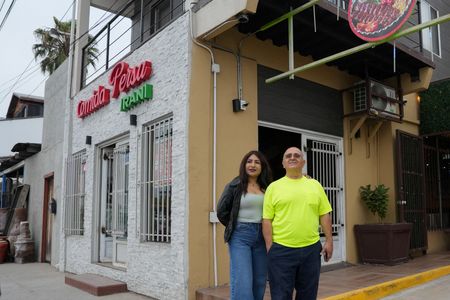

About 25 miles south of the U.S.-Mexico border, tucked in among taco shops in the outskirts of Tijuana, a flag hangs that stops passersby in their tracks. It bears Mexico’s colors of green, white, and red — but its design is anything but typical for the neighborhood.
Inside is what owner Saied Assadi describes as only the second Iranian restaurant in all of Mexico. “Food is one of my passions,” Assadi told Reuters during a visit this week, as he plated a traditional Iranian spread of rice, grilled tomatoes, mixed meats, and salad.
Not every Iranian in the area, however, feels welcome there.
Tijuana’s Iranian community is remarkably small — around 20 people in a city of roughly 2 million residents. Yet even within that handful of individuals, sharp political divisions reflect the broader fractures running through the Iranian diaspora worldwide — and the complicated backdrop facing Iran’s soccer team as it prepares for World Cup competition.
Dara Makoipour, an Iranian who relocated to Tijuana in 2018, says the flags displayed at Assadi’s restaurant are enough to keep him away. “We have different views,” said Makoipour, who instead crosses the border into California when he wants to eat Iranian food.
The flag at issue features a lion and sun design — Iran’s national symbol before the 1979 revolution, and one closely tied to the country’s former Shah-led government. The flag has become a flashpoint heading into the World Cup, as FIFA rules ban political items from stadiums. At the 2022 Qatar World Cup, security personnel turned away fans who tried to bring it inside.
When asked about Iranians who are put off by the flag, Assadi was direct: “Whether that person wants to come eat Iranian food or not because of the flag, that’s his choice. Some people are extremists.”
Still, one thing bridges the divide between Makoipour and Assadi: their shared enthusiasm for Iran’s soccer squad, known widely as Team Melli — Persian for “national team.”
AN UNUSUAL DESTINATION
Last month, the Iranian national team announced it was shifting its training base from Arizona to Tijuana, citing uncertainty over whether the U.S. would grant visas given the strained relations between the two countries. The Mexican border city made geographic sense — it sits relatively close to the team’s group-stage venues in Los Angeles and Seattle, and Mexico was receptive to hosting.
Still, the choice raised eyebrows. Iran prohibits alcohol and requires women to wear hijabs, making Tijuana — a city well known for its nightlife, strip clubs, and gambling establishments — an unconventional fit for the squad.
Any reservations appeared to melt away quickly. When the team arrived at 5 a.m. last Sunday — nearly four hours behind schedule — supporters were on hand to greet them warmly. Since then, a small group of fans has shown up outside the team’s hotel each day looking for autographs.
“Tijuana and especially the Mexican people — they’ve been amazing,” Iranian national team player Saeid Ezzatollahi told Reuters.
The team has kept a low profile since arriving. They travel with a private chef, Mexican soldiers are stationed outside their hotel, and their outings have been limited to chartered bus rides to a nearby stadium for training sessions.
FINDING HOME IN TIJUANA
Tijuana’s Iranian population is so small it doesn’t even appear in census data — a sharp contrast to nearby Los Angeles, which has the largest Iranian community outside of Iran itself.
Sadegh Galavi said he was immediately drawn to the city when he and his wife came to visit in 2022 from Tehran. “Literally, we fell in love with Mexico,” he said. “And then Tijuana makes me feel that there is a lot of opportunity to work, to do many things, to build a life.”
Galavi’s path to employment in Tijuana came through a chance encounter: he spotted a car on the street with vanity plates reading “TEHRAN,” left a note on the windshield, and discovered the owner was Makoipour. Galavi now works as a mechanic at an auto restoration business Makoipour owns.
Both men were thrilled when they learned Team Melli was heading to their city. “As long as the other side” — meaning the U.S. — “doesn’t give them a hard time, the rest is going to be easy peasy,” Makoipour said.
HEADING INTO THE TOURNAMENT
On Sunday, the team will fly by private plane to Los Angeles, arriving one day before their opening World Cup match against New Zealand. Several support staff and soccer federation members who were denied U.S. visas — including the team supervisor, analysts, and press liaison — will remain in Tijuana.
The U.S. State Department has stated it will not allow the Iranian team to “abuse this system to sneak terrorists into the U.S. under false pretenses.” Iran’s ambassador to Mexico, Abolfazl Pasandideh, fired back, saying the Trump administration believes “anybody who doesn’t think the same as them is a terrorist.”
The flag controversy continues as well. A California non-profit has filed a lawsuit seeking to block any restrictions on bringing the pre-revolutionary Iranian flag into World Cup stadiums, citing freedom of expression protections. FIFA, which previously told Reuters that its stadium code of conduct prohibits flags “of a political, offensive and/or discriminatory nature,” did not immediately respond to questions about the lawsuit.
Assadi, whose restaurant proudly displays the pre-revolutionary flag, said he believes the Islamic Republic is “not giving people the freedom” they deserve. But come Monday, he’ll be rooting for the national team — political differences aside.
“Pretty much everyone in Iran plays soccer,” he said. “I hope all Iranians will support the team as soccer players.”