
HARRISBURG, Pa. — Half a year after President Donald Trump put states on notice to stay out of artificial intelligence regulation, many are ignoring that warning and moving forward with their own rules.
While Congress has been unable to produce any federal AI legislation, states across the country are examining how AI-powered chatbots communicate with children, how businesses use AI in the workplace, and what obligations AI developers have to prevent worst-case scenarios caused by the technology.
Earlier, broader attempts to regulate AI at the state level were either vetoed or blocked by governors who felt those measures placed too heavy a burden on the industry — including proposals that would have held AI developers responsible for built-in bias in their systems. But state lawmakers have come back with more focused legislation that zeroes in on the specific ways people encounter AI in their everyday lives, often without realizing it.
Trump’s effort to rein in state AI regulation drew pushback from members of both parties, as well as civil liberties and consumer advocacy organizations, who argued that blocking state-level oversight would essentially hand a free pass to major AI companies that already face little accountability.
The president has elevated AI to a top national and economic security priority, arguing that allowing a patchwork of state regulations to complicate things for an industry investing trillions of dollars could jeopardize America’s competitive edge over China in the AI race.
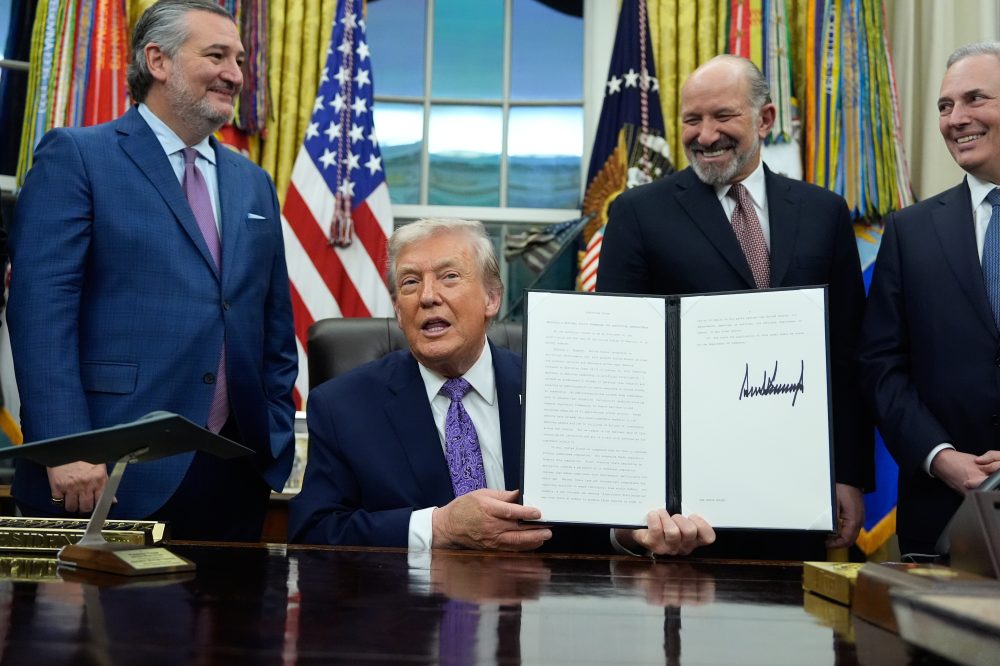
Trump signed an executive order directing the attorney general to establish a task force to challenge state AI laws deemed more than “minimally burdensome,” while also directing the Commerce Department to compile a list of regulations considered problematic. The order also threatened to cut off funding from a broadband deployment program and other grant initiatives for states that enact AI laws.
The White House said it would not go after state laws designed to prevent fraud or protect consumers and children.
The Trump administration also put out a “national policy framework” urging Congress to override state AI laws that conflict with its regulatory vision and to pass legislation covering children’s protections, intellectual property, and free speech. A new bipartisan proposal in the House recently faced sharp criticism from key members of both parties.
So far, the White House has not followed through on its threat to sue any state over an AI law or to cut off funding. In a statement, the administration said it is “eager to work with partners” to carry out its policy framework.
Rather than discouraging state action, Trump’s executive order appears to have had little effect on lawmakers. More AI-related bills have been introduced this year than last, including from Republican legislators, according to Justine Gluck, policy director of the Future of Privacy Forum — a nonprofit that champions data privacy in technology and draws its membership from industry, academia, and civic organizations.
In Illinois, a bill sitting on Democratic Gov. JB Pritzker’s desk builds on legislation passed last year in California and New York. It would require developers of large, advanced AI models to put in place safeguards against catastrophic outcomes — such as a biological weapons attack, a widespread power failure, or a major cyberattack.
Illinois went a step further by adding a requirement that AI developers bring in an independent auditor to verify whether they are living up to their own stated policies — a move analysts view as pushing the industry toward greater accountability.
The bill’s sponsor, Democratic state Sen. Mary Edly-Allen, dismissed Trump’s warnings outright.
“I don’t know if you’ve met Illinois, but we’re pretty independent,” Edly-Allen told the Associated Press.
The bill passed with near-unanimous support, reflecting a willingness among members of Trump’s own party to join Democrats in addressing the regulatory gap left by federal inaction. Similar legislation is expected to spread to additional states.
A growing number of states are also cracking down on how AI chatbots interact with people — particularly minors. States with both Republican and Democratic leadership have enacted such laws this year, including Colorado, Connecticut, Idaho, Iowa, Nebraska, and Oregon.
In many cases, these laws require companies to disclose when someone is communicating with an AI rather than a real person. Many also restrict how chatbots can engage with children, give parents oversight of their child’s access, and require that information shared with chatbots remain private.
Connecticut recently enacted rules specifically for companion chatbots — AI systems designed to maintain ongoing relationships with users. Under those rules, chatbots cannot interact with anyone under 18 unless they are programmed to discourage self-destructive behavior and give parents tools to monitor and manage their child’s usage.
In May, Colorado passed a law requiring companies that deploy AI in high-stakes areas — such as employment, education, housing, or banking — to notify individuals when AI is being used to influence a decision affecting them. The measure softened an earlier 2024 law aimed at curbing AI-driven discrimination, following pressure from Democratic Gov. Jared Polis.
Connecticut also passed a separate requirement that employers using AI in hiring or employment decisions must inform workers or job applicants that they are dealing with an AI system.
Connecticut, Washington, and Utah additionally required AI developers to embed identifying data into digital content — such as photos or videos — so users can determine whether that content was created or modified by AI.
More legislation is still possible before the year is out. In California, lawmakers are advancing the “No Robo Bosses Act of 2026,” which would bar employers from relying entirely on AI to fire or discipline workers. California is also looking to expand its oversight of AI chatbots, including a ban on using chatbot interactions with children for advertising purposes.
In Florida, the state House declined to move forward with what Republican Gov. Ron DeSantis called his AI “Bill of Rights.” The proposal would have given parents control over their children’s access to companion chatbots and required companies to disclose when consumers are interacting with AI instead of a human.
Florida House Speaker Daniel Perez argued that Trump had made clear that AI regulation belongs at the federal level. DeSantis pushed back on that view, pointing out that the federal government has yet to act.
In Utah, a bill modeled on laws from New York and California stalled after the White House sent lawmakers a one-sentence memo stating it was “categorically opposed” to the legislation.