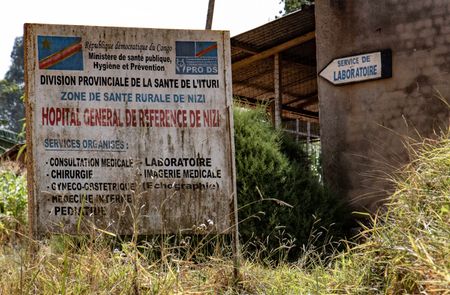

NIZI, Democratic Republic of Congo — Two weeks ago, the Kpangba displacement camp became the first in this part of conflict-ravaged Congo to see Ebola claim lives. Health teams immediately moved in to track down anyone who had been in contact with the deceased, hoping to stop the virus from spreading further.
Those efforts were quickly shut down. Residents of the camp drove away workers from the provincial health ministry, the World Health Organization, and other aid organizations, refusing to accept that the two women had died from Ebola. That’s according to Jean-Claude Lonzama, the chief doctor for the Nizi health zone — a densely populated mining region.
“Up to this day, we are not able to follow up on the contacts of these cases,” Lonzama told Reuters on Saturday.
That standoff has left health officials essentially operating in the dark as they attempt to prevent an Ebola surge inside a camp housing approximately 30,000 people, the vast majority of whom fled inter-ethnic violence in surrounding communities.
“We have 22 displaced persons sites in the Nizi health zone … with around 81,124 residents,” Lonzama said. “This is also our great worry because no preventive measures have been put in place in these sites aside from a few educational messages.”
The current outbreak was declared a month ago, and since then, several treatment facilities have come under attack. Some residents believe Ebola is a fabrication, while others are furious that traditional burial practices have been restricted to prevent the virus from spreading.
Aid organizations are particularly alarmed about the conditions inside displacement camps, where hundreds of residents may share a single toilet and open defecation is widespread. Those conditions could accelerate what is already shaping up to be one of the largest Ebola outbreaks ever recorded.
More than 5 million displaced people live across the three affected provinces — Ituri, South Kivu, and North Kivu — all of which have suffered through decades of armed conflict.
Throughout eastern Congo, health workers are running into the same wall: deep distrust of both the government and outside organizations. The attacks on treatment sites echo violence seen during a 2018-2020 Ebola outbreak in the same region, which claimed the lives of more than 25 health workers.
The two deaths in Kpangba happened on May 31 and June 1, though they weren’t publicly reported until a U.N. refugee agency document was released Thursday. A Congolese health ministry report reviewed by Reuters revealed that the first victim — a 60-year-old woman — had tested positive for Ebola on May 30, but had already left quarantine and could not be found by that point.
Health experts say the combination of community mistrust, shortages of essential supplies, and ongoing armed conflict across much of the affected region has left them gravely concerned about whether this outbreak can be brought under control.