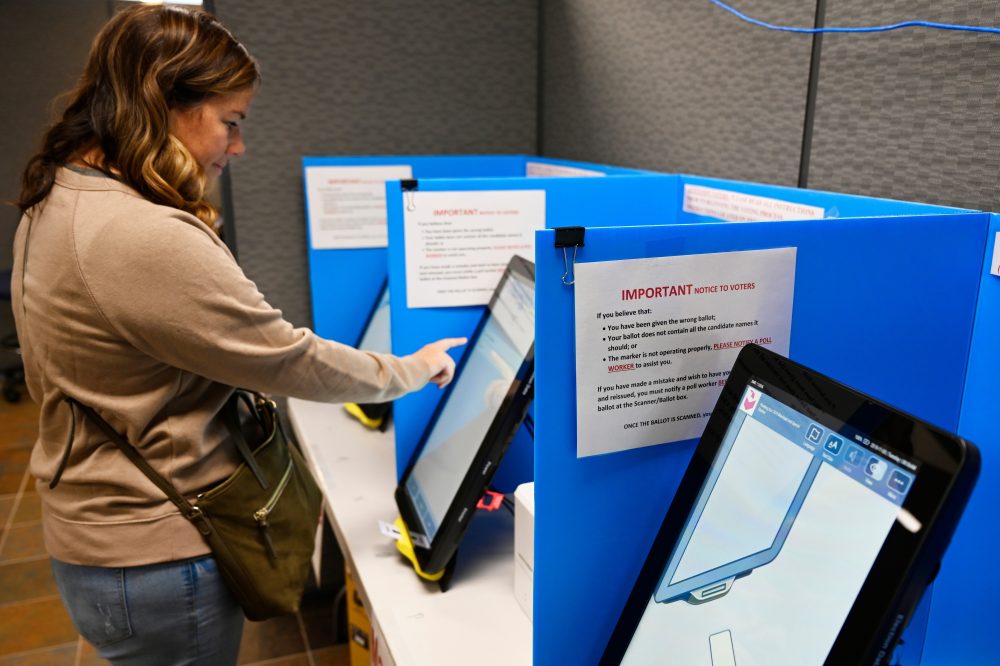

ATLANTA (AP) — Georgia lawmakers are heading back to the state Capitol this week for a special session, where one of their top priorities will be untangling an election problem that stems from their own legislation.
The voting system currently used across the battleground state relies on a QR code printed on each ballot to count votes. Two years ago, the legislature passed a law prohibiting the use of that barcode for the official vote tally after July 1 of this year — but no alternative counting method has ever been put in place.
Republican Gov. Brian Kemp, who called the special session, specifically directed lawmakers to “address issues created” by that law. Making matters worse, the secretary of state’s office and the State Election Board have issued contradictory instructions to county election officials about how votes should be cast and counted going forward.
If a resolution isn’t reached quickly, the state could face widespread confusion and potential lawsuits over elections after July 1. A special election to fill a vacant U.S. House seat is already scheduled for that month.
Georgia’s current voting system was first rolled out statewide during the 2020 primary election. After that November’s general election — in which Republican President Donald Trump narrowly lost the state to Democrat Joe Biden — Trump and his allies claimed without evidence that the machines had altered or deleted votes.
Trump supporters continued to raise objections to the touchscreen voting machines, with some pushing unsubstantiated conspiracy theories. Election integrity advocates also took issue with the machines, arguing they could be vulnerable to hacking and that voters have no way to verify their choices since QR codes aren’t human-readable.
In 2024, Republican lawmakers attempted to respond to those concerns by passing legislation banning barcodes from the “official tabulation count” after July 1, 2026. However, in the two years that followed, neither the secretary of state’s office nor the General Assembly moved to put a replacement system in place. Now, with the deadline nearly here, a major midterm election is also on the horizon.
Trump specifically called out these voting machines — which are used in at least some counties across more than a dozen states — in his first executive order on elections after beginning his second term in January 2025. That order has since been blocked by multiple courts and is not currently being enforced.
Last month, Kemp announced the special legislative session, set to begin Wednesday, to address both the QR code issue and the redrawing of congressional maps ahead of the 2028 elections.
One possible outcome is that lawmakers could push back the deadline in the law, allowing QR codes to remain in use for now while a new system is developed before the 2028 elections. However, during the final hours of this year’s regular legislative session, a similar proposal was voted down.
Even if lawmakers reach an agreement this week, putting any new system into practice before the upcoming special election could prove difficult. That election is being held to fill the remainder of the term of U.S. Rep. David Scott, who passed away in April. Voting is set for July 28, with early voting starting July 6.
Last week, the secretary of state’s office released preliminary guidance to election officials in the six counties that make up that congressional district, noting the instructions could change depending on what happens during the special session.
Under that plan, ballots would be scanned and the QR code would be used to generate the election night vote count. Before the county certifies results, however, electronic images of each ballot would be uploaded to a server, where optical character recognition software would produce a second tally using the printed text — and that second count would serve as the official result.
The secretary of state’s guidance also states that counties must continue using the current election system, including the touchscreen machines, and that nothing in the law permits hand-marked paper ballots for in-person voting.
Two days later, the State Election Board stepped in with its own conflicting guidance, with board members arguing that the secretary of state’s proposed approach isn’t authorized under state law.
The board passed a resolution telling counties what to do if the special session does not result in an extended deadline for QR code use. That resolution directs counties to fall back on their emergency procedures, which call for hand-marked paper ballots counted by scanners.
During the election board meeting, a lawyer from the state attorney general’s office, Elizabeth Young, acknowledged the problem, saying that while neither set of guidance is legally binding, “obviously it would cause confusion for elections superintendents if they are getting differing instructions from two agencies, both of which have some authority over what they’re doing.”
The election board has been dominated by a Trump-aligned majority and has frequently clashed with Secretary of State Brad Raffensperger, a Republican who has often been a target of Trump’s criticism.
Henry County, located in Atlanta’s suburbs, is among the counties where voters will cast ballots in next month’s special election. Axiver Harris, the county’s interim elections director, said officials are aware of the competing guidance and are waiting for the state to provide clearer direction.
“Given the uncertainty surrounding the guidance currently available, we believe it is wise to wait for further direction to ensure that any decisions made are consistent with state requirements and election administration best practices,” Harris wrote in an email.
Marcye Scott, who is running in the special election to finish out the term of her late father, said she doubts most voters are following the issue closely and that her focus lies elsewhere.
“My goal is to get people to the polls, get my people to the polls and get them to vote for me,” she said.
Fellow candidate Carlos Moore, one of six people running in the special election, said he’s concerned that rushing in a new vote-counting method could invite legal challenges. He is hoping lawmakers simply extend the deadline and leave the QR code system in place for the special election.
“I would ask that legislators do the right thing, leave well enough alone for the special election,” Moore said. “Otherwise, it’s almost certain there will be challenges in court.”