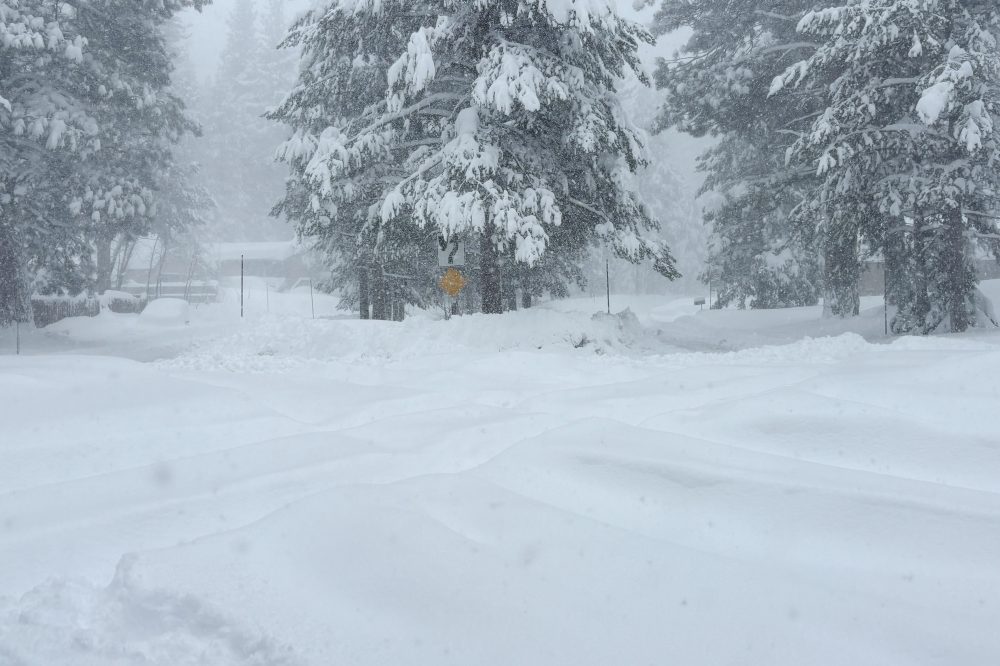
Emergency responders launched an intensive search operation Tuesday for several backcountry skiers who disappeared following an avalanche in Northern California’s mountainous terrain, as a severe winter storm continues battering the region.
Nevada County Sheriff’s Office received an emergency call around 11:30 a.m. Tuesday reporting the avalanche with individuals trapped beneath the snow, according to department spokesperson Ashley Quadros.
Multiple agencies including the sheriff’s department, their Search & Rescue unit, and California Department of Forestry and Fire Protection teams mobilized to Castle Peak, located northwest of Lake Tahoe, Quadros reported.
“It has been reported that a group of back country skiers was involved in the incident, with several members of the party missing at this time,” the sheriff’s office wrote in a Facebook post.
A fierce winter storm has been pummeling California throughout the week, delivering dangerous thunderstorms, powerful winds, and substantial mountain snowfall.
The Sierra Avalanche Center in Truckee warned that the Central Sierra Nevada region, encompassing the greater Lake Tahoe area, faced elevated avalanche risks in backcountry areas, with major slides anticipated through Wednesday.
Multiple Lake Tahoe area ski facilities shut down completely or partially due to hazardous weather conditions.
The threatening situation resulted from quickly accumulating snow, deteriorating snowpack stability, and hurricane-force winds. Areas with established avalanche control programs, including managed ski slopes and highways, faced reduced risk levels, the center noted.
The 9,110-foot Castle Peak sits in the Donner Summit region of the Sierra Nevada and attracts many backcountry skiing enthusiasts. Nearby Soda Springs recorded at least 30 inches of fresh snowfall within the past day, according to Soda Springs Mountain Resort data.
Weather experts predict the Sierra Nevada’s western slopes in northern Shasta County, including sections of Interstate 5, plus portions of the Pacific Coast Range could accumulate up to 8 feet of snow before the storm system passes late Wednesday.
Transportation chaos spread across roadways from Sonoma County through the Sierra Nevada. California Department of Transportation temporarily stopped all Interstate 80 traffic near the Nevada border due to vehicle spinouts and collisions.
Authorities reported that an avalanche claimed a snowmobiler’s life in the same region this past January. The National Avalanche Center reports that avalanches typically kill 25 to 30 people annually across the United States.
Salisbury’s Field Operations Department has shut down St. Peters Street this week as construction crews tackle concrete enhancement projects in the area.
While West Main Street and West Church Street will stay accessible to traffic, drivers should prepare for heavier congestion and potential delays when traveling through downtown. The construction timeline calls for completion by Friday, February 20.
Mayor Randy Taylor highlighted how crucial these infrastructure upgrades are for the city’s business community.
“Investing in our infrastructure is key to boosting business downtown,” the mayor said. “These improvements will make our streets safer and more accessible, creating a better experience for residents and visitors alike.”
City officials recommend that drivers plan alternative routes and budget additional time for their commutes. Those seeking project updates can check www.salisbury.md or follow the City of Salisbury’s social media accounts.
Salisbury’s Waterworks Utilities Division is conducting emergency repairs on a damaged water main located in the 600 block of Baker Street this Tuesday, February 17. The repair work is part of ongoing citywide efforts to upgrade and maintain the municipal water distribution infrastructure.
City officials anticipate the repairs will be finished by approximately 3:00 p.m., assuming no unexpected complications arise during the process.
The construction zone has forced authorities to completely shut down Baker Street between East Railroad Avenue and Barclay Street, blocking all vehicle traffic from passing through the area.
Local officials have already contacted Wicomico Schools, Central Alarm services, and utility locator companies about the street closure. Residents experiencing water service interruptions or dealing with broken pipes can contact the Salisbury Police Department’s non-emergency number at (410) 548-3165, and utility personnel will be sent to assist.
City representatives are asking for public understanding and patience while crews complete the necessary infrastructure repairs.
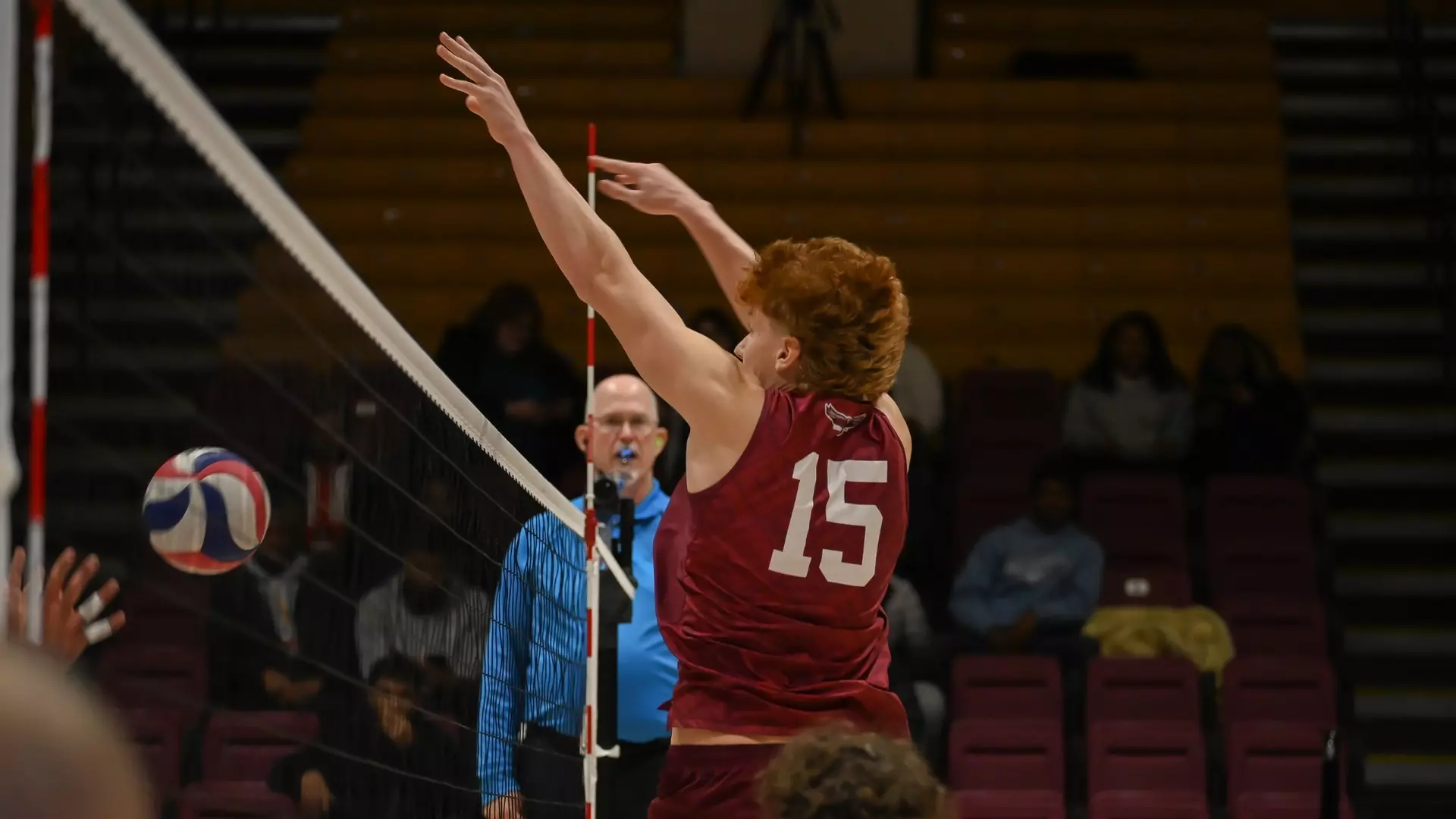
A University of Maryland Eastern Shore volleyball standout has captured dual recognition from the Northeast Conference this week.
Chase Valentine has been selected as the NEC men’s volleyball Defensive Player of the Week for the third occasion this season, while also earning Rookie of the Week distinction for the second time.
The double honor highlights Valentine’s exceptional performance on the court for the Hawks volleyball program. His consistent defensive prowess has made him a repeat recipient of the conference’s top defensive recognition throughout the current season.
Valentine’s achievements demonstrate the strong talent emerging from UMES athletics as the team continues its competitive season in Northeast Conference play.
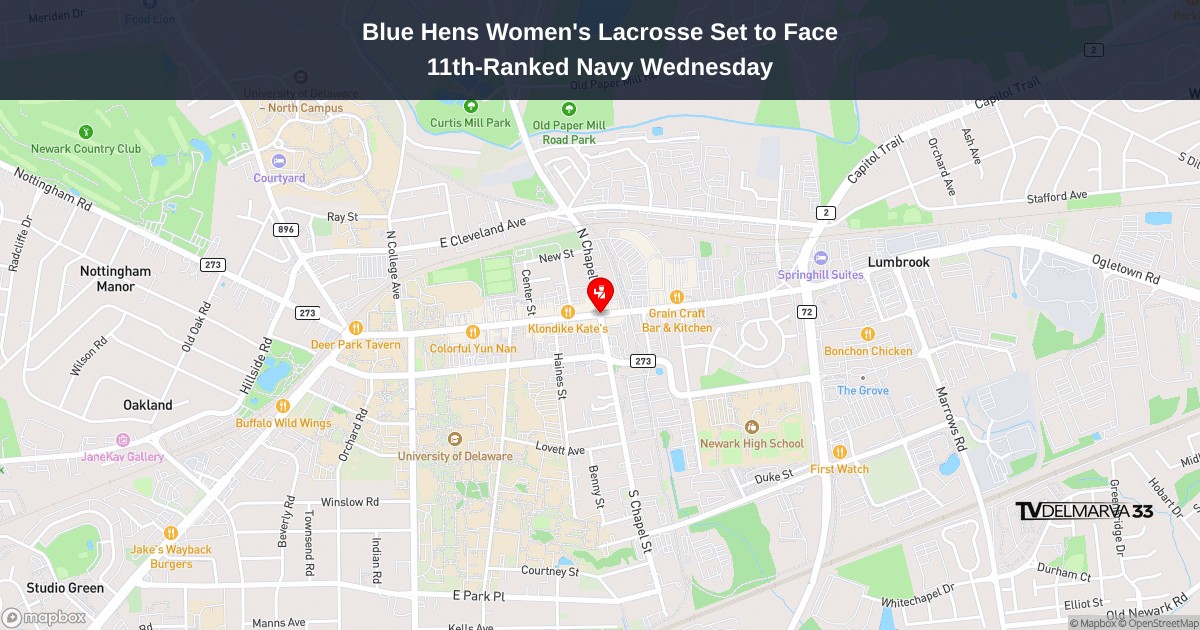
The University of Delaware women’s lacrosse squad is preparing to take on a formidable opponent this Wednesday when they welcome the 11th-ranked Naval Academy team to Delaware Stadium in Newark.
The Blue Hens will face off against the highly-ranked Midshipmen in what is expected to be a challenging home contest. Navy enters the matchup with a strong national ranking that reflects their competitive program.
The game represents an opportunity for Delaware to test themselves against one of the nation’s top lacrosse programs on their home turf. Wednesday’s contest will take place at Delaware Stadium, giving local fans a chance to support the Blue Hens against elite competition.
A Dense Fog Advisory is now in effect for the entire Delmarva Peninsula, with visibility dropping to just one-quarter to one-half mile starting at 10 PM tonight through 10 AM Wednesday morning.
The National Weather Service issued the advisory at 1:15 PM today, warning that hazardous driving conditions are expected across Delaware, the Eastern Shore of Maryland, and southeastern Virginia. The thick fog will also impact parts of New Jersey and southeastern Pennsylvania.
Locally, all Delaware counties are included in the advisory, along with Kent, Queen Anne’s, Talbot, Caroline, and Sussex counties on Maryland’s Eastern Shore. The fog is expected to be most dense during the overnight and early morning hours.
“Low visibility could make driving conditions hazardous,” meteorologists warned. Drivers are urged to slow down, use headlights, and maintain extra distance between vehicles when traveling through foggy areas.
The advisory remains in effect until 10 AM Wednesday, though conditions may improve gradually as morning temperatures rise. Commuters should plan for extra travel time and consider delaying non-essential trips during the peak fog hours.
Stay with TV Delmarva for continuing weather updates throughout the night and Wednesday morning.
The Goldey-Beacom College Lightning baseball program has once again earned national recognition, claiming a tie for 30th place in the latest American Baseball Coaches Association Division II poll released this season.
This marks the fourth occasion in five years that the Lightning have secured a position in the national rankings, demonstrating the program’s consistent excellence and competitive performance at the Division II level.
The ranking represents the first in-season poll from the American Baseball Coaches Association Division II Coaches Poll, positioning Goldey-Beacom among the top programs in collegiate baseball nationwide.
Delaware authorities are continuing their investigation into a fatal propane gas explosion that rocked a Dagsboro residence on September 30th, 2025.
The blast, which investigators have determined was accidental in nature, claimed the life of one person who was inside the home at the time of the incident. A second occupant sustained minor injuries during the explosion.
Officials have confirmed that the explosion involved liquified petroleum gas and have found no evidence suggesting any criminal wrongdoing was involved in the deadly incident.
The investigation into the circumstances surrounding the explosion remains ongoing as authorities work to determine the exact cause of the tragic accident.
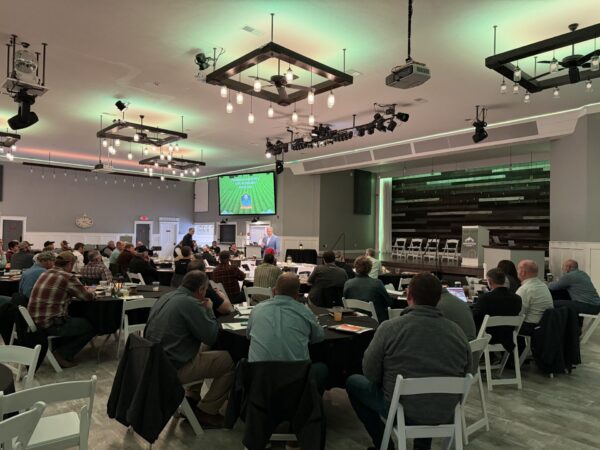
Delaware farmers who embrace technology-based agricultural methods are experiencing more reliable crop production, according to new research from a leading agricultural analytics company.
Jon Fridgen, who serves as Chief Science Officer at Advanced Agrilytics, reports that his company’s studies demonstrate how farmers benefit when they use scientific data tools to make decisions about fertilizers, seeds, and other farming inputs. The research indicates these tech-savvy growers achieve more predictable harvest results compared to those using conventional approaches.
“With these growers, we’re seeing that yield distribution shift to the right, so that gives us the yield increase,” Fridgen explained. “In the case of corn, we’re cutting about 30 bushels an acre difference.”
The findings suggest that data analytics are becoming increasingly valuable for agricultural operations throughout the region, helping farmers optimize their production while reducing uncertainty in crop outcomes.
For nearly two decades, staff at Frederick County’s jail in Maryland have routinely posed two questions to every inmate: Which country holds your citizenship? What is your place of birth?
When responses indicated origins outside the United States, local deputies with specialized federal training would begin investigating potential immigration violations. Frederick County Sheriff Charles Jenkins reports that since 2008, his department has transferred 1,884 individuals to U.S. Immigration and Customs Enforcement custody.
This practice ends immediately following legislation enacted Tuesday by Democratic Governor Wes Moore, which bans immigration enforcement partnerships between local agencies and federal authorities.
Maryland’s new statute demonstrates how Democratic-controlled states are resisting President Donald Trump’s immigration enforcement expansion. A total of ten states, all under Democratic leadership, have implemented statewide restrictions preventing law enforcement from participating in key programs Trump uses for mass deportation efforts.
Similar legislation prohibiting ICE cooperation agreements became law this month in New Mexico and took effect in January in Maine. New York Governor Kathy Hochul supports comparable measures that would prevent local officers from receiving ICE deputization. Virginia Governor Abigail Spanberger recently ended state-level ICE partnerships established by her Republican predecessor, though local sheriff agreements remain intact.
Democratic opposition has intensified as the Trump administration faces growing criticism over large-scale enforcement operations in multiple cities and the deadly shootings of Renee Good and Alex Pretti by federal agents in Minnesota.
“There needs to be accountability for this organization, because right now the Trump-Vance ICE operation is not moving with proper accountability measures,” Moore stated to reporters following the signing ceremony.
Frederick County’s longtime Republican sheriff argues that ending the ICE partnership will require releasing individuals who might subsequently commit additional offenses.
“I’m extremely disappointed with the legislation,” Jenkins said, “because really and truly, it’s going to put the public at risk in a lot of ways.”
After assuming office last year, Trump reinstated a decades-old initiative that provides local officers with training to question and detain suspected undocumented immigrants.
The 287(g) initiative — referencing the 1996 legislation that established it — operated under President Joe Biden’s administration solely for immigrants already in custody on criminal charges. Trump broadened its scope to include local task forces authorized to conduct street arrests, reviving an approach that former President Barack Obama had ended due to racial profiling concerns.
Program participation has surged dramatically, growing from 135 agreements across 20 states before Trump’s presidency to over 1,400 current agreements spanning 41 states and territories. Some local departments maintain multiple agreements covering various immigration enforcement functions.
Approximately 800 agencies hold task force agreements, providing the broadest enforcement authority. As incentive, ICE provides local agencies signing task force agreements with $100,000 for new vehicles. For each trained task force officer, ICE covers salary, benefits and $7,500 in equipment costs.
Four Republican-led states — Arkansas, Florida, Georgia and Texas — mandate local jail participation in the program. These states represent half of all 287(g) agreements nationwide.
The expansion of ICE partnerships coincides with increased federal immigration enforcement funding. A major tax reduction law signed by Trump last year allocates $150 billion for immigration enforcement, including over $46 billion to recruit 10,000 ICE agents and $45 billion for expanded immigrant detention facilities.
Nine Maryland counties led by Republican sheriffs maintain cooperative ICE agreements. These partnerships must cease under the new law, which passed with overwhelming support in the Democratic-controlled General Assembly.
Maryland House Speaker Joseline Peña-Melnyk, who arrived from the Dominican Republic at age 8, described the legislation as reflecting Maryland’s commitment to civil rights.
“We value empathy,” she stated. “We value peoples’ contribution. We value the Constitution. We value and support and protect civil rights.”
However, some Republican sheriffs and legislators warn that prohibiting cooperative agreements may prompt ICE to deploy more federal agents within the state.
“I think what you’ll see is more immigrant enforcement, not less,” said Harford County Sheriff Jeffrey Gahler, whose department has transferred approximately 430 inmates to ICE over nine years. “Our program was the safest way and the best way to identify people” in the U.S. illegally.
The Department of Homeland Security claimed the new law “will make Maryland less safe” and increase federal workload in the state.
“When politicians bar local law enforcement from working with DHS, our law enforcement officers have to have a more visible presence so that we can find and apprehend the criminals let out of jails and back into communities,” the department stated.
An AP-NORC poll indicates approximately 60% of U.S. adults believe Trump has “gone too far” in deploying federal immigration agents to American cities, with political independents showing increasing discomfort with his methods.
“The growing public pushback against Trump’s immigration enforcement – especially in more Democratic-leaning states – has created political pressure and a political opening to pass laws like the one in Maryland,” said Nayna Gupta, policy director at the nonprofit American Immigration Council.
Tuesday saw Virginia’s Senate approve legislation along party lines establishing significant restrictions on proposed 287(g) agreements. The measure still requires House approval.
“I’m seeking to give some comfort to thousands of men, women and children in the Commonwealth who are living in fear that federal agents might send them or their family members to a country they fled, or a country they have never been to,” said Democratic state Senator Saddam Azlan Salim, the bill’s sponsor.
New Mexico lawmakers also referenced intensive immigration enforcement activities in Minnesota when justifying limits on ICE cooperation. The New Mexico legislation prohibits state and local government contracts for ICE detention facilities and eliminates agreements allowing local officers to perform federal immigration duties.
Curry County, located roughly 100 miles southwest of Amarillo, Texas, represents New Mexico’s sole jurisdiction with a 287(g) agreement. Sheriff Michael Brockett explained the arrangement provides secure transfer methods to ICE custody, “rather than federal agents searching for released prisoners on the streets and in neighborhoods of our community.”
Delaware’s agricultural community is confronting challenging financial conditions as federal economists project a substantial decline in farming profits nationwide. The United States Department of Agriculture’s most recent economic analysis shows net farm income is expected to fall by $1.2 billion compared to 2025 projections.
According to Nathan Kauffman from the Federal Reserve Bank of Kansas City, crop and livestock prices have maintained relatively stable levels since the beginning of 2024. “They’re still higher than what they were in 2019. But, once again, expenses are much higher than they were in” previous years, Kauffman explained.
The income decline comes despite various federal assistance programs that have helped cushion the financial blow to agricultural producers. Without these government support measures, farming operations across Delaware and the broader Mid-Atlantic region would likely face even more severe economic pressures.
Motorists across the Delmarva Peninsula should prepare for treacherous driving conditions tonight as the National Weather Service has issued a Dense Fog Advisory effective from 10 PM tonight through 10 AM Wednesday morning.
Visibility will drop dramatically to just one-quarter to one-half mile in dense fog, creating hazardous conditions for drivers throughout the region. The advisory covers all of Delaware, including New Castle, Kent, and Sussex counties, as well as the Delaware beaches.
On Maryland’s Eastern Shore, affected areas include Kent, Queen Anne’s, Talbot, Caroline, and Sussex counties. The fog will also impact portions of southeastern Pennsylvania and southern New Jersey.
“Low visibility could make driving conditions hazardous,” warns the National Weather Service Mount Holly office, which issued the advisory at 1:15 PM today.
Drivers are strongly urged to take extra precautions if travel is necessary. Slow down significantly, use your headlights, and maintain extra distance between vehicles. Consider delaying non-essential travel until conditions improve.
The Dense Fog Advisory will remain in effect until 10 AM Wednesday morning. Stay tuned to TV Delmarva for continued weather updates and traffic conditions throughout the night.
A federal judge has blocked Immigration and Customs Enforcement from taking back into custody a Salvadoran man residing in Maryland, determining that the mandatory 90-day detention window has lapsed and federal officials lack a realistic deportation strategy.
Kilmar Abrego Garcia’s situation has emerged as a significant case in ongoing immigration discussions following his erroneous deportation to El Salvador in the previous year. Upon his return to the United States, he has been contesting efforts by Department of Homeland Security personnel to send him to multiple African nations.
U.S. District Judge Paula Xinis of Maryland criticized the government’s approach in her Tuesday ruling, stating they “made one empty threat after another to remove him to countries in Africa with no real chance of success.” She concluded that “there is no ‘good reason to believe’ removal is likely in the reasonably foreseeable future.”
The man maintains family ties in America through his wife and child and has established residence in Maryland over several years, though he originally entered the country without authorization as a minor. A 2019 immigration court decision determined he could not be sent back to El Salvador due to gang-related threats against his family there, yet he was incorrectly deported regardless.
Under mounting public criticism and judicial pressure, the Trump administration facilitated his return in June, though only after obtaining criminal charges against him for alleged human trafficking activities in Tennessee. He has entered a not guilty plea to these charges. Administration officials maintain he cannot remain in the United States permanently and have indicated plans to deport him to Uganda, Eswatini, Ghana, or Liberia according to court documents.
Judge Xinis highlighted in her decision that the government has “purposely—and for no reason—ignored the one country that has consistently offered to accept Abrego Garcia as a refugee, and to which he agrees to go,” referring to Costa Rica.
His legal representative, Simon Sandoval-Moshenberg, contended during proceedings that immigration detention should not function as punishment. He argued that immigrants may only be held to enable their removal and cannot be confined indefinitely without a realistic deportation strategy.
“Since Judge Xinis ordered Mr. Abrego Garcia released in mid-December, the government has tried one trick after another to try to get him re-detained,” Sandoval-Moshenberg stated in a Tuesday email. “In her decision today, she recognized that if the government were truly trying to remove Mr. Abrego Garcia from the United States, they would have sent him to Costa Rica long before today.”
Three student-athletes from Salisbury University have been recognized with Coast-to-Coast Athletic Conference Player of the Week awards, sponsored by Jersey Mike’s A Sub Above program.
Baseball players Jackson Inman and Aidan Brinsfield claimed the season’s inaugural weekly honors from the C2C conference for their performances during the February 9-15 period. The duo’s recognition marks the first weekly awards of the new baseball season.
Women’s lacrosse standout Avery Dunbar also earned recognition, capturing C2C Offensive Player of the Week honors for her scoring performance on the field.
The awards highlight strong early-season performances by Sea Gulls athletes across multiple sports programs at the Salisbury campus.
Delaware’s agricultural community is increasingly embracing leasing arrangements as economic pressures mount across the farming sector. Financial institutions report growing demand from producers seeking alternative ways to acquire necessary equipment and infrastructure without straining their budgets.
Anjie Erbsen, who serves as a senior leasing specialist with Compeer Financial, explains that her work involves helping agricultural clients secure leasing arrangements for various operational needs including structures, grain processing systems, and farming machinery.
“We are in an area in the ag economy currently where cash flow is tight for many clients, so we also want to make sure” farmers have access to flexible financing options, Erbsen noted.
The shift toward leasing reflects broader challenges facing Delaware’s farming community as producers seek ways to maintain operations while managing financial constraints in today’s agricultural marketplace.
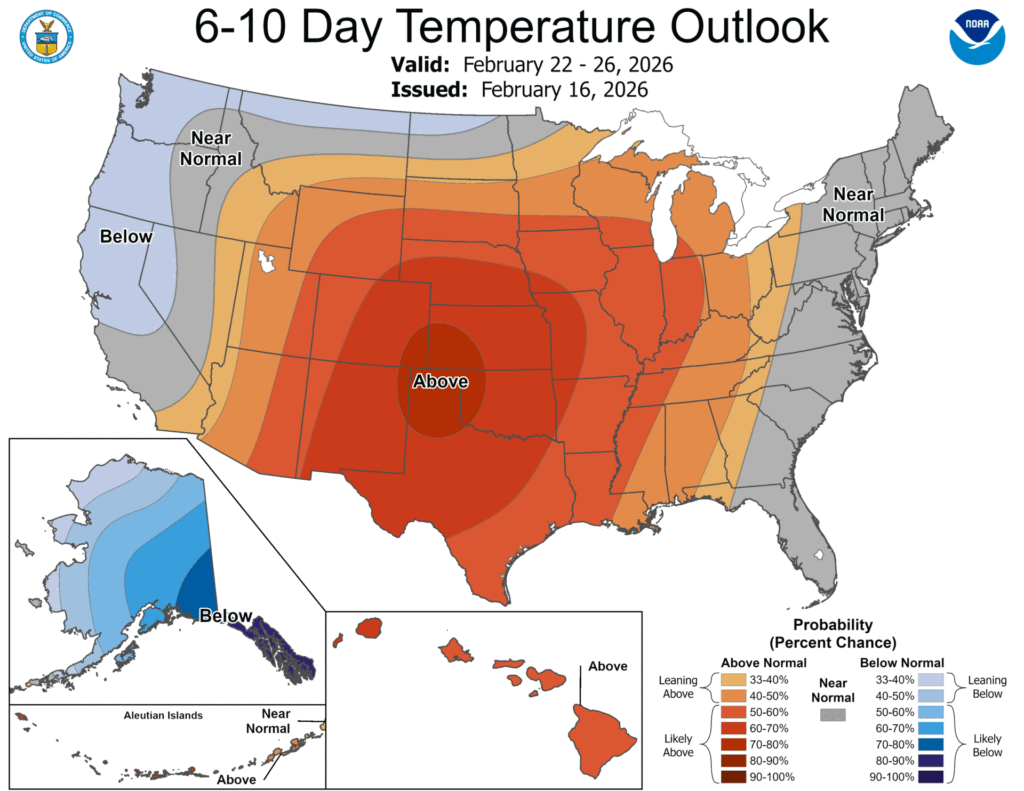
Weather forecasters are predicting warmer-than-usual conditions for most of the United States in the coming week and a half, according to the latest national weather outlook.
The extended forecast covering the next 6 to 10 days indicates that temperatures and rainfall amounts are expected to meet or exceed seasonal averages across the majority of the nation. Active weather patterns are anticipated to persist for most regions during this timeframe.
However, some areas will experience different conditions. Temperatures below normal are forecast to remain limited to northern California, the Pacific Northwest region, and communities situated along the Canadian border extending eastward to North Dakota.
Regarding precipitation, below-average rainfall is expected to affect a specific corridor, though the complete details of this drier zone were not fully specified in the initial forecast data.
Drivers in Seaford will need to find alternate routes as the Market Street drawbridge begins a lengthy construction period that will keep it closed for nearly two years.
According to the Delaware Department of Transportation, the bridge closure went into effect and will remain in place through April 9, 2026, with traffic expected to resume at 6 PM on that date.
The extended shutdown affects one of Seaford’s key transportation corridors, requiring motorists to use other crossings during the construction period. DelDOT has not yet released specific details about the nature of the construction work being performed on the drawbridge structure.
Local residents and commuters should plan for additional travel time and consider alternative routes while the infrastructure project is underway.
Maryland’s Agricultural Fair Board has announced plans for a virtual meeting set to take place on February 19th, 2026, beginning at 1:00 pm.
During the online session, board members will review organizational reports, discuss financial matters, and engage in strategic planning discussions focused on operational improvements.
Those seeking additional details about the upcoming meeting can reach out to Harrison Palmer, who serves as Chief of Staff. Palmer can be contacted via email at [email protected] or by phone at (410) 841-5882.
Delaware residents may have received a tsunami warning alert on February 17th, but there was no cause for alarm as it was only a test.
The National Weather Service’s Tsunami Warning Center conducted a routine emergency alert test that began at 12:30 PM Eastern Standard Time and concluded at 1:30 PM on the same day.
These types of testing exercises are conducted periodically to verify that emergency notification systems are working correctly and can effectively reach the public during actual emergencies.
The one-hour test helped ensure that warning protocols and communication channels remain functional for potential future coastal emergencies affecting the Delmarva Peninsula region.
ARLINGTON, Va. — Delaware farmers will soon have access to cutting-edge artificial intelligence technology that can measure the nitrogen benefits from their cover crops, thanks to a major new conservation initiative.
The Nature Conservancy is leading this groundbreaking program that combines farmers, conservation organizations, agricultural businesses, universities, and government agencies to provide AI-powered data about cover crops and their nitrogen contributions to farming operations.
According to The Nature Conservancy, this initiative targets a significant information gap regarding nitrogen management for corn production that follows diverse cover crop plantings.
The organization anticipates the program will eliminate the need for 3 million pounds of nitrogen fertilizer that farmers would typically need to buy and spread on their land.
The technology relies on PlantMap3D, a system created by North Carolina State University. Agricultural service companies Willard Agri-Service and GROWMARK FS will install specialized cameras on spray equipment to capture detailed photographs of cover crops during spring herbicide treatments. Artificial intelligence software trained to recognize different cover crop species will then process these images.
The outcome will be detailed maps showing exactly where nitrogen from cover crops is present across each acre, giving farmers precise information to adjust their fertilizer applications and apply nutrients only where necessary.
“AI-powered camera systems are how we can finally bring precision and sustainable agriculture together,” explained Chris Reberg-Horton, a North Carolina State University professor working on the project. “We hope this program will help farmers reduce their costs while also improving environmental outcomes.”
This four-year conservation effort plans to encompass 150,000 acres throughout the Chesapeake Bay watershed, including 37,500 acres in Delaware, 92,500 acres in Maryland, and 20,000 acres in Pennsylvania. Implementation begins this spring growing season.
The USDA contributed $16 million in federal support through the USDA-NRCS Regional Conservation Partnership Program, while partner organizations provided an additional $11.3 million in funding.
The initiative seeks to help farmers better understand and modify their actual nitrogen requirements while preserving crop yields, preventing greenhouse gas emissions, and enhancing soil and water quality throughout the Chesapeake Bay watershed, according to The Nature Conservancy’s announcement.
“Knowledge is power, and this program arms TNC and our agricultural partners with unparalleled data that will boost biodiversity, water quality and farmers’ bottom lines in the Chesapeake Bay watershed, a globally important conservation landscape,” stated Amy Jacobs, Chesapeake Bay Director at The Nature Conservancy. “We are thrilled to be working with partners that are leaders in their field to deploy this new technology to support farmers with solutions that are both good for the environment and their businesses.”
Delaware farmers interested in joining this program can submit applications through February 28. Requirements and application details include:
• Location: Delaware farmers in all counties are eligible (New Castle, Kent, Sussex); Maryland farmers must be in Baltimore, Caroline, Carroll, Cecil, Dorchester, Harford, Kent, Talbot, Queen Anne’s or Wicomico counties; Pennsylvania farmers must be in Adams, Cumberland or York counties.
• Farms must currently use multi-species cover crops containing legumes, with plans to terminate them this spring (Spring 2026).
• To apply, contact Amanda Bunn, Applied Agricultural Conservationist at The Nature Conservancy, at [email protected].
Part of the project funding will assist Pennsylvania farmers in establishing mixed-species cover crops on their properties, since Pennsylvania lacks a centralized cover crop program similar to those in Maryland and Delaware, where cover crop adoption is more widespread.
“In partnership with the Pennsylvania and Delaware Maryland 4R Alliances, TNC, agribusinesses, and government agencies have been working to ensure that every application of fertilizer is guided by the 4Rs of nutrient management: using the right source, at the right time, in the right place, and applying the right amount,” Jacobs added.
The University of Delaware Blue Hens have announced their athletic lineup for this week, with several teams preparing for competition.
According to the athletic department’s schedule released Tuesday, February 17th, various Blue Hens squads will be taking the field and court in the coming days.
The weekly athletic schedule provides fans and supporters with information about upcoming games and matches featuring Delaware’s collegiate teams.
Specific details about game times, opponents, and venues are available through the university’s athletic department communications.
Morning commuters on northbound Interstate 95 are dealing with reduced lanes today as construction work forces the closure of the right travel lane.
The Delaware Department of Transportation reports that the right lane on I-95 North between U.S. Route 202 and Marsh Road will remain blocked to traffic until 12:15 PM while crews complete construction activities.
Drivers traveling through the area should expect potential delays and are advised to allow extra time for their commute. The lane restriction affects traffic heading north through the Wilmington corridor.
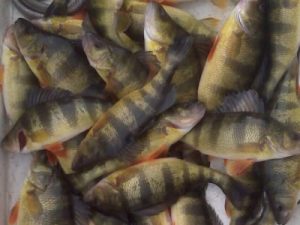
A new research study from Maryland’s Department of Natural Resources has eliminated one potential cause for the recent decline in striped bass spawning success in Chesapeake Bay waters.
Scientists found that baby striped bass had sufficient food sources available during 2023 and 2024, despite both years showing poor reproduction rates for the popular game fish. The research, published in December in Marine and Coastal Fisheries journal, examined what tiny striped bass larvae were eating in the Choptank River.
Researchers had theorized that young striped bass might be missing critical feeding opportunities when zooplankton blooms didn’t coincide with their hatching periods. However, this new study shows that theory doesn’t hold water.
“When we got done, basically a strong year class like the one in the Choptank River in 1989 didn’t really look different from 2023 or 2024 in terms of feeding,” said DNR fisheries biologist Jim Uphoff, who led the research team.
The investigation compared stomach contents of weeks-old striped bass from recent years to historical data from the 1980s, when spawning success varied widely. Scientists discovered that larval fish had adequate amounts of copepods and water fleas – their primary food sources – even during years with disappointing reproduction results.
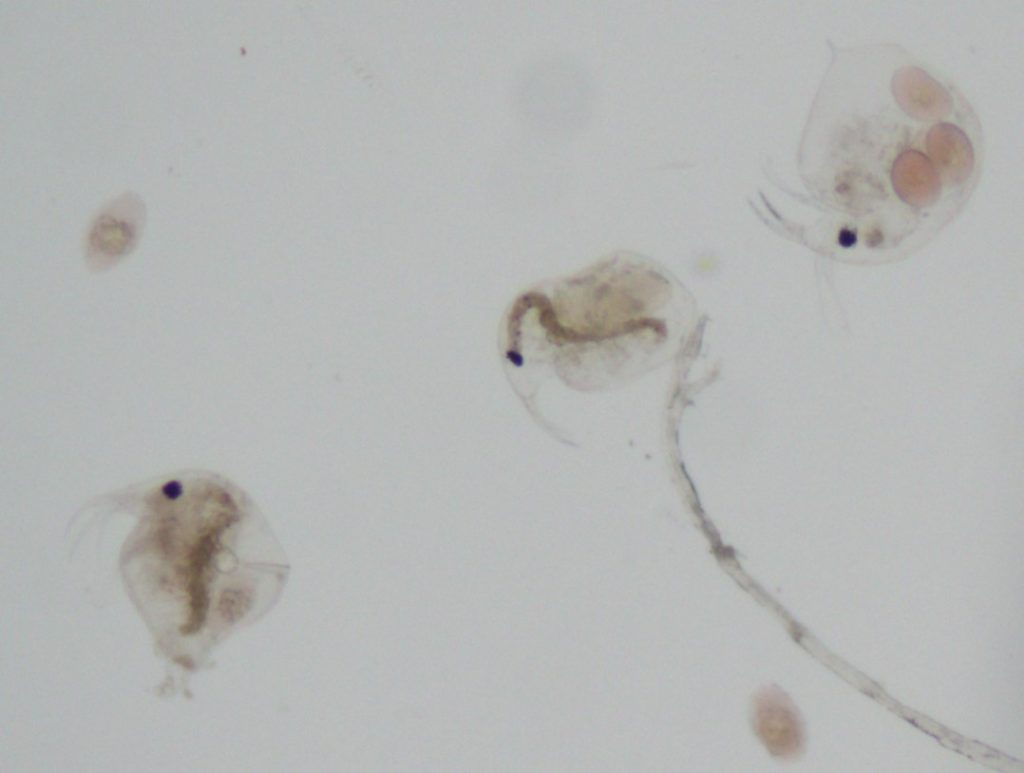
To gather this data, biologists used large plankton nets at multiple Choptank River locations following known spawning periods. Back in the laboratory, they painstakingly searched through preserved water samples to locate larval striped bass and white perch, each measuring just 5 to 10 millimeters in length. Using microscopes and dissecting tools, they analyzed what the tiny fish had consumed.
The study revealed that successful spawning years from decades past had similar zooplankton availability compared to recent unsuccessful years. This finding suggests that food supply alone doesn’t determine whether striped bass reproduction will succeed or fail.
Researchers also discovered that striped bass populations are essentially determined within their first three weeks of life, when the fish are smaller than rice grains. The number of larvae measuring 8-10 millimeters closely matched the juvenile counts found in later surveys.
Uphoff compared striped bass spawning behavior to gambling, explaining that the fish commit fully when temperatures rise slightly. “In enough cases, the timing is bad, and that doesn’t work,” he explained. “But every once in a while, they have a big year class.”
With this feeding theory ruled out, researchers are focusing on water temperature and flow as the primary factors affecting spawning success. Climate change appears to be shortening the spawning season as early spring water temperatures increase in the Bay.
“The amount of eggs is okay and the feeding larvae are okay, so now you’re looking at something in between,” Uphoff noted. “The big drivers are water flow and temperature. More and more, it’s looking like a temperature issue here, related to climate change.”
Previous DNR studies have shown that striped bass are producing sufficient eggs for good reproduction, but another study found that warming waters are compressing their spawning window. This latest research suggests the shortened breeding period is when striped bass face their greatest challenges.
“This study is another important contribution to striped bass research by our fisheries biologists at the Maryland Department of Natural Resources,” commented DNR Assistant Secretary of Aquatic Resources Kate Charbonneau. “Our scientists have brought us another step closer to understanding the ongoing low juvenile recruitment of striped bass.”
DNR officials continue emphasizing the importance of protecting adult striped bass through regulations to maintain healthy breeding populations. When environmental conditions align properly, a strong stock of spawning fish could produce a successful year class in the Chesapeake Bay.
The research team included DNR biologists Shannon Moorhead, Alexis Park, Carrie Hoover, Marisa Ponte, and Jeffrey Horne alongside lead author Uphoff.
ELKTON, MD – Quick thinking by a Maryland State Police officer turned what could have been a tragedy into a rescue story in Cecil County this past Saturday morning.
Trooper First Class Nicholas Warren was wrapping up a routine traffic enforcement action on Walnut Drive in Elkton around 9:44 a.m. on February 14 when desperate parents drove up seeking immediate assistance. As Warren headed back toward his cruiser after speaking with the motorist he had pulled over, another car approached his location.
“We need help. My baby is choking,” the driver shouted to the seven-year veteran officer, who is stationed at the North East Barrack.
Warren sprang into action, immediately requesting paramedics while pulling the struggling infant from the car to begin emergency care. Using his department training, the trooper delivered a series of back blows that successfully dislodged whatever was blocking the child’s breathing passage. The baby resumed normal breathing within moments.
Paramedics arrived soon afterward to check on the infant’s condition. Officials say Warren’s quick response, proper training application, and calm demeanor under pressure prevented what could have become a devastating situation for the family.
Delaware residents now have the opportunity to gain behind-the-scenes access to the state’s prison system through a new educational initiative launching this spring.
The Delaware Department of Correction is currently accepting applications for its Spring 2026 Citizens Academy, a comprehensive six-week educational program scheduled to commence Tuesday, April 14, in New Castle County.
This evening program will run for six consecutive weeks, providing participants with an in-depth understanding of how Delaware’s correctional facilities operate. The academy represents an effort by state corrections officials to increase transparency and community engagement with the prison system.
Delaware residents interested in learning more about the inner workings of the state’s correctional operations can apply for this unique educational opportunity that promises to provide insider access typically not available to the general public.
WILMINGTON — Delaware’s state flags will fly at half-staff at government buildings and facilities across the state following an order from Governor Matt Meyer to pay tribute to three prominent figures who recently passed away.
The governor’s directive honors two former Delaware state lawmakers, George Bunting and John Viola, who both died within the past week. The flag lowering also recognizes the life and legacy of Rev. Jesse Jackson.
State facilities throughout Delaware will participate in this gesture of remembrance for the former legislators, who served the people of Delaware during their time in the General Assembly.
ARLINGTON, Va. — Delaware farmers now have access to cutting-edge artificial intelligence technology that can measure how much nitrogen their cover crops provide, thanks to a major new conservation initiative.
The Nature Conservancy is leading this groundbreaking program, which brings together farmers, conservation organizations, agricultural businesses, universities, and government agencies to tackle a significant challenge in farming: understanding exactly how much nitrogen cover crops contribute to soil.
The organization anticipates this initiative will help farmers reduce their nitrogen fertilizer purchases by 3 million pounds that would otherwise be applied to agricultural land.
The technology works through a system called PlantMap3D, created by North Carolina State University. Agricultural service companies Willard Agri-Service and GROWMARK FS are installing specialized cameras on spray equipment that capture detailed photographs of cover crops when farmers apply herbicides in spring. Artificial intelligence software then examines these images to identify different cover crop species.
This process creates detailed field maps that show farmers precisely where nitrogen from cover crops is present, enabling them to adjust their fertilizer applications and only add nutrients where actually needed.
“AI-powered camera systems are how we can finally bring precision and sustainable agriculture together,” explained Chris Reberg-Horton, a North Carolina State University professor working on the initiative. “We hope this program will help farmers reduce their costs while also improving environmental outcomes.”
The four-year conservation effort plans to encompass 150,000 acres throughout the Chesapeake Bay watershed, including 37,500 acres in Delaware, 92,500 acres in Maryland, and 20,000 acres in Pennsylvania. Implementation begins this spring growing season.
Federal funding totaling $16 million comes from the USDA through the USDA-NRCS Regional Conservation Partnership Program, while partner organizations contributed an additional $11.3 million.
According to The Nature Conservancy, the program seeks to help agricultural producers better understand their actual nitrogen requirements while maintaining crop yields, reducing greenhouse gas emissions, and enhancing soil and water quality throughout the Chesapeake Bay watershed.
“Knowledge is power, and this program arms TNC and our agricultural partners with unparalleled data that will boost biodiversity, water quality and farmers’ bottom lines in the Chesapeake Bay watershed, a globally important conservation landscape,” stated Amy Jacobs, Chesapeake Bay Director at The Nature Conservancy. “We are thrilled to be working with partners that are leaders in their field to deploy this new technology to support farmers with solutions that are both good for the environment and their businesses.”
Delaware farmers interested in joining this program can submit applications through February 28. Requirements and application details include:
• Geographic eligibility: All Delaware counties qualify (New Castle, Kent, Sussex); Maryland participants must farm in Baltimore, Caroline, Carroll, Cecil, Dorchester, Harford, Kent, Talbot, Queen Anne’s or Wicomico counties; Pennsylvania farmers must operate in Adams, Cumberland or York counties.
• Operations must currently utilize multi-species cover crops containing legumes, with plans for spring termination (Spring 2026).
• Applications should be directed to Amanda Bunn, Applied Agricultural Conservationist at The Nature Conservancy, at [email protected].
Part of the program’s funding will assist Pennsylvania farmers in establishing mixed-species cover crops, since Pennsylvania lacks the centralized cover crop programs that Maryland and Delaware have developed, where cover crop adoption is more widespread.
“In partnership with the Pennsylvania and Delaware Maryland 4R Alliances, TNC, agribusinesses, and government agencies have been working to ensure that every application of fertilizer is guided by the 4Rs of nutrient management: using the right source, at the right time, in the right place, and applying the right amount,” Jacobs added.
HARRINGTON, Del. — Delaware soybean farmers have achieved an unprecedented breakthrough in the state’s agricultural history, with two growers becoming the first to surpass 100 bushels per acre in the Delaware Soybean Board’s annual competition.
The Delaware Soybean Board has revealed the winners of their 2025 yield competition, celebrating farmers throughout the First State who demonstrated outstanding production achievements and farming techniques.
This year’s competition created agricultural history as it witnessed not only the first growers to cross the century mark in bushels per acre, but also established a new state yield record.
“These record-setting yields highlight the skill and dedication of Delaware soybean growers,” said Tim Rogers, chairman of the Delaware Soybean Board. “Breaking the 100-bushel mark twice in one year, while also setting a new statewide record, speaks to the strong management practices being implemented across the state.”
Sussex County farmer Blaine Hitchens claimed the top spot statewide in the Full-Season Irrigated division, establishing a new Delaware Soybean Yield Contest record with an exceptional harvest of 106.68 bushels per acre. Hitchens cultivated Pioneer P37T51PR soybean varieties, which he planted on April 21, resulting in the highest production ever documented in the contest’s history.
Fellow Sussex County grower Billy O’Day also broke the 100-bushel barrier, securing Sussex County Full-Season recognition with a harvest of 105.02 bushels per acre. O’Day grew Pioneer 37A18 soybeans, also planted on April 21, making 2025 the inaugural year that contest participants achieved production levels exceeding 100 bushels per acre.
In the statewide Double-Crop division, New Castle County’s Bob Willoughby Jr. took first place with a harvest of 65.47 bushels per acre from Seed Consultants SC7485E varieties, which he planted on June 29.
Kent County farmer Tyler Shaffer claimed the statewide Non-Irrigated championship, producing 78.57 bushels per acre from Seed Consultants SC7444E soybeans planted on June 23.
Other county-level Full-Season champions included Kent County’s John Comegys, who produced 67.33 bushels per acre with Seed Consultants SC7375E planted on May 3, and New Castle County’s Robbie Emerson, who achieved 76.53 bushels per acre using FS HS41E20 varieties planted on May 6.
For the Double-Crop county division, Dickerson Farms O.G. of Sussex County captured top recognition with 61.65 bushels per acre, cultivating Pioneer P40257E soybeans planted on July 20.
The Delaware Soybean Board launched the Delaware Soybean Yield Contest in 2012, providing farmers with opportunities to identify crop varieties and farming strategies that have demonstrated success in regional growing conditions.
Throughout its 12-year existence, the competition has attracted more than 200 participants, honoring farmers’ achievements in both full season and double-cropped soybean production across irrigated and non-irrigated farmland.
Contest participants can access comprehensive competition details and results at https://desoybeans.org/yield-contest/.
Delaware agriculture includes approximately 150,000 acres of soybean cultivation each year, yielding more than seven million bushels and contributing roughly $60 million in economic value to the state. The Delaware Soybean Board includes nine farmer-directors along with the Secretary of Agriculture.
The organization operates through a checkoff program funded by a half-percent assessment on soybeans’ net market value at initial sale, collaborating with industry partners to identify opportunities that enhance farmer profitability.
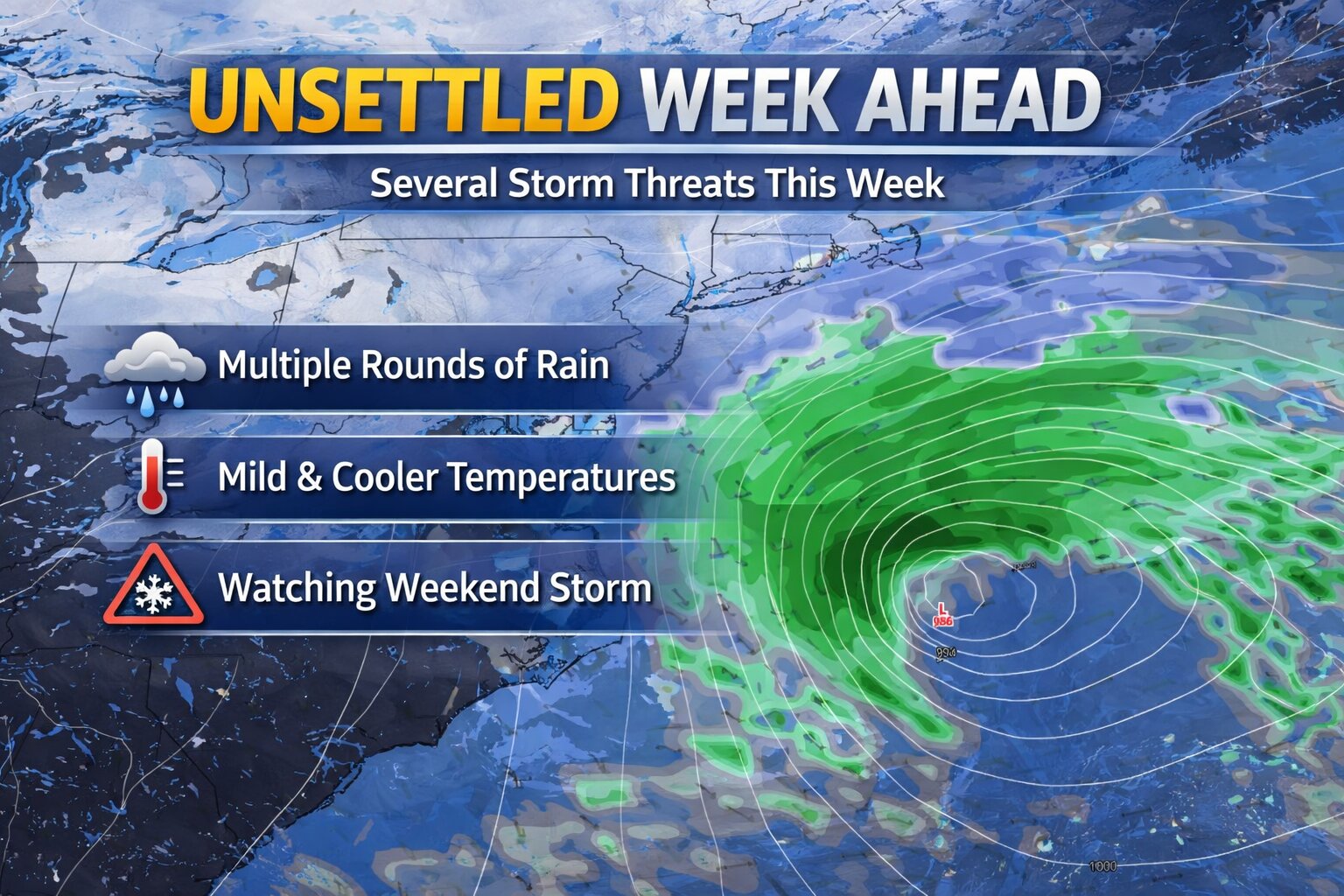
An unsettled weather pattern is setting up across the Mid-Atlantic this week, bringing several opportunities for rain to the Delmarva Peninsula through the weekend. While areas to our north may deal with some wintry precipitation at times, the setup locally favors mainly rain events for Delaware and Maryland’s Eastern Shore.
Wednesday: Light Rain, Mainly North
The first system arrives Wednesday into Wednesday night as a warm front lifts northward ahead of low pressure tracking through the Midwest.
For Delmarva, this looks to be a primarily light rain event. Current trends show the steadiest rainfall staying north of our area, with southern Delaware potentially seeing little to no measurable rain. Most locations across Delmarva should see under a tenth of an inch, though a few spots could pick up slightly more if the rain shield trends farther south.
Overall, this is not expected to be a high-impact system. However, any rainfall will be beneficial as parts of the region continue to deal with ongoing drought conditions.
Thursday: Cooler With Spotty Showers Possible
Behind Wednesday’s warm front, a backdoor cold front may slide southward late Wednesday into Thursday. This front will usher in a cooler maritime air mass from the north or northeast.
If the boundary settles close enough to Delmarva, some areas could see patchy drizzle or light showers Thursday. Confidence in exact placement remains moderate, so coverage and amounts look limited at this time.
Friday Into Saturday: Another Round of Rain
Another low pressure system is expected to move in late Friday into Saturday. As of now, this system also appears to favor rain for Delmarva.
While slightly cooler air will be in place compared to midweek, temperatures across the peninsula are expected to remain warm enough to support mostly liquid precipitation. At this time, wintry precipitation concerns remain confined well to our north and do not appear to be a factor locally.
Rainfall amounts will depend on the eventual track and timing of the system, but there is at least some potential for moderate rainfall if the storm strengthens or slows.
Late Weekend: Watching a Potentially Stronger Storm
Attention then turns to another possible system toward the end of the weekend. Of all the upcoming disturbances, this one carries the greatest uncertainty and the widest range of possible outcomes.
Forecast guidance shows everything from a storm tracking well offshore with minimal impact, to a more organized system bringing steadier precipitation to the region. It is still too early to determine specifics, including rainfall amounts or any other impacts.
At this point, the late weekend system remains in the monitoring phase, and forecast details will likely evolve over the coming days. But with the way weather models have been handling the last several storm systems, it’s hard to put faith in one single solution.
WILMINGTON — Delaware Governor Matt Meyer has issued an order directing all state government buildings and facilities to lower their flags to half-staff this week in tribute to two former Delaware lawmakers who died recently.
The flag directive honors George Bunting and John Viola, both former members of the Delaware General Assembly who passed away within the past week. The governor’s order also calls for flags to be lowered in memory of Rev. Jesse Jackson, recognizing his lifetime of service and impact.
State facilities across Delaware will display flags at half-staff as a mark of respect for the three individuals and their contributions to public service and community leadership.
With the 2026 growing season on the horizon, Delaware farmers are being advised to develop comprehensive strategies for controlling weeds in their fields, with particular emphasis on herbicides applied before planting. According to Brad Allen, a Market Development Specialist with Corteva Agriscience, early herbicide treatments create a crucial foundation for season-long weed control.
Allen explained to agricultural news outlets that these early applications of residual herbicides are essential for establishing effective weed management from the start of the growing season.
Motorists traveling north on Route 1 should expect delays today as construction crews have shut down the left lane in a busy stretch near Milton.
The lane restriction affects northbound traffic on the Coastal Highway between Paynter Road and Broadkill Road, also known as Route 16. DelDOT officials say the closure is necessary for ongoing construction work in the area.
The lane will remain blocked until 3 PM today, according to state transportation authorities. Drivers are advised to allow extra travel time and use caution when passing through the work zone.
Drivers traveling through the Rehoboth Beach area should plan for potential delays today as construction crews continue work along a busy stretch of roadway.
Delaware Department of Transportation officials report that one eastbound lane on Broadkill Road is currently blocked off to traffic between Jefferson Drive and Coastal Highway (Route 1) North. The lane restriction is scheduled to remain in effect until 3 PM today.
The construction activity is impacting traffic flow in the popular coastal corridor, and motorists are advised to allow extra travel time or consider alternate routes when possible.
Motorists traveling on Route 9 near New Castle will encounter intermittent lane restrictions this week as railroad maintenance gets underway.
The Delaware Department of Transportation has notified drivers that Norfolk Southern Railroad crews will begin general maintenance work Wednesday, February 18th at 9:00 am at the railroad crossing located just north of New Castle. The maintenance project is scheduled to wrap up by 5:00 pm on Thursday, February 19th.
DelDOT is advising drivers to exercise caution while traveling through the work zone and to allow extra time for potential minor delays during the maintenance period.
Delaware State Police are working to determine what caused a deadly collision in Newark that claimed the life of a Bear woman on Sunday.
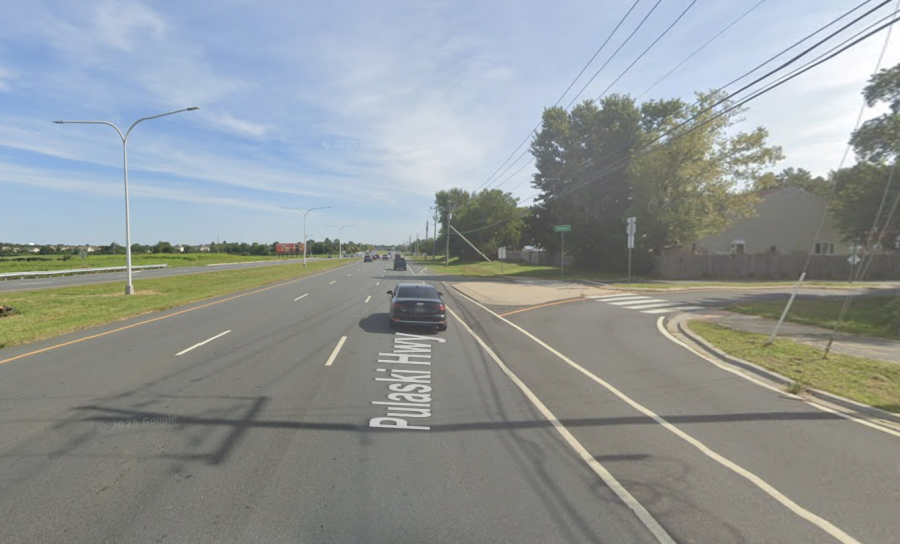
Authorities report that around 3:30 p.m. on February 15, 2026, a Jeep Compass was heading east along Pulaski Highway close to David Place when it veered off the road’s right side and struck a telephone pole. Both people inside the vehicle were rescued moments before flames engulfed the Jeep.
Betty Williams, 71, of Bear, Delaware, was riding as a passenger in the front seat without wearing a seatbelt. Medical personnel transported her to a nearby hospital where she was treated for severe injuries. Williams succumbed to her crash-related injuries in the early hours of February 16, 2026.
The 70-year-old male driver, also from Bear, Delaware, was hospitalized with significant injuries following the incident.
The crash remains under review by the Delaware State Police Troop 2 Collision Reconstruction Unit. Authorities are seeking assistance from anyone who saw the accident occur, possesses surveillance or dashboard camera video, or has other pertinent details. Those with information can reach Corporal K. Oakes at (302) 365-8483, send a private message to the Delaware State Police Facebook page, or call Delaware Crime Stoppers at 1-800-847-3333.
Victims of crime, witnesses, or families who have experienced sudden loss can access support through the Delaware State Police Victim Services Unit and Delaware Victim Center. Help is available around the clock by calling the toll-free hotline at 1-800-VICTIM-1 (1-800-842-8461) or emailing [email protected].
Drivers traveling south on Route 1 should expect delays this afternoon as construction crews have shut down the left lane between Janice Road and Cave Neck Road.
The Delaware Department of Transportation reports the lane restriction on Coastal Highway is part of ongoing construction work in the area. Traffic is being directed around the work zone using the remaining lanes.
DelDOT officials say the left lane closure is expected to be lifted by 5:00 PM today, though motorists should plan for possible delays and consider alternate routes if traveling through the area during peak hours.
WILMINGTON — Delaware Governor Matt Meyer has directed that flags at all state properties be lowered to half-staff this week following the recent deaths of two former state lawmakers.
The flag directive honors George Bunting and John Viola, both former Delaware General Assembly members who died last week. The governor’s order also recognizes the life and contributions of Rev. Jesse Jackson.
State facilities throughout Delaware will display flags at half-staff as a mark of respect for the public service these individuals provided to the state and nation.
Drivers traveling westbound on Lighthouse Road should expect delays this afternoon due to a lane closure at the intersection with Dukes Avenue.
The Delaware Department of Transportation reports that one westbound lane on Route 54 is currently blocked at Dukes Avenue, with the closure expected to last until 4 PM today.
Motorists are advised to use alternate routes or allow extra travel time when passing through the area during the afternoon hours.
Drivers traveling on Route 9 northbound should expect delays this afternoon as construction crews have closed one shoulder of the roadway.
The Delaware Department of Transportation reports that the shoulder closure is impacting traffic between Federal School Lane and Hamburg Road on River Road, which is also known as Route 9.
Officials say the construction-related closure will remain active until 5 PM today. Motorists are advised to use caution when traveling through the work zone and allow extra time for their commute.
Delaware Department of Transportation officials report that construction activities are causing a shoulder closure on northbound Route 9 today.
The affected area spans from Federal School Lane to Hamburg Road, where crews are working on the roadway’s shoulder area.
DelDOT indicates the closure will remain in place through 5 p.m. this evening, after which normal traffic patterns are expected to resume.
Drivers using this section of Route 9 northbound should exercise caution while passing through the construction zone and allow extra time for potential delays.
WILMINGTON, Del. — A Delaware man who was once married to First Lady Jill Biden is scheduled to appear before a judge Tuesday to enter a plea on murder charges in his current wife’s death.
William Stevenson, age 77, faces first-degree murder accusations and is expected to formally respond to the charges during his court appearance. Stevenson was wed to Jill Biden between 1970 and 1975, years before she became First Lady.
Earlier this month, a Delaware state grand jury indicted Stevenson in connection with the death of his wife, Linda Stevenson, 64. She was discovered unresponsive inside their residence on December 28. Since being formally charged on February 3, Stevenson has been held in jail, unable to secure his release on the $500,000 bond amount.
Public court documents currently available do not identify any attorney representing Stevenson in the case.
In the early 1970s, William Stevenson established the Stone Balloon, a well-known music establishment located in Newark, Delaware.
Linda Stevenson operated her own bookkeeping company and was remembered in her death notice as a devoted mother and grandmother who cherished her family and supported the Philadelphia Eagles. Her obituary made no reference to her spouse.
“One hug from her and all your worries would disappear,” Christine Mae, her daughter, shared on Facebook. “The pain of losing her is paralyzing and the emptiness in my heart is an abyss.”
Jill Biden wed then-U.S. Senator Joe Biden in 1977. Biden held the presidency from January 2021 through January 2025. A representative for Jill Biden has stated she will not be providing any statements regarding the Stevenson matter.
Motorists traveling through a section of Bayard Avenue should plan for potential delays today due to ongoing construction activities.
According to DelDOT officials, work crews have established periodic lane restrictions along Bayard Avenue in the area spanning from Coastal Highway (Route 1) to Bellevue Street. The construction zone will remain in effect until 5:00 PM today.
Drivers are advised to allow extra travel time when passing through this corridor and to exercise caution around work crews and equipment. Traffic may experience intermittent slowdowns as lanes are temporarily closed to accommodate the construction work.
The Delaware Department of Transportation continues to monitor the situation and will provide updates as work progresses throughout the day.
Drivers in the area should expect traffic delays on Bayard Avenue as construction crews continue their work between Coastal Highway (Route 1) and Bellevue Street.
DelDOT reports that intermittent lane closures are currently affecting traffic flow on this stretch of roadway. The construction-related lane restrictions are scheduled to remain in effect until 5:00 PM today.
Motorists are advised to plan for additional travel time when using this route and consider alternate paths if possible to avoid potential delays.
Drivers using Spring Lake Drive are encountering traffic disruptions today as construction crews work along a busy stretch of the roadway.
The Delaware Department of Transportation reports that the section of Spring Lake Drive running from Old Harmony Road to Greenridge Road is subject to periodic lane restrictions while work is underway.
These construction-related lane closures are scheduled to remain in effect through 6 PM this evening, according to DelDOT officials.
Motorists are advised to plan for potential delays and consider alternate routes if possible while traveling through the affected area.
Drivers traveling on Spring Lake Drive should plan for potential delays today as construction work creates periodic lane restrictions along a section of the roadway.
According to Delaware Department of Transportation officials, the affected area spans Spring Lake Drive from Old Harmony Road to Greenridge Road. Traffic disruptions from the ongoing construction activities are expected to last until 6 p.m. today.
The lane closures are happening on an intermittent basis throughout the day as work crews complete their construction tasks. Motorists are advised to allow extra travel time and exercise caution when driving through the work zone.
Motorists traveling through a section of New Castle County should plan for potential delays this afternoon due to construction activity.
Delaware Department of Transportation officials report that construction crews are working on Fowler Court at its intersection with Dutton Drive, causing periodic lane restrictions.
The temporary lane closures are scheduled to continue intermittently throughout the day, with work expected to wrap up by 6 PM today.
Drivers are advised to allow extra travel time when passing through the area and to use caution around construction workers and equipment.
Drivers in northern Delaware are experiencing traffic disruptions on a busy stretch of Foulk Road today due to an ongoing lane closure.
According to DelDOT, the right lane of Foulk Road is currently blocked between Naamans Road (Route 261) and Grubb Road (Route 92). The lane restriction is expected to continue affecting traffic flow until 3 PM this afternoon.
Commuters using this corridor should plan for potential delays and consider alternate routes if possible. The closure impacts a heavily traveled section of roadway that connects several residential and commercial areas in the region.
Where: Unit Block of South Independence Blvd, Dover, DE
Media Contact: Dover Police Department Public Information Officer Master Corporal Ryan Schmid Email: [email protected]
Details: Dover law enforcement officials are actively looking into an armed robbery that took place during the early morning hours on Sunday. Authorities were alerted to the crime when the victim contacted police from a parking area on the unit block of South Independence Boulevard. Through their preliminary inquiry, detectives learned the victim had been at a local gathering in the vicinity. Following the event, two individuals confronted the victim, with one brandishing a firearm and ordering him to turn over his belongings. The victim handed over his property as demanded, and both perpetrators drove away in a gray-colored car. Police describe both suspects as Black males wearing face coverings.
Investigators currently have no suspect information to share with the public.
The case remains active and authorities are seeking assistance from the community. Anyone with relevant details is encouraged to reach out to the Dover Police Department by calling (302) 736-7130. Those providing information may choose to remain unnamed. Additionally, tips can be shared through Delaware Crime Stoppers by dialing 800-TIP-3333 or visiting www.delaware.crimestoppersweb.com online. A monetary reward may be available for information that results in an arrest.
Good morning, Delmarva! We’re starting this Tuesday with some patchy fog across the peninsula, but don’t worry – it should clear out by 8 AM as we transition to mostly cloudy skies.
Today’s looking pretty mild for mid-February, with temperatures climbing to around 51 degrees. You’ll barely feel any breeze with light southwest winds at 0 to 5 mph, making it a comfortable day to get outside despite the cloud cover.
Tonight, we’ll stay mostly cloudy with temperatures dipping to a chilly 38 degrees – perfect weather for cozy indoor activities.
Looking ahead to Wednesday, it starts off cloudy with highs reaching a pleasant 57 degrees, but keep that umbrella handy! We’re tracking a chance of light rain moving in during the day, continuing into Wednesday night as temperatures settle around 40 degrees.
Nothing too dramatic in our forecast – just typical February weather with mild temps and a gentle rain system midweek. Stay warm and dry out there, Delmarva!
This is your TV Delmarva weather team keeping you informed.
Delaware motorists are encountering hazardous driving conditions today as thick fog has settled across the First State, creating visibility challenges of different severity levels in various locations.
The Delaware Department of Transportation is tracking the foggy conditions, which are affecting roadways from New Castle County in the north to Sussex County in the south. The dense moisture in the air is reducing visibility significantly, making travel particularly treacherous for morning commuters.
Drivers are advised to exercise extreme caution when traveling on Delaware roads today, reducing speed and increasing following distance to account for the limited visibility. The fog conditions are expected to impact traffic flow and could lead to delays throughout the state’s highway system.
DelDOT continues to monitor the weather situation and will provide updates as conditions change throughout the day.
While snow may still be on the ground, agricultural producers across Delaware are already looking toward spring planting season as they grapple with continued economic pressures affecting their bottom line.
During a recent Managing for Profit discussion, Jeremy Walstrom, who serves as a regional sales manager with RCIS, outlined strategies for local farmers to better leverage their crop insurance coverage. Walstrom highlighted several important updates to insurance programs that could help producers navigate financial uncertainty in the coming growing season.
The timing of this guidance comes as many farming operations continue to experience disappointing financial returns that are impacting their overall business stability. These economic challenges are prompting agricultural professionals to emphasize the importance of risk management tools like crop insurance as farmers prepare for another potentially difficult year.
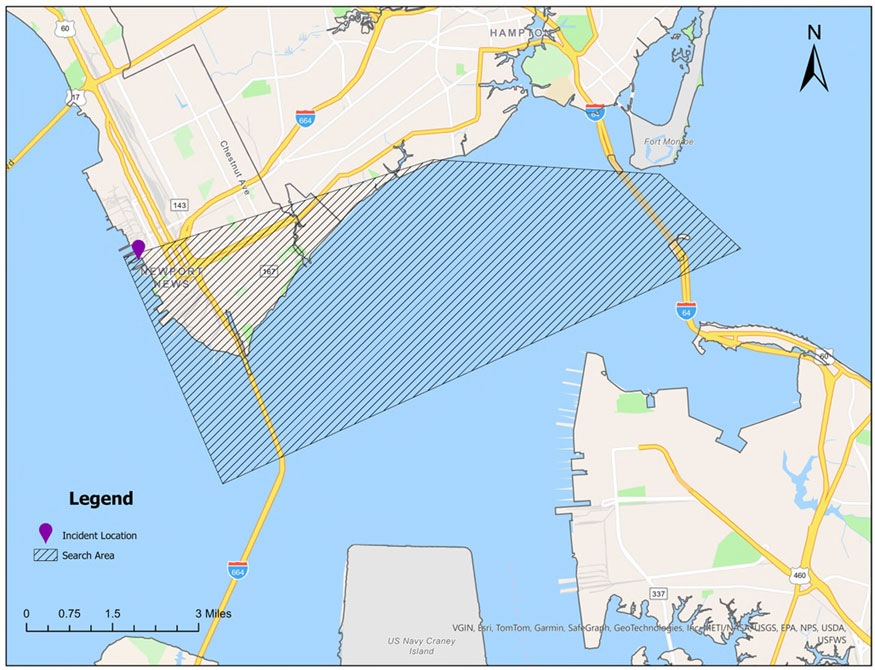
A significant aviation fuel leak has contaminated the James River after thousands of gallons spilled from a major shipbuilding facility in Newport News, Virginia, just south of our region.
The environmental disaster unfolded on February 13, 2026, when JP-5 aviation fuel escaped during a refueling procedure for the future USS John F. Kennedy aircraft carrier at the Huntington Ingalls Industries Newport News Shipbuilding facility located on Washington Avenue.
What initially appeared to be a minor leak of around 50 gallons has proven far more serious. Detailed analysis and fuel tank inspections revealed that 7,749 gallons of jet fuel actually entered the waterway. Residents across Newport News and Hampton reported strong fuel odors and visible oil slicks on the water surface.
Emergency response teams from multiple agencies quickly mobilized, including the Virginia Department of Environmental Quality, Virginia Department of Emergency Management, U.S. Coast Guard, and fire departments from both Newport News and Hampton.
Cleanup crews have deployed oil containment barriers and are using specialized boats and vacuum trucks to remove the spilled fuel from the water. Weather conditions with helpful wind patterns and tidal movements have aided in keeping the contamination from spreading further.
Coast Guard officials used drone technology to monitor the spill from above, confirming that response efforts are successfully containing most of the leaked fuel near the original spill location.
Pollution monitoring teams from Coast Guard Sector Virginia, working alongside boat crews from Coast Guard Station Portsmouth and unmanned aircraft operators, are tracking the contamination by land, air, and sea to respond quickly to any changes in conditions.
Health officials from the Virginia Department of Health are warning the public to stay away from waterfront areas where fuel smells are present or where oil sheens are visible on the water. Boat operators are also advised to avoid areas with visible contamination or fuel odors while cleanup operations continue.
The multi-agency response includes the U.S. Coast Guard, Virginia Department of Emergency Management, Virginia Department of Environmental Quality, Virginia Department of Health, and officials from Hampton, Newport News, and Suffolk.
Investigators are still working to determine what caused the fuel transfer operation to fail, leading to this major environmental incident.
Bird enthusiasts participating in Baltimore’s annual Christmas Bird Count this past December documented a diverse collection of avian species, including several rare sightings that caught researchers’ attention.
The 2025 season represented a milestone as Baltimore City’s first official Christmas Bird Count, expanding from a successful trial run the previous year. Organizers established three designated counting areas: Loch Raven, Middle River, and Baltimore City.
Several locations managed by Maryland’s Dredged Material Management Program fell within two of these counting zones. The Middle River area encompasses Hart-Miller Island Dredged Material Placement Site, while the Baltimore City zone covers multiple facilities including Cox Creek, Swan Creek Wetlands, Masonville sites, and Hawkins Point.
Weather conditions initially hampered the Middle River survey scheduled for December 14, 2025, with strong winds blocking access to Hart-Miller Island. Tim Carney from the Maryland Environmental Service conducted a makeup count on December 16, identifying 13 additional species during the extended counting period. Among these discoveries were uncommon birds such as a rough-legged hawk, short-eared owl, and tree swallow.
Improved conditions on December 20, 2025, enabled survey teams to complete comprehensive counts at all three Baltimore City dredged material sites.
Notable discoveries at each location included:
Cox Creek and Swan Creek Wetlands:
Counters recorded an impressive 2,500 ruddy ducks alongside single sightings of a Virginia rail, plus multiple American kestrels, common ravens, American pipits, and purple finches.
Masonville facilities:
Observers spotted individual examples of a common goldeneye, red-breasted merganser, common loon, and eastern phoebe.
Hawkins Point location:
Teams documented single specimens of an American kestrel, common raven, orange-crowned warbler, and notably, a blue-headed vireo – considered among the two most unusual species recorded during the entire counting effort.
The second rarest bird discovery occurred at Fort McHenry National Monument, where volunteers observed a brant. These Arctic-breeding waterfowl typically migrate to Chesapeake Bay waters each winter season, according to the Chesapeake Bay Program.
Understanding Christmas Bird Counts
These scientific surveys operate within standardized 15-mile diameter circles, ensuring data consistency for annual comparisons. Volunteer teams systematically cover assigned sections within each circle, recording every bird species encountered. The counting period extends three days before and after the official date to include “count week” observations.
This community science initiative traces its roots to early conservation efforts over a century ago.
“Holiday ‘side hunts’ were once common Christmas activities where people competed to kill the most birds,” explained Tim Carney, Senior Environmental Specialist with MES. “Ornithologist Frank Chapman introduced a conservation alternative in 1900, proposing bird counting instead of hunting. Today’s National Audubon Society coordinates this annual program, which has generated over 100 years of North American bird population data.”
Those interested in participating in future bird counts or related activities around Baltimore can visit the Baltimore Bird Club’s website for scheduling information.
Maryland’s Board of Public Works has given the green light to more than $29 million in state funding for critical water infrastructure improvements across two key projects, the Maryland Department of the Environment revealed on January 28, 2026.
The substantial investment will fund essential upgrades at Baltimore’s Patapsco Wastewater Treatment Plant and advance ongoing efforts to connect Kent Island residences to public sewer systems, moving them away from problematic septic tanks.
More than $18 million of the approved funding will go toward fixing and upgrading equipment at the Patapsco treatment facility. These improvements aim to help the plant meet compliance requirements under an agreement addressing unauthorized pollution releases and permit violations. This latest allocation brings the current administration’s total commitment to the Patapsco project to over $87 million through a combination of grants and loans.
Patapsco Plant Upgrades Address Compliance Issues
Baltimore City faces legal requirements under a consent decree related to permit violations at both the Patapsco and Back River treatment facilities.
The planned enhancements at Patapsco are intended to boost the plant’s operational effectiveness and return it to complete working capacity while ensuring dependable wastewater processing.
The state has also committed more than $32 million toward improvements at the Back River facility.
Environmental progress at both locations has been significant, with nitrogen contamination decreasing by over 78 percent at Patapsco and more than 60 percent at Back River. Phosphorus contamination has fallen by 80 percent at both treatment plants.
Kent Island Sewer Connection Project Moves Forward
The approved funding will support the fourth phase of the Southern Kent Island Sanitary Project, a multi-year initiative to transition residential properties from septic systems to public sewerage.
This project tackles groundwater pollution issues caused by elevated water tables and inadequate soil conditions in the area, where residents currently depend on individual septic systems for waste treatment.
The construction phase will establish public sewer connections for approximately 1,500 residential properties and eight commercial buildings. These properties will be linked to the Kent Narrows-Stevensville-Grasonville Wastewater Treatment Plant for enhanced waste processing.
A massive sewage pipe failure has been releasing untreated wastewater into the Potomac River for over a week after DC Water crews found the rupture on January 19th, 2026.
The break occurred in a massive 72-inch sewer main known as the Potomac Interceptor, located within the C & O Canal National Historical Park in Montgomery County, Maryland. Raw sewage has been flowing through a creek bed before reaching the Potomac River at a point downstream from Washington DC’s water intake facilities at Great Falls.
This critical pipeline normally transports approximately 60 million gallons of sewage each day from communities near Dulles Airport to DC Water’s Potomac Pumping Station. The rupture happened close to the Clara Barton Parkway, just east of where it meets Interstate 495.
Once crews identified where the overflow was occurring, DC Water immediately deployed repair teams and contractors to contain the spill and evaluate the extent of damage to the infrastructure.
To address the emergency, utility officials created a temporary solution involving a bypass system. Work crews have been clearing pathways for access, laying temporary pipes, working with National Park Service officials to modify canal structures, and installing pumps to divert the sewage flow into a controlled section of the historic C & O Canal before pumping it back into the sewer system downstream.
The emergency response required removing the upper lock gates at Canal Locks 11, 12, and 13, which allows the wastewater to move downstream where it can be pumped back into the functioning portion of the sewer line.
Repair efforts faced additional challenges when a significant winter storm struck the Washington DC area on January 24th, hampering crews’ ability to contain the spill and fix the damaged infrastructure.
The failed sewer line is currently part of DC Water’s ambitious rehabilitation program – a decade-long initiative with a $625 million budget that ranks as a top priority in the utility’s capital improvement plan. The comprehensive project aims to upgrade the most at-risk portions of the deteriorating sewer system, which has been in service for more than six decades.
Maryland has moved forward with an ambitious environmental restoration effort, announcing 37 specific projects that will receive more than $22 million in combined funding through the state’s Whole Watershed Program.
The comprehensive initiative focuses on five critical waterways selected in March 2025 under legislation passed in 2024. These locations include Antietam Creek in Washington County, Baltimore Harbor, Newport Bay near Ocean City, the Severn River in Anne Arundel County, and the Upper Choptank River on Maryland’s Eastern Shore.
State funding totals $11,248,876, while program coordinators have secured an additional $11,007,788 in matching funds from external sources. The effort brings together more than 75 partner organizations working across all five watershed areas.
A multi-agency state management team oversees the program, drawing expertise from Maryland’s departments of Agriculture, Emergency Management, Environment, Natural Resources, and Planning, as well as the Critical Area Commission. These agencies helped watershed coordinators identify high-priority projects for the coming year.
Each selected watershed will receive five years of both technical support and financial backing to design and execute conservation and restoration activities. The program emphasizes improving water quality, restoring natural habitats, and creating recreational opportunities in shallow waterways like creeks, streams, and rivers.
Near Ocean City, restoration work will focus on Horner Marsh and Bay Creek marsh in Newport Bay’s headwaters. These projects aim to build up elevation in areas damaged by rising sea levels and extensive ditching, providing crucial habitat for multiple species.
The Severn River initiative includes the Watershed Steward’s Tree Ambassador Program, which will concentrate tree planting efforts in low-income urban communities. Additional Severn River projects encompass oyster reef construction, stormwater management improvements, expanded public access at the Mulberry Hills trail, and conservation efforts along the Jabez Branch.
Baltimore Harbor projects will emphasize equitable waterfront access in the Cherry Hill neighborhood and the development of tidal wetlands near Medstar Harbor Hospital.
A new Reel Rewards program will offer financial incentives to anglers who catch invasive species, specifically targeting blue catfish and Chesapeake Channa.
Stream restoration and buffer planting initiatives in the Antietam Creek watershed will combat erosion while reconnecting flood plains, establishing habitat areas, and reducing nutrient and sediment runoff into the Bay. The Upper Choptank region will see stormwater wetland projects designed to address residential flooding, enhance water quality, and develop new habitats.
Looking ahead to 2026, officials plan to complete watershed monitoring systems to accurately track project impacts. They will also develop financing and implementation strategies with program coordinators to identify additional funding opportunities and collaboration possibilities.
The state management team will continue evaluating future projects for funding consideration. Community engagement efforts will expand to include public meetings, outreach programs, and enhanced communication initiatives.
Complete project details and partner information are available in the Department of Natural Resources’ Whole Watershed Program annual report and on the program’s official website.
Maryland transportation officials have set dates for community meetings where residents can weigh in on a major proposal to completely rebuild the Chesapeake Bay Bridge crossing that connects our region to the western shore.
The Maryland Transportation Authority has revealed plans for public sessions in February 2026 focusing on their Draft Environmental Impact Statement and their preferred construction option, known as Alternative C, which they unveiled last December. Following these community input sessions, officials will continue their analysis before making final decisions.
Federal highway officials are anticipated to release their final environmental review and official decision by fall 2026.
During February, transportation authorities will conduct both online and face-to-face community meetings, giving residents chances to examine the various options and environmental effects outlined in the draft study, understand the agency’s preferred choice, and share their opinions.
Community members can access the draft environmental study at baycrossingstudy.com or visit designated locations for in-person viewing. Those needing help accessing the document can call 1-667-203-5408 for support.
Online Community Meeting
Monday, February 9, 2026, 6-8 p.m.
www.baycrossingstudy.com
Anne Arundel County Community Meeting
Tuesday, February 10, 2026, 5-8 p.m.
Broadneck High School
1265 Green Holly Drive, Annapolis, MD 21409
Queen Anne’s County Community Meeting
Thursday, February 12, 2026, 5-8 p.m.
Kent Island High School
900 Love Point Road, Stevensville, MD 21666
All community sessions will begin with a short presentation before opening for public comments. People wanting to speak should register in advance at baycrossingstudy.com. Those unable to use the website can call 1-667-203-5408.
Face-to-face meetings will start with an informal viewing period at 5 p.m., giving attendees time to examine project information and displays. Public comment periods will start at 6 p.m. All meeting materials can be found at baycrossingstudy.com.
Should weather force venue closures, updated meeting information will be posted at baycrossingstudy.com.
The transportation authority’s preferred plan, Alternative C, encompasses:
Construction of two new four-lane bridge spans featuring full shoulders spanning the Chesapeake Bay, improving safety while adding transportation capacity, dependability and traffic flow;
Demolition of the current Bay Bridge spans, resolving existing road problems including cramped lanes and missing shoulders, avoiding major repair projects and related lane shutdowns and traffic delays, and increasing clearance height to satisfy U.S. Coast Guard standards. The clearance height will reach 230 feet, permitting larger vessels to reach Baltimore’s port;
Expansion of US 50/301 to eight lanes (four each direction) from west of Oceanic Drive to east of Cox Creek to handle connections to the new crossing;
Funding commitments for public transportation improvements; and
A possible bicycle and pedestrian pathway, which the transportation authority will study further to decide whether to include.
The transportation authority is collecting feedback on the draft environmental study and their preferred alternative until March 9, 2026. Input can be provided through mail, email, the project website, public or private comments, or by calling 1-667-203-5408. All feedback will receive equal review and will be incorporated into the final environmental study and decision.
Working alongside federal highway officials, the transportation authority is following federally required environmental review procedures to assess options that address current and future transportation needs across the Chesapeake Bay and along the U.S. 50/301 approaches to the bridge from the MD 2/MD 450 interchange near Arnold to the U.S. 50/301 split near Grasonville. Environmental review is mandatory for all major federal projects, including those using federal money or requiring federal approval.
People needing special assistance under the Americans with Disabilities Act or requiring translation services at no charge should contact the transportation authority at 410-537-1000 (711 for MD Relay) at least five business days before their chosen meeting.
The Maryland Transportation Authority manages funding, ownership, operations, security and improvements for the state’s eight toll facilities. The authority operates using toll revenue without depending on state tax money.
The U.S. Army Corps of Engineers has approved a major shipping expansion project that will transform part of the former Sparrows Point steel mill into a modern container terminal facility.
Federal officials from the Baltimore District office granted the necessary permits in December 2025 for the Sparrows Point Container Terminal project, a partnership between Tradepoint Atlantic and Terminal Investments Limited. The development will add significant cargo handling capacity to the Port of Baltimore.
The massive undertaking will span 330 acres within the current Tradepoint Atlantic industrial complex in Baltimore County. Because of the project’s scale and complexity, it required special authorization from the Secretary of the Army working through the Corps of Engineers.
Federal environmental reviewers used the FAST-41 process to coordinate the permitting timeline. This congressionally-created system helps streamline environmental assessments for major infrastructure developments while maintaining thorough oversight.
The approved construction plans call for building approximately 3,000 linear feet of waterfront terminal infrastructure. This will include a main wharf equipped with ship-to-shore cranes, extensive container storage areas, entry gates, railroad connections, and various support buildings. Additional work involves land excavation, shoreline reinforcement, and drainage systems.
To accommodate large cargo vessels, workers will need to deepen and expand the current Sparrows Point Channel and its turning area to 52 feet below mean lower low water. This dredging operation will move roughly 4.2 million cubic yards of sediment to approved disposal sites. The channel will maintain its connection to the main Brewerton Federal Navigation Channel.
Corps engineers completed a comprehensive Environmental Impact Statement to evaluate potential effects on local communities, the economy, and natural resources. The final assessment incorporated public feedback on earlier drafts and examined various project alternatives and their environmental consequences.
This container terminal represents the latest major step in redeveloping the historic Sparrows Point steel manufacturing site. Tradepoint Atlantic began this transformation in 2014 with the goal of strengthening the Port’s competitive position by expanding its container processing capabilities.
The facility will feature direct rail connections that, combined with the Howard Street Tunnel improvement project, should dramatically increase container movement through the Port. Officials expect this infrastructure to support long-term economic growth and improve supply chain reliability across the region.
Additional details about the regulatory approval process are available on the Army Corps project website at https://www.nab.usace.army.mil/SPCT/.
Anglers fishing for yellow perch in Maryland’s Chesapeake Bay region will face stricter limits during the 2026 season as state officials work to address population declines.
The Maryland Department of Natural Resources announced in early January that recreational fishermen can now catch only five yellow perch per day, down from the previous limit of 10 fish. This change affects both tidal waters and freshwater streams and rivers, though the 9-inch minimum size requirement stays in place.
State officials made this decision after observing six consecutive years of poor recruitment among yellow perch populations. However, fishing regulations at freshwater impoundments like Deep Creek Lake will remain unchanged.
The daily catch limit was originally raised from five to 10 fish back in 2009. Unlike commercial fishing operations, recreational harvest data for yellow perch remains largely unavailable due to the lack of reliable tracking systems.
Commercial fishermen have already been operating under increasingly restrictive quotas for several years while recreational limits stayed the same. The commercial Total Allowable Catch has dropped significantly from 59,662 pounds in 2018 to just 14,184 pounds in 2024, with annual averages around 36,000 pounds since 2009.
State biologists determine commercial quotas each year for the upper Chesapeake Bay, Patuxent River, and Chester River fisheries through annual stock assessments. Commercial operations must follow slot limits between 8.5 and 11 inches and can only harvest in specific areas north of the Bay Bridge plus the Chester and Patuxent rivers.
The Choptank River lacks a commercial yellow perch fishery, and DNR scientists don’t believe recreational fishing pressure is the primary cause of population decline.
Researchers suspect the population problems stem from factors beyond fishing pressure, including poor reproduction rates, habitat loss, increased predation, or disease. The new recreational limits aim to protect larger female fish, preserving breeding stock and potentially improving spawning success across Chesapeake Bay tributaries.
Population Monitoring Efforts
Data from the upper Bay winter trawl survey reveals yellow perch numbers have fallen by more than half since 2009, primarily due to consistently low recruitment in recent years.
Scientists also monitor yellow perch through the annual Choptank River fyke net survey, which has operated since 1988. Six nets are deployed from Kingston Landing to Martinak State Park for 4-6 weeks beginning in late February. Recent survey results have shown abundance levels at or near historic lows, matching trends observed in upper Bay studies.
However, 2025 brought some encouraging news. The Estuarine Juvenile Finfish Seine Survey showed above-average young-of-year numbers both Bay-wide and in the upper Bay region, marking the highest Bay-wide index since 2018.
Biologists hope this uptick in juvenile fish will translate to better results in the 2026 Upper Bay Winter Trawl Survey. This comprehensive study runs for six weeks from early January through mid-February, covering 20 sites including the Susquehanna Flats, Northeast River, Elk River, Sassafras River, and upper Bay mainstem waters.
Yellow perch have historically supported popular recreational fisheries during their late winter and early spring spawning runs throughout Maryland. The species ranges from South Carolina to Nova Scotia along the East Coast and inhabits all Maryland reservoirs, including Piney Run, Liberty, Loch Raven, and Prettyboy.
These fish have uniquely adapted to thrive in the saltier waters of the Chesapeake Bay and its major tributaries. Each late February, adult yellow perch begin their spawning migration from lower tributary areas to upstream regions.
In 2025, angler Thomas Dembeck Jr. made headlines by catching a record-breaking 2.3-pound, 16-inch yellow perch in the tidal Susquehanna River, surpassing a Chesapeake division state record that had stood since 1979.
As an additional conservation measure, DNR encourages anglers to release pre-spawn females with full bellies and instead target post-spawning fish found downstream from spawning areas.
Environmental officials in West Virginia have announced the distribution of more than $2.8 million in grant funding aimed at improving water quality and supporting restoration efforts throughout the Chesapeake Bay watershed.
The West Virginia Department of Environmental Protection (WVDEP) revealed that over $1.5 million in 2025 Chesapeake Bay Program grants will fund water quality enhancement projects, habitat restoration work, and land conservation initiatives throughout the state’s Eastern Panhandle region.
The funding announcement comes at a time when West Virginia has distinguished itself as one of just two areas within the Chesapeake Bay watershed – alongside Washington D.C. – that has successfully met or surpassed its pollution reduction targets set for 2025.
Data analysis conducted by the U.S. Environmental Protection Agency (EPA) indicates that West Virginia has successfully reached 100% of its nitrogen and sediment reduction targets based on recent milestone assessments and computer modeling. The state is also projected to achieve its phosphorus reduction goal by the 2025 deadline, positioning it as a leading performer in the multi-jurisdictional bay restoration initiative.
State officials credit West Virginia’s environmental achievements to collaborative efforts between local governments, state agencies, and nonprofit organizations, along with ongoing improvements to major sewage treatment facilities and robust voluntary conservation initiatives that minimize runoff and safeguard water quality in the Potomac River’s headwater regions.
The grant funding will support Chesapeake Bay Implementation Grant (CBIG) and Chesapeake Bay Regulatory and Accountability Program (CBRAP) initiatives, which include farm conservation practices, nutrient management planning, stormwater mitigation projects, streamside buffer restoration, forest management practices, and regional watershed coordination efforts.
Organizations receiving 2025 Chesapeake Bay Program funding include:
The West Virginia Conservation Agency received $435,741 to maintain personnel who work with farmers and property owners on agricultural conservation methods, provide educational training, operate conservation district incentive programs, and focus on priority watersheds for water quality and wildlife habitat enhancement.
The West Virginia Department of Agriculture was awarded $343,979 to employ Nutrient Management Specialists who develop nutrient management strategies, analyze soil samples, and encourage producers to implement conservation practices while also supporting the monitoring and documentation of agricultural conservation efforts throughout the region.
The Cacapon Institute secured $464,668 to fund tree planting initiatives and stormwater reduction programs involving schools, communities, and local governments, plus employ a conservation practices specialist to verify and document best practices across various sectors, particularly voluntary conservation efforts on developed properties.
The West Virginia Division of Forestry received $70,000 to support forestry professionals who help private property owners develop forest management strategies, enhance timber harvesting methods, and implement forestry conservation practices that safeguard water quality and minimize erosion.
Trout Unlimited was granted $100,000 to continue streambank, in-stream, and riparian buffer restoration work within the Potomac River watershed, reducing sediment and nutrient pollution through technical support, community outreach, and riparian buffer maintenance.
The Region 9 Planning and Development Council obtained $60,000 to fund a Watershed Implementation Plan (WIP) Coordinator who will collaborate with local governments, industry, wastewater facilities, and agricultural/forestry sectors in Berkeley, Jefferson, and Morgan counties to achieve EPA’s 2017 and 2025 pollution reduction standards and document progress for WVDEP.
The Region 8 Planning and Economic Development Council received $50,000 to support a Potomac Highlands Environmental Project Coordinator who provides guidance to local governments on Chesapeake Bay funding opportunities, implementation approaches, and stormwater management best practices.
Governor Morrisey also revealed that WVDEP has distributed over $1.2 million in federal Section 319 Nonpoint Source (NPS) grants to organizations focused on reducing pollution, restoring waterways, and implementing watershed management plans statewide.
The Section 319 Program, created through the federal Clean Water Act, provides funding to states for addressing nonpoint source pollution, which encompasses diffuse pollution sources including farm runoff, inadequately managed stormwater, sedimentation, malfunctioning septic systems, and abandoned mine drainage.
Administered by WVDEP’s Division of Water & Waste Management, the state’s Section 319 Program distributes grants to watershed organizations, conservation districts, and local partners to develop and execute projects that enhance water quality and help remove streams from impaired waterway lists.
Initiatives supported through the federal fiscal year 2025 funding include watershed planning, abandoned mine drainage treatment, habitat restoration, conservation practice implementation, septic system rehabilitation, and statewide technical assistance for local partners. All grant recipients must contribute a 40% funding match.
Section 319 Nonpoint Source (NPS) grant recipients include:
West Virginia Conservation Agency – $104,000
Friends of the Cheat – $55,950
Friends of the Cheat and West Virginia Rivers Coalition – $137,894
Friends of Deckers Creek – $243,800
Canaan Valley Institute – $147,760
West Virginia Conservation Agency (Potomac Valley District) – $207,970
West Virginia Conservation Agency (Western District) – $135,000
West Virginia Conservation Agency (Greenbrier Valley District) – $86,200
West Virginia Conservation Agency (Eastern Panhandle District) – $82,000
WVDEP, working alongside the West Virginia Conservation Agency, Division of Forestry, and Division of Natural Resources, will provide over $100,000 in 2026 Stream Partners Program (SPP) grants to assist watershed organizations statewide in their efforts to protect, restore, and advocate for West Virginia’s rivers and streams.
The Stream Partners Program, created by the state Legislature to empower local, volunteer-based watershed associations, offers grants up to $5,000 to community organizations engaged in hands-on initiatives including streambank stabilization, water quality monitoring, habitat restoration, litter removal, invasive species management, public education, and long-term planning that strengthens local watershed stewardship.
These yearly grants represent a fundamental component of West Virginia’s comprehensive watershed restoration approach. They help develop local group capabilities, enhance community participation, and support ground-level improvements that complement larger state and federal restoration investments.
2026 Stream Partners Program Grant Recipients will each receive up to $5,000 to support stream restoration, water quality, education, or community-based conservation initiatives.
2026 Stream Partners Program (SPP) grant recipients include:
Delaware’s transition from winter storms to spring rain brings an unseen environmental challenge as melting snow carries road salt into the region’s precious waterways. While salt-treated roads keep drivers safe during icy conditions, the runoff creates serious problems for the Inland Bays ecosystem.
When temperatures warm up, the salt applied to highways flows into nearby water bodies and surrounding environments. The high chloride content in road salt poses multiple threats to both water-based and land-based ecosystems. Within the Bays and smaller waterways, salt contamination decreases oxygen levels in the water, increasing death rates among small fish, shellfish, and crabs. The elevated chloride also limits food availability for these creatures and stunts their development.
On land, the environmental impact continues as birds often confuse salt crystals with seeds, consuming them with fatal results. Plant life also suffers from increased soil chloride levels, which can kill vegetation or prevent new growth during spring germination.
Delaware residents face their own risks from excessive salt in water systems. Those depending on well water may find their drinking supply compromised, creating particular concerns for people on low-sodium diets. The corrosive nature of salt also damages household plumbing systems.
Local agencies are implementing targeted strategies to address these environmental concerns. Current solutions include applying salt before storms arrive rather than afterward, which reduces water supply contamination, and combining salt with water, sand, or gravel to decrease overall salt usage.
Looking toward next winter, Delaware residents can help protect the watershed by using salt sparingly and choosing products containing potassium acetate instead of chloride. Community awareness and collective action can make a significant difference in preserving the region’s water quality and marine ecosystems.
OCEAN VIEW – Local environmental researchers are calling on community members to join their yearly study of horseshoe crab populations throughout Delaware’s coastal bay system. The Delaware Center for the Inland Bays will host a training session for potential volunteers on Thursday, April 5, 2018, starting at 5:00 pm at the CHEER Center on 30637 Cedar Neck Road in Ocean View.
The community-based research project collects information on horseshoe crab breeding activity across three bay locations: Rehoboth Bay, Indian River Bay, and Little Assawoman Bay. Survey teams conduct their observations during high tide periods on evenings coinciding with both full and new moon phases from May through June.
Volunteer duties include tallying horseshoe crab numbers, documenting findings, and transporting survey gear to different monitoring locations. The training session will cover survey procedures, safety protocols, team organization, equipment distribution, and will provide refreshments for attendees.
Organizers strongly encourage participation in the orientation session. Those interested can register at www.cibhorseshoecrabsurvey.eventbrite.com or contact the center at (302) 226-8105 extension 112. Additional survey details are available at www.inlandbays.org/hcs.
Established in 1994, the Delaware Center for the Inland Bays operates as a nonprofit organization and serves as one of 28 National Estuary Programs nationwide. The center collaborates with numerous partners to safeguard, protect, and rehabilitate Delaware’s Inland Bays, including the waterways that feed into them and the surrounding watershed area.
Additional information is available by contacting Katie Young at 226-8105 extension 109, emailing [email protected], or visiting www.inlandbays.org.
Armed with survey forms, binoculars, and waterproof boots, I prepared for my inaugural participation in the Diamondback Terrapin Survey on Tuesday, May 25, at 2 p.m. However, Mother Nature had other ideas. With overcast skies and 16 mph winds recorded at the Indian River Station, I had to postpone my first survey attempt. This early setback taught me that conducting these wildlife counts wouldn’t always go according to schedule during the designated three-week window.
At each survey location, I used my binoculars to scan the water systematically from left to right, searching for small terrapin heads poking above the surface. When winds picked up, spotting them became much more challenging among the choppy waves. But once I located one, there was no mistaking what I was observing: a small reptile head connected to a distinctively shaped body that often remained hidden beneath the dark water. Watching them swim in their natural environment was truly thrilling. I repeated this scanning process three times with five-minute breaks between each sweep, documenting the number of terrapins observed each time. The complete process required 30-40 minutes per location before moving to the next site.
I originally registered for two survey locations near my Lewes home that offered easy access. The first site was positioned at a small beach area beyond the 17th tee at Rehoboth Beach Country Club. I would park, walk across the tee box to the far side, then head down to the shoreline. Remarkably, I never encountered golfers preparing to play through.
My second location was the Delaware Department of Natural Resources and Environmental Control boat ramp at the terminus of Mulberry Knoll Road off Route 24 in Rehoboth Beach. A dirt pathway brought me to the spot where Love Creek flows into Rehoboth Bay. My waterproof boots proved essential, as the route from the road to the survey point contained deep ruts and holes typically filled with standing water. This location became my favorite site, where I even rescued four horseshoe crabs that had become trapped in roadside puddles following a storm and high tide. I also discovered two young painted turtles attempting to cross the gravel road en route to the site and safely moved them out of harm’s way.
During the survey period, I exchanged the Rehoboth Country Club location for a site at Pot Nets Community Beach to help gather data from that area. I completed several surveys directly from the beach, even with swimmers in the water nearby. The terrapins I observed appeared completely unbothered by the human activity and splashing around them.
Beyond my role as a volunteer in the Center’s citizen science initiative, I’m also training to become a Delaware Master Naturalist. Through this training, I volunteered with the Center to gain comprehensive knowledge about the Delaware Inland Bays’ wildlife, vegetation, habitats, and ecological systems. I previously contributed to the Center’s work by conducting fish surveys during one summer season. I’m thankful that the Center has agreed to sponsor my volunteer participation in the Delaware Master Naturalist training program.
With such a diverse array of citizen science volunteer opportunities available through the Center, selecting where to focus my efforts proved challenging. I developed an interest in learning about diamondback terrapins because my knowledge was so limited. My only familiarity with terrapins came from the University of Maryland – College Park, which uses the diamondback terrapin as its mascot. I also understood that this particular turtle gets its name from the distinctive diamond-shaped patterns on its shell. Since I planned to spend time searching for these animals, I decided I should learn more about them.
Through research using various online sources, including the Center’s publications, I discovered fascinating information about this aquatic species, including their unique preference for brackish water environments. I learned that diamondback terrapins mate actively during spring, after which females travel to deposit their eggs in sandy areas and dunes along shorelines of locations like the Inland Bays. This active breeding period provides the optimal time for observation and surveying, which is exactly what we accomplished through one of the Center’s newest research initiatives.
The Center’s knowledgeable Project Manager, Nivette Perez-Perez, conducted virtual training sessions to prepare us for the survey that ran for three weeks from May 25, 2021, through June 14, 2021. Surveys had to occur during daylight under very specific meteorological conditions: air temperature above 50 degrees, cloud coverage below 50 percent, and wind speeds under 8 mph – ideal summer weather for terrapin basking behavior. The project involved volunteers like myself counting basking turtles from 21 different land-based and water-based locations using kayaks. To monitor daily weather conditions, we utilized the Delaware Environmental Observing System (DEOS) operated by the University of Delaware. DEOS serves as an excellent public resource that provides weather data from multiple monitoring stations statewide and is accessible to anyone online.
Beyond weather limitations, all surveys needed to be completed within two hours of daily low tide because this timing offered the best opportunity to observe terrapins near the shoreline. I selected two land-based survey locations: at Rehoboth Country Club and lower Love Creek, both situated in Rehoboth Bay and closest to my residence. Later, I added a third survey site at the Pot Nets Community, also on Rehoboth Bay.
With numerous volunteers participating in this effort, coordination was essential. Bill MacLachlan, a fellow Delaware Master Naturalist trainee, generously volunteered to keep everyone organized and focused. He shared crucial information daily, including general weather updates, and provided ongoing encouragement to all participants. He performed exceptionally well in this role.
Overall, volunteers completed more than 100 surveys and identified over 1,100 diamondback terrapins. Using this data, the Center can begin developing a clearer understanding of whether populations are growing, declining, or remaining steady.
At the University of Maryland – College Park, they say “Fear the Turtle.” However, terrapins deserve no fear. They are peaceful creatures that merit respect, protection, and conservation. The Center works toward these goals through various programs, including initiatives to prevent nesting females from crossing busy Coastal Highway to lay eggs through fencing projects and terrapin garden nesting areas constructed with volunteer assistance. I strongly encourage anyone who enjoys outdoor activities, volunteering for a dedicated and effective organization, and wants to contribute to protecting our natural environment to seriously consider volunteering with the Delaware Center for the Inland Bays. If you do, you’ll discover an entirely new world filled with exciting adventures. Learn more and register today at inlandbays.org/volunteer.
REHOBOTH BEACH, Del. — Advanced monitoring technology is revealing troubling details about contamination levels in Delaware’s most polluted waterways, according to new findings from the Delaware Center for the Inland Bays.
The organization has deployed specialized underwater sensors known as “sondes” that gather environmental data around the clock at five strategic points throughout the Inland Bays watershed. These blue monitoring devices record water conditions every half hour as part of the Center’s newly revised Environmental Monitoring Plan for Delaware’s Inland Bays.
This comprehensive monitoring strategy focuses on tracking critical environmental factors to assess the overall health of the bay system, its connecting waterways, and the marine species that call them home. The enhanced surveillance efforts represent a crucial element of the plan, designed to provide scientists with detailed information about actual environmental conditions in the Inland Bays.
According to Dr. Marianne Walch, the Center’s Science & Restoration Coordinator, sustained monitoring efforts are essential for multiple reasons. “Long-term monitoring is key to not only understanding the health of our Bays, but also to evaluating the effectiveness of the many investments that have been directed at improving water quality and habitats,” Dr. Walch explained. “The Environmental Monitoring Plan is intended to guide future research and increase the integration and efficiency of monitoring efforts across organizations involved in collecting data.”
Beyond water quality surveillance, the Center’s comprehensive plan encompasses research into baygrasses (which serve as reliable water quality indicators), identification of new pollutants, monitoring sea-level rise effects, oyster development, and changes to coastlines and marshlands.
The continuous data collection has already provided valuable insights during recent environmental crises. When fish die-offs occurred in both Rehoboth and Indian River Bays, the monitoring equipment documented dangerously low oxygen concentrations across multiple bay locations. These findings suggest that harmful conditions and resulting marine deaths — including more than one million menhaden fish in June alone — represent widespread seasonal problems rather than isolated incidents.
Dr. Walch noted concerning trends in the data, particularly from Indian River sections. “Despite the millions of dollars that have been put into management actions, water quality in many parts of our Bays is not improving,” she stated. “Data collected monthly or bimonthly by the state of Delaware does not reveal the full picture of what is actually happening in polluted areas. That points out the importance of the Center’s work to collect and share high-frequency data.”
Severe algae outbreaks, fueled by nutrient contamination from farm and city runoff, regularly plague the bays during this season. These blooms deplete dissolved oxygen that marine life requires for survival.
The monitoring network functions as constant surveillance of bay conditions, measuring dissolved oxygen, salt content, water transparency, pH levels, and temperature at locations throughout Indian River, Pepper Creek, and Guinea Creek.
Information gathered between June 1, 2020, and October 1, 2020, revealed that oxygen concentrations in upper Indian River fell short of state water quality requirements on 75% of mornings. During five separate periods, dissolved oxygen remained below safe thresholds for eight hours or more. Researchers are documenting similar patterns during summer 2021.
The Center has formed a partnership with the University of Delaware for this initiative, with additional monitoring stations planned for installation in 2021 and 2022.
Details about this research project appear in the Spring/Summer 2021 edition of the Inland Bays Journal, a complimentary quarterly publication showcasing the Center’s initiatives and achievements. The Journal reaches anyone enrolled in the Center’s mailing list through inlandbays.org/mailing.
Nitrogen and phosphorus nutrient contamination continues to pose the most significant danger to bay water quality. The Center is currently developing a five-year update to its State of the Inland Bays report, which will present the most recent data on bay conditions.
Established in 1994, the Delaware Center for the Inland Bays operates as a nonprofit organization and serves as one of 28 National Estuary Programs. Working alongside numerous partners, the Center focuses on preserving, protecting, and restoring Delaware’s Inland Bays and surrounding watershed areas.
A Dagsboro native recently concluded his tenure as an Environmental Educator at the James Farm Ecological Preserve, operated by the Center for Inland Bays, after spending spring and summer 2021 leading educational programs and connecting visitors with Delaware’s natural habitats.
Jared Ryan began his position in March 2021, when the 150-acre preserve was still dormant from winter. As spring arrived and new vegetation emerged, Ryan threw himself into developing engaging educational experiences for both public audiences and young participants.
Throughout his months at the preserve, Ryan discovered that the location became more than just a workplace. While leading visitors past native highbush blueberry bushes with their distinctive white, bell-shaped blooms and watching massive pileated woodpeckers hunt for insects on the forest floor, he found the preserve offered a sense of belonging and tranquility.
Standing on the observation deck overlooking the salt marsh, Ryan described feeling embraced by the maritime forest’s canopy, listening to marsh grasses rustling in the breeze, and watching sunlight dance on the bay waters as if welcoming him home. The natural beauty and diverse wildlife inspired him, but sharing these experiences with others brought him the greatest satisfaction.
The preserve’s 150 acres of diverse ecosystems provided continuous learning opportunities for both Ryan and program participants. During one “Birds of the Inland Bays: Marsh Bird” program, Ryan guided eight adults to the observation platform overlooking sporobolus grasslands. In a moment of complete silence, the group heard nature’s symphony unfold around them – male ospreys calling to their mates after successful fishing trips and clapper rails defending their territories in the grass. The experience taught participants that nature’s voices are always present for those who take time to listen.
Ryan’s programming wasn’t limited to adult audiences. “Kids Days” brought excited children aged 6 to 10 to explore the preserve’s wonders. One memorable program focused on turtle species found throughout the Inland Bays region, including the secretive Eastern box turtle known for its distinctive coloring. Children participated in box turtle scavenger hunts, learning how these reptiles camouflage themselves among fallen leaves and forest debris. Ryan valued this hands-on learning approach because it teaches investigation skills applicable to many life situations.
This investigative mindset helped Ryan develop deeper connections with nature during his “Bay-Friendly Native Plant Tour” programs. He demonstrated how native species support coastal Delaware’s wildlife ecosystem – from American holly berries feeding songbirds during winter months to loblolly pine needles providing ground cover and soil nutrients, and milkweed plants supporting monarch butterflies throughout their complete life cycle.
As his time at the preserve concluded, Ryan reflected on how the experience had transformed his relationship with nature, expanded his teaching methods, and strengthened his understanding of the coastal environment he came to consider home. The position provided both personal fulfillment and professional development as he prepared for the next chapter of his career.
Ryan has since moved on to pursue graduate studies at Texas State University, leaving behind the preserve where he blazed trails for future environmental educators. Despite his excitement for new opportunities, he acknowledges he will miss the special connection he formed with the Inland Bays region.
The James Farm Ecological Preserve continues offering public programs and educational opportunities. Additional information about the preserve and its programming is available online at inlandbays.org/james-farm-preserve.
Motorists traveling on northbound Route 1 should expect delays this morning due to an ongoing lane closure between exits 165-B and 165-A.
The Delaware Department of Transportation has blocked the left lane in this section of the highway, with the restriction expected to last until 5:00 AM.
Drivers are advised to allow extra travel time and use caution when passing through the area. Traffic may be moving slower than usual as vehicles merge into the remaining open lanes.
DelDOT continues to monitor the situation and will provide updates as they become available.
Motorists traveling on northbound Interstate 495 should expect delays this morning due to lane restrictions at the Christina River Bridge.
According to the Delaware Department of Transportation, two right lanes are currently shut down on I-495 North in the area spanning from Terminal Avenue to Twelfth Street. The lane closures are scheduled to remain in effect until 5 a.m.
Drivers are advised to allow extra travel time and use caution when passing through the work zone. Traffic may be heavier than usual as vehicles merge into the remaining open lanes.
Delaware Department of Transportation officials have temporarily shut down a portion of Front Street due to flooding conditions affecting the roadway.
The closure impacts the section of Front Street running from Walnut Street to Cave Neck Road, with motorists advised to seek alternate routes until the water subsides and the road can safely reopen.
DelDOT continues to monitor the situation and will provide updates on when normal traffic flow can resume on this stretch of roadway.
Motorists will need to find alternate routes as a portion of South West Street remains blocked off for construction activities.
The Delaware Department of Transportation has closed the section of South West Street running from West North Street to Bank Lane while crews complete construction work in the area.
The road closure is scheduled to remain in effect until Tuesday, February 17th, 2026 at 6:00 PM, when the street is expected to reopen to normal traffic flow.
Drivers are advised to plan extra time for their commutes and use alternative routes to avoid the construction zone during this period.
The Norfolk State Spartans emerged victorious against the University of Maryland Eastern Shore Hawks in a competitive Mid-Eastern Athletic Conference matchup that took place Monday evening.
The contest between these two MEAC rivals demonstrated the intensity typical of conference competition, with both squads battling throughout the game. The Spartans managed to maintain their edge over the Hawks to secure the win.
This victory adds to Norfolk State’s conference record as both teams continue their campaigns in MEAC play. The Hawks will look to regroup following this setback as they prepare for upcoming conference matchups.
Both programs remain focused on their respective goals within the competitive landscape of the Mid-Eastern Athletic Conference as the season progresses.
The University of Maryland Eastern Shore Hawks wrapped up their series against the La Salle Explorers on a disappointing note, suffering a 7-4 loss in the final game.
Despite the defeat, Hawks standout Jonathan Gonzalez Perez delivered an impressive performance at the plate, connecting for his second home run of the season. The power display offered one of the few highlights for UMES in an otherwise challenging contest.
The Explorers managed to build enough offensive momentum throughout the game to secure the series finale victory, leaving the Hawks to regroup as they look ahead to their next matchup.
The loss caps off what proved to be a competitive series between the two programs, with La Salle ultimately claiming the decisive final game.
The University of Maryland Eastern Shore Hawks women’s indoor track and field squad is making final preparations for the upcoming indoor championship season through strategic competition at two key venues.
The team will participate in meets hosted at the University of Pennsylvania and Virginia Beach as they fine-tune their performance ahead of the championship segment of their season.
These competitive events serve as crucial preparation opportunities for the Hawks athletes to sharpen their skills and build momentum before the most important competitions of their indoor track and field campaign.
The dual-meet strategy allows the team to experience different competitive environments while working toward peak performance during championship season.
The University of Maryland Eastern Shore Hawks men’s volleyball team suffered a defeat against Central State University in a competitive four-set match.
The Hawks, representing the Eastern Shore of Maryland, were unable to overcome their opponents despite putting up a strong fight throughout the contest. Central State managed to secure victory by winning three of the four sets played.
This loss adds to the Hawks’ season record as they continue to face tough competition in their volleyball schedule. The team will look to regroup and prepare for their upcoming matches as they work to improve their performance on the court.
The Hawks compete as part of the University of Maryland Eastern Shore athletics program, which serves students and the broader Delmarva Peninsula community.
The University of Maryland Eastern Shore Hawks basketball team faced another setback on the road, falling to Howard University in their latest matchup. This defeat marks the fifth consecutive loss for the Hawks, extending a difficult period in their current season.
The game at Howard University added to the Hawks’ ongoing struggles as they continue searching for ways to break out of their current slump. The team will need to regroup and refocus as they look ahead to upcoming games in their schedule.
UMES will be working to address the issues that have contributed to this losing streak as they prepare for their next opportunity to get back in the win column.
The University of Maryland Eastern Shore Hawks softball squad faced adversity at the HBCU Invitational tournament, suffering defeats in both contests they played.
While the Hawks were unable to secure victories in either game, they did witness an impressive offensive display from player Hudson, who delivered a grand slam home run during the tournament competition.
The HBCU Invitational brought together teams from historically black colleges and universities for competitive softball action, though specific details about the Hawks’ opponents and final scores were not immediately available.
Despite the disappointing results, Hudson’s grand slam provided a bright spot for the Hawks as they continue their season and look to bounce back from the tournament setbacks.
The University of Maryland Eastern Shore women’s basketball squad dropped a conference game to Howard University, as the Hawks struggled to contain the Bison’s offensive attack on their home court.
UMES found themselves unable to match Howard’s shooting performance throughout the Mid-Eastern Athletic Conference contest. The Bison maintained their scoring momentum while the Hawks battled on the road.
The loss adds another challenge to UMES’s conference schedule as they continue their season in MEAC competition. The Hawks will look to regroup as they prepare for upcoming games in their conference slate.
The University of Maryland Eastern Shore Hawks baseball team encountered defeat against the La Salle Explorers during the second contest of their ongoing series.
Despite the setback, the Hawks witnessed a notable performance from newcomer Richard De Jesus, who took the mound for his inaugural collegiate appearance. The freshman pitcher demonstrated promising ability by recording four strikeouts during his debut outing.
The loss puts the Hawks at a disadvantage in the series against the visiting Explorers, as they look to regroup for upcoming games.
De Jesus’s strong showing provides a bright spot for the Hawks’ pitching rotation as the season progresses, offering hope for future matchups despite the team’s struggle in this particular game.
Rehoboth Beach, Del. — The Delaware Center for the Inland Bays is seeking boat-owning volunteers to participate in their yearly waterway cleanup initiative scheduled for Saturday, August 28, running from 9 a.m. until 1 p.m.
This environmental initiative will target shoreline areas throughout Rehoboth and Indian River Bays using watercraft, while Delaware Department of Transportation’s Adopt-A-Highway teams handle terrestrial cleanup operations. The aquatic cleanup program, which the Center has coordinated since the early 2000s, receives backing from the Delaware Department of Natural Resources and Environmental Control (DNREC).
Historical cleanup campaigns have successfully collected thousands of pounds of waste materials, encompassing plastic containers and bags, automotive tires, aluminum cans, food packaging, abandoned fishing equipment, and dock materials. Waterway debris poses significant threats to both recreational bay users and diverse wildlife populations, including avian species, aquatic life, and marine mammals like dolphins.
Organizers specifically require boat operators with motorized vessels to gather and transport collected waste materials. Interested boat captains should reach out to Program Manager Bob Collins at 302-226-8105 ext. 711 or via email at [email protected].
Individuals without boats are also welcome to assist with debris collection activities on the water and help transfer gathered materials into onshore dumpsters. Participants must complete advance registration for the 2021 cleanup event online at tinyurl.com/InlandBaysCleanUp. Pre-registration is mandatory to ensure sufficient boat capacity for all volunteers.
Cleanup assignments will be distributed to participants on event day at the designated departure location: Massey’s Landing Public Boat Ramp, situated at Long Neck Road’s terminus in Millsboro.
Participants should prepare for variable weather conditions, including potentially cooler and windier circumstances on the water, and wear appropriate clothing for messy and damp working conditions. Work gloves are suggested and closed-toe footwear is mandatory. Volunteers who own personal flotation devices should bring them, as life jackets are required aboard all cleanup vessels. Additional lifejackets will be supplied when necessary. Participants must provide their own beverages and meals, as no refreshments will be available.
All participants must complete liability waivers on the day of the event. This activity is not suitable for children younger than 12, and minors under 18 must have parental or guardian supervision.
The Center will adhere to CDC and state COVID-19 safety protocols.
DNREC continues its support through the Delaware Natural Resources Police. Event sponsors include DNREC’s Fish and Wildlife Division, DNREC’s Parks and Recreation Division, Dewey Beach Lions Club, GFL Environmental/Waste Industries of Delaware, state Senator Ernie Lopez, and the Delaware Solid Waste Authority’s Community Cleanup Initiative.
The Delaware Center for the Inland Bays operates as a nonprofit organization founded in 1994 and represents one of 28 National Estuary Programs. Through collaborative partnerships, the Center focuses on preserving, protecting and restoring Delaware’s Inland Bays and surrounding watershed areas. Additional information is available at inlandbays.org.
The Delaware Department of Natural Resources and Environmental Control manages the state’s natural resources, safeguards public health, offers outdoor recreation opportunities and provides environmental education to Delaware residents. More details can be found on their website, with social media updates available @DelawareDNREC on Facebook, Twitter and LinkedIn.
Additional information is available by contacting Program Manager Bob Collins at 302-226-8105 ext. 711 or through email at [email protected].
REHOBOTH BEACH, Del. — Community members can discover how Delaware officials are bringing oysters back to the Inland Bays during a special public meeting scheduled for Thursday, August 5. The Delaware Center for the Inland Bays will host its Citizens Advisory Committee – Citizens Café to discuss shellfish restoration and aquaculture initiatives in local waters.
The session begins at 6 p.m. at the Center’s headquarters located at 39375 Inlet Road within Delaware Seashore State Park. Those unable to attend in person can participate online via Zoom. All attendees must register in advance at tinyurl.com/AugustCAC, whether joining virtually or physically.
Once abundant throughout East Coast waters, American oysters thrived in Delaware’s coastal areas for generations. However, disease outbreaks and declining water conditions nearly wiped out these shellfish populations from the Inland Bays. Today, multiple conservation programs are successfully reintroducing oysters to these waters.
Environmental specialists from both the Center and state agencies will present current data about the obstacles and achievements in cultivating oysters locally. They will also discuss the critical role these mollusks play in maintaining healthy coastal environments.
Environmental scientist Zina Hense from the Department of Natural Resources and Environmental Control will discuss the background of shellfish farming in the Inland Bays and provide updates on the current Shellfish Aquaculture Program status.
The Center has operated a community-based initiative since 2003, partnering with waterfront property owners to cultivate small oyster populations along private docks and seawalls through its Oyster Gardening Program. Project Manager Nivette Pérez-Pérez will detail this program, including participation requirements and its environmental benefits.
These bivalves serve dual purposes by cleaning water through their natural feeding process while creating reef structures that shelter important marine life including blue crabs and flounder, according to program officials.
“Oysters are an iconic species and an intrinsic part of the story of the Bays, one that we lost and are trying to bring back,” Pérez-Pérez said. “The Oyster Gardening Program and our gardeners are giving them a head start by taking care of them when they are most vulnerable.”
Officials are currently seeking new volunteers for the Oyster Gardening Program as they work to extend coverage throughout all areas of the Inland Bays. Interested residents can find additional information or register at inlandbays.org/oyster-gardening.
Complete details about the Citizens Advisory Committee and the August 5 gathering are available online at inlandbays.org/citizens-advisor.
Established in 1994, the Delaware Center for the Inland Bays operates as a nonprofit organization and represents one of 28 National Estuary Programs nationwide. The Center collaborates with numerous partners to safeguard, preserve and rehabilitate Delaware’s Inland Bays and surrounding watershed areas.
The Citizen Advisory Committee serves as a vital link between community concerns regarding Inland Bays protection and the Center’s Board of Directors. These quarterly Citizen Café sessions provide opportunities for public engagement with Committee members and Center staff while educating attendees about watershed issues.
Additional information is available by contacting Lisa Swanger at 302-226-8105 ext. 703 or [email protected], or by visiting inlandbays.org.
Rehoboth Beach, Del. — Local residents can join a virtual scientific meeting this Friday to discover the latest research on tiny plastic particles and water quality assessments in Delaware’s Inland Bays.
The Delaware Center for the Inland Bays has scheduled a public Scientific & Technical Advisory Committee session running from 9 a.m. until noon on July 30. These gatherings offer community members a chance to explore environmental concerns affecting the region and pose questions about current scientific studies.
The advisory committee delivers unbiased, research-based recommendations to the Center’s governing board and partner organizations involved with the Inland Bays ecosystem.
Two key presentations will anchor the session. David Wolanski from the Delaware Department of Natural Resources and Environmental Control, along with Bill Richardson from the U.S. Environmental Protection Agency, will explain Delaware’s water quality data collection methods and reporting systems. They’ll detail how this information shapes management choices and regulatory decisions across state and federal levels. Delaware submits water quality assessments to the EPA every two years, which then guide water management initiatives.
“It’s very important that data used by the State to guide important management decisions accurately reflects the water quality conditions in the Bays and their tributaries,” said Dr. Walch. “At this meeting, we’ll be discussing how Center scientists and STAC members can best support DNREC with improved monitoring programs.”
University of Delaware Associate Professor Dr. Jonathan Cohen will team up with laboratory technician Taylor Hoffman to reveal results from a five-year investigation into microplastics throughout Delaware Bay, tidal waterways, and the Inland Bays. Their presentation will explore where these microscopic contaminants end up and how they travel through regional water systems.
“Delaware is proving to be an important case study for microplastics research in coastal environments,” Dr. Cohen said. “We have a mixture of rural and urban land use, which is helping to isolate pathways of debris into waterways. Once in the water, many questions remain as to how microplastics are transported through coastal systems and ultimately to the ocean, and how biota are affected. Work in Delaware is helping to resolve these.”
EPA Region 3 scientist Kelly Somers will round out the program by examining microplastics contamination and its possible effects on human health and environmental systems. Research conducted in the Chesapeake Bay is helping scientists create “ecological risk assessments” to evaluate microplastics impacts. These evaluations aim to establish uniform classification methods and documentation standards while building science-based solutions.
Community members and journalists can access the Zoom session at https://udel.zoom.us/j/98410695414 using the passcode “science.” Phone participants can dial 646-876-9923 and enter meeting ID “984 1069 5414.”
The meeting agenda and information about previous sessions are available at inlandbays.org/stac.
Founded in 1994, the Delaware Center for the Inland Bays operates as a nonprofit organization and represents one of 28 National Estuary Programs nationwide. The Center collaborates with numerous partners to preserve, protect and restore Delaware’s Inland Bays and surrounding watershed. Additional details can be found at inlandbays.org.
OCEAN VIEW, Del. – A major boost is coming to one of southern Delaware’s most popular nature destinations. The Delaware Center for the Inland Bays has secured a substantial $200,000 grant from the Longwood Foundation to advance significant improvements at the James Farm Ecological Preserve.
The funding represents a crucial step forward in developing what officials envision as a premier environmental education destination for the region.
“We are incredibly grateful to the Longwood trustees for realizing the importance of the James Farm and choosing to support it at such a high level,” said Chris Bason, the Center’s Executive Director. “Their rigorous application process challenged us to think critically about the potential impact of our efforts and how best to maximize that impact for the benefit of our community. We and our fellow nonprofits are fortunate to have a foundation like Longwood investing so significantly in the quality of life and future of Delaware.”
The comprehensive renovation of the 150-acre preserve has been developing for several years. Planned enhancements include redesigning the current trail network to address rising sea levels while creating a more immersive natural experience for visitors. Officials also plan to add educational signage throughout the property to teach guests about the preserve’s diverse ecosystems and historical significance, plus new maintenance buildings that will provide storage and workspace to better maintain the preserve and support broader environmental restoration work.
The Longwood Foundation grant will accelerate the upcoming phase of improvements, designed to expand educational programming for visitors of all ages and abilities, accommodate increasing visitor numbers, and help the Center reach a broader and more diverse community.
This effort represents a partnership between the Center and Sussex County, with the county contributing nearly $300,000 toward the enhancements. Both organizations, along with George & Lynch, also provided services for the recently completed ADA-compliant restroom facility. Sussex County owns the property while the Center handles daily operations.
These improvements are included in the second phase of the Center’s Master Plan for the Preserve, which also features construction of a three-season education building designed to strengthen environmental learning programs and provide weather protection.
The Master Plan was created using feedback from stakeholders, local residents and visitors to address both physical restoration needs and emerging challenges like sea level rise.
When the preserve first opened in 1998, the facilities weren’t designed to handle Sussex County’s rapid population growth. With only basic shelter and amenities, outdoor educational programs face frequent interruptions during bad weather.
The preserve’s popularity has surged dramatically. In 2020, as more people sought outdoor recreation during the pandemic, the preserve welcomed nearly 40,000 individual visits – a remarkable 300% increase from 2012 numbers. Visitor growth has continued over the past five years as more people discover the unique attractions along Indian River Bay. The preserve features diverse coastal environments including freshwater wetlands, salt marshes and maritime forests, showcasing the natural beauty of the Delmarva Peninsula while supporting osprey, shorebirds, horseshoe crabs and numerous other wildlife species.
The preserve serves a vital educational role for underserved local students through its “Day on the Bay” program. This initiative has provided comprehensive, curriculum-based STEM education to more than 19,000 students over its 20-year history. The planned improvements will significantly benefit this program by accommodating more students, enabling year-round programming regardless of weather, and creating immersive learning environments that help students develop deeper connections with nature.
Project fundraising continues through the Lessons in Nature capital campaign. Part of the proceeds from the Center’s annual Decked Out! fundraising event on September 30, 2021, at Big Chill Beach Club will support the preserve improvements. Those interested in contributing to the project can contact the Center directly.
The first phase of the James Farm Master Plan launched in fall 2018, featuring expanded parking to safely handle increased vehicle and foot traffic, dedicated school bus parking areas for student safety, and a multipurpose event lawn for recreation and community gatherings.
The Delaware Center for the Inland Bays, established in 1994, operates as a nonprofit organization and is one of 28 National Estuary Programs nationwide. Working with numerous partners, the Center focuses on preserving, protecting and restoring Delaware’s Inland Bays and surrounding watershed.
For additional information or to arrange interviews with Center staff at the preserve, contact Development Coordinator Anna Short at 302-226-8105 ext. 702 or [email protected].
Participating in the Delaware Center for the Inland Bays’ citizen science surveys marked a first for me this year, and I consider myself fortunate to have witnessed our area’s osprey population and local wildlife through such a meaningful and captivating opportunity.
Throughout recent months, I enjoyed monitoring approximately 13 osprey nesting sites located along Pilottown Road in Lewes and at the University of Delaware’s College of Earth, Ocean, and Environment campus. Observing these nests revealed just how strategic and agile these birds truly are. I observed how male ospreys typically handle most of the hunting duties and nest protection, particularly after females begin incubating and safeguarding their young. These remarkable hunters demonstrate such skill that they can actually capture two fish at once!
Prior to my volunteer work, I had no understanding of just how robust and thriving the osprey community is throughout Delaware and Maryland’s coastal areas. As a photographer who spends considerable time in nature, volunteering to gather scientific data about these animals provided me with an extraordinary opportunity. (My survey photographs and additional Cape Region images can be viewed on my Facebook page at facebook.com/KevinLynamPhotography.)
I was also unaware of the numerous dangers these birds face, including harsh weather conditions, natural predators such as eagles and owls, plus human-caused hazards like excessive development, chemical pesticides, and fertilizer contamination from homes and farms. The research project allowed me to develop an intimate understanding of these remarkable creatures: their magnificence, their determination, and their appealing nature. These true sea hawks consume only fish and continuously watch over one another and their young. These endearing birds also mate for life. They’re skilled architects as well, constructing massive nests each year on tall poles and structures to shield their offspring from danger and protect themselves from storms and strong winds. This survey experience has given me fresh insight into a species I previously knew little about.
Observing their behavior in their native environment was genuinely remarkable. Beyond creating a lasting impact that deepened my appreciation for this species, simply watching these incredible birds helped me understand the critical importance of healthy bay systems and oceans for maintaining global ecological balance.
The Center’s Osprey Survey has also enhanced my understanding of how we’re all connected to nature, wildlife, and our planet through our daily decisions. As Newton’s third law explains: “for every action there is an equal and opposite reaction.” Humanity has reached a crucial moment where we must consider how our behavior affects the Earth. We must also modify our most harmful practices that damage the environment and wildlife like ospreys, including plastic contamination. This is the time when our choices will shape what we pass on to coming generations. I will always prioritize nature, as it provides me with comfort and beauty… but also tremendous hope.
Everyone knows that Earth’s most precious assets are water, wildlife, sunlight, and love. Not valuable minerals, not material possessions. Without these essential resources, our world would become far more dismal and less beautiful. The natural systems we depend on will collapse if we continue neglecting them, and Earth could face another mass extinction or worse. This is why the Center’s citizen science programs that gather information about ospreys, horseshoe crabs, fish, blue crabs, and diamondback terrapins are so crucial for monitoring our wildlife, helping us better understand how to restore and preserve these ecosystems. We aim to minimize our environmental impact so future generations can appreciate and enjoy these species and habitats just as we do today.
I thoroughly enjoyed participating in the Osprey survey this season, and I’m excited to see many of these magnificent birds return to our bays next year. Learning about these animals and monitoring their progress through summer before they migrate south for winter was truly rewarding.
Anyone interested in joining next year’s surveys should register as a volunteer now and watch for upcoming opportunities! I’m definitely planning to return and help study our ospreys again next year!
More information about volunteering with the Center is available at inlandbays.org/volunteer.
The agricultural industry extends far beyond just growing crops – it represents generations of families dedicated to nourishing their local communities. Data from the 2022 Agriculture Census reveals that family-owned and operated farms account for 95% of all U.S. agricultural operations, demonstrating that America’s food supply stems primarily from multi-generational family businesses.
Many farmers explain their career choice simply by stating they’ve never known anything else. The profession typically transfers from parents to children, with young people spending countless childhood hours alongside family members learning the trade from tractor seats. These formative experiences and family bonds form the foundation of what agricultural workers cherish most about their profession.
Megan Bishop from Bishop Farms in Felton shared her story during a Stories from the Field Podcast interview: “When I was about 12 years old, [my dad] came and got me and said he needed some help mowing some corn stalks and he put me in a tractor and I just started going and ever since I don’t think I’ve left.”
Local communities particularly appreciate agriculture because of the personal relationships they can build with food producers. Modern consumers increasingly seek transparency about their food’s origins and production methods. Direct farmer relationships provide reassurance that their meals come from caring, responsible sources.
Camden resident Jessie Redden expressed this sentiment, saying: “I love the idea of being able to grow my own or purchase my food locally know how it was raised.”
These bonds between farming families and their neighbors form agriculture’s backbone. The industry encompasses more than food production – it cultivates community relationships, maintains cultural heritage, and guarantees future generations will benefit from the same quality and trust standards valued today.
Ultimately, agriculture’s enduring appeal stems from its timeless qualities: families collaborating across generations, neighbors supporting local producers, and collective satisfaction in understanding food origins and the dedication required to bring it to our tables.
The Delaware Farm Bureau made an impressive showing at this year’s American Farm Bureau Federation Convention held in Anaheim, California from January 9-14, 2026, bringing home multiple prestigious awards.
The national organization divides states into six categories based on membership numbers, with Delaware competing in group one alongside states having up to 6,999 members. For the third consecutive year, Delaware dominated the competition within its category, claiming every major award.
The state organization earned the New Horizon Award, which celebrates the most creative new state Farm Bureau initiative. Delaware was recognized for its Specialty Crop Crate Program, an educational effort supported by USDA Specialty Crop Block Grant funding that supplies teachers with agricultural materials and lesson plans aligned with educational standards.
Delaware also claimed the Pinnacle award, representing the highest recognition available to state Farm Bureau organizations. This distinction celebrates exceptional performance in innovative member programming and overall organizational excellence.
Additionally, the Delaware Farm Bureau secured the Awards of Excellence, honoring states that excel across four key areas: Advocacy, Coalitions & Partnerships, Engagement & Outreach, and Leadership & Business Development.
“It is an honor to accept these awards on behalf of the Delaware Farm Bureau,” said DEFB President Bill Powers. “Delaware is as successful as it is because of our dedicated and passionate members and staff, and I am grateful for each of them.”
The Delaware Farm Bureau Foundation earned recognition with the Leader award for supporting the American Farm Bureau Foundation for Agriculture, an honor granted when every board member contributes at least $50 to the Foundation.
Several Delaware representatives participated in various convention activities. Mollie Lynch, who chairs the state Women’s Committee, served as the Women’s Committee Delegate, with Kim Klair from New Castle County serving as alternate at the national Women’s Committee gathering.
Maci Carter, co-chair of Delaware’s Promotion and Engagement committee, participated in the Young Farmers and Ranchers Discussion Meet Competition, marking the first time Delaware had representation in this event for many years.
Steve Breeding, who serves as Delaware’s First Vice President and Sussex County Farm Bureau President, was chosen to serve as Vice Chair of the national Promotion and Engagement Committee.
President Powers represented Delaware as the state’s delegate during policy discussions at the annual meeting. Convention polling revealed that 99% of voting participants operate family farms, with over two-thirds running small to mid-size operations.
Policy topics addressed during the convention included enhancing labor programs, backing federally supported research and biosecurity infrastructure, emphasizing locally produced food in institutional settings like schools and government buildings, among other issues. Complete policy information is available at https://www.fb.org/news-release/american-farm-bureau-establishes-2026-policies.
Next year’s convention is scheduled for Charlotte, North Carolina from January 8-12, 2027. Those interested in attending can contact the Delaware Farm Bureau state office at 302-697-3183. Additional information about Delaware Farm Bureau is available at defb.org.
Delaware agricultural producers who attended a special preparedness workshop in Harrington during Delaware Ag Week discovered how inadequate emergency planning could jeopardize their farming businesses.
The educational session, organized by Nationwide Insurance working alongside the Delaware Farm Bureau, focused on helping farmers develop comprehensive risk management strategies.
According to Todd Givler from Nationwide, the key lesson for participants involves taking a moment to consider potential scenarios by asking themselves a simple question: “What if?” He explained that numerous situations could impact agricultural operations, including personal injuries, extreme weather conditions, staff departures, and economic fluctuations.
The insurance company is urging agricultural producers to develop detailed response strategies for various emergency situations. Givler illustrated this concept using the example of solo farm work, prompting attendees to think about basic safety questions: “Who is your emergency contact? What happens if they don’t answer? What if you don’t have your cell phone or service? What if you’re unconscious?”
Weather-related emergencies also require advance planning, Givler noted. While farmers cannot control meteorological conditions, they can reduce potential damage through proper preparation. He recommended developing specific protocols for hurricanes, tornadoes, flooding, and similar catastrophic events. The insurance representative revealed that major weather disasters along the East Coast typically cost $250,000 on average, yet approximately half of all farmers adopt a reactive stance rather than proactive planning, leaving them exposed to significant financial losses.
Workshop participants received several practical suggestions, including conducting routine employee safety training, performing annual comprehensive insurance policy evaluations, and regularly assessing both professional and personal risk factors.
Givler also warned that obtaining insurance coverage is becoming increasingly difficult as worldwide markets become more restrictive. He explained that farmers who establish solid risk management protocols and safety procedures can show insurance companies they represent lower-risk clients, making policy approval easier and potentially reducing premium costs.
Additional details about the Farm Risk Ready program are available at nationwide.com/lc/resources/farm-and-agribusiness/articles/farm-risk-ready. Information about the Delaware Farm Bureau can be found at defb.org.
Delaware residents can now apply for full scholarships to attend a comprehensive leadership training program thanks to a partnership between Delaware Farm Bureau and Corteva Agriscience. The organizations are funding complete participation in Leadership Delaware Inc.’s professional development series, covering the entire $1,500 cost for selected participants.
Delaware Farm Bureau members will receive preference in the selection process, though the opportunity is open to all qualified applicants. The scholarship funds will be sent directly to Leadership Delaware Inc. on behalf of chosen participants.
The comprehensive training program features six educational sessions that combine traditional classroom instruction with personalized coaching and collaborative group work to build essential leadership capabilities. Following completion of the program, participants will receive additional support through a follow-up session scheduled 90 days later to assess their development and review their professional objectives.
Three separate program cycles will run throughout 2026 to accommodate different schedules and locations across the state. The initial session begins in New Castle County with meetings scheduled for February 3, 10, 17, 24 and March 3, 10. A second cycle will take place in Sussex County, running April 14, 21, 28 and May 5, 12, 19. The final session returns to New Castle County for meetings on September 15, 22, 29 and October 6, 13, 20.
Those interested in applying must submit their applications through the Delaware Farm Bureau website at https://defb.org/leadership-development-series/ before the January 20, 2026 deadline. Additional information about the scholarship program is available by calling the Delaware Farm Bureau state office at 302-697-3183.
Local farmers will have the opportunity to learn valuable risk management strategies when Delaware Farm Bureau teams up with Nationwide for a special workshop during Delaware Ag Week. The educational session is scheduled for Tuesday, January 13, 2026, running from 1 to 2 p.m. at the Delaware Building.
Today’s farming operations must navigate an increasingly complex landscape of unexpected obstacles, including disrupted supply chains, volatile market conditions, and unforeseen disease outbreaks. The upcoming workshop aims to equip agricultural producers with the knowledge needed to anticipate and manage these challenges before they impact their businesses.
During the educational program, participants will learn about the Farm Risk Ready Plan, a comprehensive approach that empowers farmers to spot emerging risks, make informed decisions under pressure, and keep their operations stable during difficult times. The workshop will cover effective methods for building long-term business resilience, avoiding expensive disruptions, and safeguarding the agricultural enterprises that families have dedicated years to developing.
Attendees can expect to walk away from the session equipped with hands-on tools and valuable information to evaluate potential risks, build stronger defenses against uncertainty, and develop a comprehensive strategy that ensures their farming operation continues to thrive regardless of future obstacles.
Local farmers will have the chance to learn valuable business protection strategies at an upcoming conference hosted jointly by Delaware Farm Bureau and University of Delaware Cooperative Extension. The organizations will present their fourth annual farming risk management event on February 25, 2026, at Harrington Fire Hall.
Since its debut in 2022, this annual gathering has focused on helping agricultural producers reduce operational risks. Given the constantly shifting market landscape, farmers need effective approaches to safeguard their financial stability.
The 2026 program will include presentations covering commodity crop financial planning for the coming year, technology investment economics, insurance coverage choices for 2026, grain market predictions, agricultural chemical costs, farmer retirement planning, and coping with uncertain losses. Presenters from University of Delaware, University of Maryland, American Farm Bureau, and additional organizations will provide expert knowledge on these subjects. Participants can also obtain one Delaware and two Maryland Nutrient Management continuing education credits.
The educational event begins at 8:00am and concludes at 4:00pm on February 25, 2026, at Harrington Fire Hall. Organizers will provide lunch at no cost, and attendance is complimentary, though advance registration is required. Farmers can sign up at defb.org/risk-management-conference/. Questions may be directed to Nate Bruce at [email protected] or Mikayla Paul at [email protected].
Delaware farmers gathered on December 12 to get answers about transportation rules and road safety during a panel discussion at the Delaware Farm Bureau Convention. Officials from three state agencies – Mark Luszcz with the Delaware Department of Transportation, Keith Lamey representing Delaware State Police, and Jacob Carey from the Division of Motor Vehicles – addressed questions from agricultural producers statewide.
Harvest Season Road Signs
Agricultural producers inquired about implementing rotating warning signs during busy harvest periods. Luszcz responded that harvest time overlaps with numerous special events when temporary signage is already prevalent. He advised farmers to contact DelDOT about problem areas where additional warning signs might be beneficial.
Concerns were also raised about road signs positioned directly across from each other on two-lane highways. While some locations make alternating placement impossible, Luszcz said DelDOT workers receive instructions to offset signs when feasible. Problems can be reported through #77, the DelDOT mobile app, or the department’s website issue reporting feature.
Understanding Farm Tag Classifications
Carey outlined the distinction between Farm Vehicle and Farm Truck registration tags: Farm Vehicle tags don’t mandate inspections, but Farm Truck tags do require them.
Questions arose about the 20-mile operating limit for Farm Vehicle tags. Carey specified that these vehicles can travel on roads and highways within a 20-mile radius of farms owned or operated by the vehicle owner.
He stressed that colored diesel fuel remains restricted to off-road applications only, with no exceptions for Farm Vehicle or Farm Truck tagged equipment.
State Police noted that MAP-21 federal legislation established farm trailer tags and related exemptions. Without proper farm trailer registration, operators forfeit these exemptions regardless of their truck’s farm tag status.
Frequent Enforcement Issues
Lamey identified under-inflated tires as the most common violation his department encounters. Tires are considered flat when they reach 50% of required pressure, and this infraction can rapidly harm safety ratings. He urged regular tire pressure monitoring.
Additional frequent violations include improperly secured cargo and malfunctioning lighting systems. Load securement guidelines are available at fcsa.com.
Roundabout Challenges
Farmers voiced frustration about roundabouts being inadequately sized for agricultural equipment. Luszcz explained that these traffic circles are becoming more common due to their proven ability to reduce accidents by 70-80%.
All new roundabouts utilize a design tested by farmers, and DelDOT attempts to include local consultants in planning. However, the department may be unaware of farm-to-farm traffic patterns without notification. DelDOT has no authority over roundabouts constructed by private developers.
Farmers should monitor DelDOT’s website for upcoming construction projects, as design-phase input is more effective than post-construction modifications.
Roadway Width Limitations
DelDOT recognized narrow road concerns but highlighted the challenge that wider roadways typically encourage higher speeds, while shoulder additions are prohibitively expensive. As an example, adding shoulders to every two-lane road in Sussex County would require 40-50 years and approximately $16 billion, excluding inflation.
Licensing and Weight Requirements
Vehicles exceeding 10,000 GVW should obtain DOT numbers. Weight limits for Farm Vehicle and Farm Truck registrations depend on manufacturer door tag specifications, and registration cannot exceed these limits.
State Police recommended the Non-CDL license option for farmers. Qualification requires being over 18, having one year of driving experience, maintaining a valid license, and passing knowledge and road tests. Lamey described this alternative as simpler and more affordable than commercial driver’s license requirements.
Morgan Webb has claimed the top prize in the Delaware Farm Bureau’s yearly amateur photography competition, which attracted more than 200 submissions from across the state. Webb’s winning photograph shows a young child with a lunch pail walking toward farm equipment, creating a nostalgic scene that resonated with contest judges.
The touching image evokes memories familiar to many farming families – youngsters spending time alongside tractors and learning about agricultural life from an early age. These childhood experiences in farm settings often cultivate a deep appreciation for agriculture and introduce children to the commitment and effort required in farming.
Contest results were revealed during the Delaware Farm Bureau’s Annual Banquet held on December 13. The winning photographs will be featured at two locations: the Delaware Farm Bureau headquarters in Camden and the Delaware Agriculture Museum in Dover.
The competition results are as follows:
Top four finishers: • Morgan Webb, First Place • Emerson Hickey, Second Place • Lois Uniatowski Wilkinson, Third Place • Kristen Kemp, Fourth Place
Recognition also went to six honorable mention recipients: • Shelby Alexander • Charlotte Betley • April Doyle • Deborah Felmey • Madison Pete • Tracy Thompkins
Photography enthusiasts can start preparing for next year’s competition, as the 2026 contest launches in May. Organizers encourage participants to capture Delaware’s farming community throughout the upcoming year.
Those interested in learning more about the competition or joining the Promotion and Engagement Committee can visit defb.org or contact the state office at 302-697-3183.
The Delaware Farm Bureau Women’s Committee made a significant impact in their community this past December through two meaningful initiatives focused on helping those in need and remembering fallen heroes.
During the Delaware Farm Bureau’s annual convention last month, the women’s group organized a food drive that resulted in collecting 100 pounds of canned food items. Convention participants were asked to bring non-perishable goods, which the committee then delivered to the Food Bank of Delaware to help address local hunger issues.
The women’s organization also maintained their annual commitment to the Wreaths Across America initiative, a nationwide program that places commemorative wreaths on veterans’ graves during the holiday season. On December 13, members of the committee traveled to the Delaware Veterans Memorial Cemetery located in Millsboro, where they placed wreaths to pay tribute to service members who have passed away.
Community involvement remains a central mission for the Delaware Farm Bureau Women’s Committee. Those interested in joining their efforts can reach out to Mollie Lynch or contact the Delaware Farm Bureau State Office by calling 302-697-3183.
After a multi-year absence, the Delaware Farm Bureau brought back its Discussion Meet competition during the organization’s annual convention on Saturday, December 13. The contest returned as part of efforts to develop leadership skills among the state’s emerging agricultural professionals.
The competition format requires participants to work together in a committee-style setting, tackling current agricultural challenges and developing viable solutions. Young farmers and college students demonstrate their ability to communicate effectively, think critically, and work collaboratively during the event.
Six individuals took part in this year’s restored competition, representing both the Young Farmer & Rancher division and collegiate programs across Delaware:
Young Farmer & Rancher participants included Maci Carter from Kent County, Noah Dixon from Kent County, and Connor Vincent from Sussex County. College competitors were Makayla Bradley representing Delaware State University, Emerson Hickey from the University of Delaware, and Ainsley West from Delaware Technical Community College.
In the Young Farmer & Rancher category, Maci Carter secured first place and a $500 cash award. Carter will travel to Anaheim, California, in January to compete at the 2026 American Farm Bureau Federation Annual Convention representing Delaware.
Emerson Hickey took the top spot in the collegiate division, earning a $500 scholarship. Hickey will advance to national competition at the 2026 Young Farmers and Ranchers Leadership Conference in Portland, Oregon, this March.
The Delaware Farm Bureau thanked Horizon Farm Credit, King Crop Insurance, and Nagel Crop Insurance for providing financial support for the awards. The organization also recognized the judges and volunteers who contributed to making the event successful.
The return of this competition represents a significant step in nurturing Delaware’s future agricultural leaders through programs that emphasize teamwork, analytical thinking, and leadership development. All participants received recognition for their commitment and preparation, while the two winners prepare to showcase Delaware’s agricultural talent on a national platform.
Those interested in learning more about the Discussion Meet program can reach out to Sydnie Grossnickle, YF&R Coordinator, at [email protected] or by calling (302) 697-3183.
ANNAPOLIS, Md. — Maryland lawmakers are taking action to combat the aggressive spread of Palmer amaranth across Eastern Shore farmland by proposing faster enforcement measures against property owners who fail to control this invasive weed.
The proposed legislation, brought forward by Talbot County’s legislative delegation, would mandate that Maryland’s Department of Agriculture immediately issue elimination orders whenever Palmer amaranth is discovered on any property throughout the state. Property owners would have just two weeks to remove the weed, followed by biweekly inspections until complete removal is achieved. Those who don’t comply would face escalating financial penalties: $500 for initial violations, $1,000 for second offenses, and $2,000 for additional infractions.
While Maryland has classified Palmer amaranth as a harmful weed since 2020, with existing legal requirements for property owners to manage or eliminate it, this new bill focuses on accelerating enforcement procedures once the weed is identified.
State Senator Johnny Mautz, a Republican from Talbot County, explained that current enforcement protocols often involve multiple warnings before any penalties are applied.
“By the time you get to a fine, it’s too late,” Mautz stated.
The Talbot delegation’s proposal would allow immediate fines for property owners who receive elimination orders but take no action, representing a strategic change designed to encourage prompt intervention and prevent further spread.
Agricultural experts consider Palmer amaranth among the most damaging weeds impacting row crops throughout the Mid-Atlantic region. This rapidly growing pigweed variety can grow beyond 6 feet tall, aggressively competes for essential resources like water and nutrients, and can generate hundreds of thousands or even more than one million seeds from a single plant. Multiple herbicide-resistant populations have emerged, making swift detection and immediate control essential.
The agriculture department currently collaborates with property owners facing weed challenges, taking enforcement measures through a “case-by-case basis” approach, though financial penalties against farmers are uncommon due to the weed’s management complexity, according to department spokesperson Lauren Moses. She noted that existing regulations already mandate noxious weed control or elimination, with the department offering technical support and guidance on herbicide applications or mowing strategies.
Mautz explained that the legislation emerged from issues identified by Talbot County’s weed management program, which documented instances of property owners neglecting to address infestations.
“It’s a super-difficult weed,” he acknowledged.
While the proposed bill maintains existing penalty amounts under state regulations, it would create more explicit enforcement through mandatory elimination orders, established timelines, and required follow-up inspections. Talbot County farmers report that Palmer amaranth expanded rapidly in certain areas during the previous year.
“We had last year several locations in the county where (it) has gotten out of control in some farm fields,” explained John Swaine, who serves as president of the Maryland Association of Soil Conservation Districts and vice president of the Talbot County Farm Bureau. “Some neighbors complained about it.”
Swaine, who operates corn and soybean farms near Royal Oak, described how Palmer amaranth spreads rapidly through seeds and can overtake entire fields without early intervention. He noted that control methods differ significantly depending on the crop type. Herbicide treatments work most effectively with corn and soybeans that have specific genetic traits, while other crops provide fewer chemical control options. Vegetable producers face particularly limited alternatives and may need to rely heavily on manual removal.
Eddie Boyle, president of the Talbot County Farm Bureau, observed that the weed’s presence has become increasingly noticeable throughout the county, including roadside areas and public properties where reduced mowing schedules due to budget limitations have allowed plants to reach maturity.
“If something is not done sooner or later, it’s going to be a really big issue,” Boyle warned.
The Maryland Department of Agriculture did not participate in creating this legislation and will likely remain neutral on the proposal, Moses indicated. She added that implementing the bill as currently written would require additional department personnel.
Both Mautz and Swaine confirmed that farmers support the legislation. However, Mautz suggested that opposition might come from absent property owners who prefer not to monitor their land more closely.
The Senate Education, Energy and the Environment Committee has set a hearing for the bill on March 3 at 1 p.m. The companion House version will be heard by the House Environment and Transportation Committee on February 27 at 1 p.m. If approved, the legislation would become effective October 1.
COLLEGE PARK, Md. — Students interested in agriculture, environmental protection, forestry, policy work, or legal careers now have an opportunity to gain hands-on experience through a paid summer internship program.
The Harry R. Hughes Center for Agro-Ecology, Inc., along with the Agriculture Law Education Initiative, is currently accepting applications for the Russell Brinsfield Agro-Ecology Summer Internship program. The program targets both law students and undergraduates looking to explore careers in related fields.
Several students will be chosen for this two-month program, which offers competitive compensation and networking opportunities with agricultural and environmental leaders, plus connections with state government officials.
The program runs from June 1 through July 24, with participants earning $19.91 per hour for full-time, 40-hour work weeks.
Interns will start their experience with an introductory session at the Wye Research Center located in Queenstown. Throughout the program, participants will attend weekly gatherings either at Wye or other locations across Maryland. When not attending in-person meetings, interns will work remotely or travel to various meetings statewide.
The curriculum covers challenging environmental topics such as Chesapeake Bay restoration initiatives, farming methods, and regional food systems. Participants will interact with various interest groups and learn about the intricate relationships between farming communities and environmental protection advocates.
Interns will also have the chance to meet with lawmakers and government agency personnel as they tackle ongoing environmental challenges.
Those interested must submit applications by Feb. 27. A informational online session is planned for 3 p.m. on Thursday, Feb. 19.
Application materials must include a resume, cover letter, and a minimum of one academic and professional recommendation letter with references.
Undergraduate applicants should email their materials to Nancy Nunn at [email protected], while law students should contact Megan Todd at [email protected].
(Editor’s note: Dr. Rich Barczewski serves as Professor Emeritus at Delaware State University.)
Youth programs focusing on livestock education have always earned my strong endorsement, particularly those offering young people pathways into animal agriculture careers.
Whether through 4-H, FFA, or independent youth initiatives, these activities teach valuable lessons about animal care fundamentals – daily nutrition requirements, veterinary needs, sales processes, and similar responsibilities. The most comprehensive programs also educate participants about meat processing and product creation.
However, I’ve noticed one significant shortcoming in these initiatives: they frequently fail to present accurate economic realities of commercial livestock operations.
This issue centers on the disconnect between what families spend on project animals versus the actual market returns when these animals are sold.
A specialized sector has emerged within the livestock industry, separate from commercial operations, dedicated to breeding animals specifically for youth competitions.
As these contests have grown increasingly competitive, certain breeders have responded by developing premium project animals featuring specialized bloodlines and genetic traits tailored to meet show ring demands.
This specialization commands premium pricing, as breeders seek specific breeding stock to produce pigs, sheep, goats, and cattle that excel in competition settings.
Anyone attending county fairs or livestock exhibitions can discover the substantial sums families invest in these specialized genetics by simply asking participants about their purchase prices.
Frequently, buyers pay amounts equal to or exceeding the value of a completely finished market animal just to acquire a young feeder animal of the same species.
This investment strategy banks on the possibility that the purchased animal will claim victory at shows, earn selection for champion sales, and command premium selling prices.
While participants certainly acquire all expected knowledge about raising pigs, sheep, goats, or cattle, they miss learning one crucial element: the genuine marketplace value of livestock.
This gap unfortunately creates distorted perceptions about the financial realities of livestock production among some participants.
Therefore, 4-H project coordinators and FFA instructors should prioritize educating their members about authentic commercial market values to maintain proper perspective.
Another frequently overlooked aspect involves the actual characteristics of animals raised in commercial settings. Show livestock represent more extreme genetic selections rather than the typical animals found in commercial production systems.
I find nothing problematic with entrepreneurs who have established successful niches serving this specialized market. Like other agricultural sectors, these producers have discovered profitable opportunities in industry segments they’re passionate about.
Nevertheless, it’s crucial to recognize that this market exists because numerous supporters of youth programs willingly invest by paying exceptional prices for project animals at livestock auctions.
Interestingly, the trend toward elevated prices shows considerable regional variation based on local competition levels at shows, though it generally becomes more widespread over time.
The essential point remains that regardless of specific conditions in your area, maintaining authenticity by ensuring young people understand the true commercial value of their animals – while appreciating the generous support from community members – is paramount.
ANNAPOLIS, MD (January 29, 2026) — State agriculture officials in Maryland have identified what appears to be a case of H5 bird flu at a commercial chicken operation in Caroline County, according to an announcement from the Maryland Department of Agriculture.
The detection represents the initial occurrence of this highly pathogenic avian influenza strain at a commercial poultry facility in the region.
Delaware’s vital poultry industry is grappling with challenges that go far beyond providing proper feed and shelter to their flocks, according to agricultural experts.
Today’s commercial chickens have been specifically developed to achieve remarkable efficiency, fast development, excellent feed conversion ratios, and consistent results across entire flocks. However, agricultural specialists warn that even in the best-managed facilities, poultry encounters numerous hidden stress factors that silently undermine their genetic potential.
These concealed challenges extend well beyond obvious problems like excessive temperatures or overcrowded conditions. Industry professionals point to additional low-level stressors that can significantly impact bird performance, though the original report was incomplete and did not specify all the factors involved.
For Delaware, where poultry represents a cornerstone of the agricultural economy, understanding and addressing these invisible performance barriers could be crucial for maintaining the state’s competitive edge in the industry.
The findings highlight the complexity of modern poultry management, where success requires attention to factors that may not be immediately apparent to farm operators.
Delaware’s poultry industry waste may soon contribute to a groundbreaking solution for sustainable protein production, according to new scientific research examining how processed chicken farm wastewater can nourish black soldier fly larvae.
The study focuses on using electrocoagulation-treated sludge from poultry operations as nutrition for these specialized insects, which are gaining recognition as an environmentally responsible alternative to conventional fishmeal used in fish farming.
With the aquaculture industry increasingly seeking alternative protein sources, black soldier fly larvae have captured attention for their potential to replace traditional fish-based feeds while reducing environmental impact.
The research represents a dual environmental benefit – finding productive uses for poultry industry byproducts while creating sustainable protein sources for fish farming operations.
This development could particularly benefit Delaware’s significant poultry sector by providing new revenue streams from waste materials that previously required costly disposal methods.
Delaware’s poultry industry relies on tiny but powerful nutrients that pack a major punch when it comes to keeping birds healthy and productive. These essential micronutrients, known as trace minerals, are fed to chickens and turkeys in small amounts but deliver outsized benefits for farm operations across the region.
Five key minerals – zinc, copper, manganese, iron, and selenium – serve as critical building blocks that help activate hundreds of different enzymes and proteins within poultry. These biological processes control vital functions including disease resistance, energy processing, reproductive health, cellular protection, skeletal strength, and the ability to handle environmental pressures.
Today’s commercial poultry operations push birds to achieve high levels of egg and meat production while managing various stressors, making proper mineral nutrition more important than ever for Delaware’s agricultural economy.
Dangerous fungal toxins are becoming an increasingly serious threat to poultry operations as changing weather patterns create unpredictable growing conditions, according to agricultural experts.
During the recent Alltech 2025 Global Harvest Broadcast, industry analysts delivered a concerning assessment about the growing complexity and occurrence of these harmful substances, known as mycotoxins, which can contaminate feed crops.
The specialists emphasized that weather-related changes are dramatically affecting crop harvests, while new types of fungal contamination are emerging that require constant monitoring from farmers and producers.
Despite these challenges, experts noted that advancing laboratory testing methods are creating fresh possibilities for identifying problems earlier and developing better prevention strategies.
This development is particularly significant for Delaware’s agricultural sector, where poultry farming represents a major economic driver for the state’s rural communities.