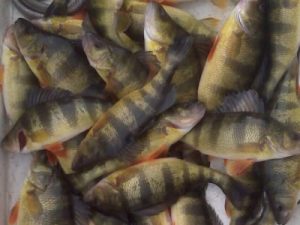

Anglers fishing for yellow perch in Maryland’s Chesapeake Bay region will face stricter limits during the 2026 season as state officials work to address population declines.
The Maryland Department of Natural Resources announced in early January that recreational fishermen can now catch only five yellow perch per day, down from the previous limit of 10 fish. This change affects both tidal waters and freshwater streams and rivers, though the 9-inch minimum size requirement stays in place.
State officials made this decision after observing six consecutive years of poor recruitment among yellow perch populations. However, fishing regulations at freshwater impoundments like Deep Creek Lake will remain unchanged.
The daily catch limit was originally raised from five to 10 fish back in 2009. Unlike commercial fishing operations, recreational harvest data for yellow perch remains largely unavailable due to the lack of reliable tracking systems.
Commercial fishermen have already been operating under increasingly restrictive quotas for several years while recreational limits stayed the same. The commercial Total Allowable Catch has dropped significantly from 59,662 pounds in 2018 to just 14,184 pounds in 2024, with annual averages around 36,000 pounds since 2009.
State biologists determine commercial quotas each year for the upper Chesapeake Bay, Patuxent River, and Chester River fisheries through annual stock assessments. Commercial operations must follow slot limits between 8.5 and 11 inches and can only harvest in specific areas north of the Bay Bridge plus the Chester and Patuxent rivers.
The Choptank River lacks a commercial yellow perch fishery, and DNR scientists don’t believe recreational fishing pressure is the primary cause of population decline.
Researchers suspect the population problems stem from factors beyond fishing pressure, including poor reproduction rates, habitat loss, increased predation, or disease. The new recreational limits aim to protect larger female fish, preserving breeding stock and potentially improving spawning success across Chesapeake Bay tributaries.
Population Monitoring Efforts
Data from the upper Bay winter trawl survey reveals yellow perch numbers have fallen by more than half since 2009, primarily due to consistently low recruitment in recent years.
Scientists also monitor yellow perch through the annual Choptank River fyke net survey, which has operated since 1988. Six nets are deployed from Kingston Landing to Martinak State Park for 4-6 weeks beginning in late February. Recent survey results have shown abundance levels at or near historic lows, matching trends observed in upper Bay studies.
However, 2025 brought some encouraging news. The Estuarine Juvenile Finfish Seine Survey showed above-average young-of-year numbers both Bay-wide and in the upper Bay region, marking the highest Bay-wide index since 2018.
Biologists hope this uptick in juvenile fish will translate to better results in the 2026 Upper Bay Winter Trawl Survey. This comprehensive study runs for six weeks from early January through mid-February, covering 20 sites including the Susquehanna Flats, Northeast River, Elk River, Sassafras River, and upper Bay mainstem waters.
Yellow perch have historically supported popular recreational fisheries during their late winter and early spring spawning runs throughout Maryland. The species ranges from South Carolina to Nova Scotia along the East Coast and inhabits all Maryland reservoirs, including Piney Run, Liberty, Loch Raven, and Prettyboy.
These fish have uniquely adapted to thrive in the saltier waters of the Chesapeake Bay and its major tributaries. Each late February, adult yellow perch begin their spawning migration from lower tributary areas to upstream regions.
In 2025, angler Thomas Dembeck Jr. made headlines by catching a record-breaking 2.3-pound, 16-inch yellow perch in the tidal Susquehanna River, surpassing a Chesapeake division state record that had stood since 1979.
As an additional conservation measure, DNR encourages anglers to release pre-spawn females with full bellies and instead target post-spawning fish found downstream from spawning areas.