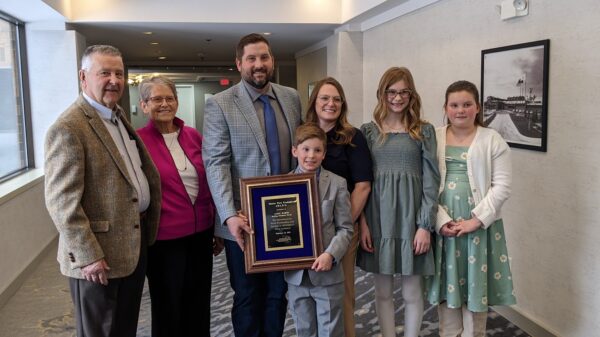
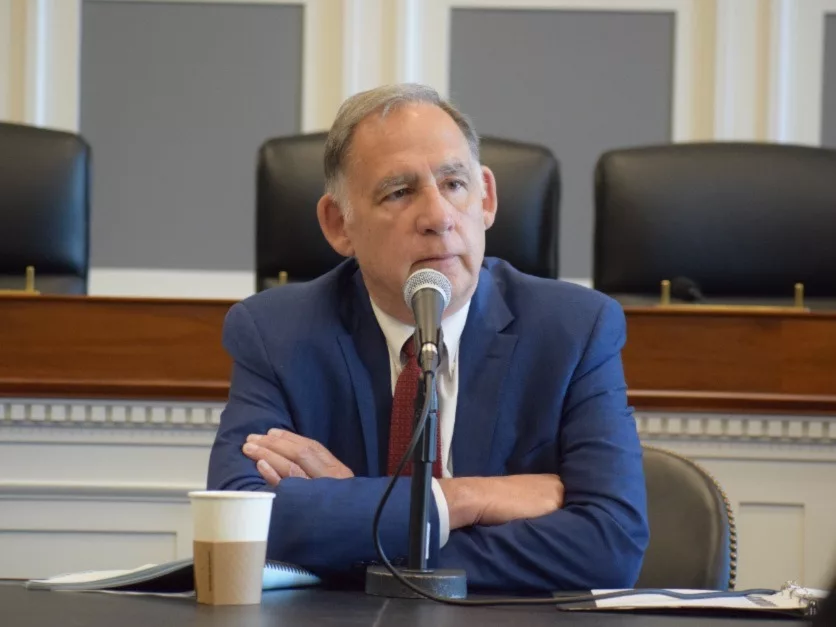
KANSAS CITY, Mo., March 5, 2026 — John Parker has been selected to receive the prestigious Paulson-Whitmore State Executive Award from the National Pork Producers Council, celebrating his extraordinary contributions and leadership spanning more than four decades in the pork industry. The honor was announced in collaboration with the National Pork Board.
Throughout his remarkable career of over 40 years leading the Virginia Pork Council as executive secretary, Parker established himself as an influential figure who significantly shaped Virginia’s farming community while strengthening connections between local and national agricultural organizations.
“John’s knack for bringing people together and his even-handed style was particularly valuable during times of industry challenge, especially when tough decisions required both clarity and empathy,” said Duane Stateler, NPPC president and Ohio pork producer. “He became the glue that held together a diverse state council, managing board meetings, policy priorities, and producer communications with calm competence and sharp attention to detail.”
During his extensive tenure, Parker successfully guided the organization through significant policy changes, major industry developments, and transitions between generations of farmers.
Parker played a crucial role in developing producer-funded promotion and research initiatives, contributing to the establishment of the National Pork Board and the reorganization of the National Pork Producers Council. His pioneering work to strengthen communication and collaboration between state and national groups helped create the foundation for today’s more cohesive industry structure. He was also pivotal in creating the inaugural State Pork Leadership Conference, an ongoing program that develops emerging leaders throughout pork-producing regions nationwide.
Beyond his professional achievements, Parker gained recognition for his generous mentorship approach. He guided new executives, provided wise advice, and supported young people entering agriculture through his active participation in 4-H and FFA youth livestock initiatives.
Looking back on his career, Parker shared, “I never saw this role as about one person. It has always been about the producers we serve and the relationships that keep our industry moving forward. I have been fortunate to work alongside dedicated leaders in Virginia and across the country who care deeply about agriculture’s future, and I share this recognition with them.”
The Paulson-Whitmore State Executive Award is presented each year during the National Pork Industry Forum to honor individuals who have made substantial contributions to their state’s pork sector and supported the broader goals of NPPC and NPB. The award bears the names of two respected former state executives, Don Paulson from Minnesota and Rex Whitmore from Wisconsin, highlighting the vital role state organizations play in the pork industry’s continued success.
The United States dairy industry reported robust cheese manufacturing numbers for the latest reporting period, with production reaching 1.28 billion pounds when cottage cheese is not included in the calculations.
According to federal agricultural data, this production volume represents a substantial 4.7 percent jump compared to January 2025 figures. The numbers also show a modest 0.1 percent increase over December 2025 production levels.
The production statistics reflect the ongoing strength in America’s dairy manufacturing sector, with cheese makers maintaining steady output levels across the country.
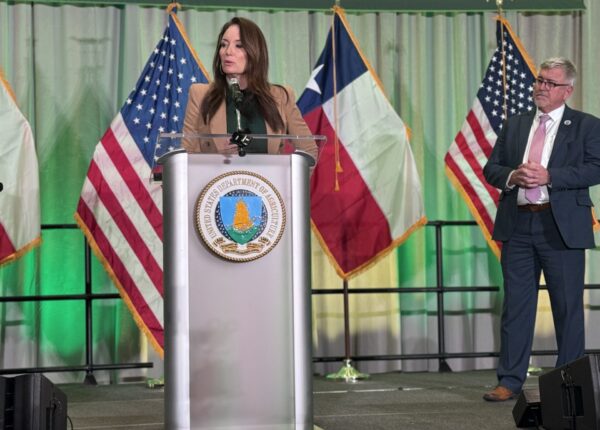
RICHMOND—More than 50 women agricultural leaders from across Virginia made history on February 26 when they gathered at the state capitol for the inaugural Farm Woman Lobby Day.
The participants, who represent farming operations throughout the state, came together as part of the Virginia Farm Bureau Federation Women’s Leadership Program to advocate for agricultural literacy while the 2026 General Assembly session continues. The women visited lawmakers’ offices to share their perspectives and promote farming education.
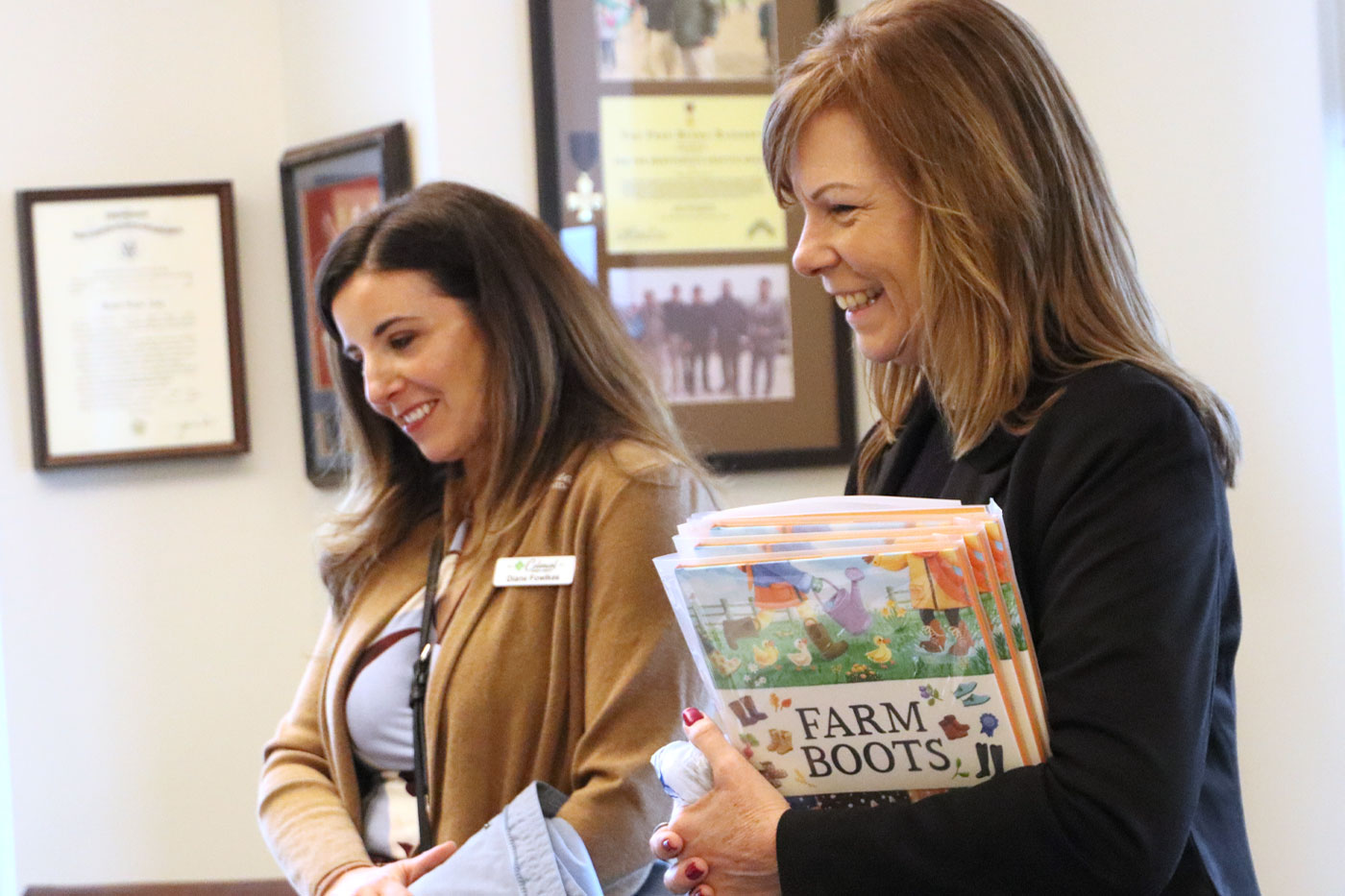
During their visits, the farm women handed out copies of “Farm Boots,” this year’s Agriculture in the Classroom featured book, to state legislators. They urged the lawmakers to read the book to students in their districts during Agricultural Literacy Week, scheduled for March 23-27.
The event featured remarks from several key state officials, including Gov. Abigail Spanberger and Lt. Gov. Ghazala Hashmi, along with administration officials and rural advocates.
“Thank you for the work you do in communities across Virginia,” Gov. Spanberger told the assembled women. “In the legislation that’s moving forward, or the work our administration is doing, it’s important we have an agricultural perspective at the table.”
Katie Frazier, Virginia’s Secretary of Agriculture and Forestry, emphasized the state government’s dedication to supporting the commonwealth’s largest private industries.
“And we want to build on the diversity of our industries and see opportunities for growth across all sectors in all areas,” Frazier explained. “Many of our legislators are not from areas that represent agriculture anymore, but they still understand and appreciate the impact that all of you make in your community.”
Del. Justin Pence, R-Edinburg, who farms in addition to serving in the legislature and sits on the VFBF state board representing the northern Shenandoah Valley, highlighted the significance of 2026 being declared the International Year of the Woman Farmer.
“Women need to be where the decisions are made,” Pence emphasized. “It’s meaningful when you come here to share your perspectives. Agriculture is a bipartisan issue, and Farm Bureau has a great working relationship with legislators on both sides of the aisle.”
Orange County farmer and district women’s leader Katelyn Burner delivered a book to the office of Del. Lily V. Franklin, D-Roanoke.
“We are celebrating women in agriculture,” Burner explained. “About a third of Virginia farms are women-owned and-operated, which is amazing. And we’re also celebrating 16 years of Ag Literacy Week. This is an opportunity to teach children in kindergarten through third grade about where their food comes from, the importance of farms, and how hard farmers work.”
Sen. Russet W. Perry, D-Leesburg, praised the impact that Farm Bureau advocates have on state lawmakers, noting that their voices distinguish themselves among the numerous special interest groups that lobby the General Assembly.
“We know that women of the Farm Bureau are so strong, so tough and so smart!” Perry declared.
Faye Hundley, who chairs the Women’s Leadership Committee, urged the participating women leaders to “keep that little fire burning.”
“And continue to advocate as strongly as you have today,” she added.
RICHMOND—Female agricultural leaders from across Virginia came together to share honest perspectives about juggling farming operations, family obligations, and community roles during a forum titled “Harvest of Hustle: Women Leading Farms, Families & Futures.”
The discussion took place after morning advocacy work at the Virginia State Capitol, where participants in the Women’s Leadership Program met with legislators to champion Agricultural Literacy Week and other key issues during Farm Woman Lobby Day on February 26.
The panel featured representatives from farming operations throughout Virginia’s agricultural regions, including longtime farm advocate Maxine Arey from Augusta County, Kimberly Foley who leads Foley Seed & Service in Hanover County, fifth-generation farmer and agribusiness owner Kayla Lawrence from Frederick County, and Sarah Barlow Rudolph, a Wythe County advocate who manages both farm duties and a full-time career.
Foley recalled watching her father’s difficulties in the cattle industry during the early 2000s, which forced him to take work as a local agriculture instructor to save the farm.
“Up until that point, I was absolutely determined that I was not going to be involved in agriculture or subject my family to the tough stuff that they dealt with,” she recalled.
However, witnessing his dedication inspired Foley to forge her own agricultural career path. She emphasized that personal strength often becomes clear only when looking back.
“A setback can signify progress,” Foley said. “It’s putting you in the right position at the right time to be creative about new decisions you get to make.”
Lawrence similarly observed her father overcome farming obstacles and changes. She now works alongside him full-time at Richard’s Fruit Market, a family operation spanning 73 years.
“We’ve had freezes, we’ve had droughts,” Lawrence said. “We’ve had to sell cattle because we couldn’t feed them. But I’ve learned you have to fix that problem right then and there, and worry about tomorrow’s problems tomorrow. Farm Bureau has pushed us through these times. Those connections helped us figure out how to solve these problems.”
Rudolph emphasized that preserving Virginia’s agricultural heritage depends on investing in future farmers. She criticized the longstanding practice of discouraging bright rural students from returning to agriculture.
“We won’t do that to this next generation, because there’s so many wonderful ways that they can play into agriculture, regardless of whether they decide on a four-year university or not,” she said. “We can use their passion to continue to grow our industry.”
Arey stressed that current farm operators must prepare pathways for the next generation to succeed.
“One of the best gifts you can give is a good farm succession plan,” she said.
The farm women also attended a confidence-building presentation by Carrie Walker, American Farm Bureau Federation director of membership engagement.
APPOMATTOX, Va.—A corporate donation is helping accelerate construction of a new agricultural facility for a Virginia FFA chapter that has earned the state’s top ranking three years running.
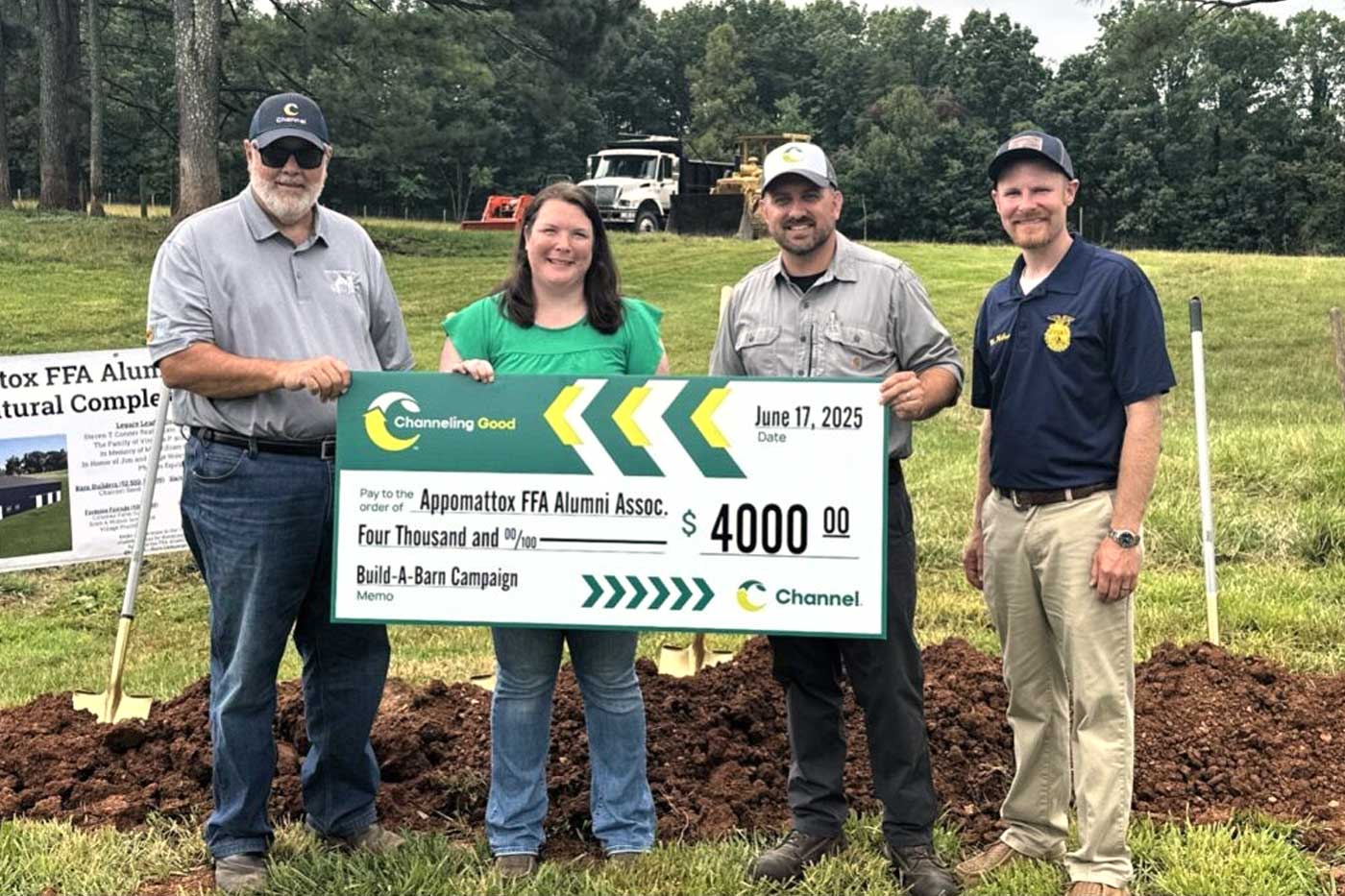
Channel Seed has provided $4,000 through its Channeling Good program to support the Appomattox FFA Alumni Agricultural Complex, a multipurpose building that will feature livestock handling facilities and space for community agricultural activities.
The contribution comes as the Appomattox County chapter continues to demonstrate exceptional performance, with roughly 20% of students participating in the Future Farmers of America program and donning the organization’s signature blue corduroy jackets.
More than 75 individuals including current students, program graduates, and community supporters attended last summer’s groundbreaking ceremony for the new complex.
Two Channel Seed employees, Bobby Long and Glenn Dye, submitted the nomination for the donation. Dye operates farming operations across Appomattox, Fauquier and Stafford counties and holds a position on the Stafford County Farm Bureau’s board of directors. He has also championed farm equipment highway safety initiatives throughout Virginia.
“The FFA is trying to secure funds for this tremendous building project opportunity,” Dye explained. “Since they’ve been chosen as the top FFA chapter in the state for three consecutive years now, I felt they were most deserving. The Appomattox FFA program is preparing the students to be positively contributing young adults. After graduation, they are much more desirable job candidates and possess the soft skills to be productive members of society.”
Mary Beth Primm, who leads the Appomattox FFA Alumni as president, spoke with the Appomattox-Times about the significance of Channel Seed’s contribution to their agricultural facility project.
“Support like this allows us to provide hands-on learning opportunities, develop student leadership, and move one step closer to making the agricultural complex a reality,” she stated.
The new structure will make livestock-related educational projects more accessible to students while creating a central location for regional farming events and activities.
Channel Seed specializes in providing tailored seed products along with agronomic guidance and local assistance for farmers growing corn and soybeans.
Dye emphasized the critical need for young people to enter agricultural careers, pointing to demographic challenges facing the farming industry.
“Our industry faces a constant uphill battle in so many facets,” he noted. “We need our young leaders to continue—not just operating—but advocating for our great and increasingly important industry. They are the agricultural leaders of the future.”
He also highlighted concerns about the aging farmer population, noting that the average age continues to climb annually.
Those interested in supporting the Appomattox FFA’s facility construction can contribute at secure.qgiv.com/for/appomattoxbarnproject.
For media inquiries, contact Emily Biras with Channel Seed communications at 314-221-3620.
A Virginia wildlife biologist shared a memorable moment from last spring when his grandson Eli called in turkeys for his older brother Sam during their Craig County hunt. While no birds were harvested that day, the experience highlighted the excitement of turkey hunting across generations.
Now, Virginia Department of Wildlife Resources Upland Game Biologist Mike Dye is providing hunters with expectations for the upcoming 2026 spring season. Wildlife managers closely monitor the poults per hen (PPH) ratio from previous years, particularly focusing on birds that are now two years old, since these gobblers tend to be the most responsive to calls and vocal during hunting season.
“The 2024 hatch was 2.1 PPH, which was pretty good,” Dye said. “Maybe not as high as in the past, but average for what we have seen in recent years. As far as 3-year-old gobblers, the 2023 PPH was 1.8, which is somewhat low. However, the 2025 PPH dropped significantly to a statewide average of 1.3, which is concerning. While there are many factors that influence turkey recruitment, poor weather during nesting and when the poults are young can reduce success substantially. In much of the state during early June 2025 when poults were hatching, we had rain and cold weather, which is not ideal. Though, of course, we’ve received scattered reports of good hatches, but, overall, summer recruitment was pretty minimal.”
The challenging weather conditions have led to realistic expectations for this hunting season. “So, I am expecting hunting to be more difficult this spring,” Dye said. “I would expect a slight decline in the harvest this spring as a result of that lower productivity in the past few seasons. But on a historical level, turkey populations are still in fairly good shape in most of the state. Since 2020, the statewide harvest has been historically high, and the harvest seems to be moving back toward pre-COVID levels.”
According to Dye, Virginia’s turkey population would benefit significantly from favorable weather conditions this year, particularly warm and dry conditions during the first two weeks of June when most young turkeys emerge across the state.
Despite reproduction challenges, some factors are working in favor of Virginia’s turkey population. “One thing in favor of our hens is that the last two autumns have seen good acorn production statewide,” Dye continued. “So, the hens should be entering this spring in good physical shape. Another plus is that in the Southwest Virginia Coalfields region, there was a tremendous periodic cicada hatch the spring of 2025. Every creature from turkeys to bears to coyotes to songbirds benefits from abundant cicadas in that they are an easy, high protein food for wildlife to eat…and this is especially true for poults.”
Hunters should be aware of significant regulatory changes taking effect for the 2026-27 season. The annual harvest limit remains at three birds, but new restrictions limit hunters to one beardless turkey, which can only be taken during fall season. This means fall hunters can still take three birds total, but two must have beards. Spring hunters may continue using all three tags for bearded birds as in previous years.
“With this regulation, we are simply trying to protect a few more hens,” Dye said. “Of course, weather and habitat are the main factors affecting turkey numbers, but DWR hopes this regulation will help some, too.”
Virginia’s Youth and Apprentice Weekend is scheduled for April 4-5, with the regular spring season running from April 11 through May 16. All-day hunting opportunities begin April 27.
ARLINGTON, Va. — A major agricultural trade organization is praising recent progress on farm legislation in Congress, describing the advancement as a vital move toward delivering stability to America’s farming sector.
The National Grain and Feed Association issued a statement on March 5, 2026, expressing support for the House Agriculture Committee’s decision to move forward with the farm bill during committee markup proceedings.
The organization recognized Committee Chairman Glenn “GT” Thompson, a Pennsylvania Republican, along with other committee members for their efforts in pushing the legislation ahead. They also called on House leadership to schedule floor consideration of the measure without delay.
“Advancing the farm bill out of committee is a critical step toward delivering the certainty farmers, grain handlers, and the broader agricultural supply chain urgently need,” said NGFA President and CEO Mike Seyfert. “Congress should build on this bipartisan momentum and move quickly to consider the legislation on the House floor.”
The association highlighted its strong backing for keeping the existing Conservation Reserve Program spending limits unchanged, as well as enhanced funding for the Market Access Program and additional trade initiatives. These programs are viewed as essential for boosting export potential and maintaining the competitive edge of American agriculture in global markets.
The organization expressed its commitment to ongoing collaboration with legislators from both the House and Senate as the farm bill moves through the legislative process toward final approval.
Listen to the Morning Delmarva Farm Report Update — March 5, 2026
DELMARVA — Cattle farmers across Delmarva are now in the crucial 90-day window that determines breeding season success. This 3-month preparation period happens well before artificial insemination begins or bulls are introduced to herds. During these critical months, female cattle undergo significant metabolic adjustments and reproductive developments that directly impact egg quality and prepare the uterus for pregnancy. Getting nutrition and body condition right now pays dividends when breeding actually starts.
Markets
A massive Brazilian soybean harvest is adding pressure to commodity markets that will affect Delmarva grain farmers. An Iowa State economist says Brazil’s situation mirrors last year’s overwhelming U.S. corn harvest, when post-World War 2 record acreage combined with record yields drove prices down.
March corn futures settled at $3.92/bu, soybeans at $10.43, and wheat at $5.18. Locally, corn is trading around $4.10 on Delmarva.
Forecast
Dense fog continues this morning with visibility under a quarter mile in spots, clearing by mid-morning. Light rain likely today with a high near 54°F and east winds 5-10 mph. Tonight, widespread fog returns with rain likely, low around 39°F. Friday brings patchy fog and a high near 50°F.
This article is based on the Delmarva Farm Report Update Morning Edition, March 5, 2026. Hosted by Tom Bradley.
Listen to the Evening Delmarva Farm Report Update — March 4, 2026
DELMARVA — Farmers across the country are showing cautious optimism despite concerns about the agricultural economy’s direction, according to new research from Purdue University. The latest Ag Economy Barometer tracked responses from 400 producers nationwide, revealing a modest uptick in confidence levels. However, the survey also exposed deeper anxieties about where the sector is headed. The mixed sentiment comes as agricultural producers focus heavily on managing input costs heading into the spring planting season.
Policy
House Agriculture Committee lawmakers began farm bill markup sessions Tuesday, with producers still waiting for long-term policy certainty. Committee Chairman GT Thompson addressed conservation funding concerns, stating there are no cuts to the conservation title in the proposed legislation.
Markets
May corn closed at $4.43¾, down 2¾ cents. May soybeans settled at $11.69½, down 1 cent. May Chicago wheat finished at $5.68¼, down 5¾ cents. April live cattle jumped $4.22 to $238.35.
Forecast
Areas of dense fog are expected tonight with a low near 39°. Thursday brings likely light rain with a high near 56°. Light rain continues Thursday night with temperatures dropping to 39°.
This article is based on the Delmarva Farm Report Update Evening Edition, March 4, 2026. Hosted by Tom Bradley.
The National Agricultural Statistics Service has issued its most recent weekly compilation of agricultural data from states nationwide.
The federal agency’s latest report provides updated statistics and information related to farming operations and crop conditions across the country.
The weekly publication is part of USDA’s ongoing effort to track and document agricultural trends and developments at the state level throughout the growing season.
The provided article appears to contain only a video embed from the Virginia Farm Bureau YouTube channel without accompanying text content. Based on the headline about Virginia farmers working multiple jobs to support global food production, this story would typically explore the economic pressures facing agricultural workers and their efforts to maintain food security while managing financial challenges.
Without the full article text available, specific details about individual farmers, statistics, or expert commentary cannot be accurately reported at this time.
Listen to the Morning Delmarva Farm Report Update — March 4, 2026
DELMARVA — Delaware farmers are working to understand the implications of newly enacted federal legislation known as the One Big Beautiful Bill Act. The comprehensive measure contains several sections that will directly affect farming operations throughout the First State and surrounding region.
Agricultural analysts note that while some provisions may benefit farmers, others present new challenges for the industry. Local farming advocates are currently reviewing 3 key components of the legislation that are expected to have the most significant impact on Delmarva operations.
Meanwhile, a Delaware farming operation has developed into a significant agricultural enterprise. Hamer Farms now cultivates approximately 1,500 acres dedicated to potato production while also raising alfalfa, corn, wheat and mustard crops. The multi-generational business, which includes both farming and packing facilities, provides jobs for nearly 60 employees throughout their operation.
Markets
April corn futures settled at $4.71/bu. Soybeans for March closed at $10.43. Wheat for March finished at $5.52.
Forecast
Patchy fog this morning with a chance of light rain developing later today. High near 51°. Tomorrow brings rain showers likely with highs near 57°. Southeast winds 5-10 mph. Conditions stay unsettled through Friday with showers and thunderstorms likely Thursday night.
This article is based on the Delmarva Farm Report Update Morning Edition, March 4, 2026. Hosted by Tom Bradley.
Federal agriculture authorities have officially designated Sri Lanka as a region impacted by African Swine Fever, according to an announcement from the Animal and Plant Health Inspection Service.
The agency has updated its official registry on the APHIS website to include the island nation following verified cases of the disease within Sri Lanka’s borders.
This designation comes as part of ongoing federal efforts to monitor and track the global spread of African Swine Fever, which poses significant risks to pig populations worldwide.
Listen to the Evening Delmarva Farm Report Update — March 3, 2026
DELMARVA — Delaware farmers may soon have access to new planting technology designed to improve crop establishment across the region. PTx unveiled their ArrowTube seed planting system at this year’s Commodity Classic, promising better results for agricultural operations.
According to Caleb Stuber from PTx’s strategic marketing division, the system manages speed and uses strategically positioned resistance to direct individual seeds along a specially designed pathway from the planting mechanism into the soil. The technology creates a narrow trench beneath the surface for more consistent seed placement.
Markets
Corn futures closed mixed with nearby contracts under pressure while deferred months posted modest gains. Soybeans advanced during Tuesday’s session, with the March contract up 12 cents following volatile trading. Wheat futures showed mixed results as traders monitored global supply conditions. April live cattle climbed $1.02 to settle at $234.12 per hundredweight.
Forecast
Dense fog continues impacting the Delmarva Peninsula through 10 o’clock this evening with visibility dropping below 1/4 mile in some areas. Tonight brings light rain with lows around 42 degrees and southwest winds near 5 miles per hour. Wednesday looks mostly cloudy with a chance of light rain and highs reaching 54 degrees. Wednesday night continues the wet pattern with more light rain and lows around 40 degrees.
This article is based on the Delmarva Farm Report Update Evening Edition, March 3, 2026. Hosted by Tom Bradley.
Delaware’s Department of Agriculture is urging farm insurance agents across the state to participate in an online discussion with federal officials regarding crop insurance subsidy matters scheduled for Monday, March 9 at 2 p.m.
The virtual question-and-answer session will feature representatives from the USDA Risk Management Agency addressing concerns about crop insurance subsidy topics. State agriculture officials emphasize that crop insurance serves as an essential element of agricultural safety nets, providing protection for farmers against unpredictable weather patterns, environmental challenges, and fluctuating economic circumstances that can impact farming operations.
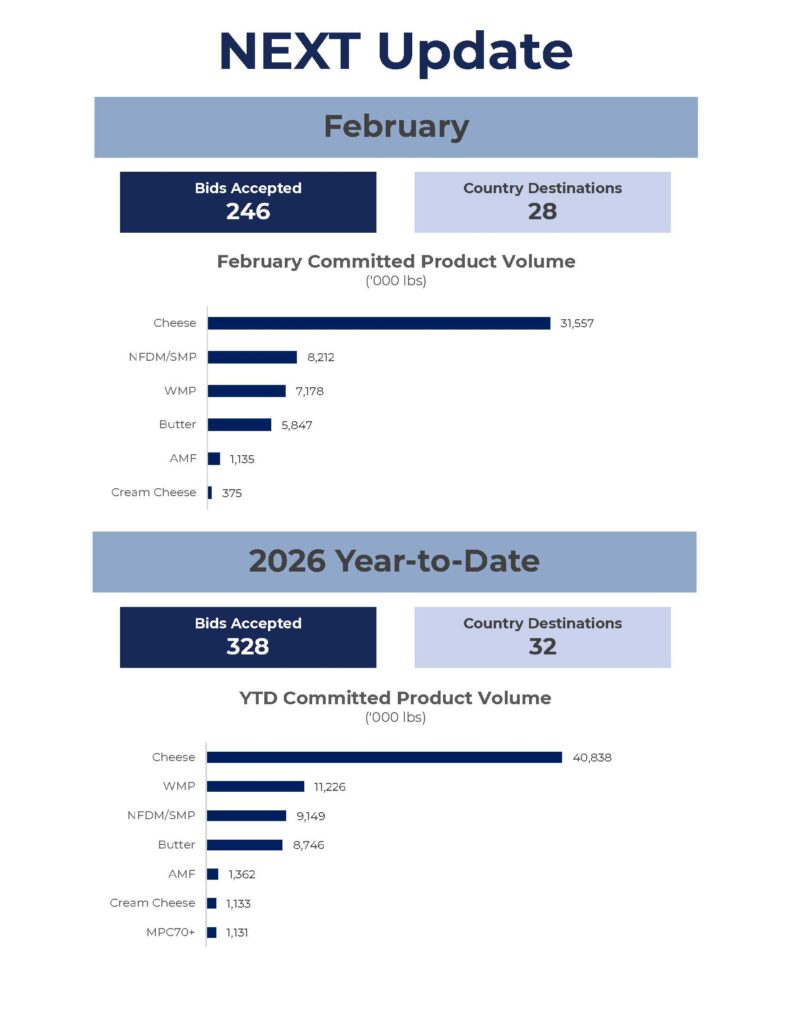
Dairy cooperatives participating in the NEXT assistance program finalized 246 export contracts during February, representing 54.3 million pounds of dairy products scheduled for international delivery in 2026. The shipments will reach customers spanning ten global regions including Asia, Europe, North America, Oceania, Middle East-North Africa, Eurasia, South America, Central America, the Caribbean and Sub-Saharan Africa, with deliveries scheduled from February through July.
The NEXT program serves as a vital resource for participating U.S. dairy cooperatives seeking to expand their international sales reach, an increasingly crucial component for dairy farmers and their cooperatives across the nation. International market expansion remains essential for generating dairy demand, regardless of whether a cooperative currently maintains active export operations. Those interested in learning more about the NEXT Program can reach out to the team at [email protected].
Officials note that the reported dairy product quantities represent active contracts awaiting delivery rather than finalized export volumes. The NEXT program will distribute export assistance payments to successful bidders only after export completion and product delivery are confirmed through proper documentation submission.
The National Milk Producers Federation has intensified its advocacy efforts in preparation for the upcoming U.S.-Mexico-Canada Agreement review scheduled for this summer, deploying both congressional testimony and coalition-building strategies to push for critical improvements.
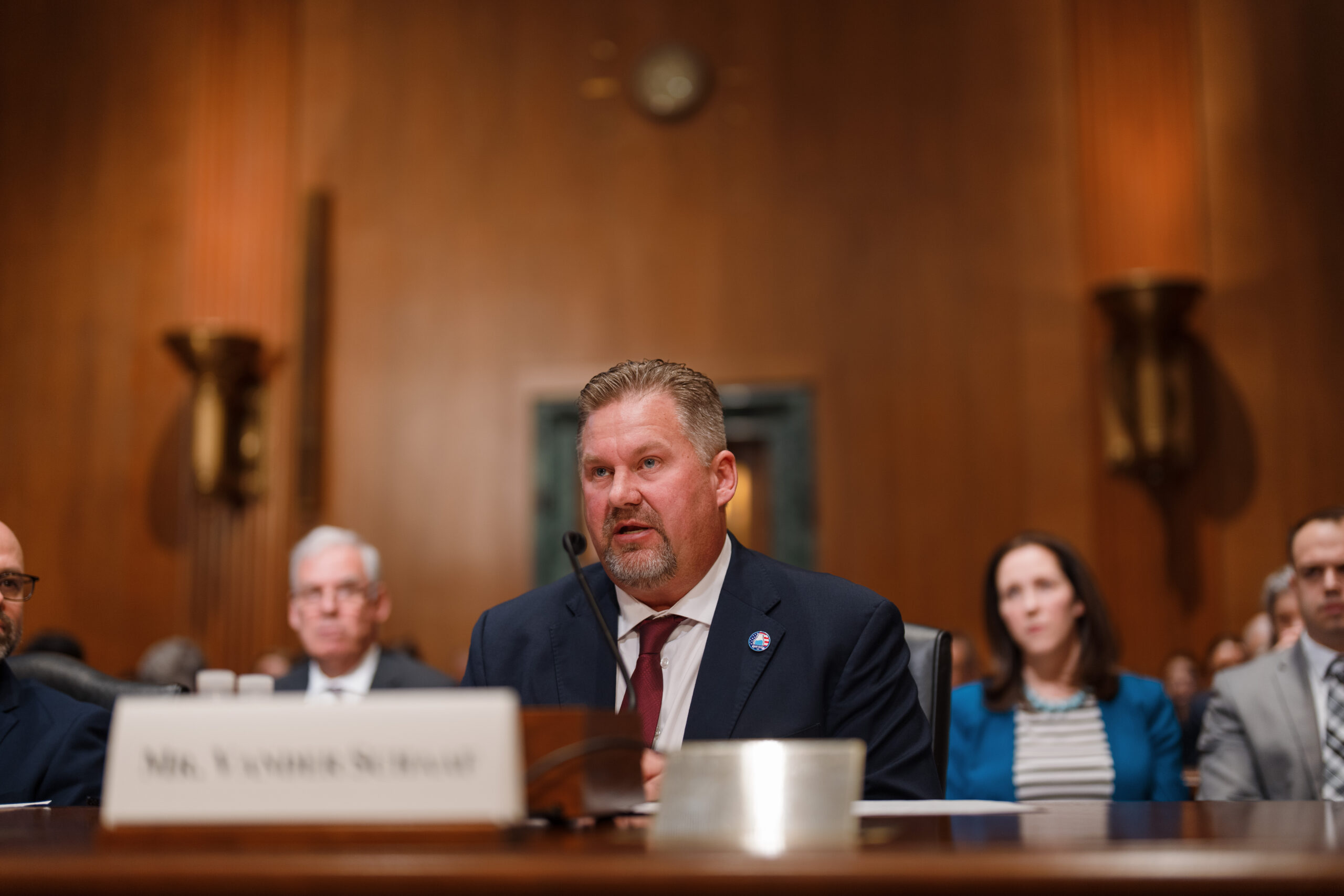
Idaho dairy producer Ted Vander Schaaf, who serves on the boards of Northwest Dairy Association/Darigold and the Idaho Dairymen’s Association, appeared before the Senate Finance Committee on February 12th to outline the dairy sector’s priorities for the trade agreement assessment. Vander Schaaf holds a position with an NMPF associate member organization.
During his testimony, Vander Schaaf stressed the critical role USMCA plays in ensuring reliable and transparent market access, especially for exports to Mexico. However, he also pointed to significant deficiencies that require attention. He called out Canada’s ongoing manipulation of dairy tariff-rate quotas and its efforts to bypass USMCA dairy protein export rules, which disadvantage American dairy exporters. Additionally, he addressed Mexico’s delays in fully honoring its commitments to safeguard common cheese names, explaining why this matters to both dairy farmers and processing companies.
The organization also took a central role in establishing the Agricultural Coalition for USMCA on February 5th, a broad industry initiative aimed at supporting the agreement’s renewal while pushing for necessary enhancements. This coalition plans to collaborate with both Congress and the current Administration to address the trade deal’s weaknesses prior to its renewal.
During the coalition’s inaugural press conference, NMPF Executive Vice President Shawna Morris stated, “USMCA is an extremely strong agreement, but it’s not perfect. The USMCA review offers an unmissable opportunity to make targeted enhancements so the agreement can live up to its full intended potential.”
The U.S. Department of Agriculture announced a $148 million investment on February 19th aimed at supporting dairy farmers struggling with depressed milk prices while increasing consumption of dairy products nationwide. The federal purchase program represents the most significant butter buying initiative in half a decade and directly aligns with advocacy efforts launched by the National Milk Producers Federation last November.
“Dairy farmers have shared in the struggles faced throughout the agricultural economy, and these purchases will provide important relief to producers who will benefit from the additional demand, helping them provide nutritious dairy products to Americans and the world,” stated Gregg Doud, President and CEO of the National Milk Producers Federation.
The federal purchasing initiative breaks down as follows:
• Butter purchases totaling $75 million • Cheddar cheese acquisitions worth $32.5 million • Fresh fluid milk purchases of $20.5 million • Swiss cheese buying program valued at $10 million • Ultra-High Temperature shelf-stable milk purchases of $10 million
This investment directly mirrors the funding amount the National Milk Producers Federation requested in correspondence sent to agriculture officials last November, which led to ongoing discussions and formal communications with the USDA. The dairy support package compares well with other recent federal agricultural assistance programs, including $80 million allocated for specialty crops and $100 million designated for seafood industries.
These dairy acquisitions fall under USDA Section 32 authority, established through the Agricultural Adjustment Act of 1935, which empowers the department to purchase excess domestically-grown agricultural commodities to stabilize farm markets and supply food for federal nutrition programs.
Through this program, the USDA’s Agricultural Marketing Service alerts industry participants and stakeholders about new purchasing opportunities by releasing Purchase Program Announcements year-round. Following this week’s announcement, the USDA will accept bids from certified vendors and distribute purchase contracts accordingly.
ANNAPOLIS, MD – The Maryland Department of Agriculture is joining the national observance of Weights and Measures Week, which runs through March 7, 2026.
The weeklong recognition, which began March 1st, focuses on this year’s theme ‘We Measure What Matters,’ highlighting the critical role that accurate measurements play in the daily routines of Maryland residents and the state’s economic well-being.
The annual observance draws attention to the importance of measurement precision across various aspects of life that affect families throughout the state.
ANNAPOLIS, MD (March 3, 2026) – Maryland’s Department of Agriculture is alerting agricultural producers about available financial assistance programs designed to help with spring manure management expenses.
The state agency announced that farmers may request cost-share assistance to help pay for hauling specific manure types to agricultural fields that have suitable soil phosphorus concentrations. The program also provides financial support to help cover expenses related to liquid manure injection procedures.
These grant opportunities are part of Maryland’s ongoing efforts to support sustainable farming practices while helping producers manage operational costs during the critical spring planting season.
Listen to the Morning Delmarva Farm Report Update — March 3, 2026
DELMARVA — Delaware’s poultry industry is facing a serious threat from aflatoxin B1, a toxic compound produced by certain fungi. Agricultural experts warn this mycotoxin ranks among the most harmful contaminants affecting broiler chickens.
The toxin primarily attacks birds’ digestive systems, causing severe intestinal damage that can devastate commercial operations. Poultry producers across Delmarva should monitor feed quality closely as fungi producing this toxin thrive in warm, humid conditions.
Markets
May corn futures settled Monday at $4.45¾ per bushel, down 2¾ cents. May soybeans closed at $11.64 per bushel, falling 6¾ cents. May Chicago wheat dropped 4 cents to finish at $5.39¾.
April live cattle gained 87 cents to close at $233.10 per hundredweight.
Forecast
A winter weather advisory remains in effect until 8:00 this morning across the region. Expect light rain today with temperatures reaching 46°F. Tonight brings patchy fog and continued light rain with lows around 42°F.
Wednesday looks for a high near 55°F with a chance of light rain continuing. Wet conditions persist through the week with rain showers likely Thursday and Friday. Field work will be limited through the extended period.
This article is based on the Delmarva Farm Report Update Morning Edition, March 3, 2026. Hosted by Tom Bradley.
Federal agricultural officials are seeking public input on a proposal that could significantly expand pineapple imports from Taiwan to the United States.
The Animal and Plant Health Inspection Service has completed risk assessment studies examining the potential expansion of Taiwanese pineapple imports. Under current regulations, only fresh pineapples that are at least 50 percent Smooth Cayenne variety by genetic lineage can enter the U.S. from Taiwan, and these shipments are restricted to Guam and the Northern Mariana Islands.
Taiwan’s plant protection agency has requested permission to ship any pineapple variety to all American states and territories. In response, federal inspectors have conducted comprehensive evaluations of potential plant disease and invasive weed threats that could accompany expanded imports.
The assessment documents, which include proposed safety measures to address identified risks, are now available for public review and comment. The studies examine what protective steps would be necessary to prevent harmful pests from entering the continental United States along with the tropical fruit shipments.
Federal agriculture authorities have completed a comprehensive safety evaluation regarding the potential importation of fresh artichokes from the Italian island of Sardinia into the United States.
The assessment focuses on fresh, young flower buds of the globe artichoke plant, scientifically known as Cynara cardunculus or spiny artichoke, that would be shipped from Sardinia to American markets.
According to the completed evaluation, officials have concluded that implementing specific plant health safety protocols will adequately prevent the introduction or spread of harmful plant diseases and invasive weeds that could potentially accompany these Italian artichoke shipments.
The comprehensive risk assessment is now available for public examination and feedback as part of the regulatory review process.
American dairy farmers are celebrating a banner year for overseas sales, with export revenues climbing 15% to reach $9.63 billion in 2025, just shy of the all-time record set in 2022.
The success comes on the heels of a major trade breakthrough announced February 19th, when U.S. negotiators finalized a long-sought agreement with Indonesia that removes all tariffs on American dairy products. The deal represents decades of effort by the National Milk Producers Federation, working alongside the U.S. Dairy Export Council and the Consortium for Common Food Names.
Indonesia already ranks as the eighth-largest buyer of American dairy products, but as the world’s fourth most populous country, industry leaders see tremendous potential for future growth among U.S. producers.
This Indonesian agreement marks the ninth trade deal achieved by U.S. negotiators that opens new markets for American dairy exports. The recent string of successful agreements delivers several key benefits:
Complete tariff elimination on U.S. dairy products in most agreements, along with significant tariff reductions in others, helping American suppliers compete more effectively against rivals from Australia, New Zealand, and European Union countries. One notable example is the competitive advantage now enjoyed by extended shelf-life milk exports to Taiwan.
Prohibition of burdensome dairy facility registration requirements across all these markets. In Indonesia’s case, this removes a lengthy approval process that previously required over three years for processing plants to gain shipping authorization.
Protection for American exporters to use up to 40 commonly recognized cheese names including “parmesan.” This provision becomes increasingly critical as the European Union expands its free trade network, potentially restricting U.S. opportunities to market cheeses under widely accepted terms.
The National Milk Producers Federation credited Chief Agricultural Negotiator Julie Callahan as instrumental in securing these beneficial trade agreements. NMPF expressed gratitude to Callahan and the entire U.S. Trade Representative team for their substantial efforts in bringing these deals to fruition.
Despite recent Supreme Court decisions on tariffs creating additional trade policy uncertainty, the progress achieved demonstrates dairy’s bright prospects. Bilateral negotiations continue while the industry steadily develops new markets worldwide.
The year 2025 stands among the strongest on record for dairy exports. Export volumes measured in milk solids equivalent grew 4% compared to 2024, ranking second only to 2022 for total shipments. Revenue-wise, the $9.63 billion total fell just $30 million short of 2022’s record-setting $9.66 billion.
Cheese emerged as the standout performer, with shipments jumping 20% over the previous year’s already record-breaking totals. Expanded domestic processing capacity contributed to this growth, along with increasing international recognition of American product quality and taste. The record sales spanned globally, reducing risks from over-dependence on any single market. In 2025, thirty-nine different countries purchased more than 1,000 metric tons of U.S. cheese.
Both butterfat and high-protein whey products also experienced exceptional years, demonstrating the broad-based nature of export growth. While trade conflicts between the U.S. and various partners create uncertainty in some sectors, dairy exports remain largely unaffected. American dairy products maintain strong global competitiveness, with industry leaders building stable, collaborative relationships expected to endure and support long-term farmer prosperity.
The National Milk Producers Federation attributes much of its trade advancement to the NEXT program (NMPF Exports & Trade), launched during the second half of last year. NEXT works to create export opportunities for U.S. dairy producers by eliminating trade barriers and maintaining competitive pricing for domestic products in international markets.
During its initial six-month period, NEXT facilitated 142 million pounds of export volume, nearly matching the full-year 2024 totals under its predecessor, the Cooperatives Working Together program. The initiative continues testing innovative approaches to expand dairy’s market share through new strategies, including diversifying product offerings and providing targeted support in key markets where the U.S. faces tariff disadvantages or growth opportunities exist.
Enhanced trade access through upcoming bilateral agreements, a complete year of NEXT operations, and continued collaboration among dairy industry partners creates strong momentum for 2026 U.S. dairy exports. Industry leaders remain optimistic about future prospects despite ongoing discussions about tariffs and trade tensions, confident that skilled navigation can continue delivering impressive results for American dairy farmers.
Virginia’s structured hunting organizations trace their roots back over 150 years, with fox hunting groups being the first to establish formal competitive events through organized associations. In modern times, deer hunting organizations and their members oversee the majority of private hunting grounds across Virginia. Given that more than 95 percent of the state’s territory remains in private hands and whitetail deer stands as the primary big game species, these hunting organizations represent the vast majority of the deer hunting population.
The crisp November and December dawns continue to transport me back to the weekend mornings and holiday excursions I experienced as a young hunter in the late 1950s and early 1960s. During those formative years, I accompanied my Uncle Dickie and participated with his Chesterfield County Oakland Hunt Club.
Throughout that period, hunting with hounds in eastern Virginia was our standard approach, and most of rural Chesterfield County’s countryside remained accessible for hunting, with minimal posted restrictions. Property owners frequently welcomed a holiday ham or turkey as appreciation, and providing a deer hindquarter from animals harvested on their land was deeply valued. Club members owned the hunting dogs, and rather than formal membership fees, regular hat-passing for contributions was the customary funding method.
Following my high school graduation in 1968, I became a member of Spears Hunt Club located in the Skinquarter area of Western Chesterfield County. At the time, I was employed part-time at Vepco (currently known as Dominion Energy) while pursuing studies at John Tyler Community College. My colleague Bobby Moore became a close friend and facilitated my club membership. The yearly membership cost upon joining was $25.
During this time, formal hunting agreements with private property owners and hunting organizations began gaining popularity. When I assumed one of the club leadership positions, I would meet with area landowners prior to season opening to establish these agreements. The property owners from that era, similar to those I encounter currently, provided tremendous support.
Among my initial experiences as an organized hunt club member involved actively participating in the hunting process. Coordinating drives with the hounds and ensuring hunting stands were positioned in secure locations were responsibilities handled with utmost seriousness.
Nevertheless, the most meaningful aspect of hunt club membership has been developing relationships with fellow hunters who share similar interests and the positive experiences we create together.
Over the years, I have participated in two separate hunt clubs and maintained active involvement in both organizations. Previously, I authored a piece called “Safety Should Always Be The #1 Priority,” which highlighted the senior member of my Amelia Springs Hunt Club, who suffered an 11-foot fall from his elevated hunting structure in 2023, resulting in fractures to both legs.
Walter Link celebrated his 89th birthday on December 13, 2023. Following three surgical procedures and extensive prayers for his healing, our fellow hunter returned to club activities on the opening day of general firearm season. Walter represents not only a lifelong hunting enthusiast but also a skilled heavy equipment specialist. Throughout our club’s existence, he has operated bulldozers and backhoes for major projects under his supervision. Walter has consistently been dependable, and following his accident, the club decided to honor him with something meaningful.
Understanding his hunting structure’s deteriorated state, we proposed providing him with a Red Neck Elevated Blind. However, he preferred restoring his existing structure. When he expressed this preference, Allen Wells and Jack Bergman assumed responsibility for the renovation. With over $1,500 in supplies and multiple days of labor, the old hunting house was completely renewed.
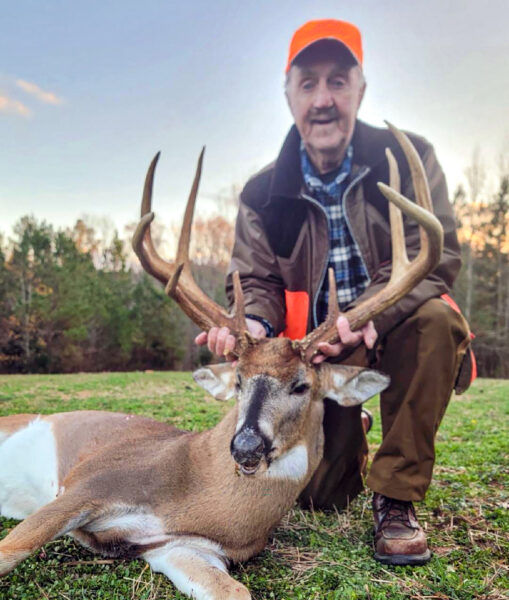
The concluding portion of this extraordinary story occurred on the Friday after Thanksgiving Day. Walter harvested the largest buck taken on club property that season from the identical hunting structure he had fallen from the previous year. This became the highlight of the club’s 2024-2025 season, and we arranged for the buck to be mounted for display in the clubhouse dining area.
We maintain awareness of everyone’s hunting locations through our property map and magnets displaying club members’ names indicating their positions. Shane Rudd, who was hunting near Walter that afternoon, explained, “When I heard him shoot, I went straight to him to see if he needed any help.” This demonstrates how we care for one another and establish an example we can take pride in.
Membership Costs and Property Agreements
Circumstances have dramatically transformed since I joined a hunt club over 57 years ago and paid $25 in membership fees. Current membership costs frequently depend on the total number of club participants and overall acreage to be leased. I observe that some organizations’ membership fees begin at $500, while others exceed $2,000. Certain clubs organize fundraising events to help reduce expenses and support projects beyond what membership dues can cover. Hunt Club participants who collaborate effectively maintain strong unity.
Virginia hunting lease expenses can vary significantly, influenced by property size, game quality, and additional factors. Limited partnerships, corporations, timber companies, along with farms and family-owned properties, supply the hunting agreements for these clubs. Private landowners serve as the foundation of hunting and the opportunities we all appreciate.
Wildlife Management
When I began deer hunting, the statewide regulation established a two-buck maximum, and antlerless deer harvesting was gradually developing. “Traditional” deer hunting involved harvesting any legally antlered buck, which characterized my early hunting experience. Hunt club leadership during that period opposed shooting does, and this perspective persisted.
Currently, deer management goals have shifted toward population control and stabilization throughout much of Virginia. The transformation in deer management approach—from establishing and permitting herd growth to controlling population expansion—has been guided by cultural carrying capacity. Hunt clubs serve a significant function in achieving these goals.
The Department of Wildlife Resources (DWR) has over 700 clubs and landowners participating in the Deer Management Assistance Program (DMAP). Many of these hunting organizations implement Quality Deer Management by allowing young bucks to mature. These same clubs harvest more does to establish improved herd balance. DMAP was established in 1988, and the program has been essential in contemporary deer management for hunt clubs.
Hunt Club Brotherhood and Community Support
When hunt clubs assemble during and following hunting seasons, the fellowship creates the genuine spirit of brotherhood. Those days spent around the processing area, exchanging stories and celebrating others’ achievements, make all the effort and preparation worthwhile. The special club gatherings that include family, friends, and landowners create memorable occasions we can all appreciate.
I have discovered that membership in a respected hunt club proves extremely rewarding. When hunt clubs extend their reach beyond their organization to the community and those in need, it establishes a standard we can be proud of. The Hunters for the Hungry Program depends on hunt clubs for this assistance, which provides another opportunity to support the less fortunate. Clubs maintaining these standards receive recognition in public perception, and the organizations setting this example represent our values.
I have encountered hunters who maintain strong friendships, yet during hunting season would seldom communicate. Envy has no role in a hunt club. I am happy to report that the clubs I have participated with believe that harvesting a quality buck represents an achievement that all members value. Sharing the success with fellow club members truly unites a group of hunters and establishes the foundation for a solid, meaningful organization.
Participation in an established hunt club provides a very positive experience and has developed into year-round involvement. From pre-season and post-season scouting to constructing and maintaining food plots—these represent labors of love. The satisfaction of assisting another member in recovering and transporting their trophy buck to the processing area creates the enjoyment upon which memories are formed.
Virginia has never experienced a greater need for organized hunt clubs, and the support of our private landowners represents what we value most. With the backing of ethical, safety-conscious hunters who adhere to fair chase principles, this enduring tradition maintains a bright future!
Recommended Guidelines for Effective Hunt Clubs
Club participants and visitors must comply with all club regulations and state hunting laws; Members and visitors must maintain proper hunter ethics and safety practices; Members must share work responsibilities and club activities; Members will cooperate and avoid creating disputes; Members will support youth and guests for hunting’s future; Members and visitors will adhere to the club’s management protocols; Members and visitors will be prohibited from alcohol consumption while hunting; Members will assist fellow hunters with deer transportation and recovery; Members must ensure another club member knows their hunting location for emergency purposes; Members should consistently show courtesy to participating landowners and neighboring hunt clubs. Remember that hunting private land represents a privilege and each hunter bears the responsibility to protect those rights.
Listen to the Evening Delmarva Farm Report Update — March 2, 2026
DELMARVA — Prairie plants could offer Delaware farmers a new tool for improving soil health and water quality on their operations. Judd McCullum from Hoksey Native Seeds in Iowa says incorporating native plant varieties into farming areas adds valuable organic matter to the soil. These indigenous plants build soil structure year after year, potentially boosting productivity while addressing environmental concerns. It’s an approach gaining attention as producers look for ways to enhance land quality.
Markets
Commodity trading closed mixed Monday. May corn futures settled at $4.45¾ per bushel, down 2¾ cents. May soybeans dropped 6¾ cents to $11.64 per bushel. May Chicago wheat declined 4½ cents, closing at $5.37¼. Meanwhile May soybean oil climbed 89 points to 62.74 cents per pound.
Forecast
Light snow is possible through Monday evening across Delmarva with temperatures around 37°. Tonight expect rain and snow likely with lows near 30°. Tuesday brings light rain with highs reaching 45°. Rain continues Tuesday night with temperatures holding around 41°.
This article is based on the Delmarva Farm Report Update Evening Edition, March 2, 2026. Hosted by Tom Bradley.
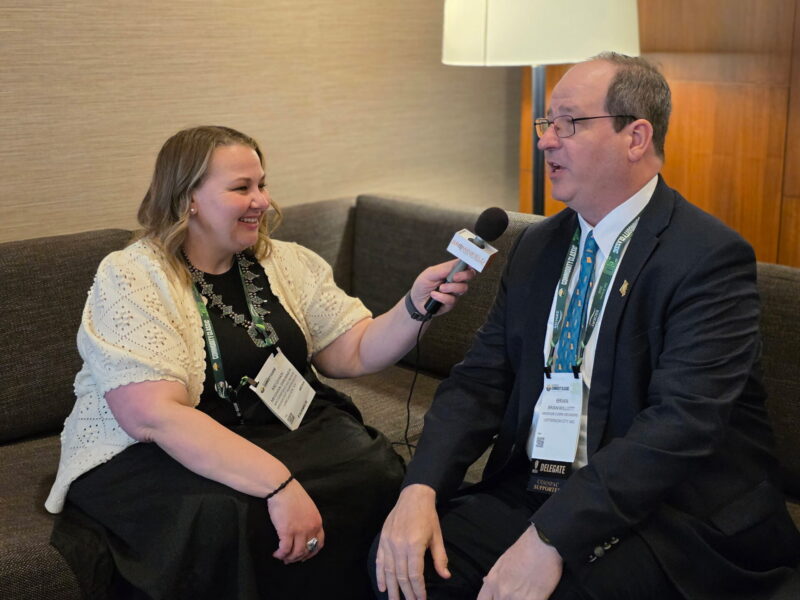
An agricultural producer from Missouri is sounding the alarm about the need to strengthen the market for American corn as Brazil emerges as a formidable competitor in the global grain trade. Brian Willott shared his concerns with Brownfield, emphasizing that the competitive pressure from South America shows no signs of letting up.
“And every year they are able to produce more and more soy and more and more corn, both, because a lot of their double cropping,” Willott explained. “So we have to be sharp.”
The farmer’s comments highlight the challenges facing American grain producers as Brazil leverages its climate advantages to harvest multiple crops annually, significantly boosting their agricultural output and market presence.
Michigan’s efforts to manage its deer population are showing mixed results, according to a representative from the Michigan Farm Bureau who says more focused strategies are essential moving forward.
The organization’s lobbyist Justin Tomei explained to Brownfield that maintaining stable deer numbers requires harvesting roughly 40 percent of Michigan’s estimated two million deer annually. “We need to be up over around 800,000,” Tomei stated when discussing the target harvest numbers needed for proper herd management.
Despite some advancement in deer population control measures, Tomei emphasized that the state must implement more precise approaches to achieve the desired results. The declining harvest figures for 2025 highlight the ongoing challenge of balancing wildlife management with agricultural and environmental concerns.
Agricultural families in Ohio now have access to a comprehensive statewide program designed to assist with generational farm transitions, according to an Ohio State University agricultural attorney.
Robert Moore, who works with the university’s agricultural law program, explains that the Ohio Farm Transition Network offers educational resources and guidance to help farming operations prepare for the future. The program aims to equip agricultural producers with the knowledge needed to make well-informed choices about their farm’s future.
“Farm families often have a difficult time finding resources,” Moore stated. “This program will help them find” the assistance they need for successful transitions.
The network addresses a critical need in Ohio’s agricultural community, where many farming families struggle to locate appropriate guidance for succession planning. The initiative provides structured support to ensure farming operations can continue successfully from one generation to the next.
Manufacturing facilities processed 138,000 pounds of extra long staple cotton through cotton system operations during the month of January 2026, according to recently released agricultural data.
The consumption figure reflects activity in the specialized cotton processing sector, where extra long staple varieties are utilized for their superior fiber quality and length characteristics.
Extra long staple cotton represents a premium grade of the crop, typically commanding higher prices due to its enhanced properties for textile manufacturing applications.
American agricultural processors handled 75.2 million tons of soybeans during 2025 to extract crude oil, according to the latest annual report from federal agriculture officials.
The figure represents the total volume of soybeans that went through crushing operations nationwide to produce soybean oil, a key component in food production and industrial applications.
The data comes from the annual fats and oils industry summary, which tracks processing volumes across the United States agricultural sector.
Agricultural processing facilities crushed 6.84 million tons of soybeans during January 2026 to extract crude oil, according to federal data released this week.
The processing volume, equivalent to 228 million bushels, reflects ongoing activity in the nation’s soybean oil production sector during the opening month of the year.
The figures come from the latest agricultural processing report tracking commodity crushing operations across the United States.
New agricultural statistics reveal that corn utilization for alcohol production and other industrial applications totaled 505 million bushels throughout January 2026, according to federal grain processing data.
The monthly grain crushing report provides insight into how America’s corn harvest is being processed and consumed across various industries, with alcohol production representing a significant portion of demand.
The data reflects processing activity during the 31-day period of January, following the completion of December 2025’s 31-day reporting cycle.
The United States cotton industry processed 1.2 million pounds of extra long staple cotton through its manufacturing system during 2025, according to newly released federal data.
This premium grade cotton fiber represents a significant portion of the nation’s textile production capabilities. Extra long staple cotton is considered a higher quality material used in specialized manufacturing applications.
The figures come from the latest annual industry report tracking cotton consumption patterns across American manufacturing facilities.
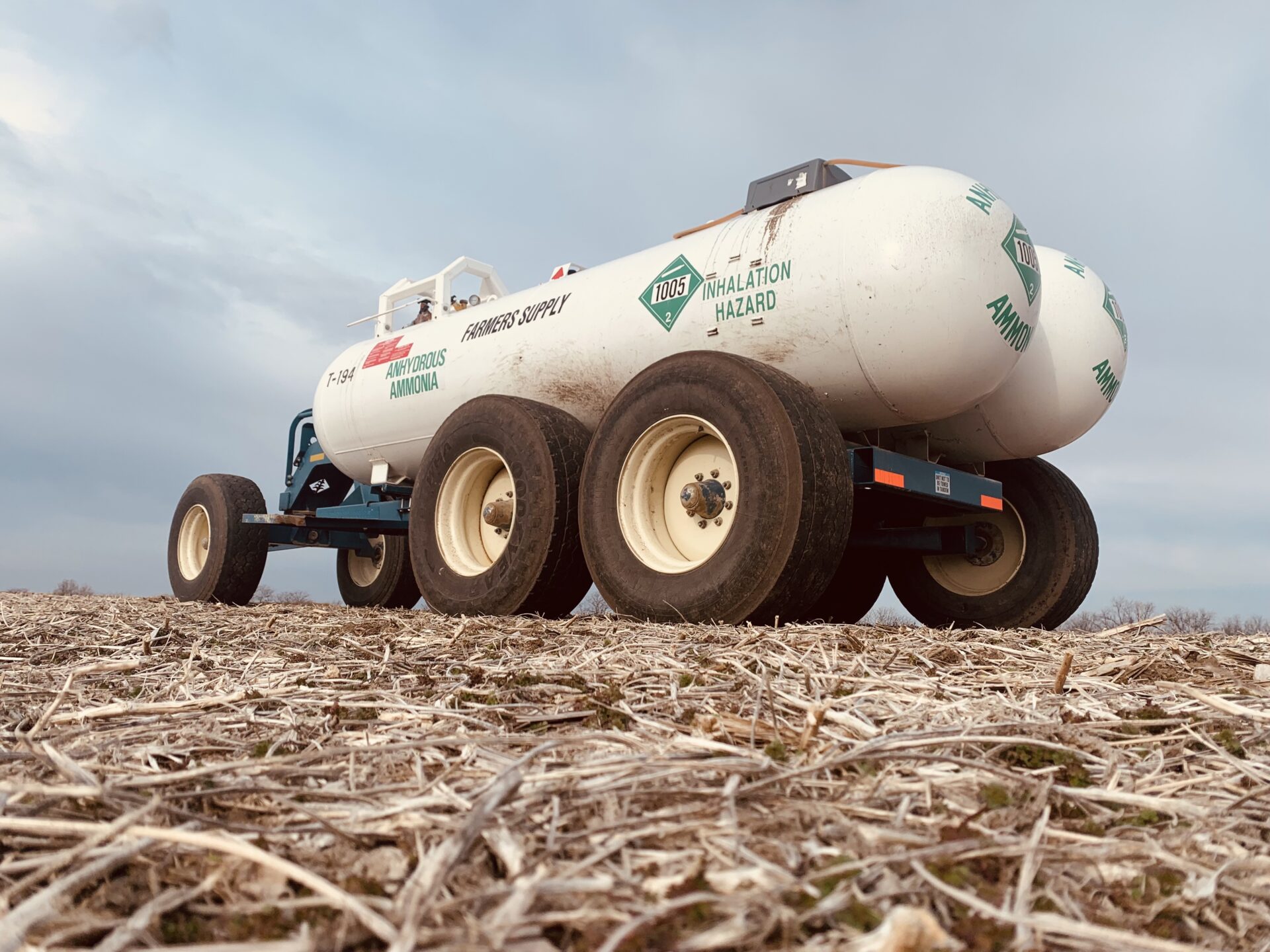
Agricultural producers across the region are raising concerns that corporate mergers within the fertilizer sector are contributing to dramatically increased farming expenses. Despite companies expanding their production capabilities, growers say they’re not seeing the expected cost reductions at the farm level.
Mark Mueller, who serves as a farmer director with Iowa Corn, explains that agricultural producers anticipated lower prices as companies increased their manufacturing capacity. However, Mueller notes that reality has been different.
“For some reason the increased production doesn’t necessarily translate into savings that get passed along to the farmer. Let’s face it,” Mueller stated, highlighting the disconnect between industry expansion and farmer costs.
The situation has left many in the agricultural community questioning whether industry consolidation is working against their economic interests, as input expenses continue to climb despite greater production volumes.
Young soybean producers throughout Missouri are participating in a specialized fellowship program designed to strengthen their leadership capabilities while expanding their understanding of agricultural operations. The Missouri Grassroots Fellowship brings together emerging farmers from different regions of the state for comprehensive training and development.
Among the participants is Luke Hopper, who previously served as an intern with Missouri Soybeans before joining the fellowship program. Hopper has been sharing insights about his involvement in the initiative and the valuable experiences it has provided to participating farmers.
The program focuses on building essential leadership qualities among the next generation of agricultural professionals while providing them with in-depth knowledge about soybean production and industry practices. Participants gain exposure to various aspects of farming operations and develop skills that will benefit their future careers in agriculture.
Monday’s livestock trading remained subdued as market participants focused on inventory management and weekly preparations rather than active transactions. The quiet trading environment is characteristic of the start of the market week.
Price negotiations have not yet begun in earnest, with neither purchase offers nor seller quotes being firmly established at this point in the week.
Market observers anticipate that substantial trading activity will likely emerge later in the week, consistent with patterns observed in recent trading sessions. Heavy transaction volumes are expected to materialize around Thursday or Friday, following established market rhythms.
Most dairy commodity values fell during Monday’s trading session at the Chicago Mercantile Exchange, though butter bucked the downward trend with significant gains.
Dry whey dropped half a cent to close at $0.6275 per pound, with one transaction recorded at that level. Forty-pound blocks of cheese declined by three-quarters of a cent to $1.5150, supported by three transactions ranging between $1.5125 and $1.5150. Cheese barrels fell one cent to $1.55 per pound, though no transactions occurred in that category.
Butter stood out as the day’s winner, climbing $0.2650 to reach $2.1050 per pound. Trading activity was robust with fifteen transactions completed, spanning from $2.05 to $2.1075. Nonfat dry milk prices retreated four cents to $1.67 per pound, with eighteen sales executed in a range from $1.6575 to $1.71.
As economic pressures mount in the farming industry, agricultural producers are seeking strategies to maximize productivity on each acre while controlling expenses. Croplan Seed is assisting farmers in addressing this challenge through an emphasis on data analysis, field trials, and regional expertise.
Jeff Osterhaus, who serves as Seed Portfolio Manager for Croplan, noted that although numerous companies provide quality products, Croplan distinguishes itself through its commitment to data-driven decision making and localized agricultural knowledge to help farmers optimize their seed investments.
Recent escalation of conflict in the Middle East may offer temporary financial benefits for American grain producers, according to an agricultural market specialist. Naomi Blohm, a senior market advisor at Total Farm Marketing, indicates that commodity prices experienced an uptick after weekend airstrikes targeted Iran, though she cautions the price boost might not sustain itself over time.
“If South America ends up getting rain, if the conflict doesn’t escalate further, we could see prices retreat,” Blohm explained, noting that several factors could quickly reverse the current price momentum in grain markets.
The length of ongoing military tensions involving Iran will play a crucial role in determining market stability, according to an agricultural economics expert. Chad Hart from Iowa State University notes that this marks the second military strike carried out by the United States and Israel within the past year.
“We saw a brief spike up in prices, but we saw things calm,” Hart explained, referring to initial market reactions to the conflict.
Hart emphasizes that the duration of any sustained military action will be the determining factor in whether commodity markets experience significant volatility or return to more stable trading patterns.
Agricultural technology company Syngenta has announced the upcoming launch of Durastak, a revolutionary corn trait system scheduled for release during the 2027 growing season. The breakthrough technology represents the agricultural industry’s first triple-Bt protein combination specifically engineered to provide enhanced protection against corn rootworm infestations.
The new trait system has been developed to address growing concerns about pest resistance, offering farmers significantly improved crop protection capabilities. According to the company, Durastak provides approximately 50% more effective protection compared to their existing Duracade technology, while also delivering an average yield boost of 9.7 bushels per acre.
This advancement comes as Delaware and regional farmers continue to face challenges from corn rootworm, a persistent pest that can cause substantial crop damage and economic losses. The enhanced protection offered by the triple-Bt protein stack could provide local agricultural producers with a more reliable defense against these destructive insects.
The technology’s introduction in 2027 will give farmers access to what Syngenta describes as the most advanced corn rootworm control system available in the marketplace, potentially offering Delaware’s agricultural community improved crop security and enhanced profitability.
With the Trump administration preparing to examine the United States-Mexico-Canada Agreement during the summer months, agricultural leaders warn that the consequences of any changes could be severe. Nebraska Corn representative Andy Jobman emphasizes that farmers across the country have a straightforward position on the matter.
“Our big thing is do no harm,” Jobman stated, highlighting the unified stance among agricultural producers. According to Jobman, the current trade agreement has delivered consistent stability and reliability for the farming community over many years.
A leading agricultural scientist is providing farmers with guidance on how to better utilize advanced weed management techniques this growing season. Dr. Eric Scherder, who serves as the U.S. Crop Protection Technical Lead for Corteva Agriscience, emphasizes that the Enlist system serves as an essential component in comprehensive weed management and resistance prevention strategies.
Speaking with Brownfield, Scherder outlined several approaches that growers can implement to optimize their use of the Enlist system during the upcoming season. He stressed the importance of incorporating these tools as part of a broader, systematic approach to controlling unwanted vegetation while preventing the development of herbicide-resistant weeds.
Agricultural chemical company BASF has unveiled a groundbreaking advancement in crop protection that could revolutionize how growers battle a devastating agricultural enemy: the soybean cyst nematode (SCN). The company’s newly developed genetic trait, called Nemasphere, marks a historic first as the initial genetic technology engineered exclusively to shield soybean crops from this destructive pest that severely reduces harvests.
This microscopic threat has long plagued soybean producers, causing substantial financial losses through diminished crop yields. The soybean cyst nematode attacks plant roots, weakening crops and significantly reducing the amount farmers can harvest from their fields.
According to Michael McCarville, who serves as BASF’s Trait Technology Lead, this innovation represents a major breakthrough for agricultural producers. McCarville explained to Brownfield that plant breeders now have access to this cutting-edge genetic tool to help protect one of America’s most valuable crops.
The development of Nemasphere addresses a critical need in modern agriculture, where farmers continuously seek effective methods to combat persistent threats that erode their crop yields and profitability. This genetic trait technology offers producers a new weapon in their ongoing battle against one of soybean production’s most costly adversaries.
Indiana agriculture officials are dealing with a fresh outbreak of deadly bird flu after confirming six new infections of Highly Pathogenic Avian Influenza within the past seven days.
According to the Indiana State Board of Animal Health, the dangerous strain was found at two commercial egg-laying operations located in LaGrange County. Health officials have ordered the destruction of more than 43,000 birds to prevent further spread of the virus.
Authorities have established containment measures including a control zone extending approximately 6.2 miles around the affected facilities, with an expanded surveillance area covering more than 12 miles to monitor for additional cases.
The latest detections add to ongoing concerns about avian influenza’s impact on poultry operations across the Midwest, as officials work to prevent the virus from spreading to additional farms in the region.
Listen to the Morning Delmarva Farm Report Update — March 2, 2026
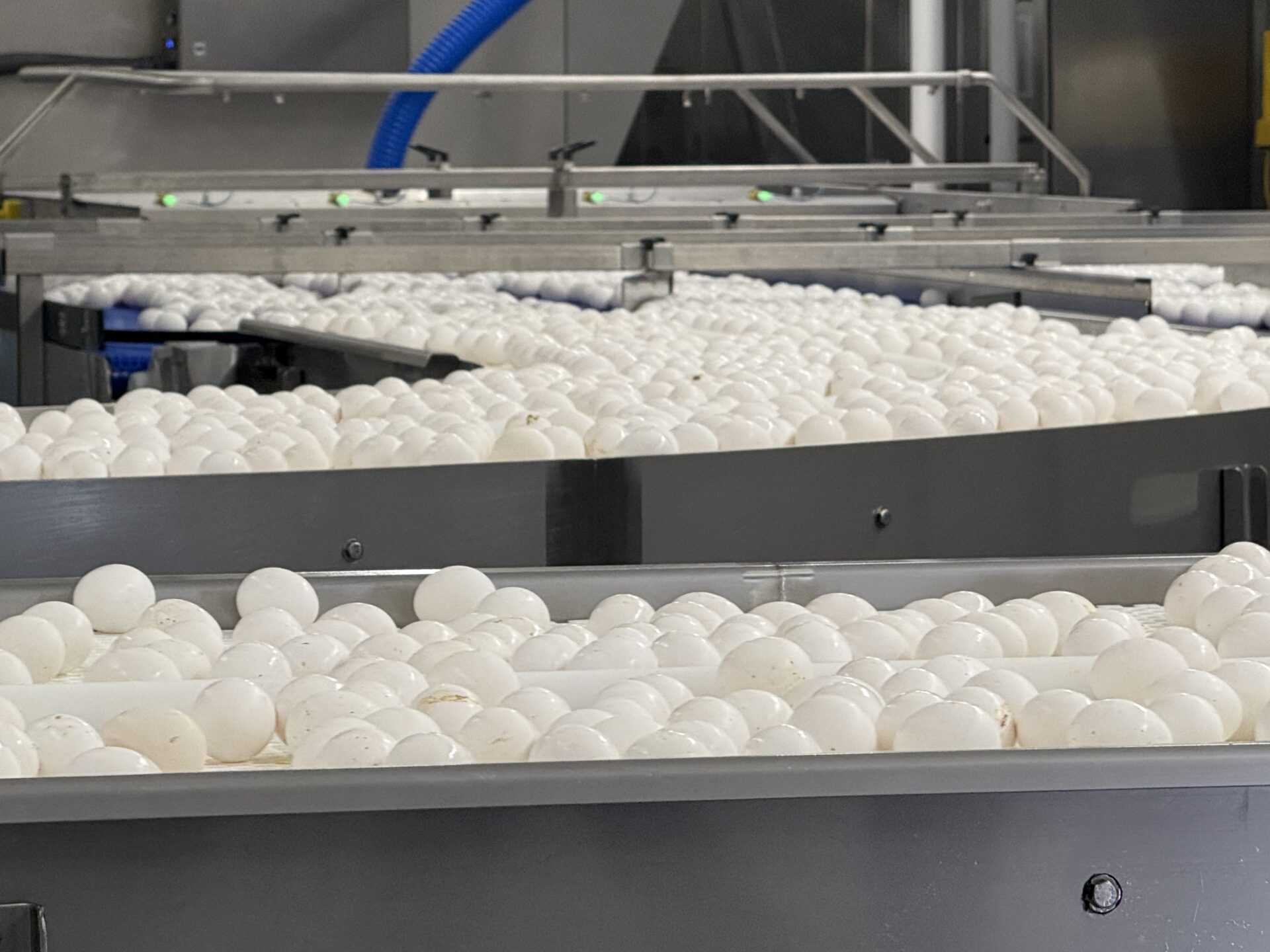
DELMARVA — Delaware’s egg industry is setting an ambitious new standard with producers now targeting 500 eggs per hen before birds reach 100 weeks of age. What once seemed impossible has become achievable thanks to advances in breeding, management, and nutrition.
Industry experts say hitting this 500 by 100 milestone doesn’t mean pushing hens harder but providing better care and support through advanced genetics, improved management practices, and precision nutrition. The shift is transforming operations across Delmarva as producers work to remain competitive while meeting rising demand.
The egg sector faces workforce challenges as labor shortages combine with growing technical demands and stricter regulatory standards.
Markets
March corn futures are trading at $4.72 per bushel. Soybeans are at $10.38. Wheat is sitting at $5.51. Local grain elevators across Delaware are paying $4.60 for corn and $10.15 for soybeans.
Forecast
The region is looking at a high near 38° today with a slight chance of light snow and east winds around 5 mph. Tonight drops to 29° with a chance of rain and snow developing. Tuesday brings light rain with temperatures climbing to 46°. Field conditions will remain wet through midweek with more rain expected Wednesday.
This article is based on the Delmarva Farm Report Update Morning Edition, March 2, 2026. Hosted by Tom Bradley.
A leading European exhibition focused on livestock and poultry farming is preparing for its 2026 showcase, with organizers highlighting innovation as the central theme.
According to Natalie Taylor, who serves as project manager for VIV Europe, the upcoming event will feature significant developments and new offerings for industry professionals. In a recent video presentation, Taylor outlined the key attractions attendees can expect and provided guidance on maximizing their experience at both VIV Europe and the broader VIV Week programming.
The exhibition, recognized as a premier gathering for professionals in animal and poultry farming sectors, is set to take place as scheduled. Taylor emphasized how participants can best utilize their time at the comprehensive industry event.
VIV Europe has established itself as a significant platform where livestock and poultry industry stakeholders gather to explore the latest advancements, technologies, and trends shaping modern animal husbandry practices.
February brought several noteworthy developments across the worldwide poultry sector that industry professionals and stakeholders should be aware of.
Among the key highlights from last month, a broiler chicken variety received approval under animal welfare standards set by the RSPCA, marking progress in humane farming practices. The poultry feed sector also saw innovation with the introduction of a specialized enzyme designed to enhance nutrition in bird feed.
International expansion continued as well, with Kenya welcoming the opening of a new feed production facility, demonstrating growth in global poultry infrastructure.
These February developments reflect ongoing trends in the poultry industry toward improved animal welfare standards, enhanced feed technology, and international market expansion that continue to shape the sector’s direction.
Federal health officials are committing $200 million to investigate how multiple chemical exposures impact human health and to explore alternatives to chemical-intensive farming practices.
The Department of Health and Human Services announced the substantial funding will support research into what officials call “cumulative chemical exposures” – examining how various chemicals affect people when encountered together over time.
The initiative also focuses on decreasing agriculture’s dependence on chemical-based crop protection methods, potentially affecting farming operations across the region including Delaware’s significant agricultural sector.
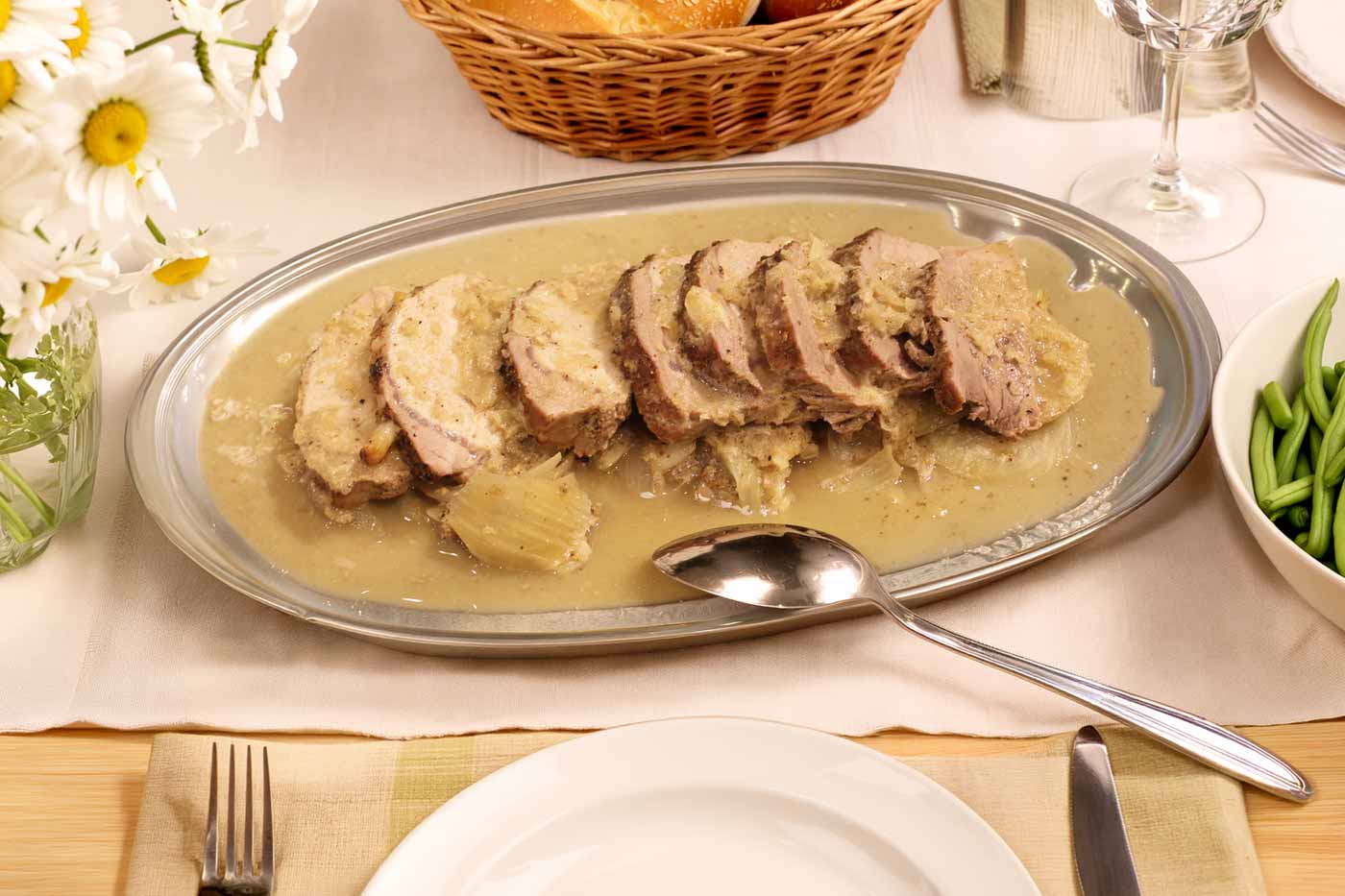
A delicious fennel-seasoned pork loin recipe was showcased by Chef Tammy Brawley during an episode of ‘Real Virginia,’ the weekly television show produced by Virginia Farm Bureau.
Fennel-Crusted Pork Loin Recipe
Ingredients needed: 24 cloves of garlic 4 large sweet onions, cut into rounds 1½ inches thick 2 fennel bulbs, with fronds chopped and saved, ribs removed, bulbs sliced ¼ inch thick One 6-7 pound boneless pork loin Salt and freshly ground black pepper ¼ cup fennel seeds 3 cups buttermilk ½ cup extra-virgin olive oil
Begin by preheating your oven to 400 degrees.
Crush 12 garlic cloves into a paste and spread in a roasting pan large enough for the pork loin. Layer the sliced onions over the garlic paste, then add the fennel slices on top.
Toast the fennel seeds in a dry pan until fragrant, allow to cool, then grind them completely in a spice or coffee grinder.
Create cuts in the pork loin approximately 2 inches apart and insert 7-8 garlic cloves into each opening. Season the entire roast with salt and pepper, then coat with the ground toasted fennel.
Position the seasoned pork on the vegetable bed in the roasting pan. Cover with buttermilk and seal tightly with aluminum foil. Roast for 40-45 minutes until the internal temperature reaches 145 degrees at the thickest section. Remove the foil and continue cooking for another 10-15 minutes. Take the pan out and transfer the loin to a cutting board.
Combine half of the roasted onions and fennel with all the cooking juices in a blender or food processor and blend for 30 seconds. While the machine runs, slowly add the olive oil until the mixture becomes smooth and thick. If the sauce is too thick, gradually add warm water, ¼ cup at a time, until it reaches a pourable consistency. Adjust seasoning with salt and pepper.
Place the remaining vegetables on a heated serving platter. Slice the meat into ½-inch pieces and arrange over the vegetables. Drizzle several spoonfuls of sauce over the meat and serve right away. Offer the remaining sauce separately in a gravy boat.
A mouth-watering comfort food recipe that brings together Mexican flavors in pie form has been featured by Chef Tammy Brawley during her appearance on Real Virginia, the weekly television show produced by Virginia Farm Bureau.
The hearty taco pie recipe combines a homemade biscuit-style crust with a savory seasoned meat filling and a rich cheese topping that’s sure to please the whole family.
For the Crust:
2½ cups plus 1 tablespoon flour 1½ teaspoons baking powder 1 teaspoon kosher salt 5½ tablespoons cold, unsalted butter, cut into ½” cubes ½ cup plus 1 tablespoon milk
For the Filling:
1 tablespoon butter 1 pound ground beef or ground turkey 2 teaspoons kosher salt & coarse ground pepper 2 tablespoons chili powder 1 tablespoon ground cumin 1 teaspoon onion powder ½ teaspoon cayenne ½ teaspoon ground coriander 1 teaspoon cornstarch 2/3 cup water 1¼ cups sour cream 4½ ounces cheddar cheese, grated 1 large egg, beaten 2 tablespoons mayonnaise salt and pepper to taste
Begin by preheating your oven to 350 degrees.
To prepare the crust, use a food processor to blend flour, baking powder, and salt until the mixture has a coarse texture. Incorporate the cold butter pieces, then gradually add milk, pulsing until a cohesive dough forms. If the mixture seems too dry, add small amounts of water until you achieve a soft consistency. Form the dough into the bottom and partway up the sides of either a 9-inch springform pan or deep pie dish. Wrap in plastic and chill for approximately 45 minutes until firm.
For those without a food processor, you can achieve the same results by whisking the dry ingredients in a bowl, then working in the butter with your fingers or a pastry blender until it resembles coarse crumbs. Add the milk and mix until the dough holds together.
Time-saving suggestion: The crust can be prepared the evening before and removed from refrigeration about 30 minutes prior to continuing with the recipe.
For the meat mixture, warm butter in a medium-sized skillet over medium heat and brown the ground meat thoroughly, stirring frequently for about 5 minutes. Create a spice blend by whisking together the 2 teaspoons of salt with all the spices and cornstarch in a small bowl. Stir this seasoning mixture and the water into the cooked meat, continuing to cook while stirring until the liquid evaporates, approximately 3 minutes. Remove from heat.
Prepare the cheese topping by combining sour cream, grated cheddar, beaten egg, and mayonnaise in a medium bowl, whisking until smooth. Add salt and pepper to taste.
Place the chilled crust on a parchment-covered baking sheet. Using a slotted spoon, distribute the seasoned meat evenly over the crust, then spread the creamy cheese mixture on top. Bake for about 45 minutes until the topping is firm and the crust turns golden brown. Allow the pie to rest for approximately 15 minutes before slicing and serving.
ATLANTIC CITY — Agricultural spray drones offer tremendous possibilities for farming operations, according to Adam Kyle from Warren County Rutgers Cooperative Extension, but federal oversight agencies like the FAA and FDA haven’t kept up with the rapid technological advances in safe drone spraying applications.
During a presentation at the Northeast Ag Expo in late January, Kyle discussed both the benefits and challenges surrounding spray drones that can help farmers reduce costs and save valuable time.
Farmers have shown increasing interest in spray drone technology over recent years, Kyle noted, particularly because the equipment proves valuable during wet conditions when conventional machinery cannot access fields.
“A lot of the companies that sell you drones offer you a waiver package which is typically a good thing,” Kyle said. “The issue is I see a lot of farmers and companies that buy spray drones don’t usually read those exemptions exactly to a tee, so they’re good to fly them but they don’t understand everything they’re legally required to do.”
Kyle warned that misunderstanding these exemption requirements can create significant problems, especially since the FAA has only informal guidelines rather than comprehensive regulations for spray drone operations.
“They have sets of regulations for smaller drones, but for the spray drone they have no formal sets of regulations yet, this is why it’s so complicated,” he explained. Despite the expanding market, most drone companies lack sufficient personnel to meet growing demand from farms requesting services, particularly in northwestern New Jersey where Kyle works.
“A lot of farmers have asked me if they should get their own spray drone,” he said, describing this as a complex decision given current circumstances, though he acknowledged that drone service companies are experiencing rapid growth “and that seems to be mostly a good thing.”
Kyle recommended viewing spray drone technology as an additional farming tool, particularly useful for accessing wet fields or areas blocked by forests and difficult terrain. For now, he suggests hiring professional drone crews might be the safest approach.
“The drone doesn’t really care about terrain or road access,” he said.
Purchasing spray drone equipment requires substantial investment, with American-manufactured units typically costing more than Chinese-built alternatives.
“I’ve heard rumors from people that the FAA was going to regulate spray drones, but so far they have not been forthcoming. I know the FAA is working to create a formal set of regulations just like part 107 where you could just go and take a class at a community college and be able to take it online and then go take a test and be a certified drone pilot, but right now that’s not where it is and that’s why it’s so complicated with spray drones.”
Safety concerns with larger spraying drones include entanglement in electrical power lines and potential interference with roadway traffic.
“If you have 100 liters of [potential] poison flying in the air, imagine if that goes out into the road or someone crashes into that. If you look online you can see that happening, you see them getting tangled in power lines all the time, people think of drones traditionally as a toy.”
Kyle said his growing understanding of spray drone safety challenges helps him comprehend “the more I understand why the FAA is kind of nervous about it, because the sprayers have tons of autonomous capabilities.”
Modern drones include video and audio safety systems designed to prevent collisions, he explained, “but the issue is people get frustrated with these things and sometimes they turn them off or lower the thresholds, so it won’t see a really thin branch or a really thin wire. It might see it sometimes but it also might not see it and it’ll fly right into that wire and now you have a $60,000 spray gun entangled in power lines.”
ASBURY PARK — Community Supported Agriculture programs vary significantly in their structure and approach, as demonstrated by three regional farmers who shared their experiences at the NOFA-NJ Winter Conference held at the Berkeley Oceanfront Hotel.
The panel featured Dean and Emily Buttacavoli from Cabbage Throw Farm located on the Hunterdon County side of Asbury, John Crooke who operates Tinicum CSA across the Pennsylvania border near the Frenchtown Bridge, and Jeff Tober who oversees Rancocus Creek Farm as part of the Pinelands Alliance initiative.
These Community Supported Agriculture operations have each developed distinct approaches to serve their communities, though all share the fundamental CSA model where customers pay farmers upfront for seasonal produce before crops are planted.
Crooke manages just over four acres of vegetables on a 20-acre property, working alongside his landlord who runs a roadside nursery and farm stand. The arrangement allows them to share equipment and facilities while maintaining separate operations.
“Don’t get in each other’s way,” Crooke explained about the partnership.
His operation employs nine workers, including several full-time positions, and serves 365 households who must collect their shares directly from the farm. Now in his 14th season, Crooke follows organic growing methods but hasn’t pursued formal certification.
“There’s not so much motivation to apply for organic certification,” he said. “With a CSA, you build trust.” He emphasized that his customers know and trust his farming practices.
Over the years, Crooke has adapted his program, switching from large shares to smaller options and implementing a sliding payment scale. He’s also extended pickup hours and uses direct-mail marketing with photographs. His CSA offers customer choice through selections displayed on a chalkboard.
The Buttacavolis face different pressures as their CSA represents their sole income source. Since establishing their farm in 2018, they’ve cultivated seven acres of vegetables on rented land spanning both sides of the Musconetcong River. The property came with existing organic certification.
Their program runs 32 weeks from May through December with three share sizes available. Beyond the CSA, Dean and Emily operate at three farmers markets, allowing shareholders to pick up orders at any location.
“We have a core group of customers,” Dean noted, explaining that their 125 member families “have our back.”
The couple transitioned to CSA during 2021 after feeling pressure to adapt during the 2020 season. Emily handles payments through Square, which streamlines her administrative duties.
Tober’s situation differs significantly as his farm operates under the nonprofit Pinelands Alliance. The organization acquired over 72 acres of former conventional soybean farmland, establishing both their offices and the farm operation on the preserved property.
The land required extensive rehabilitation due to erosion damage and poor stormwater management. Tober focused on reducing erosion, increasing carbon sequestration, and rebuilding soil health. His improvements included planting over 1,200 trees and implementing former Agriculture Secretary Phil Alampi’s beneficial insect program.
The farm now operates sustainably and hosts apprentices through the Collaborative Regional Alliance for Farm Training. Tober launched a small CSA in his second year, which has grown to a projected 425 members for the 2026 season with a flexible 21-week share structure.
While offering only full shares, Tober encourages families to split memberships and includes pick-your-own options. The farm’s revenue breaks down as 55 percent CSA sales, 9 percent wholesale, 9 percent farm store, 5 percent deliveries, 5 percent farmers market, 4 percent fundraising events, and 7 percent grants due to their nonprofit status.
The operation also generates income from value-added products. Tober highlighted the strong relationships with members, recalling how staff received homemade baked goods and breakfast sandwiches from customers in 2015.
During the audience question period moderated by NOFA’s Lana Mustafa, the farmers shared advice for improving CSA operations. Crooke emphasized learning from other farms’ practices, while Tober acknowledged the challenge of “CSA guilt” when recruiting neighbors as members.
“It’s easier to sell a member on something new,” Dean Buttacavoli suggested, recommending introducing new vegetables including ethnic varieties to existing customers.
The farmers also appreciate traditional approaches. “It’s like vinyl records,” Crooke said about using chalkboards for customer communication.
“It’s a human-oriented enterprise,” Tober concluded, emphasizing that success depends on attention to details, tracking customer preferences, and innovating when possible.
Dean Buttacavoli, who previously farmed in Camden for three years, noted benefits of urban agriculture. “There is a benefit to growing in an urban setting,” he said, explaining that cities create demand while providing opportunities to educate consumers.
All three operations prioritize sustainability by donating surplus produce, offering pick-your-own opportunities, and composting extensively. The farmers remained available for individual conversations following the panel discussion.
ASBURY PARK, N.J. — Agricultural professionals gathered at the Berkeley Oceanfront Hotel on January 31st for the annual winter gathering of the Northeast Organic Farming Association of New Jersey, where they were introduced to the organization’s newly appointed board president.
Melanie Ganzman, who has served as a board member for several years, addressed the audience before the main presentation, sharing her unique perspective on agriculture.
“I come to farming with no legacy,” Ganzman told the assembled farmers during her introductory remarks.
She described her learning journey, explaining how she needed to understand milling processes and connected with grain producers while visiting milling facilities to grasp the technical support required in the industry. When seeking guidance on policy matters, she turned to veteran board member Cali Alexander for direction.
Reflecting on her leadership role, Ganzman noted that “leadership is a lot like farming, it’s about stewardship.” She outlined her guiding principles as “soil-labor-policy-trust.”
The conference also featured remarks from Assemblywoman Luanne M. Peterpaul (D-11), who represents the local district. Originally from Newark, Peterpaul has made Long Branch her home for many years, where she previously served as municipal judge. She operates Peterpaul Law in Asbury Park as managing partner, specializing in labor and employment law, general litigation, and training and education. Her background includes work as an assistant county prosecutor, with educational credentials from Duquesne University in Pittsburgh and Seton Hall University Law School.
Currently serving as vice chair of the judiciary committee while also participating in financial institutions and insurance and aging and human services committees, Peterpaul expressed her desire to return to her previous role on the agriculture committee.
“Being on the ag committee opened my eyes to what our state is so much about: farmers, food, caring about people,” Peterpaul explained. She praised the growing involvement of women in agriculture, saying “I love so many women are involved in farming. They have a different sense of compassion and of gathering. It’s important for the legislature to know what you do.”
Concluding her address, she assured the audience: “You have a friend in the Assembly.”
ATLANTIC CITY — A fourth-generation Burlington County farmer shared her business philosophy at a recent agriculture conference, breaking down her approach to just one simple concept.
Rose Robson, who operates Robson Family Farm in Wrightstown, told attendees at the Northeast Agriculture Conference at Harrah’s Resort Atlantic City in late January that choosing a single defining word has transformed her business strategy.
“I think having a word is probably the most important thing you could do for your business. A word is basically the shortest form of a mission statement. Our word at Robson’s Farm is ‘cute,’” Robson explained. “If it isn’t cute, we’re not saying it, we’re not posting it, we’re not stocking it at our farm stand, we’re not making it into merchandise.”
The farm, located next to the Joint MDL Base (previously McGuire Air Force Base), has evolved into primarily orchard operations. Robson returned to farming after working in medical sales, which she described as profitable but ultimately unsatisfying. She’s now completing her 13th year running the family operation.
The business operates two main divisions, according to Robson – flowers and produce. Working alongside her mother and team, they provide customers with 32-ounce containers for self-picked flowers. While she previously handled wedding florals, she found that market too demanding despite good profits.
Their product lineup includes apples, peaches, paw-paws, donut peaches, cut flowers and sunflowers. Robson applies her single-word philosophy to analyze competing farms in her area as well.
“The closest businesses to me that do something similar to me would be Strawberry Hill Farm, which does peaches and apples, and Johnson’s Locust Hall Farm, which does a lot of stuff, almost everything,” she noted.
“Johnson’s Farm is the other direction from us and they offer everything, weddings, hayrides, all kinds of baked goods and they offer premium products. The word I use for their farm is ‘luxury,’ and I would put Strawberry Hill as ‘classic,’ and we at Robson’s Farm directly in the middle, are ‘cute,’” she continued.
During her presentation, Robson explained how she leverages the farm’s website, Facebook and Instagram for customer feedback, while weekly email newsletters help strengthen profits and build customer loyalty while attracting new visitors.
“The only bad review we had online was someone who simply said ‘Bad.’ And it was in February and I’m pretty sure it was a disgruntled neighbor — 99% sure I know who it is, so we don’t even count that one,” she mentioned.
The farm has undergone significant changes since Robson took over. Initially, they delivered vegetable packages to homes, which performed well financially but proved exhausting for her personally. They also tried farmers’ markets but found the time investment didn’t justify the returns.
“It was a nightmare, for me at least, so in 2019 we started saying ‘vegetable free in three,’ meaning in three years, we’re going to really commit to doing just orchard fruits and stop doing all the vegetable stuff. It just was not working.”
“Ultimately, I want to be in my own happy place and now I’m there, we also want to be the cutest and that is really important to me, so the scope of what we do is apples, peaches, paw-paws, you-cut flowers, and we have room to grow other unique crops, these items need to be unique hard-to-find and of high quality fit into what we are already doing. I’m putting in two new products this spring and it’s a lot of fun,” Robson shared, though she kept details about the new offerings under wraps.
For their flower picking experience, the farm charges $12, with the 32-ounce containers typically accommodating around 60 stems.
“Pay only for what you pick is what separates us from other farm businesses in our area, others charge an entry fee, so I’m constantly thinking about how we can add value without spending a ton of money,” she explained.
Robson stressed that successful marketing requires viewing everything from the customer’s perspective.
“You have to come at it from a customer-focused perspective, what’s in it for the customer,” she advised, describing wallet-sized cards she created for fruit picking customers.
“They give us their email address and we give them a cute little Peach Pass which is a cute little card. They come, they pick their own peaches, and they get 10% off what they pick.” The farm also distributes peach and apple scented scratch-and-sniff stickers during harvest months from July through October.
One of their signature events, paw-paw walks held multiple times each September, originated from an unexpected source. A National Geographic reporter years ago inquired about paw-paw events at the farm. Since none existed, Robson and her team developed guided walks where visitors can harvest from their limited paw-paw trees. These September events have become what Robson calls “paw-paw insanity month.”
She also emphasized the importance of training staff to handle common customer questions effectively.
“Because nothing is worse than asking an employee a question and having him or her stumbling and stuttering and not sure who to ask. It doesn’t inspire much confidence in what’s going on at the farm,” she concluded.
CRANBURY — Frigid temperatures and bone-chilling winds couldn’t keep determined farmers and collectors away from a major equipment auction at the historic Walker Gordon Farms site this past January.
Approximately 200 people endured brutal single-digit wind chills to bid on farm machinery, antiques, and memorabilia from the legendary Walker Gordon Dairy operation, according to auctioneer Alfred Finocchiaro of Alfred’s Auctions in Monroe Township.
“We’re all just a little bit crazy,” remarked one landscaper from Monmouth County who made the trip despite the harsh conditions.
Event organizers set up steel barrel fires and designated heated areas inside barns to help attendees stay warm during the marathon January 24th sale, which lasted six hours and 22 minutes.
Finocchiaro, who grew up on family farms near Swedesboro in Gloucester County, has built strong relationships with area farmers over his career as both an auctioneer and agriculturalist. His reputation for honest dealing has made him a trusted figure in the farming community.
The veteran auctioneer noted that even more bidders would likely have attended if not for an approaching snowstorm that was predicted to hit the Mid-Atlantic region the following day.
Walker Gordon Dairy, once famous for its “Elsie the Cow” marketing campaigns, ceased dairy operations in the early 1970s. While portions of the original property along Route 1 were developed into residential communities, the auction took place on land closer to Route 130 near South Brunswick township.
“The sale featured both agricultural antiques and Walker Gordon memorabilia, which brought out a diverse crowd of farmers and collectors,” Finocchiaro explained in a follow-up phone interview. “Some of the farm machinery was over a century old, and the vintage Hickory furniture pieces were particularly popular with bidders.”
Despite the extreme weather conditions, the auctioneer praised the turnout and efficiency of the sale, crediting his team, his wife, and the cooperative spirit of all attendees.
Among the most sought-after items were five John Deere tractors, all in working condition. Finocchiaro made sure to demonstrate each machine and openly discuss any mechanical issues, such as oil leaks, before bidding began.
“Participants came from Ohio, New York, Pennsylvania, and Delaware, and we certainly would have seen more out-of-state buyers without the storm forecast,” he noted.
The success of the auction stemmed partly from Walker Gordon Dairy’s enduring reputation and the skilled maintenance work performed by its mechanics and technicians through the 1970s and 1990s, Finocchiaro explained.
“Transparency is key in this business,” Finocchiaro emphasized. “If equipment has problems, I make sure everyone knows about it upfront. When a tractor leaks oil, we announce it to the entire crowd. Buyers need complete honesty about any issues with used machinery. Farmers understand equipment because they work on it themselves, so we fired up all those old tractors despite the record cold to show they ran properly. That level of openness made the whole event successful.”
ASBURY PARK, N.J. — Despite cold temperatures and snow blanketing the Jersey Shore, farmers throughout New Jersey gathered at the Berkeley Oceanfront hotel on Saturday, January 31st for the Northeast Organic Farming Association – New Jersey’s annual winter conference.
The keynote presentation featured Anna Roberts, a representative from The Moth storytelling organization, who may have appeared to be an unconventional choice for an agricultural audience. However, conference organizers recognized that farming professionals possess compelling narratives worth sharing, particularly newer farmers who may lack outlets for their experiences.
Roberts provided background information about The Moth, an organization that brings individuals to stages worldwide to share personal narratives. The group also produces an NPR radio program and podcast featuring these stories.
Speakers at Moth events tell their stories without written materials, focusing on life-changing moments and transformative experiences.
Roberts first encountered The Moth concept during her graduate studies when her journalism class visited a Union Square café for five-minute storytelling sessions.
“It dawned on me why we were doing it,” Roberts explained, “journalism school is so competitive.” The exercise helped students open up about themselves, and Roberts believes agricultural professionals can experience similar benefits.
“Stories can show how we can make meaning of what we want to say,” she noted. “Our brains are wired for storytelling and they sync up when people are listening.” Roberts emphasized that information wrapped in narrative form becomes more memorable.
Following a demonstration using an actual Moth story, Roberts invited conference attendees to share their own experiences. She outlined storytelling fundamentals, focusing on technique and creating emotional connections with listeners. “Each story has an arc,” Roberts said, explaining that compelling narratives involve genuine transformation and shifts in how storytellers relate to institutions or the world around them. She encouraged participants to consider prompts like “I used to…” or “now I…”
Roberts walked the audience through examples showing that while story stakes can vary dramatically, all effective narratives contain conflict and tension. She advised speakers to observe their audience and adapt accordingly.
“There is no best way to share,” she concluded. “So share as yourself.”
Multiple attendees volunteered to share farming-related anecdotes, with several participants noting that the storytelling exercise helped them feel more connected to fellow farmers in attendance.
ATLANTIC CITY — Renowned autism advocate and livestock expert Dr. Temple Grandin traveled from Colorado to address agricultural professionals during a midday presentation at the Northeast Ag Expo in Atlantic City late last month.
The 78-year-old Colorado State University professor, who holds a doctorate in animal science, shared her personal journey and professional insights with attendees. Following her presentation, Grandin signed copies of her latest publication “Thinking In Pictures” along with her other written works.
Drawing from her experience growing up with undiagnosed autism in the 1950s, Grandin spoke candidly about facing bullying throughout her educational years. Born into an affluent Boston family, she didn’t receive an autism diagnosis until her early twenties while attending college.
Beyond her numerous publications and biographical films, Grandin has revolutionized livestock handling through innovative facility designs that minimize animal stress. Her work has transformed slaughterhouse operations across the nation to create more humane conditions.
Reflecting on her childhood, Grandin explained how she was initially labeled as having “brain damage” during an era when autism was poorly understood. She described her learning challenges with abstract concepts, noting her preference for visual and concrete thinking.
“I never got a chance to try geometry because I failed miserably in Algebra,” she explained. “But I could always do real world, applied practical math. The problem with algebra is it’s too abstract for me to remember.”
The speaker strongly advocated for music and arts education for children on the autism spectrum, emphasizing the developmental benefits these programs provide.
Grandin stressed the critical importance of early employment opportunities for young people, particularly those working outside their family circle to build essential life competencies.
“We need paper route substitutes nowadays, like walking the neighbors’ dogs, where you are doing something for somebody outside the immediate family, even church or synagogue volunteer jobs, these kids need real jobs,” she stated, highlighting the necessity of developing practical skills.
“I advocate now for getting work skills early on,” she continued. “Let’s say a guy is going into college now with no work skills. Let him slow down, five years [instead of four,] and he’ll gain some work and life skills while he’s there. These are the things I see as I travel around.”
During her youth, Grandin found refuge from bullying by working at a local horse facility, which became a safe haven for her development.
“At 13, my mother got me a job with a lady who works out of her home altering dresses. When I was in college I did internships in research labs and also as an aide for children with autism. How did I get the research job? One of my professors in college had a friend with a research lab. That’s how you get into these places, take these jobs through the back doors. Your 18-year-old needs to get a job,” she shared.
The expert emphasized that developing life skills during elementary school years through part-time employment opportunities is crucial for all children.
“Get your 8-and-9-year-old child out there selling stuff so they learn how to talk to people. This is important!” she urged.
Grandin recommended that younger children with autism can gain valuable experience working with smaller farm animals including goats, sheep, chickens, and rabbits. She expressed frustration with educators struggling to help students who cannot master abstract mathematical concepts like algebra and trigonometry.
“There are some very good programs in low income areas where kids are working with turkeys and raising chickens, so this is something where you can raise an animal and learn from it, and you can always take them to places where you couldn’t keep a lamb,” she noted.
“And I want to commend the 4-H leaders that are in here today because these are really great programs that get young people involved and interested. With construction companies, the big question is how do we get them interested? We can’t take little kids onto construction sites but getting them into a building with a window next to a big construction site is one way to get them interested. I’m a big believer that you have to show [autistic] kids interesting things to get them interested in interesting things. My interest in cows started in high school,” she recalled.
Grandin concluded by emphasizing that overcoming fears and anxieties requires exposure to new experiences and challenges.
“Get the kids out and get them doing a lot more real things in real time,” she advised.
CHESTER TOWNSHIP, NJ — When labor shortages threatened to ruin the harvest at Riamede Farm back in 1974, the owners placed a newspaper advertisement asking community members to come pick their own vegetables. That creative solution not only saved the crop but launched what would become a beloved u-pick destination in Western Morris County.
Today, Ashley Adsell runs the historic 60-acre operation alongside farm manager Jamie Bourgeois. The former Naval officer had no agricultural background when a previous owner recruited her help, but her military experience provided valuable leadership and risk assessment skills that translated well to farming.
After 11 years in the Navy, Adsell saw an opportunity to purchase the property, settle outstanding debts, and begin a new chapter. Bourgeois, who hails from a South Jersey farming family, has worked at Riamede for 17 years and brings the technical expertise that complements Adsell’s management abilities.
The farm’s name comes from an early farmer named Mead and his wife Mariah. Located on sloping terrain north of Chester Borough’s shopping area, near the popular Bernie’s bar, Riamede sits in a stone farmhouse originally constructed in 1742. Interestingly, Adsell grew up just miles away in another stone house built around the same time by a brother of Riamede’s original builder, both members of the historically significant Swayze family.
The original two-room structure (one upstairs, one down) received a major expansion in 1790 that more than doubled its size. Additional renovations over the years created the current home where Adsell lives with her 4-year-old son Oliver, while also housing the farm office and seasonal workers.
Apple production has anchored the farm since the 1930s, with some original trees still bearing fruit. The orchard spans 30 acres and showcases 54 different varieties, including Rome, Winesap, Red and Gold Delicious, Cortlands, Paragons, Northern Spy, and Macintosh. Adsell has observed how flavors have evolved between older and newer plantings of traditional varieties.
“Taste is powerful,” Adsell explained. “It connects us to history.”
The apple trees range from historic specimens to recent additions from Rutgers University’s experimental program. When Adsell took over, she noticed limited recent plantings and has since added approximately 500 new trees using tighter spacing methods. However, many mature trees remain both for their fruit production and the character they bring to the landscape.
Adsell has incorporated modern technology including a weather station and is exploring remote soil monitoring systems. While she embraces these innovations, her primary goals focus on water conservation and minimizing chemical applications. She’s also diversifying the orchard with Asian pears and peach trees.
Recognizing that apples may not hold the same appeal for all consumers, Adsell has expanded the agritourism aspects of the operation. The farm offers hayrides to the orchard and various entertainment options to draw visitors.
The 10-acre vegetable section continues the u-pick tradition that saved the farm decades ago. Adsell finds it remarkable how enthusiastic people become about harvesting their own produce, noting with amusement: “Who’d think people would get excited about pick-your-own-eggplant?”
Bourgeois plants numerous vegetable varieties reflecting Morris County’s ethnic diversity, acknowledging that different eggplant types serve as staples across many global cuisines. What surprises Adsell most is how disconnected many visitors are from agricultural processes. People express amazement at seeing how broccoli and Brussels sprouts develop, and even at the appearance of tomato plants.
This disconnect motivates her educational efforts, particularly welcoming children to the farm. The fall festival features a child-sized corn maze and apple slingshot (a corn cannon would be inappropriate given the nearby residential area). While Riamede doesn’t produce its own cider, Adsell purchases it from Melicks and combines it with soft-serve ice cream to create apple-cider slushies.
“Every new crop is a new business,” she observed about the challenges of diversification.
The agritourism expansion includes monthly line dancing in one of the property’s barns, plus music events on alternate weekends. Adsell organizes two annual craft and vendor fairs: one in early May and another on Veterans Day weekend with a “Christmas at the farm” theme.
Her commitment to agricultural education extends to hosting school field trips, allowing children to experience both the educational and entertainment aspects of farm life. Through u-pick operations, hayrides, and various events, Adsell has successfully created a genuine community gathering place in her corner of Chester Township.
ATLANTIC CITY — A Burlington County farmer has distilled her family business strategy into a single, powerful concept.
Rose Robson, who operates the fourth-generation Robson Family Farm in Wrightstown, told attendees at the Northeast Agriculture Conference in late January that choosing one defining word transformed her approach to business. Speaking at Harrah’s Resort Atlantic City, she explained her philosophy.
“I think having a word is probably the most important thing you could do for your business. A word is basically the shortest form of a mission statement. Our word at Robson’s Farm is ‘cute,’” Robson said. “If it isn’t cute, we’re not saying it, we’re not posting it, we’re not stocking it at our farm stand, we’re not making it into merchandise.”
The farm, located next to the Joint MDL Base (previously McGuire Air Force Base), now focuses primarily on fruit orchards. Robson returned to agriculture after working in medical sales, a field she found profitable but personally unsatisfying. This marks her 13th year managing the family operation.
According to Robson, the business operates two main divisions: floral and produce. Customers receive 32-ounce containers and can harvest their own flowers. While she previously handled wedding arrangements, she discontinued that service due to excessive stress despite good profits.
The farm’s offerings include apples, peaches, paw-paws, donut peaches, cut flowers, and sunflowers. Robson applies her single-word branding strategy to analyze nearby competitors as well.
“The closest businesses to me that do something similar to me would be Strawberry Hill Farm, which does peaches and apples, and Johnson’s Locust Hall Farm, which does a lot of stuff, almost everything,” she explained.
“Johnson’s Farm is the other direction from us and they offer everything, weddings, hayrides, all kinds of baked goods and they offer premium products. The word I use for their farm is ‘luxury,’ and I would put Strawberry Hill as ‘classic,’ and we at Robson’s Farm directly in the middle, are ‘cute,’” she continued.
Robson detailed how she leverages digital platforms including the farm’s website, Facebook, and Instagram to gather customer feedback continuously. Weekly email newsletters help strengthen relationships with existing customers while attracting new ones, boosting revenue in the process.
“The only bad review we had online was someone who simply said ‘Bad.’ And it was in February and I’m pretty sure it was a disgruntled neighbor — 99% sure I know who it is, so we don’t even count that one,” she noted.
The farmer described her evolution in finding the right business model. Initially, they delivered vegetable packages to homes, which succeeded but required too much driving. Farmers’ markets followed but proved time-intensive with minimal returns.
“It was a nightmare, for me at least, so in 2019 we started saying ‘vegetable free in three,’ meaning in three years, we’re going to really commit to doing just orchard fruits and stop doing all the vegetable stuff. It just was not working.”
“Ultimately, I want to be in my own happy place and now I’m there, we also want to be the cutest and that is really important to me, so the scope of what we do is apples, peaches, paw-paws, you-cut flowers, and we have room to grow other unique crops, these items need to be unique hard-to-find and of high quality fit into what we are already doing. I’m putting in two new products this spring and it’s a lot of fun,” Robson revealed, though she kept the new offerings secret.
For flower picking, Robson charges $12, with the standard 32-ounce containers typically accommodating around 60 stems.
“Pay only for what you pick is what separates us from other farm businesses in our area, others charge an entry fee, so I’m constantly thinking about how we can add value without spending a ton of money,” she said.
Customer perspective drives all marketing decisions, according to Robson. She developed wallet-sized cards for fruit picking customers as an example of this approach.
“You have to come at it from a customer-focused perspective, what’s in it for the customer,” she emphasized, describing her Peach Pass program where customers provide email addresses in exchange for cards offering 10% discounts on picked fruit. During harvest season from July through October, she distributes peach and apple scented scratch-and-sniff stickers.
The farm’s popular paw-paw walks originated from an unexpected source. Several years ago, a National Geographic reporter inquired about special paw-paw events at the farm. Since none existed, Robson and her team created guided walks where visitors could pick from limited paw-paw trees. These September events continue today during what she calls “paw-paw insanity month.”
Robson stressed the importance of training staff to handle common customer questions effectively.
“Because nothing is worse than asking an employee a question and having him or her stumbling and stuttering and not sure who to ask. It doesn’t inspire much confidence in what’s going on at the farm,” she concluded.
CHESTER TOWNSHIP, N.J. — When a labor crisis struck in 1974, farm operators at Riamede Farm found an unexpected solution by placing a newspaper advertisement asking community members to harvest vegetables themselves or lend a hand during picking season.
The response was overwhelming. People flocked to help save the harvest and discovered they loved the hands-on farming experience.
That emergency measure transformed Riamede into one of Western Morris County’s premier pick-your-own destinations.
Today, Ashley Adsell runs the operation alongside farm manager Jamie Bourgeois. The former Naval officer was inexperienced in agriculture when a previous owner recruited her assistance. Bourgeois brings 17 years of experience at Riamede and comes from a South Jersey farming background. He lives on the property with his wife and daughters.
“I credit him with the farming innovations and expertise,” Adsell explained. However, her military background provided valuable leadership abilities, risk assessment skills, and decision-making experience that proved essential for agricultural management.
After 11 years in the Navy, Adsell was considering a career change when the farming opportunity presented itself. She purchased the land, cleared existing debts, and began her agricultural journey.
The sloping 60-acre property sits north of Chester Borough’s shopping area, near the well-known Bernie’s dive bar. The farm’s name combines “Mead” with his wife “Mariah” from an early farming family.
Riamede’s story mirrors Chester’s agricultural heritage. The original farmhouse dates to 1742, with Adsell’s childhood home just miles away on Route 124 built around the same period by a relative of Riamede’s builder. Both belonged to the Swayze family, prominent in Morris and Warren county history.
The initial structure contained just two rooms — one upstairs, one down. A “newer” section added in 1790 more than doubled the space. Subsequent expansions created the current home where Adsell lives with her 4-year-old son Oliver, along with farm offices and seasonal workers’ quarters.
Apple cultivation has dominated the farm since the 1930s, with some original trees still bearing fruit. The orchard showcases 54 varieties including Rome, Winesap, Red and Gold Delicious, Cortlands, Paragons, Northern Spy, and Macintosh. Adsell notes how flavors have evolved between older and newer plantings of the same varieties.
“Taste is powerful,” Adsell said, “it connects us to history.”
The 30-acre orchard contains everything from heritage specimens to recent varieties from Rutgers’ experimental program.
Upon assuming ownership, Adsell observed minimal recent plantings had occurred. She’s added approximately 500 new trees using tighter spacing while preserving older specimens for both their produce and the atmosphere they create.
Beyond expanding the orchard with climate-resilient varieties, Adsell has installed weather monitoring equipment and is exploring remote soil sensors. While embracing technology, she prioritizes water conservation and minimal chemical applications.
Asian pears and peach trees are joining the apple collection.
Although apples may not be everyone’s preferred fruit anymore, Adsell recognizes that pick-your-own operations and agricultural tourism create strong appeal. She offers orchard hayrides and various activities.
The property includes 10 acres dedicated to pick-your-own vegetables.
Adsell remains fascinated by visitors’ enthusiasm for specific crops. “Who’d think people would get excited about pick-your-own-eggplant?” Bourgeois cultivates numerous varieties reflecting Morris County’s ethnic diversity and eggplant’s global culinary importance.
She’s equally surprised by many people’s disconnection from agricultural processes.
Visitors express amazement at how broccoli and Brussels sprouts develop, even at tomato plant appearance. This motivates her to welcome children whenever possible. Her autumn celebration includes a child-sized corn maze and apple slingshot — residential proximity prevents using a corn cannon.
Rather than producing cider on-site, she purchases from Melicks and combines it with soft-serve for apple-cider slushies.
“Every new crop is a new business,” she observed.
Expanding into agritourism, Adsell hosts monthly line dancing in one barn and weekend music events. She organizes two annual craft and vendor markets — one in early May and another on Veterans Day weekend with a “Christmas at the farm” theme.
Her commitment to agricultural education includes school visits, with children enjoying both educational and entertainment offerings.
Through pick-your-own activities, hayrides, and special events, Adsell has fostered a genuine community within her Chester Township corner.
CRANBURY, N.J. — Freezing temperatures and bone-chilling winds couldn’t keep determined farmers and antique hunters away from a major equipment sale at the historic Walker Gordon Farms site this past January.
Nearly 200 bidders endured the harsh conditions on January 24th to participate in the extensive auction featuring dairy equipment, vintage furniture, and collectible items from the legendary Walker Gordon Dairy operation.
As one landscaper from Monmouth County put it: “We’re all just a little bit crazy.”
The crowd stayed warm thanks to burning wood barrels scattered around the property and heated indoor areas set up in various barns, according to auctioneer Alfred Finocchiaro from Alfred’s Auctions in Monroe Township.
Finocchiaro, who grew up working on family farms near Swedesboro in Gloucester County, has built strong relationships with area farmers over his years in the business and earned a solid reputation for conducting fair sales.
The veteran auctioneer noted that attendance could have been even larger, but a major snowstorm was forecast to hit the Mid-Atlantic region the following day, keeping some potential bidders at home.
Walker Gordon Dairy gained widespread recognition through its “Elsie the Cow” marketing efforts before ceasing dairy operations in the early 1970s. While portions of the original property along Route 1 were developed into residential communities, the auction site remained closer to Route 130 near South Brunswick township.
“We offered both vintage farm equipment and Walker Gordon memorabilia, which created an interesting mix of working farmers and antique enthusiasts,” Finocchiaro explained in a follow-up phone interview. “Some of the machinery went back more than a century, and the old Hickory furniture pieces were particularly popular with bidders.”
Despite the brutal weather conditions, Finocchiaro expressed satisfaction with both the turnout and the auction’s efficiency, which wrapped up in just over six hours. He praised his team, including his wife and assistants, along with the cooperative spirit of all attendees.
The sale’s major attractions included five operational John Deere tractors, with any mechanical issues like oil leaks clearly disclosed to potential buyers beforehand.
“Bidders came from Ohio, New York, Pennsylvania, and Delaware, and we definitely would have seen more out-of-state participation without that storm approaching,” he noted.
According to Finocchiaro, the auction’s success stemmed partly from Walker Gordon Dairy’s enduring reputation and the skilled maintenance performed by the farm’s mechanics and technicians who worked there through the 1970s and 1990s.
“My approach is complete honesty about every item,” Finocchiaro emphasized. “When equipment has problems like oil leaks, I make sure everyone knows upfront. Farmers understand machinery and do their own repairs, so they appreciate transparency. Even in those record-breaking cold temperatures, we started up all the old tractors so buyers could see exactly what they were getting. That level of openness made the whole event successful.”
ASBURY PARK, N.J. — Despite cold temperatures and snowy conditions along the Jersey Shore, agricultural professionals from across New Jersey gathered on Saturday, January 31st at the Berkeley Oceanfront hotel for the Northeast Organic Farming Association – New Jersey’s annual winter conference.
The event featured an unexpected but compelling keynote speaker: Anna Roberts from The Moth, a renowned storytelling organization. While her background might initially appear unrelated to agriculture, Roberts argued that farmers possess compelling narratives that deserve to be heard, particularly newer farmers who may lack outlets for sharing their experiences.
Roberts provided attendees with background information about The Moth, an organization that brings individuals to stages worldwide to share personal narratives. The group also produces an NPR radio program and podcast featuring these stories.
The organization’s speakers deliver their tales without written materials, focusing on pivotal life moments that created transformation, Roberts explained. Her own introduction to The Moth concept occurred during graduate studies when her class visited a Union Square café for five-minute storytelling sessions.
“It dawned on me why we were doing it,” Roberts explained. “Journalism school is so competitive.” The exercise helped students connect by revealing personal aspects of themselves, a benefit she believes farmers could also experience.
“Stories can show how we can make meaning of what we want to say,” she told the audience. “Our brains are wired for storytelling and they sync up when people are listening.” Roberts emphasized that information becomes more memorable when presented through narrative structure.
Following a demonstration using an actual Moth story, Roberts invited conference participants to share their own experiences. She outlined storytelling fundamentals, focusing on technique and creating emotional connections with listeners.
“Each story has an arc,” Roberts noted, explaining that effective narratives involve genuine transformation and shifts in how storytellers relate to organizations or the broader world. She encouraged participants to structure their thoughts around “I used to…” or “now I…” frameworks.
Through brief video examples, Roberts demonstrated that while story stakes can vary dramatically in importance, all effective narratives contain conflict and tension. She advised speakers to observe their audience and adapt their delivery accordingly.
“There is no best way to share,” she concluded. “So share as yourself.”
Multiple conference attendees took the opportunity to share farming-related stories, with several participants noting that the exercise helped them feel more connected to fellow farmers in attendance.
ATLANTIC CITY — Dr. Temple Grandin, a renowned author, inventor, and advocate for individuals with autism, traveled from Colorado to address attendees at the Northeast Ag Expo’s lunchtime session in Atlantic City during late January. The Colorado State University professor, who holds a doctorate in animal science, conducted a book signing following her presentation, featuring her latest work “Thinking In Pictures” along with her other publications.
The accomplished speaker, known for incorporating humor into her presentations, shared personal experiences of growing up with autism during the 1950s and facing harassment throughout her educational journey for being different. Her autism diagnosis didn’t come until her early twenties while she was attending college.
At 78 years old, Grandin was raised in an affluent Boston family. Beyond her extensive writing and the multiple films documenting her life story, she has gained recognition for creating groundbreaking designs that minimize cattle stress at processing plants. Her work has transformed slaughterhouses across America to operate more humanely.
During her youth in the 1950s, Grandin received a “brain damage” diagnosis, but her learning difficulties stemmed from challenges with abstract thinking. She explained that her thought processes were picture-based and heavily visual in nature.
“I never got a chance to try geometry because I failed miserably in Algebra,” she explained. “But I could always do real world, applied practical math. The problem with algebra is it’s too abstract for me to remember.”
According to Grandin, music and arts education provides tremendous benefits for children on the autism spectrum.
She also advocates for allowing teenagers and preteens to begin employment with individuals outside their immediate family circle to build essential life skills.
“We need paper route substitutes nowadays, like walking the neighbors’ dogs, where you are doing something for somebody outside the immediate family, even church or synagogue volunteer jobs, these kids need real jobs,” she emphasized, highlighting the importance of developing life skills.
“I advocate now for getting work skills early on,” she continued. “Let’s say a guy is going into college now with no work skills. Let him slow down, five years [instead of four,] and he’ll gain some work and life skills while he’s there. These are the things I see as I travel around.”
In her younger years, Grandin found employment at a local horse farm, which became her refuge from bullying.
“At 13, my mother got me a job with a lady who works out of her home altering dresses. When I was in college I did internships in research labs and also as an aide for children with autism. How did I get the research job? One of my professors in college had a friend with a research lab. That’s how you get into these places, take these jobs through the back doors. Your 18-year-old needs to get a job,” she shared.
She stressed the importance of teaching all children life skills during elementary school through some form of part-time employment.
“Get your 8-and-9-year-old child out there selling stuff so they learn how to talk to people. This is important!”
Grandin noted that younger children with autism can gain valuable experience and life skills by working with smaller farm animals including goats, sheep, chickens, and rabbits. She expressed frustration with encountering discouraged educators in both public and private schools whose students struggle because they cannot master algebra, trigonometry, or pre-calculus.
“There are some very good programs in low income areas where kids are working with turkeys and raising chickens, so this is something where you can raise an animal and learn from it, and you can always take them to places where you couldn’t keep a lamb,” she noted.
“And I want to commend the 4-H leaders that are in here today because these are really great programs that get young people involved and interested. With construction companies, the big question is how do we get them interested? We can’t take little kids onto construction sites but getting them into a building with a window next to a big construction site is one way to get them interested. I’m a big believer that you have to show [autistic] kids interesting things to get them interested in interesting things. My interest in cows started in high school,” she recalled.
However, the crucial element, she emphasized, involves providing opportunities to face and overcome anxieties and fears.
“Get the kids out and get them doing a lot more real things in real time.”
ASBURY PARK, N.J. — Agricultural producers gathered at the Berkeley Oceanfront Hotel on January 31st for the annual winter gathering of the Northeast Organic Farming Association of New Jersey, where they were introduced to the organization’s newly appointed board president.
Melanie Ganzman, who has served as a board member for several years, stepped into the leadership role and addressed attendees before the main presentation. Speaking candidly about her background, Ganzman acknowledged that she entered agriculture without inherited farming traditions.
“I come to farming with no legacy,” she told the audience during her introductory remarks.
Her agricultural education included connecting with grain producers and visiting milling operations to understand the technical support requirements of the industry. When seeking guidance on policy matters, she consulted with Cali Alexander, a veteran and engaged board member.
“I went to Cali about policy,” Ganzman explained, “to get a sense of where I stand.”
Drawing parallels between her new responsibilities and agricultural work, she noted that “leadership is a lot like farming, it’s about stewardship.”
Ganzman concluded her address by outlining her guiding principles with the phrase “soil-labor-policy-trust.”
The conference also featured remarks from Assemblywoman Luanne M. Peterpaul (D-11), who addressed the farming community prior to the keynote presentation. A Newark native who has made Long Branch her long-term home, Peterpaul previously served as a municipal judge and currently operates as managing partner of Peterpaul Law in Asbury Park, where she focuses on employment law, general litigation, and educational training. Her background also includes work as an assistant county prosecutor, with educational credentials from Duquesne University in Pittsburgh and Seton Hall University Law School.
Currently serving as vice chair of the judiciary committee while also participating in financial institutions and insurance and aging and human services committees, Peterpaul expressed her desire to rejoin the agriculture committee where she previously served.
“Being on the ag committee opened my eyes to what our state is so much about: farmers, food, caring about people,” she stated, adding “I love so many women are involved in farming. They have a different sense of compassion and of gathering. It’s important for the legislature to know what you do.”
Concluding her remarks, Peterpaul assured the agricultural community: “You have a friend in the Assembly.”
ATLANTIC CITY — Agricultural spray drones hold tremendous promise for farmers, but federal agencies haven’t kept pace with the rapidly evolving technology, according to Adam Kyle from Warren County Rutgers Cooperative Extension.
Speaking at the Northeast Ag Expo in late January, Kyle discussed both the benefits and challenges surrounding spray drones that could help farmers save both time and money.
Farmer interest in spray drone technology has grown significantly in recent years, Kyle noted. The equipment proves especially valuable during wet conditions when traditional machinery cannot access fields.
“A lot of the companies that sell you drones offer you a waiver package which is typically a good thing,” Kyle explained. “The issue is I see a lot of farmers and companies that buy spray drones don’t usually read those exemptions exactly to a tee, so they’re good to fly them but they don’t understand everything they’re legally required to do.”
Kyle warned that misunderstanding these regulatory exemptions can lead to serious problems. While the Federal Aviation Administration has loose guidelines, no comprehensive regulations specifically govern spray drone operations.
“They have sets of regulations for smaller drones, but for the spray drone they have no formal sets of regulations yet, this is why it’s so complicated,” he said.
Despite the regulatory uncertainty, the market continues to grow rapidly. However, most drone companies lack sufficient personnel to serve all the farms requesting their services, particularly in northwestern New Jersey where Kyle works.
Many farmers have asked Kyle whether they should purchase their own spray drones, a question he finds difficult to answer given current circumstances. Meanwhile, companies offering drone services continue expanding at a rapid pace.
Kyle recommends farmers view spray drone technology as an additional resource rather than a replacement for existing equipment. The drones excel in situations where fields are too wet for conventional machinery or when terrain makes access difficult.
For now, hiring professional drone crews may be the safest approach, Kyle suggested.
“The drone doesn’t really care about terrain or road access,” he said.
Purchasing spray drone equipment requires substantial investment, with American-manufactured models typically costing more than Chinese-built alternatives.
Kyle has heard speculation about forthcoming FAA regulations for spray drones, but nothing concrete has emerged. He knows the agency is developing formal certification programs similar to existing Part 107 regulations, which would allow pilots to complete training at community colleges and obtain certification through testing.
“I know the FAA is working to create a formal set of regulations just like part 107 where you could just go and take a class at a community college and be able to take it online and then go take a test and be a certified drone pilot, but right now that’s not where it is and that’s why it’s so complicated with spray drones.”
Safety concerns include potential entanglement with power lines and drones straying into traffic areas. Kyle emphasized the serious risks involved when large spraying drones malfunction.
“If you have 100 liters of [potential] poison flying in the air, imagine if that goes out into the road or someone crashes into that. If you look online you can see that happening, you see them getting tangled in power lines all the time, people think of drones traditionally as a toy.”
As Kyle has learned more about spray drone safety requirements, he better understands the FAA’s cautious approach, particularly given the autonomous capabilities of modern spraying equipment.
Current drone models include video and audio safety systems designed to prevent collisions, Kyle noted. However, operators sometimes disable these features out of frustration or adjust sensitivity settings that may cause the system to miss thin branches or wires.
“It might see it sometimes but it also might not see it and it’ll fly right into that wire and now you have a $60,000 spray gun entangled in power lines,” he warned.
ASBURY PARK, N.J. — Three distinct Community Supported Agriculture operations shared their unique approaches during a panel discussion at the NOFA-NJ Winter Conference held at the Berkeley Oceanfront Hotel.
The panel showcased how CSA programs have developed differently to serve their communities. Dean and Emily Buttacavoli operate Cabbage Throw Farm in Hunterdon County on the Asbury side, while John Crooke manages Tinicum CSA across the Pennsylvania border near the Frenchtown Bridge. Jeff Tober oversees Rancocus Creek Farm, which operates under the Pinelands Alliance.
These Community Supported Agriculture programs have each found their own specialized approach over time. The CSA model provides farmers with guaranteed income upfront, as members purchase their seasonal produce before crops are even planted.
Crooke’s operation spans just over four acres within a 20-acre property. He manages eight acres total while his landlord runs a roadside nursery and farm stand on the same land. The two operations share equipment and facilities without interfering with each other, according to Crooke.
His operation supports nine employees, including several full-time workers, and serves 365 households who must collect their shares directly from the farm. Now in his 14th year, Crooke follows organic farming methods he’s developed through experience.
“There’s not so much motivation to apply for organic certification,” Crooke explained. “With a CSA, you build trust.” He emphasized that his customers have confidence in his practices without needing official certification.
Over the years, Crooke has adapted his approach. He switched from offering one large share to providing smaller options and implemented a sliding payment scale. Extending the pickup timeframe has also proven beneficial, he noted.
His marketing strategy includes direct-mail materials featuring numerous photographs, and Tinicum offers members choices by listing available items on a chalkboard.
The Buttacavolis depend entirely on their farm income, making their CSA’s success crucial since starting their operation in 2018. They lease land on both sides of the Musconetcong River, cultivating seven acres of vegetables on property that came with existing organic certification.
Their program offers three different share sizes throughout a 32-week growing period from May through December. The couple also operates at three farmers markets, allowing CSA members to pick up shares at any of these locations.
“We have a core group of customers,” Dean Buttacavoli said, noting that their 125 member families “have our back.” The couple felt significant pressure to launch their CSA during 2020 and made the transition the following year.
Emily Buttacavoli mentioned they process payments through Square, which streamlines her administrative duties.
Tober’s situation differs significantly from the others. He explained that the Pinelands Alliance acquired more than 72 acres that had been used for conventional soybean production for decades.
The alliance preserved the property and established its headquarters there, where Tober’s wife is employed. The land had experienced significant erosion and required extensive stormwater management improvements. Tober addressed the erosion issues, began carbon sequestration efforts, and enhanced soil quality.
His restoration work included planting over 1,200 trees and implementing former Agriculture Secretary Phil Alampi’s beneficial insect program. The farm now operates sustainably and hosts apprentices through the Collaborative Regional Alliance for Farm Training.
Tober launched a small CSA in his second year and expects to serve 425 members in the 2026 season. He created a flexible 21-week share program that offers only full shares but encourages families to split them. The program includes pick-your-own opportunities.
His revenue breakdown shows 55 percent from CSA sales, 9 percent wholesale, 9 percent farm store sales, 5 percent deliveries, 5 percent farmers markets, and 4 percent from farm-to-table fundraising events, with grants covering the remaining 7 percent due to the alliance’s nonprofit status.
The operation also generates income from value-added products, Tober noted. He highlighted the strong relationships with members, mentioning how staff received baked goods and hot breakfast sandwiches from members in 2015.
Following their presentations, the farmers answered audience questions moderated by NOFA’s Lana Mustafa. When asked about improving the CSA model, Crooke said he constantly observes other operations to identify better practices. Tober mentioned there’s a “level of CSA guilt” that can be applied to neighbors.
“It’s easier to sell a member on something new,” Dean Buttacavoli observed, suggesting the introduction of new vegetables, including ethnic varieties.
Traditional methods also maintain appeal. “It’s like vinyl records,” Crooke said, referring to his use of chalkboards. “It’s a human-oriented enterprise,” Tober added, noting that success ultimately depends on attention to detail, tracking customer preferences, and innovating when possible.
Dean Buttacavoli previously farmed in Camden for three years. “There is a benefit to growing in an urban setting,” he said, explaining that it creates demand while providing opportunities to educate consumers.
All three operations prioritize donating surplus produce, offering pick-your-own options, and composting as much as possible. The farmers remained available for individual discussions after the session concluded.
ATLANTIC CITY — The New Jersey Farm Bureau Women’s Committee brought together approximately 400 farmers and agricultural professionals for their annual Women in Agriculture luncheon during this year’s Northeast Ag Expo, timing the event to coincide with the United Nations’ designation of 2026 as the International Year of the Woman Farmer.
Darcy Perehinys, who helped organize the gathering, explained the unique challenges facing agricultural leaders today. “Leadership in agriculture doesn’t look like a corner office, it looks like boots by the door and a to-do list that never ends,” Perehinys said. “And sometimes plans completely fall apart before they’ve even been put into action. Let’s be honest, agriculture is hard. Some days it’s amazing and some days you question every decision that you ever made.”
According to Perehinys, the luncheon was designed as an opportunity for agricultural professionals to connect over a meal and share insights about their farming operations.
Dakota Meys, who serves as New Jersey Dairy Princess and is Perehinys’ daughter, addressed the crowd about the importance of guiding newcomers into agricultural careers.
“From dairy farms to produce fields, from equine operations to specialty crops, agriculture has shaped our state for generations now, and as we look to the future one thing is clear: the success of New Jersey agriculture depends on mentorship, generational learning and a willingness to open our hearts and our farms,” she said.
Meys emphasized that guidance in farming extends beyond technical skills. “Mentorship is one of the most powerful tools we have in agriculture, the lessons passed down from generation to generation go far beyond how to plant a crop or how to care for livestock, it teaches responsibility, perseverance and respect for the land.”
She added that honoring past agricultural practices while embracing innovation remains crucial. “Learning from the generations before us allows us to honor the sacrifices they made to keep agriculture alive in a small-but-mighty agricultural state like New Jersey. While technology continues to evolve, the values that define agriculture remain the same, by combining traditional knowledge with new ideas and innovation, we can continue our agricultural heritage while building a stronger future.”
The featured speaker, Dr. Carrie Edsall, teaches animal science at State University of New York, Cobleskill, and operates Black Willow Pond Farm near the campus where she raises chickens, pigs and sheep.
Edsall focused her presentation on straightforward approaches to farm marketing and sales, emphasizing the importance of establishing clear financial objectives.
She challenged attendees to consider their marketing strategies, asking, “we all know we can grow great things, but what happens if you can’t market them?” Edsall described her own efforts to secure farmers’ market spots and build relationships with restaurants, particularly targeting New York City’s market of 8 million consumers.
The professor shared how she incorporated her young sons into evening business meetings and prioritized building relationships with neighboring farmers and potential customers. Her farm hosts annual community events like hog roasts as part of her community outreach strategy.
“Technology and resources are out there and I urge you to grab them where you can, and when and where you can,” she said, noting her decision to invest time in networking with local businesses and farmers, including joining the New York State Certified Organic Association.
Throughout her presentation, Edsall returned to her central message about maintaining straightforward business goals. She acknowledged the demanding nature of farming, particularly dairy and livestock operations that require constant attention to animals.
“Keep your farm goals simple. What are your [monetary] targets for each new thing you’re introducing? When I started, it was, ‘I want to make $10,000 from those broiler chickens’ or ‘Can I make $10,000 off of these rabbits?’ It was simple and for some reason $10,000 was what I wanted each entity to be able to raise so that I would gross $50,000 and that number was a salary to me. I just set simple targets for that.”
ALLAMUCHY, N.J. — What began as a floor-sweeping job for a 12-year-old has blossomed into a thriving greenhouse empire spanning nearly 100 acres.
Abe Willekes started his career doing basic cleaning tasks at a greenhouse facility. Over time, he took on maintenance duties, flower deliveries, and climbed the ranks at Plainview Growers in Pompton Plains, Morris County.
“In 1998, Plainview Growers expanded into Allamuchy, and I became manager of the operations,” said Abe. “Six years later, my wife, Beverly, and I bought 35 acres of land from a local dairy farmer.”
“We established Riverside Greenhouses in 2004, and started selling flowers during the following year,” he continued. “We began with about 16,000 square feet of greenhouse space.”
The business has experienced remarkable growth since its humble beginnings. Today’s operation spans 92 total acres with approximately 76,000 square feet under glass, Abe reports. Ten acres serve as outdoor growing areas, and during busy periods, the company employs around 20 workers.
The Willekes’ five sons, ranging from 6 to 17 years old, also pitch in around the facility.
“It’s beautiful here,” said Abe. “There is a lot of preserved farmland in the area. That means you’re able to get more land for less cost as compared to other areas.”
Riverside Greenhouses maintains year-round production schedules. Spring varieties include begonias, dahlias and geraniums, followed by summer bloomers like zinnias, cannas, and petunias. Autumn brings mums, ornamental cabbage, and ornamental kale, while winter focuses on various poinsettia cultivars.
The operation also produces foliage plants and houseplants beyond flowering varieties.
Production methods vary depending on the crop. Some plants begin as plugs, others as liners, then transfer from 102-cell liner trays or 288-plug trays into individual containers. Direct seeding handles vegetables like cucumbers, melons, and beans.
“We sell on a wholesale basis,” Abe said. “Most of our customers are within about two hours of our location. We sell to independent garden centers, landscapers, and florists in New Jersey, New York, and Pennsylvania. Landscapers use our flowers to enhance properties, including country clubs and golf courses, throughout the area.”
“We email and fax almost 500 customers weekly,” he continued. “We let them know what we have available every week. Sometimes, we email and fax them twice a week.”
Perhaps the most surprising product line involves citrus trees — an unusual sight in Warren County, New Jersey.
“We bring two tractor-trailer loads of citrus trees up from Florida each year,” said Abe. “We re-wholesale the forty pallets of trees to our customers.”
“Lemon trees are the most popular type of citrus trees we sell,” he continued. “We also sell lime, orange, and tangerine trees. The trees are in one-gallon, three-gallon, five-gallon, and ten-gallon containers. We even have 30-gallon containers. Some of our garden center customers use these larger trees as showpieces.”
Recent expansion efforts have diversified the business further.
“We’ve added a product line of shrubs,” Abe said. “This includes roses and hydrangeas. We see great potential in the future.”
ATLANTIC CITY — The New Jersey Farm Bureau Women’s Committee brought together approximately 400 regional farmers and agricultural professionals for a special luncheon honoring women in farming at this year’s Northeast Ag Expo. The timing was particularly meaningful, as the United Nations Food and Agriculture Organization has designated 2026 as the International Year of the Woman Farmer.
Event organizer Darcy Perehinys explained the motivation behind the gathering, emphasizing the unique challenges facing agricultural leaders today.
“Leadership in agriculture doesn’t look like a corner office, it looks like boots by the door and a to-do list that never ends,” Perehinys said. “And sometimes plans completely fall apart before they’ve even been put into action. Let’s be honest, agriculture is hard. Some days it’s amazing and some days you question every decision that you ever made.”
“This event was created so we could all just eat lunch together, talk with each other and learn about each other’s operations,” she said.
The program featured remarks from New Jersey Dairy Princess Dakota Meys, who is also Perehinys’ daughter. Meys highlighted the critical role of mentorship in attracting the next generation to farming.
“From dairy farms to produce fields, from equine operations to specialty crops, agriculture has shaped our state for generations now, and as we look to the future one thing is clear: the success of New Jersey agriculture depends on mentorship, generational learning and a willingness to open our hearts and our farms,” she said.
“Mentorship is one of the most powerful tools we have in agriculture, the lessons passed down from generation to generation go far beyond how to plant a crop or how to care for livestock, it teaches responsibility, perseverance and respect for the land.”
“Learning from the generations before us allows us to honor the sacrifices they made to keep agriculture alive in a small-but-mighty agricultural state like New Jersey. While technology continues to evolve, the values that define agriculture remain the same, by combining traditional knowledge with new ideas and innovation, we can continue our agricultural heritage while building a stronger future.”
The featured speaker was Dr. Carrie Edsall, an animal science professor at State University of New York, Cobleskill, who operates Black Willow Pond Farm where she raises chickens, pigs and sheep near the college campus.
Edsall focused her presentation on the importance of straightforward marketing approaches for farm operations.
“We all know we can grow great things, but what happens if you can’t market them?” She asked. “That’s where I really stepped up trying to find farmers’ markets, trying to make connections with restaurants and get stuff to New York City. After all there’s 8 million people just south of us. I made all those connections and I was doing a lot of that.”
The professor shared how she balanced family life with business networking, often bringing her young sons to evening meetings while building relationships with neighbors and potential customers. She cited her farm’s annual hog roast and pig roast as examples of strengthening community ties.
“Technology and resources are out there and I urge you to grab them where you can, and when and where you can,” she said, explaining her decision to prioritize networking with local businesses, fellow farmers and neighbors, including joining the New York State Certified Organic Association.
Throughout her talk, Edsall repeatedly stressed the value of uncomplicated goal-setting, particularly given the demanding nature of livestock and dairy operations that require constant attention.
“Keep your farm goals simple. What are your [monetary] targets for each new thing you’re introducing? When I started, it was, ‘I want to make $10,000 from those broiler chickens’ or ‘Can I make $10,000 off of these rabbits?’ It was simple and for some reason $10,000 was what I wanted each entity to be able to raise so that I would gross $50,000 and that number was a salary to me. I just set simple targets for that.”
Schools across the region are discovering that improving milk consumption isn’t about better advertising—it’s about smarter distribution methods.
The growing trend of installing bulk milk dispensers in cafeterias—sleek, self-serve units that replace individual cartons—is earning recognition as a win-win solution. These systems deliver multiple advantages: reduced waste, increased student consumption, cost savings for districts, and much-needed support for dairy producers during tough economic times.
Anyone familiar with school lunch programs has witnessed the common sight of barely touched milk containers heading straight to the trash. Studies conducted by organizations like the World Wildlife Fund demonstrate that bulk dispenser systems can slash milk waste by more than 50 percent. Students consistently report that dispensed milk tastes fresher and colder, and when children can control their portion sizes, consumption increases while waste decreases—a combination of smart nutrition policy and practical thinking.
Virginia’s implementation provides compelling evidence of these benefits. According to the Virginia State Dairymen’s Association, schools that received donated bulk dispensers experienced approximately 15 percent higher milk consumption—a significant boost for a product already mandated in school meal programs. One Virginia elementary school reported consumption increases exceeding 50 percent following the equipment installation, while simultaneously achieving substantial reductions in packaging waste. These results demonstrate that delivery method significantly impacts student acceptance.
The initiative is supported by substantial financial backing. The Virginia State Dairymen’s Association recently obtained funding from the Van der Lely Foundation to expand bulk dispenser installations beginning in 2026, building upon initial program achievements.
Additional support from organizations including The Dairy Alliance and Farm Credit of the Virginias helps schools manage equipment costs and facilitate the transition. This comprehensive support approach is crucial—while launching pilot programs is straightforward, successfully expanding effective solutions requires sustained commitment, which Virginia is demonstrating at an ideal time. President Trump’s recent approval of the bipartisan Whole Milk for Healthy Kids Act eliminates Obama-era limitations on whole and 2 percent milk availability in schools, some of which are already providing students enhanced milk access through dispensers.
For dairy industry stakeholders, this represents the type of positive advancement that merits widespread adoption and promotion. Bulk dispensers strengthen student connections with genuine milk products, address both perceived and actual waste concerns, and maintain dairy relevance in educational environments increasingly filled with alternative beverages. The approach also creates rare harmony between environmental objectives and agricultural interests, proving that sustainability and farm profitability can coexist.
While this solution may not be revolutionary and doesn’t address every dairy industry challenge, it demonstrates effectiveness, practicality, and immediate benefits for schools, families, and farmers. Other states should examine these results closely. When straightforward modifications lead to increased milk consumption and decreased waste, the outcome benefits everyone—particularly the dairy community nationwide.
(Editor’s note: Ed Wengryn serves as New Jersey’s Secretary of Agriculture.)
This month, I’m advancing our ongoing series examining the various divisions within the New Jersey Department of Agriculture.
For those fascinated by science or curious about New Jersey’s diverse animal population and the efforts required to maintain their wellbeing, the Division of Animal Health (DAH) offers compelling work.
DAH ranks as one of our most scientifically-focused divisions, alongside the Division of Plant Industry. Similar to how its plant-focused counterpart protects vegetation, DAH focuses on stopping diseases that could establish themselves among New Jersey’s animals and cause widespread damage to livestock operations.
The division prioritizes preventing invasive species and diseases from taking hold, since these threats lacking natural predators or defenses in New Jersey can rapidly dominate entire ecosystems.
DAH employs some of the state’s leading veterinarians, led by New Jersey State Veterinarian Dr. Amar Patil, who serves as the division’s director.
The division also operates a nationally recognized laboratory that performs various livestock health screenings for animals entering New Jersey, conducts testing to prevent poultry diseases from infiltrating the state’s approximately 40 live bird markets, and carries out necropsies on request for animals ranging from chickens to a zoo giraffe and dolphins that appeared on Jersey Shore beaches several years ago.
Another segment of this division handles animal cruelty complaints.
This work primarily involves our humane-law chief and a team of Certified Livestock Inspectors (CLIs). This aspect often proves most challenging for the public to comprehend.
Within our state, only approximately 1.5 percent of residents participate in farming. Among that small group, even fewer operate farms involving animals.
Consequently, people driving past livestock farms typically lack specific knowledge about whether an animal they observe is experiencing abuse, neglect, illness while receiving veterinary care, or has no health issues whatsoever – knowledge that varies by species and season.
This situation results in individuals without livestock expertise filing humane-law complaints against animal owners.
When law enforcement responds, similar unfamiliarity with livestock diseases can lead to sick animals being removed from properties, creating potential for those animals to transmit contagious diseases to other animals.
In cases involving “zoonotic” diseases (which can cross species), this could even result in disease transmission to humans.
This concern explains why the division collaborates through the Animal Emergency Working Group at its annual training symposium to enhance Humane Law Enforcement Officers’ understanding of proper biosecurity protocols when responding to farms or other livestock properties.
The most important precaution involves always contacting DAH when complaints involve livestock, ensuring a CLI expert can visit the location and provide context regarding any animals’ “condition.”
New Jersey has long worked to ensure that misunderstandings about animal husbandry don’t unfairly affect farmers operating within animal-cruelty laws.
In 2009, the Department, guided by DAH and assisted by veterinary and livestock experts, established The Humane Standards for the Care and Keeping of Livestock.
This comprehensive regulation, the nation’s first of its kind, establishes minimum standards farmers must meet to remain in a “safe harbor” from animal-cruelty complaints stemming from livestock health misunderstandings.
Ultimately, the division’s primary mission involves protecting the state’s agriculture industry from economically devastating diseases.
Over the past five years, the main disease requiring DAH attention has been Highly Pathogenic Avian Influenza (HPAI, or “bird flu”).
The current “HPAI outbreak” across the United States started in early 2022.
It has primarily affected very large poultry operations in the Midwest, West, and South, including cases where the disease jumped (zoonotic) from poultry to animals like dairy cows (impacting the milk industry) and even farm cats (which consumed raw milk from infected cows before farmers knew about the infection).
A significant component of New Jersey’s surveillance involves continuous monitoring of approximately 40 “live bird markets.”
These markets, typically located in urban areas, import live birds from producers in states like Pennsylvania and Midwest and southern states, allowing customers to select live birds from current inventory.
Market staff then process and prepare the birds for customers to take home.
New Jersey lacks many commercial-level chicken-raising facilities, so most birds entering live bird markets come from other states, some of which have experienced far more birds requiring depopulation due to HPAI infection on their originating farms.
New Jersey has experienced several thousand birds needing depopulation for HPAI during this outbreak, while other states have seen millions of birds destroyed to stop HPAI spread.
New Jersey, through DAH, has also conducted milk testing from dairy cows to ensure HPAI doesn’t infiltrate their milk as occurred in several other states.
To date, no evidence of the disease entering New Jersey dairy products has been documented.
However, HPAI isn’t the only livestock disease DAH monitors.
The division was activated when Mad Cow Disease spread through European herds in the early 2000s, remains constantly aware of potential Foot and Mouth Disease in livestock possibly reaching our shores, must stay vigilant against horse diseases like Equine Herpes entering the state from horses arriving for various horse racing and show events held here, and in the latest development, tracks how far north into Mexico the New World Screwworm is progressing, as this parasitic fly disease that deposits eggs in livestock tissue can devastate the livestock industry.
Since much of DAH’s work involves natural phenomena that can create severe emergencies, it’s logical that they’re among the NJDA divisions most deeply involved in preparing for and planning responses to other disaster types.
DAH staff coordinate the County Animal Response Teams (CARTs) that many counties maintain to prepare volunteers for staffing animal shelters located near human evacuation shelters during events like hurricanes.
This “co-located” evacuation shelter approach developed following Hurricane Katrina in Louisiana and other Gulf states in 2005.
Many residents refused to evacuate their homes and escape danger because they were told they couldn’t bring their pets.
Some died after refusing to leave their homes. This recognition that “pets ARE family members” created the CART system in New Jersey, with the state and counties now planning for those co-located pet shelters.
Additionally, DAH collaborates with volunteers and agricultural groups to ensure livestock also remain safe when severe weather strikes the state.
Some counties make their fairgrounds or other properties available where stalls and other animal accommodations already exist.
While large numbers of large livestock are difficult to relocate during storms, sometimes “sheltering in place” in barns isn’t feasibly safe.
State facilities like the Horse Park of New Jersey can also serve as temporary livestock shelters.
One of DAH’s newest responsibilities involves how the division and its laboratories will support the brand-new veterinary school at Rowan University.
Until now, New Jersey’s lack of a veterinary school has meant students leaving the state for education and typically remaining in those areas to practice rather than returning to New Jersey.
DAH is collaborating with that school’s leadership to design a “practicum” using the division’s facilities at the Public Health, Environmental, and Agriculture Laboratories headquarters located on the State Police compound in West Trenton, providing hands-on experience for those veterinary students.
Certainly, volumes could be written about the extensive programs and animal disease-prevention efforts of the Division of Animal Health, but I hope this column has provided at least a foundation for understanding what this part of the NJDA accomplishes.
(Editor’s note: Taylor Ross serves as a Teaching Instructor and Undergraduate Advisor in the Department of Animal Sciences at Rutgers University-New Brunswick.)
The topic of animal well-being has gained significant attention among both farmers and the general public in recent times. In the past, our focus was primarily on identifying negative conditions through indicators like disease, wounds, stress, and decreased productivity.
While these negative signs are clearly undesirable and relatively straightforward to observe and track, this raises important questions: Does the absence of suffering automatically mean an animal enjoys positive well-being and a good quality of life? How can we evaluate animal welfare in a more comprehensive way that captures the positive aspects? And what happens when an animal displays mixed welfare signals, appearing content while experiencing health problems?
These positive indicators prove more challenging to recognize and measure. Examining multiple factors simultaneously is crucial for this very reason. Understanding the complete picture when evaluating welfare is essential, since the various elements that influence welfare are interconnected and cannot be completely isolated from one another.
Researchers have developed numerous frameworks over the years to tackle these challenges, continuously creating new approaches and improving existing methods as additional research emerges.
Currently, the most comprehensive and effective approach is the Five Domains Model, which Mellor and colleagues published in 2020.
In this model, Mellor and his research team demonstrate how four functional areas, where humans have considerable influence, ultimately combine to shape an animal’s mental state. The framework shows how different aspects of an animal’s life overlap and interact, ultimately influencing how they view their existence and handle various stressors, whether real or perceived.
Animal owners typically research and understand the nutrition area quite well. This category encompasses providing both water and food, with particular emphasis on species-appropriate nutrition. When problems arise, they often stem from insufficient micronutrients or suboptimal feeding schedules and methods.
Feeding practices that mirror what wild ancestors consumed typically work best, such as providing pasture access for most livestock and horses. However, effective strategies exist to balance the constraints of captivity with proper nutrition for all species. Some approaches will intersect with other areas, including behavioral interactions and health considerations.
The environmental category concentrates on the animal’s living conditions, whether that involves a large pasture, medium-sized barn, or small stall. This also encompasses the conditions and elements present within that space: temperature levels, humidity, air quality, structures or furnishings, and other animals.
Health represents another area that owners have consistently prioritized, particularly with veterinary guidance and disease prevention strategies.
Maintaining animals free from disease and injury, or at least minimizing these issues, while ensuring they produce their intended output (meat, milk, offspring, athletic performance, etc.) defines this category. This area also clearly demonstrates how the different domains interconnect. Nutritional deficiencies quickly lead to health deterioration. Extended exposure to extreme temperatures results in weight loss and reduced productivity. Repetitive behaviors or stereotypies can cause physical harm to animals. Historically, this has been the primary domain used to identify welfare concerns.
These initial three categories address internal imbalances and have benefited from solid research foundations for many years, representing some of the first considerations producers address for their animals. The behavioral category has experienced the most significant changes and improvements recently.
This area examines external interactions and behaviors in animals, which can be divided into three main types of interactions: with the environment, other animals, and humans. Observing how animals choose to engage or avoid these three areas, and the manner of their interactions, can strongly indicate positive or negative welfare outcomes. Do they approach or retreat from humans entering their space? Do they engage with enrichment materials provided? Do they groom their herd companions?
These four functional categories collectively influence the mental domain, which ultimately determines what the animal is “experiencing.” This domain essentially represents the positive or negative effects of the elements controlled in the other four areas.
For instance, consuming a well-balanced diet in appropriate amounts produces signs of satisfaction and comfort. Failing to provide adequate mental stimulation leads to boredom-related behaviors. Implementing gentle handling techniques results in fewer stress indicators and increased tolerance of humans, potentially even leading to animals seeking human contact.
This domain is the most individual-specific since it reveals how each animal perceives their experience. Even when providing identical “correct conditions” for cattle, different herds may show varying levels of contentment, with even greater differences among individual animals within the same herd.
One farmer might need to provide additional enrichment, modify their handling techniques, or adjust nutrition more than another to achieve similar results. This is why welfare assessment always considers the complete context and examines the entire herd when individual customization isn’t practical. This approach can also guide culling decisions to relocate animals that don’t adapt as well to different environments.
Evaluating welfare presents challenges because every aspect of an animal’s life influences it. Using a systematic framework to methodically examine each element helps identify improvement opportunities and establishes a foundation for moving toward assessing positive welfare indicators rather than simply noting the absence of suffering.
Federal agriculture officials are projecting a substantial improvement in the nation’s farm trade balance over the next two fiscal years, with new data released Friday showing optimistic forecasts.
The U.S. Department of Agriculture now expects America’s agricultural trade deficit to drop significantly from $43.7 billion in the 2025 fiscal year down to $29 billion by fiscal year 2026. This represents a reduction of more than $14 billion in the trade gap.
The improved outlook is attributed to expectations of reduced agricultural imports coming into the United States during this period.
Listen to the Evening Delmarva Farm Report Update — February 28, 2026
DELMARVA — Caroline County’s poultry industry took another hit this week as Maryland agriculture officials confirmed a second bird flu outbreak at a commercial operation. The highly pathogenic avian influenza detection marks the 3rd case across the state this month, with Wicomico County also reporting an earlier incident.
Officials have quarantined all impacted facilities with depopulation either completed or underway. This represents a challenging week for Delmarva’s poultry sector as producers remain on high alert for additional cases.
Markets
Grain futures closed the week with solid gains. March corn settled Friday at $4.38¾ per bushel, up 5½ cents. March soybeans advanced 9½ cents to $11.57¼. Wheat showed the strongest performance as a weakening dollar and global weather concerns pushed prices higher.
Livestock markets moved the opposite direction with live cattle dropping sharply. April contracts fell $4.67 to $232.22 per hundredweight. Kansas reported cash cattle trading at $244, down $5 from last week.
Forecast
Mild conditions continue this evening with temperatures around 51° under mostly sunny skies. Tonight brings patchy fog with lows dropping to 32°. Sunday looks wet with rain showers likely and highs only reaching 43°. Fields will stay too wet for any work through the weekend.
By Monday the region will dry out with sunshine returning and highs climbing back to 36°, but a slight chance of light snow returns Monday night into Tuesday morning.
This article is based on the Delmarva Farm Report Update Evening Edition, February 28, 2026. Hosted by Tom Bradley.
Listen to the Morning Delmarva Farm Report Update — February 28, 2026
DELMARVA — Maryland’s poultry industry took another hit this week as agriculture officials confirmed a 2nd bird flu outbreak at a commercial operation in Caroline County. That brings Maryland’s total cases to 3 this year, including an earlier detection in Wicomico County.
All affected facilities remain under quarantine with birds already destroyed or in the process of being depopulated. Officials are working to contain the highly pathogenic avian influenza strain and prevent further spread across Delmarva’s critical poultry sector.
Crop Insurance
Delaware farmers have less than 3 weeks to secure crop insurance for the 2026 season. The March 15 sales deadline is approaching fast for coverage on corn, soybeans, and wheat. Producers need to refresh business entity information with their insurance agents and review coverage levels before that deadline hits.
Markets
March corn closed Friday at $4.38.75/bu, up 5.5 cents. March soybeans climbed 9.5 cents to $11.57.25. March wheat gained 14.75 cents. Live cattle futures took a beating, with April contracts dropping $4.67 to $232.22/hundredweight.
Forecast
Patchy fog gives way to mostly sunny skies Saturday with highs reaching 51° and light south winds. Sunday brings a chance of light rain with highs near 45° and northeast winds 5-10 mph.
This article is based on the Delmarva Farm Report Update Morning Edition, February 28, 2026. Hosted by Tom Bradley.
As commodity prices continue to struggle, agricultural producers across Delmarva are exploring new ways to maintain profitability on their operations.
Grain sorghum has captured increased interest among local farmers in recent years, with many choosing to plant it on fields where traditional crops fail to generate adequate returns.
Although the majority of sorghum production occurs in the Great Plains states, this crop – sometimes referred to as milo – has historical roots in the Mid-Atlantic area.
Historical USDA records indicate that approximately one million acres of sorghum were cultivated along the eastern seaboard before genetically modified corn and soybeans became the dominant crops. While Delmarva states currently grow only a small portion of that historical amount, USDA data shows each state expanded sorghum acreage beyond their three-year averages last year.
Wicomico County producer Mike Harcum remembers university extension agents promoting sorghum during the late 1980s.
“They were pushing it as an alternative to corn then,” he said. “Everybody tried it.”
However, many farmers abandoned the crop due to various problems including weed management difficulties, disappointing yields, and harvesting complications. Harcum admits he typically plants sorghum reluctantly, mainly attempting to recover some value from fields destroyed by deer.
“We don’t put it on our best ground,” he said. “For me it’s a rotation thing. A lot of it’s got to do with the farm. Weather will dictate some of it.”
Industry experts report that prolonged low corn prices combined with escalating deer damage has driven farmers back to sorghum recently. Modern genetics have significantly improved compared to previous decades, enhancing both yields and crop management practices.
Tyler Franklin, who owns Elevated Ag Systems in Eastern Virginia, discusses sorghum with nearly every seed customer he visits. Franklin notes that current and projected commodity market conditions have producers considering every available option.
“If corn was $6, we wouldn’t be talking about it,” he said. “The demand is there, but that’s not the driver. The economics is pushing them along.”
Sorghum offers several advantages, including superior heat and drought resistance compared to corn, development of more extensive root systems, and the ability to reduce nematode populations that damage soybean crops. Farmers report it shows promise in double-cropping situations and typically generates substantial biomass that enhances soil organic matter. Despite improvements in genetics and management practices, its primary appeal remains its unpalatable nature to deer.
“In the last 10 years, deer have become such a problem on some places, you either plant milo or give up farming it,” Harcum said.
Steve Hurley, Harcum’s neighbor and experienced sorghum producer, cultivates between 300 and 400 acres annually. While initially adopting the crop to address deer damage, he has since invested in on-farm storage facilities and established contracts with birdseed manufacturing companies.
Hurley explains that they have conducted extensive experimentation with planting dates, seeding rates, and other management factors, as the crop’s limited regional acreage generates minimal local research compared to more common row crops.
“Every year you learn a little more,” Hurley said. “We’ve had to teach ourselves a lot over the last few years.”
Although sorghum requires less labor than corn production, Hurley emphasizes that planting it on marginal land doesn’t justify marginal management practices.
“There’s some potential,” Hurley said. “But if you treat it like a stepchild, it’ll pay you like a stepchild.”
Seed technology improvements have enhanced the situation through herbicide tolerance and hybrids specifically developed for Mid-Atlantic growing conditions.
Following a seven-year development process, Carolina Seed Systems introduced its Launch sorghum hybrid in 2019, featuring anthracnose resistance and high aphid tolerance, later releasing Launch 2.0 with genetic aphid resistance.
Company Founder and Chief Technology Officer Zach Brenton announced plans to release three additional hybrids next year with enhanced yield potential, while also developing herbicide tolerance traits.
Since 2021, Corteva, Advanta, and S&W Seed Company have introduced proprietary systems featuring herbicide-tolerant hybrids and specialized herbicide formulations enabling post-emergence grass control options.
Brenton reports that Carolina Seed System’s varieties are planted from Pennsylvania to Louisiana, with Maryland showing the fastest acreage growth. He advises farmers that sorghum deserves serious consideration in areas where corn consistently yields below 140 bushels per acre or soybeans produce less than 30 bushels per acre.
“Our biggest thing is profitability,” he said. “That’s the only way someone would change what they’re doing. They need to make more money.”
As a plant breeder, Brenton notes their sorghum focus places his company among a small national group, and an even smaller one in the Eastern United States.
“I joke that I’m one of the top 10 sorghum breeders in the country because there’s like eight of us left,” Brenton said.
Despite sorghum’s small acreage relative to corn and soybeans, Brenton claims their regionally-focused breeding program captures 60-70% of Delmarva’s sorghum acres.
“There’s no secret sauce, it’s because we breed and test here,” Brenton said. “Plant breeding is like a home field advantage. My germplasm doesn’t work in Kansas and there’s doesn’t work out here.”
With high corn input costs, planting sorghum at approximately half the expense on acres where corn performs poorly or suffers repeated deer damage has gained regional consideration.
Jarrett Hostetter, grain merchandiser at Hostetter Grain in Oxford, Pennsylvania, observed definite increased grower interest in the crop and expects this trend to continue. Two years ago, his company allocated bin space at their Cochranville facility for sorghum from Northern Maryland and Southern Pennsylvania producers, doubling capacity the following year.
“It’s more about providing a service for growers that grow the crop,” he said, noting most producers plant sorghum to address deer pressure. “The demand is definitely there. It’s been pretty consistent.”
Regional demand primarily comes from birdseed companies incorporating sorghum into their product mixes.
T.J. Collins, merchandising manager for Global Harvest Foods, which operates facilities in multiple states including Allentown, Pennsylvania, confirms significant Mid-Atlantic usage.
“It’s a very economical grain for us,” Collins said.
Collins reports that over half their national sorghum purchases supply Pennsylvania and Indiana facilities located near population centers. This proximity allows Global to offer premiums above corn prices, which sorghum typically follows.
“We can’t buy enough out in that area,” he said. “The more I can buy locally, the more I can back off on rail.”
Gary Wessner, merchandiser at Albrights Mill in Kempton, Pennsylvania, recalls that decades ago sorghum purchases were much more seasonal, but now he buys year-round.
“It’s more steady today and it does seem like it keeps growing,” he said.
However, farmers caution that advances and demand don’t make sorghum a guaranteed success. Planting on marginal ground affects yields. Weeds, aphids, and anthracnose remain potential problems. Harvest challenges, including slow dry-down and bird damage after maturity, add complications. Storage and transportation costs can reduce premiums offered by end users. Nevertheless, until deer damage is significantly controlled or corn markets return to profitable margins, sorghum remains a viable alternative.
“If we pick up the weaker acres, our overall profits increase,” Franklin said. “To me, that’s really where we need to start.”
According to a key agricultural industry leader, emerging innovations utilizing soybeans could significantly boost market demand for the crop. Thomas Frisch, who serves as secretary of the United Soybean Board and farms in Minnesota, believes these technological advances offer considerable promise for expanding soybean markets.
Frisch indicates that the development of new soy-based applications represents an important opportunity for increasing demand in the agricultural sector.
SAN ANTONIO — A Delaware farmer from Greenwood has been posthumously honored with the most prestigious award in the soybean industry during this year’s Commodity Classic trade show in San Antonio.
The American Soybean Association presented its Pinnacle Award to the late Richard Wilkins during the 2026 ASA Awards Celebration. This top industry recognition celebrates individuals whose lifetime achievements demonstrate exceptional contribution and leadership within the soybean community.
According to ASA officials, Wilkins showed remarkable innovative leadership throughout his 53-year career that enhanced both sustainability and unity across the soybean sector.
Wilkins wore many hats as a champion for soybean producers, serving as a Mid-Atlantic Soybean Association member, ASA president, and Delaware’s former state executive director for the Farm Service Agency.
His agricultural journey started modestly in 1972 when he cultivated just three acres of soybeans on leased land. By his high school graduation in 1976, he had grown his operation to 65 acres.
These formative years shaped his lifelong commitment to diligent work, innovation, and producer-driven leadership — values that influenced his contributions throughout all levels of the soybean community.
On the state level, Wilkins served Delaware farmers as a member of the Delaware Water Infrastructure Advisory Council, advocating for agricultural interests while navigating increasingly complex nutrient management requirements.
In this position, he championed research-backed, workable solutions that enabled farmers to meet environmental standards while maintaining both productivity and profitability.
ASA also credited Wilkins with a crucial role in restructuring the Mid-Atlantic Soybean Association in 2002, which guaranteed Delaware soybean growers maintained influential representation in regional and national policy conversations.
When elected ASA president in 2015, Wilkins guided the organization through significant national policy challenges, particularly during discussions surrounding Vermont’s proposed GMO labeling legislation.
His presidential leadership mobilized farmers and industry partners to inform lawmakers, ultimately achieving a consistent national food labeling framework that prevented market confusion, safeguarded consumers, and maintained industry stability.
“Richard will be remembered for his role in ensuring fair and equitable representation for smaller soybean-producing states within the American Soybean Association,” ASA said in a statement. “Richard’s enduring impact will be measured not only by the policies he helped shape and the markets he expanded, but also by the leaders he mentored.”
ANNAPOLIS, Md. — Martin Proulx took on a brand new position at the Maryland Department of Agriculture in 2023, tackling a challenge many farmers across the region know well: while agricultural producers are being pushed to expand their operations, the regulations surrounding those expansions haven’t evolved to match.
Farm operations that go beyond traditional growing — such as processing products on-site, welcoming visitors for agritourism activities, or serving prepared food — require farmers to navigate a maze of different government agencies. These ventures bring health departments, zoning boards, environmental agencies, and building code officials into the picture, often creating more confusion than clarity for farm owners.
Proulx joined the department from local economic development work as Maryland’s inaugural value-added agricultural specialist, tasked with helping farmers work through these regulatory challenges. This past January, his responsibilities grew when he became chief of marketing and agricultural development, incorporating value-added farming support into broader business development and promotional efforts.
The core issues he addresses haven’t changed much with his expanded role.
“When you talk about value-added agriculture being the processing of raw agricultural product, the serving overall of cooked foods, whether it be agritourism, food service, sampling at farmer’s markets, you realize that there are a number of other regulatory agencies that enter into the equation,” Proulx said.
Traditional farming typically operates under one set of rules, but diversified farm businesses find themselves caught between multiple regulatory systems that weren’t created with these hybrid operations in mind.
During his initial two years, Proulx traveled throughout Maryland, visiting each county to meet with zoning administrators, environmental health workers, building code inspectors, and economic development representatives. Instead of addressing specific farm conflicts, his mission was to learn how different localities interpret and apply regulations.
“It was really important to flip the script, if you will,” he said.
While Maryland operates under one state agriculture department, it contains 24 separate local governments — including Baltimore City — each maintaining distinct zoning laws and land-use definitions. Agricultural activities might be classified differently for environmental compliance, tax purposes, and zoning requirements. These varying definitions typically don’t create problems until farms attempt to diversify their operations.
“As value-added agriculture continues to expand in popularity and be an economically viable option for many of these diversifying farms, or maybe even new beginning farms, you realize that agriculture and commercial are two terms that become water and oil when you’re talking about land use and zoning,” Proulx said.
This conflict becomes most apparent in the licensing process. State permits for processing or food service are typically written in broad terms, applying the same standards to a farm using an existing outbuilding and a manufacturer in an industrial complex. Local authorities, however, might handle these identical activities very differently based on how “commercial” operations are defined within agricultural districts.
According to Proulx, this creates a regulatory framework that doesn’t always work well for farming operations. Infrastructure demands add another complication.
Requirements for permanent bathroom facilities, septic installations, and waste management systems might be reasonable for year-round commercial businesses, but they can be financially overwhelming for farms testing seasonal or limited-scale projects.
“Very frequently, the infrastructure investment for permanent restrooms or permanent waste disposal, septic systems, can often come with a very, very hefty price tag that small and diversifying farm operations may not be able to necessarily take on right away,” Proulx said.
These discoveries formed the basis for a comprehensive statewide guidance and analysis document about value-added agriculture and agritourism that the department released in October. Instead of recommending major regulatory overhauls, the document outlined the current system, identified common obstacles, and pinpointed opportunities where increased flexibility or clearer guidelines could help farms succeed.
Proulx reports that some improvements have emerged since the document’s publication. The department has internally reorganized to officially connect value-added agriculture with marketing and business development functions. Additionally, proposed regulatory modifications and legislative measures designed to create more adaptable, seasonal alternatives for on-farm food service are being reviewed.
For Proulx, this effort ultimately centers on keeping farms economically sustainable in a state experiencing development pressures and agricultural land loss.
“With all of the challenges facing Maryland’s agriculture, whether that be development pressure (or) loss of farmland, it’s really, really encouraging to see the passion and the patience within the industry in diversifying and finding these new opportunities for future generations,” he said.
(Editor’s note: John Hall is a professional commodities analyst.)
Agricultural economists presenting at the Ag Forum Outlook conference on Feb. 19-20 announced their findings: “The U.S. corn outlook for 2026-27 is for reduced production, domestic use, exports and ending stocks.”
Forecasters anticipate the corn harvest will reach 15.8 billion bushels, representing approximately a 7 percent decrease compared to the previous year’s production.
Farmers are expected to plant corn on 94.0 million acres, a reduction of 4.8 million acres from last year’s totals. Yield estimates of 183.0 bushels per acre are based on assumptions of typical planting schedules and average summer weather conditions.
Despite higher beginning inventory levels from the previous season, total corn supplies are predicted to reach 17.9 billion bushels, down from the record 18.6 billion bushels recorded in 2025-26.
The situation involves multiple declining factors: fewer planted acres, reduced production, and decreased usage, combined with substantial carryover inventory from the prior year.
Overall U.S. corn consumption for 2026-27 is expected to drop roughly 2 percent due to lower domestic demand and reduced export volumes.
Food, seed, and industrial consumption remains steady at 7 billion bushels. Ethanol production is projected to utilize 5.6 billion bushels, reflecting expectations of stable gasoline consumption and export levels.
Feed and residual usage is anticipated to decline about 3 percent to 6 billion bushels based on reduced supply availability.
Export volumes are forecast to decrease by 200 million bushels to 3.1 billion.
America’s share of global corn trade is expected to shrink slightly as South American competitors increase their exports and worldwide demand growth remains modest.
The global corn landscape has undergone dramatic transformation!
Here’s the broader context. In my Feb. 17 analysis, I examined worldwide corn production patterns. The data revealed a clear trend using 2017-18 as the baseline year.
Evidence clearly demonstrates that global corn expansion began accelerating in 2021-22.
International corn production has expanded 15 percent since 2017-18, fundamentally altering the marketplace.
Where has this growth originated?
Analysis of the three largest global corn producers reveals significant insights, using 2016-17 as the comparison baseline.
Data clearly indicates substantial production increases in Brazil and China beginning in 2021-22. Research published last summer by Dr. Joana Colussi from Purdue University’s Center of Commercial Agriculture examined Brazil’s agricultural expansion.
While the study mentioned China’s growth, the scale became apparent later: China added approximately 4.6 million acres of farmland between 2020 and late 2024 through land reclamation projects and high-quality farmland development.
China’s total cultivated area reached nearly 319.57 million acres in 2024.
What drives this expansion? China’s enormous appetite for pork provides the answer.
Reports from April 2025 showed China maintaining 427 million head of pigs, compared to the European Union’s 132 million head and the United States’ 76 million head during the same period.
This massive livestock population explains their substantial corn requirements for feed production, as well as their soybean needs for protein supplementation in pig feed.
As noted in my Feb. 17 analysis, China’s grain reserves represent almost two-thirds of global ending stocks.
Their food security approach has transformed from rigid government-controlled self-sufficiency (1949-1970s) to market-based strategies emphasizing “absolute security of staple foods.”
Under President Xi Jinping’s leadership, the strategy emphasizes 95 percent grain self-sufficiency, stringent farmland preservation, and agricultural technology advancement, shifting focus from quantity alone to quality and diversification.
Beginning in 2004, policy evolved to prioritize “guaranteed supply” through international commerce while maintaining tight oversight of domestic wheat and rice production.
Consequently, the government maintains a year’s worth of grain reserves, distributing supplies to farmers gradually.
This system also enables government control over farmer pricing.
Given China’s position as the world’s largest grain purchaser, we must analyze President Xi Jinping’s statement about “95 percent grain self-sufficiency, strict farmland protection, and agricultural technology, transitioning from mere quantity to quality and diversification.”
This suggests they have made substantial investments in domestic agricultural expansion and intend to reduce import dependency.
Taking this analysis further, this likely explains their significant investments in Brazilian agriculture to achieve this “self-sufficiency.”
What triggered this strategic shift? Many attribute it to Trump’s trade tariffs. However, examining the timeline reveals Trump’s first presidency spanned 2017-20.
What other major event occurred? COVID-19 was initially identified in China during December 2019, rapidly spreading globally thereafter.
COVID-19 severely damaged global food security by disrupting supply networks, forcing factory shutdowns, and limiting transportation, resulting in widespread hunger and revealing vulnerabilities in food production and distribution systems.
Lockdown measures and economic disruptions amplified these problems, exposing more populations to food insecurity.
The chronology suggests COVID-19 served as the primary catalyst for President Xi Jinping’s strategic thinking shift. If accurate, this altered perspective has transformed the global commodity grain marketplace. This deserves serious consideration!
Returning to U.S. corn utilization completes this analysis. Recent data shows usage patterns for the past two years and projections for the upcoming season.
The information indicates usage has remained relatively stable. As noted, U.S. corn projections for 2026-27 anticipate reduced production, domestic consumption, exports, and ending inventory, which current data confirms.
In conclusion, effective marketing requires understanding both customers and competitors. I detected market changes this past year due to unusually flat price patterns.
This research helps explain the underlying causes. Assuming this data proves accurate, don’t anticipate significant price improvements without major drought conditions.
Additionally, the market appears unable to absorb increased production.
It seems reducing planted acres might support pricing? Is this feasible for producers?
(Note: I research material from Allendale, DTN, USDA, University Land Grants and other credible sources in compiling this article. It is not merely my opinion, but rather a consensus of experts in the trade. Looking for a marketing coach or someone to discuss strategies with? Contact me at [email protected], or call 410-708-8781.)
Livestock trading activity ramped up Friday across several major cattle-producing states, with transactions occurring at prices below last week’s levels.
In Kansas, cattle deals were completed at $244 per hundredweight, representing a $5 decrease compared to the previous week’s weighted average prices. Nebraska also saw trading activity with several transactions reported at $243 on a live weight basis.
Meanwhile, in Texas, packers have offered $244 per hundredweight for live cattle, but producers have declined these bids so far. The rejection of these offers suggests Texas ranchers may be holding out for higher prices despite the downward trend seen in other states.
The price movements reflect ongoing market dynamics in the cattle industry as producers and packers negotiate terms for livestock sales across the region.
As the planting season approaches, farmers are focusing on developing comprehensive crop protection strategies. According to Ty Witten, who serves as vice president for commercial LTO at Bayer, seventeen states have already given their approval for Dicamba registration.
“Hopefully over the next 30 days we’ll have that product available and place so growers can have a good season,” Witten stated.
Witten noted that producers planning to utilize over-the-top applications should be preparing their management programs accordingly as they gear up for the upcoming growing season.
The United States will continue blocking live cattle imports from Mexico for the foreseeable future, Agriculture Secretary Brooke Rollins announced during the Commodity Classic conference. The ongoing ban stems from concerns about New World screwworm remaining too close to American borders.
Speaking to reporters at the agricultural event, Rollins explained the daily monitoring process behind the import restrictions. “Every day, I get an update and every day, I have to make the decision to continue to protect livestock,” she stated.
The Agriculture Secretary emphasized that officials currently have no timeline for when the import suspension might be lifted, citing the persistent proximity of the dangerous parasite to U.S. territory.
Agricultural commodity markets displayed mixed trading results at Thursday’s closing bell on February 27, 2026, with grain prices showing strength while livestock futures faced downward pressure.
March corn contracts finished the day at $4.38¾ per bushel, climbing 5½ cents from the previous session. Soybean futures for March delivery posted even stronger gains, advancing 9½ cents to settle at $11.57¼ per bushel.
However, soybean-related products showed divergent performance. March soybean meal contracts dropped $2.10 to close at $315.50, while March soybean oil remained flat at 61.29 cents.
Chicago wheat futures demonstrated significant strength, with March contracts surging 19½ cents to end trading at $5.91¼ per bushel.
Livestock markets faced selling pressure across most sectors. April live cattle futures declined $4.67 to $232.22 per hundredweight, while March feeder cattle dropped $6.22 to $355.42. April lean hog contracts bucked the trend by remaining unchanged at $95.72.
These market movements reflect ongoing volatility in agricultural commodities as traders assess supply and demand factors affecting both grain and livestock sectors.
Despite rising farming expenses, one agricultural specialist believes corn production is poised for a significant comeback this season. Alex Case, who works as a retail sales agronomist with Brevant Seeds in the Eastern Corn Belt region, anticipates that elevated input costs won’t discourage many farmers from planting corn this year.
According to Case, southeastern Indiana could experience a robust corn growing season if weather conditions remain favorable. He noted that corn acreage had declined in the previous year, setting the stage for this anticipated recovery.
“Last year we were off some corn acres just because,” Case explained, suggesting that various factors had contributed to reduced plantings in the prior season.
The prediction comes as farmers across the Midwest prepare for spring planting decisions, weighing factors such as commodity prices, weather forecasts, and production costs when determining their crop allocations for the upcoming growing season.
Livestock futures took a major hit during Friday’s trading session at the Chicago Mercantile Exchange, with both live and feeder cattle contracts experiencing substantial losses. The downturn came as direct cattle trading activity intensified throughout the week, while broader market volatility added additional pressure to agricultural commodities.
Live cattle contracts saw steep declines across multiple delivery months. The April contract dropped by $4.67, settling at $232.22 per hundredweight, while the June contract fell $4.25 to close at $229.15. Feeder cattle futures were hit even harder, with March contracts tumbling $6.22 to $355.42 per hundredweight, and April contracts also posting significant losses.
Market analysts pointed to two primary factors driving the sell-off: increased direct cattle trading activity during the week and substantial losses in the Dow Jones Industrial Average during Friday’s session. The combination of these market forces created downward pressure on cattle futures throughout the trading day.
A Michigan agricultural producer has been honored with the state’s top recognition in pork production for 2026. Andy White, who manages a complete hog operation from breeding to finishing along with 3,200 acres of row crop farming in Cass County, received the Michigan Master Pork Producer designation.
White expressed optimism about maintaining profitable operations through the upcoming year as industry forecasts suggest. However, he remains cautious about market uncertainties that could quickly shift the agricultural landscape.
“That could all change with a tweet,” White noted, highlighting the volatile nature of modern agricultural markets. “That could all change with any announcement. We export…” he added, referencing the importance of international trade to the pork industry.
The White family operation represents the type of diversified farming that combines livestock production with substantial crop cultivation, a common approach in Michigan’s agricultural sector.
High school students in Ohio are getting hands-on experience in agricultural careers through a new partnership program. Ohio 4-H has teamed up with Ohio State University’s College of Food, Agricultural, and Environmental Sciences to launch an initiative designed to connect young people with potential career paths in farming and related fields.
The program, known as Spark EXPO, takes a unique approach to career preparation by allowing teenagers to tackle real-world challenges in areas that interest them most. According to Margo Overholt-Seckel from Ohio 4-H, the initiative showcases various academic departments to give students comprehensive exposure to different opportunities.
“We try to feature all of our academic units to help students learn about” the diverse career possibilities available in agriculture and environmental sciences, Overholt-Seckel explained.
The collaborative effort represents a growing trend of educational institutions working together to bridge the gap between classroom learning and practical career preparation, particularly in agricultural sectors that face workforce development challenges.
The Senate Agriculture Committee is preparing to develop its own farm bill legislation over the next several months, according to Committee Chairman John Boozman in an interview with Agri-Pulse.
Boozman indicated that the committee’s schedule will be influenced by the progress of House deliberations on their farm bill version, which are set to take place next week.
As dicamba herbicide prepares to return for the 2026 growing season, agricultural experts are emphasizing the need for extensive preparation and coordination among farming communities.
Kevin Bradley, a weed scientist at the University of Missouri, is advising farmers who are considering over-the-top dicamba applications for weed control to prioritize careful preparation and open dialogue with neighboring operations.
“Talk, talk, talk. You’ve got to talk to your neighbors about what you intend to do with planting so there can at least be [coordination],” Bradley stated, highlighting the critical importance of communication in agricultural planning.
The expert’s recommendations focus on three key areas: comprehensive training, strict adherence to regulatory guidelines, and thorough advance planning before implementing dicamba treatments during the growing season.
Local farmers in Wisconsin successfully fought off new regulatory measures after a county board rejected proposed restrictions on agricultural operations. The Pierce County Town of Rock Elm Board voted down an ordinance that had been recommended by a CAFO study committee.
According to Erin Tomasik from the Dairy Business Association, agricultural producers actively engaged in the local political process to voice their concerns. “We’re super appreciative that the” farmers took initiative to participate in the discussion, Tomasik told Brownfield.
The proposed regulations would have imposed additional requirements on concentrated animal feeding operations in the area, but the board ultimately sided with the farming community’s opposition to the new rules.
Agricultural commodity markets closed higher Friday, with wheat posting strong gains driven by a declining U.S. dollar and persistent weather-related concerns affecting global crop conditions.
Soybean markets also moved upward, supported by short covering activities and technical purchasing patterns that helped secure a positive weekly close. Market analysts are closely monitoring weather conditions across key South American growing regions in Argentina and Brazil, which could impact global supply chains.
The soybean market faces significant uncertainty as traders await potential renewed purchasing activity from China. Current market dynamics are complicated by ongoing tariff concerns and Brazil’s competitive pricing advantage over U.S. exports, creating challenges for American grain producers.
Industry observers are anticipating the U.S. Department of Agriculture’s upcoming market reports for additional guidance on supply and demand fundamentals in the coming weeks.
Delaware farmers are running out of time to secure crop insurance protection for the 2026 growing season, with the sales deadline fast approaching on March 15th.
According to Shelby Twenter, who serves as Vice President of Crop and Livestock Insurance at FCS Financial, agricultural producers need to take immediate action to ensure they have adequate coverage in place. Twenter recently outlined several critical updates that farmers should be aware of for the upcoming policy year.
Key steps that Delaware growers must complete before the deadline include refreshing their business entity details with insurance providers and providing their 2025 harvest yields to ensure premium calculations reflect accurate production history. This yield information is essential for obtaining precise coverage quotes and determining appropriate protection levels.
Farmers are also encouraged to carefully evaluate their coverage alternatives to select policies that best match their operation’s specific needs and risk tolerance. Insurance experts recommend consulting with local agricultural insurance representatives to navigate the various options available and ensure compliance with all requirements before the March 15th cutoff date.
Federal trade officials have begun a mandatory assessment of penalties imposed on phosphate fertilizer imports from Morocco and Russia, as agricultural producers continue to struggle with elevated costs and ongoing commercial disputes.
The International Trade Commission is conducting this required five-year evaluation of countervailing duties that were placed on phosphate fertilizers originating from these two nations. The review process occurs amid a challenging environment of soaring fertilizer prices and international trade tensions affecting the agricultural sector.
Listen to the Evening Delmarva Farm Report Update — February 27, 2026
DELMARVA — Another suspected bird flu outbreak hit a commercial chicken farm in Caroline County today, marking Maryland’s 3rd case this year and the 2nd in Caroline County. The Maryland Department of Agriculture has placed the facility under quarantine, with birds already destroyed or scheduled for immediate depopulation. This follows an earlier Wicomico County case detected earlier this month. Officials continue intensive surveillance across all commercial poultry operations on the Eastern Shore.
Markets
Agricultural commodities closed Friday with mixed results. March corn finished at $4.38¾ per bushel, up 5½ cents. March soybeans gained 9½ cents, settling at $11.57¼. March soybean meal dropped $2.10 to $315.50 per short ton, while soybean oil held steady at 43.8 cents per pound. Live cattle futures took a beating, with April contracts down $4.67 to $232.22 per hundredweight.
Forecast
Partly cloudy skies are expected tonight with patchy fog developing and a low near 28°. Saturday brings mostly sunny conditions after morning fog clears, with highs reaching 52°. Sunday brings a chance of rain showers with highs near 47°.
This article is based on the Delmarva Farm Report Update Evening Edition, February 27, 2026. Hosted by Tom Bradley.
Pennsylvania officials are dealing with a catastrophic avian influenza outbreak that has killed 7.4 million chickens across the state in just the past month, marking one of the most severe losses the region has experienced.
The massive die-off continues a nationwide bird flu crisis that started four years ago and has now claimed 196 million birds across the United States. This highly contagious virus, typically carried by migrating wild birds, has also jumped to farm workers and affected poultry and other animals worldwide.
“We are obviously in crisis mode,” Pennsylvania Governor Josh Shapiro declared during a public forum this week, emphasizing that infections were happening “dramatically earlier in the season than what we expected.”
According to Shannon Powers, a spokesperson for the Pennsylvania Department of Agriculture, snow geese and other wild birds that remained in Pennsylvania through the winter months are believed to be the source of the poultry outbreaks.
The state ranks as America’s fourth-largest producer of eggs, making these losses particularly significant for the national food supply.
Experts believe this winter’s extreme cold played a crucial role in the outbreak’s severity. Dr. Megan Lighty, a veterinarian with Penn State University, explained that the harsh temperatures likely forced wild birds away from their usual habitats as rivers and ponds froze over.
“The theory is that they were looking for sources of food and may have ventured closer to farms than they normally would,” Lighty explained on Friday, though she noted she couldn’t definitively confirm this scenario occurred.
The hardest-hit area has been Lancaster County, located roughly an hour west of Philadelphia, where numerous farms operate in close proximity to each other.
Chris Herr, who serves as executive vice president of PennAg, a Pennsylvania agricultural business association, observed unusual bird behavior this winter. “We had birds in this area maybe a little bit earlier than we normally would have had,” Herr said, referring to the wild bird populations.
“In some cases, they got stuck here. They were looking for open water,” he added.
Historically, poultry farms face the greatest risk of viral infections during spring and fall seasons when waterfowl migrate through the region.
However, 2025 has broken that pattern. Pennsylvania recorded its first commercial outbreak of the year in February, ending more than a year without any reported cases, according to federal government data. The current surge began when a farm housing 1.5 million egg-laying hens reported an infection in late January, following a positive test at a commercial duck operation in December 2025.
Standard protocol requires the destruction of all birds at any infected facility. Since January 28, Pennsylvania farms housing more than 7 million birds combined have confirmed outbreaks, federal data shows.
Looking ahead, Dr. Lighty expressed concern about what spring migration season might bring. “If things are this bad now, once spring migration starts and we’ve got more birds moving through the area… my gut feeling is it’s probably going to get worse,” she warned.
Minnesota state lawmakers are advancing legislation that would restore whole milk and 2% milk options to school cafeterias across the state. The proposed measure is currently making its way through the Minnesota legislature.
The legislation matches federal regulations that permit schools to offer students expanded milk variety. State Senator Torrey Westrom, a Republican from Alexandria, describes the proposal as beneficial for both students and the state’s dairy industry.
“Making it easier for students that want an alternative,” Westrom said, highlighting how the measure would provide more options in school lunchrooms while simultaneously supporting Minnesota’s agricultural community.
Agricultural students across Ohio marked National FFA Week by engaging in community service projects designed to showcase their organization’s values and mission. State FFA Secretary Abbey Garland explained that the annual celebration provided young people involved in agriculture nationwide with chances to contribute meaningfully to their local areas.
According to Garland, Ohio’s participation included various service initiatives, with the Veterans Remembrance Program standing out as one example where FFA participants paid tribute to military veterans. The week-long celebration allowed agricultural youth to demonstrate their commitment to community involvement while promoting awareness of their organization’s goals and impact.