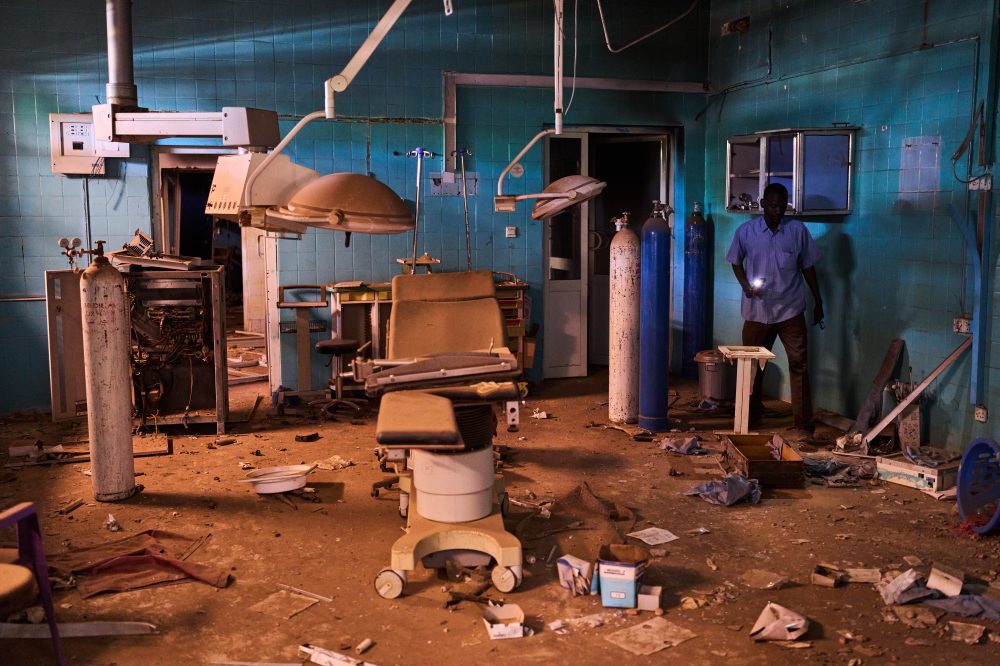

OMDURMAN, Sudan — Dr. Jamal Eltaeb faced impossible decisions every day for three years. Which patients had the best chance of survival? Should he perform surgery without proper medication if it could save a life? How could he secure fuel to power the hospital generators?
While Sudan’s civil war erupted around his medical facility, the orthopedic surgeon made one unwavering choice: continue treating patients.
Eltaeb directed Al Nao hospital in Omdurman, located near Sudan’s capital Khartoum, as military forces and paramilitary groups battled for territorial control. When fighting intensified and wounded patients flooded the facility, many of his medical colleagues abandoned their posts out of fear.
The quiet-mannered surgeon remained at his post despite multiple bombing attacks on the hospital and dwindling medical resources.
“I weighed the options of staying here, and taking care of your patients and helping other people that need you as a skilled surgeon, rather than choose your own safety,” he explained during an Associated Press interview.
Eltaeb represents one of many Sudanese citizens who stepped up to assist their communities while international attention focused on conflicts in Ukraine and the Middle East. He witnessed firsthand the casualties behind estimates showing tens of thousands have perished, experiencing what it means when the United Nations declares the nation’s healthcare system approaching total failure.
Close to 40% of Sudan’s medical facilities have ceased operations. Armed groups have converted many hospitals into military bases or stripped them of equipment. Sudan’s military has regained control of the capital, leaving Al Nao among the few operational healthcare centers in the region.
During a tour of the medical complex, the 54-year-old physician pointed out to AP reporters evidence of the most challenging period of his career.
He indicated a damaged window where shrapnel killed a patient’s family member. In the courtyard stood the final remaining tent from dozens erected during intense fighting to handle mass casualties.
“We were working everywhere, in tents, outside, on the floor, doing everything to save patients’ lives,” Eltaeb recalled.
His dedication earned Eltaeb the $1 million Aurora Prize for Awakening Humanity, recognizing people who endanger themselves to rescue others. He donated portions of the award to medical and humanitarian organizations worldwide.
Hospital staff described Al Nao before the conflict as a peaceful facility where nearly 100 beds often remained vacant. When violence erupted in Khartoum and the paramilitary Rapid Support Forces seized large portions of the city, injured civilians rushed to the hospital.
Eltaeb’s original hospital closed soon after fighting began in April 2023, prompting his transfer to Al Nao. Most personnel had evacuated by July, leaving him as the facility’s leader.
He worked alongside a small group of employees and volunteers to maintain hospital operations. Power outages lasted weeks while the facility depended on military fuel deliveries for generators. Critical medications including antibiotics and pain relievers became unavailable.
The hospital suffered its first attack in August, one month after Eltaeb assumed leadership.
“From that moment, we knew that we are a target … And from that time, they didn’t stop targeting us,” he stated. The RSF subsequently bombed the hospital three additional times.
Normal life had collapsed. The father of three worked from his office, distributing candy to a continuous flow of patients and staff seeking his guidance.
Medical choices became agonizing. During one devastating day in late 2024, he and his team rushed to treat more than 100 wounded individuals after an explosion struck a local marketplace. Eight patients died.
“You choose … as if you can choose who is going to live and who is going to die,” he said.
The situation deteriorated further when Eltaeb had to determine whether to amputate children’s limbs without complete anesthesia because they were losing blood rapidly and couldn’t be moved to the operating room in time.
Using only local numbing medication, he amputated an arm and leg from a 9-year-old boy and removed his 11-year-old sister’s leg.
He keeps photographs of these procedures on his mobile phone, trying to help others understand horrors that few can comprehend.
The hospital depended on volunteers to maintain supply chains. They posted needs on social media platforms, and pharmacists provided keys to their shuttered stores, allowing volunteers to collect medicines and equipment without charge.
Volunteer Nazar Mohamed spent months traveling throughout Omdurman, frequently on bicycle, transporting supplies while explosions thundered nearby.
Additional donations arrived from international organizations and individuals. Sudanese physicians living overseas offered remote consultation on managing mass casualties and operating with limited antibiotics or anesthesia.
Remaining hospital workers improvised solutions, constructing beds and crutches from wood and using clothing instead of medical gauze for emergency splints.
Combat has moved away from the Khartoum region. Some financially strained organizations that previously supported Eltaeb’s hospital now direct aid to areas with greater needs.
He estimates current funding will cover salaries and generator operations until June, but the hospital requires approximately $40,000 monthly to maintain full functionality.
Although several nations have promised assistance for Sudan’s reconstruction efforts, concerns exist that conflict with Iran might redirect attention and resources, particularly from Gulf states that pledged recovery support.
Medical facilities that sustained heavier damage than Al Nao remain destroyed and require significantly more resources.
Across the city, Dr. Osman Ismail Osman, who directs Al Shaabi hospital, described the several hundred thousand dollars provided by the government as insufficient.
The RSF occupied his hospital during the war. Damaged medical equipment worth millions of dollars lies in dusty piles, surrounded by concrete debris and twisted metal bed frames.
Plans to reopen the severely damaged hospital for emergency referrals within weeks appear ambitious, but medical professionals like Eltaeb have developed skills for tackling seemingly impossible tasks.
“I believe I did my best as a doctor as a Sudanese,” the surgeon concluded.