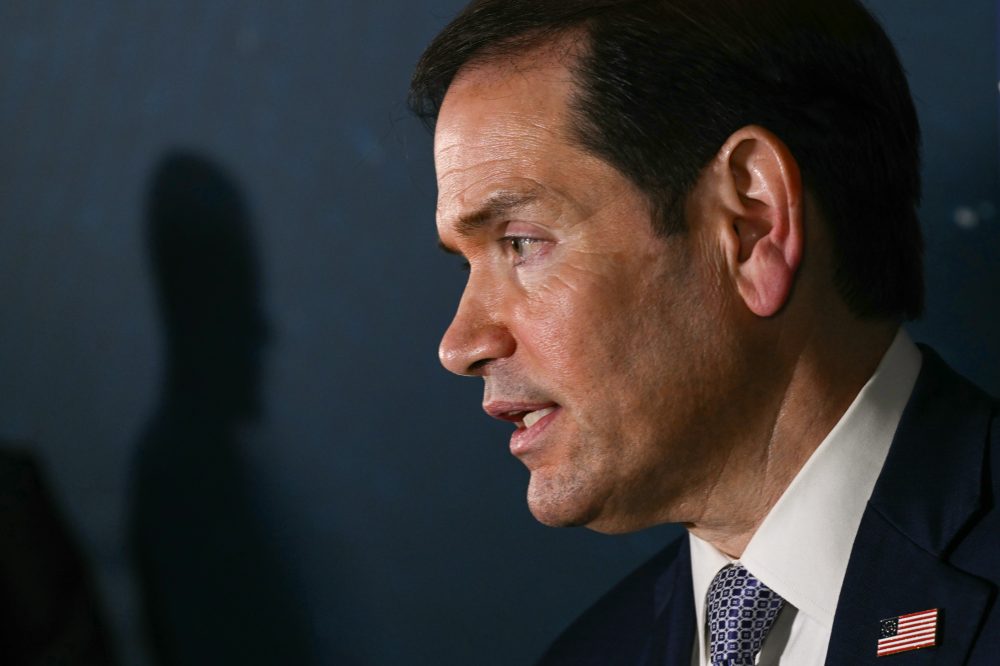

WASHINGTON — The Trump administration is poised to sign a nuclear cooperation agreement with Saudi Arabia as soon as Wednesday, a deal that could open the door to uranium enrichment capabilities for the kingdom’s civilian nuclear energy program. Secretary of State Marco Rubio is defending the move, saying no agreement signed by the United States will put the world at greater risk of nuclear weapons spreading.
Two individuals with knowledge of the decision — who were not authorized to speak publicly and requested anonymity — confirmed the deal to The Associated Press. The agreement could potentially allow for the construction of a uranium enrichment facility on Saudi soil following a joint study conducted by both nations.
While Rubio stopped short of officially confirming the deal, he pushed back against growing criticism while speaking to reporters during a visit to the Philippines on Wednesday. Critics have raised concerns that helping Saudi Arabia develop its own uranium enrichment program could trigger a new wave of nuclear competition in an already unstable region.
“The U.S. is not going to reach any agreement with any country in the world that leads to the risk of proliferation,” Rubio stated.
Notably, the deal is not expected to include the International Atomic Energy Agency’s Additional Protocol — a framework that allows for more extensive monitoring, inspections, and verification of nuclear activities — according to one source familiar with the matter.
The agreement is anticipated to span 30 years and include participation from U.S. companies in developing Saudi Arabia’s nuclear program. It is expected to be submitted to Congress for review, where it could encounter significant opposition.
The announcement comes at a sensitive time, as the U.S. and Israel are engaged in military action against Iran aimed partly at eliminating Tehran’s capacity to build a nuclear weapon. Iran maintains that its nuclear enrichment activities are strictly for peaceful purposes.
Neither the White House nor Saudi officials in Riyadh responded to multiple requests for comment on the decision, which was first reported by The Wall Street Journal.
Alexander Bollfrass, a nuclear expert at the International Institute for Strategic Studies in London, described the deal as “a revolutionary new approach” to nuclear nonproliferation policy.
“The revolutionary aspect of this agreement is that the United States is not asking Saudi Arabia to abide by the highest possible safeguards, internationally monitored safeguards that are standard and are available today, but instead is willing to at least theoretically transfer highly sensitive technology without the same level of oversight that one would expect,” Bollfrass said.
Both President Donald Trump and former President Joe Biden previously attempted to negotiate a nuclear technology-sharing deal with Saudi Arabia. Nonproliferation experts warn that operational centrifuges inside the kingdom could lay the groundwork for a future weapons program — a possibility that Saudi Arabia’s de facto leader, Crown Prince Mohammed bin Salman, has suggested he might pursue should Iran succeed in obtaining a nuclear bomb.
Energy Secretary Chris Wright traveled to Saudi Arabia last year, shortly before Trump visited the kingdom, and held discussions with his Saudi counterpart about developing a commercial nuclear power industry there. The U.S. Department of Energy has also not responded to requests for comment.
Adding to the regional tensions, Saudi Arabia and nuclear-armed Pakistan recently signed a mutual defense agreement following an Israeli strike in Qatar targeting Hamas officials. Pakistan’s defense minister subsequently stated that his country’s nuclear capabilities “will be made available” to Saudi Arabia if necessary — a statement widely interpreted as a warning directed at Israel, long believed to be the only nuclear-armed state in the Middle East.
Experts note that uranium enrichment alone does not automatically lead to a nuclear weapon — additional complex steps are required — but it does create a pathway toward weaponization, which is the core of Western concerns about Iran’s nuclear activities.
For comparison, the United Arab Emirates, which borders Saudi Arabia, signed a nuclear cooperation agreement with the United States to build its Barakah nuclear power plant with South Korean help, but did so without pursuing enrichment capabilities — a model that nonproliferation experts have long considered the “gold standard” for nations seeking civilian atomic energy.