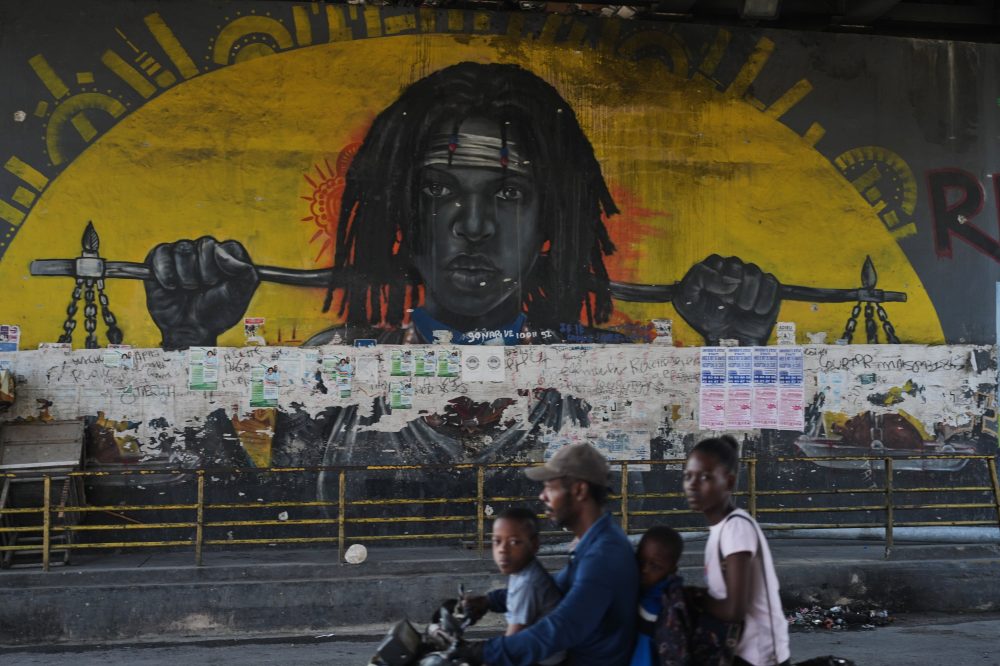

PORT-AU-PRINCE, Haiti — Dawn breaks over a scene of cautious renewal as several women unfold weathered beach umbrellas in central Port-au-Prince, checking their surroundings before setting up produce stands.
An unusual calm has settled over Carrefour Aéroport, the well-known crossroads in Haiti’s capital that previously thrived with busy traffic and trade before hundreds of gang members invaded the location in early March 2024 during an extraordinary surge of violence.
The criminals destroyed shops, murdered innocent people, and burned down a police station while officers escaped.
Following the assault, criminal groups sucked the vitality from Carrefour Aéroport for almost two years.
In December, Haitian law enforcement launched a continuous offensive against the criminal organizations to push them from the territory, supported by a private security company and Kenyan officers leading a United Nations-backed operation that is now concluding.
Recapturing Carrefour Aéroport represents “probably one of the very first tangible messages sent by the authorities that, ‘yes, we can take back the territory of … no man’s land,’” stated Romain Le Cour, director of the Haiti Observatory at the Global Initiative Against Transnational Organized Crime.
The development offers a preview of potential outcomes throughout Port-au-Prince following attacks by the influential gang alliance Viv Ansanm, which started targeting neighborhoods and crucial government facilities in February 2024. These assaults forced the main international airport to close and ultimately caused former Prime Minister Ariel Henry to step down.
“It is a sign of hope,” Le Cour stated. “It sends the message that this is doable.”
On February 7, Haitian officials ceremoniously reopened a refurbished police station at Carrefour Aéroport amid great celebration in a capital where criminal groups control 90% of the territory.
Interested spectators observed, with one person applauding as heavily protected officers entered their restored facility almost two years after gangs had burned it down.
“Life is timidly returning to normal,” Jacques Ader, a police commissioner, told reporters.
Following the reopening, street merchants and operators of vibrant buses called tap taps have begun returning to the location.
“Small businesses are recovering,” said Jean-Remy Laveau, a 35-year-old motorcycle taxi driver who previously operated in the area before criminal groups took control.
“It will be good for me, more activities, more money more work. I’ll be able to better feed my two kids and my wife,” he said.
Mario Volcy, a 44-year-old tap tap operator, was also anxious to resume work. On a recent morning, he highlighted the vans and large buses moving through the area for the first time since early 2024.
He urged the government to prosecute those responsible for the violence and assist those harmed by it.
“All victims should receive support from the state,” he said as he ended the conversation quickly, noting with a grin that his tap tap was packed. “I have to go now!”
He departed with a Bible on his dashboard and his tap tap displaying “God is my guide” along its side.
Not everyone is celebrating Carrefour Aéroport’s revival.
Gaspar Caseus, 49, expressed continued frustration because gangs still dominate the primary highway to southern Haiti. He urged officials to regain control of other major crossroads.
“I need to be able to move south,” he said. “That is where I pick up coal to bring back to the city for sale.”
“Things changed after the attack,” he continued. “It destroyed my life. It forced my family to move. I look like a beggar. I was able to eat whenever I felt like it. Now, I eat only if something comes around or a good friend remembers me.”
Caseus mentioned hearing radio reports that additional assistance would arrive in April, when a gang-suppression force is scheduled to replace the current UN-backed mission that is ending due to insufficient funding and staffing.
“As long as I am alive,” he said, “someday, things will change for the better.”
Recently, 32-year-old Antoinette Desulmon put on a large hat to shield herself from the sun and arranged mangoes, oranges, tomatoes, and peppers, hoping someone at Carrefour Aéroport would purchase from her.
She observed police patrolling in an armored vehicle and noted the station had reopened, but worried the tranquility might be temporary.
“Fear is with me every second,” she said. “I am here selling, but my head is somewhere else.”
Desulmon’s partner disappeared two years ago; she suspects he fell victim to gang violence.
“I miss him a lot,” she said, expressing concern for her two children living in temporary housing with a cousin, among the 1.4 million Haitians forced from their homes by gang violence.
Desulmon explained she had no alternative but to resume selling produce to support her two children and cousin.
“My heart is broken,” she said. “The depression is real.”
Surrounding her, only the police station has been reconstructed. Numerous burned homes remain destroyed while businesses and schools stay closed.
Le Cour, the Haiti specialist, predicted it would likely require time before Carrefour Aéroport returns to its former bustling activity of street vendors, auto parts shops, and restaurants serving morning coffee to commuters and local soup called bouillon at lunch.
He expressed optimism that the incoming gang-suppression force would reclaim additional territory.
However, significant challenges persist even if successful.
“We’re missing the other side of the equation, which is, what do you do with gang members? What’s the plan for the day after you retake the territory?” Le Cour questioned. “Are you able to rebuild the territory? Are you able to bring people back in?”