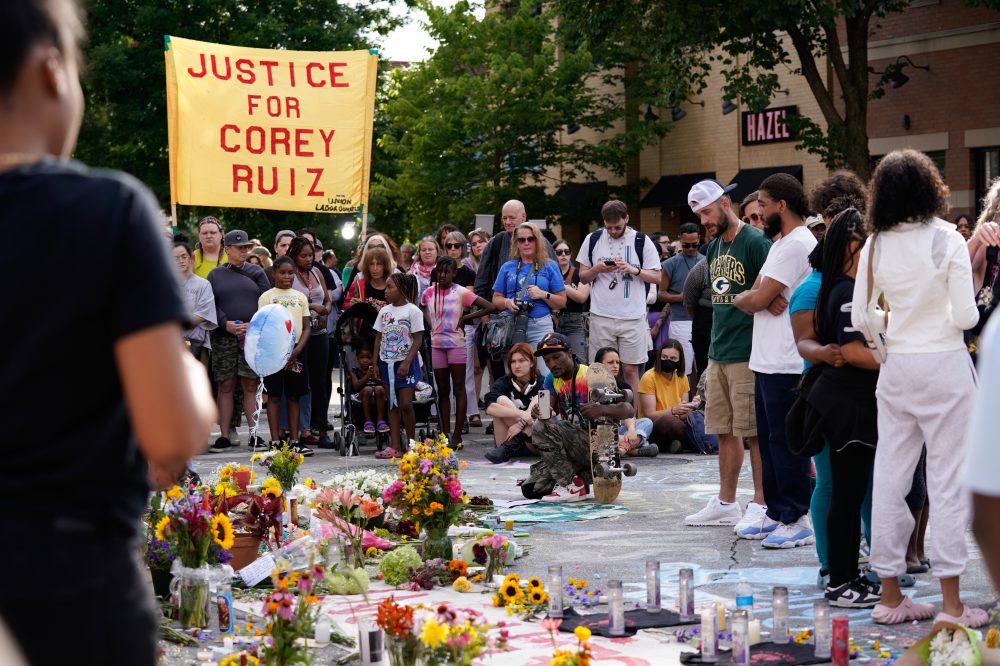

When a homeless man was fatally shot by Madison, Wisconsin police officers, residents hoping for a full picture of what happened were left without a crucial source of information — footage from body-worn cameras. That’s because, unlike nearly every other city of comparable size, Madison does not require its officers to wear them.
Police say Corey Ruiz pulled out a knife during a physical struggle involving four officers, injuring one of them. That officer fired the shots that killed Ruiz. All four officers have since been placed on administrative leave while a state investigation is conducted.
Bystander videos of the encounter have circulated widely, but without body camera footage, the moments leading up to the shooting remain unclear to the public. The shooting has reignited a fierce and long-standing debate in the city over whether officers should be required to wear the cameras.
Just last November, the Madison Common Council turned down a proposal that would have shifted funding from a police oversight group to pay for a body camera program. Now, a new proposal calling for $414,800 to fund a three-year rollout of the program is expected to receive approval from the council.
Police Chief John Patterson has called the proposal “modest” and said the cameras have become “essential tools for the modern police officer.”
Law enforcement experts largely agree, and some say they were surprised to learn that a department with nearly 500 officers still hasn’t adopted the technology. Michael D. White, a criminal justice professor at Arizona State University who led body camera training for the U.S. Department of Justice, put it plainly: “There are very, very few agencies of that size that do not have a body-worn camera program.”
White added that Madison’s reputation made the situation even more unexpected. “Madison has a long-standing tradition of being an innovative, progressive police department, so it’s startling,” he said.
By 2016, roughly 80% of police departments with 500 or more sworn officers had already acquired body cameras — a number White says is now close to 100%.
Madison officials have been wrestling with the body camera question for more than a decade. Committees have spawned subcommittees, which have generated feasibility studies, proposed amendments, and countless hours of debate — with little to show for it.
Local officials point to budget concerns and political gridlock as the main reasons progress has stalled. A 2021 feasibility study also identified opposition from community groups who feared the cameras could be used to monitor and criminalize vulnerable populations.
“I cannot approve something that doesn’t have a policy and procedure behind it that is potentially going to hinder the community more than help the community,” said Veronica Figueroa, who was a member of the body-worn camera subcommittee at the time.
Common Council President Sabrina Madison said those concerns have largely faded as body cameras have become more common. But she said city leaders have been consumed by a different pressing issue — finding housing for a homeless population that has grown since the COVID-19 pandemic.
“It was like: if we’re going to figure out anything, we’re going to figure out how to fund shelter operations,” Madison told The Associated Press on Thursday. “So the last couple years, that’s where the focus has been.”
The city did run a short body camera pilot program during the summer of 2024. A report on that program found the cameras had minimal effect on officer behavior or how residents viewed the police. Dr. Broderick Turner, the independent researcher who wrote the report, noted that the pilot lasted only 90 days — not long enough for meaningful changes to emerge.
Turner also highlighted a racial divide in how residents viewed the cameras. “Black communities tend to want body cameras, but Madison is majority white,” he said. “The groups opposed were less impacted by crime and less impacted by policing.”
For some Madison residents, this week’s shooting brought back painful memories of Tony Robinson, an unarmed 19-year-old fatally shot by Madison police in 2015. That death eventually led to the creation of the Office of the Independent Police Monitor.
This past winter, city lawmakers rejected a budget proposal that would have funded a body camera program by cutting money from that same oversight office. Katey Nelson, a member of the police civilian oversight board, called that proposal a “false choice.”
“There are cuts that can be made with the Madison Police Department or the County Sheriff’s department, but they’re trying to pit similar agendas against each other,” Nelson said.
“Nobody can agree on anything,” she added. “Now we’re here, looking at another police shooting where we don’t have what we need to make sure the officers are held accountable.”