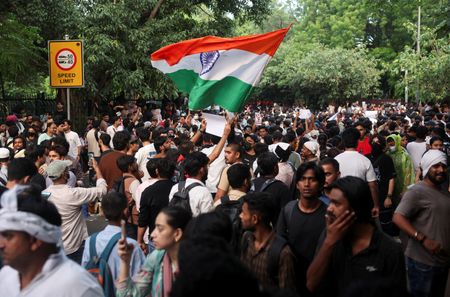

NEW DELHI — Leaders of India’s youth-driven “cockroach” movement have agreed to sit down with government officials on Friday in an attempt to settle a standoff over leaked national examination papers — but they made clear the nationwide protests will keep going regardless of how those talks unfold, according to a group spokesperson.
The announcement came just hours after activist Sonam Wangchuk ended a hunger strike that had lasted 26 days, a development that sparked hopes the two sides might be inching toward a resolution. The crisis has drawn tens of thousands of young people to the nation’s capital, Delhi, where they have been demanding that the education minister step down over the exam leak scandal.
The demonstrations represent the most significant youth-led challenge to Prime Minister Narendra Modi since he first took office in 2014. Opposition parties have rallied behind the movement’s calls for accountability and have repeatedly disrupted the current monsoon session of parliament, which got underway this week.
Talks between government ministers and representatives of the self-described Cockroach Janta Party, or CJP, are set to take place at a neutral location, CJP spokesperson Saurav Das told reporters late Wednesday night.
“We hope that the government comes with an open mind and it will listen to the people of this country who have been out on the roads for so long,” Das said. “We will explain our demands to them in greater detail. And we hope that the government will listen to us.”
Das stressed that the street protests would not be suspended in the meantime.
“We are not backing out,” he said. “Because, real awakening starts from the grassroots and that is what we really need.”
The CJP movement began as an internet-based satire involving just a few hundred young people, but it has since exploded in size with millions of online supporters, catching the government off guard.
Earlier this week, tens of thousands of demonstrators marched toward parliament on Monday in defiance of a ban on such gatherings. Police responded with tear gas and canes, leading to clashes with the crowd. More violence broke out Wednesday night when over 10,000 protesters assembled at the Jantar Mantar demonstration site in central Delhi.
Analysts say the movement’s rapid growth reflects deep frustration among India’s young population over issues including a lack of jobs and a pattern of recurring exam leaks, and they have warned the government to take meaningful action to address the underlying problems.
On Thursday, authorities shut down 16 metro stations, cut off mobile internet access, and restricted business activity in the central parts of Delhi where protesters have gathered — moves widely seen as an effort to suppress the demonstrations, causing significant disruption for thousands of residents.
The Delhi Metro Rail Corp. announced it would again close 17 stations beginning early Friday morning until further notice, marking the third time this week the transit system — considered a lifeline for the capital — has undergone such a sweeping shutdown.
Prime Minister Modi announced late Thursday that the federal cabinet would convene on Friday to review a proposed law that would impose stricter penalties on those responsible for exam paper leaks, with the goal of getting the legislation through parliament as quickly as possible.
However, protesters have rejected that proposal, arguing that the examination system itself needs to be overhauled to prevent leaks from happening in the first place.
Activist Wangchuk, who ended his hunger strike after meeting with two government ministers, is expected to release a video — likely on Friday — detailing what was discussed during those conversations.